
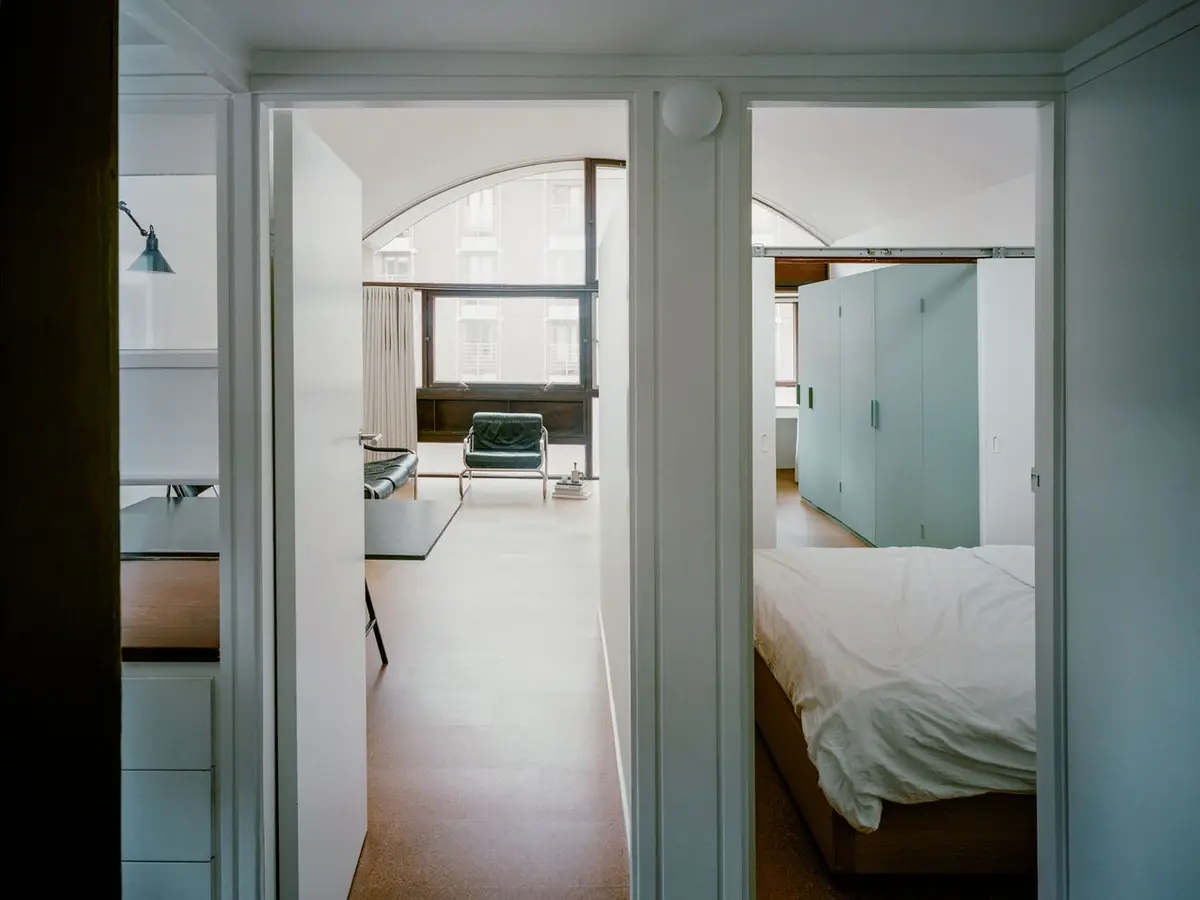
TYPE Retrofits a 45-Square-Metre Studio in London's Grade II* Listed Crescent House
Cork floors, honeycomb cardboard screens, and aerogel insulation bring a 1960s Golden Lane Estate flat into the present without betraying its past.


Crescent House was the last building completed on London's Golden Lane Estate, finished in 1962 by Chamberlin, Powell and Bon, the same practice that would go on to design the Barbican. Its bush-hammered concrete facade curves to follow Goswell Road, and its arched lintels nod openly to Le Corbusier's Maisons Jaoul. It is Grade II* listed, which places it in the top 5.8 percent of all listed buildings in England. Working inside a structure this protected means that virtually every intervention must be reversible, demountable, and approved. TYPE took that constraint and turned it into a design philosophy, treating the listing not as a limitation but as a generative brief.
What makes this project worth studying is not its scale (45 square metres is smaller than many hotel rooms) but its discipline. TYPE's renovation rejects the common retrofit instinct to gut and start over. Instead, it retains, insulates, and reinterprets, using a material palette of cork, honeycomb cardboard, and Ecoboard that is both low-cost and genuinely circular. The sliding partition screens, fabricated from veneered honeycomb cardboard, even complete an idea that Chamberlin, Powell and Bon originally proposed but never built: lightweight partitions to create dressing areas within the studio's open plan. That kind of historical literacy, paired with a rigorous sustainability ethos, is rare at any budget.
A Concrete Shell on a Bombed-Out Site
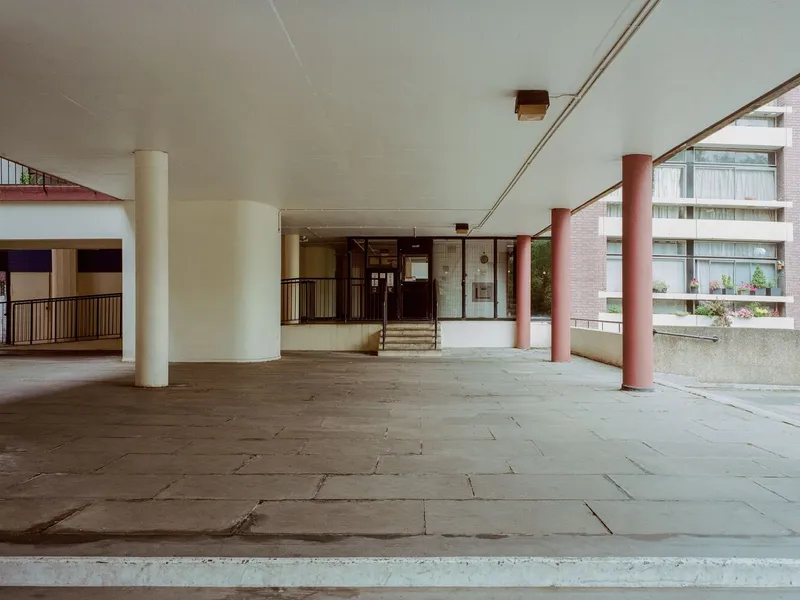
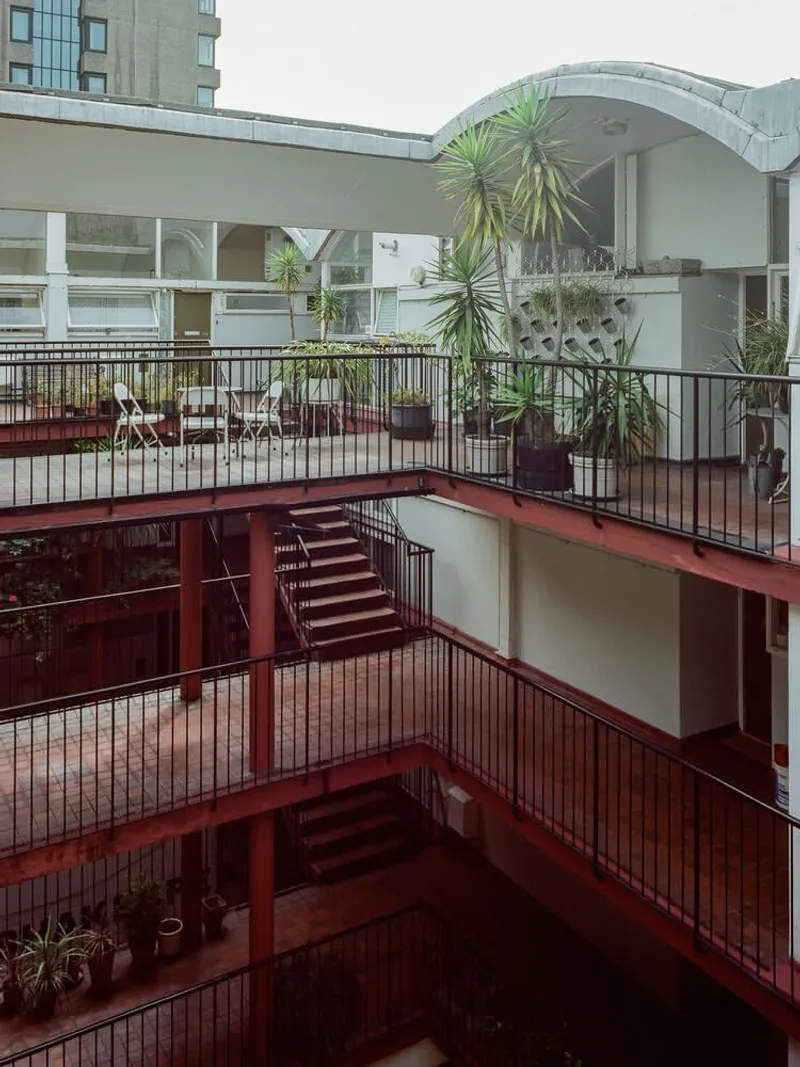
Golden Lane Estate was built on a site in Finsbury that had been heavily bombed during the Second World War. Crescent House, with its cream and pink cylindrical columns and exposed concrete soffits, belongs to a generation of British housing that believed social architecture could be both robust and generous. The covered terrace and interior courtyard, with their red-painted steel staircases and potted palms, still function as communal thresholds between public and private life. Any renovation within these walls carries the weight of that civic ambition.
TYPE's project sits on the third floor, so the architects had no opportunity to reshape the building's relationship with the ground. Their influence begins at the front door and ends at the arched window wall. Understanding the communal spaces that surround the flat, however, is essential to understanding why the interior needed to be so carefully considered: the apartment is not a standalone object but a single cell in a larger architectural organism.
The Arched Windows as Organizing Element
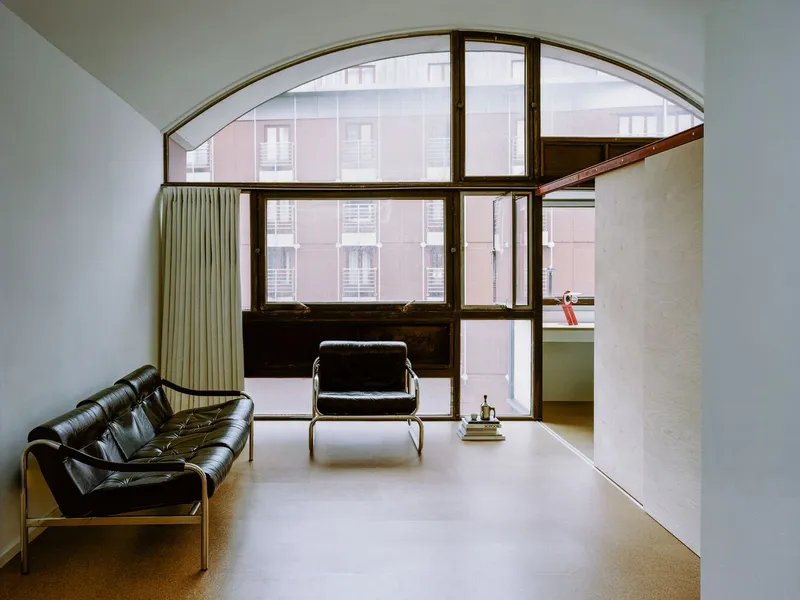
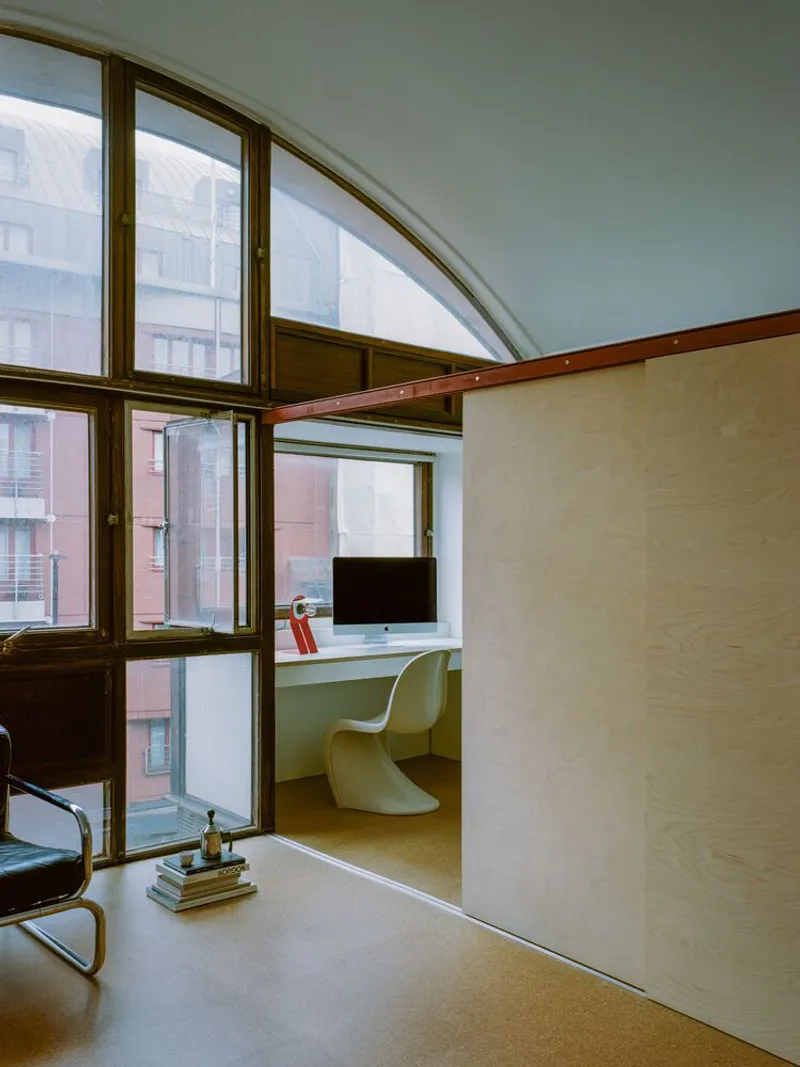
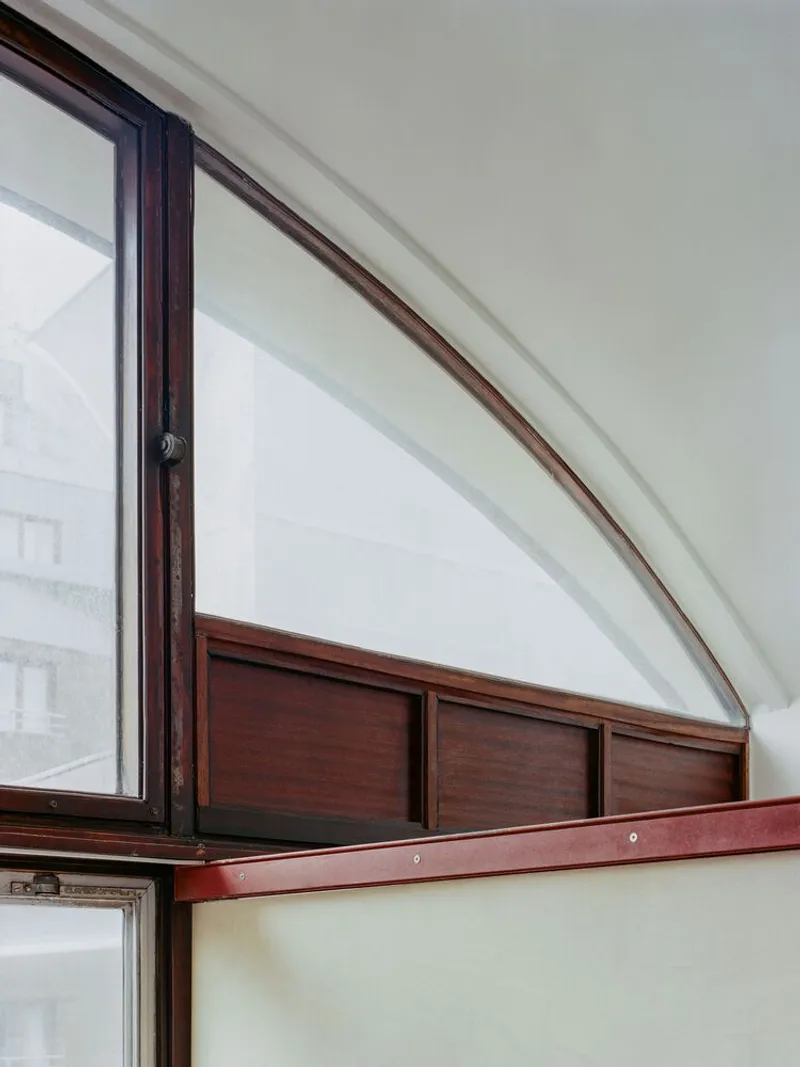
Chamberlin, Powell and Bon's arched concrete lintels and hardwood timber window frames are the dominant architectural feature of the flat. They define the proportions of the rooms and establish a rhythm that TYPE wisely chose not to compete with. The existing single-glazed windows were retained in anticipation of a Local Authority program to upgrade them to double or triple glazing, a pragmatic decision that acknowledges the limits of any single renovation effort within a listed estate.
What TYPE did instead was work around the windows. The sliding plywood-veneered partitions sit just inside the arched openings, allowing daylight to wash past them into the deeper zones of the flat. In the photographs, you can see how the partition edge aligns with the curve of the arch without touching it, maintaining a legible separation between original structure and new insertion. It is a detail that reads as simple but requires careful coordination between the arc geometry and the straight-edged screen.
Honeycomb Cardboard and the Case for Cheap Materials
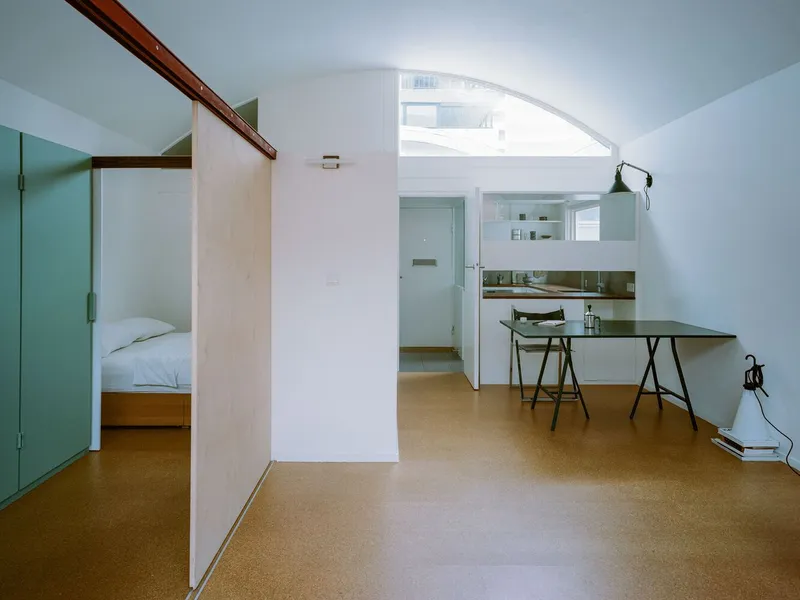
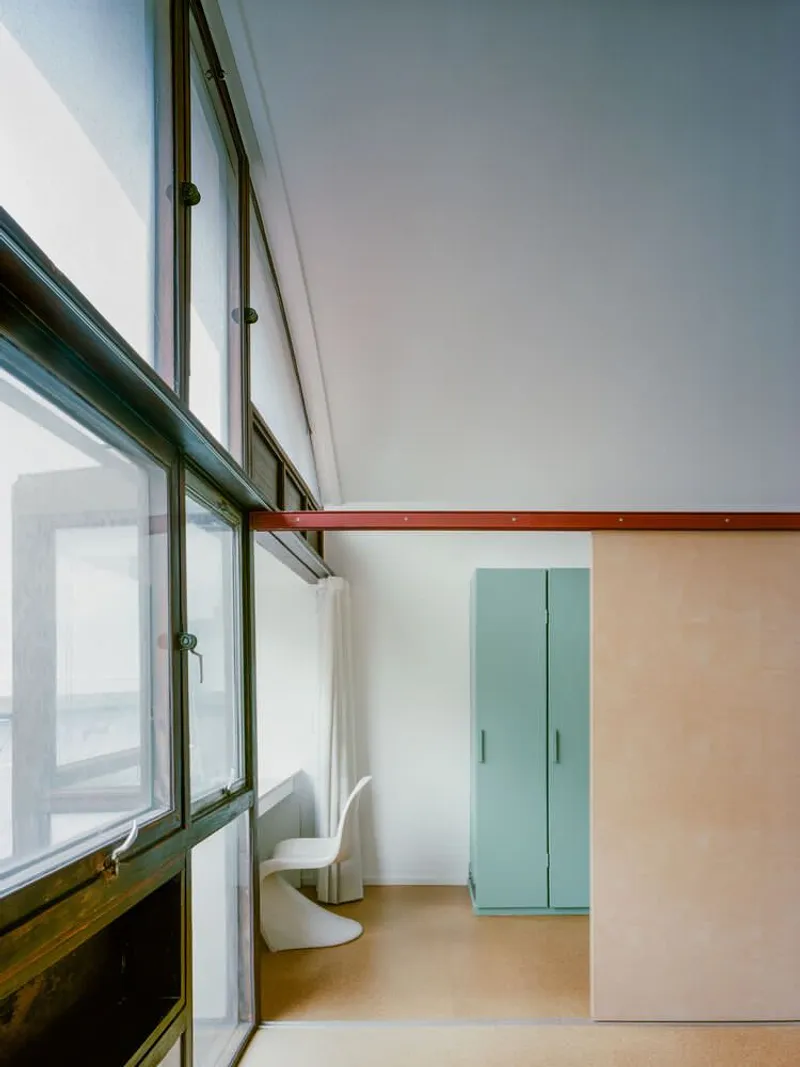
The sliding screens are made from veneered honeycomb cardboard, a material more commonly associated with packaging than with residential interiors. TYPE's argument for using it is twofold: it is light enough to slide easily in a compact space, and it is fully recyclable when the listing authority requires its removal. The screens fulfill the listing's demand for demountability while also completing the unrealized partition concept from the original architects' drawings. It is an intervention that is simultaneously deferential and inventive.
The kitchen cabinetry and joinery are fabricated from Ecoboard, a biomaterial panel that replaces MDF. Combined with cork flooring and painted finishes, the material palette keeps embodied carbon low and avoids the petrochemical adhesives that conventional board products rely on. TYPE describes its approach as "retain, re-use, recycle," which sounds like a slogan until you see it executed at this level of consistency. Every surface that the architects could control has been selected for its end-of-life scenario as much as its appearance.
Insulation Without Erasure
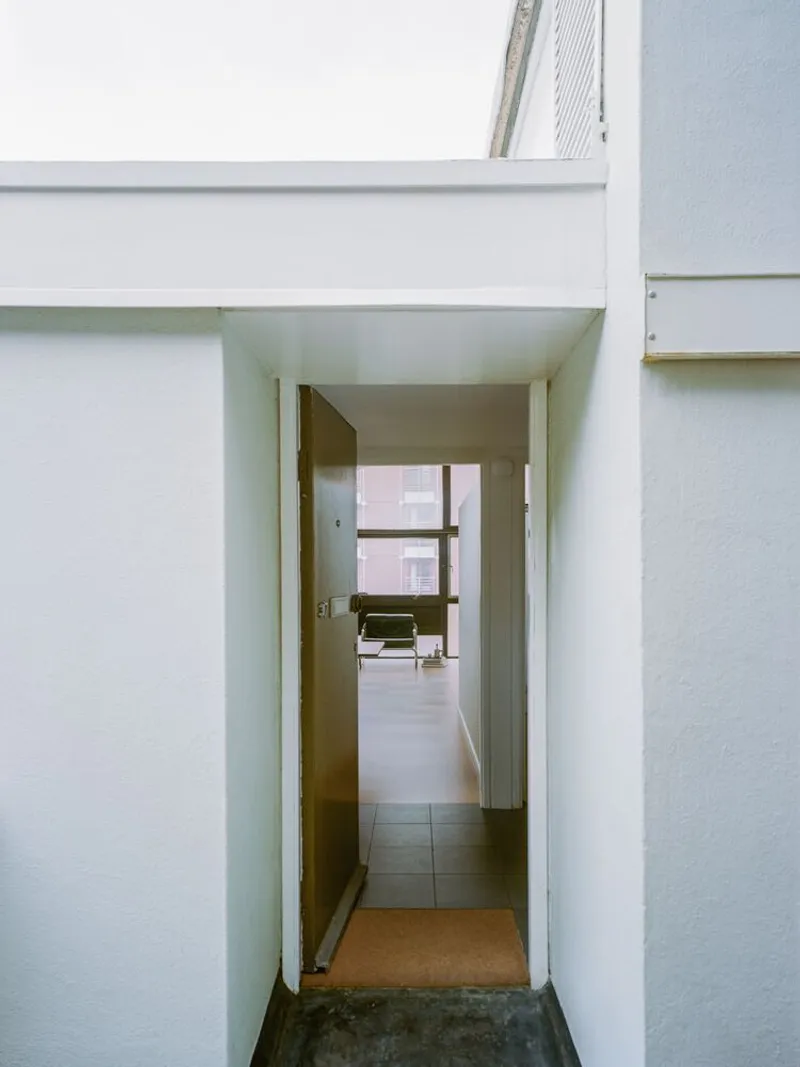
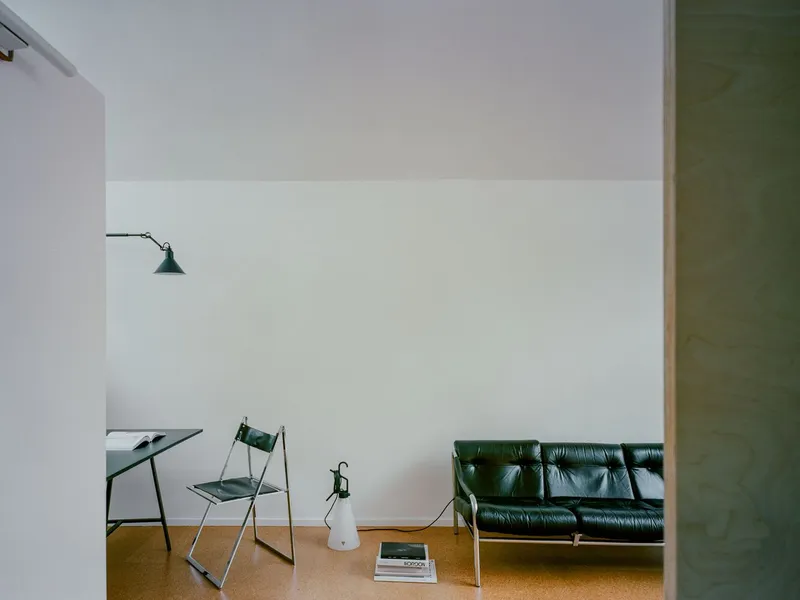
The original flat had virtually no insulation. Damp and condensation were chronic problems, common across mid-century concrete housing in the UK. TYPE addressed this with a fabric-first strategy, lining the interior walls and barrel-vaulted ceiling with Spacetherm and aerogel insulation. Aerogel is one of the thinnest insulating materials available, which matters enormously in a 45-square-metre flat where every centimetre of depth lost to wall buildup is a centimetre taken from living space.
The underfloor heating system was designed to be both removable and thin enough to sit within the zone occupied by the flat's existing built-in furniture, another listed element that could not be altered. These are not glamorous moves. They do not photograph well. But they represent the hardest and most consequential decisions in the project: how to make a listed concrete box thermally comfortable without destroying the thing that makes it worth listing.
Color and Softness in a Concrete Frame
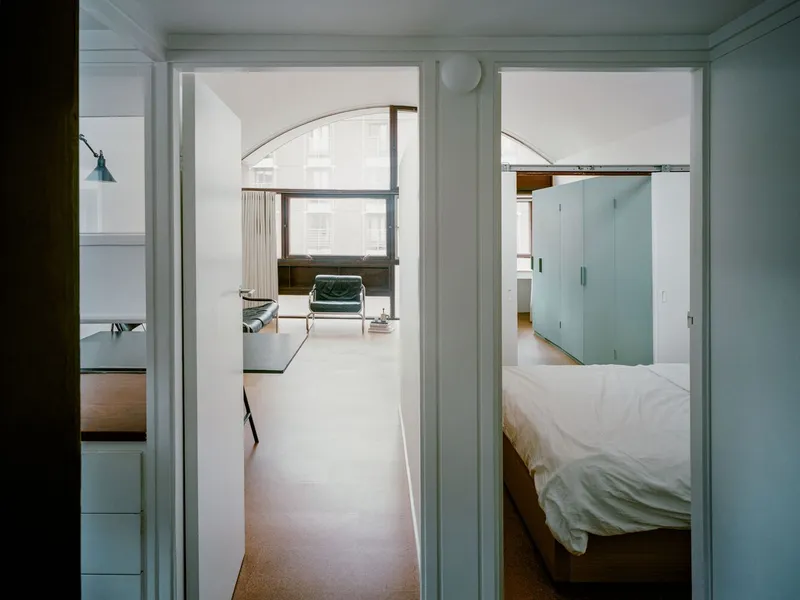
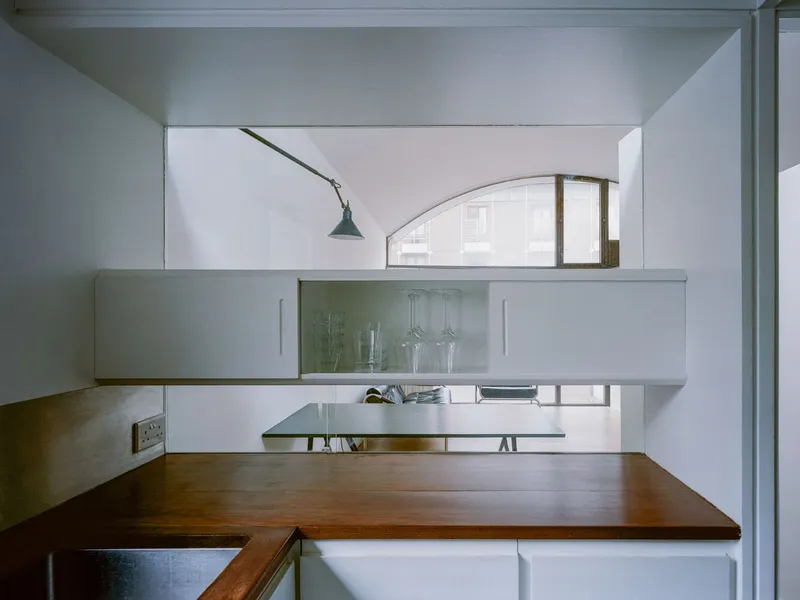
The pale green that appears on the cabinetry and bedroom walls introduces a warmth that the raw concrete exterior does not suggest. It is a quiet, considered choice that avoids the two extremes common in heritage renovations: the sterile all-white approach that treats the old as a gallery, and the heavy period-color approach that pretends the past never ended. TYPE's green sits comfortably between eras, reading as neither nostalgic nor assertively contemporary.
The timber worktops in the kitchen pick up the tone of the original hardwood window frames, creating a material continuity between old and new that reinforces the sense of a single, coherent interior rather than a collage of interventions. Articulated wall lamps appear in both the kitchen and living areas, their industrial character sympathetic to the estate's post-war vocabulary. Everything has been selected to sit within a narrow tonal range, which is how you make 45 square metres feel calm rather than cluttered.
Why This Project Matters
The UK has millions of post-war homes that are thermally underperforming, and a growing number of them are being listed. The tension between heritage protection and climate performance is only going to intensify. TYPE's Crescent House renovation offers a credible model for navigating that tension: use the thinnest possible insulation, choose materials for their reversibility, and treat the listing constraints as design parameters rather than obstacles. The project demonstrates that sustainability and conservation are not competing agendas but parallel ones, both rooted in the principle that existing buildings deserve a longer life.
At a broader level, this is a project about attention. It asks architects to look more closely at what already exists, to research the unrealized intentions of the original designers, and to find materials that are cheap, effective, and honest about their own impermanence. Honeycomb cardboard will never win a material award, but in this context it does exactly what architecture should do: it solves a problem elegantly, at low cost, with minimal harm. That is a harder achievement than it appears.
Crescent House Renovation by TYPE. Golden Lane Estate, London, United Kingdom. 45 square metres. Completed 2024. Photography by Lorenzo Zandri.
About the Studio
Share Your Own Work on uni.xyz
If projects like this are the kind of work you want to make, uni.xyz is a place to publish your own, find collaborators, and enter design competitions.


Popular Articles
Popular articles from the community

Opera by the Sea Estonia: Three Shells Dissolving Architecture into Tallinn's Coastline
A winning opera house proposal replaces monumental form with interconnected shells that blur the boundary between building, park and Baltic Sea.

Opera on the Sea: Driftwood Logic Shapes a Timber Opera House on Estonia's Coast
Trevor Orgill's opera house translates the entangled drift of floating timber into a civic building where wood, water, and music converge.
Temporary Home for Dogs: A Reversed Zoo Rethinks Animal Shelter Architecture
In Bucharest, a sinuous corridor and freed landscape flip the logic of containment, designing a shelter that works to make itself unnecessary.

The Amber Palace Opera: A Geological Fiction Surfaces on Tallinn's Baltic Waterfront
Pierre Brillard reimagines a Baltic legend as a public landscape, opera house, and waterfront promenade rooted in Tallinn's coastal identity.

Similar Reads
You might also enjoy these articles


Hodi-Mandai Geram
Project Function: Preservation and revitalization of the Intangible heritage and socio-spatial identity of the Hodi by Housing, Cultural Memory Center, Sacred Grove, landscape, local tourism economy


Olio Towers: A Mid-Rise for Performers That Fuses Housing, Rehearsal, and Stage
Located blocks from Houston's Theater District, this modular tower stacks living units around a central performance atrium.

Oasis: Modular Green Housing Carved into Dhaka's Urban Fabric
A shortlisted Plugin Housing entry reclaims unauthorized settlements in Dhaka with stepped concrete volumes, green roofs, and ventilation-driven design.

Black Hole: A Floating Megastructure for the Post-Physical Era
Emiliano Mazzarotto envisions a spherical, self-scaling arena where e-sports, digital hotels, and holographic stadiums replace traditional public space.

Explore Conservation Architecture Competitions
Discover active competitions in this discipline

Challenge to reimagine the Iron Throne

Photograph architecture without architects

Illustrate the lost glory of Angkor Wat - Render Challenge

Design challenge to reuse E-waste
Comments (0)
Please login or sign up to add comments
No comments yet. Be the first to comment!