

CSADI Sinks a Massive E-Sports Arena Beneath a Spiraling Vortex Roof in Hangzhou
China's first Asian Games e-sports venue buries most of its program underground and caps it with an interstellar canopy in a Hangzhou ecological park.


The Hangzhou E-sports Center is not a building that announces itself with height. At just under 24 meters tall, it barely crests the residential towers that crowd around it on three sides. What it does instead is spread, sink, and spiral. CSADI placed the vast majority of the venue's nearly 800,000 square meters of gross built area underground, capping the whole operation with a layered, elliptical roof whose concentric bands read from the air like the accretion disk of a galaxy. The result is China's first Asian Games standard venue purpose-built for e-sports competition, and one of the more convincing arguments in recent years for treating a stadium as landscape rather than object.
The interesting move here is the inversion. Conventional arenas pile program upward to justify their spectacle. CSADI went the other way, burying functional spaces beneath a soil-covered landscape that doubles as an extension of the surrounding Beijingyuan Ecological Park. Vehicles and pedestrians enter through a subterranean network. Sunken plazas punch daylight into the lower levels. The roof floats above all of this like a landed craft, its anodized honeycomb aluminum panels shimmering without ever feeling aggressive. For a building type synonymous with LED-drenched maximalism, the restraint is striking.
A Vortex in the Urban Grid
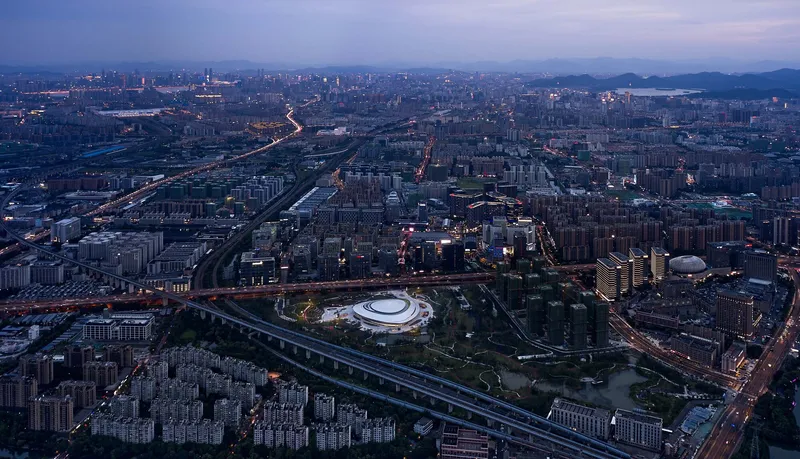

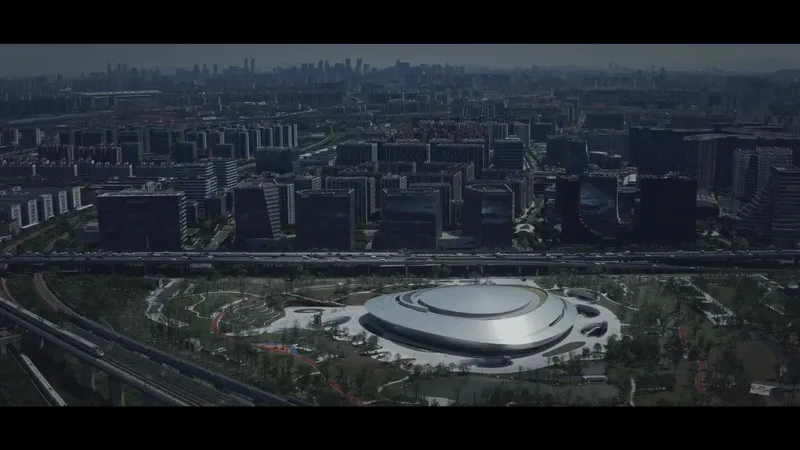
From a distance, the center reads as a soft interruption in a hard city. Hangzhou's grid of residential towers and elevated expressways presses in from nearly every direction, and the building's low, curving profile absorbs that pressure rather than fighting it. The aerial views at blue hour are revealing: the roof's pale bands glow faintly against a sea of repetitive housing blocks, making the arena feel less like an addition to the city than a clearing in it.
The siting between an elevated expressway and an intercity railway line could easily have turned the building into a traffic island. Instead, the sunken approach routes and landscaped deck stitch it into the adjacent park, giving the 361,000-square-meter site a porosity that a traditional podium-and-tower scheme would never achieve.
The Roof as Terrain
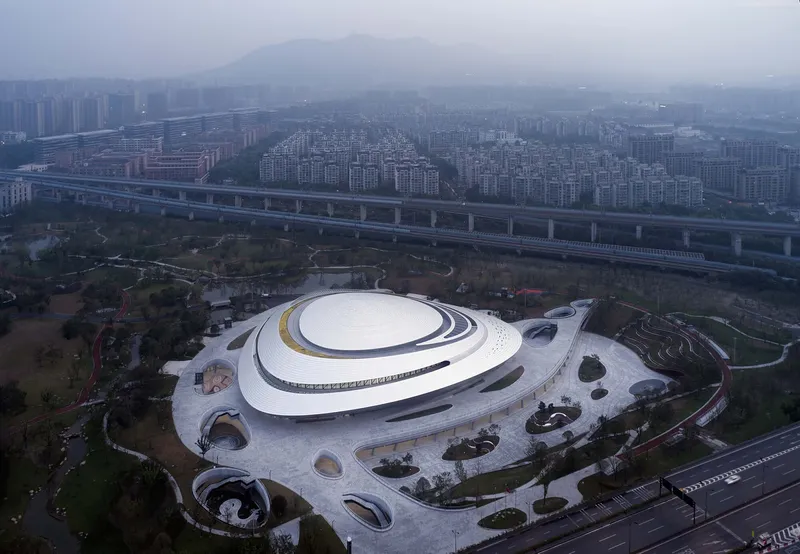
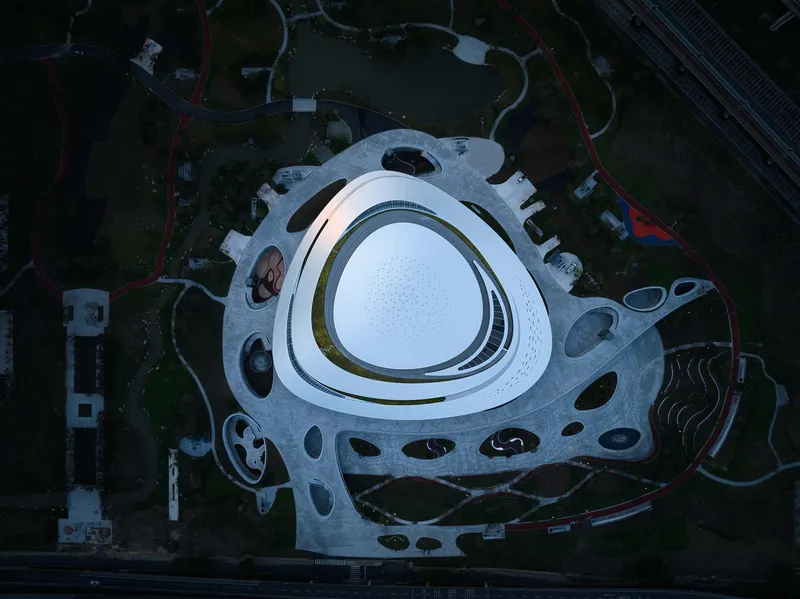
Seen from directly above, the roof dissolves the boundary between architecture and ground. Organic openings in the landscape deck allow light and air to reach the levels below, while the perforated surface blurs into the surrounding parkland. The concentric banding of the canopy, constructed from hyperboloid anodized honeycomb aluminum panels, gives the form its spiraling legibility without relying on literal formal mimicry. It suggests a vortex without ever becoming a literal one.
The soil-covered landscape that buries much of the program serves a dual climate purpose. It dampens temperature fluctuations inside the building and reduces the thermal load on the subterranean spaces. Combined with the cantilevered cornice that self-shades the perimeter glazing and an adjustable external sun-shading system, the design earned a Green Samsung standard rating, China's top-tier sustainable building certification.
Cantilever and Entry

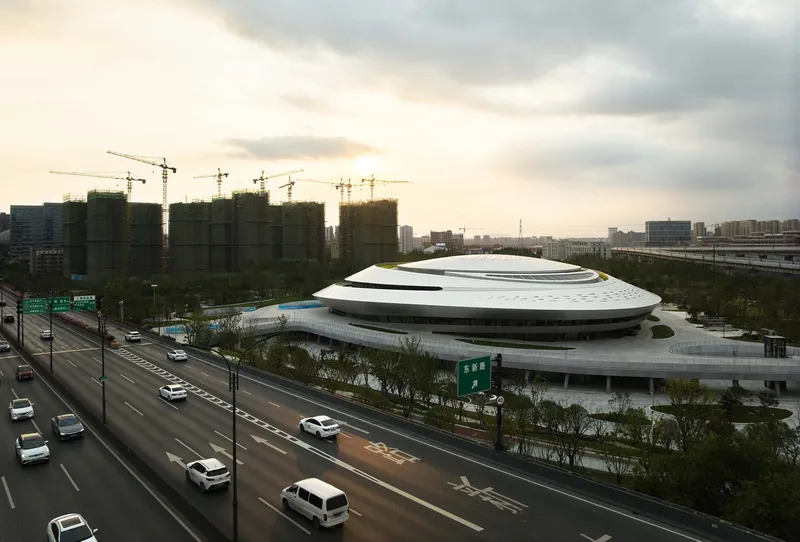
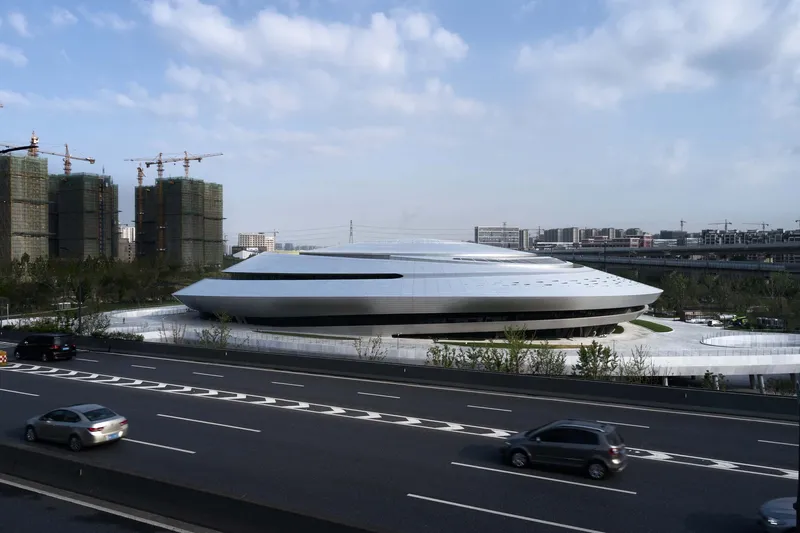
At ground level, the roof's cantilever becomes the defining spatial gesture. The ribbed white bands extend far beyond the glazed perimeter, creating a deep threshold zone that shelters arrival plazas and reflects light into the entry lobbies. Viewed from the adjacent highway, the stacked disc forms hover with surprising lightness given the structural mass they conceal. Forty-eight steel beams with variable cross-sections and inclined columns carry the audience hall, an engineering fact that is almost invisible in the finished building but essential to the sense of effortless suspension.
The horizontal banding of the facade reinforces the building's commitment to the horizon line. Nothing reaches upward. Even the signage and lighting stay flush with the aluminum skin, preserving the silhouette's clean geometry against the sky.
Layered Facade and Materiality


Up close, the building's materiality resolves into a careful layering of metal, glass, and concrete. The curtain wall facades visible between the roof's stacked discs reveal the structural depth of the project: multiple levels of program concealed behind a relatively modest glazed surface. The hyperboloid aluminum panels that clad the roof are not flat. They curve in two directions simultaneously, catching light at different angles across the day and producing a surface that reads as matte from one vantage and subtly reflective from another.
Construction images hint at the scale of the steelwork involved. Yellow cranes dwarf the surrounding urban infrastructure, and the exposed structural ring, visible in the exploded axonometric, shows a radial steel frame of considerable complexity. That none of this muscular engineering registers in the finished product is a testament to how thoroughly the design subordinates structure to surface.
Interior Circulation and Light
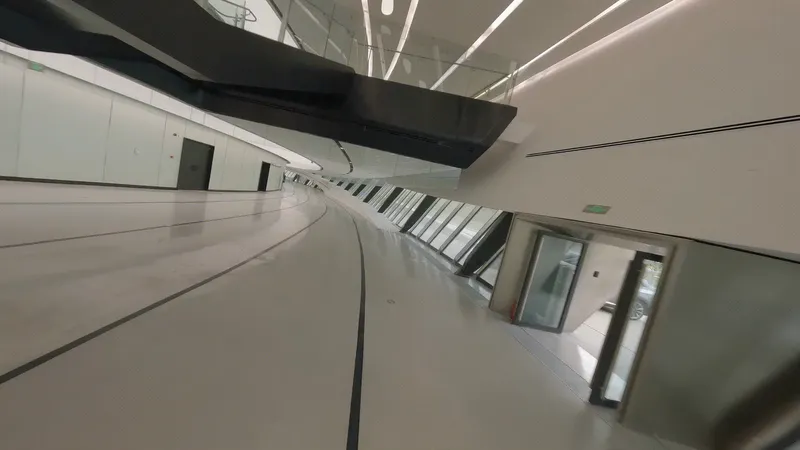

Inside, the audience hall wraps around a central circular competition arena, unifying multiple levels into a single fluid volume. A center-hung LED video board, capable of rising to 22 meters above the floor, serves as the focal point for approximately 5,000 spectators. The curving white ramps and escalators in the gallery spaces continue the exterior's commitment to smooth, continuous surfaces. Linear ceiling lights trace the circulation paths, guiding movement without the need for signage.
The most evocative interior moment is the simplest. A narrow beam of daylight cuts through a darkened corridor, illuminating a solitary figure. Large and small skylights on the roof, some fitted with electrochromic glass that automatically adjusts thermal radiation based on outdoor temperature, introduce controlled daylight into the auditorium. It is a reminder that even a building designed for screens and artificial spectacle can find power in natural light.
Plans and Drawings
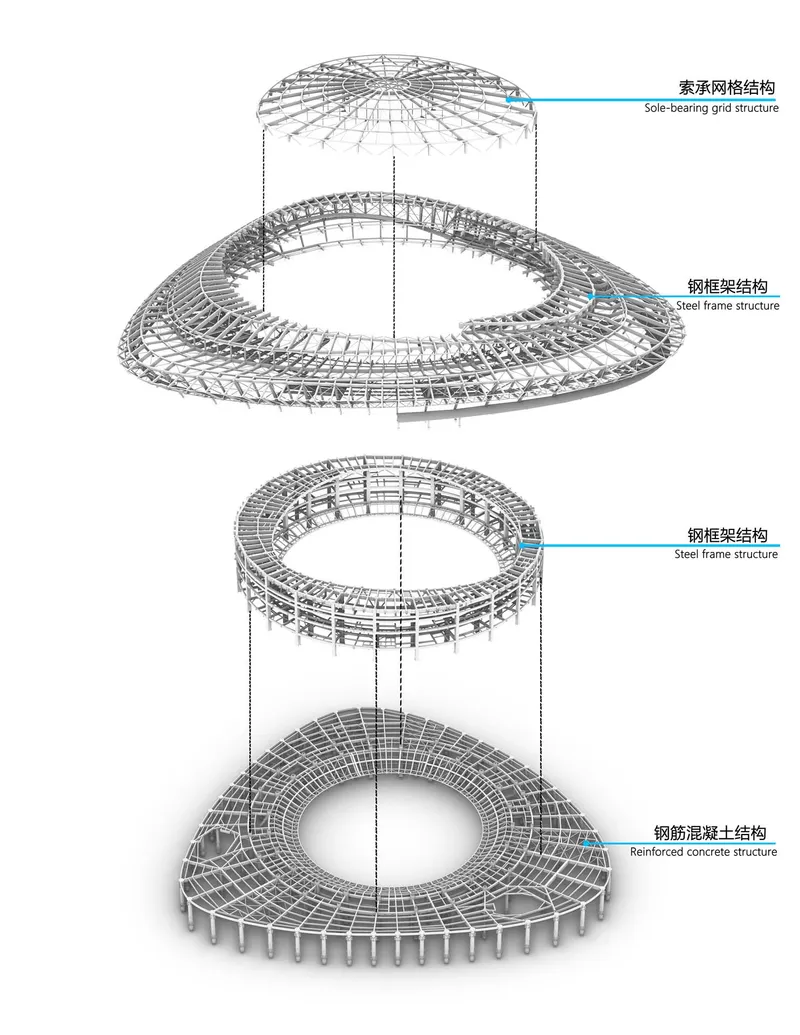
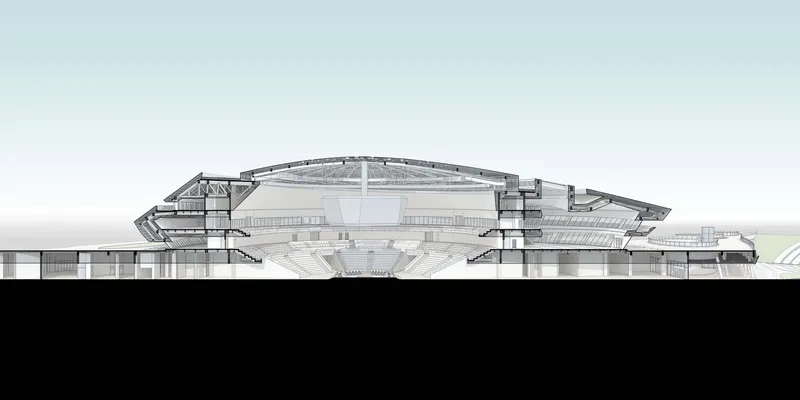
The exploded axonometric is the most instructive drawing. It separates the project into its constituent layers: the radial roof canopy at the top, the steel frame ring that carries the audience hall in the middle, and the concrete base levels that house the bulk of the underground program below. The section drawing confirms what the aerials suggest: the above-ground volume is modest relative to the total built area. Three floors rise above grade, but it is the single underground level, spread across the full extent of the site, that contains the majority of the functional space. The relationship between visible architecture and hidden infrastructure is roughly inverted from what you would expect.
Why This Project Matters
The Hangzhou E-sports Center matters because it reframes the stadium typology at a moment when that typology desperately needs reframing. E-sports venues, perhaps more than any other contemporary building type, are tempted toward pure spectacle. The competition takes place on screens. The audience is as much online as in person. The temptation to build a giant LED billboard and call it architecture is real, and most cities have indulged it. CSADI chose instead to go underground, to treat the landscape as the primary architectural surface, and to make the roof a quiet, spiraling form rather than a screaming icon.
The result is a building that works at two scales simultaneously. From the air and from a distance, it is legible and distinctive, a pale vortex in a dense urban field. Up close and inside, it is a network of sunken plazas, controlled daylight, and continuous circulation that connects park to arena to underground city. As a precedent for how to insert large-scale sports infrastructure into existing urban fabric without destroying the fabric in the process, it sets a high bar.
China Hangzhou E-sports Center by CSADI. Located in Hangzhou, China. 797,900 m². Completed in 2022. Photography by AOGVISION.
About the Studio
Share Your Own Work on uni.xyz
If projects like this are the kind of work you want to make, uni.xyz is a place to publish your own, find collaborators, and enter design competitions.


Popular Articles
Popular articles from the community


Singing Woman: An Opera House That Performs Before the Curtain Rises
Ovidiu Cristian Pavel's conceptual opera house translates Estonia's choral identity into a sculpted waterfront landmark facing the Baltic Sea.
Cloaked Colonization: A Mobile Underwater Habitat That Moves Like a Fish
Micah Abaya's shortlisted EHC Pacific entry reimagines ocean settlement as a dispersed network of self-sustaining architectural organisms.

The Amber Palace Opera: A Geological Fiction Surfaces on Tallinn's Baltic Waterfront
Pierre Brillard reimagines a Baltic legend as a public landscape, opera house, and waterfront promenade rooted in Tallinn's coastal identity.
Temporary Home for Dogs: A Reversed Zoo Rethinks Animal Shelter Architecture
In Bucharest, a sinuous corridor and freed landscape flip the logic of containment, designing a shelter that works to make itself unnecessary.

Similar Reads
You might also enjoy these articles

Pixel Gardens: One Repeated Module Stacked Into a Terraced Social Housing Tower for Famagusta
Salem Bader's shortlisted housing tower builds a vertical neighbourhood from one repeated module, offsetting units to carve terraces, light and air.

Bao Huynh Watercolor Atelier: A Serene Art Retreat in Hội An
Bao Huynh Watercolor Atelier in Hội An blends multifunctional art spaces, sustainable design, local materials, and family-friendly living in a serene environment.

Atelier Macri Concept Store Interior Design by CASE-REAL
Atelier Macri store features a "ko" counter, walnut wood details, cork displays, blending retail, gallery, and seamless customer experiences.

Manuel Vargas Izquierdo Stadium and High-Performance Sports Center: Architectural Excellence in Jalpa de Méndez
The Manuel Vargas Izquierdo Stadium blends sustainable design, inclusive sports facilities, and cultural-inspired architecture, revitalizing Jalpa de Méndez’s public spaces.

Explore E-Sport Arena Competitions
Discover active competitions in this discipline

Challenge to reimagine the Iron Throne

Photograph architecture without architects

Illustrate the lost glory of Angkor Wat - Render Challenge

Design challenge to reuse E-waste
Comments (0)
Please login or sign up to add comments
No comments yet. Be the first to comment!