

CUL-CHAKRA: A Rotating Vendor Platform That Follows the Clock of Indian Streets
A modular street architecture module cycles through five vendor programs in 24 hours, keeping Indian sidewalks alive around the clock.


A milk vendor at dawn, a newspaper stall by breakfast, a tea cart through the afternoon, a food stall at dusk, and a public bench after dark. Five programs, one platform, zero permanent walls. CUL-CHAKRA, designed by Prajakt Karmarkar, compresses the entire lifecycle of an Indian street corner into a single rotating, modular piece of urban furniture. The name itself sets the agenda: chakra means time wheel, and the design treats a 24-hour cycle not as a scheduling problem but as a spatial opportunity.
The project received an Honorable Mention at Urbanscape 2018, a competition on uni.xyz focused on reimagining urban streetscapes. It tackles a persistent blind spot in Indian city planning: the millions of street vendors who generate economic and cultural vitality yet remain invisible in conventional design frameworks. Rather than displacing vendors into rigid commercial zones, CUL-CHAKRA embeds them directly into the architecture of the sidewalk.
Streets That Already Work: Reading the Existing Condition
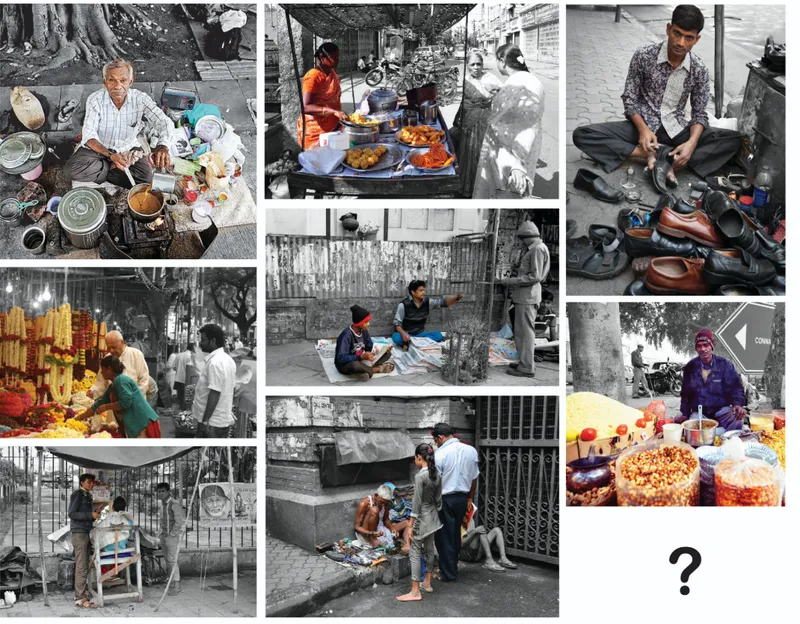
Before proposing anything new, Karmarkar documents what already exists. The collage of street vendors selling food and goods along sidewalks and under trees throughout the day reveals a pattern that most planners overlook: Indian streets are already intensely programmed spaces, just not by architects. Vendors improvise canopies from tarps, repurpose tree shade as overhead structure, and negotiate territorial boundaries that shift with the sun. The problem is not that these activities lack energy; it is that they lack infrastructure. Cooking happens without proper surfaces, seating is nonexistent for customers, and storage forces vendors to haul their setups in and out every day.
One Platform, Five Programs: The Rotation Mechanism
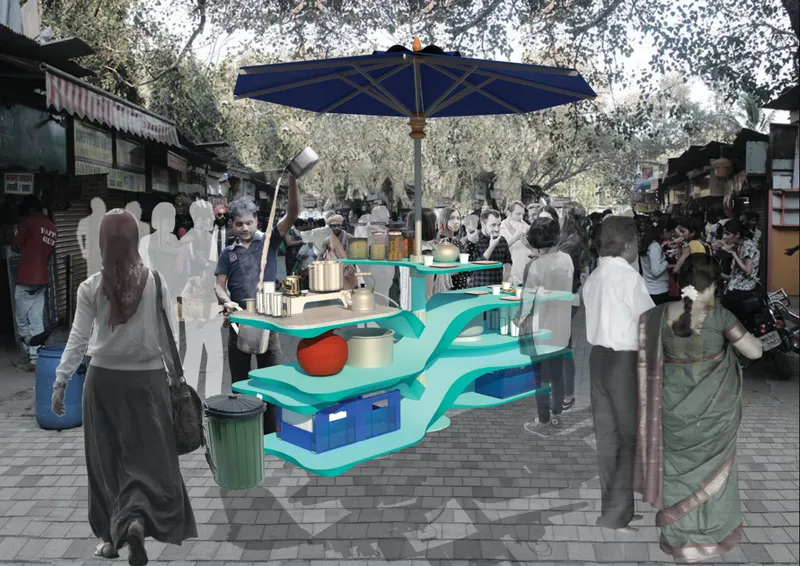
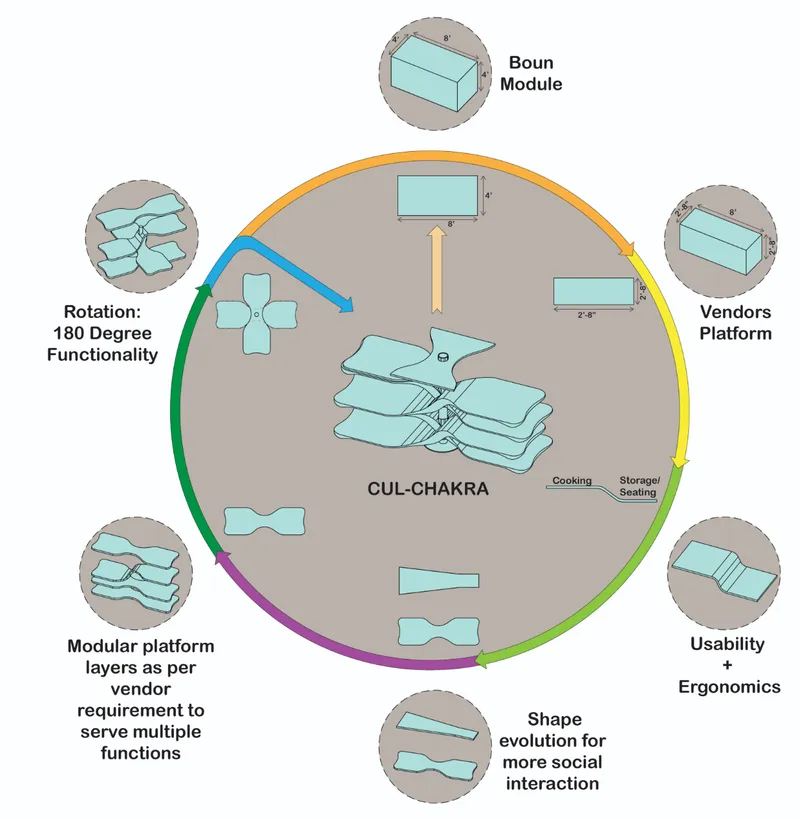
The core innovation is a central rotation mechanism that allows the platform to pivot, reconfiguring its surfaces for different vendor types at different hours. The circular diagram breaks down the modular components: layered platforms that can serve as cooking surfaces, display shelves, seating ledges, or flat benches depending on orientation and assembly. The turquoise modules visible in the street rendering show how the system looks when deployed: compact enough to sit alongside pedestrian traffic yet substantial enough to function as real infrastructure, complete with an umbrella canopy.
The time schedule is precise. From 6:00 to 7:30 AM, the platform serves milk vendors. By 7:30 to 9:30 AM it converts into a newspaper stall. The longest slot, 9:30 AM to 5:00 PM, accommodates a tea stall. Evenings from 5:00 to 9:00 PM bring food vendors. And from 9:00 PM to 6:00 AM, the structure flattens into a public bench. This is not abstract flexibility; it is a tightly choreographed sequence that mirrors how Indian street commerce actually operates.
Sidewalk Integration: Fitting Into the Tree-Lined Streetscape
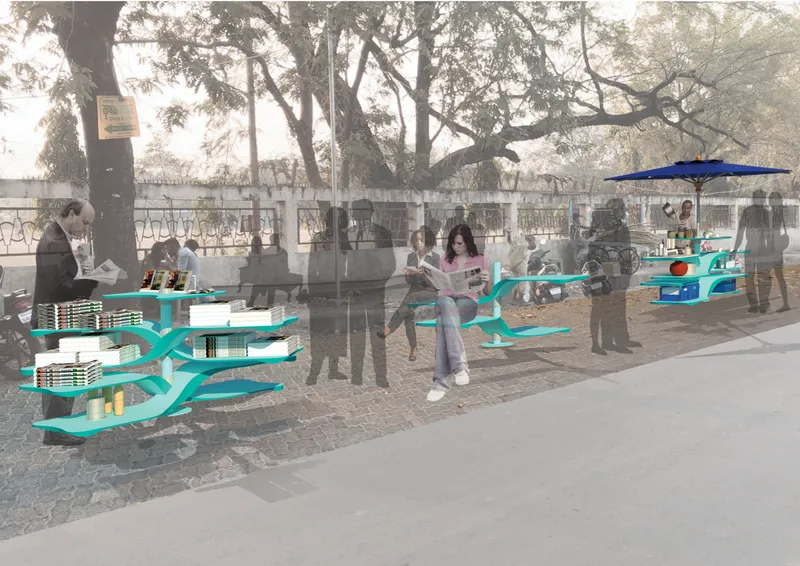
The perspective rendering along a tree-lined sidewalk is the most convincing image in the set. It shows multiple CUL-CHAKRA units deployed in series, their layered turquoise platforms catching morning light while pedestrians gather naturally around them. The platforms do not compete with the existing streetscape; they slot into the rhythm of trees and paving. People cluster in the way they already do around chai carts and fruit stalls, but here they have proper surfaces to lean on and sit at. The design preserves the informality of street culture while providing the ergonomic backbone it has always lacked.
Dimensions and Temporal Logic in Plan
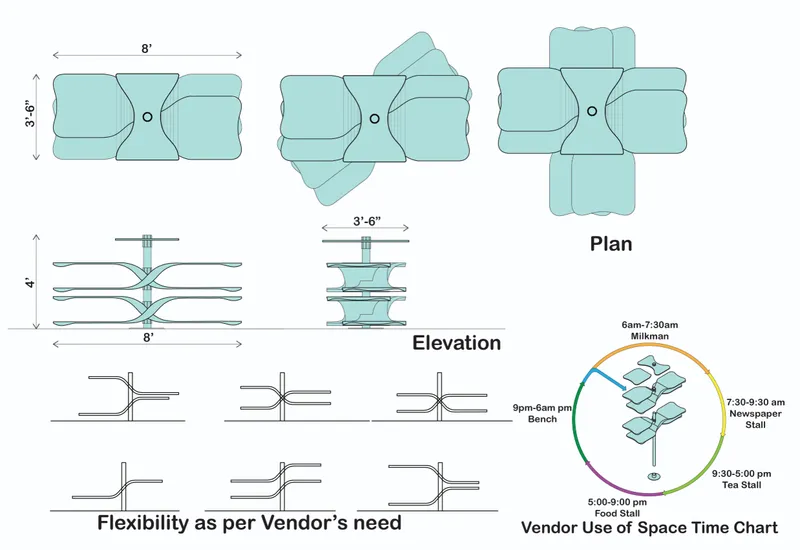
The plan and elevation drawings make the system legible at an architectural level. Dimensioned layouts show how each configuration occupies the sidewalk footprint, while the temporal usage schedule maps each vendor program to its time slot. What becomes clear is that the modularity is not just about swapping parts; it is about compressing multiple spatial identities into a single footprint. The elevations reveal the layered stacking that gives different programs different working heights, a critical ergonomic detail that separates this from a generic kiosk concept.
Why This Project Matters
CUL-CHAKRA confronts a question that most urban design projects sidestep: who actually owns the street? In Indian cities, the answer has always been negotiated in real time by vendors, pedestrians, and commuters rather than dictated by planners. Karmarkar's contribution is not to impose order on this negotiation but to give it better tools. The rotating, modular platform respects the temporal rhythms that vendors already follow while offering surfaces, storage, and ergonomic support that improvised setups cannot.
The strongest move here is the refusal to design for a single use case. By treating time as a design variable rather than a fixed constraint, CUL-CHAKRA turns one sidewalk slot into five functional programs. That is a genuine spatial argument, not a branding exercise. For a competition entry by a young designer, it demonstrates a sharp reading of how Indian cities actually function and a willingness to design infrastructure that serves the people already shaping those cities every day.
View the Full Project
About the Designers
Designer: Prajakt Karmarkar
Enter a Design Competition on uni.xyz
uni.xyz runs architecture and design competitions year-round that reward proposals with spatial conviction and real site intelligence.
Project credits: CUL-CHAKRA by Prajakt Karmarkar Urbanscape 2018 (uni.xyz).


Popular Articles
Popular articles from the community


Architekt Andreas Gruber Scatters 23 Dark Timber Chalets Across a South Tyrolean Forest Edge
In Molini di Tures, Amonti Chalets breaks a resort into a hamlet of gabled timber houses, with parking, storage and services pushed into the slope.

David Ortega Stacks a Two-Story Mexico City Penthouse Around a Steel Stair and a Pergola-Shaded Roof Terrace
In Colonia Roma, a 300 m² penthouse uses oak joinery, a planted steel stair and a slatted roof pergola to make a new-build apartment feel like a house.

U.GA Architects Wraps an Oval Rooftop Pool in Curved Board-Formed Concrete on Busan's Jeollidan-gil
In Busan's Jeonpo-dong, a 454 m² mixed-use block stacks a neighborhood facility, guest rooms and an oval rooftop pool inside spiraling concrete walls.

Juan García Correa, John González and Claudia Rueda Sink a Circular Amphitheater into a Manizales Engineering Building
On the La Nubia campus in Manizales, Colombia, the S1 Building folds labs and offices into a hillside of ramped lawns that double as a campus route.

Similar Reads
You might also enjoy these articles


Aquadapt: An Underwater Habitat That Rewrites Its Rooms by the Hour
Curved modules ring the seabed while one shell shifts from breakfast room to cinema, farm and football pitch as residents' needs change.

Play: Fragments of Their World: Remembered Architecture Rebuilt as a Modular Playground for Refugee Camps
Tom Gardner abstracts domes, arches and towers from the homelands of displaced families into a kit of child-scaled play parts for camp settlements.
REBIRTH: A Circular Settlement Where Afghan Widows and Their Children Rebuild Life Together
A shortlisted Resile entry turns the circle into a protective ring of timber and brick, gathering homes, classrooms and gardens around a shared landscape.
The Main Dream: A Recycled Plastic Kit That Lets Refugee Children Build Their Own Playground
Thirty-centimetre interlocking cubes that connect on three axes turn play into construction, letting children author the spaces they occupy.

Explore Furniture Design Competitions
Discover active competitions in this discipline

Design challenge to equip cities with modern furniture

Competition to design a workstation for architects

Packaging challenge - Design meets sustainability
Comments (0)
Please login or sign up to add comments
No comments yet. Be the first to comment!