
Curio
Create, Exhibit, Explore
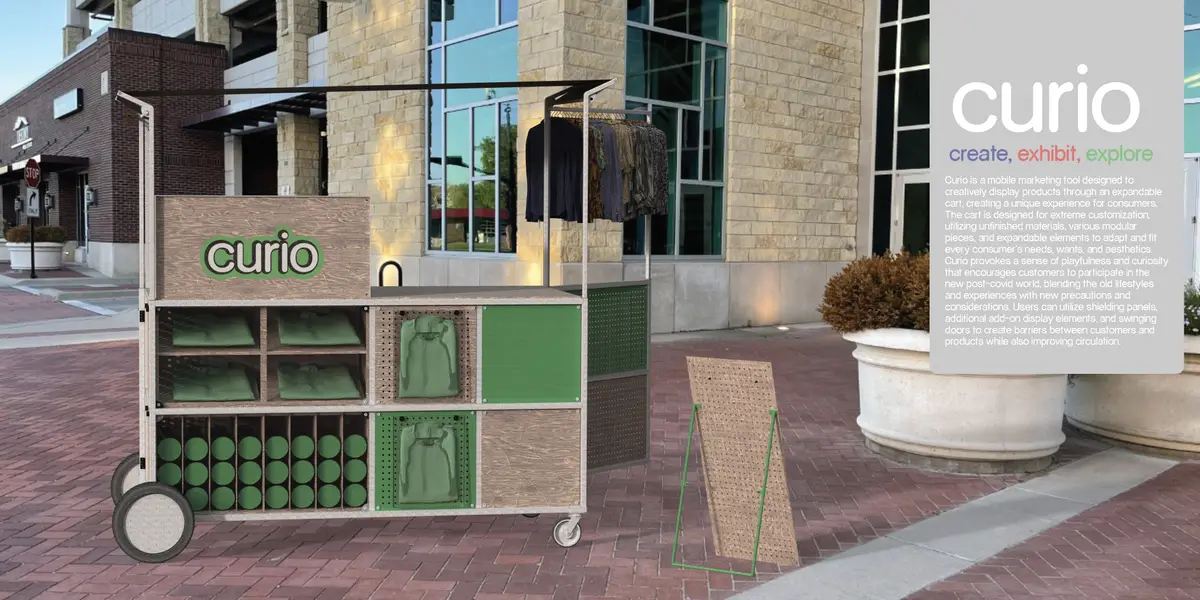
Curio is a mobile marketing tool designed to creatively display products through an expandable cart, creating a unique experience for consumers. The cart is designed for extreme customization, utilizing unfinished materials, various modular pieces, and expandable elements to adapt and fit every consumer’s needs, wants, and aesthetics. Curio provokes a sense of playfulness and curiosity that encourages customers to participate in the new post-covid world, blending the old lifestyles and experiences with new precautions and considerations. Users can utilize shielding panels, additional add-on display elements, and swinging doors to create barriers between customers and products while also improving circulation.
After thorough research and ideation, Curio became much more than a simple hand cart that sells hot dogs. It is an ultra customizable tool for all types of entrepreneurs and small business owners. The main focus of the design is modularity. The cart features three levels of modularity, starting with the frame and its storage. The frame of the cart is a simple 3' x 6' x 3' rectangle, utilizing a 6' social distance length, optimal 3' counter height, and a large 3' deep workspace. To increase durability and decrease weight, the frame is primarily constructed using 1" square steel tubing, with the exception of the 3/4" square steel tubing for the expandable canopy. The handlebars double as the expandable canopy and utilize a push snap clip connection to expand out of the cart and snap into place. The left frame expands to 34" and the right to 36", creating a slight angle for precipitation to flow away from the cart. This simple rectangular skeletal frame affords plenty of space for the designed storage modules to fit inside. Users can choose from flower storage, t-shirt storage, merch storage, or adjustable shelving to accommodate their needs. The stand storage module allows for a more open storage space while also elevating any of the other desired modules to a double-height position. Once the user has configured the inside of the cart, they will move on to the second level of modularity.
The second level is the exterior panel modules. Each face of the cart is subdivided into sections where the panel modules fit. The user can choose from a variety of different panels depending on their intended usage scenario. All panels come in two different sizes: primary (36" x 16.25") and secondary (16.25" x 16.25"), and are broken into three categories of transparency. The solid panels are meant to hide the interior of the cart, while also displaying branding or other imagery to the customers. These panels can be wood, sheet metal, or plastic. The second type of panels is the peg panels. These are designed to hide the interior of the cart but also function as a customizable display unit. Each panel is designed with standard pegboard dimensions, allowing the user to utilize accessories already on the market as well as the ones included with the design. The activity-specific peg attachments include a flower pot holder, an acrylic t-shirt display, and a small shelving unit with optimal dimensions for small merchandise. These units are attached to the pegboard using small pins specifically designed to be secure and ergonomically comfortable. The panel itself can either be wood, sheet metal, or plastic. Lastly, the transparent panels are meant to protect and display the interior of the cart. Users can utilize the previously mentioned storage modules as displays, paired with a clear exterior panel. These panel modules are clear acrylic. Panel modules can be easily interchanged and rearranged depending on the desired usage scenario. The front face of the cart can either hold four primary panels or two primary panels and four secondary panels. Once the panels are configured, the user will proceed to arrange and display their products on the cart to meet their exact needs.
After the storage and panel modules are configured, the third level of modularity expands the cart with extra add-on accessories. Users can utilize portable modules, external displays, and swing arm doors to create secondary spaces around the cart itself to help improve spacing and circulation. The portable module consists of a bent sheet metal frame, with connections for any primary panel and adjustable shelving. This module is designed to sit on the tabletop and has a variety of functions depending on the user's needs. With a solid or peg panel attached, the module becomes a personal nook for the user behind the counter to keep their belongings protected and hidden while also affording display or branding on the exterior. Small adjustable shelving paired with a transparent panel creates a portable display case. Users can utilize this to display products that aren't available for customers to interact with, or remove the panel and allow customers to easily interact with the merchandise. The external display panels are created using a primary peg panel attached to a simple steel tubing stand. These displays can be propped up around the cart and provide extra display and branding opportunities. This also expands the footprint of the cart and can be configured to help guide customers to circulate in a certain way, keeping them engaged with the merchandise but also socially distant. Both the portable module and external display panels can easily be compacted and stored inside the cart for convenient transportation. The swingarm doors attach to the frame of the cart and utilize the same extending connection as the canopy. Primary panels can be attached to this, or they can be used to display products by hanging them. This door can be opened to any desired angle, and again creates a secondary space improving circulation and distancing. For transport, the top half of the frame compacts into the bottom half and swings to sit flush to the side of the cart, locking into place.
The construction of the cart is specifically designed to be affordable, easily attainable, and finished to any desired aesthetic. The steel frame and other elements can be painted to any desired color, and the wooden pieces are left unfinished for the user to stain. All materials used are available to purchase at local hardware stores and created using basic construction methods, making replacements and upgrades easy and quick. The design is meant to be a blank canvas with unlimited possibilities for customization, personalization, and branding.
The construction of the cart is designed to open source allowing for the cart to be affordable. All materials used are easily attainable at local hardware stores. The skill level required for this project requires basic welding skills. By utilizing basic construction methods, allows the user to make replacements and custom upgrades easily and quickly. Open source also allows for the user to customize and finish the materials to any desired aesthetic. The design is meant to be a blank canvas with unlimited possibilities for customization, personalization, and branding. Our intention with the open-source design is to also make the cart sustainable. By utilizing the IKEA model of requiring the user to assembly the cart our hopes are that the user bonds with the cart and continues to modify and grow the cart with their business rather than tossing it in the trash.
The construction of the cart is specifically designed to be affordable, easily attainable, and customizable by open-sourcing materials. This allows for ultimate aesthetic customization, as the cart is a blank canvas with unlimited possibilities for personalization and branding. All supplies needed to build Curio can be bought at local hardware stores and built using basic construction methods. The user would need to either have basic welding knowledge or buy the frame already constructed. Open-sourcing also affords the cart to be more sustainable, as the user can build their cart from scratch and make it exactly how they desire. They build a certain relationship and attachment with the cart, as it fits all of their personal requirements. They understand how to construct the cart, which also allows them to easily expand the cart as their business grows rather than buying a new one.

Popular Articles
Popular articles from the community


The Amber Palace Opera: A Geological Fiction Surfaces on Tallinn's Baltic Waterfront
Pierre Brillard reimagines a Baltic legend as a public landscape, opera house, and waterfront promenade rooted in Tallinn's coastal identity.

Opera by the Sea Estonia: Three Shells Dissolving Architecture into Tallinn's Coastline
A winning opera house proposal replaces monumental form with interconnected shells that blur the boundary between building, park and Baltic Sea.

Singing Woman: Contemporary Architecture Inspired by Estonia’s Voice and the Sea
Singing Woman turns Estonia’s song culture into flowing opera house architecture, blending public life, landscape, sea, and national memory.

Temporary Home for Dogs: A Reversed Zoo Rethinks Animal Shelter Architecture
In Bucharest, a sinuous corridor and freed landscape flip the logic of containment, designing a shelter that works to make itself unnecessary.

Similar Reads
You might also enjoy these articles

The Rhythm of Seasons
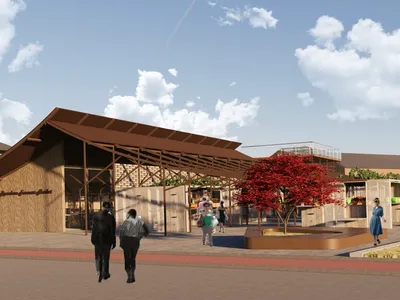
A Farmers' Market Connecting Nature and the City

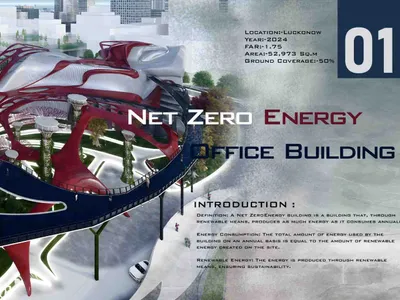
More Than a Building-Designing a Living System
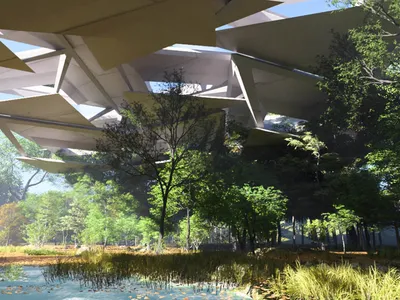
More Than a Building-Designing a Living System
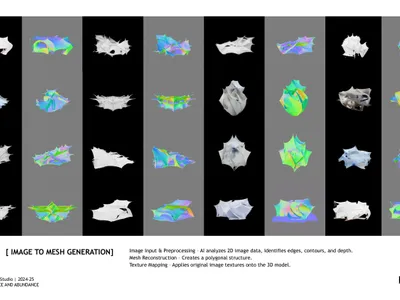
Base Beyond
DESERT COMPOUND ARID: TOURISM OF ABSENCE AND ABUNDANCE

Explore Low Cost Design Competitions
Discover active competitions in this discipline


Design challenge to equip cities with modern furniture

Design challenge to reuse E-waste

Packaging challenge - Design meets sustainability
Comments (0)
Please login or sign up to add comments
No comments yet. Be the first to comment!