

Davood Boroojeni Office Nests a Laboratory Atop a Public Gathering Space in Rural Iran
In the stork city of Qarah Ziya od Din, a pathobiology lab doubles as a rare civic hangout for 27,000 residents.


Qarah Ziya od Din is a small city in northwestern Iran with ancient roots dating to the eighth century BCE and a population of around 27,000. It is known locally as the city of storks, birds that build their heavy nests on top of existing urban infrastructure, telephone poles and rooftops and minarets. When Davood Boroojeni Office began field studies for a new pathobiology laboratory here, interviews with residents surfaced a consistent complaint: the city lacked spaces for public gathering. The architects took that finding and turned it into the building's organizing principle.
Kia Lab, completed in 2021, is a 1,200 square meter building that functions simultaneously as a working laboratory and as a piece of civic infrastructure. Its form literalizes the stork metaphor. A dark, low base aligns with the rooflines of its neighbors, following the geometric rules of the surrounding fabric. A clean white volume perches on top, structurally distinct, punched with asymmetric windows and crowned with rooftop cypresses. The lower portion is given over almost entirely to public use: a courtyard, external stairs, planted terraces, and gathering spaces accessible without ever setting foot in the lab. It is a building that solves two problems at once, one medical, one social, and finds its logic in a local bird.
A White Volume in a Brick City


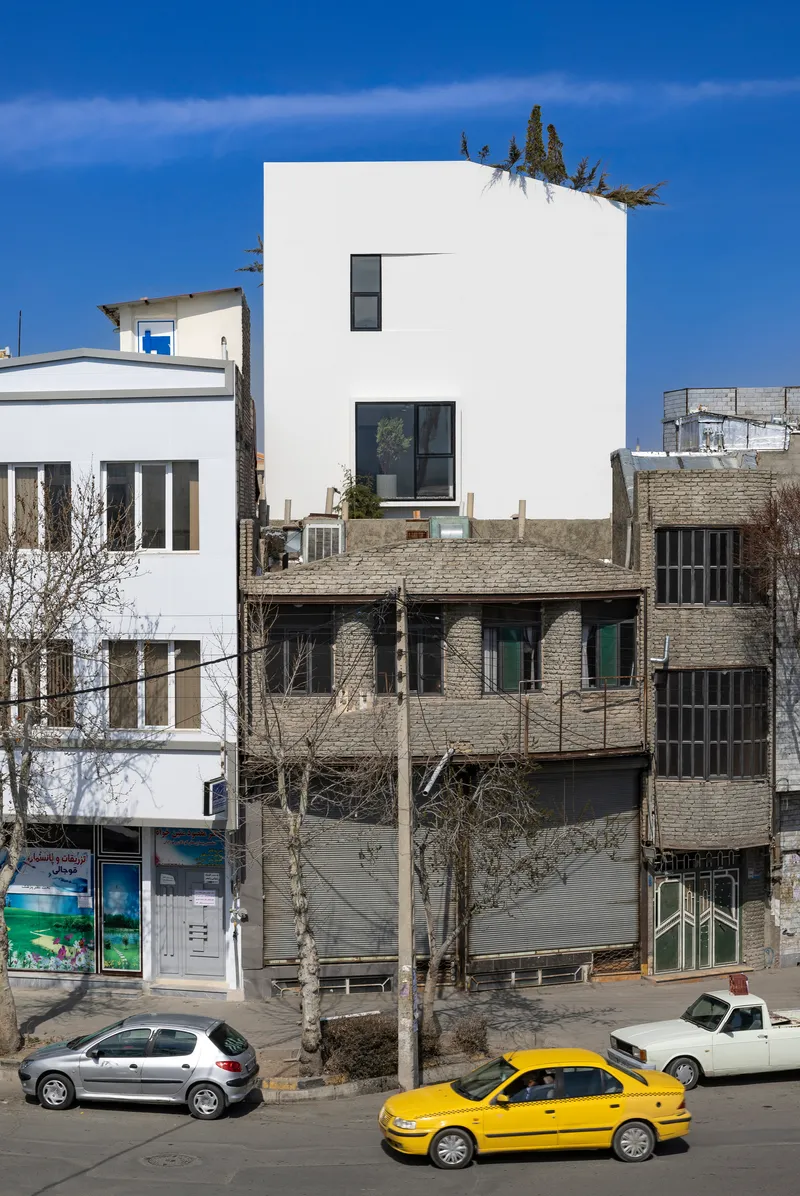
The contrast is deliberate and unapologetic. Qarah Ziya od Din's existing fabric is low-rise, largely brick, and the architects describe it bluntly as "low-quality, almost worthless." Rather than imitating that context, the white stucco upper volume announces itself as something different. It rises above the parapet line of its neighbors like a signal. The scattered rectangular windows, each sized and placed without apparent pattern, give the facade a restless energy that prevents the box from reading as monolithic.
From the street, the building reads as two things at once: an object that belongs to the neighborhood by height and setback at its base, and one that breaks from it in color, material, and massing above. The rooftop garden softens the top edge with cypresses and planting, a nod to the idea that life can perch on top of structure, stork-like.
The Ground as Public Domain
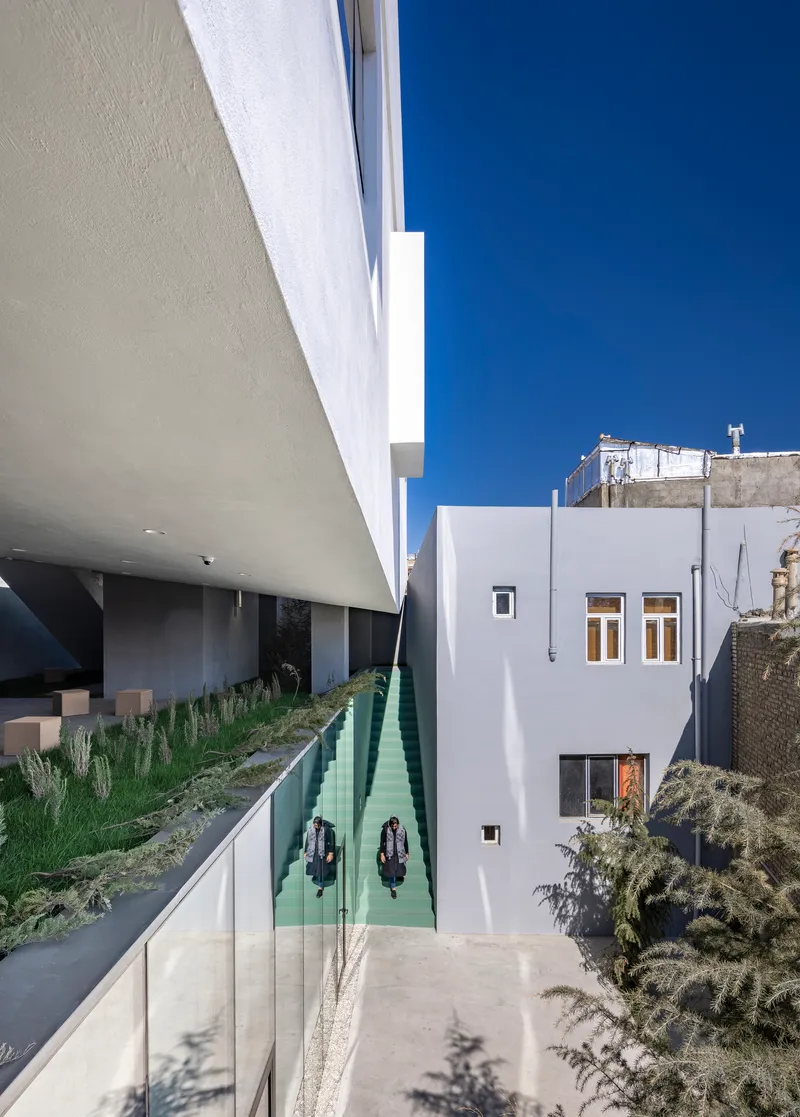


The most radical decision here is programmatic, not formal. The entire first floor is conceived as an empty public space with views to the street, accessible via external stairs in an adjacent passage. A mint green reflecting pool sits beneath the cantilevered white volume, turning what could have been a leftover gap into a civic threshold. The narrow courtyard between the white facade and an existing brick party wall is planted with trees and paved simply, creating a buffer zone that feels neither fully inside nor outside.
The architects cite ancient Iranian precedent for this move: stairs in traditional cities like Naein and Isfahan that connect urban passages to upper floors, blurring the line between street and building. Here that tradition is reinterpreted. The passage stairs don't lead to a private residence; they lead to a public room that a laboratory chose to give away.
Gathering Spaces Carved from Structure
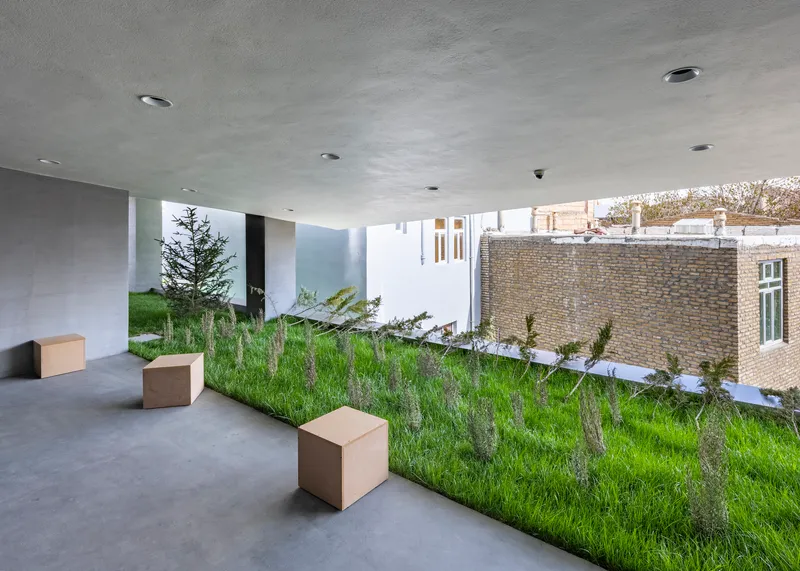


Inside the public zone, sculpted niches and planted slopes create a series of informal gathering spaces. Concrete walls angle apart to admit light, and grass strips run along corridors like miniature landscapes. Cardboard cube benches, simple and inexpensive, provide seating without formality. People sit, talk, and occupy the space as if it were a park rather than a building. The images confirm that residents have actually adopted these spaces, which is the only metric that matters.
The planted courtyard with its grass mound and small tree beneath an angular skylight is perhaps the most successful moment. It brings sky and soil into the center of the plan, creating a microclimate that cools the air and rewards anyone who ventures past the threshold. The clerestory windows above wash the interior slope with changing light throughout the day.
Mint Green and Concrete


The interior palette is restrained to three elements: exposed concrete, white plaster, and a distinctive sage-to-mint green that appears on ceilings, stairwells, and glazing mullions. The green reads as a single continuous surface threaded through the section, tying the public ground floor to the laboratory floors above. In the kitchen and corridor spaces, it transforms ceilings into a kind of canopy, lowering the perceived height and creating a sheltered intimacy.
The central staircase is the clearest expression of this strategy. Mint green walls rise through the building with a skylight above pulling natural light down the treads. It functions as a vertical courtyard, a light well dressed in color rather than planting.
Terraces and Thresholds


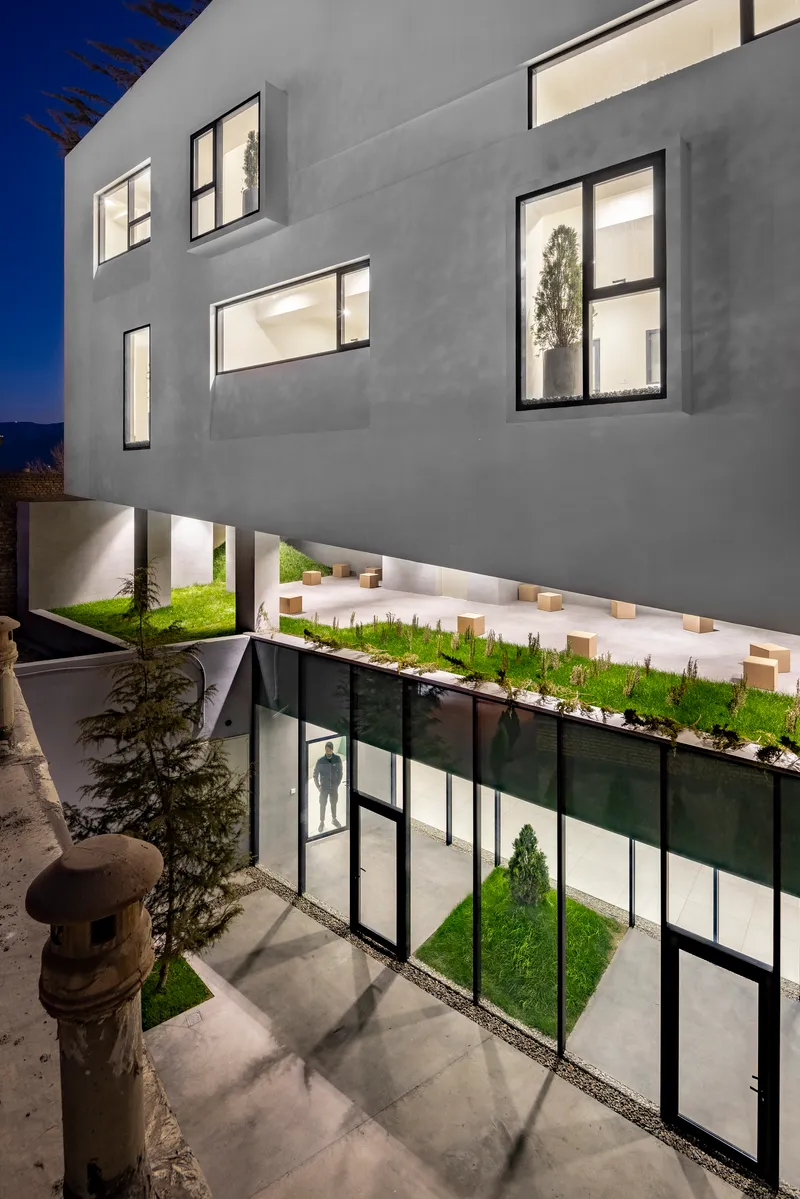
Between the fully public ground and the private laboratory floors, a series of terraces mediate the transition. Covered outdoor rooms with planted grass strips and polished concrete floors offer views back to the courtyard below and out to the mountains beyond. At dusk, glazed walls glow against the planted terraces, and the building reveals its layered section: ground, terrace, lab, rooftop garden.
These in-between spaces are where the building's dual identity is most legible. They belong neither to the lab program nor to the street. They are threshold zones, and they give the building a porosity that most institutional projects in small cities never attempt.
Urban Presence at Dusk

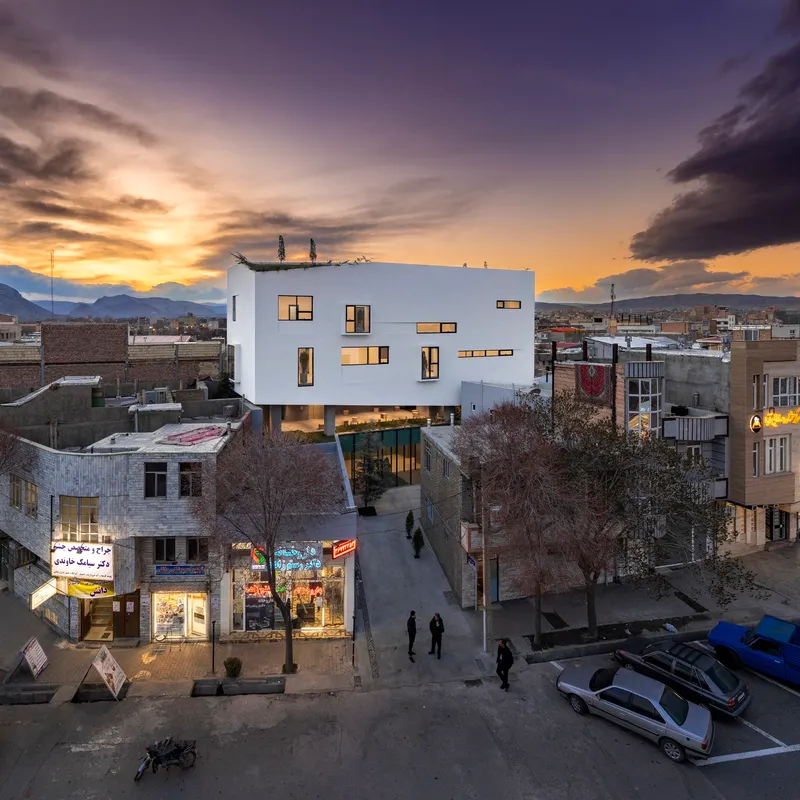

At twilight, the building's relationship to its context becomes most dramatic. The white volume catches the last light while the surrounding fabric recedes into shadow. Illuminated windows scatter across the facade like a constellation, and the street below remains active with pedestrians and storefronts. The building participates in the life of the street without mimicking it, a presence rather than an imposition.
The mountain backdrop visible in several shots is a useful reminder of scale. This is not Tehran or Isfahan. It is a small city where a single building can genuinely alter the civic landscape, and the architects appear to have understood that responsibility.
Plans and Drawings

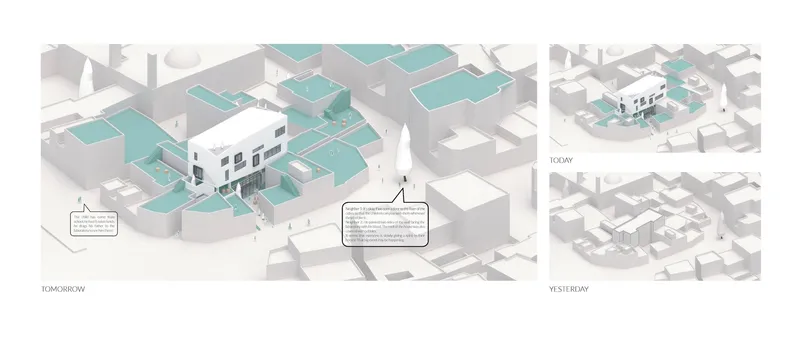


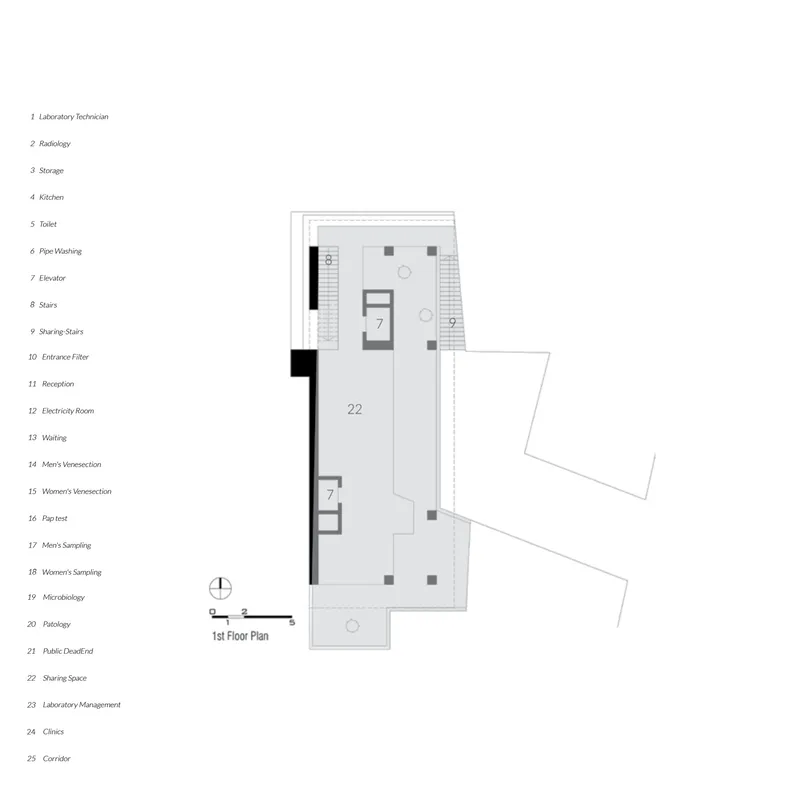
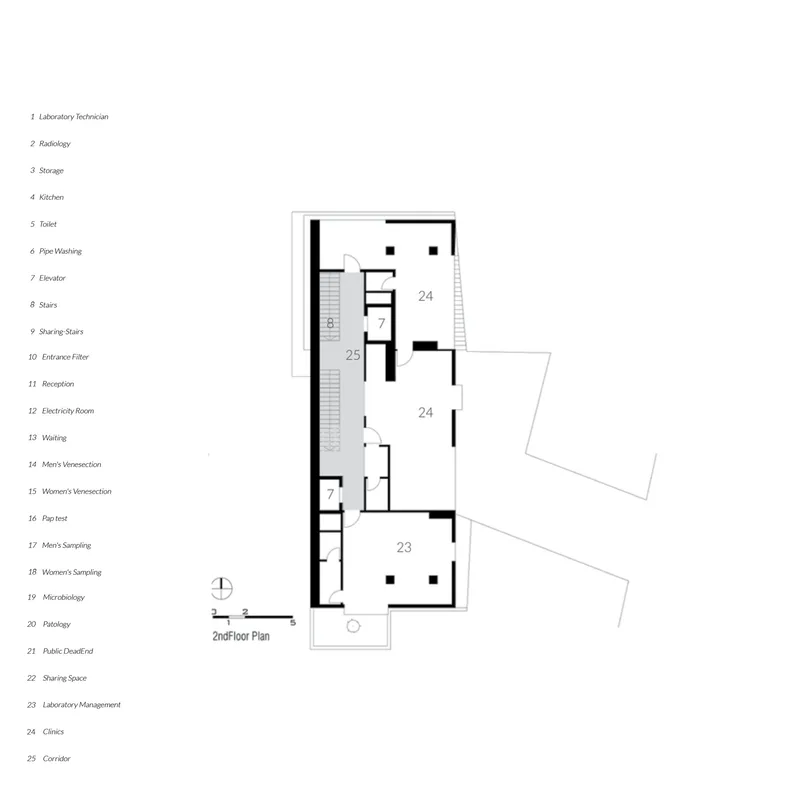


The drawings reveal a three-phase development strategy within the surrounding street grid, suggesting the architects conceived Kia Lab not as a standalone object but as the first move in a longer urban transformation. The axonometric views clarify the structural split between the lower base and the upper volume, showing how the glazed facade mediates between them. Floor plans progress logically from basement storage through ground-level public space to laboratory, clinic, and office floors above, all organized around a central stair and elevator core.
The programmatic axonometric showing five possible configurations of volumes and green spaces along the linear site is particularly telling. It suggests the design was tested against multiple scenarios before arriving at the built solution, a level of rigor that explains why the final building feels resolved rather than arbitrary.
Why This Project Matters
Kia Lab matters because it refuses the premise that a pathobiology laboratory in a small Iranian city should be nothing more than a pathobiology laboratory. The decision to sacrifice an entire floor of rentable or functional space to public gathering is an act of civic generosity that most clients would reject and most architects would not propose. That it was built, occupied, and apparently embraced by residents suggests the field research that preceded the design was genuine rather than performative.
The stork metaphor could easily have remained a poetic conceit, a nice story for the project description. Instead, it produced a structural logic, a heavy base that follows the existing urban grain, a lighter volume that lands on top with its own rules, that is legible in the built work. The building demonstrates that even in cities where the surrounding fabric offers little to respond to formally, context can be engaged through program, through public generosity, and through the simple act of asking residents what they actually need.
Kia Lab Laboratory, designed by Davood Boroojeni Office (lead architects Davood Boroojeni, Saba Ammari, and Hamed Kalateh), Qarah Ziya od Din, Iran. 1,200 m², completed 2021. Photography by Parham Taghioff.
About the Studio
Share Your Own Work on uni.xyz
If projects like this are the kind of work you want to make, uni.xyz is a place to publish your own, find collaborators, and enter design competitions.


Popular Articles
Popular articles from the community


Manzana Morphosis: Stretching Barcelona's Grid into a Living Landscape for 2050
A radical reworking of the Eixample manzana turns density into a tool for generous public space, vertical ecology, and environmental performance.
Tsunami Convergenics: Turning Catastrophic Ocean Forces into Underwater Housing Infrastructure
A speculative underwater settlement off the coast of Onagawa, Japan, treats tsunamis and typhoons as energy sources rather than threats.

The Amber Palace Opera: A Geological Fiction Surfaces on Tallinn's Baltic Waterfront
Pierre Brillard reimagines a Baltic legend as a public landscape, opera house, and waterfront promenade rooted in Tallinn's coastal identity.

Temporary Home for Dogs: A Reversed Zoo Rethinks Animal Shelter Architecture
In Bucharest, a sinuous corridor and freed landscape flip the logic of containment, designing a shelter that works to make itself unnecessary.

Similar Reads
You might also enjoy these articles

Bao Huynh Watercolor Atelier: A Serene Art Retreat in Hội An
Bao Huynh Watercolor Atelier in Hội An blends multifunctional art spaces, sustainable design, local materials, and family-friendly living in a serene environment.

Atelier Macri Concept Store Interior Design by CASE-REAL
Atelier Macri store features a "ko" counter, walnut wood details, cork displays, blending retail, gallery, and seamless customer experiences.

Manuel Vargas Izquierdo Stadium and High-Performance Sports Center: Architectural Excellence in Jalpa de Méndez
The Manuel Vargas Izquierdo Stadium blends sustainable design, inclusive sports facilities, and cultural-inspired architecture, revitalizing Jalpa de Méndez’s public spaces.

KAKR Buluh Awar Hall: Revitalizing Community and Ecology Through Bamboo Architecture
Community built bamboo hall revitalizes Buluh Awar village, empowering youth, restoring ecology, celebrating vernacular craftsmanship through sustainable architecture and culture.

Comments (0)
Please login or sign up to add comments
No comments yet. Be the first to comment!