

Delhi Eye: Reimagining Connaught Place Around a Civic Landmark and Pedestrian Core
A proposal to pedestrianise New Delhi's historic commercial heart and crown it with a flag-inspired observation wheel and cultural complex.


What would it take to reclaim one of India's busiest commercial districts for the people who walk through it every day? Swati Gupta and Nikita Jain answer that question with a single, radical move: strip vehicles from Connaught Place's inner circle, redirect traffic to its outer ring, and anchor the newly liberated public realm with a towering observation wheel inspired by the Ashoka Chakra on India's national flag. The result, called Delhi Eye, is equal parts transit strategy, heritage retrofit, and cultural provocation.
Connaught Place sits at the symbolic centre of New Delhi, flanked by Rajpath, India Gate, and Rashtrapati Bhawan. Its three concentric rings (inner, middle, and outer circles) define both its colonial-era identity and its contemporary dysfunction: severe pedestrian congestion, chronic parking shortages, declining visibility for local artisans, and a near-total absence of dedicated cultural programming. The Delhi Eye proposal confronts each of these failures through a holistic plan that reorganises circulation, introduces new public spaces, and anchors the district with a landmark structure designed to draw tourists and residents alike into a richer civic experience.
Three Rings, One Logic: Rewriting Connaught Place's Circulation
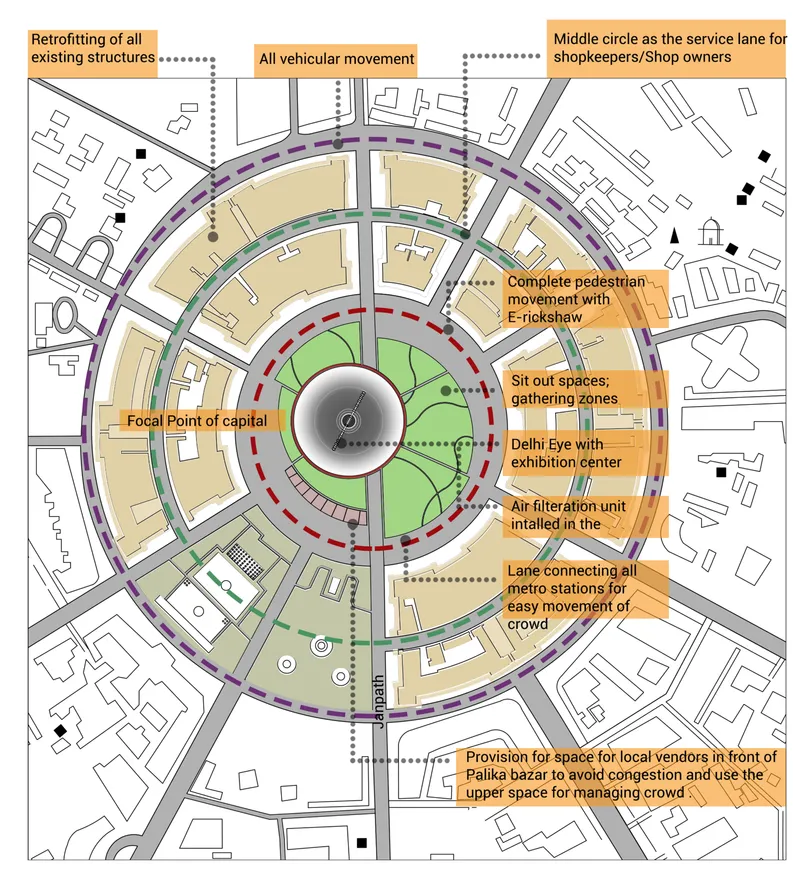
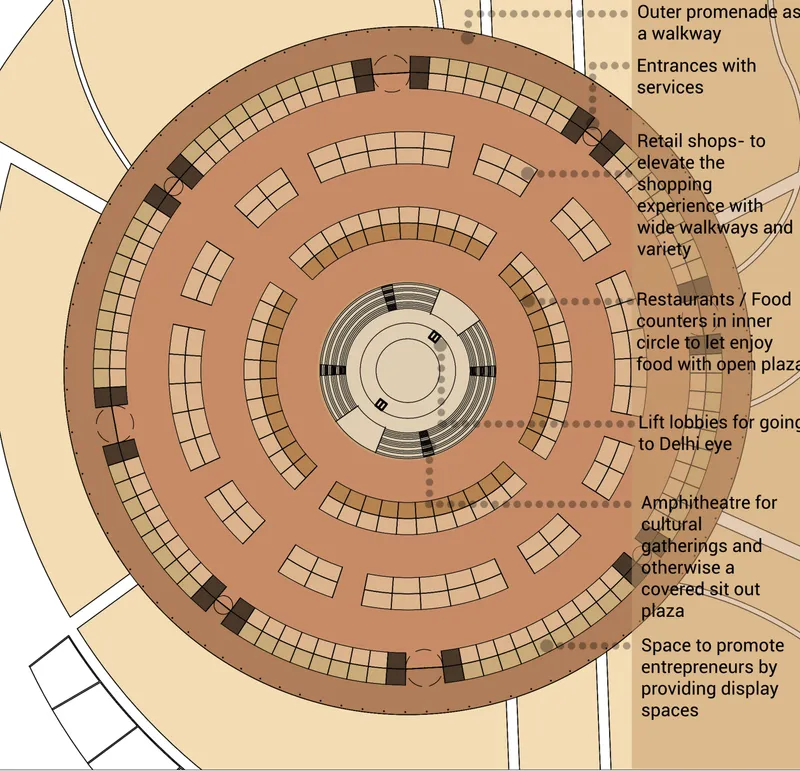
The plan diagrams reveal how Gupta and Jain untangle the district's movement crisis. Vehicles are pushed firmly to the outer circle, with designated drop-off points along the middle ring. E-rickshaws replace cars in the transitional zone, offering accessibility for elderly and differently-abled visitors without reintroducing congestion. The inner circle becomes an entirely pedestrian realm: landscaped walkways, shaded arcades, and direct metro-connected lanes replace the current scrum of cars, buses, and foot traffic. The designers estimate this single move could reduce inner-circle congestion by up to 70%.
The circular floor plan of the proposed cultural complex shows how programme radiates outward from a central core. An outer promenade wraps the perimeter as a continuous pedestrian loop. Retail corridors sit in the next band, widened for better visual exposure. Restaurants and food courts face inward, oriented toward an open plaza and performance space. Exhibition galleries occupy the intermediate ring, dedicated to Indian crafts, contemporary design, and rotating cultural narratives. Every ring has a purpose, and no ring depends on private vehicle access.
The Chakra in the Sky: Structure and Programme of the Delhi Eye
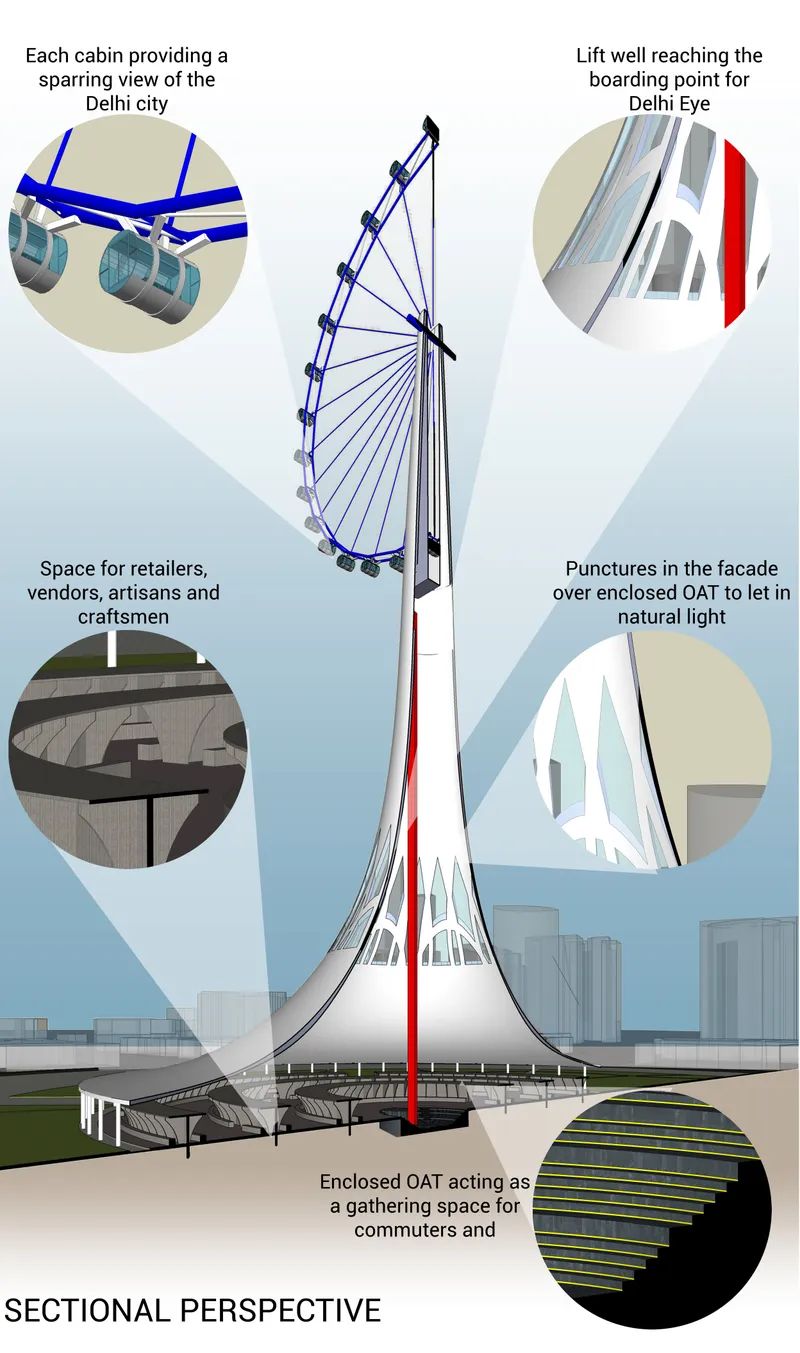
The sectional perspective cuts through the tower and its radiating observation wheel, annotating programme zones from ground-level lobbies to the panoramic capsules at the top. The Delhi Eye is conceived as a national landmark on the scale of the London Eye, but its formal reference is distinctly Indian: the spokes and rim recall the Chakra from the tricolour flag, turning a piece of infrastructure into an identity marker for both Delhi and the nation. Lift lobbies provide vertical circulation, feeding visitors from the cultural complex below into the elevated observation loop above.
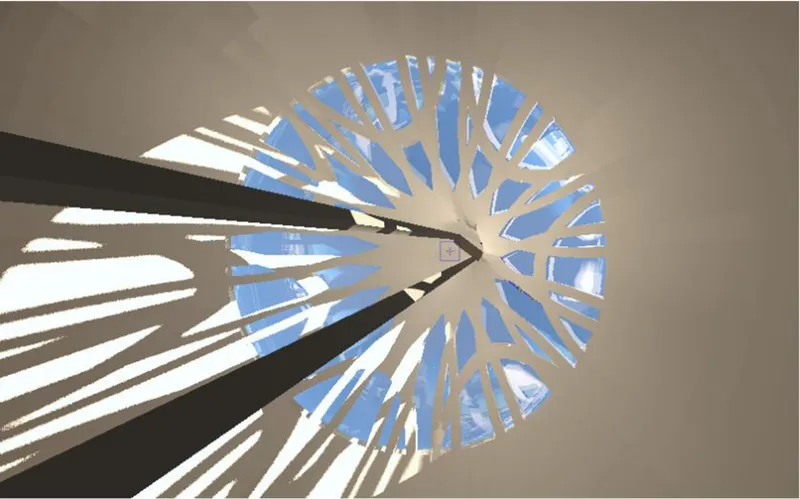
The upward photograph through the circular opening captures the structural ambition in a single frame. Radial white fins converge toward the sky, creating a rhythmic canopy that filters light into the space below. It is an image that communicates both engineering discipline and spatial drama, a reminder that landmark status requires more than height; it requires a legible structural idea visible from within as well as from across the city.
Day, Night, and the Wireframe: The Landmark as Urban Silhouette
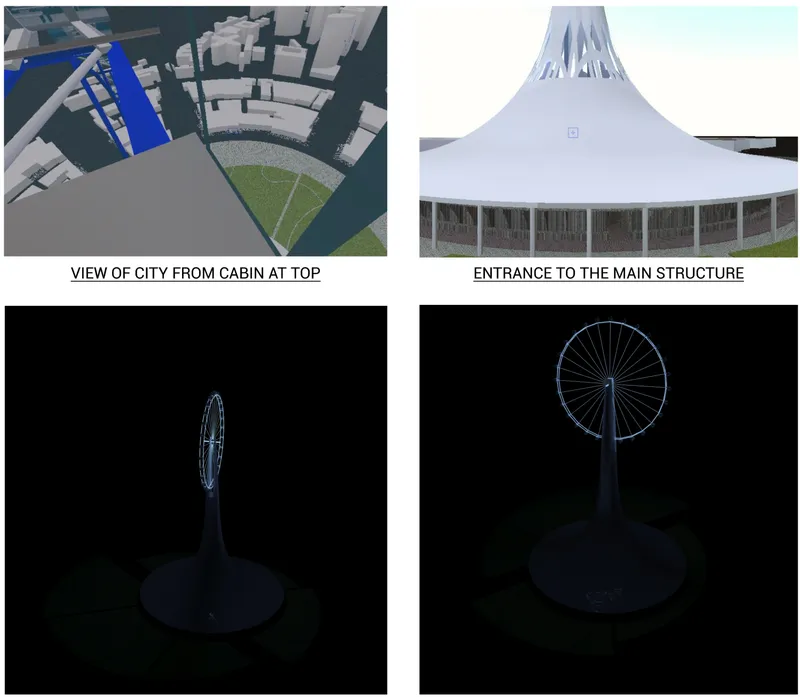
Four rendered views present the observation tower in different modes: a daytime elevation revealing the conical roof structure, a nighttime rendering where the wheel glows against the skyline, and wireframe studies that strip the form back to its geometric essentials. Together, they argue that the Delhi Eye is not a single-condition spectacle. Its conical base, spoked wheel, and slender tower are calibrated to read at every scale, from a pedestrian standing in Central Park to a commuter spotting it from the outer ring road. The night views are particularly effective, suggesting a lit beacon that redefines Connaught Place's identity after dark, a period when the district has historically offered little reason to linger.
A Central Amphitheatre for Gathering, Performance, and Civic Life
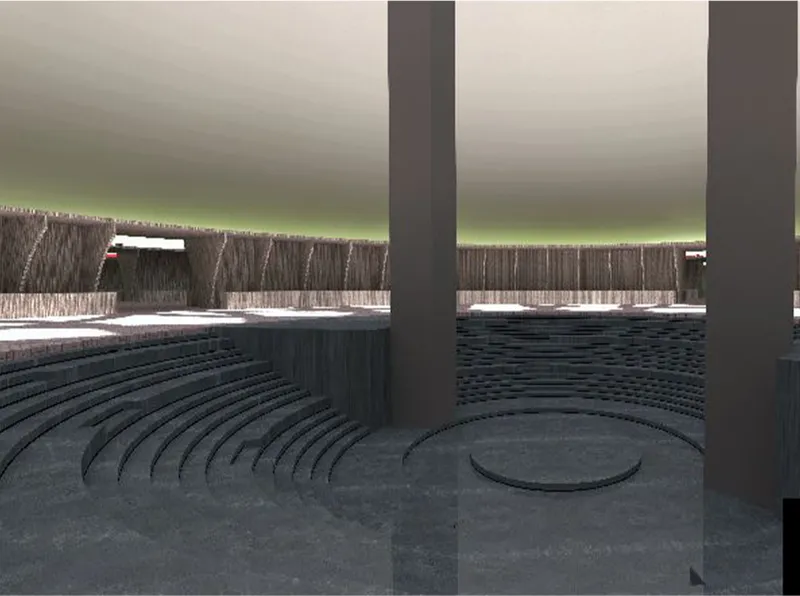
The interior rendering shows tiered seating wrapping a circular stage, bathed in green uplighting and framed by textured wall panels. Conceived as a flexible venue for performances, festivals, and civic gatherings, the amphitheatre occupies the centre of the cultural complex. It fills a gap that the existing Connaught Place conspicuously lacks: a dedicated, weather-protected space for public assembly. The circular geometry echoes the district's own plan, reinforcing the concentric logic that organises everything from traffic lanes to retail corridors. In a city where extreme seasonal heat and monsoon rains routinely shut down outdoor programming, a sheltered amphitheatre of this scale is not a luxury; it is infrastructure.
Why This Project Matters
Delhi Eye is significant because it refuses to treat heritage preservation and contemporary ambition as opposing forces. Rather than freezing Connaught Place in its colonial-era form, Gupta and Jain propose retrofitting every existing structure to preserve architectural character while upgrading functional performance. The pedestrianisation strategy, the transit redistribution, and the cultural programming all flow from a single conviction: that a historic district can absorb a bold new landmark without losing its identity, provided the infrastructure beneath that landmark actually solves the problems people face every day.
What makes the proposal genuinely compelling is its scalar range. It operates at the level of urban logistics (rerouting tens of thousands of vehicles), building programme (galleries, retail, amphitheatre), structural spectacle (the observation wheel), and symbolic meaning (the Chakra as national emblem). Few student proposals attempt to hold all four registers simultaneously. That Gupta and Jain manage to keep them legible within a single concentric plan is a testament to disciplined design thinking, and a provocation for anyone involved in the future of New Delhi's public realm.
View the Full Project
About the Designers
Designers: Swati Gupta, Nikita Jain
Enter a Design Competition on uni.xyz
uni.xyz runs architecture and design competitions year-round that reward proposals with spatial conviction and real site intelligence.
Project credits: Delhi Eye by Swati Gupta, Nikita Jain.


Popular Articles
Popular articles from the community


Tsunami Convergenics: Turning Catastrophic Ocean Forces into Underwater Housing Infrastructure
A speculative underwater settlement off the coast of Onagawa, Japan, treats tsunamis and typhoons as energy sources rather than threats.

Opera on the Sea: Driftwood Logic Shapes a Timber Opera House on Estonia's Coast
Trevor Orgill's opera house translates the entangled drift of floating timber into a civic building where wood, water, and music converge.
Faces of the Soviet Avant-Garde: Turning Moscow's Street Names into an Open-Air Museum
A network of sculptural installations across a Moscow residential district transforms forgotten architect names into spatial encounters with cultural memor

Manzana Morphosis: Stretching Barcelona's Grid into a Living Landscape for 2050
A radical reworking of the Eixample manzana turns density into a tool for generous public space, vertical ecology, and environmental performance.

Similar Reads
You might also enjoy these articles

Play: Fragments of Their World: Remembered Architecture Rebuilt as a Modular Playground for Refugee Camps
Tom Gardner abstracts domes, arches and towers from the homelands of displaced families into a kit of child-scaled play parts for camp settlements.
REBIRTH: A Circular Settlement Where Afghan Widows and Their Children Rebuild Life Together
A shortlisted Resile entry turns the circle into a protective ring of timber and brick, gathering homes, classrooms and gardens around a shared landscape.
The Main Dream: A Recycled Plastic Kit That Lets Refugee Children Build Their Own Playground
Thirty-centimetre interlocking cubes that connect on three axes turn play into construction, letting children author the spaces they occupy.

Lunar Spiral: A Fibonacci-Driven Moon Settlement Rising from Shackleton Crater
Golden-spiral geometry organises buried infrastructure and orbiting habitable spheres into a lunar base designed to grow as life on the Moon expands.

Comments (0)
Please login or sign up to add comments
No comments yet. Be the first to comment!