
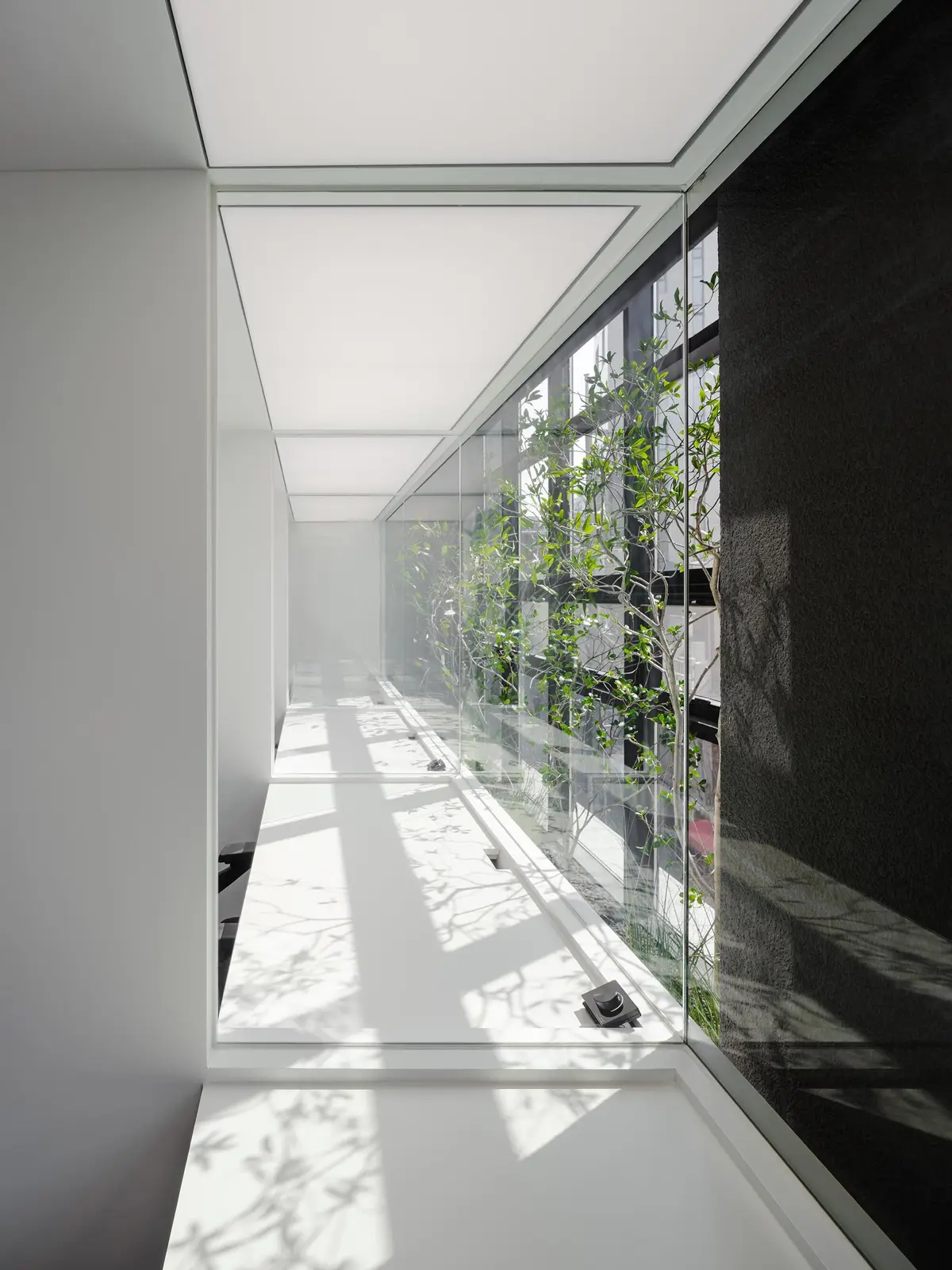
Design Studio BYO Builds the Physical Shell for a Virtual Office in Seoul
Metaverse Workpod offers one-person pods, planted atriums, and IoT controls for a proptech firm's hybrid workforce in Jung-gu.


The premise sounds almost paradoxical: a company whose product is a metaverse-based virtual office called SOMA commissions a physical workspace. But that is exactly what South Korean proptech firm Zigbang asked of Design Studio BYO when it developed its Metaverse Workpod, also known as SOMAPOD, in Seoul's Jung-gu district. The result, completed in 2022, is an offline counterpart to a digital platform, a place where remote workers can drop into a real room with real air, real light, and real trees growing behind glass.
What makes the project genuinely interesting is not the metaverse branding but the design problem underneath it. How do you build a workplace for people who do not share a schedule, do not know each other, and may stay for thirty minutes or eight hours? Design Studio BYO's answer treats noise, light, and ventilation as the three non-negotiable variables, then wraps everything else around them: double-layer walls for acoustic isolation, individually controllable LED color temperatures, dedicated air supply in every pod, and 24-hour keyless access governed by IoT. The architecture is less a conventional office than a serviced landscape of solitary capsules held apart by planted courtyards.
A Garden Between the Pods
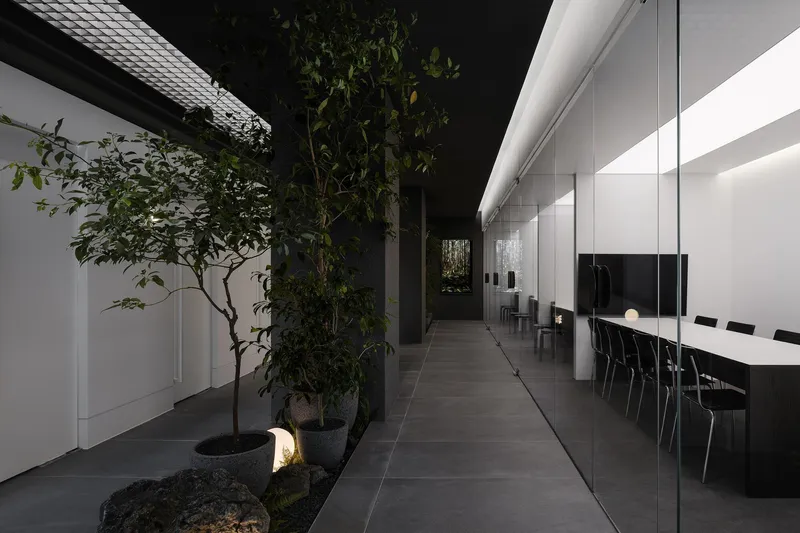
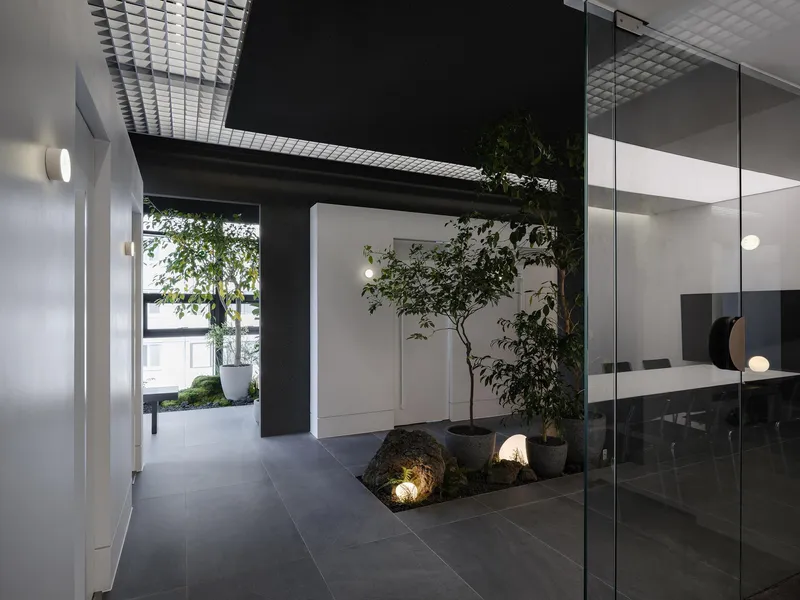
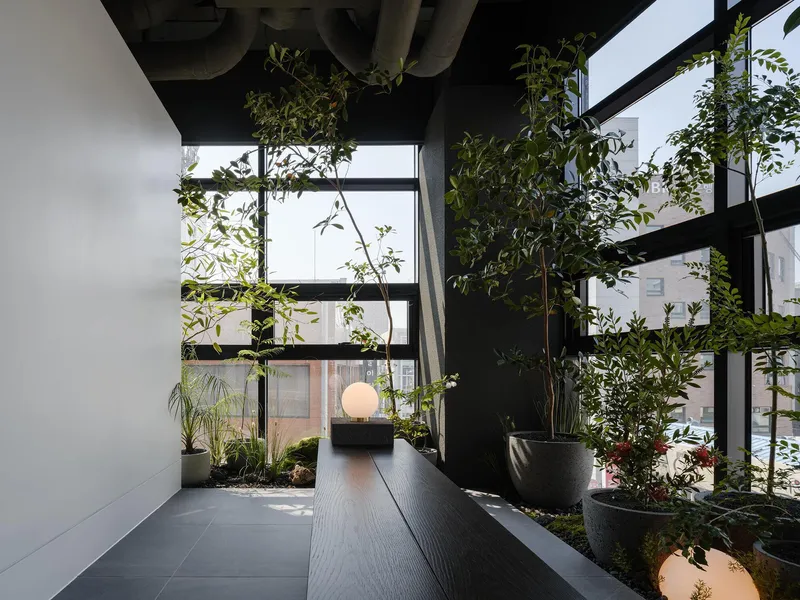
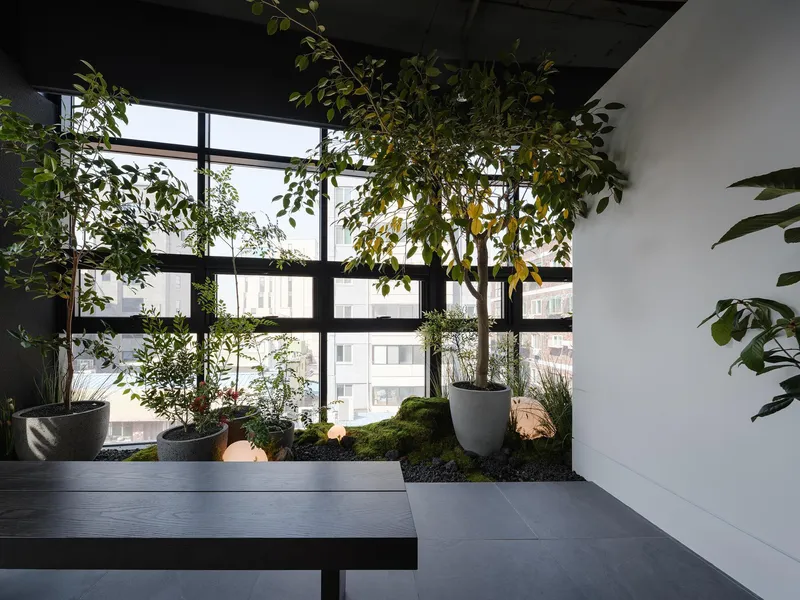
The central organizing move is a series of interior planted atriums that separate the work pods from one another. Trees grow in dark gravel beds and moss covers loose rocks behind full-height glass walls, creating a visual buffer that does double duty as an acoustic one. The courtyards are not residual space; they are the plan's backbone, the element that gives each pod a sense of address within the building. You always know where you are because you can orient yourself against a living, three-dimensional reference point rather than a corridor number.
A metal mesh skylight sits above the largest of these gardens, filtering daylight into a dappled pattern that shifts throughout the day. The effect is closer to a forest floor than a corporate atrium, and it introduces an unpredictable temporal quality to a space otherwise governed by precise environmental controls. That tension between wild and managed runs through the entire project.
Light as a Controllable Material

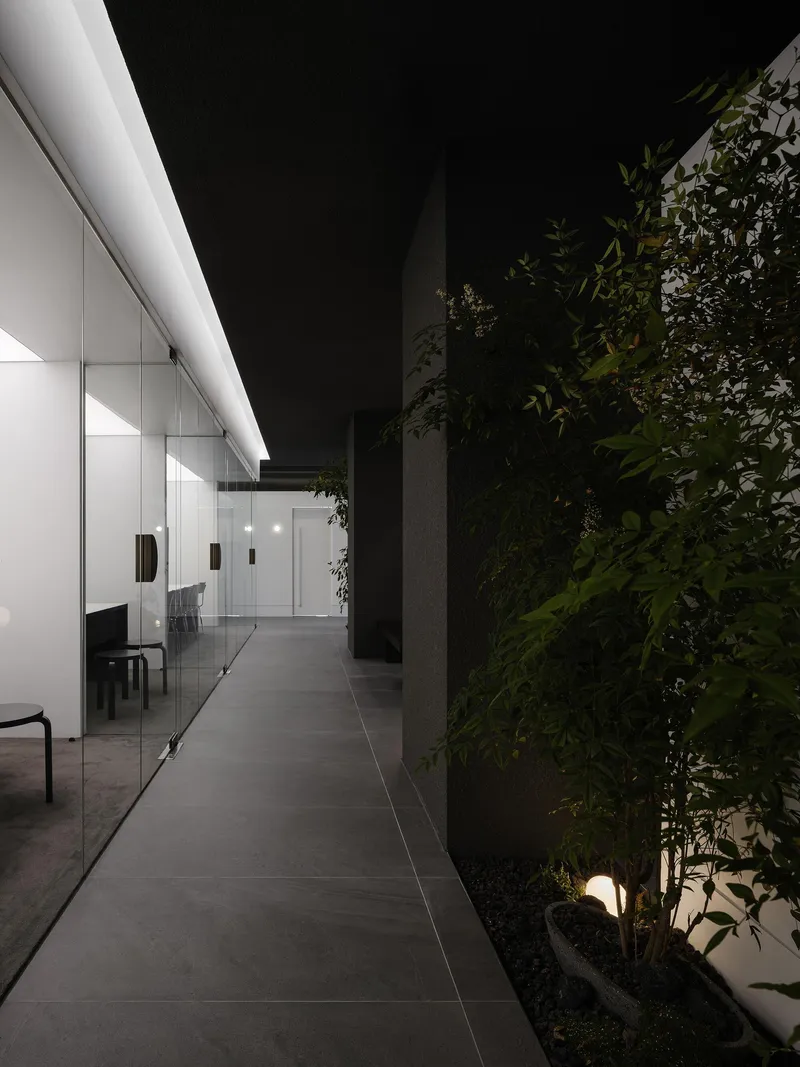
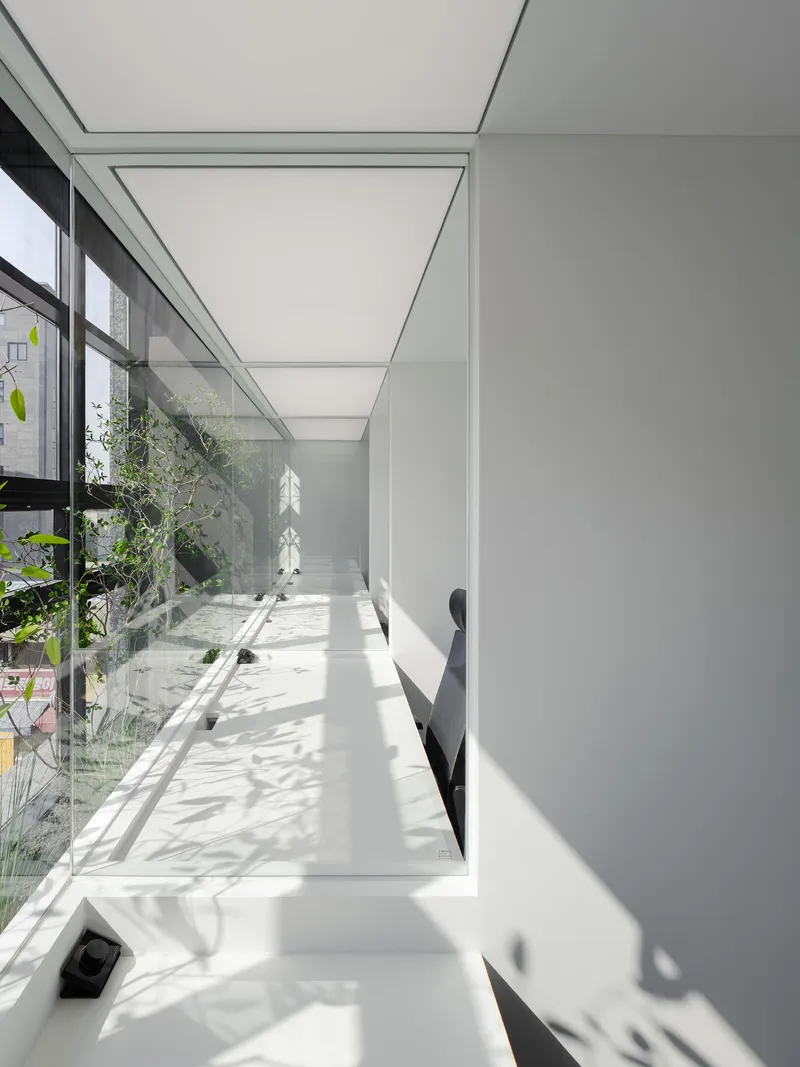
The conference room's recessed linear skylights produce angular shadow lines across the ceiling, turning structure into a sundial. Elsewhere, uplights wash planted green walls at night, shifting the space's atmosphere from productive daytime clarity to something softer and more contemplative after hours. Because the building operates around the clock, the lighting scheme had to work at every hour, not just during a standard nine-to-five window.
Users can adjust both color temperature and brightness inside individual pods, a feature that sounds trivial until you consider that the occupants may be staring at a screen for the duration of their stay. The ability to shift ambient warmth independently of the shared corridors means no two pods need to feel the same, even when they are physically identical. Light becomes the primary mechanism of personalization in a building that, by definition, has no permanent tenants.
Corridors That Do More Than Connect
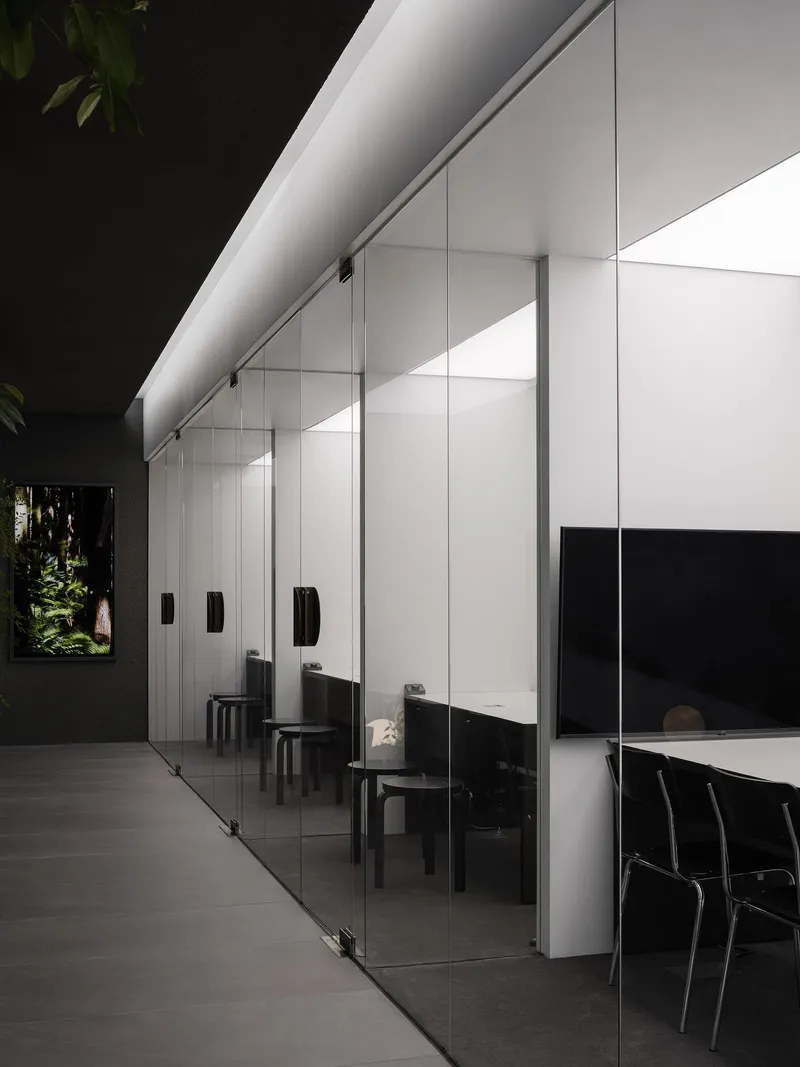
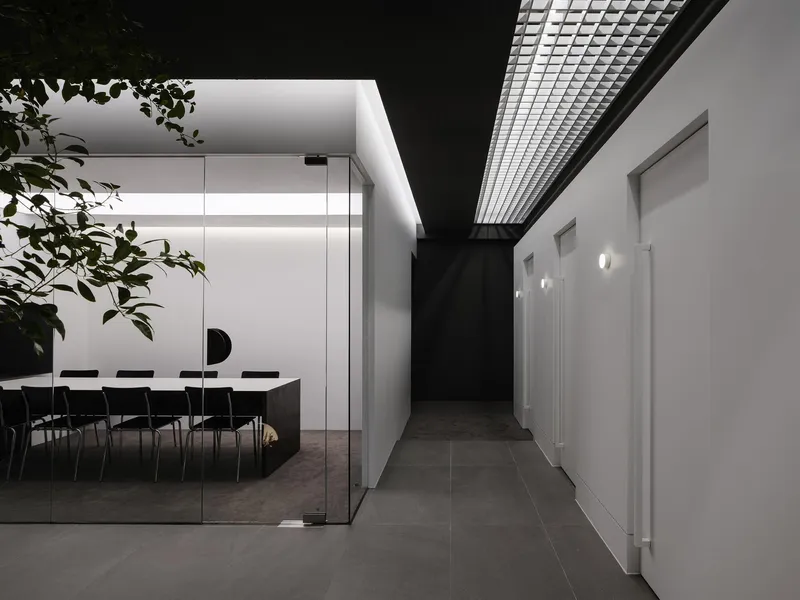
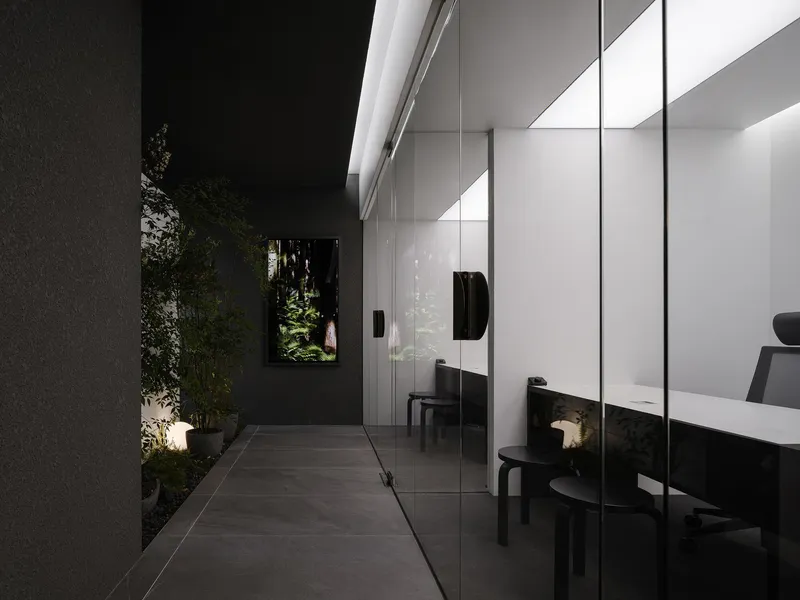
Circulation here is not just a way to get from entrance to pod. The corridors are lined floor to ceiling with black-framed glass, so every journey through the building offers lateral views into courtyards, meeting rooms, or the street outside. At night, the glazed walls become reflective, doubling the perceived depth of narrow passages. The continuous perimeter lighting of the conference room volume glows against the evening sky like a lantern, visible from the approach.
There is a deliberate legibility to the circulation: you can read the entire program without consulting signage. Transparent partitions reveal whether a meeting room is occupied, planted beds signal decompression zones, and the shift from white soffit to metal mesh overhead marks the threshold between functional and contemplative territory. For a building that serves anonymous, rotating users, this kind of spatial literacy is essential.
The Individual Pod as Acoustic Capsule
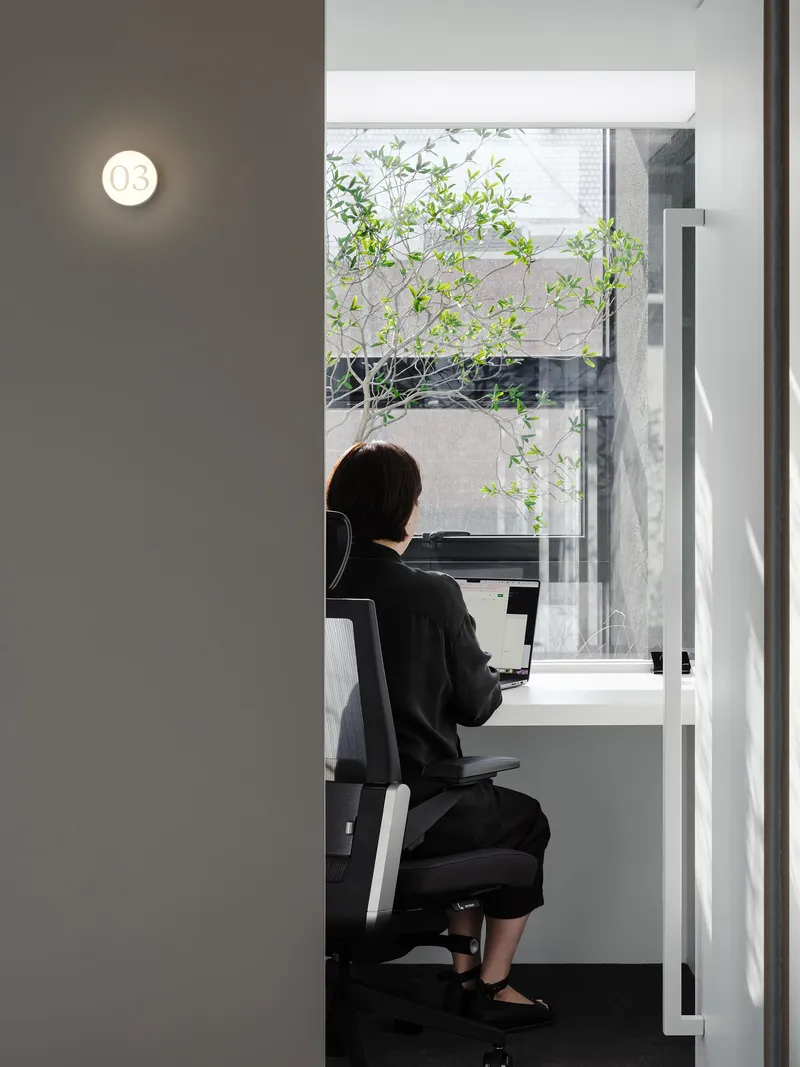
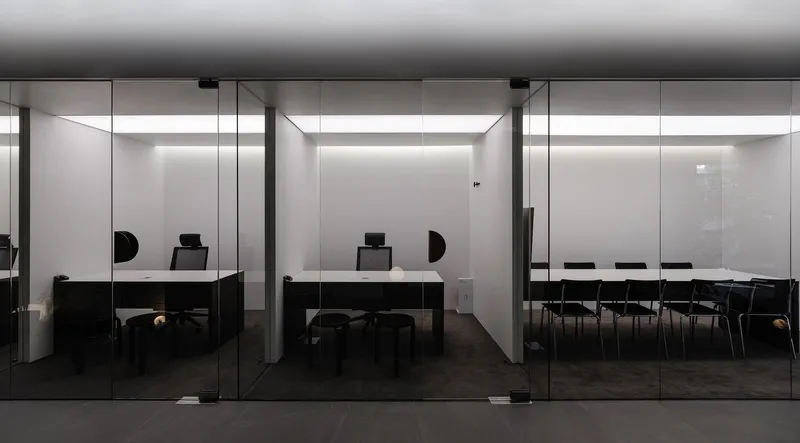
Each one-person work pod sits behind double-layer walls and ceilings, creating an envelope within an envelope. The strategy borrows from recording studio construction: an inner shell floats inside an outer one, and the air gap between them absorbs sound transmission. For a space that might host a video conference in one pod and silent deep work in the next, the acoustic separation is not a luxury but the fundamental requirement that makes the entire program viable.
Inside, the pods are deliberately restrained. A white desk, a chair, a window framing a green tree. There is no branded signage, no novelty furniture, nothing that dates the space to a particular corporate moment. The restraint is strategic: because Zigbang's metaverse platform provides the visual identity, the physical room only needs to provide comfort, silence, and access to fresh air. It is infrastructure, not expression.
Meeting Rooms and Hidden Rest

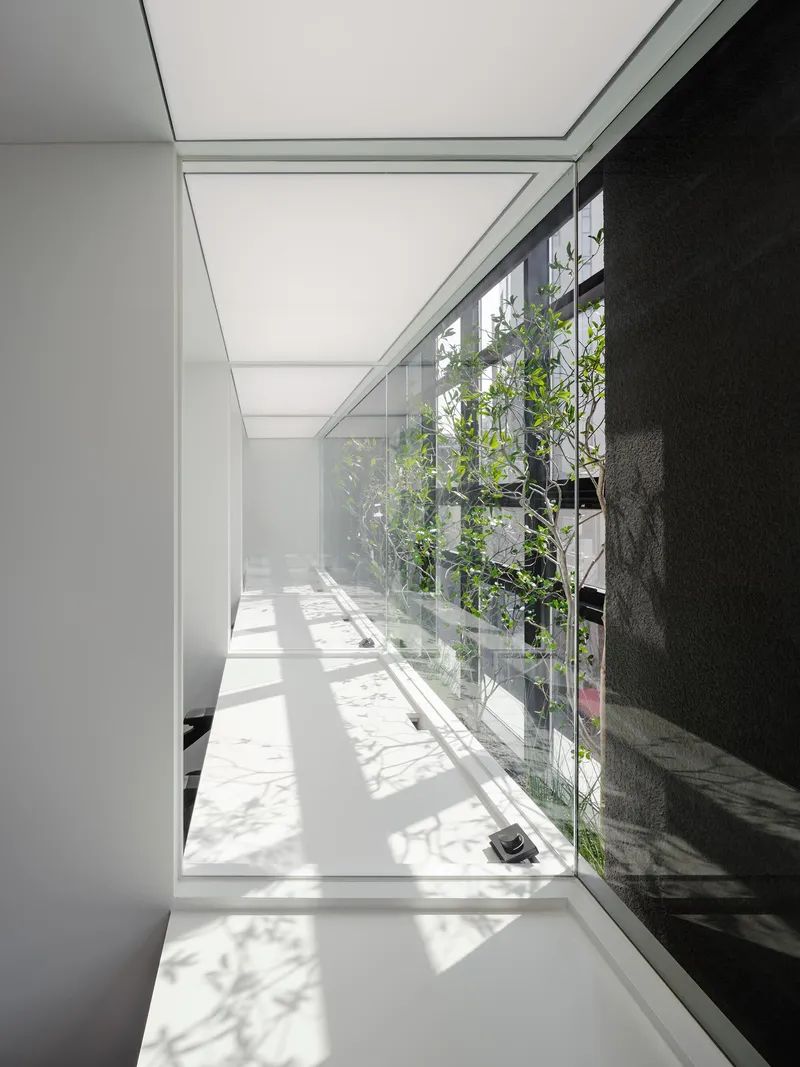
The program includes open meeting spaces and hidden rest areas alongside the individual pods. The meeting rooms sit inside glass-enclosed volumes that glow at night, their transparency serving a functional purpose: in a 24-hour building without a receptionist, visual openness substitutes for social oversight. You can see who is inside before you enter. The hidden rest zones work on the opposite principle, tucked away from sightlines so that a fatigued worker can decompress without performing relaxation for an audience.
The planted beds along the perimeter windows soften the boundary between interior and street. Potted trees and grasses sit in front of black-framed glass, creating a layered screen that gives privacy without blocking daylight. From the street, the building reads as inhabited greenery; from inside, the city becomes a backdrop filtered through leaves.
Plans and Drawings
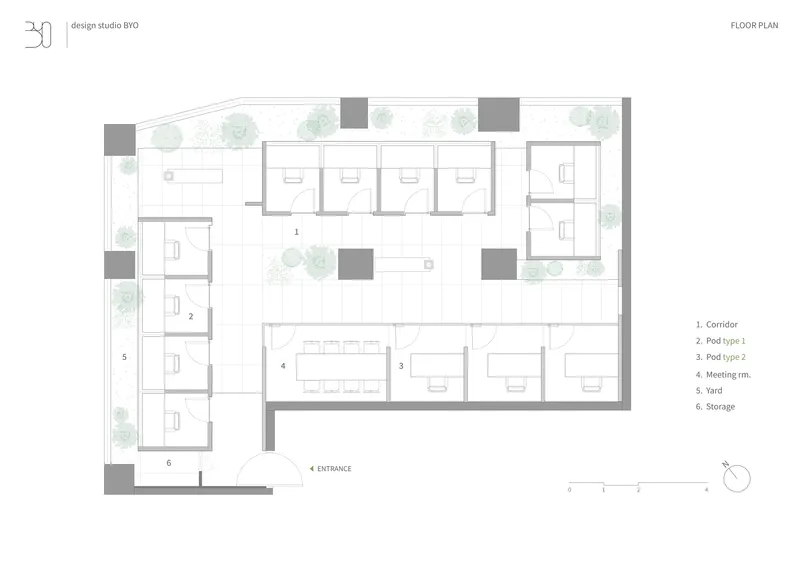
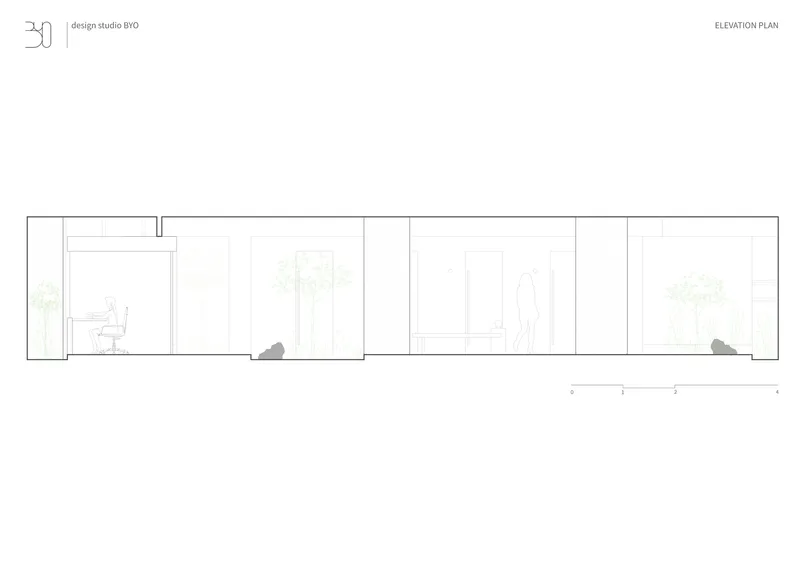

The floor plan confirms what the photographs suggest: the pods are arranged around a central meeting area with planted courtyards acting as interstitial separators. The plan is almost centripetal, pulling individual cells toward a shared green core rather than stringing them along a double-loaded corridor. The elevation drawing shows how the transparent partitions maintain visual continuity at the human scale, while the section reveals the planted atrium as a full-height void that brings daylight deep into the building's center. Together, the drawings make clear that the greenery is not decoration layered on after the spatial logic was set; it is the spatial logic.
Why This Project Matters
The pandemic rewired the relationship between offices and the people who use them. Most architectural responses have focused on making existing offices more flexible or more hygienic. Design Studio BYO takes a different position entirely: rather than retrofitting the conventional workplace, it builds a new typology from scratch, one calibrated for solitary, transient, self-directed use. The Metaverse Workpod is closer to a hotel than an office, closer to a library than a coworking space. It assumes that the user already has a workplace (a virtual one) and only needs a physical room that does three things well: block noise, supply air, and let light in.
What elevates the project beyond a competent technical exercise is the insistence on landscape as structure. The planted atriums are not wellness amenities bolted onto a floor plate; they are the plan's organizing geometry, its wayfinding system, and its primary source of daylight. In a building that could easily have been a grid of soundproofed boxes, the courtyards make the difference between architecture and infrastructure. They give the Metaverse Workpod something its virtual counterpart can never offer: the slow, unpredictable presence of living things.
Metaverse Workpod (SOMAPOD) by Design Studio BYO, Jung-gu, Seoul, South Korea, 2022. Photography by Kang MinGu.
About the Studio
Share Your Own Work on uni.xyz
If projects like this are the kind of work you want to make, uni.xyz is a place to publish your own, find collaborators, and enter design competitions.


Popular Articles
Popular articles from the community


Juan García Correa, John González and Claudia Rueda Sink a Circular Amphitheater into a Manizales Engineering Building
On the La Nubia campus in Manizales, Colombia, the S1 Building folds labs and offices into a hillside of ramped lawns that double as a campus route.

longwave studio Reorganizes a 112 m² Tainan Apartment Around the Daily Routines of a Family and Two Cats
In Tainan, Taiwan, birch plywood, rust-red furniture and a freestanding plaster wall link arrival, storage, work and family life in one apartment.

Cube Design Draws an Ecological Corridor Between Two Shenzhen Hills with the Nankai Building
Beside Shenzhen's container docks, the Nankai Building pairs stacked balconies with a climbing green screen to connect two hillsides across its height.

Architekt Andreas Gruber Scatters 23 Dark Timber Chalets Across a South Tyrolean Forest Edge
In Molini di Tures, Amonti Chalets breaks a resort into a hamlet of gabled timber houses, with parking, storage and services pushed into the slope.

Similar Reads
You might also enjoy these articles


LAVA Architecten Gives Vocational Education a Sawtooth-Roofed Face on a Mechelen School Campus
In Mechelen, Belgium, a 2,053 m² STEM school on a 6×6 m grid turns workshops and classrooms into rooms that can be rearranged as teaching changes.

KEMA Studio Turns a Derelict Marvila Attic into a 60 m² Lighthouse Apartment Above Lisbon
In Lisbon's Marvila district, a rebuilt roof, four skylights and two plywood volumes turn an unlivable attic into a bright home facing the Tagus.

Pixel Gardens: One Repeated Module Stacked Into a Terraced Social Housing Tower for Famagusta
Salem Bader's shortlisted housing tower builds a vertical neighbourhood from one repeated module, offsetting units to carve terraces, light and air.

Bao Huynh Watercolor Atelier: A Serene Art Retreat in Hội An
Bao Huynh Watercolor Atelier in Hội An blends multifunctional art spaces, sustainable design, local materials, and family-friendly living in a serene environment.

Explore Futuristic Workspaces Competitions
Discover active competitions in this discipline

Design challenge to equip cities with modern furniture

Competition to design a workstation for architects
Comments (0)
Please login or sign up to add comments
No comments yet. Be the first to comment!