

Grass+Batz Arquitectos Builds Latin America's First Memorial for People Who Died on the Streets
An abandoned elevated structure in Santiago's largest cemetery becomes a 270 m² mausoleum honoring the city's unhoused dead.


There is no polite way to say this: when unhoused people die in Santiago de Chile, their remains have historically had nowhere dignified to go. The Dignity Memorial Mausoleum, a collaboration between Grass+Batz Arquitectos and Fundación Gente de la Calle, is the first project in Latin America to address that absence directly. Completed in 2022 inside the Santiago General Cemetery in Recoleta, it provides 372 funerary units for people who spent their final years living on the streets, and it does so without acquiring a single square meter of new land.
The move that makes the project possible is also the move that makes it architecturally compelling. Rather than negotiate for a conventional plot, the architects proposed building on top of an abandoned elevated structure along the cemetery's northwest edge, a concrete artifact from the 1970s that had sat deteriorating for decades. The cemetery granted a 40-year loan, the first such agreement in its 200-year history. The result is a 270 m² memorial that rehabilitates forgotten infrastructure, sidesteps land costs entirely, and turns a ruin into something the city genuinely needed.
Building on What Was Already There
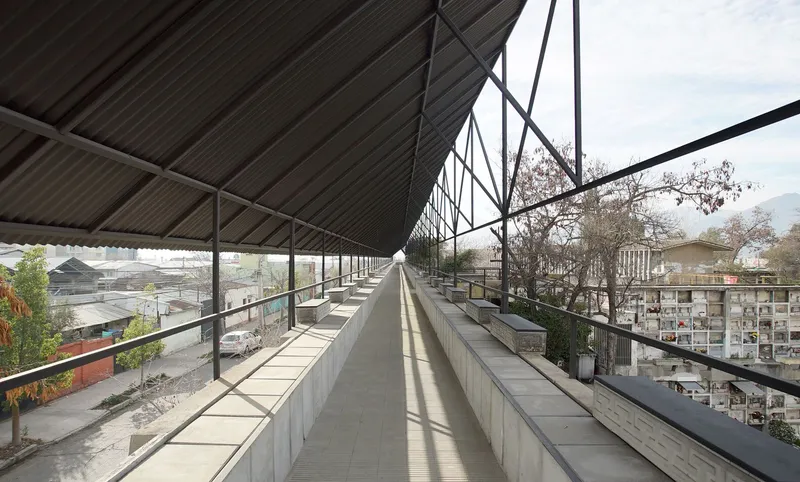

The 100-meter-long elevated structure was in bad shape when the architects found it. Two access points had to be reconstructed so people could ascend to the platform at all. But the bones were solid enough to carry a new program, and crucially, building atop an existing structure meant no existing graves below had to be disturbed or demolished. The design threads itself through these constraints with precision: new elements sit on top of, or alongside, old concrete without contradicting it.
From the elevated platform, visitors look out over the urban horizon of Santiago. The siting is deliberate. The cemetery's northwest boundary faces the city, and the memorial positions its occupants at the threshold between the necropolis and the metropolis they once inhabited. There is a pointed metaphor in that orientation, but it works spatially too. The open edge floods the interior with light and air, while the cemetery wall at the back provides a solid anchor.
A Roof That Does the Work
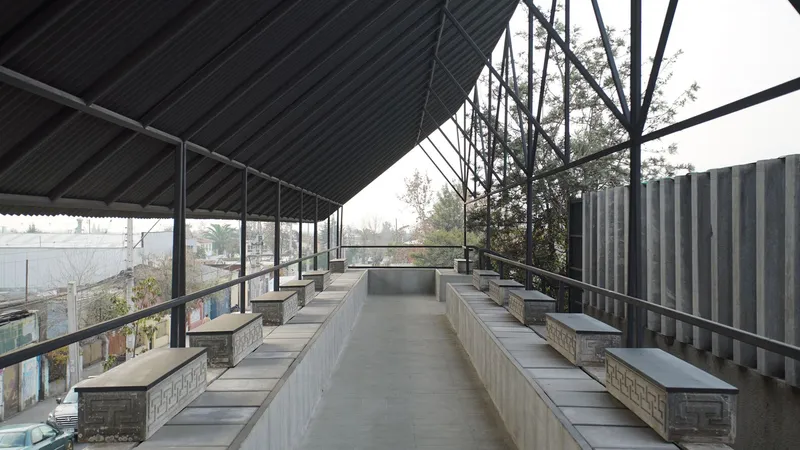
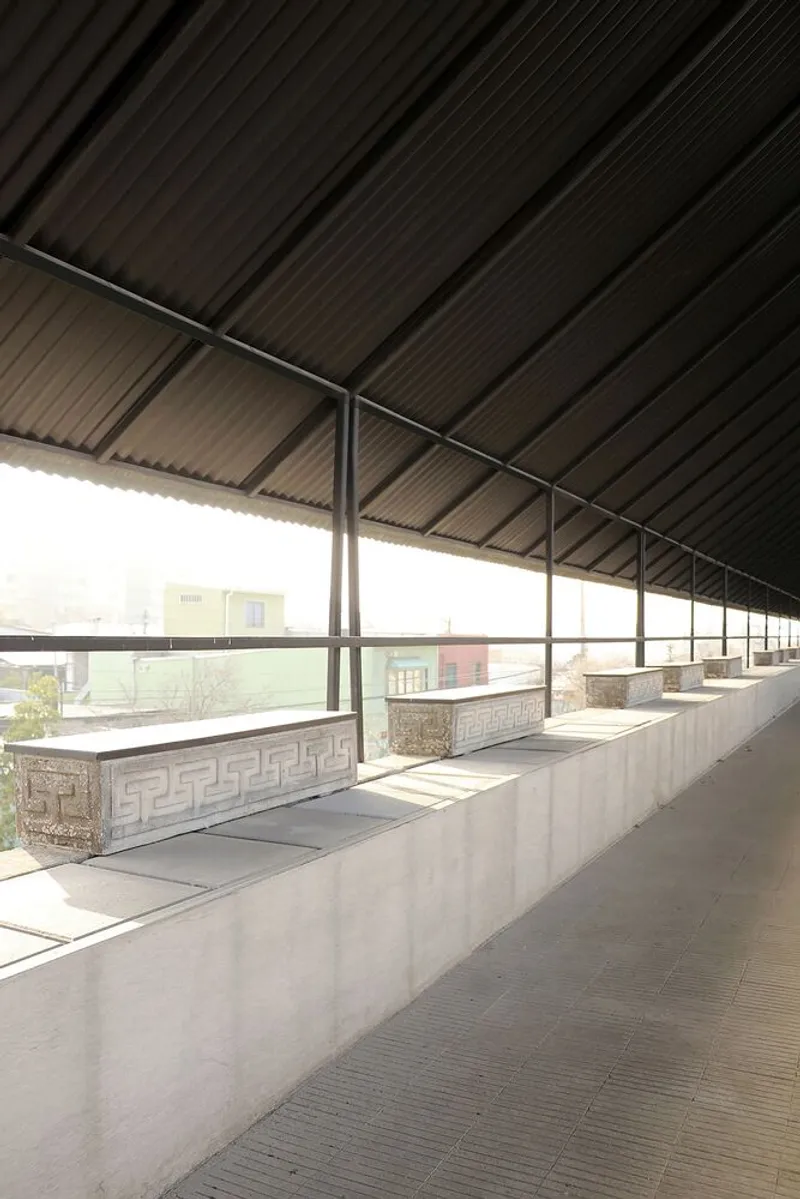
The primary architectural intervention is a lightweight black canopy of corrugated galvanized aluminum supported by a steel truss system built from 40x40x3mm sections. It is deliberately ordinary in its materials and construction methods, a decision rooted in budget reality but one that also resonates with the project's ethos. The people memorialized here lived under improvised shelters, overpasses, and awnings. Giving them a roof made from standard construction materials honors that experience without romanticizing it.
The black color is not decorative. It signals mourning and creates a stark tonal contrast against the weathered concrete and pale columbarium niches below. Practically, the roof provides essential shade in a climate where direct sun would make the space unusable for contemplation. The trusses are left exposed, their geometry visible beneath the corrugated skin, lending a structural honesty that suits a project where every decision had to justify its cost.
Graves That Double as Benches
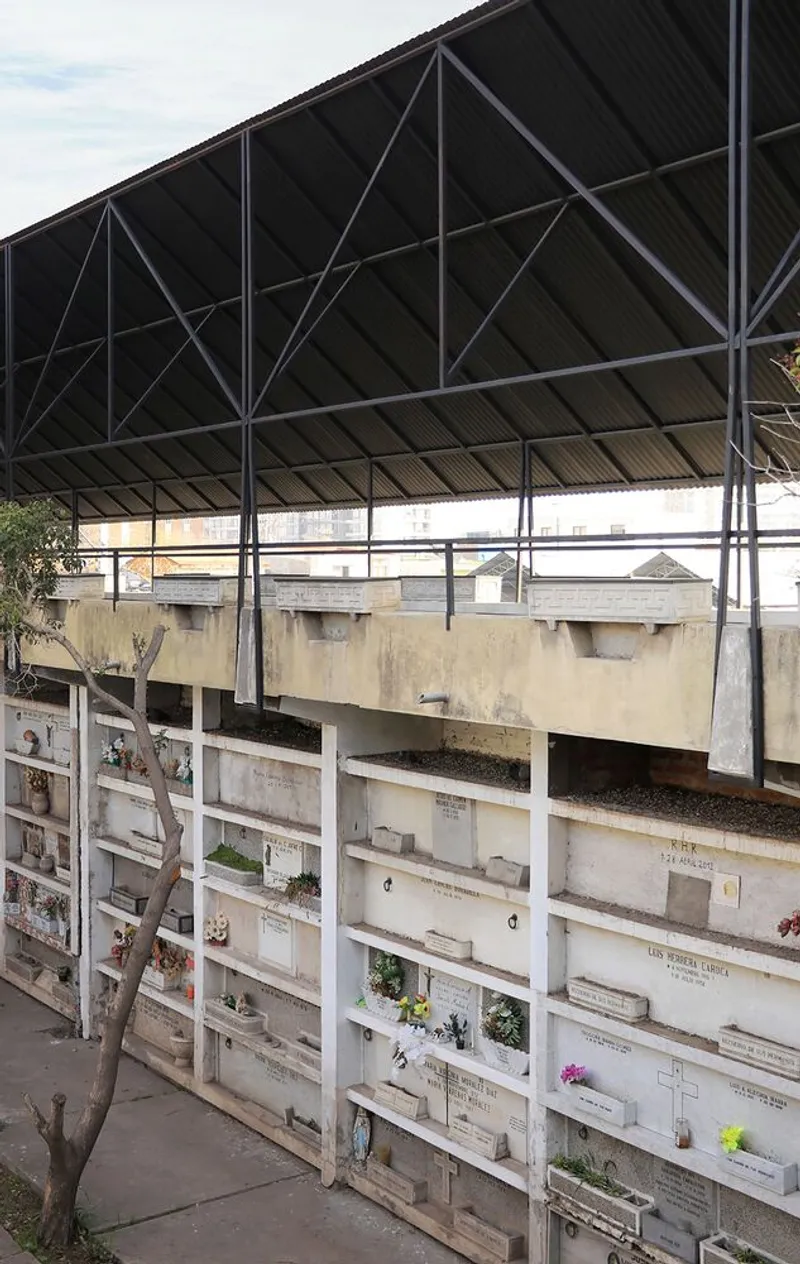
The spatial layout is disarmingly simple: two parallel rows of columbaria face each other along the length of the platform, and each row is shaped to function simultaneously as a bench. Visitors sit among the dead, not in front of them. The arrangement eliminates the typical hierarchy of a memorial visit, where the living stand and gaze at a wall of names. Here, mourning is closer to resting, which feels appropriate for a place dedicated to people who were denied rest in life.
The concrete surfaces of the benches bear decorative carved panels, small moments of craft that individualize what could otherwise be an anonymous sequence of niches. Memorial plaques mark each unit. With 372 available spaces, the mausoleum is sized to serve its community for years, and the linear arrangement means future expansion along the existing elevated structure remains possible without altering the design logic.
Space for the Living, Too
One detail that speaks volumes about the architects' sensitivity: beneath one of the reconstructed staircases, an enclosed space was designed for the informal cemetery workers who maintain the grounds. These workers, often invisible in the cemetery's daily operations, now have a room of their own within the memorial's footprint. It is a small gesture in square meters but a significant one in intent, extending the project's ethic of dignity beyond its primary program.
The mausoleum functions not only as a funerary space but as a public amenity within the cemetery. The bench-grave hybrid invites lingering. The shaded canopy makes the platform comfortable in heat. The elevated vantage point offers a perspective on Santiago that most cemetery visitors never see. The project quietly argues that a memorial for marginalized people does not need to be marginal itself.
Plans and Drawings
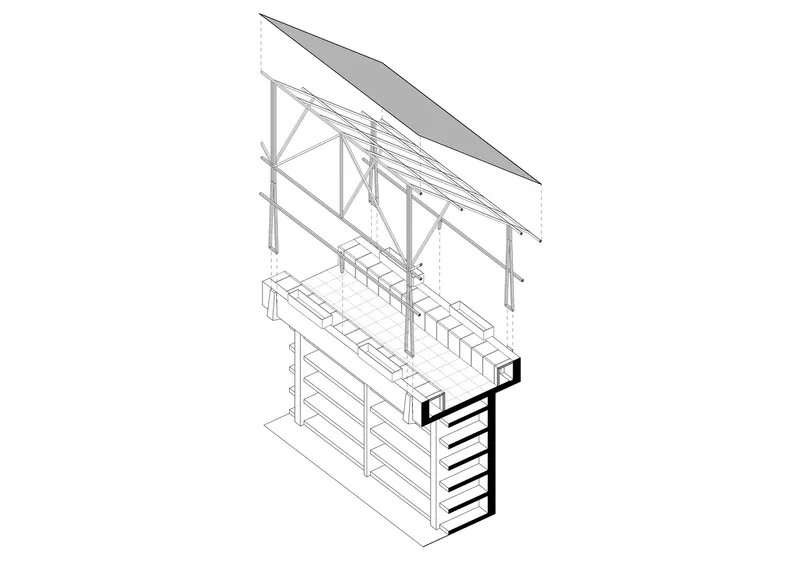
The axonometric drawing reveals the project's layered logic with clarity. At the bottom sits the existing 1970s elevated structure with its columbarium niches. Above that, the new concrete seating terraces slot into place, their geometry following the original footprint. The steel truss canopy crowns the assembly, its form distinct from the concrete below but aligned to it. The drawing makes visible what the photographs imply: this is a project of careful addition, where each new layer respects the one beneath it and none of them could stand alone.
Why This Project Matters
Architecture for the dead is often architecture for the wealthy. Mausoleums, crypts, and memorial parks cater to families who can afford permanence. The Dignity Memorial Mausoleum inverts that equation entirely. By building on abandoned infrastructure with ordinary materials and zero land cost, Grass+Batz Arquitectos and Fundación Gente de la Calle prove that dignified funerary architecture does not require extraordinary budgets. It requires extraordinary will and a willingness to see value in what others have discarded.
The project also reframes what cemetery architecture can do for a city. It rehabilitates a decaying structure, provides a social service that no one else was providing, creates a contemplative public space, and makes visible a population that urban life systematically renders invisible. In 270 square meters, it accomplishes more social architecture than many projects ten times its size. That it is the first of its kind in Latin America is not a point of pride. It is an indictment of how long it took.
Dignity Memorial Mausoleum by Grass+Batz Arquitectos in collaboration with Fundación Gente de la Calle. Recoleta, Chile. 270 m². Completed 2022. Photography by Grass+Batz Arquitectos and José Hassi.
About the Studio
Share Your Own Work on uni.xyz
If projects like this are the kind of work you want to make, uni.xyz is a place to publish your own, find collaborators, and enter design competitions.




Popular Articles
Popular articles from the community

EW PARK: Sustainable Architecture Reimagines the Future of Urban Parking
EW PARK reimagines city parking as a modular wooden tower combining automation, solar energy, electric mobility, and adaptable urban design.

Riyadh For All: Intergenerational Urban Design for Active Aging in Rabat
Riyadh For All reimagines urban design in Rabat with intergenerational co-living, adaptive courtyards, and Moroccan cultural exchange today.

The Musturak Paradise: Senior Living Architecture for a Connected Future in Temara, Morocco
The Musturak Paradise reimagines senior living architecture in Temara via private homes, social spaces, culture, community, and shared care.

Co-life: Sustainable Architecture for Age-Friendly Community Living
Co-life reimagines sustainable architecture for seniors through courtyards, rammed earth, shared gardens, and spaces designed for belonging.


Similar Reads
You might also enjoy these articles


Hodi-Mandai Geram
Project Function: Preservation and revitalization of the Intangible heritage and socio-spatial identity of the Hodi by Housing, Cultural Memory Center, Sacred Grove, landscape, local tourism economy


Olio Towers: A Mid-Rise for Performers That Fuses Housing, Rehearsal, and Stage
Located blocks from Houston's Theater District, this modular tower stacks living units around a central performance atrium.

Oasis: Modular Green Housing Carved into Dhaka's Urban Fabric
A shortlisted Plugin Housing entry reclaims unauthorized settlements in Dhaka with stepped concrete volumes, green roofs, and ventilation-driven design.

Black Hole: A Floating Megastructure for the Post-Physical Era
Emiliano Mazzarotto envisions a spherical, self-scaling arena where e-sports, digital hotels, and holographic stadiums replace traditional public space.


Explore Memorial Design Competitions
Discover active competitions in this discipline



Challenge to reimagine the Iron Throne


Photograph architecture without architects


Illustrate the lost glory of Angkor Wat - Render Challenge


Design challenge to reuse E-waste
Comments (0)
Please login or sign up to add comments
No comments yet. Be the first to comment!