

Documentation Work on Buddhist Wooden Temple
Architectural syncretism and cultural hybridity: A comparative study of the Buddhist temples in Chattogram Hill tracks

The architecture of the Buddhist temples in the Chattogram hill tracks presents a unique amalgam of Arakanese architectural influence and endogenous craftsmanship and vernacular practices of South-east Bengal. This syncretism occurred due to a long history of migration and trade, ethno-cultural exchange, and shared cultural and religious heritage between the indigenous communities of Chittagong hill tracks, such as the Chakma and Marma people, and the People of Myanmar’s Rakhine state, formerly known as Arakan. The temples not only depict the shared identity and stories of these people but also stand as significant examples of cultural hybridity that has been thoughtfully adapted to the distinct context and topography of the hill tracks. Distinguished by use of building materials, spatial organization, and formal outlook, the architecture of these temples has been less focused, less researched, and less discussed in the academic fields of architecture, heritage studies, and archaeology. This paper identifies this gap and conducts an architectural documentation of some of these temples in Chattogram hill tracks, presenting a comparative analysis of the influence of Arakanese architectural features and local adaptations in them. The study also conducted a conditional assessment of these structures and sheds light on the neglected built heritage of the South-eastern hilly regions of Bengal.


Popular Articles
Popular articles from the community


Riyadh For All: Intergenerational Urban Design for Active Aging in Rabat
Riyadh For All reimagines urban design in Rabat with intergenerational co-living, adaptive courtyards, and Moroccan cultural exchange today.

Play: Fragments of Their World
Familiar architecture becomes modular playground design, creating safe spaces where displaced children can learn, connect, imagine and play.

The Musturak Paradise: Senior Living Architecture for a Connected Future in Temara, Morocco
The Musturak Paradise reimagines senior living architecture in Temara via private homes, social spaces, culture, community, and shared care.

Lunar Spiral: Space Architecture Shaped by the Mathematics of the Universe
Lunar Spiral reimagines space architecture through Fibonacci geometry, lunar regolith, levitating habitats, and self-sustaining Moon living.

Similar Reads
You might also enjoy these articles

Day and Night Park: A Time-Based Urban Newsstand in Beijing
A temporary urban newsstand in Beijing blending travel, light, and reading through poetic colors, compact form, and community-focused design.

Modernist Patio Renovation in El Masnou, Barcelona by Oliver Segura Arquitectura + Cebrià Arquitectura
Modernist patio renovation blending tradition and innovation with a movable pool, leveled floors, and Catalan materials in El Masnou.

Alto Residencial Coop: Cooperative Housing Development in Santiago de Compostela by Carbajo Barrios Arquitectos
A linear cooperative housing complex blending white volumes and perforated metal façades, enhancing community living, natural light, privacy, and urban integration.
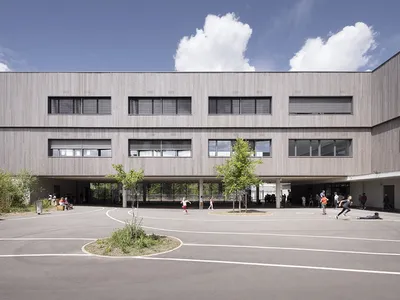
Vil Genis School by BPA ARCHITECTURE – Massy, France
Vil Genis School in Massy, France, features sustainable design, south-facing classrooms, community integration, accessible spaces, and modern educational architecture.


Comments (0)
Please login or sign up to add comments
No comments yet. Be the first to comment!