
DOMANI Wraps 1950s Guangzhou Granaries in Steel and Glass to Build a Riverside Exhibition Center
Four brick warehouses on the Pearl River's west bank get new rooftops and a second life as a 5,000 m² public exhibition hall.


Guangzhou's west bank of the Pearl River was once defined by grain. In the 1950s, four brick warehouses lined the waterfront as the city's most important granary, storing staples for a rapidly growing metropolis. By the time DOMANI and lead architect Ann Yu arrived, the buildings had long lost their original function, sitting as fragmented relics in a traditional industrial district now earmarked for renewal. The commission, the first phase of a city government master plan, asked a pointed question: how do you turn storage sheds into a civic destination without erasing the memory they hold?
The answer is not demolition and not preservation in amber, but something more painterly. DOMANI describes the concept as "restoration of the old as a painting," a phrase that captures the project's central tension. The original brick walls, roof slopes, and warehouse proportions remain legible, but new steel and glass roof structures hover above them, reframing each building as an exhibit of its own past while creating a coherent 5,000 m² exhibition center and activity hub. The result feels simultaneously ancient and provisional, a granary that now stores ideas.
Old Brick, New Canopy

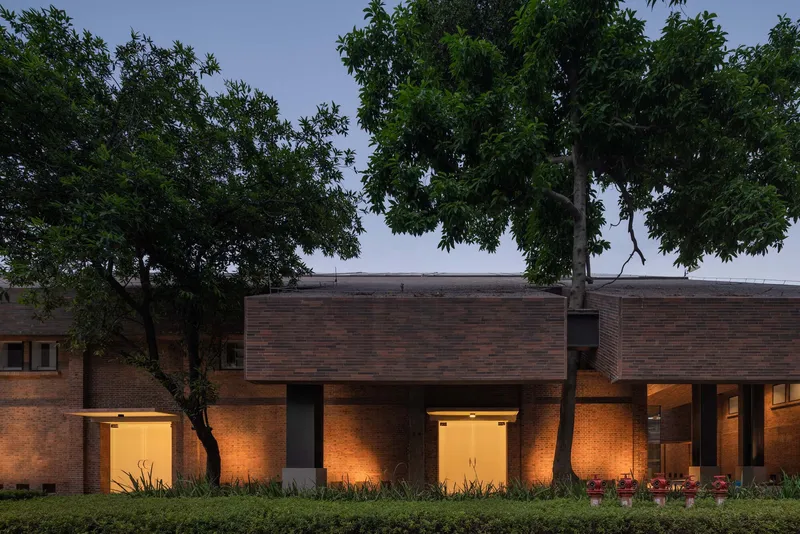
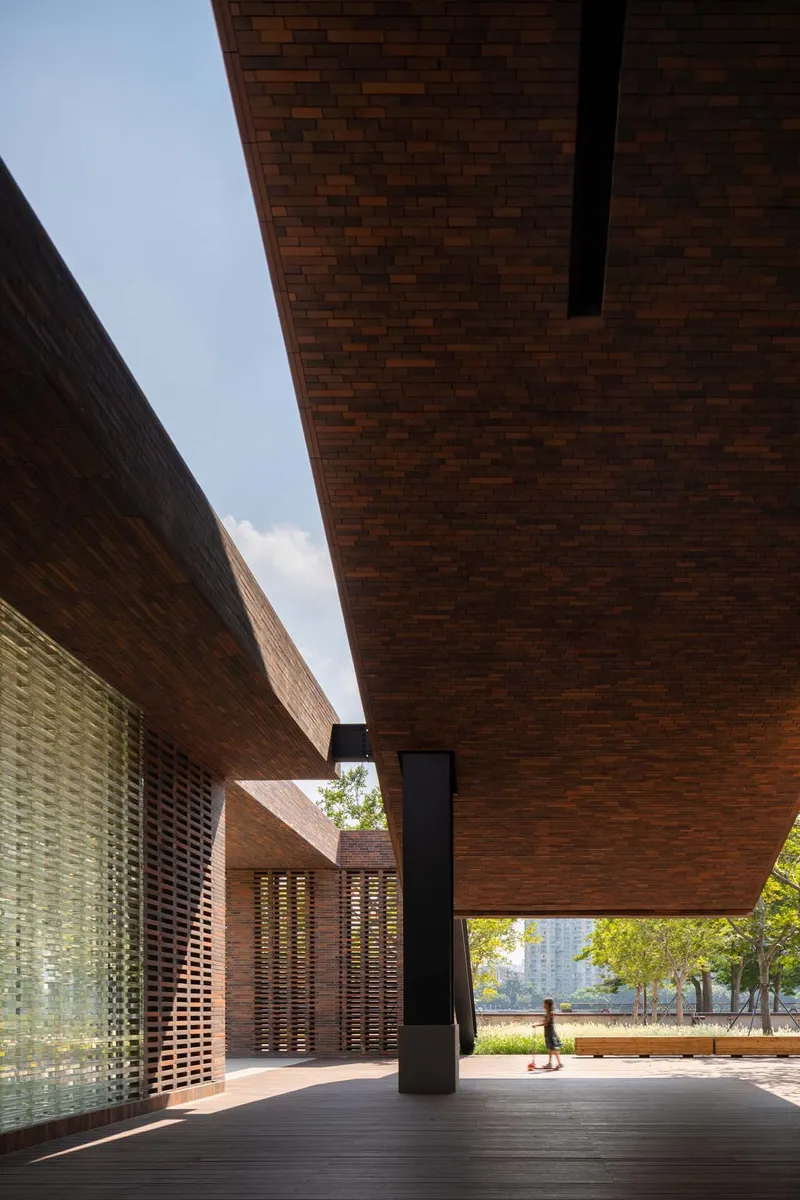
The four warehouses are oriented east-west along the riverbank, a layout dictated by logistics rather than landscape. DOMANI kept that alignment intact, retaining the structures and materials of each building to the greatest extent possible. The original red brick is left exposed, its variegated tones a record of age and weather. Where new construction was required, replica industrial red brick was used, close enough in character to read as continuous but never trying to deceive. The honesty is quiet but consistent.
Walk between the buildings and you move through covered passages framed by brick walls and black steel columns. The colonnade effect borrows from the warehouse's original rhythm of structural bays, but the addition of timber soffits and planted beds transforms what were service corridors into genuinely pleasant public pathways. The mature trees that survived the renovation anchor the composition, making the architecture feel like an insertion into a landscape rather than a replacement of one.
The Steel Horizon
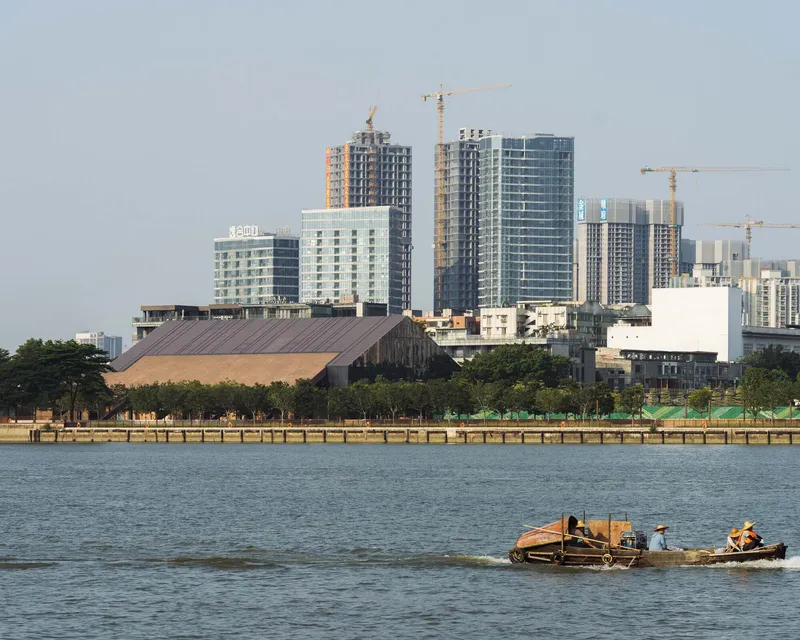
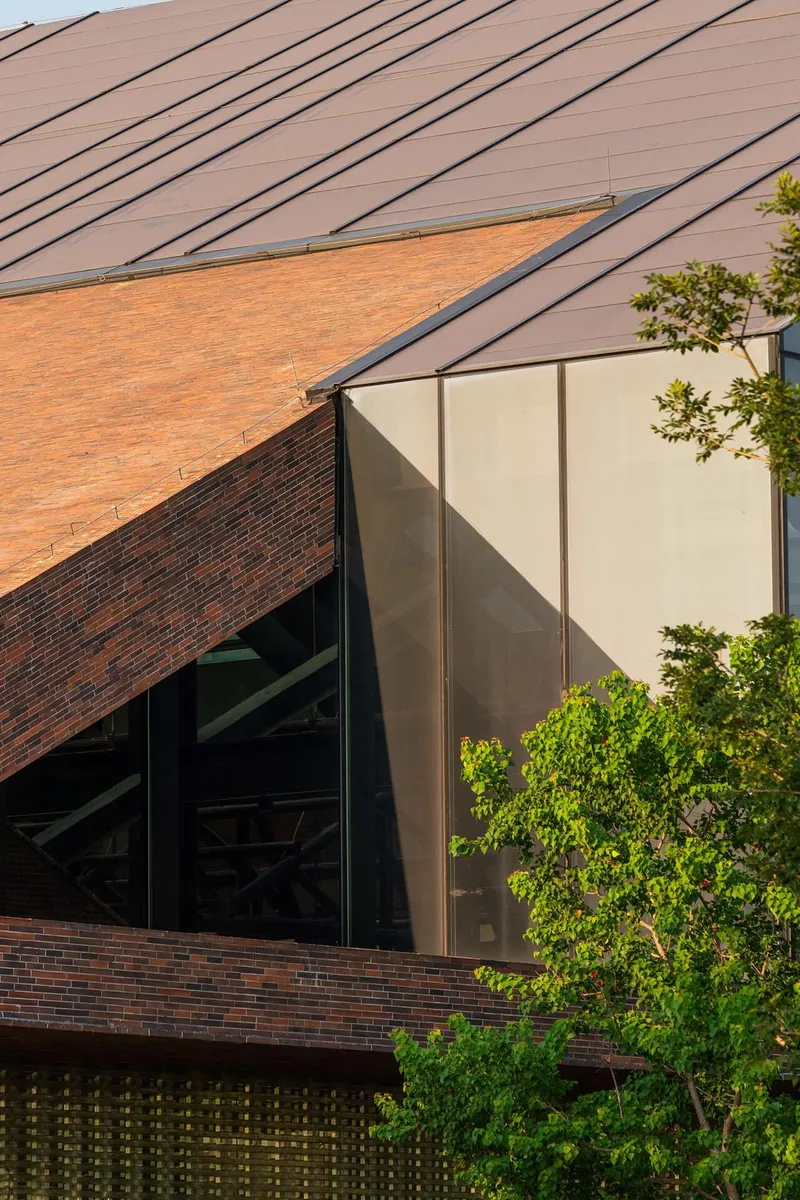
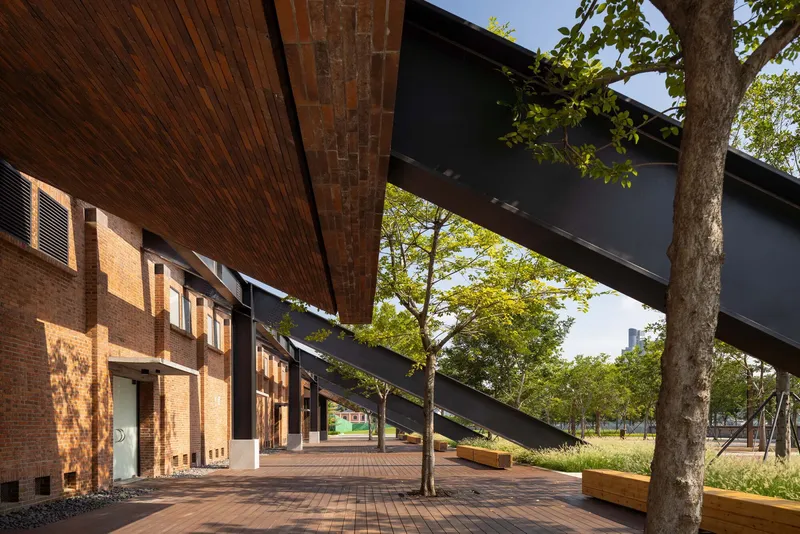
The most visually striking move is the steel and glass roof structure that stretches horizontally across three of the four warehouses. These new canopies follow the sloping angle of the original rooflines, so the silhouette of the granary persists even as the materiality shifts from tile and timber to metal seam and glazed panels. From across the river, the roofs read as a low, continuous datum against the vertical eruption of high-rise towers under construction behind them. The contrast is stark and probably intentional: the old city lies down while the new one stands up.
On the west-facing river side, the roof extends beyond the brick walls to form a semi-sheltered zone, a covered outdoor space that mediates between interior galleries and the waterfront leisure area. It is a simple gesture with outsized effect, turning the building's edge into a threshold rather than a boundary. The triangular profile of the canopy, which DOMANI links symbolically to the government-backed development of the west bank, also functions pragmatically, shedding rain while admitting light through glazed corners and skylights.
Interior as Archaeology
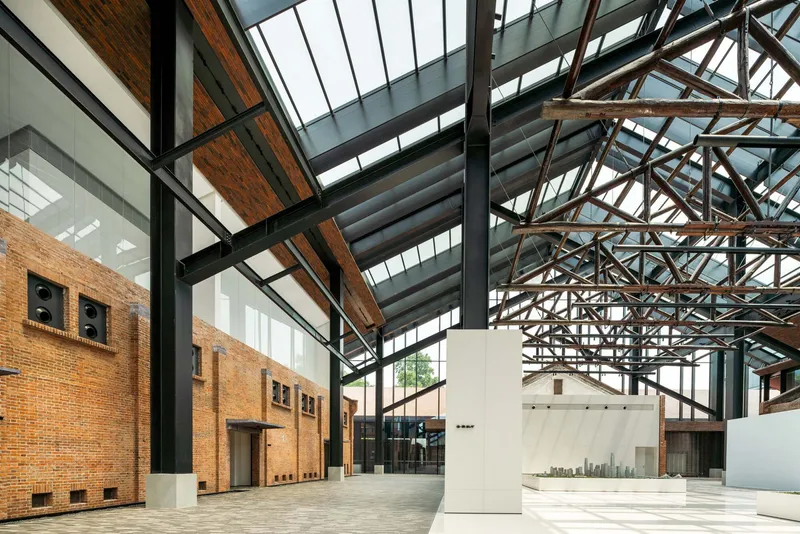

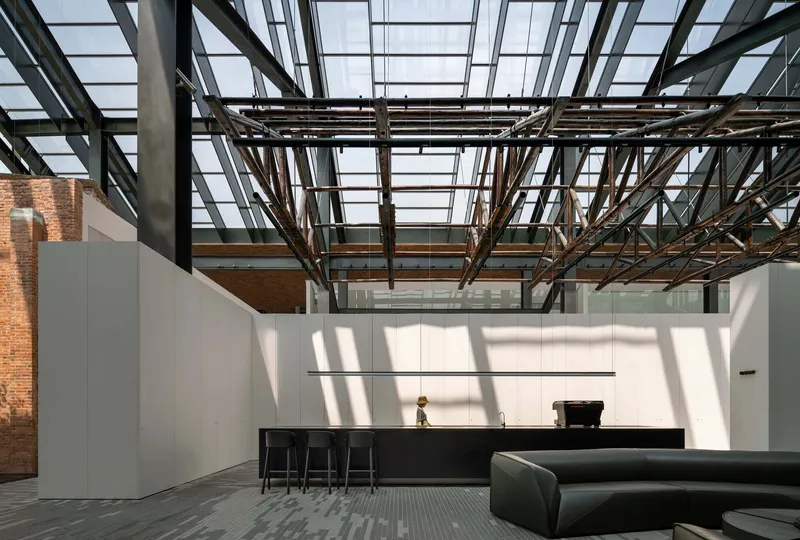
Inside, the strategy is additive rather than subtractive. Original brick walls are retained and punctuated with new steel-framed openings, creating a layered reading of old and new structure that rewards close inspection. The exposed steel trusses overhead carry glazed roof panels that wash the brick in daylight, turning grain warehouse walls into gallery backdrops. White display plinths and exhibition walls are inserted as freestanding elements, clearly distinct from the host structure. Nothing pretends to be original that isn't.
The geometric shadows cast by the truss work onto the white walls below are one of the project's most compelling visual features. They shift through the day, marking time in a building that was once about storing surplus against it. The interplay between the heavy, opaque brick base and the transparent, lightweight roof creates a section that is legible even from inside: you feel the granary's mass and the new intervention's lightness simultaneously.
Gallery Spaces and Flexible Program
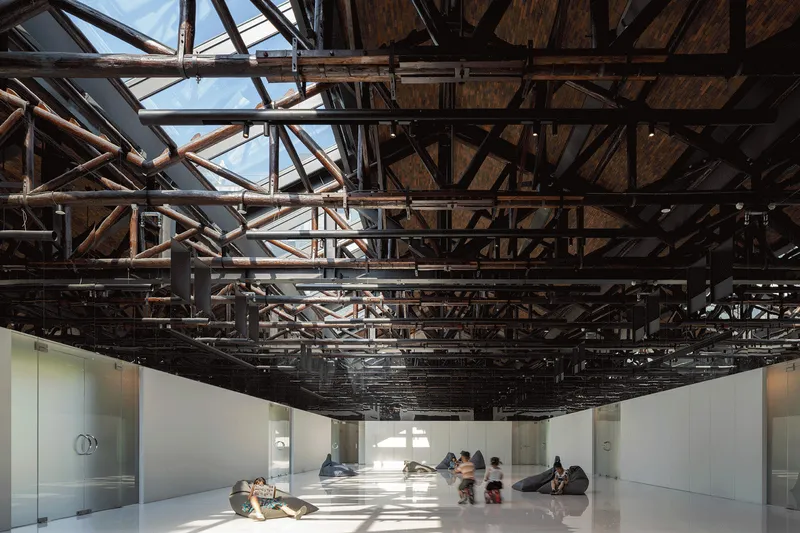
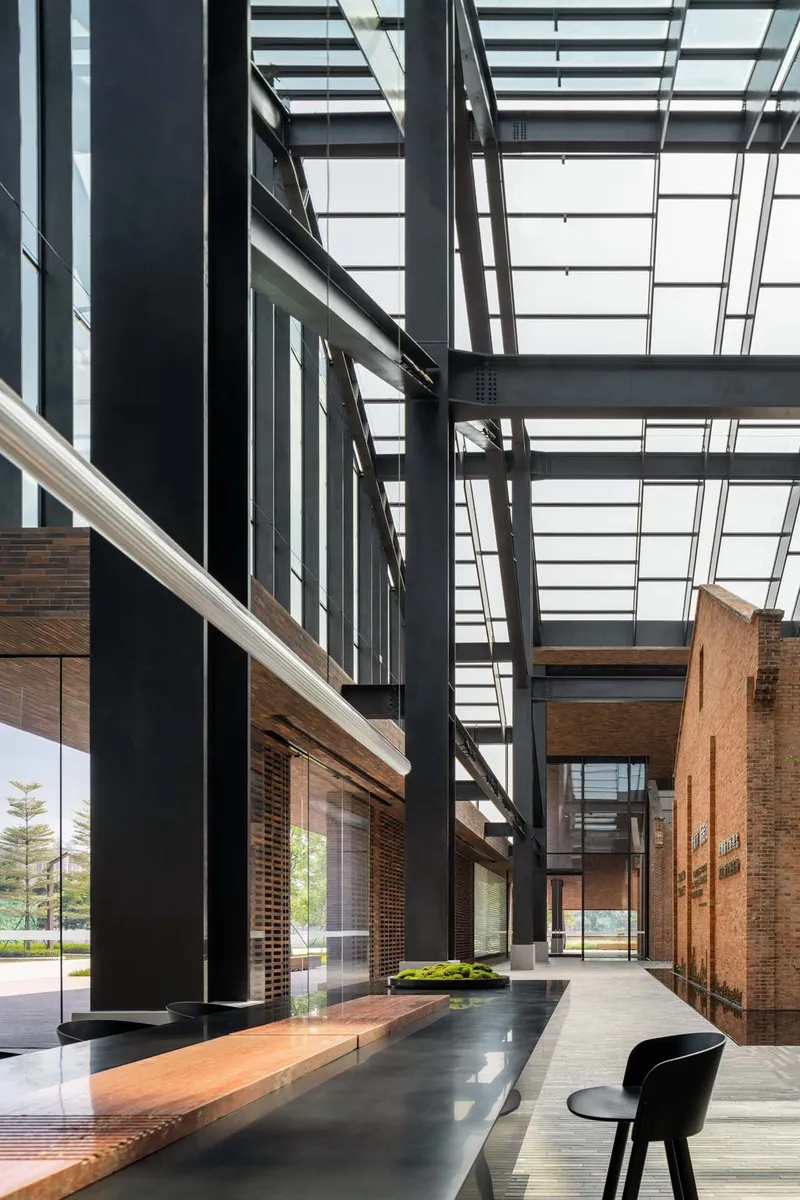
The renovated complex operates as both an urban planning exhibition hall and a multi-functional activity center, a dual program that demands spatial flexibility. The original warehouses had low connectivity between them, essentially four independent sheds. By adding the steel roof structures and reworking circulation, DOMANI integrated these fragments into a coherent sequence of rooms and corridors. The gallery halls are generous in volume, with exposed timber and steel truss ceilings high enough to accommodate large-scale installations.
An atrium corridor running through one of the buildings offers a quieter register: black steel columns, a glazed roof, timber benches, and planted beds create a space that functions as a rest point, a transition zone, and a piece of landscape architecture all at once. The project's SITES Platinum Award, earned in part through a landscape collaboration with SASAKI, reflects the care given to these interstitial moments. The landscaping is not decoration applied after the fact but an integral layer of the spatial strategy.
Riverfront Presence
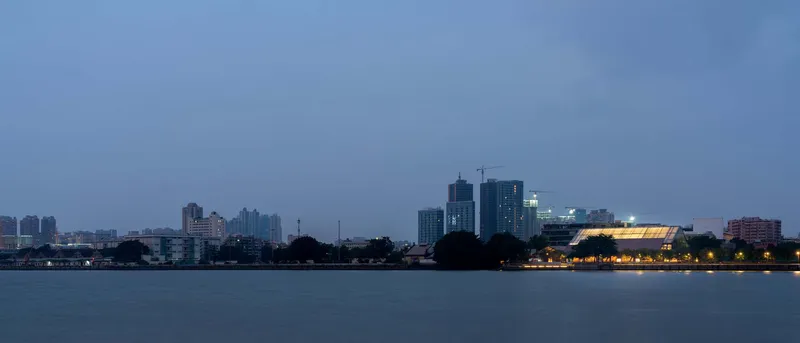
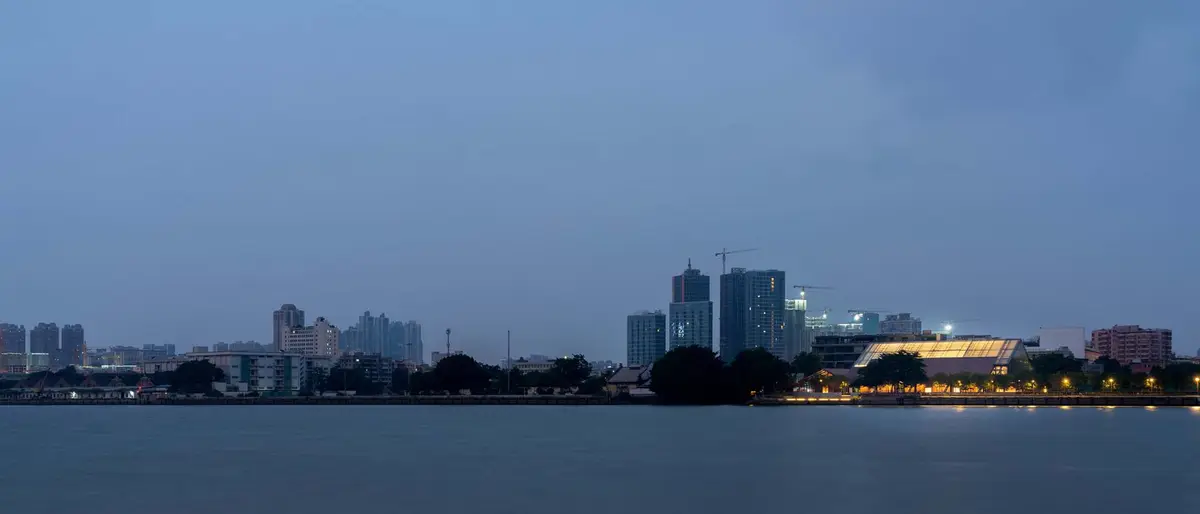
Seen from across the Pearl River at twilight, the exhibition center glows at a human scale against a skyline of cranes and half-built towers. The building's horizontal posture is a deliberate counterpoint to the vertical ambitions of the surrounding development. It is the kind of civic gesture that cities need during periods of rapid transformation: a place that acknowledges what came before while serving present needs. The warm light emanating through the glazed roofs at night gives the old granaries a lantern-like quality, signaling public access from a distance.
Plans and Drawings
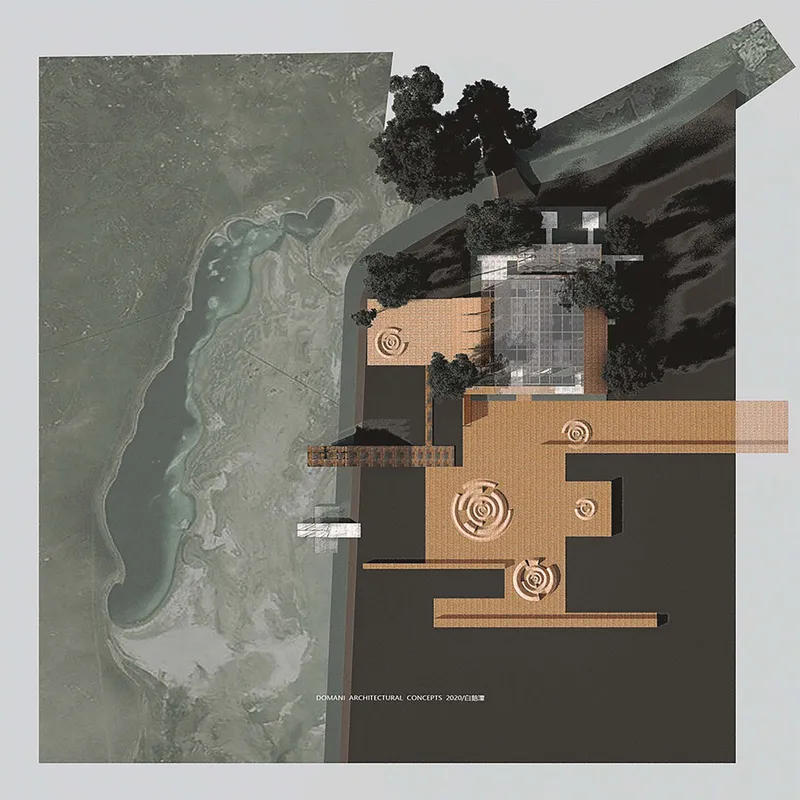
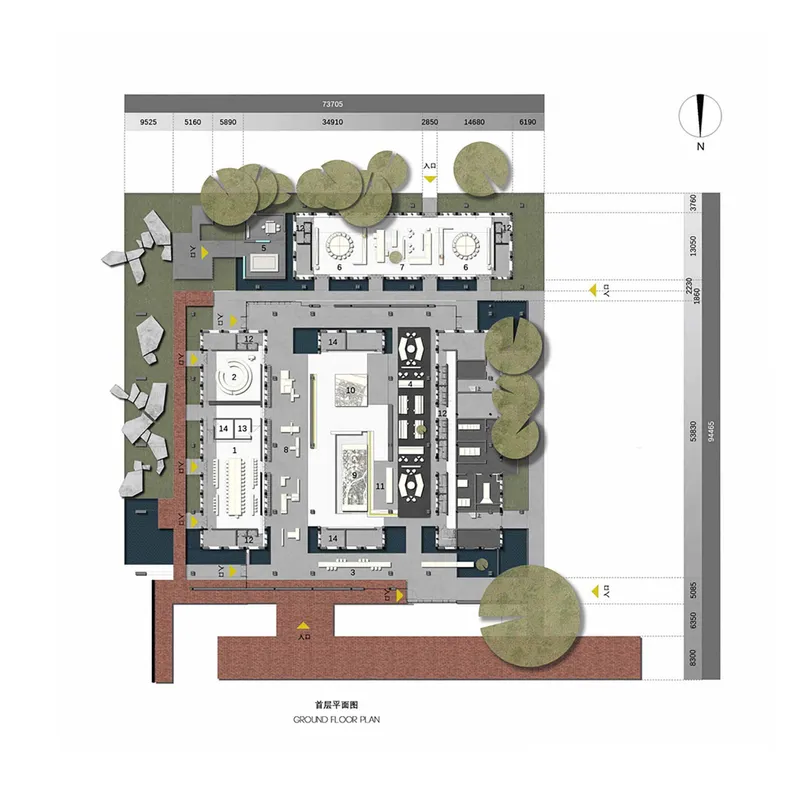
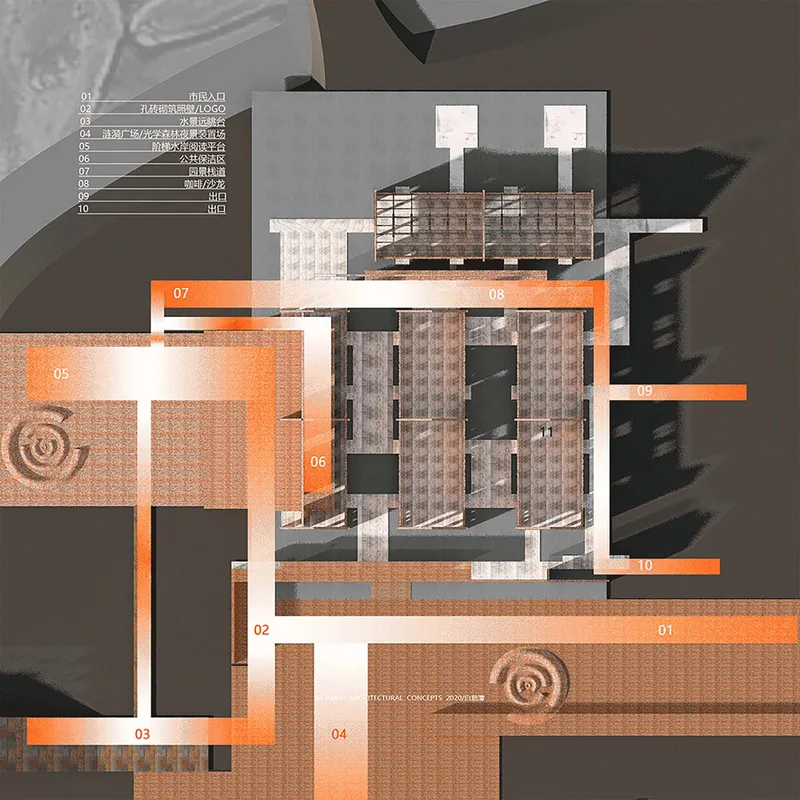
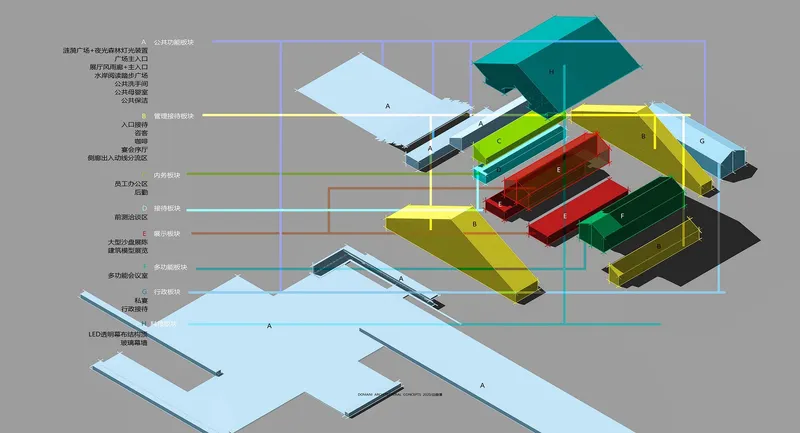
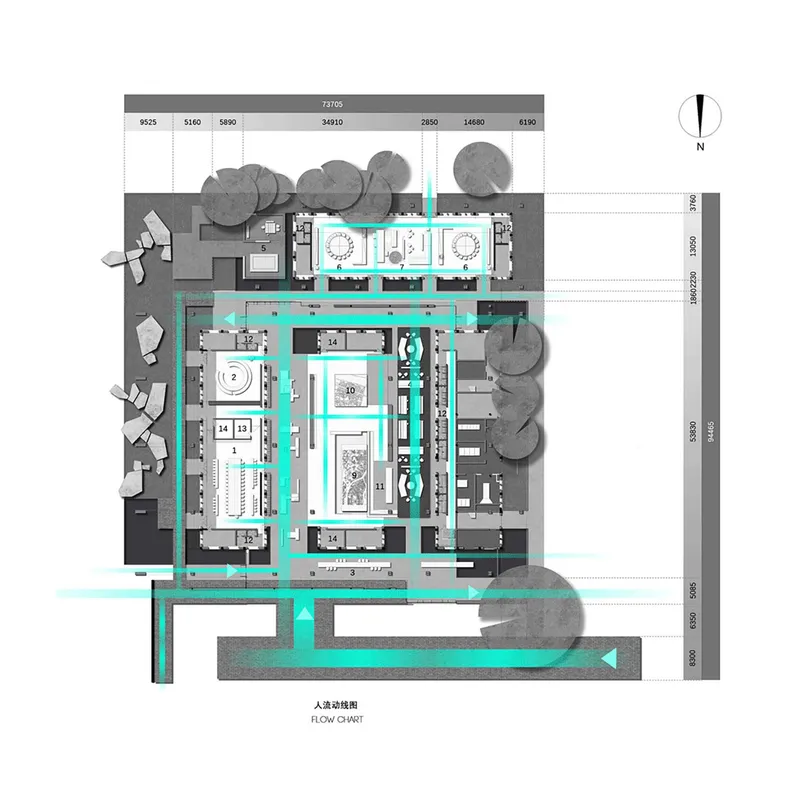
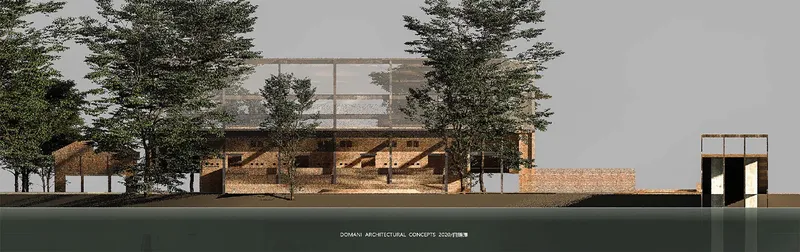
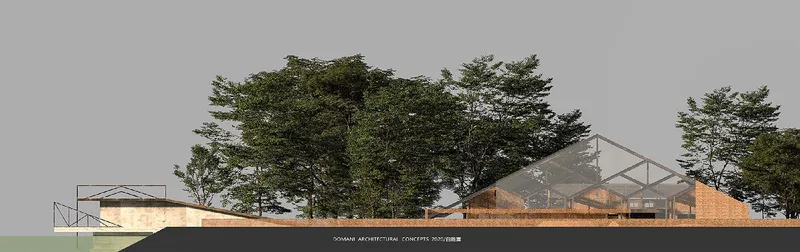
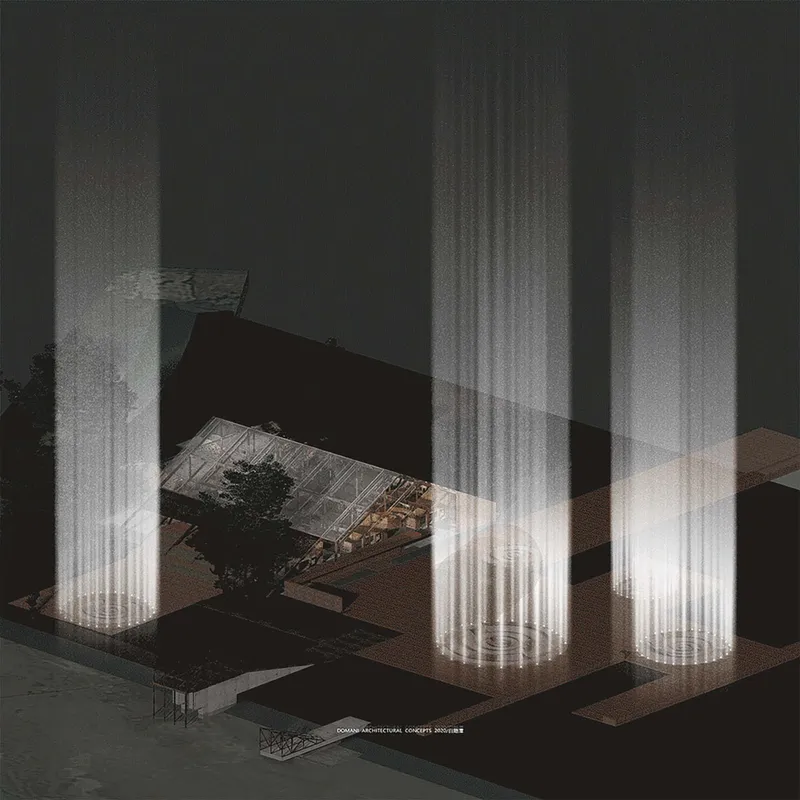
The drawings reveal the project's organizational logic with clarity. The site plan shows the four warehouse footprints lined up along the riverbank, their east-west orientation preserved. Circulation diagrams trace the paths DOMANI carved through and between the buildings, connecting previously isolated structures into a legible public sequence. The sectional elevations are especially telling: they show the original brick volumes sitting beneath their new steel and glass canopies like objects under display cases, the mature trees reaching up to the roofline and softening the boundary between architecture and landscape.
The axonometric exploded view separates the programmatic layers, making visible how the new roof structures, the retained brick shells, and the inserted exhibition elements stack and interlock. What reads as a seamless experience on the ground is, in plan, a carefully choreographed assembly of independent systems, each legible and each reversible. The structural design by Yang Kun and Zhu Lixiong at Guangzhou Pearl River Foreign Investment Architectural Designing Institute deserves credit for the delicacy of the steel work, which sits atop the old masonry without overwhelming it.
Why This Project Matters
Adaptive reuse projects in Chinese cities often struggle with two temptations: gutting the original building until only a shell remains, or preserving it so faithfully that no new program can function inside. DOMANI's Julong Bay Exhibition Center avoids both traps. The granaries are genuinely present, their brick walls and structural rhythms shaping the visitor's experience in ways that a new building never could. But the new steel and glass layers are equally assertive, reframing the old volumes without mimicking them. The result is a building that feels lived-in rather than curated.
As the first phase of a larger west bank renewal plan, the project also sets a precedent. It argues that industrial heritage on the Pearl River is worth engaging with rather than demolishing, and that exhibition space carved from warehouse stock can hold its own against the gleaming towers rising behind it. For a district in transition, having a civic anchor that remembers where it came from is not nostalgia. It is strategy.
Guangzhou Julong Bay Exhibition Center by DOMANI (lead architect Ann Yu). Located in Guangzhou, China, on the west bank of the Pearl River. 5,000 m². Completed in 2021. Landscape design by SASAKI. Structural design by Guangzhou Pearl River Foreign Investment Architectural Designing Institute. Photography by Vincent Wu.
About the Studio
Share Your Own Work on uni.xyz
If projects like this are the kind of work you want to make, uni.xyz is a place to publish your own, find collaborators, and enter design competitions.


Popular Articles
Popular articles from the community


GROUP A Strips a 1969 Rotterdam Harbor Headquarters to Its Frame and Wraps It in Timber Louvers
In Rotterdam's M4H harbor district, Ferro Offices reuses a 1969 frame, adds one timber storey and reaches BREEAM-NL Outstanding.

longwave studio Reorganizes a 112 m² Tainan Apartment Around the Daily Routines of a Family and Two Cats
In Tainan, Taiwan, birch plywood, rust-red furniture and a freestanding plaster wall link arrival, storage, work and family life in one apartment.

David Ortega Stacks a Two-Story Mexico City Penthouse Around a Steel Stair and a Pergola-Shaded Roof Terrace
In Colonia Roma, a 300 m² penthouse uses oak joinery, a planted steel stair and a slatted roof pergola to make a new-build apartment feel like a house.

U.GA Architects Wraps an Oval Rooftop Pool in Curved Board-Formed Concrete on Busan's Jeollidan-gil
In Busan's Jeonpo-dong, a 454 m² mixed-use block stacks a neighborhood facility, guest rooms and an oval rooftop pool inside spiraling concrete walls.

Similar Reads
You might also enjoy these articles


LAVA Architecten Gives Vocational Education a Sawtooth-Roofed Face on a Mechelen School Campus
In Mechelen, Belgium, a 2,053 m² STEM school on a 6×6 m grid turns workshops and classrooms into rooms that can be rearranged as teaching changes.

KEMA Studio Turns a Derelict Marvila Attic into a 60 m² Lighthouse Apartment Above Lisbon
In Lisbon's Marvila district, a rebuilt roof, four skylights and two plywood volumes turn an unlivable attic into a bright home facing the Tagus.

Pixel Gardens: One Repeated Module Stacked Into a Terraced Social Housing Tower for Famagusta
Salem Bader's shortlisted housing tower builds a vertical neighbourhood from one repeated module, offsetting units to carve terraces, light and air.

Bao Huynh Watercolor Atelier: A Serene Art Retreat in Hội An
Bao Huynh Watercolor Atelier in Hội An blends multifunctional art spaces, sustainable design, local materials, and family-friendly living in a serene environment.


Comments (0)
Please login or sign up to add comments
No comments yet. Be the first to comment!