
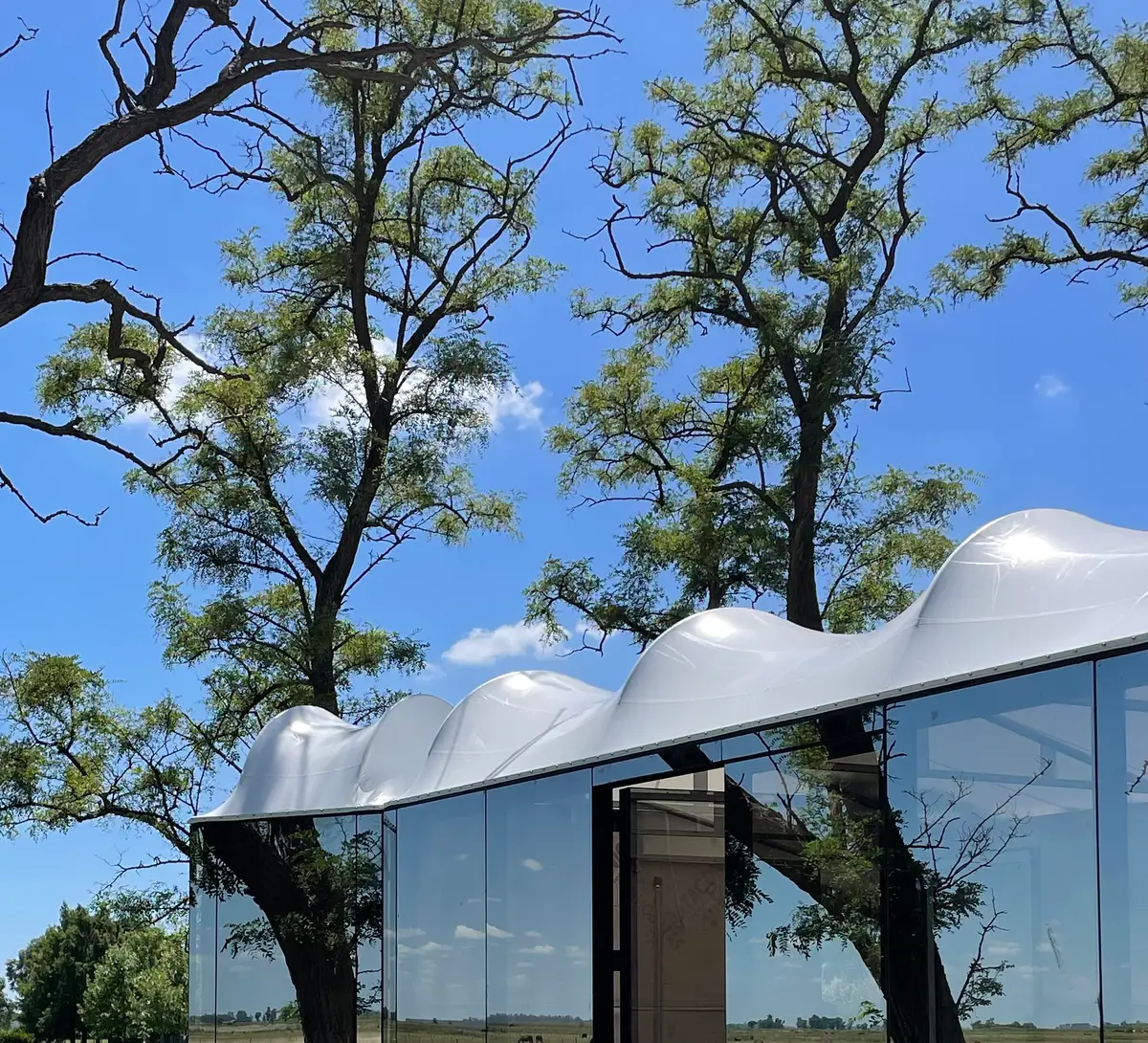
DUB Arquitectura Builds a 30 m² Off-Grid Painting Studio in Argentina's Pampean Plains
Reclaimed wood and translucent fabric shelter a visual artist's retreat among acacia trees near Veinticinco de Mayo, Buenos Aires province.


Thirty square meters is barely enough for a parking space. In the hands of DUB Arquitectura, led by Angie Dub and Belén Butler, it becomes a complete world: a painting studio, a bathroom, a storage room, an outdoor deck, and a triangular courtyard that frames the sky between two rotated timber volumes. Atelier-A sits in a grove of acacia trees on a rural property near Veinticinco de Mayo, surrounded by crops and polo horses on the flat expanse of Buenos Aires province's Pampean plains. The client is a visual artist who paints while watching the landscape, and the architecture exists to hold her gaze steady on that horizon.
What makes the project genuinely interesting is the economy of its means. The structure is steel framing, the envelope is reclaimed wood salvaged from a mid-twentieth-century vivarium that once stood on a neighboring plot, and the roof is translucent fabric stretched taut across a metal framework. The building runs entirely off-grid. There is no heroic technology at work here, just disciplined material choices that let the landscape do the talking. When wind moves the acacia branches above, their shadows ripple across the fabric ceiling like ink on wet paper. At night, the interior light turns the whole pavilion into a lantern visible from the surrounding fields.
Two Volumes, One Rotation
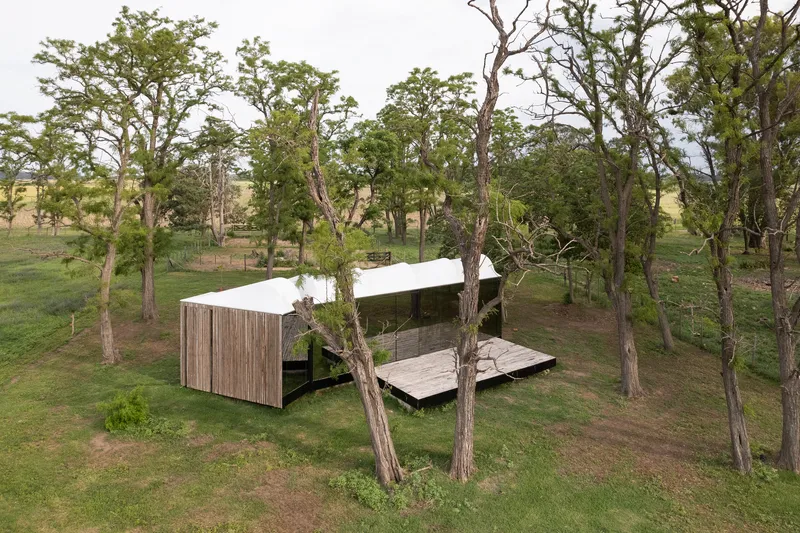
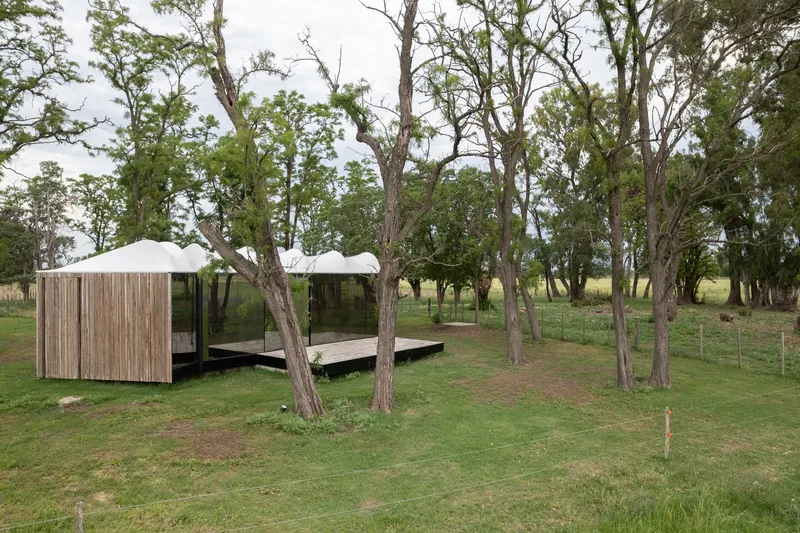
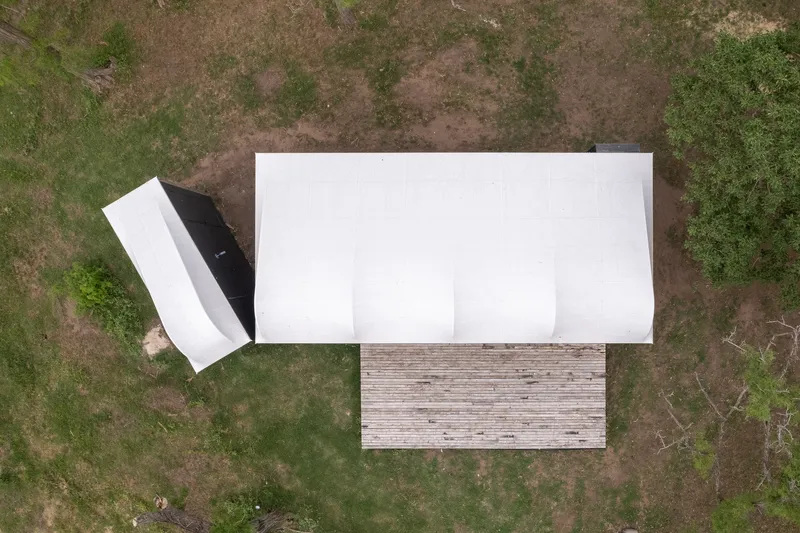
Seen from above, the logic is immediate. Two rectangular boxes sit side by side, but one has been rotated slightly at the point of connection, opening a thin sliver of space between them that becomes a triangular entrance courtyard. The larger volume houses the painting studio with a sink and workstation. The smaller one holds storage and a bathroom with full-height glazing. That air slit between the two is not incidental decoration: standing in the courtyard, you can see straight through to the landscape beyond. The gap turns a simple pair of boxes into a threshold that negotiates between arrival and the vast openness of the plains.
Reclaimed Timber and the Memory of Place
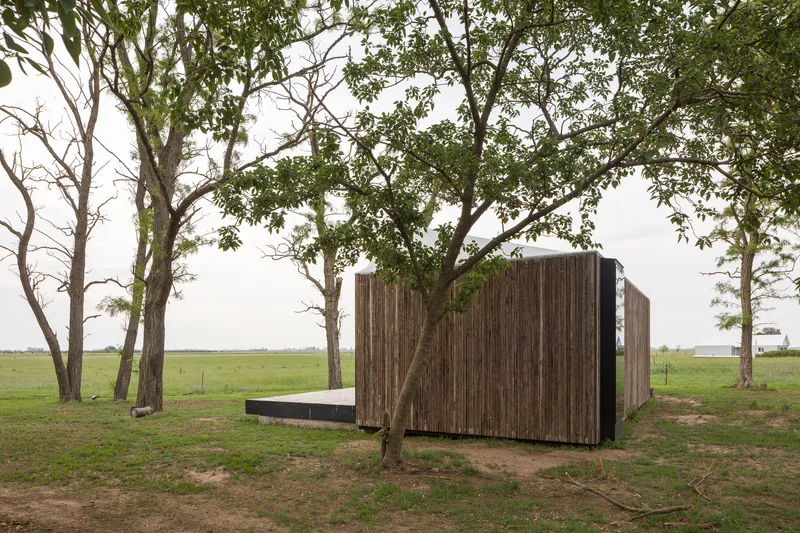
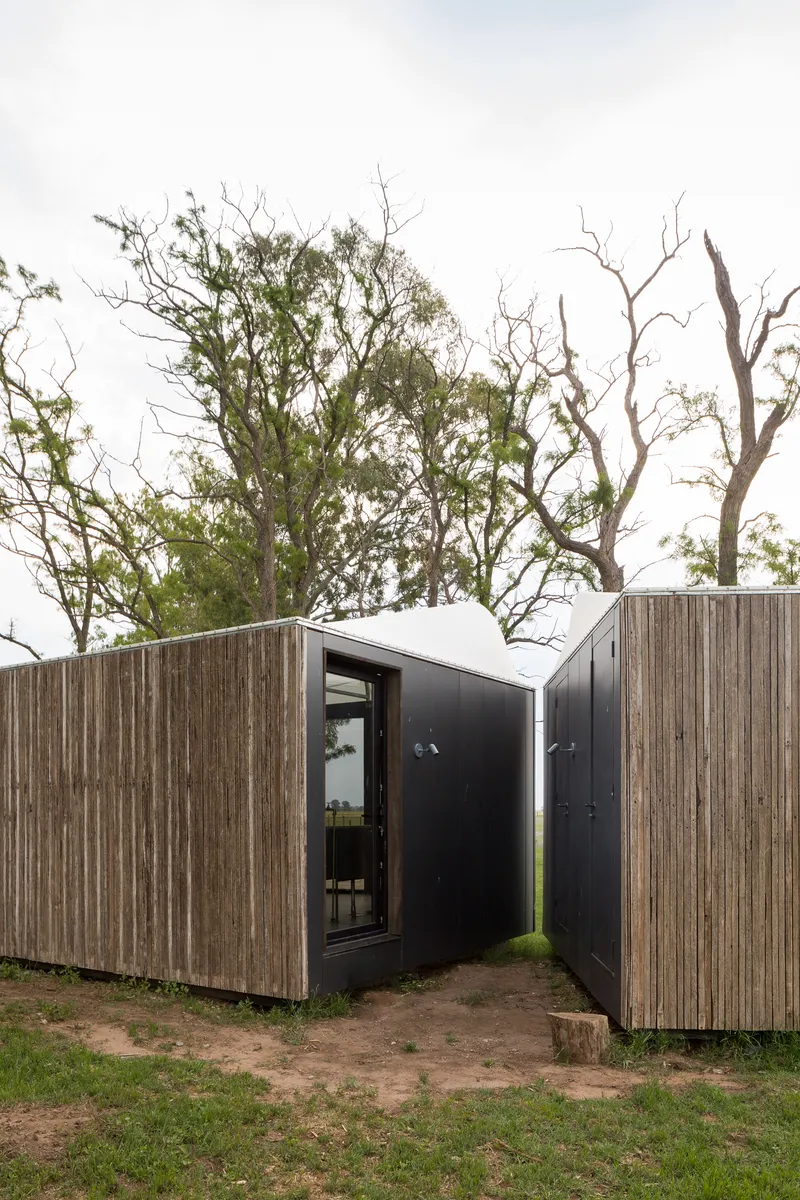
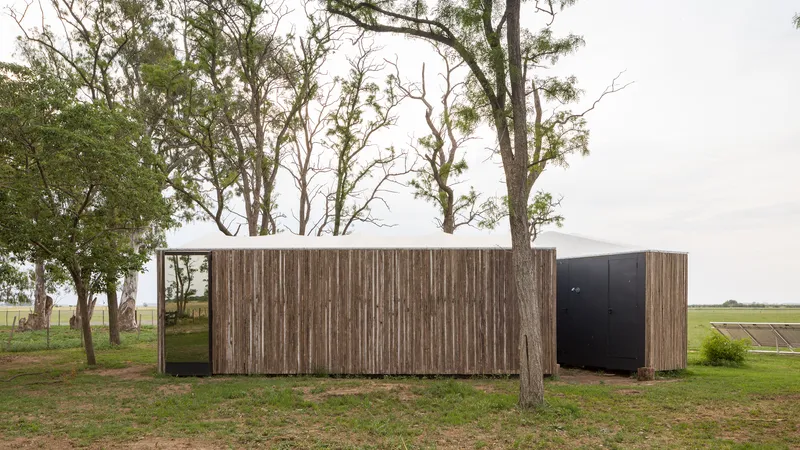
The vertical timber cladding that wraps both volumes has a weathered, silver-grey tone that could only come from decades of exposure to Pampean sun and rain. DUB Arquitectura sourced the wood from a decommissioned vivarium nearby, giving the studio a material continuity with the site's own history. There is no attempt to sand or stain the boards into uniformity. The planks carry their age openly, and the result is a surface that reads as part of the landscape rather than something imposed on it.
Against this rough cladding, the black steel pivot door at the entrance and the dark metal window frames register as precise, deliberate insertions. The contrast is productive: it keeps the building from sliding into pastoral nostalgia and reminds you that this is a working studio, not a shed.
The Translucent Roof as Filter
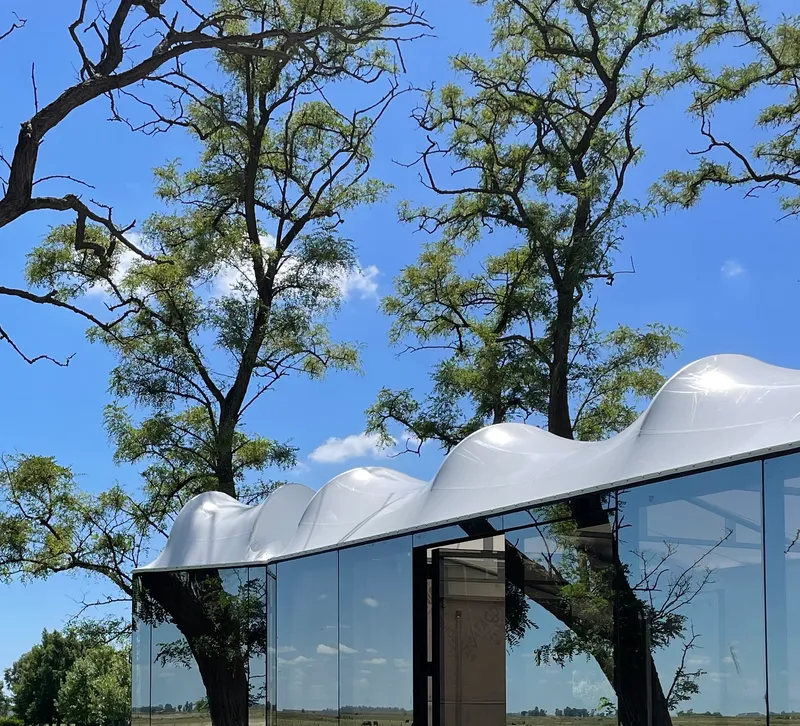
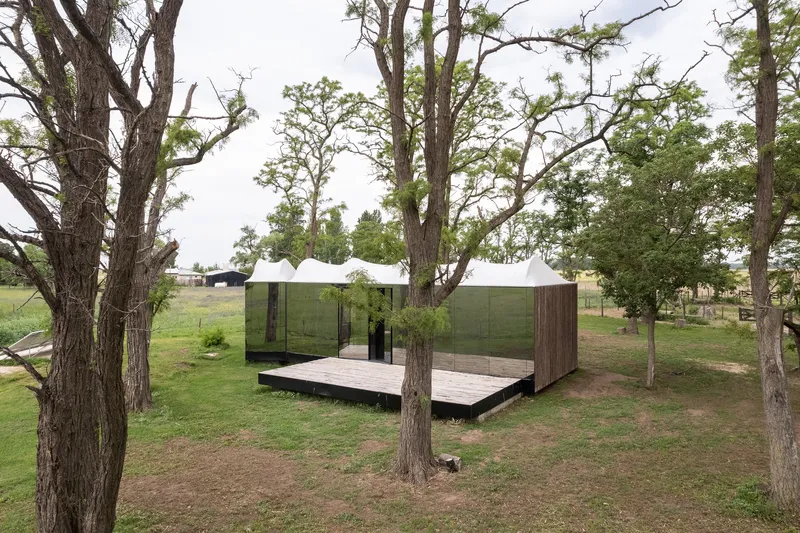
The most distinctive move is the undulating white roof. Stretched fabric over a steel framework creates a soft, billowing form that stands in sharp contrast to the angular timber boxes below. Functionally, it serves as a constant, diffused light source. The translucent membrane admits daylight evenly throughout the day, eliminating harsh shadows that would make painting difficult. But it also acts as a projection screen for the landscape above: acacia leaves, passing birds, shifting clouds all register as moving silhouettes on the ceiling.
For a painter who works by observing nature, this is an architectural gift. The landscape is not only visible through the windows; it is present overhead, filtered into abstraction. The studio becomes a camera obscura of sorts, with nature performing on every surface.
Interior: Light, Glass, and the Horizon Line
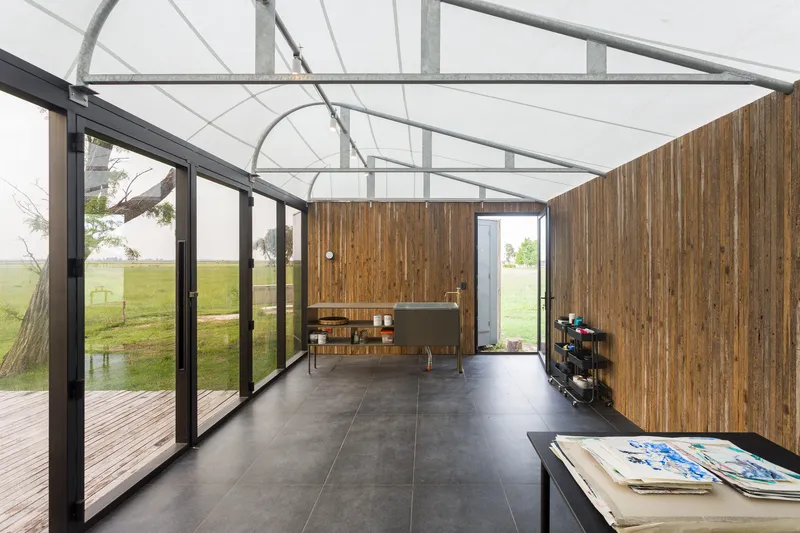
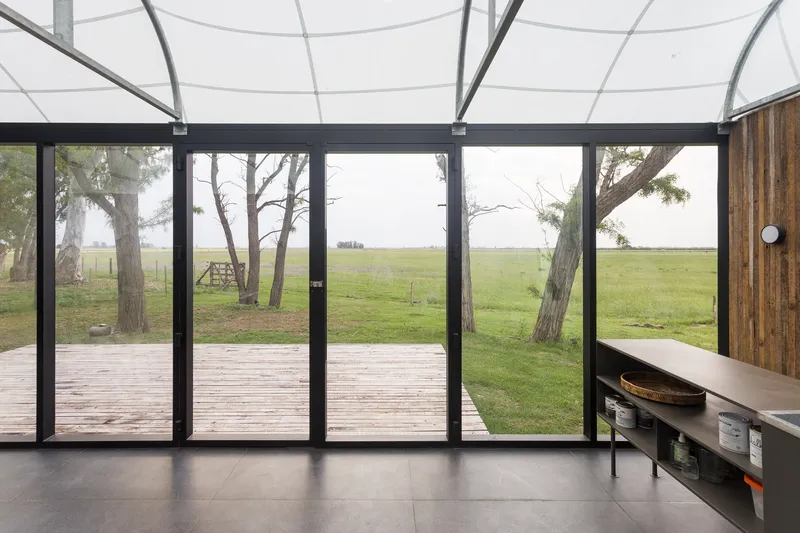
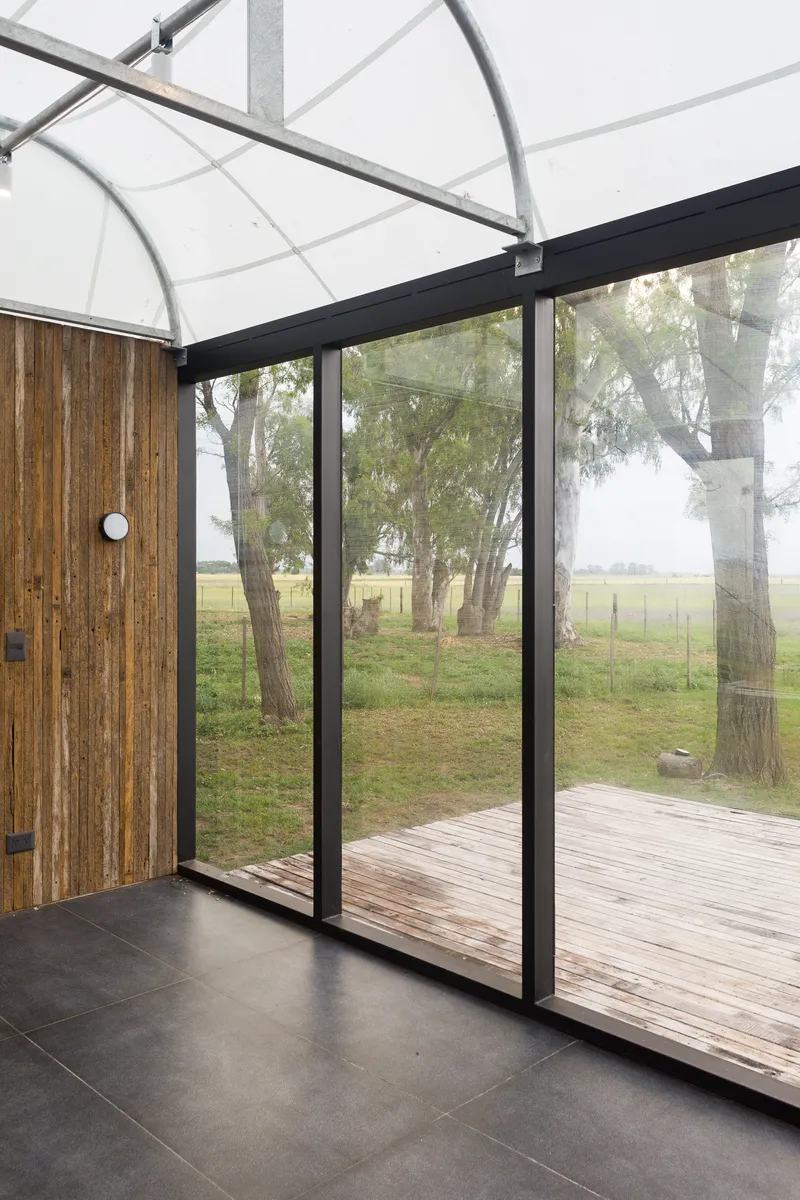
Inside the main studio volume, exposed steel trusses and grey floor tiles establish a neutral background. The walls alternate between vertical timber cladding on the closed faces and floor-to-ceiling black-framed glazing on the landscape-facing sides. The full-height glass doors open directly onto the timber deck, collapsing the boundary between interior workspace and exterior platform. On overcast days, the grey sky and muted tones of the grassland merge with the interior palette, and the studio feels less like a room than a covered clearing.
The elongated horizontal proportion of the windows is deliberate. It frames the Pampean plains exactly as a painter would compose them: as a continuous band of land and sky, emphasizing the flatness and scale of the terrain. The architecture does not compete with the view. It organizes it.
The Bathroom as a Small Landscape Room
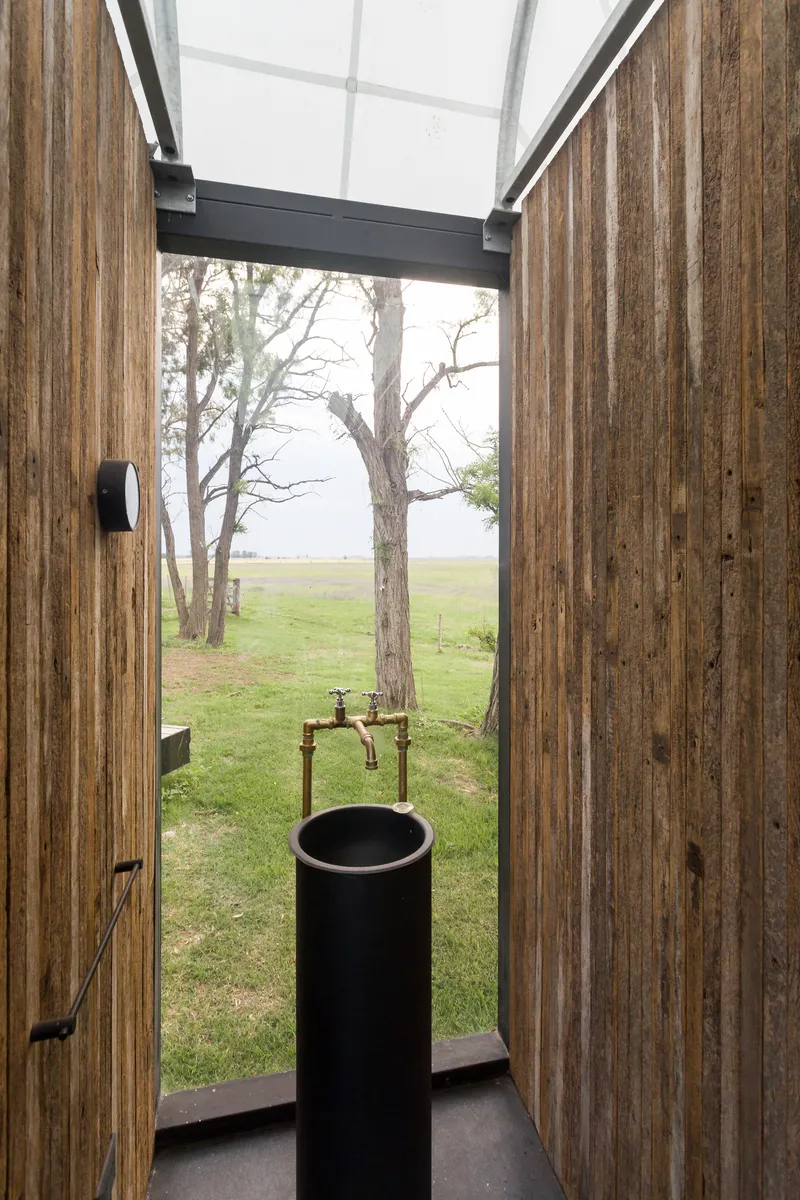
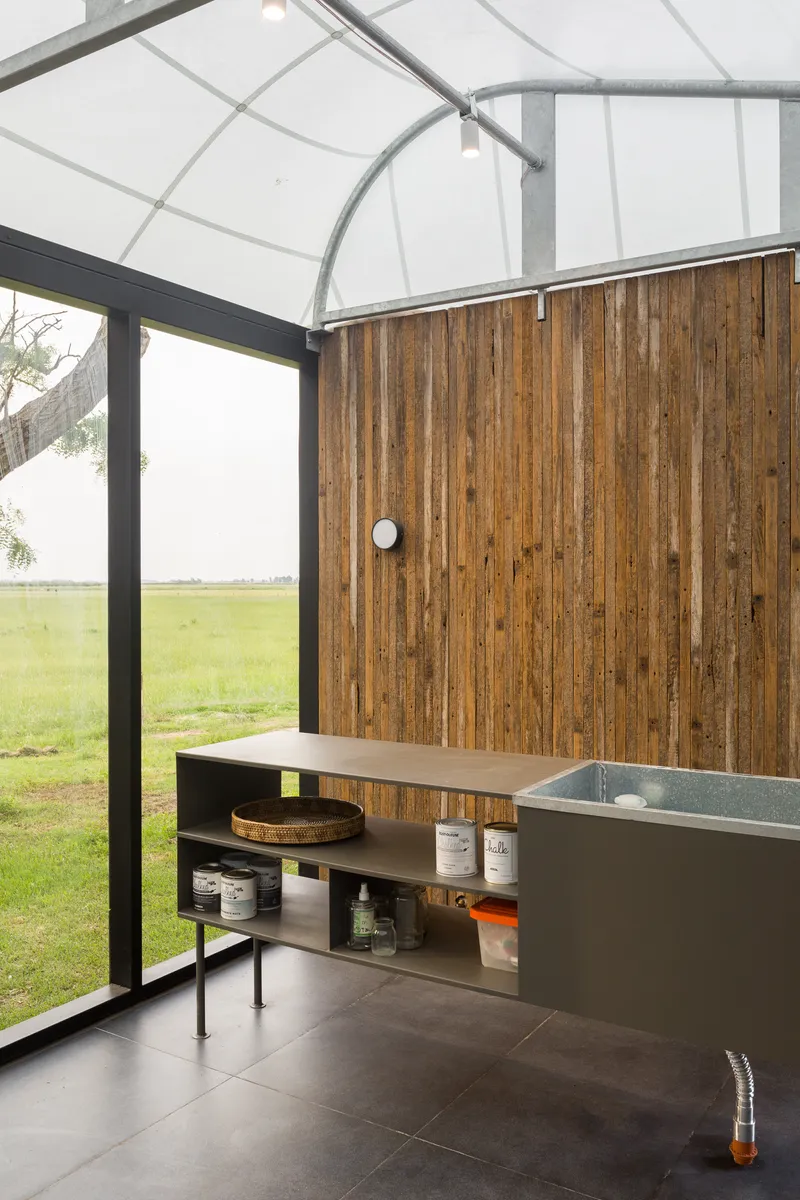
Even the bathroom gets the full treatment. In the smaller volume, a narrow space lined with vertical timber cladding opens through a glazed corner onto the surrounding green field. A cylindrical black basin sits beneath a skylight, and the curved translucent roof brings the same filtered light found in the studio into this tiny room. A terrazzo vanity grounds the space with a material that feels more urban than rural, which is a quiet acknowledgment that this is still a designed interior, not a rustic cabin.
Most architects would not spend this much design attention on a 30 m² bathroom and storage unit. That DUB Arquitectura does says something about their conviction that every space, regardless of size, deserves the same rigor.
Plans and Drawings

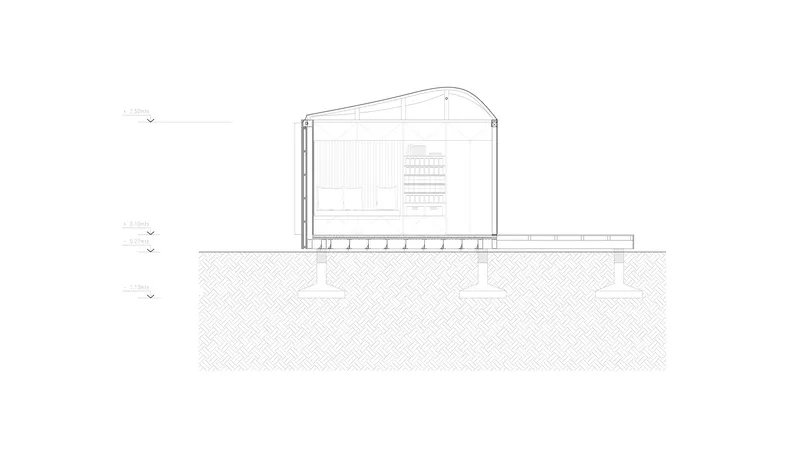
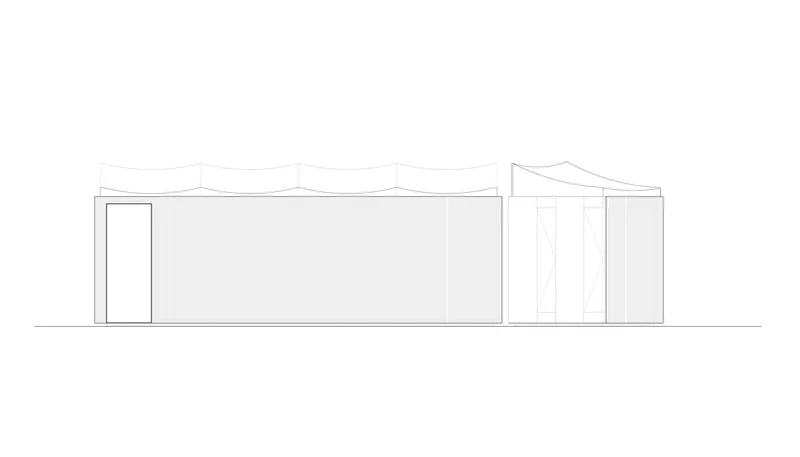
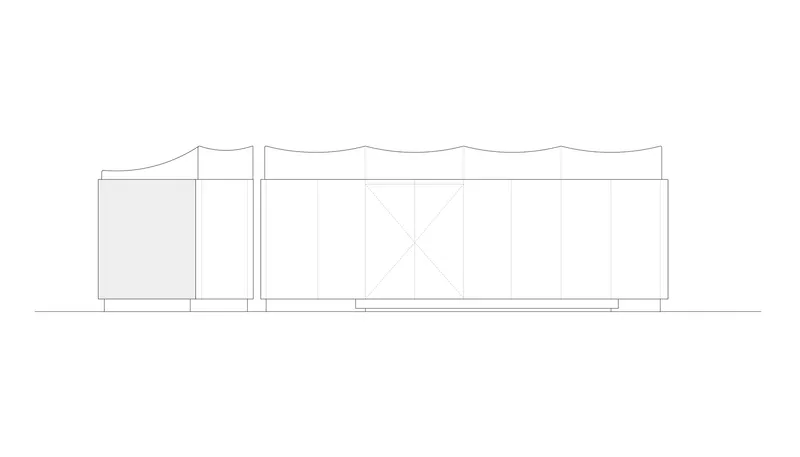
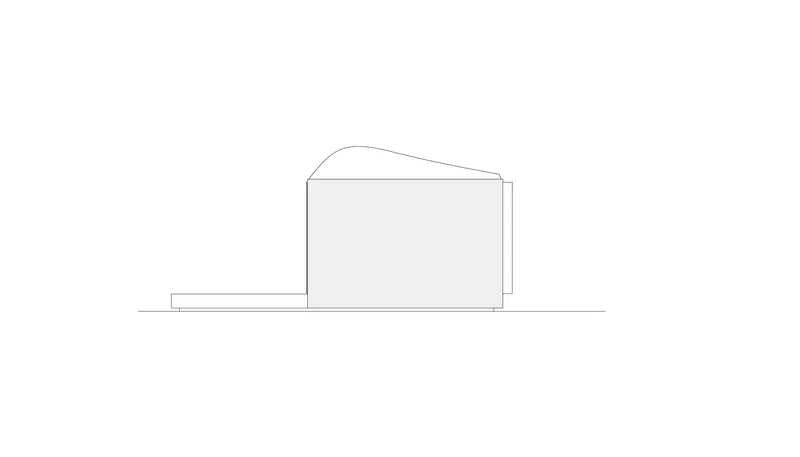
The section drawing reveals how the arched fabric roof sits above the grade-level timber box, with the deck extending outward as an unroofed platform toward the horizon. The site plan confirms the isolation: a single compact footprint scattered among trees, with nothing else nearby. The elevations read as a catalog of the project's dual personality. From one angle, you see the curved billowing roof and a fully glazed facade. From another, the building is entirely closed in vertical timber cladding, almost opaque. The architects calibrate openness and enclosure precisely according to orientation, privacy, and the direction of the best views.
Why This Project Matters
Atelier-A belongs to a category of project that is easy to overlook: small, rural, single-client, and without the ambition to reshape a city block. But the discipline on display here is instructive. With just 30 square meters, DUB Arquitectura manages to create spatial variety through rotation, material depth through salvage, and environmental performance through passive means alone. The off-grid operation is not a marketing claim bolted onto a conventional design; it is the natural outcome of a well-insulated envelope, a fabric roof that eliminates the need for artificial lighting during the day, and a program modest enough to run on minimal energy.
More than that, the project is a thoughtful argument about what an artist's studio should be. It does not isolate the painter from the landscape; it orchestrates the landscape into the room through glass, through shadow play on the translucent ceiling, through the air gap between two volumes. The building is a viewing instrument tuned to the Pampean plains, and it does its job with clarity and restraint.
Atelier-A by DUB Arquitectura (Angie Dub, Belén Butler). Veinticinco de Mayo, Buenos Aires Province, Argentina. 30 m². Completed 2022. Photography by Fernando Schapochnik.
About the Studio
Share Your Own Work on uni.xyz
If projects like this are the kind of work you want to make, uni.xyz is a place to publish your own, find collaborators, and enter design competitions.


Popular Articles
Popular articles from the community


Manzana Morphosis: Stretching Barcelona's Grid into a Living Landscape for 2050
A radical reworking of the Eixample manzana turns density into a tool for generous public space, vertical ecology, and environmental performance.


Cube Design Draws an Ecological Corridor Between Two Shenzhen Hills with the Nankai Building
Beside Shenzhen's container docks, the Nankai Building pairs stacked balconies with a climbing green screen to connect two hillsides across its height.

Aquadapt: An Underwater Habitat That Rewrites Its Rooms by the Hour
Curved modules ring the seabed while one shell shifts from breakfast room to cinema, farm and football pitch as residents' needs change.

The Amber Palace Opera: A Geological Fiction Surfaces on Tallinn's Baltic Waterfront
Pierre Brillard reimagines a Baltic legend as a public landscape, opera house, and waterfront promenade rooted in Tallinn's coastal identity.

Similar Reads
You might also enjoy these articles

LAVA Architecten Gives Vocational Education a Sawtooth-Roofed Face on a Mechelen School Campus
In Mechelen, Belgium, a 2,053 m² STEM school on a 6×6 m grid turns workshops and classrooms into rooms that can be rearranged as teaching changes.

KEMA Studio Turns a Derelict Marvila Attic into a 60 m² Lighthouse Apartment Above Lisbon
In Lisbon's Marvila district, a rebuilt roof, four skylights and two plywood volumes turn an unlivable attic into a bright home facing the Tagus.

Pixel Gardens: One Repeated Module Stacked Into a Terraced Social Housing Tower for Famagusta
Salem Bader's shortlisted housing tower builds a vertical neighbourhood from one repeated module, offsetting units to carve terraces, light and air.

Bao Huynh Watercolor Atelier: A Serene Art Retreat in Hội An
Bao Huynh Watercolor Atelier in Hội An blends multifunctional art spaces, sustainable design, local materials, and family-friendly living in a serene environment.

Explore Atelier Competitions
Discover active competitions in this discipline

Challenge to reimagine the Iron Throne

Photograph architecture without architects

Illustrate the lost glory of Angkor Wat - Render Challenge

Design challenge to reuse E-waste
Comments (0)
Please login or sign up to add comments
No comments yet. Be the first to comment!