
East Courtyard: A Concrete Homecoming in Rural China
Benzhe Design builds a layered concrete house in Jiangsu's coastal farmland, reimagining the rural Chinese home as a vessel for light, memory, and return.


The story behind East Courtyard is one architects encounter often but rarely handle this well: children who have moved away commission a new house for aging parents in the village they grew up in. The site is in Qidong, a coastal district of Nantong where flat agricultural plots stretch toward the sea and wind turbines line the horizon. Benzhe Design, led by Huajian Jiang, had to reconcile an intimate domestic program with a landscape that is simultaneously vast and tightly gridded by canals, roads, and neighboring rooftops.
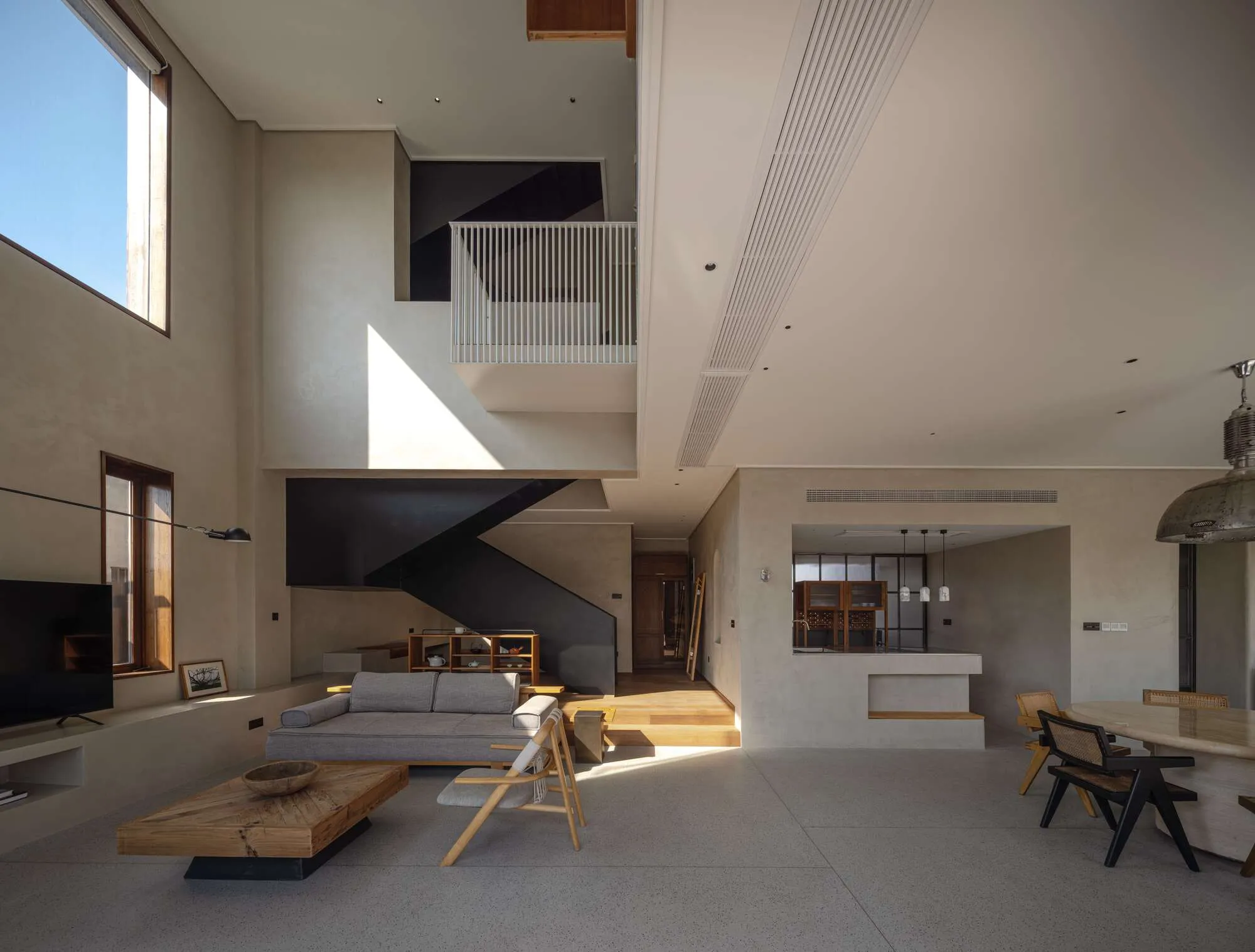
What makes this project genuinely interesting is its refusal to play the obvious cards. It does not romanticize the village vernacular, nor does it parachute in a white-box gallery aesthetic. Instead, it builds with raw concrete panels, punched openings, and staggered volumes that feel at once monolithic and porous. The 320 square meters are organized vertically across multiple half-levels, turning a compact footprint into a surprisingly spatial sequence of rooms, courtyards, and roof terraces. Light is the primary material here: clerestory slots, angular skylights, and carefully framed windows choreograph the sun's path across plaster walls and timber surfaces throughout the day.
Landscape and Context
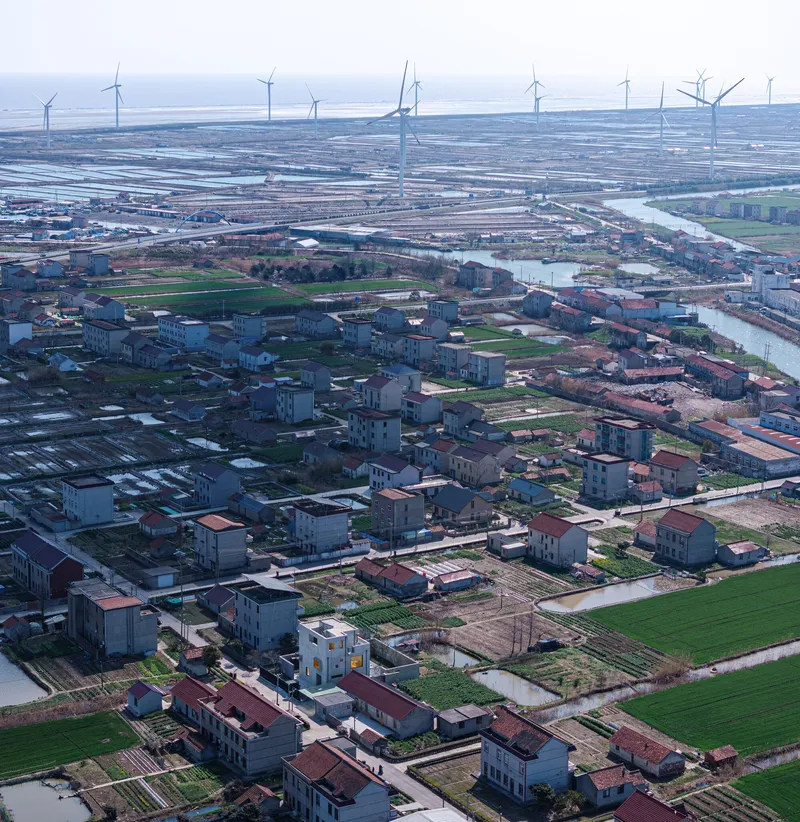


Seen from above, East Courtyard registers as a compact, slightly taller volume within a low-rise settlement defined by pitched roofs and small agricultural plots. The aerial views are revealing: irrigation canals subdivide the land into parcels, wind turbines punctuate the flat horizon, and the house sits at the intersection of road and waterway. It is unmistakably modern, yet its footprint respects the grain of the settlement. Benzhe Design chose not to sprawl but to stack, preserving open ground for planting and a gravel courtyard.
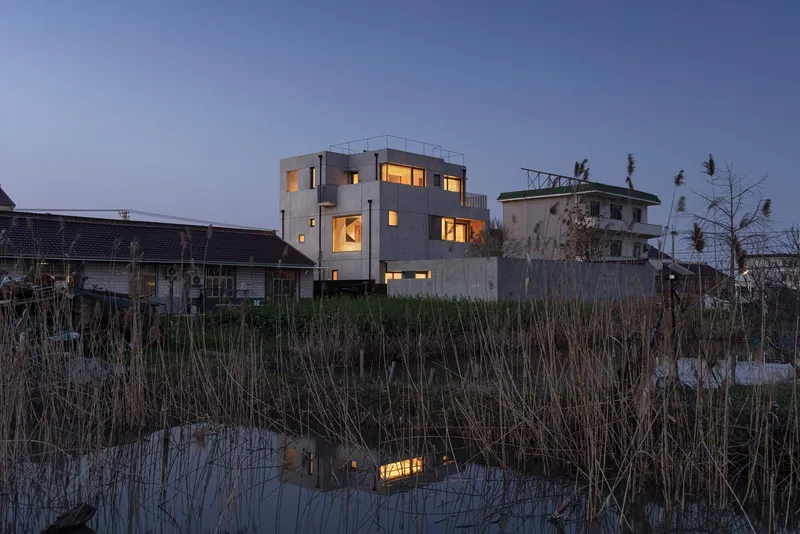
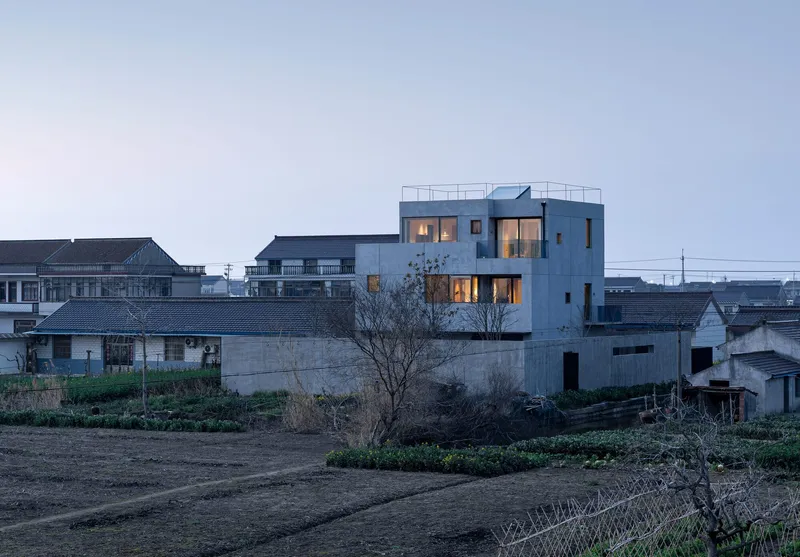
At dusk the house glows from within, its illuminated openings transforming it into a kind of lantern among the darkening fields. That effect is not accidental. The scattering of windows across the facade ensures that light escapes at multiple levels, signaling occupation and warmth without resorting to floor-to-ceiling glass walls that would feel alien in this context.
The Concrete Facade as Threshold
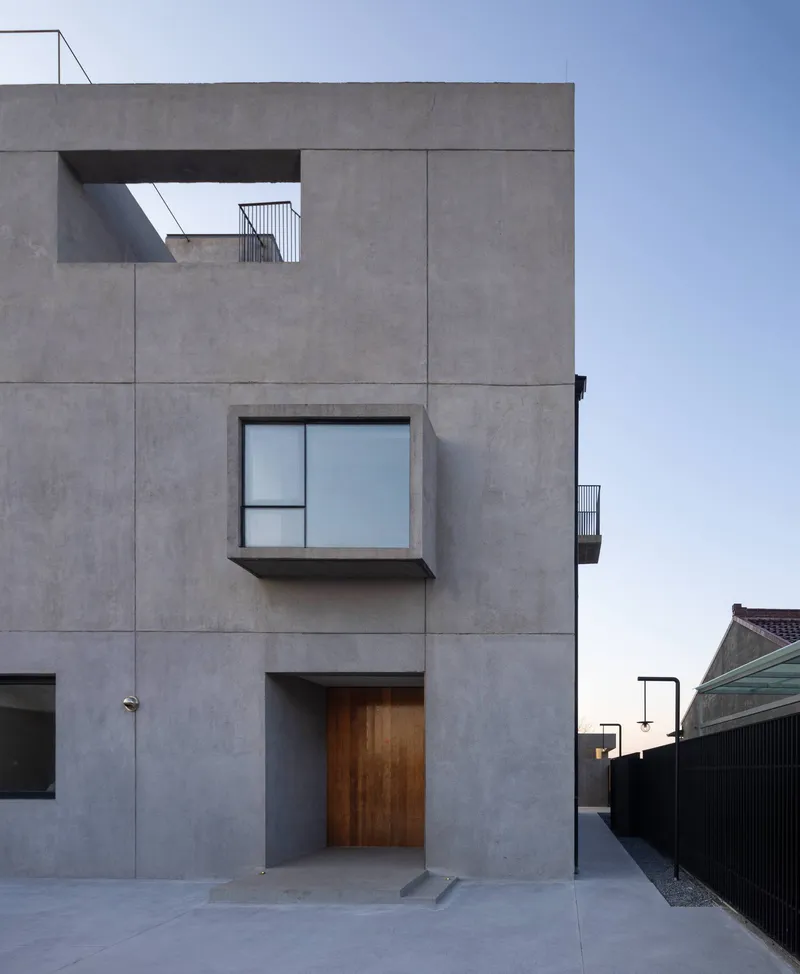

From the street, the house presents a deliberately restrained face. Gray concrete block panels, a timber entry door, and a projecting box window compose a facade that is more wall than building. The punched square openings appear almost randomly placed, but they correspond precisely to interior functions: a bedroom here, a stairwell there, a bathroom above. Overhead power lines and bare winter trees only reinforce the no-nonsense materiality. There is nothing decorative about this elevation; it earns its presence through proportion and weight.
Move around to the canal side and the concrete acquires a different character. Reflected in the water at twilight, the house becomes softer, doubled. The narrow irrigation channel and dry winter grasses provide a foreground that is both picturesque and practical, a buffer zone between public path and private domain.
Stacked Volumes and the Rear Elevation

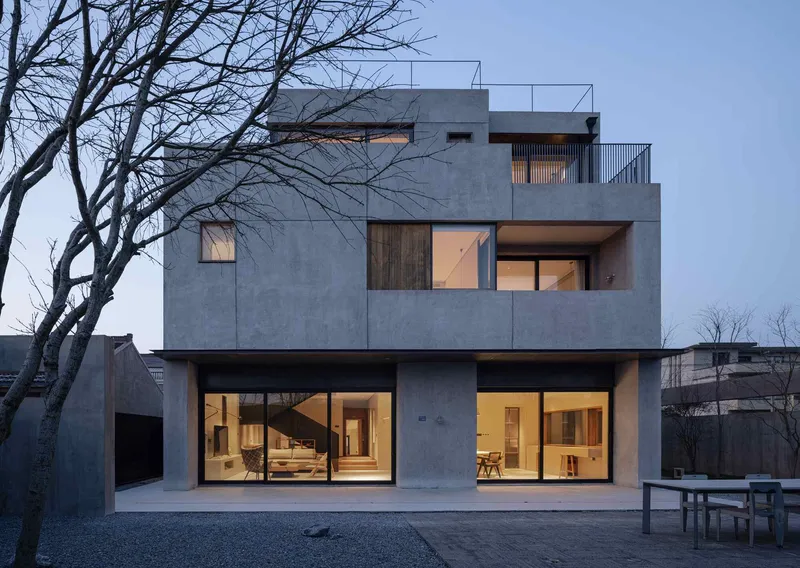
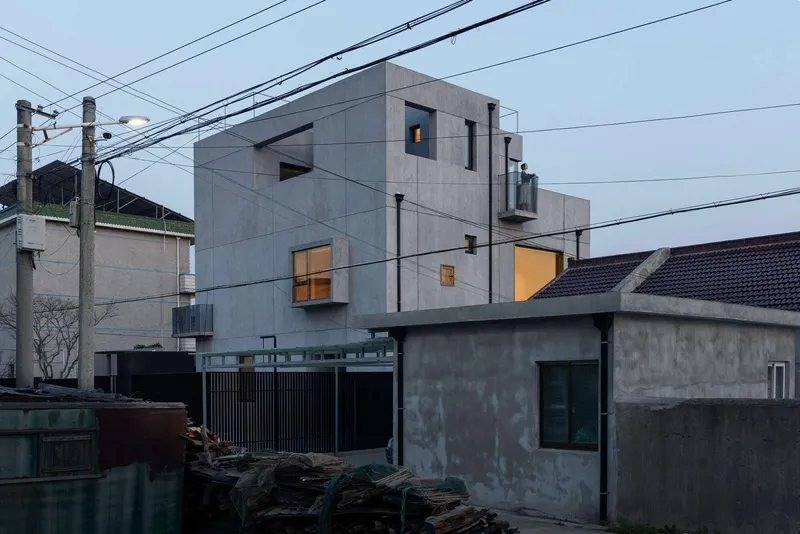
The rear of the house is where the volumetric game becomes legible. Concrete boxes stack and shift, creating cantilevered terraces and recessed balconies. Large glazed openings face the gravel courtyard, inverting the street facade's opacity. The logic is clear: protect from the public side, open to the private side. A figure standing on the upper balcony, visible in several shots, gives scale to the composition and hints at how the family actually inhabits these in-between spaces.
At dusk, the wetland pond behind the house acts as a mirror, reflecting the illuminated interior back at the landscape. It is a powerful image, and it underscores the architects' sensitivity to orientation and ground conditions. The house does not just sit on the land; it engages with the water table, the canal network, and the seasonal vegetation that surrounds it.
The Central Staircase as Spine
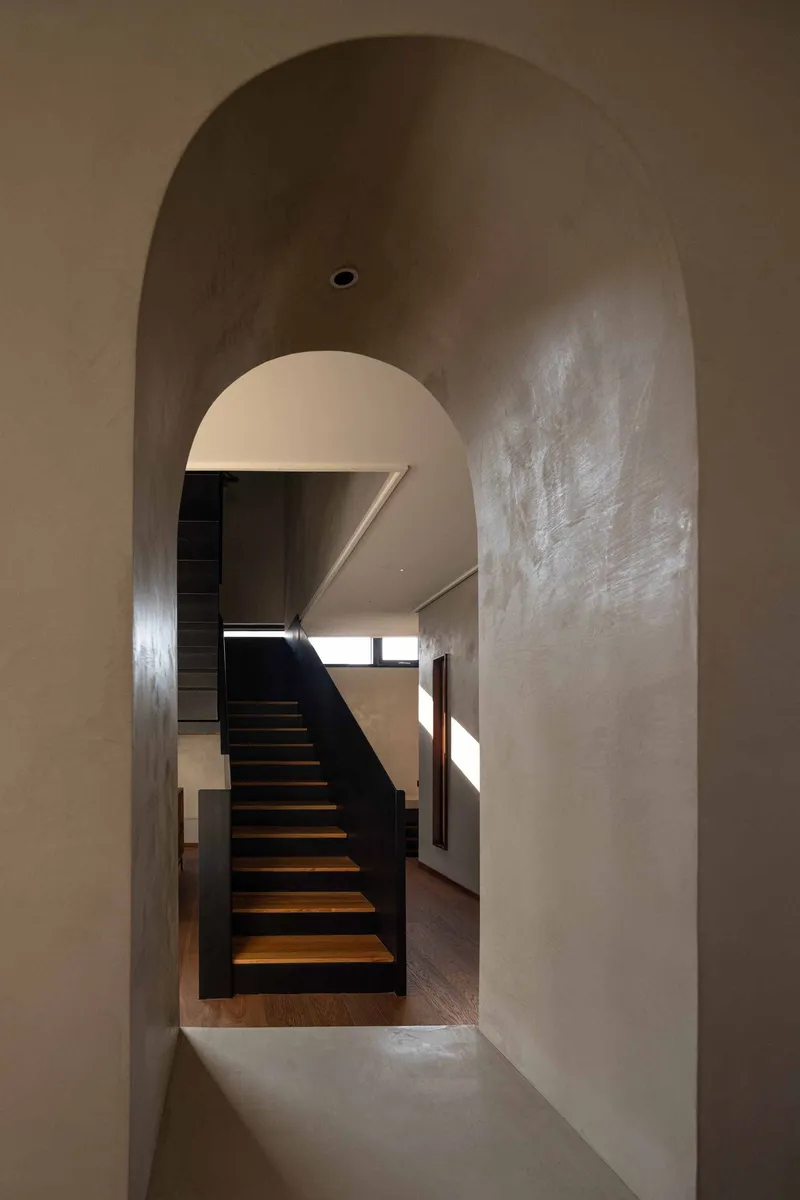

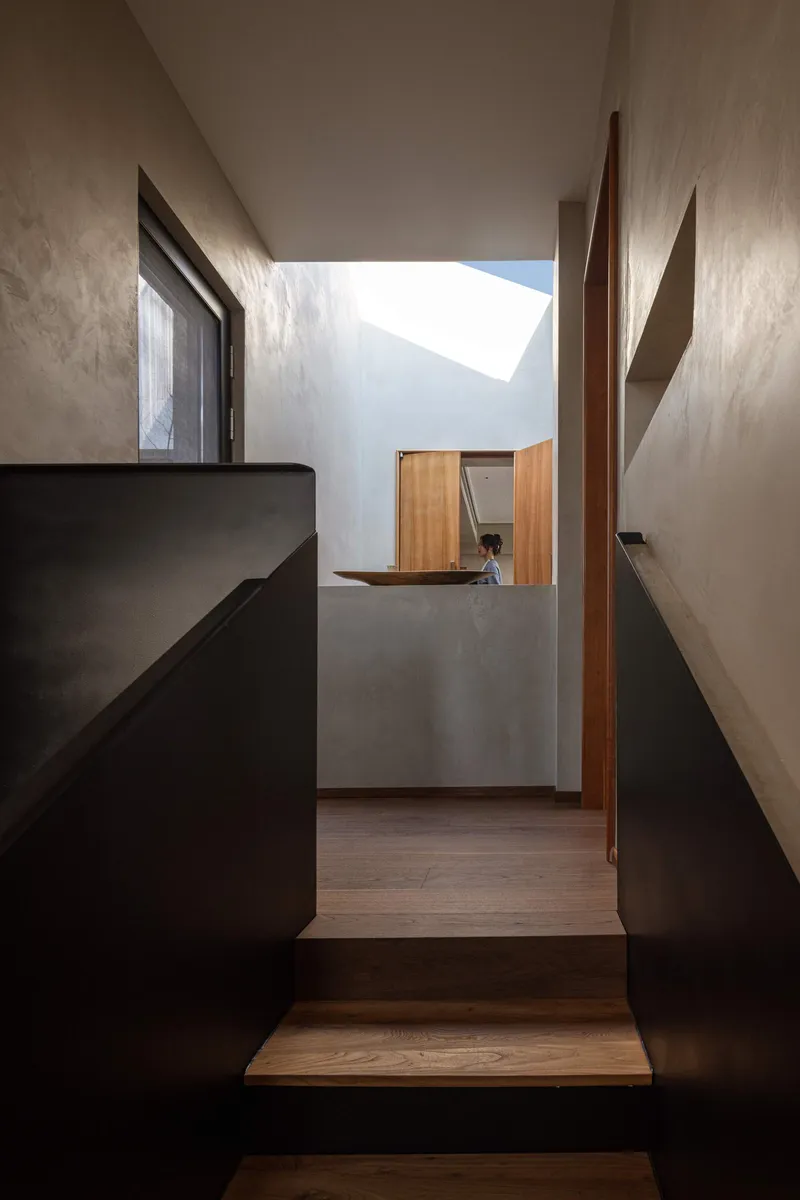
The black steel staircase with timber treads is the spatial engine of the house. It threads through all levels, linking half-floors and connecting interior rooms to exterior terraces. Seen through an arched passageway with afternoon light pouring from above, it becomes almost cinematic. The narrow stairwell with its slot windows creates dramatic light patterns on the plaster walls, turning vertical circulation into a sensory event.
Angled skylights on the upper landing cast geometric shadows that shift throughout the day, marking time in a way that clocks cannot. For a house built for elderly parents who spend most of their hours at home, this attention to the quality of light in transitional spaces is not a luxury; it is the architecture doing its job.
Living Spaces and the Quality of Light

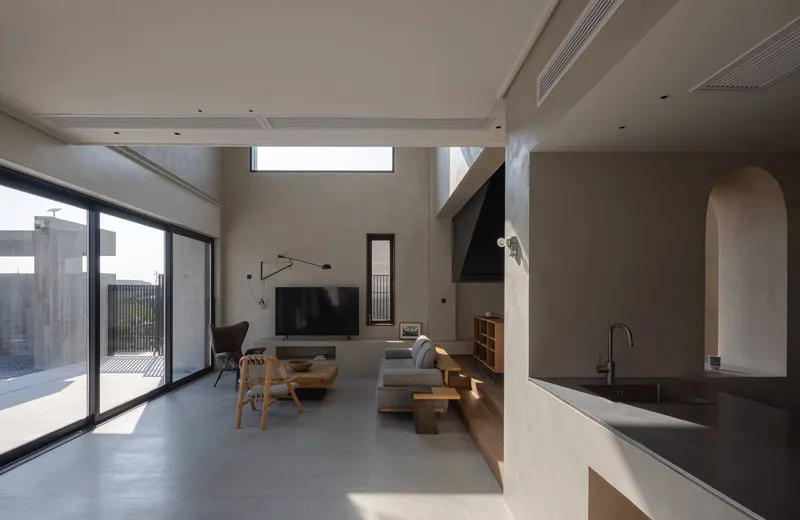
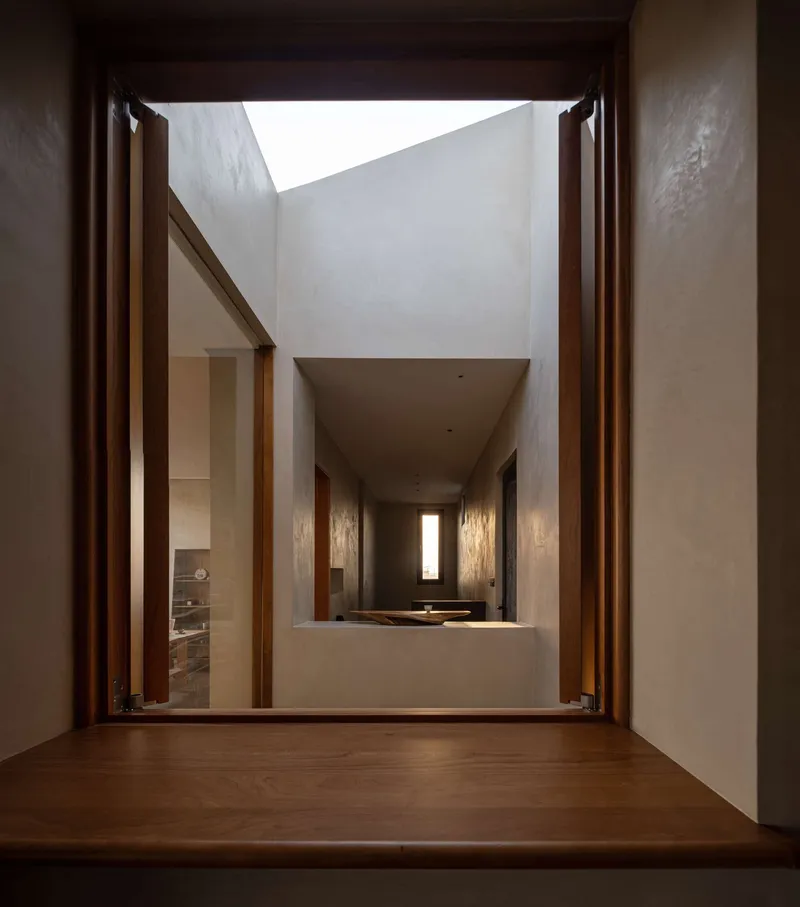
The double-height living space is the heart of the house. Sunlight streams through high clerestory windows, washing across the concrete floor and kitchen island below. The scale is generous but not cavernous; the proportions remain domestic. A timber-framed doorway opens to a double-height courtyard with white plastered walls and a skylight above, blurring the line between inside and outside in a way that recalls traditional Chinese courtyard houses without literally reproducing them.
The dining area and kitchen sit at the base of this volume, grounded by concrete floors and warmed by timber furniture. It is the kind of space where you can cook, eat, and look up to see the sky changing color through a slit of glass three meters above your head. That vertical connection to weather and time is what elevates the room beyond function.
Intimate Rooms and Framed Views

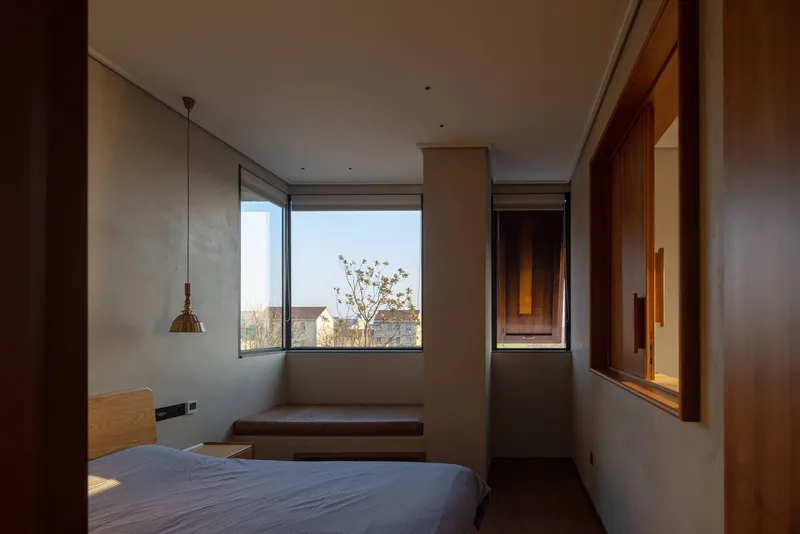
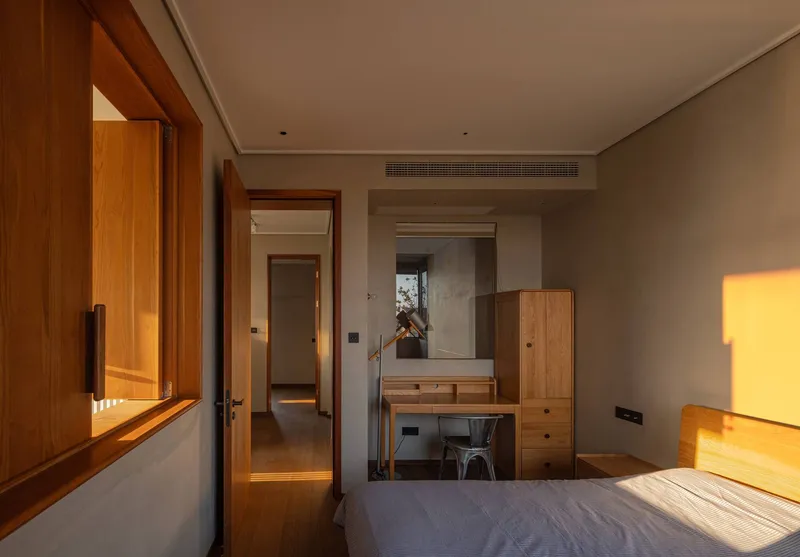
The bedrooms occupy the upper levels and are characterized by timber-framed window alcoves that function as both seating niches and viewing devices. One bedroom overlooks the fields through a deep window recess, its ensuite bathroom glimpsed beyond a partition. Another pairs corner windows with a built-in desk, creating a workspace bathed in afternoon sun. The dressing table in a third bedroom catches warm late-afternoon light through carefully placed openings, turning a mundane domestic moment into something quietly beautiful.
Throughout, the palette remains consistent: white plaster, exposed concrete, timber joinery, and black steel. The restraint is deliberate. In a house where light does most of the decorative work, competing materials would only get in the way.
Dining, Thresholds, and the Roof Terrace


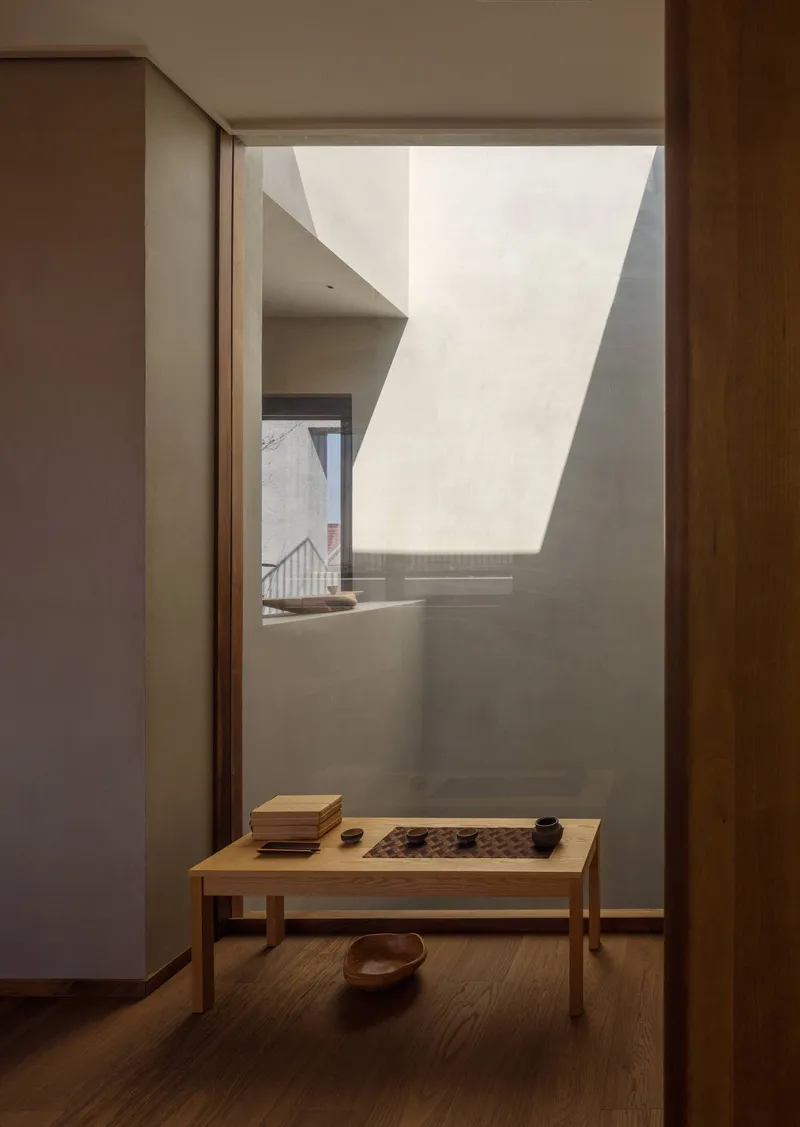
The dining room is a lesson in how to make a small room feel expansive. A round timber table sits beneath a metal pendant light, flanked by a horizontal window that frames the courtyard at eye level. Bamboo roller shades filter afternoon sunlight through corner windows, casting warm patterns across the bench and floor. A low timber table elsewhere sits beneath an angular skylight, its white plaster wall washed with a blade of daylight. These are rooms designed for sitting still and paying attention.


The rooftop terrace is the reward for the vertical climb. A recessed timber seating nook faces west over agricultural fields, perfectly positioned for watching the sunset. The terrace lifts the inhabitants above the village roofline, offering a horizon line that includes wind turbines and open sky. An exterior steel staircase alongside corrugated metal cladding and bare winter vines provides a secondary route up, adding a more rugged, utilitarian character to the otherwise refined composition.
Material Detail and Facade Texture

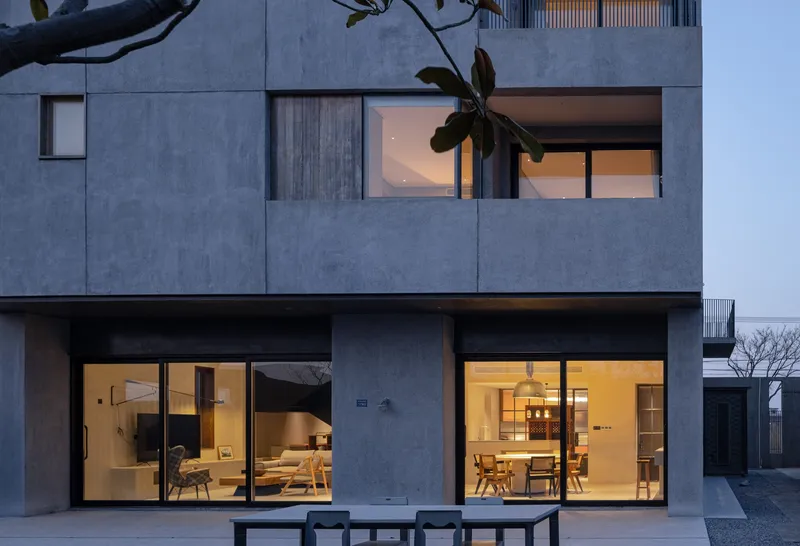

Close-up views of the facade reveal the care Benzhe Design invested in surface treatment. The concrete panels are not monolithic; they are composed of smaller blocks with visible joints, giving the walls a textured, almost woven quality. Timber shutters and glazing are set into these surfaces, sometimes flush, sometimes recessed, creating a subtle play of depth. A slatted metal fence and bare tree branches in the foreground add layers of transparency and screening.
One image captures a figure standing on the upper balcony beside the interior staircase, the recessed opening framing them like a portrait. It is a reminder that architecture at its best creates moments of inhabitation that feel composed without being staged.
Corridors and Stairwell Light
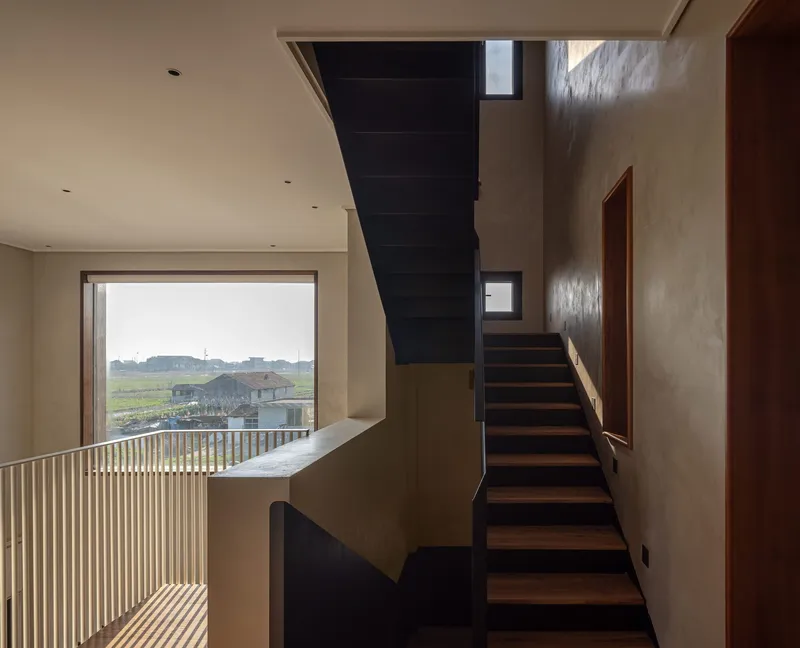
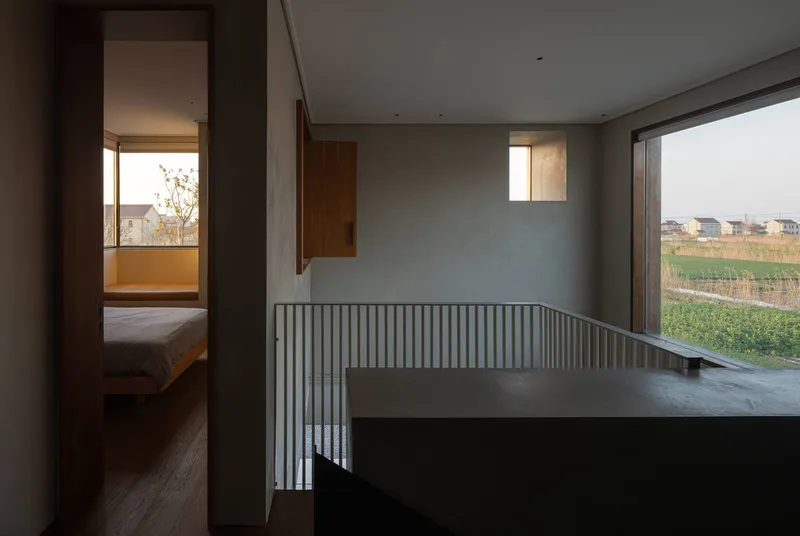
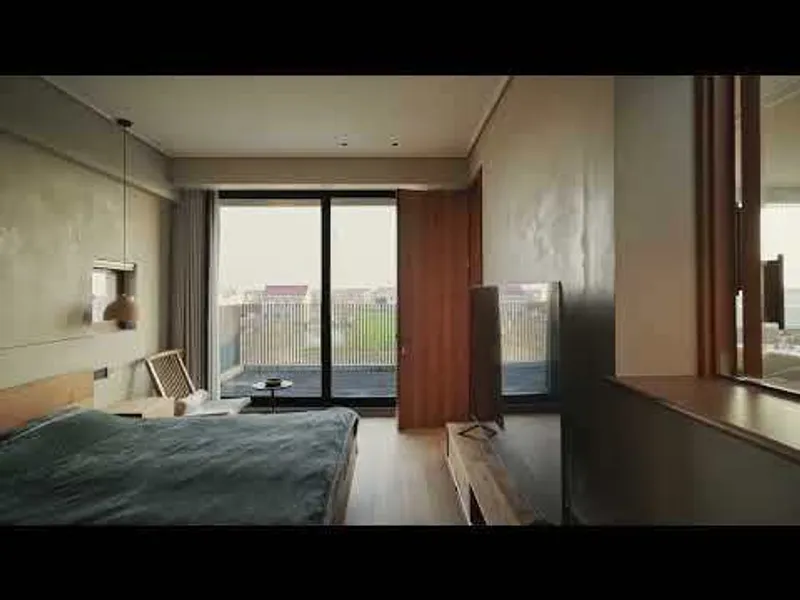
The staircase reappears throughout the house as a source of incident. An angled flight with dark metal stringers and timber treads sits beside a vertical slot window overlooking farmland, compressing the view into a cinematic strip. The upper landing opens to a bedroom through vertical slat railings, with large windows framing the rural landscape beyond. Even the bedroom with textured plaster walls and a timber divider panel treats its sliding glass doors to the balcony as a threshold worth lingering at.
These transitional moments are where the architecture distinguishes itself from a competent floor plan. The staggered half-levels mean that moving through the house always involves a slight shift in elevation, a new angle of light, a different framed view. It is architecture that rewards slow occupation.
Dusk and the Canal Edge
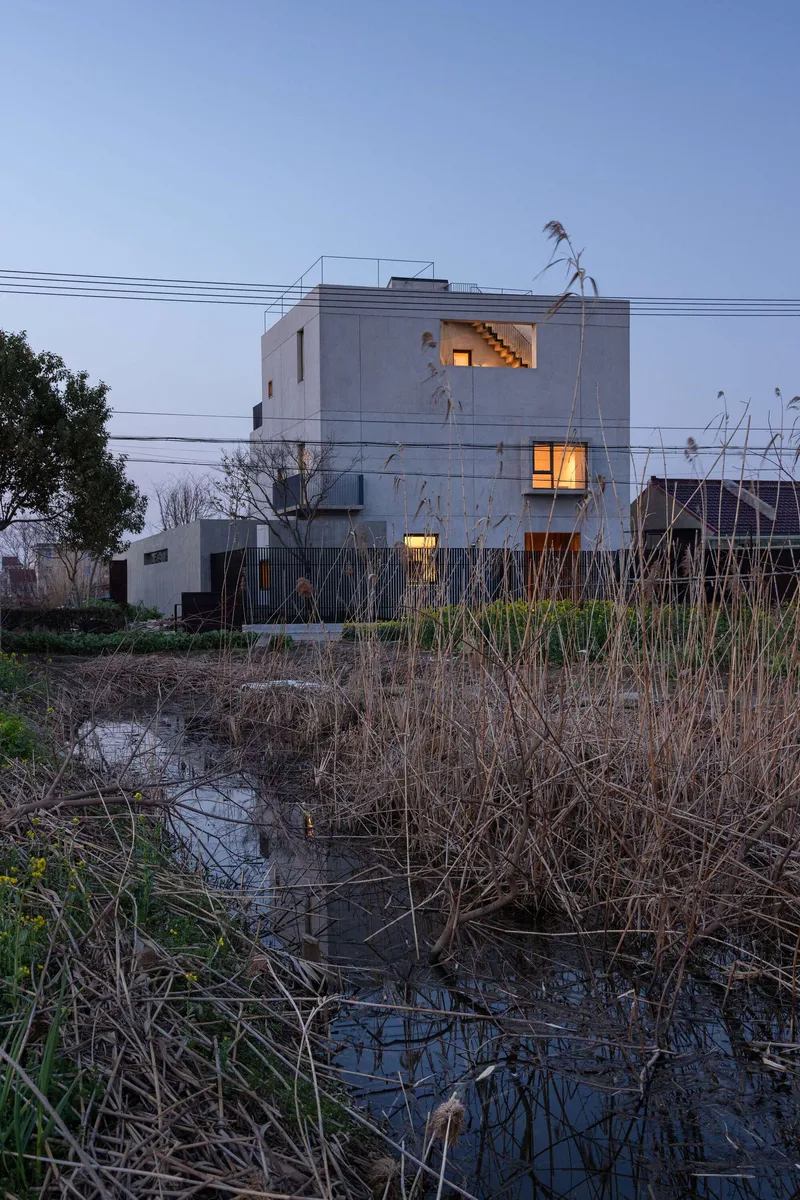
Several images capture the house at dusk, and they collectively make the strongest argument for the project. The concrete facade with lit windows across a narrow irrigation channel, the white volume rising above neighboring buildings, the cubic form glowing behind a slatted fence: these are all variations on the same theme. The house is a lantern, a signal of habitation in a landscape that empties out as younger generations leave for cities. Its luminosity is both functional and symbolic, a declaration that someone is still home.
Plans and Drawings
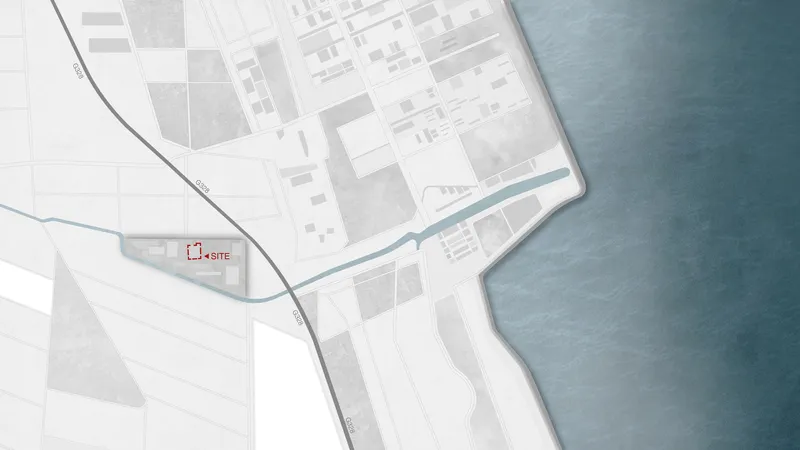

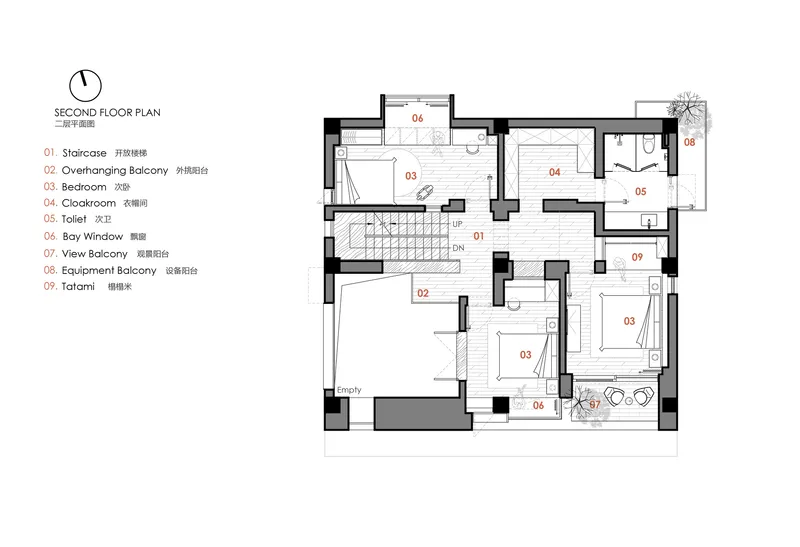
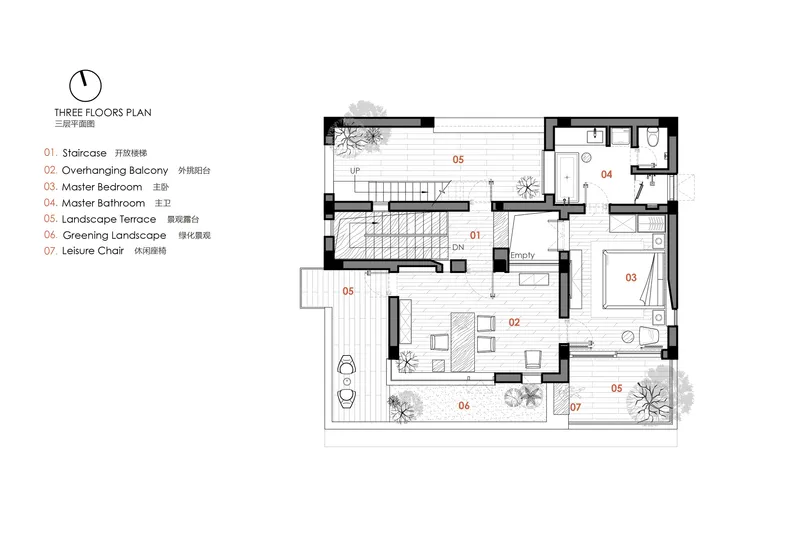


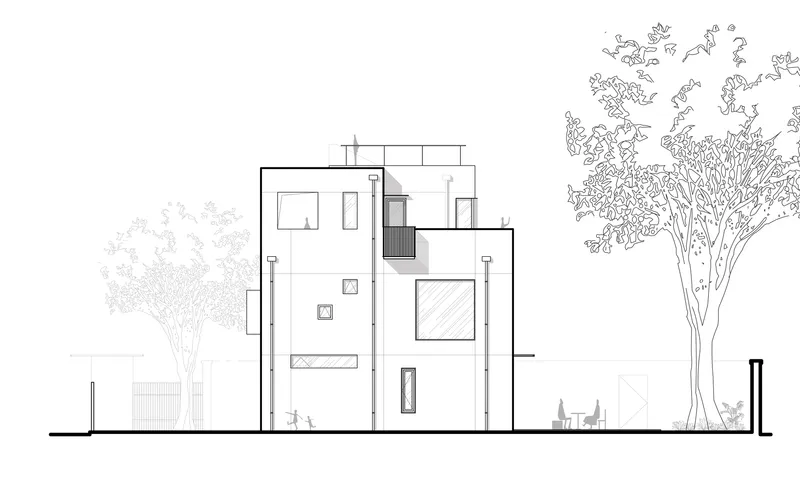
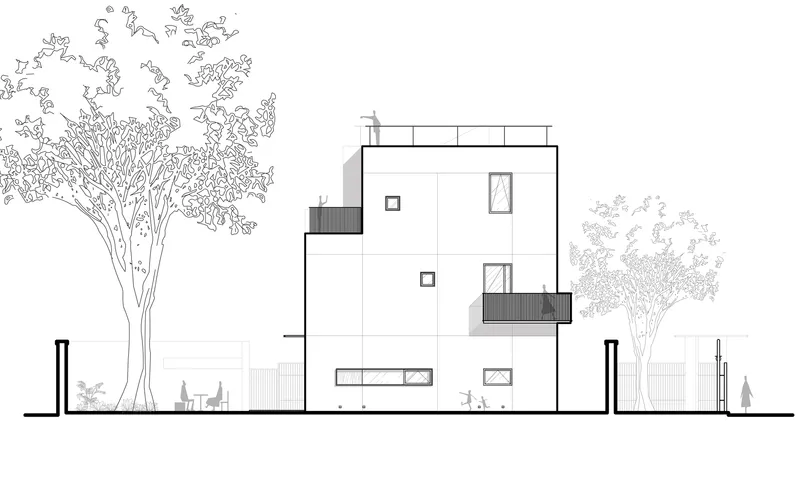

The drawings confirm what the photographs suggest: the house is organized around a central stairwell that connects staggered floor levels, with the site plan showing how the building addresses both a curving road and the canal edge. The first floor plan reveals the entrance courtyard and living areas alongside planted landscape zones, while the second and third floors progressively open up to balconies and terraces. The sections are particularly instructive, showing how the multi-level interior spaces stack to create double-height voids while maintaining a compact overall envelope. The four elevation drawings reveal the varied window composition on each face, confirming that no two sides of the house are alike.
Why This Project Matters
East Courtyard addresses a condition that is reshaping rural China: the departure of working-age adults and the question of what kind of architecture remains for those who stay. Benzhe Design's answer is neither nostalgic nor indifferent to context. The house respects the settlement pattern, uses robust materials suited to the coastal climate, and creates interior spaces that are rich in light and spatial variety. It does not pretend to be a farmhouse, but it understands why farmhouses work: courtyard logic, orientation to wind and sun, a clear distinction between public face and private garden.
What sets this project apart from the growing catalog of architect-designed rural houses in China is its restraint. At 320 square meters, it is generous but not extravagant. Its material palette is limited but deployed with precision. And its most powerful moves, the staggered half-levels, the clerestory slots, the rooftop nook facing the sunset, cost nothing in terms of finish but everything in terms of spatial imagination. For the parents who live here and the children who commissioned it, East Courtyard is proof that coming home does not have to mean going backward.
East Courtyard by Benzhe Design (lead architect: Huajian Jiang), Nantong, China. Completed 2025. 320 m². Photography by Shengliang Su.
About the Studio
Share Your Own Work on uni.xyz
If projects like this are the kind of work you want to make, uni.xyz is a place to publish your own, find collaborators, and enter design competitions.




Popular Articles
Popular articles from the community


Co-Life: Senior Housing Design That Reconnects Older Adults With the City
Co-Life reimagines senior housing design through healing gardens, shared streets, workshops, and a sustainable community across generations.

The Earth Pod: 3D Printed Homes for Resilient Refugee Communities
The Earth Pod reimagines refugee housing through 3D printed homes made from clay, combining resilience, self-sufficiency, and rapid shelter.

AL-JANNAH: Sustainable Architecture and Permaculture for Afghan Widows
AL-JANNAH uses sustainable architecture and permaculture to create resilient oasis of housing, learning, work and renewal for Afghan widows.
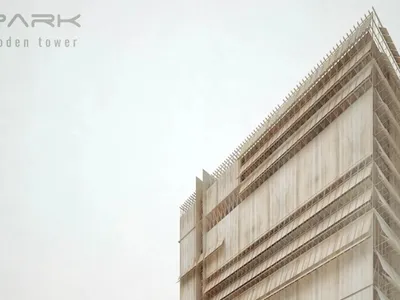
EW PARK: Sustainable Architecture Reimagines the Future of Urban Parking
EW PARK reimagines city parking as a modular wooden tower combining automation, solar energy, electric mobility, and adaptable urban design.
Similar Reads
You might also enjoy these articles

Bao Huynh Watercolor Atelier: A Serene Art Retreat in Hội An
Bao Huynh Watercolor Atelier in Hội An blends multifunctional art spaces, sustainable design, local materials, and family-friendly living in a serene environment.

Atelier Macri Concept Store Interior Design by CASE-REAL
Atelier Macri store features a "ko" counter, walnut wood details, cork displays, blending retail, gallery, and seamless customer experiences.

Manuel Vargas Izquierdo Stadium and High-Performance Sports Center: Architectural Excellence in Jalpa de Méndez
The Manuel Vargas Izquierdo Stadium blends sustainable design, inclusive sports facilities, and cultural-inspired architecture, revitalizing Jalpa de Méndez’s public spaces.

KAKR Buluh Awar Hall: Revitalizing Community and Ecology Through Bamboo Architecture
Community built bamboo hall revitalizes Buluh Awar village, empowering youth, restoring ecology, celebrating vernacular craftsmanship through sustainable architecture and culture.


Explore Chinese Small Scale Architecture Competitions
Discover active competitions in this discipline



Comments (0)
Please login or sign up to add comments
No comments yet. Be the first to comment!