

Eco-friendly Bee-siness
🐝🐝🐝

The proposed bee center project is a contribution to addressing an extremely important environmental problem of bee population decline. The center is set to be a multifunctional facility that incorporates a research complex, an educational venue and a honey production enterprise. It is designed to improve beekeeping techniques both scientifically (e.g. in terms of breeding, treating specific bee diseases, etc.) and in practice, share experience and raise public awareness of the highlighted environmental problem as well as of the industry in general.
The building is divided into three functional areas:
1. the research center;
2. the production facility;
3. the visitors' area.
Research center includes labs, working rooms, offices and a library with a reading room. Production facility incorporates production area itself, loading area with a service elevator and the apiary located on the green rooftop. Visitors’ center is designed as an edutainment area with activity rooms, workshops and an indoor amphitheater that can be used as a lecture hall or a performance venue. Bee product shop and a restaurant are also at visitors’ disposal.
The project features separation of people’s and bees’ circulation paths to create safe yet eco-friendly environment. It is achieved by multi-level design of the building as well as its positioning on the difficult terrain. The bee center itself occupies first and second floors, while ground floor contains only a parking lot. Bee center is accessible for visitors and employees through separate entrances. The apiary is located on the green roof; it is a landscape complex consisting of beehives surrounded by bee-pollinated flowers. The apiary is both the visitors’ attraction that helps to get a better understanding of bee life and the part of the production facility. Therefore, there are two roof exits on the second floor that provide easy access to the apiary: main exit for visitors and researchers and service exit for production staff. To ensure safety, it is required to wear protective equipment while in the apiary.
There are two additional options for visitors to watch bees: a live video streamed from the apiary directly to the amphitheater and a glass beehive mounted into the rooftop; its inside is open for public view, and bees can enter the hive from the outside. The latter option was inspired by the Terschelling Island Museum of Beekeeping (Lies, the Netherlands), where the big observation hive is hung from the ceiling, and visitors can closely see honeycombs constructed by bees. A set of glass tubes connecting the observation hive to the outside is used as an entrance path for bees.
It is suggested to use the following construction materials for bee center:
1. concrete for building framework, load-bearing walls and beam;
2. wood, glass and local stone for building envelope;
3. primarily wood for interior;
4. soil layer on the rooftop thick enough for growing grass and flowers.
The shape of the bee center building was chosen with respect to terrain properties and maximum allowed height, and was changed three times throughout the project development. Several points of initial statement of work were revised in order to ensure people’s safety and to meet performance requirements. Namely, the indoor amphitheater concept was chosen over open air theater and the restaurant area was enlarged to increase seating capacity in order to serve both visitors and bee center employees.
Design of the building is inspired by structures that bees create. It has to be noted beforehand that well-known hexagonal pattern (basically a honeycomb cross-section) was not used intentionally since it is featured in the design of almost every building in the beekeeping industry. Conversely, the face of the building is decorated with rectangular window cells, which evokes associations with a chunk of comb honey. Such an allusion gets even more obvious if flowers are put into such cells, just like honeycombs filled with pollen. Inside the building, it is suggested to install honey-look-alike backlit wall panels made of onyx next to the reception desk. Moreover, it is proposed to install a replica of famous Fontana delle Api (Fountain of the Bees) in the visitors’ center, which can become a local tourist attraction. The original fountain was sculpted by Italian architect G. Bernini and completed in 1644; it is regarded as one of the oldest works of art featuring bees. It consists of an open shell with three bees inside of it, coming down to the water.
The project can be expanded in the future in order to achieve is main environmental goal of increasing the bee population in the area. The expansion plan includes installation of beehives around the center within the effective bee flight distance (approx. 2-3 mi.), which would be kept by bee center researchers and production team.

Popular Articles
Popular articles from the community


Co-Life: Senior Housing Design That Reconnects Older Adults With the City
Co-Life reimagines senior housing design through healing gardens, shared streets, workshops, and a sustainable community across generations.

The Ocean Hive: Sustainable Architecture for a Self-Sufficient Civilization at Sea
The Ocean Hive imagines sustainable architecture at sea, where modular habitats, algae, wave power and ocean waste sustain a growing colony.

The Musturak Paradise: Senior Living Architecture for a Connected Future in Temara, Morocco
The Musturak Paradise reimagines senior living architecture in Temara via private homes, social spaces, culture, community, and shared care.

Conexión: Biophilic Design Reimagines High-Rise Living in Hong Kong
Conexión reimagines high-rise living in Hong Kong through biophilic design, green facades, shared spaces, daylight, water and nature within.

Similar Reads
You might also enjoy these articles

Day and Night Park: A Time-Based Urban Newsstand in Beijing
A temporary urban newsstand in Beijing blending travel, light, and reading through poetic colors, compact form, and community-focused design.

Modernist Patio Renovation in El Masnou, Barcelona by Oliver Segura Arquitectura + Cebrià Arquitectura
Modernist patio renovation blending tradition and innovation with a movable pool, leveled floors, and Catalan materials in El Masnou.

Alto Residencial Coop: Cooperative Housing Development in Santiago de Compostela by Carbajo Barrios Arquitectos
A linear cooperative housing complex blending white volumes and perforated metal façades, enhancing community living, natural light, privacy, and urban integration.
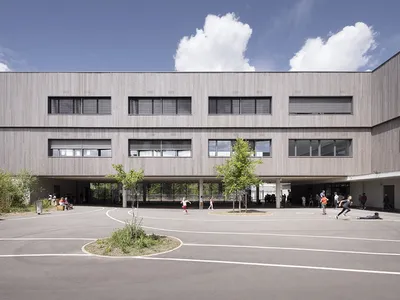
Vil Genis School by BPA ARCHITECTURE – Massy, France
Vil Genis School in Massy, France, features sustainable design, south-facing classrooms, community integration, accessible spaces, and modern educational architecture.

Explore Eco Building Competitions
Discover active competitions in this discipline


Challenge to reimagine the Iron Throne

Photograph architecture without architects

Illustrate the lost glory of Angkor Wat - Render Challenge

Design challenge to reuse E-waste
Comments (0)
Please login or sign up to add comments
No comments yet. Be the first to comment!