

Enrique Mora Builds a Culinary Ecosystem on Ecuador's Coast to Rebuild After an Earthquake
A hybrid school, restaurant, and innovation lab rises from the dunes of San Vicente, turning local food culture into a recovery engine.


When the 7.8-magnitude earthquake struck Ecuador's coast in April 2016, it killed over 700 people and gutted the productive infrastructure of Manabí province. Rebuilding after that kind of loss is never just about putting walls back up. In San Vicente, a small coastal town where the Chone River meets the Pacific, architect Enrique Mora proposed something rarer than reconstruction: a new institution. The Iche Ecosystem Culinary Innovation Center is a compact 830-square-meter campus that houses a cooking school, a restaurant, a culinary research lab, and a gastronomic business incubator, all under one roof and within one landscape. It is, in the most literal sense, architecture as infrastructure for recovery.
What makes Iche genuinely interesting is the refusal to separate the building from the program it serves. The architecture does not merely contain a culinary school; it performs the logic of one. Students grow vegetables on the premises, learn technique in a classroom on the lower level, then apply it in a working restaurant that is open to the public. Research and incubation happen alongside service. The building's L-shaped plan, its transparency, its planted courtyard, its terraces overlooking the hills and sea: all of it is organized to keep those cycles visible and interconnected. It is a building that teaches by being walked through.
Rooted in the Dunes
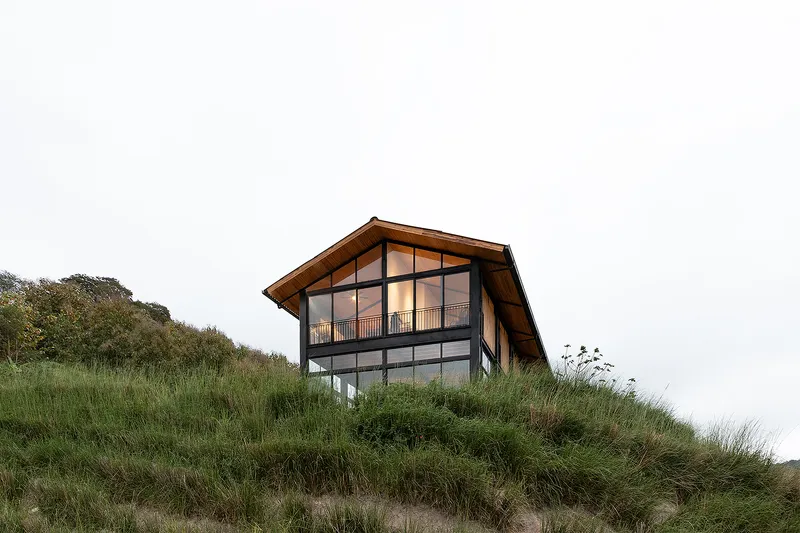

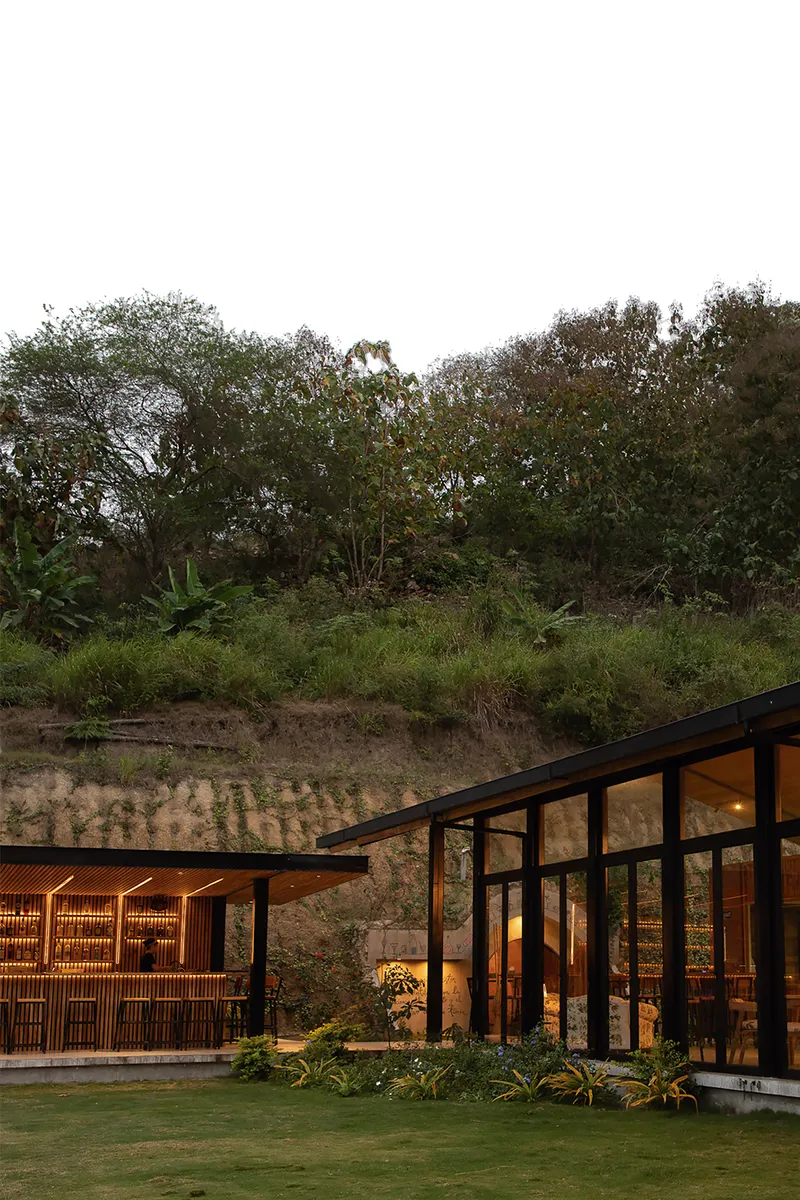
The center sits about four kilometers from San Vicente's urban core, embedded in native dune grasses on a slope that rolls toward the Pacific. The building's gabled form reads as both modest and deliberate. A steel-framed glazed facade rises over a two-story volume clad partly in timber, partly in brick, settling into the topography rather than flattening it. From the side, the structure almost disappears behind the grasses, its profile low enough to let the hillside dominate.
At twilight, the glass walls glow against the vegetated hillside, making visible the interior life of the building without announcing it. This is not a monument to gastronomy. It is a working tool set into a landscape, and the restraint of its exterior language reflects that purpose.
The Courtyard as Connector
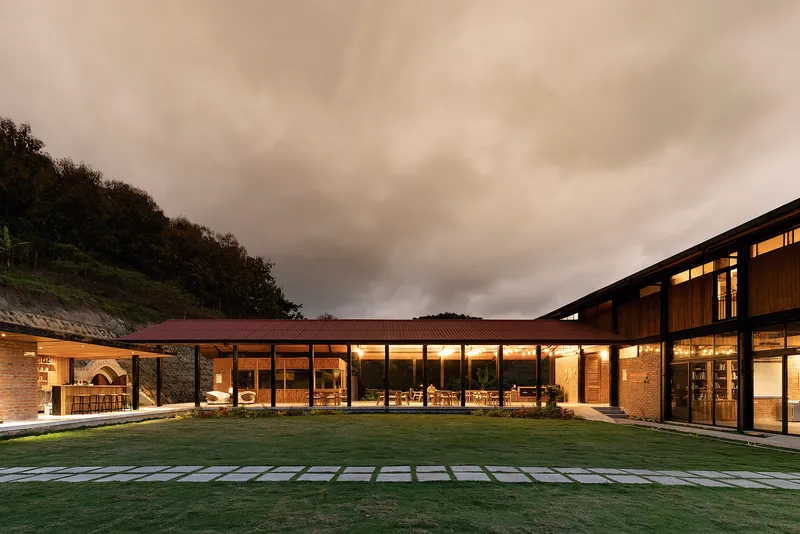

The L-shaped plan wraps around a central planted courtyard that does most of the organizational work. At dusk, the glazed facades of both wings face inward, creating a kind of lit cloister. The courtyard is not ornamental. It links the brick-clad volume housing the classroom and lab with the timber-and-glass volume of the restaurant and terrace. Herbs and produce grow here, directly connected to the kitchen, collapsing the distance between cultivation and preparation.
The covered outdoor terrace, with its timber slatted ceiling and steel columns, acts as a threshold between inside and out, between the courtyard and the broader landscape. It is one of the most generous spaces in the project: open to air and light, sheltered from rain, and positioned so that every meal served has the hills and sky as backdrop.
Structure as Expression
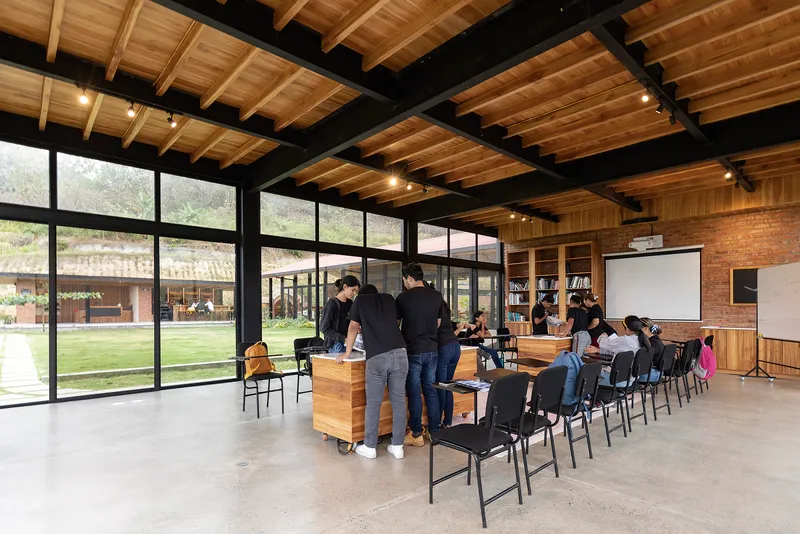
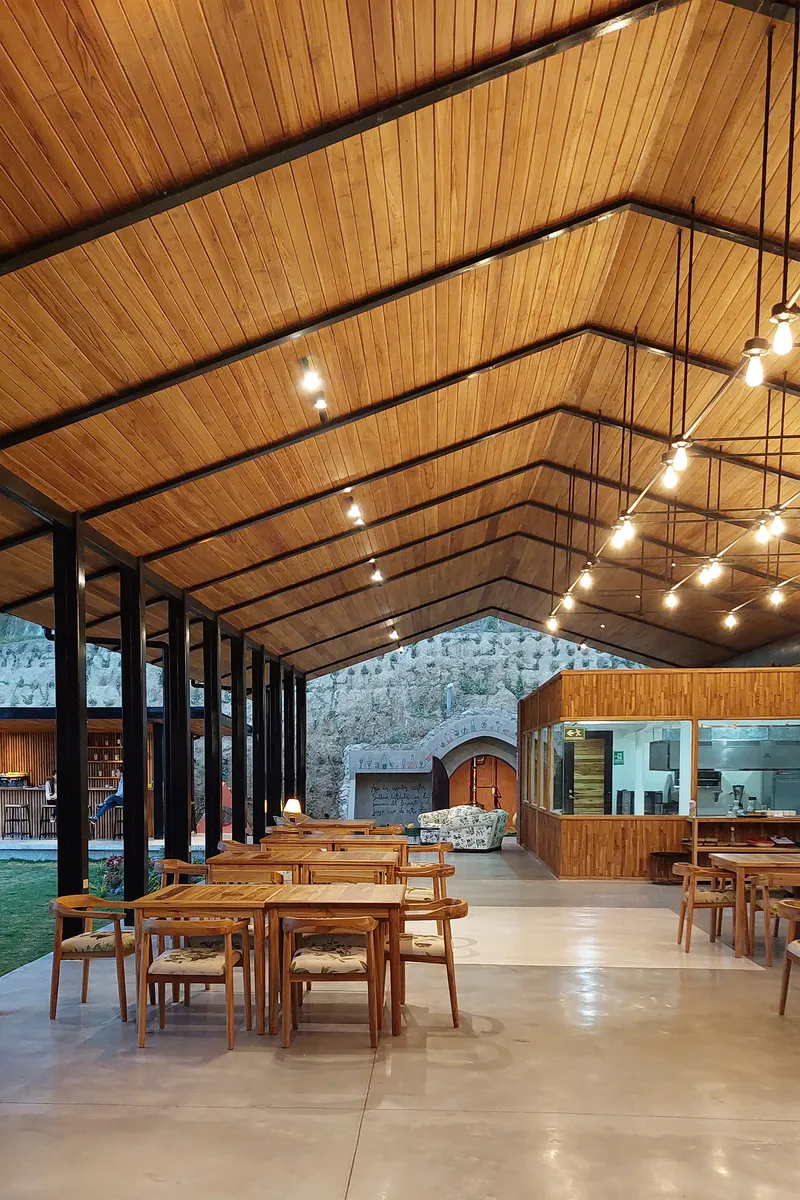
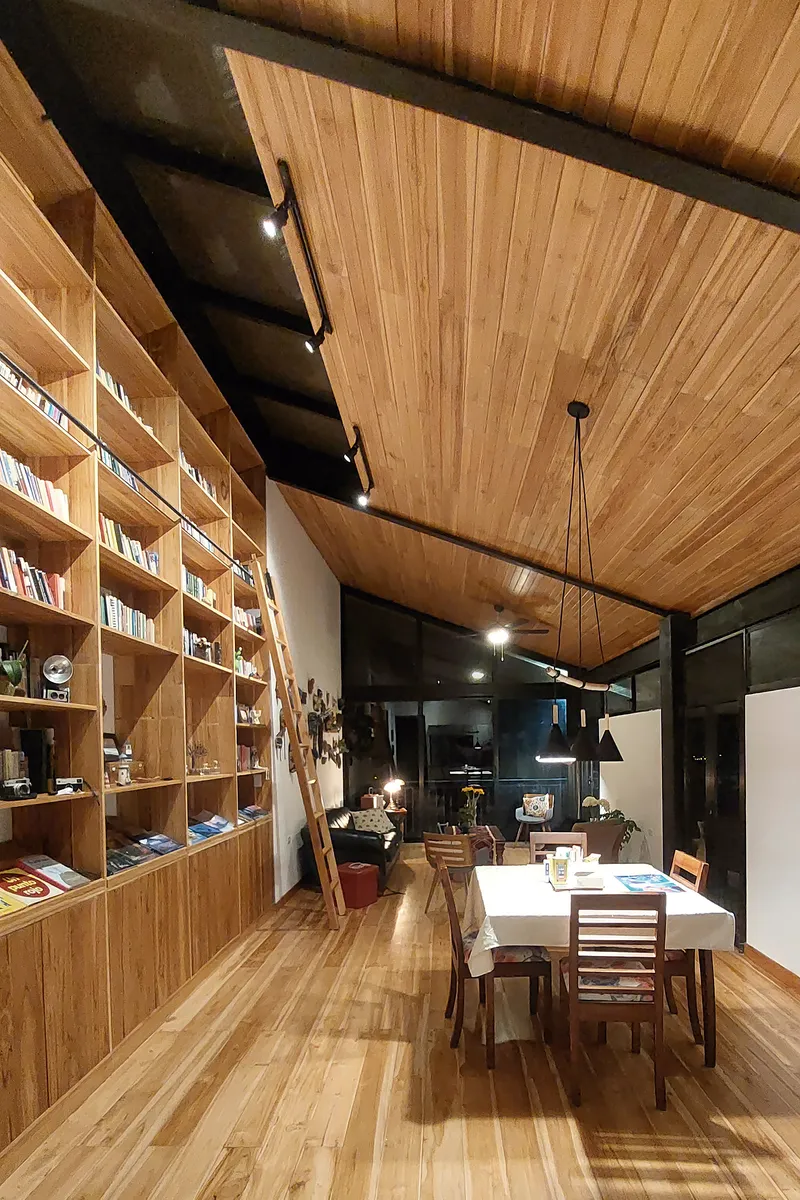
Inside, the architecture is honest about how it holds itself up. Exposed timber joists and black steel beams cross over polished concrete floors, giving every room a workshop quality. The gabled timber ceiling in the main dining hall is the most dramatic move, its pitched planes meeting along a ridge that runs the length of the space. Steel columns mark the rhythm, and string lights thread between them, softening the industrial palette into something warm enough for dinner.
A timber bookshelf wall in one dining area doubles as spatial partition and cultural statement, stacking references alongside plates. The slat ceiling above filters and diffuses light, creating a layered quality overhead that contrasts with the plainness of the concrete below. Nothing is precious. Every surface can take a spill, a rearrangement, a class of thirty students dragging chairs around. The building anticipates use, not admiration.
Open Dining, Open Landscape


The open-air dining terrace on the upper level offers the project's most expansive relationship to its site. Timber ceiling panels overhead, steel beams framing the view, and beyond them the green hills of Manabí rolling under evening light. The restaurant is not a closed box; it is a sequence of progressively more open spaces, from classroom to indoor dining to covered terrace to open sky.
An aerial perspective reveals the center's scale within its valley context. Misty mountains, a small pond, and a single-story structure tucked into the fold of the land. The building is not trying to be bigger than its setting. It is trying to be useful within it, and the scale feels right for a place where the ambition is local transformation, not global spectacle.
Plans and Drawings
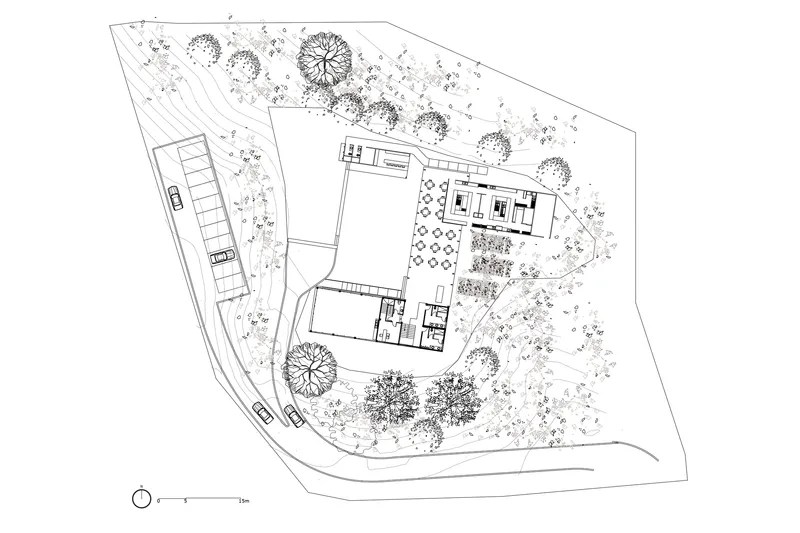
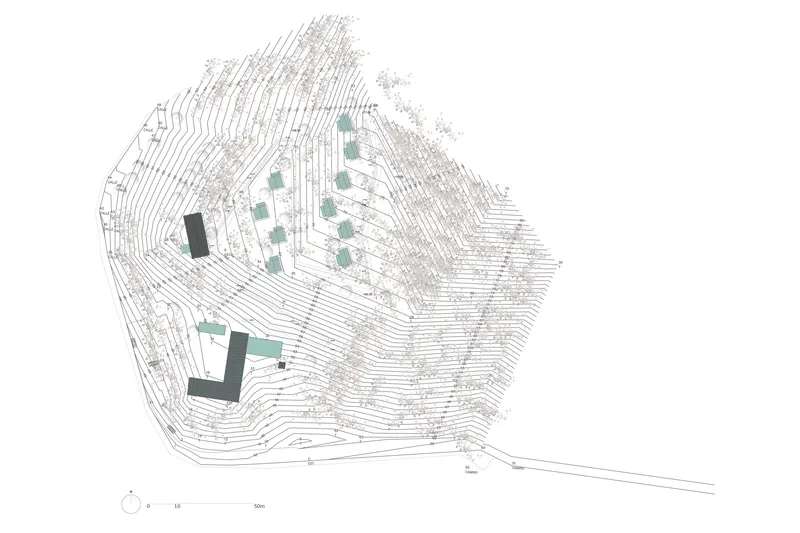
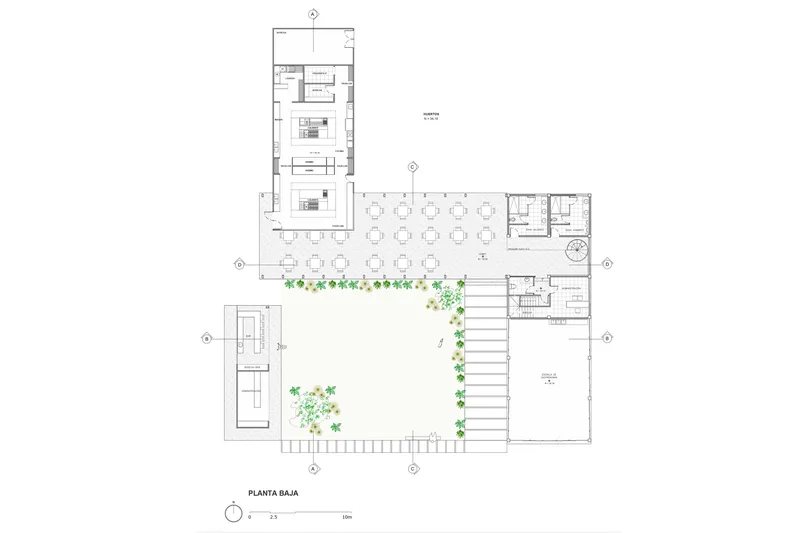

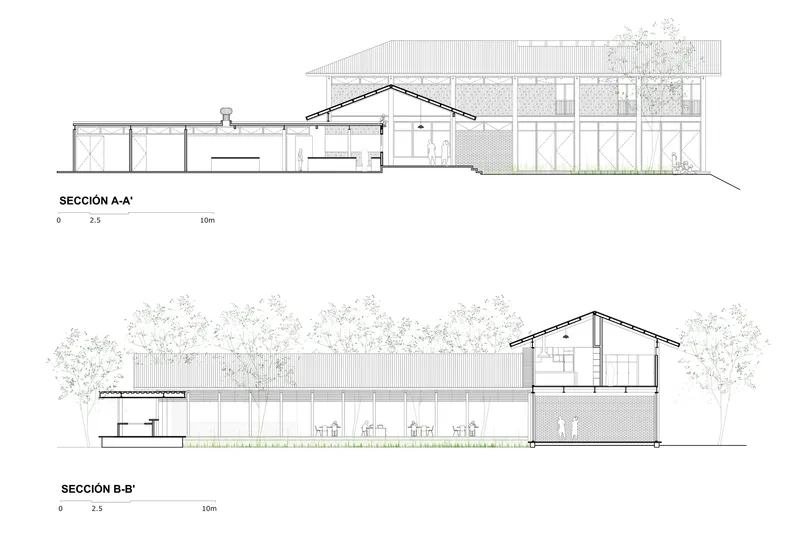
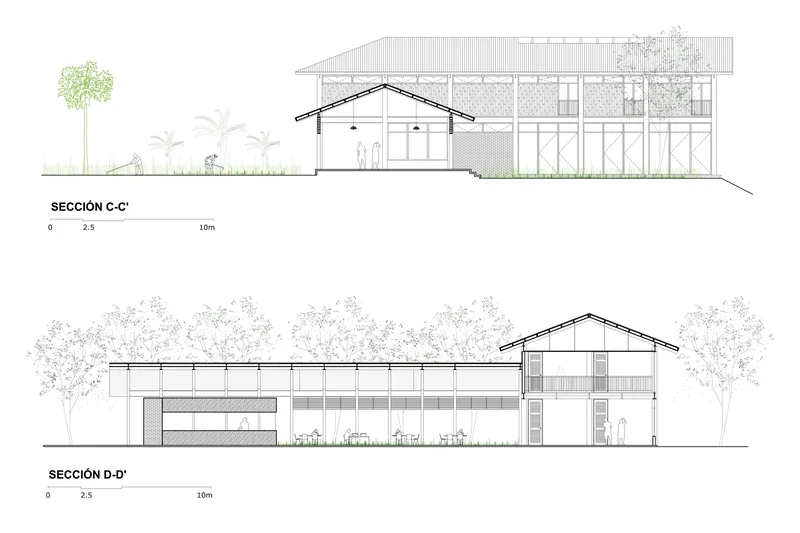
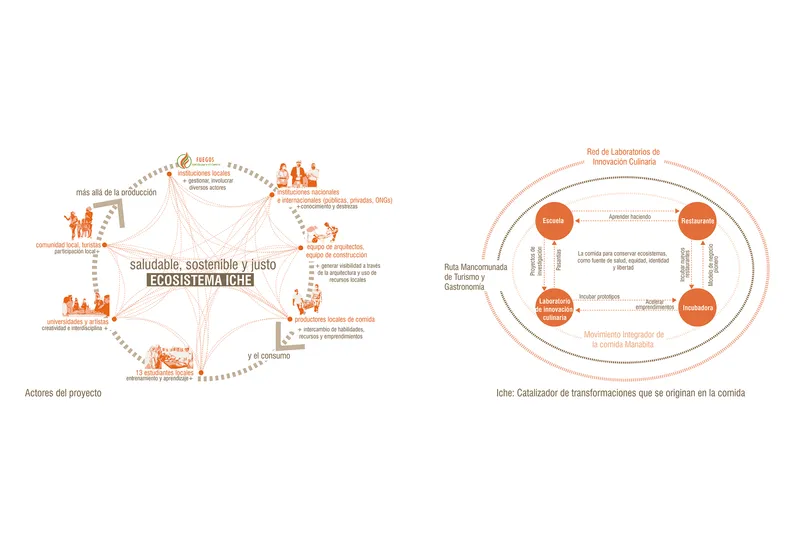
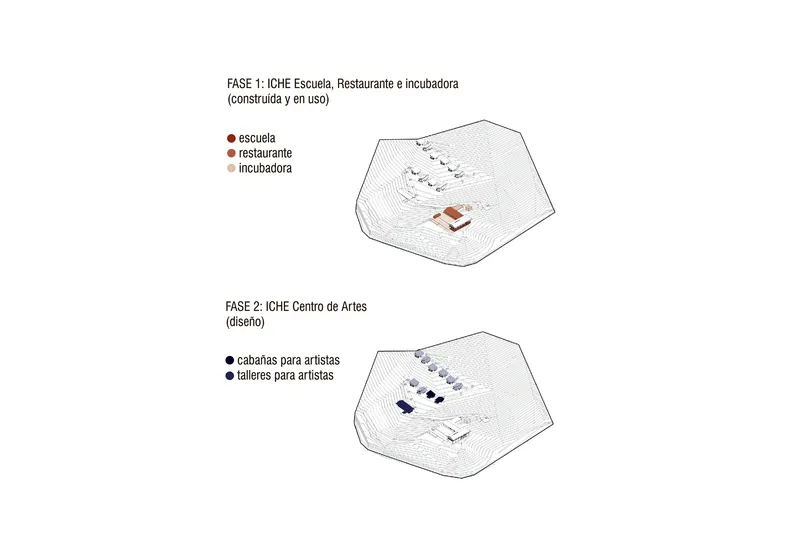
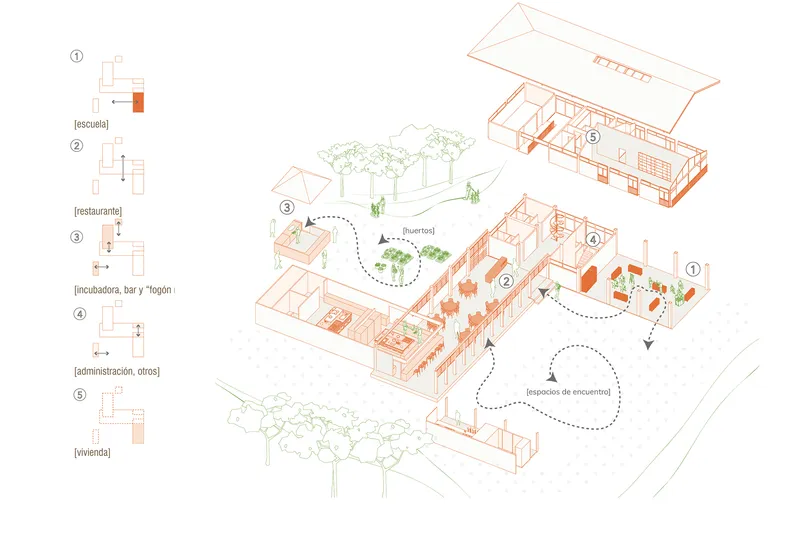
The drawings reveal the full logic of the project. The site plan shows two building footprints placed on sloped terrain, respecting contour lines and existing vegetation. The ground floor plan makes the L-shaped courtyard strategy legible: kitchen and lab in one wing, restaurant and public space in the other, a stair connecting to the upper level where the architect's living quarters occupy a quieter zone with private terraces.
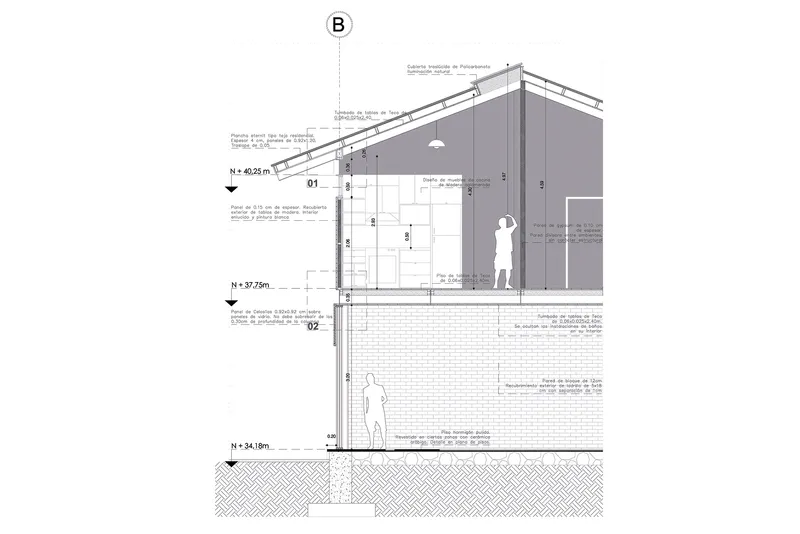
Sections cut through the pitched roof volumes, exposing the varied ceiling heights that give each interior space its own character. The detail section shows how the multilevel arrangement works, with the large classroom below and dining spaces above, connected by changes in floor level that allow views to move through the building. The programmatic diagram is particularly telling: circular flows link training, research, incubation, and production in a loop, making explicit the operational model the architecture is designed to support. The exploded axonometric shows the full campus vision, with multiple volumes arranged around courtyards, trees, and circulation paths, suggesting a phased development that could grow over time.
Why This Project Matters
Post-disaster architecture too often defaults to emergency housing or symbolic memorials. Iche does neither. It proposes that the best response to catastrophic loss is the creation of new economic and cultural capacity. By embedding a school inside a restaurant inside an incubator inside a garden, Enrique Mora designed a building that generates compounding returns: trained cooks, new food businesses, preserved culinary traditions, and a working model of how coastal communities can rebuild around what they already know how to do well.
The architecture itself is quiet and good. It does not call attention to its own cleverness. The timber, steel, glass, and brick are assembled with care but without fuss. The courtyard is generous, the terraces are well-placed, and the structural expression gives every room dignity without pretension. What elevates the project beyond competent design is the clarity of its purpose. Iche is proof that architecture can be a genuine instrument of recovery, not by housing people in the immediate aftermath, but by giving a community the productive infrastructure it needs to thrive in the decades that follow.
Iche Ecosystem Culinary Innovation Center by Enrique Mora. San Vicente, Ecuador. 830 m². Completed 2021. Photography by JAG Studio, Enrique Mora, ONG Fuegos, and Daniel Portilla.
About the Studio
Share Your Own Work on uni.xyz
If projects like this are the kind of work you want to make, uni.xyz is a place to publish your own, find collaborators, and enter design competitions.


Popular Articles
Popular articles from the community


longwave studio Reorganizes a 112 m² Tainan Apartment Around the Daily Routines of a Family and Two Cats
In Tainan, Taiwan, birch plywood, rust-red furniture and a freestanding plaster wall link arrival, storage, work and family life in one apartment.

David Ortega Stacks a Two-Story Mexico City Penthouse Around a Steel Stair and a Pergola-Shaded Roof Terrace
In Colonia Roma, a 300 m² penthouse uses oak joinery, a planted steel stair and a slatted roof pergola to make a new-build apartment feel like a house.

U.GA Architects Wraps an Oval Rooftop Pool in Curved Board-Formed Concrete on Busan's Jeollidan-gil
In Busan's Jeonpo-dong, a 454 m² mixed-use block stacks a neighborhood facility, guest rooms and an oval rooftop pool inside spiraling concrete walls.

Cube Design Draws an Ecological Corridor Between Two Shenzhen Hills with the Nankai Building
Beside Shenzhen's container docks, the Nankai Building pairs stacked balconies with a climbing green screen to connect two hillsides across its height.

Similar Reads
You might also enjoy these articles


LAVA Architecten Gives Vocational Education a Sawtooth-Roofed Face on a Mechelen School Campus
In Mechelen, Belgium, a 2,053 m² STEM school on a 6×6 m grid turns workshops and classrooms into rooms that can be rearranged as teaching changes.

KEMA Studio Turns a Derelict Marvila Attic into a 60 m² Lighthouse Apartment Above Lisbon
In Lisbon's Marvila district, a rebuilt roof, four skylights and two plywood volumes turn an unlivable attic into a bright home facing the Tagus.

Pixel Gardens: One Repeated Module Stacked Into a Terraced Social Housing Tower for Famagusta
Salem Bader's shortlisted housing tower builds a vertical neighbourhood from one repeated module, offsetting units to carve terraces, light and air.

Bao Huynh Watercolor Atelier: A Serene Art Retreat in Hội An
Bao Huynh Watercolor Atelier in Hội An blends multifunctional art spaces, sustainable design, local materials, and family-friendly living in a serene environment.

Explore Food Generation Hub Competitions
Discover active competitions in this discipline

Challenge to reimagine the Iron Throne

Photograph architecture without architects

Illustrate the lost glory of Angkor Wat - Render Challenge

Design challenge to reuse E-waste
Comments (0)
Please login or sign up to add comments
No comments yet. Be the first to comment!