
Erevna
Innovation hub

Construction system:
The main supportive structure is made by concrete. The two basements is also made by concrete. The main five floors building is made in a steel construction.
The facade all around the building is made by aluminium and glass. Some of the glass is windows which can be opened.
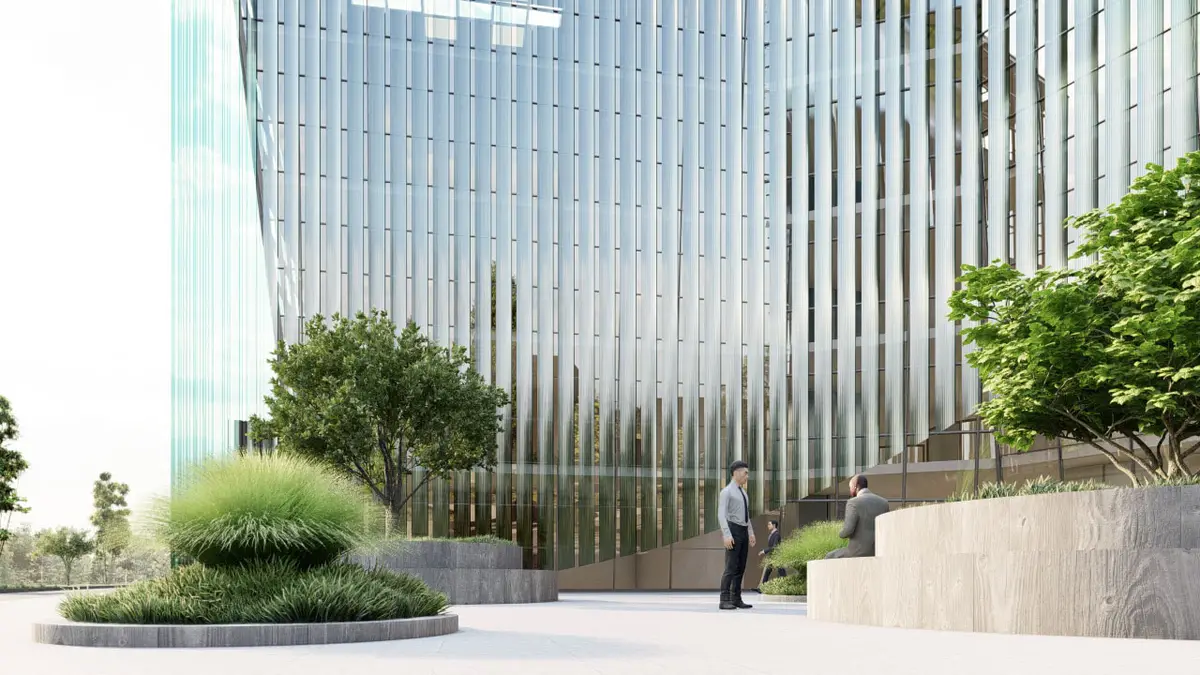
All around the building is vertical glass panels made by see-through glass with in-build sun energy. The distance from the main buildings are between 2 and 5 meters wide. The panels produces energy and isolates the building, both against the cold and the heat.
The roof is also a steel construction with in-build solar panels. Between these are holes for day light.
Material:
Concrete
Steel
Aluminium
Glass
Plastic
Wood
See-through glass with in-build vertical solar panels
Idea and vision of the building:
The idea is to build three towers, each got a conic shape on the three sides and is straight on the forth.
Each tower has five floors, which gives space to 30 different companies.
On the ground floor, between the towers, is a common lobby for all the different businesses to meet customers and each other, if they choose to do so, but also for reception and administration.
On the top floor is canteen and kitchen for all the companies.
Rooms and functions:
Each floor got six closed areas for separate companies, plus two areas for companies with open space.
The basement 1 and the basement 2 is an area for parking, food and kitchen preparation and store rooms for all the companies. The basement is also location for changing clothes.In the basements are also the engineering rooms for the vertical solar panels, as well as storage for the energy.
Because of the towers each floor got three closed areas for the big companies, with one big open space between them that gives room for smaller companies and small open offices.
Around the towers is a outer wall of vertical solar panels that moves according to the movements of the sun, thus optimizing the production of energy. The individual rooms on the inside are also able to move the panels, to get air.
The see-through glass makes it possible for everybody to see all of the surrounding nature.
Build into the walls are thin power elements like the ones in car rear windows, for providing warmth. At the same time the space between the towers and the outer structure is giving room for air circulation that both isolates and ventilate the building on the inside.
The panels and the materials are all of our own design.
This construction we feel is the best possible both for the environment and for saving energy.


Popular Articles
Popular articles from the community


Co-Life: Senior Housing Design That Reconnects Older Adults With the City
Co-Life reimagines senior housing design through healing gardens, shared streets, workshops, and a sustainable community across generations.

Little Red Riding Hood: Architectural Design as a Journey Through Fear, Light, and Storytelling
Little Red Riding Hood reimagines the fairy tale through architectural design shaped by fear, light, scale, memory, uncertainty, and choice.

Lunar Spiral: Space Architecture Shaped by the Mathematics of the Universe
Lunar Spiral reimagines space architecture through Fibonacci geometry, lunar regolith, levitating habitats, and self-sustaining Moon living.

The Musturak Paradise: Senior Living Architecture for a Connected Future in Temara, Morocco
The Musturak Paradise reimagines senior living architecture in Temara via private homes, social spaces, culture, community, and shared care.

Similar Reads
You might also enjoy these articles

Day and Night Park: A Time-Based Urban Newsstand in Beijing
A temporary urban newsstand in Beijing blending travel, light, and reading through poetic colors, compact form, and community-focused design.

Modernist Patio Renovation in El Masnou, Barcelona by Oliver Segura Arquitectura + Cebrià Arquitectura
Modernist patio renovation blending tradition and innovation with a movable pool, leveled floors, and Catalan materials in El Masnou.

Alto Residencial Coop: Cooperative Housing Development in Santiago de Compostela by Carbajo Barrios Arquitectos
A linear cooperative housing complex blending white volumes and perforated metal façades, enhancing community living, natural light, privacy, and urban integration.
Vil Genis School by BPA ARCHITECTURE – Massy, France
Vil Genis School in Massy, France, features sustainable design, south-facing classrooms, community integration, accessible spaces, and modern educational architecture.

Comments (0)
Please login or sign up to add comments
No comments yet. Be the first to comment!