
Esteras Perrote Builds a Painter's Refuge Between Two Dry Riverbeds in the Argentine Mountains
Atelier Cambre gives artist Juan José Cambre a five-metre-tall studio nestled among coco and algarrobo trees at 1,200 metres above sea level.


Painting outdoors is a romantic idea until the sun shifts, the wind picks up, or the rain arrives. For Argentinian artist Juan José Cambre, the ideal workspace would recreate the expansiveness of open-air painting while offering the controlled conditions a studio demands. Esteras Perrote, led by Lucía Esteras and Gonzalo Perrote, answered with Atelier Cambre: a brick compound in the village of Los Cocos, deep in Córdoba's Punilla Valley, where two rotated rectangular volumes generate a building that is simultaneously tower, gallery, living quarters, and landscape frame.
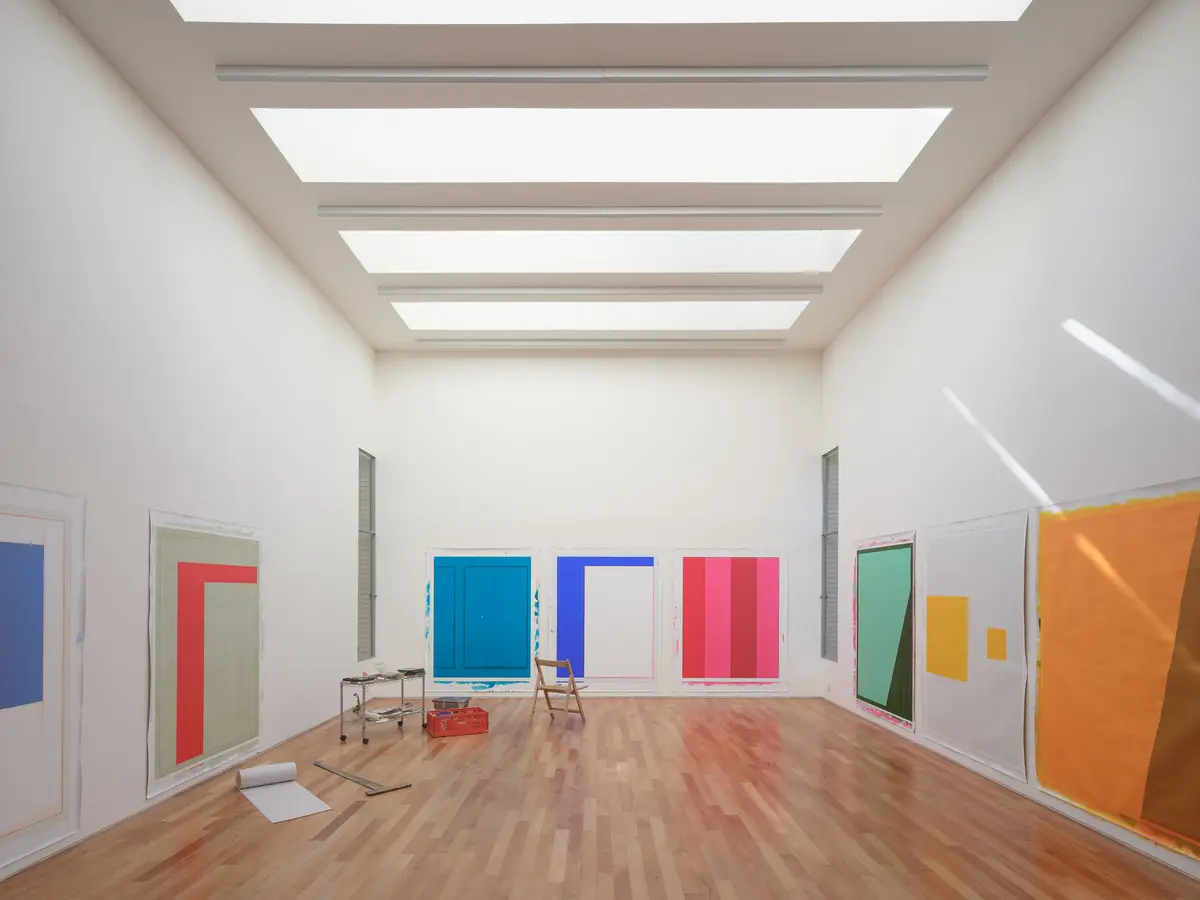
The site sits in a clearing locals call "el pantano" (the marsh), crossed by two mountain water courses that run dry most of the year. At 1,200 metres above sea level, surrounded by native coco and algarrobo trees, the terrain is irregular and steep. The architects responded not with a single box but with a geometric operation: two rectangles pivoting from a shared fixed point, their overlap subtracted to produce a third volume dedicated to circulation and services. The result is an angular courtyard that funnels views of the forest inward, while the five-metre-tall painting space at its core captures even northern light through long parallel skylights.
A Brick Tower in the Forest Canopy
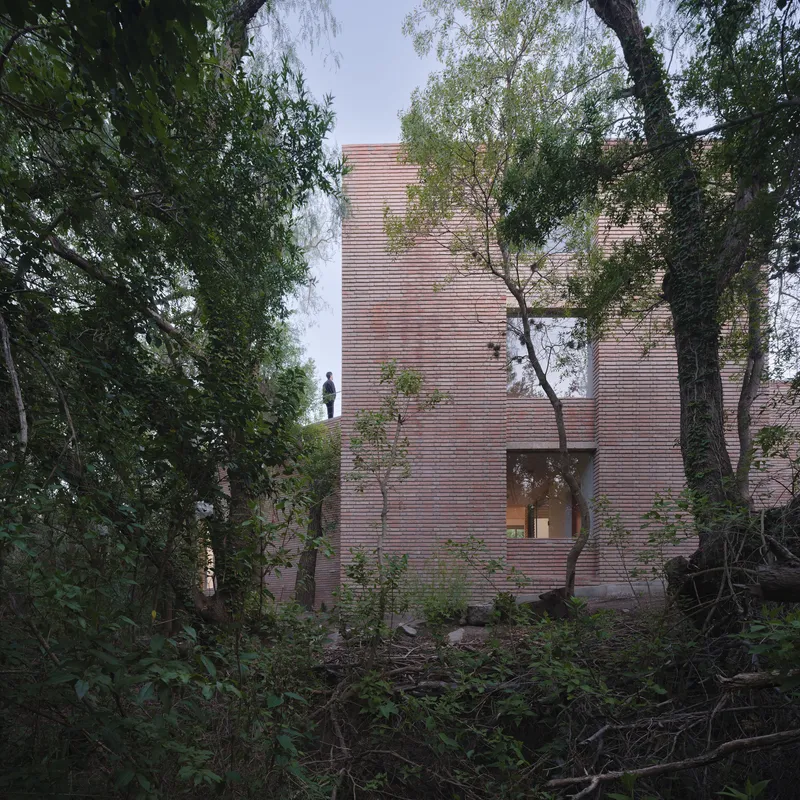
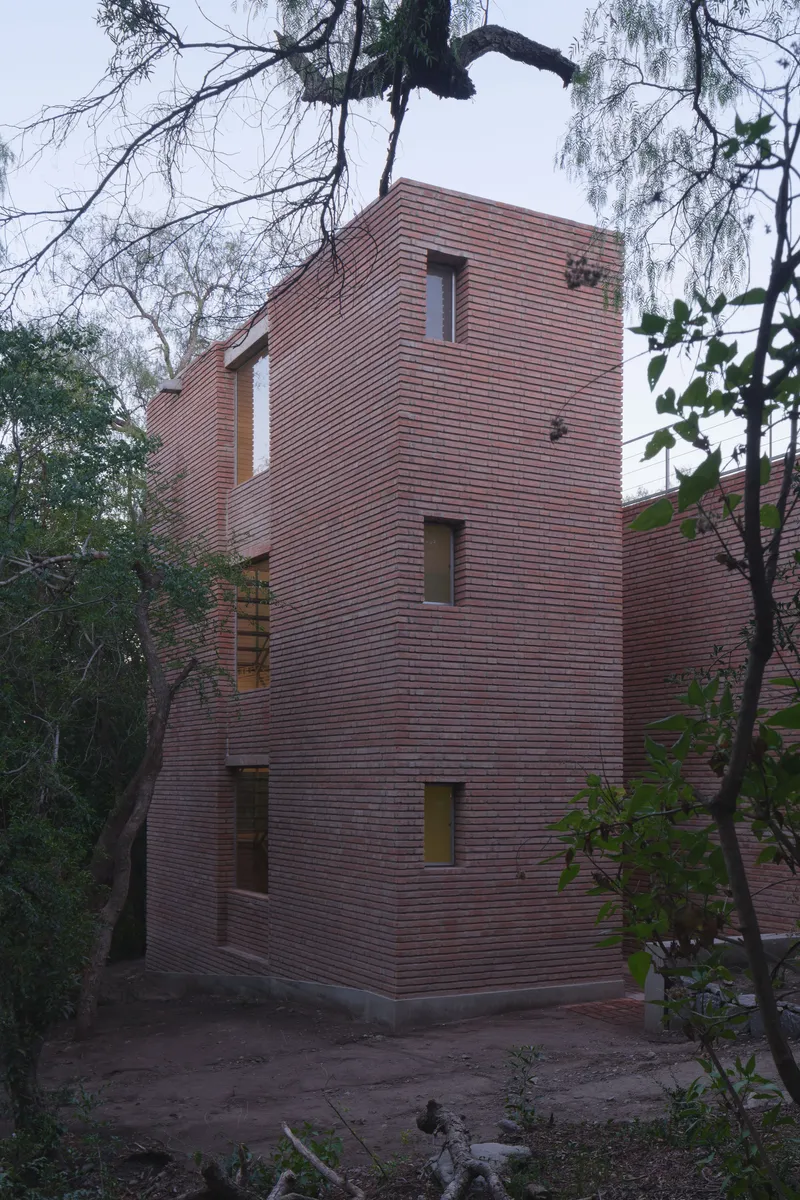
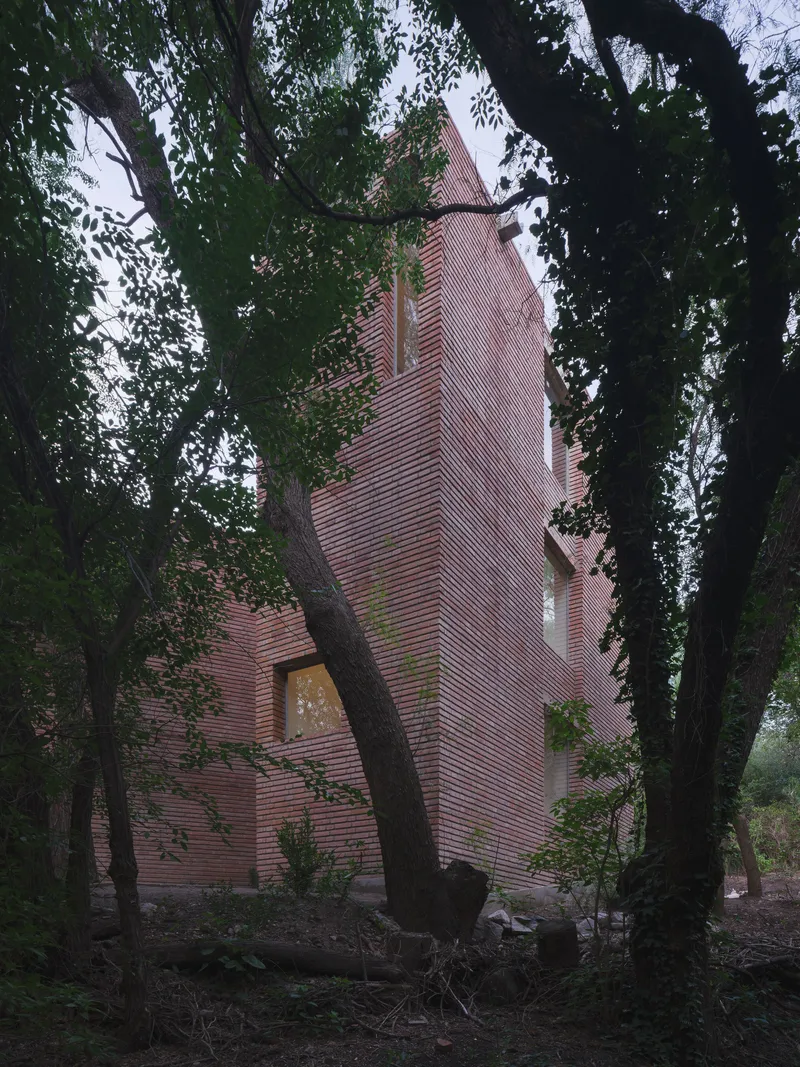
The most striking reading of Atelier Cambre from the outside is vertical. A three-story brick tower rises through the tree canopy with the quiet authority of a campanile, its scattered windows punched into the masonry like carefully chosen apertures in a camera obscura. Each opening frames a specific fragment of the surrounding landscape rather than offering panoramic views. The architects clearly understand that what you exclude from a frame matters as much as what you include.
The horizontally striated brickwork gives the facades a pronounced grain that reads differently depending on light and distance. At dusk, the warm tones of the brick merge with the bark of adjacent trunks, making the building feel less like an intrusion and more like a geological event, something that was always going to emerge from this particular clearing.
Two Volumes Rotating Into Place
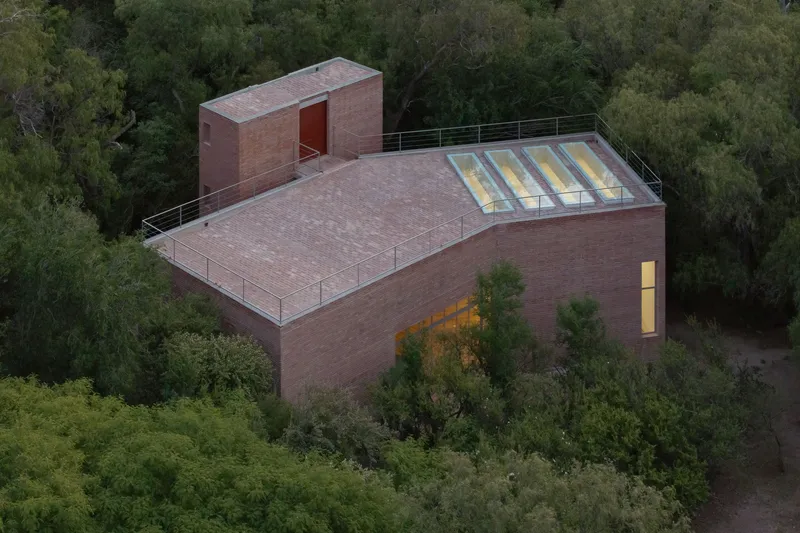
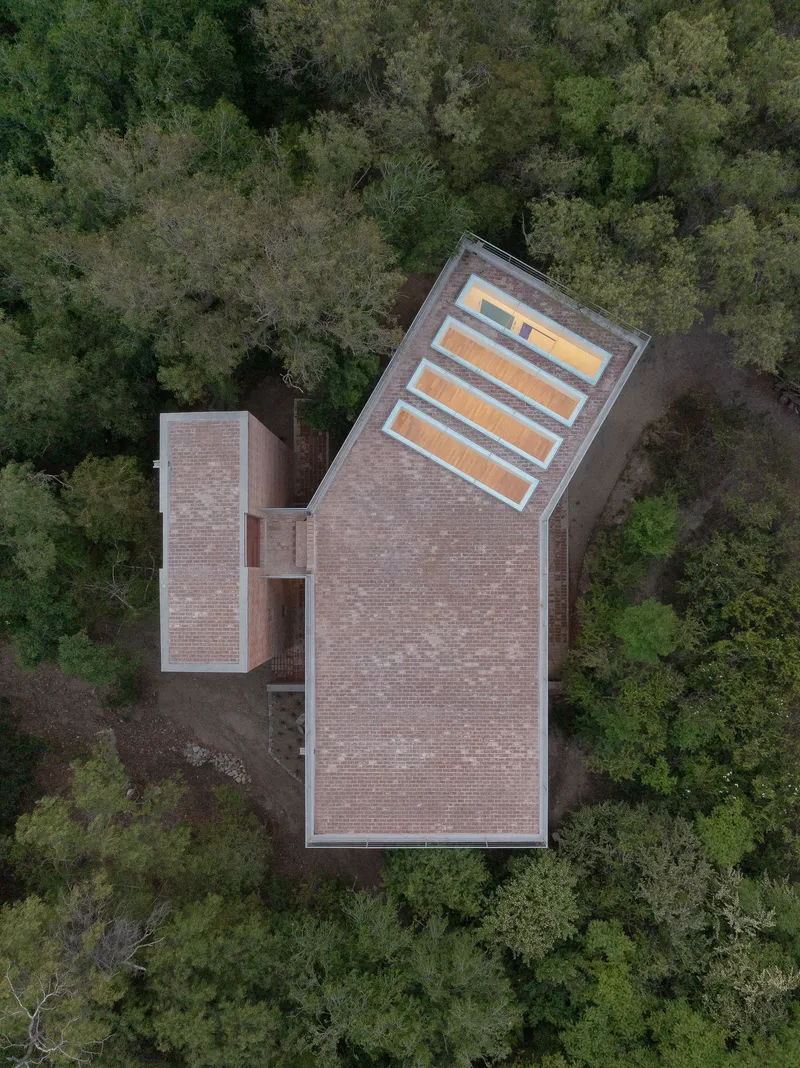
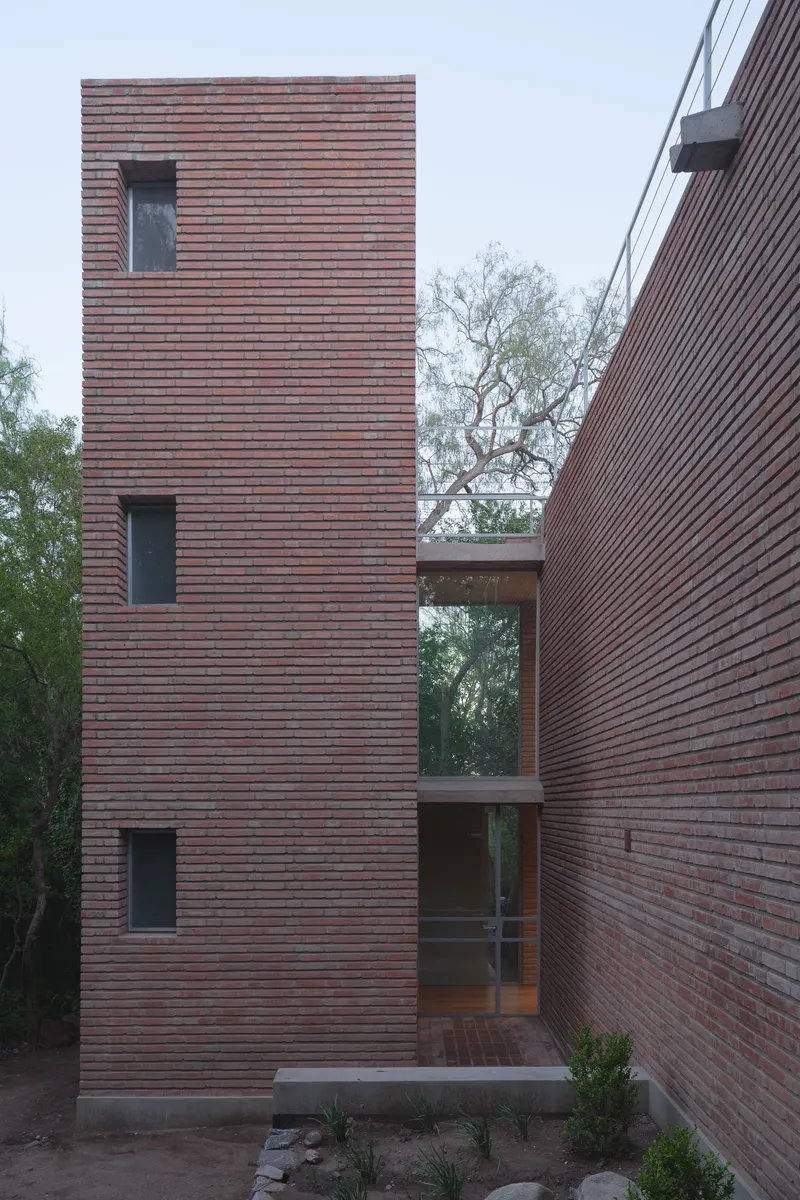
Seen from above, the geometric logic becomes legible. Two rectangular volumes sit at a slight angle to each other, connected by a glazed bridge. The rotation is not arbitrary; it positions each wing to embrace a different aspect of the hillside while generating the courtyard that serves as an outdoor extension of the studio. A separate service volume configures the arrival sequence, keeping pragmatic functions (storage, circulation, mechanical) from cluttering the creative spaces.
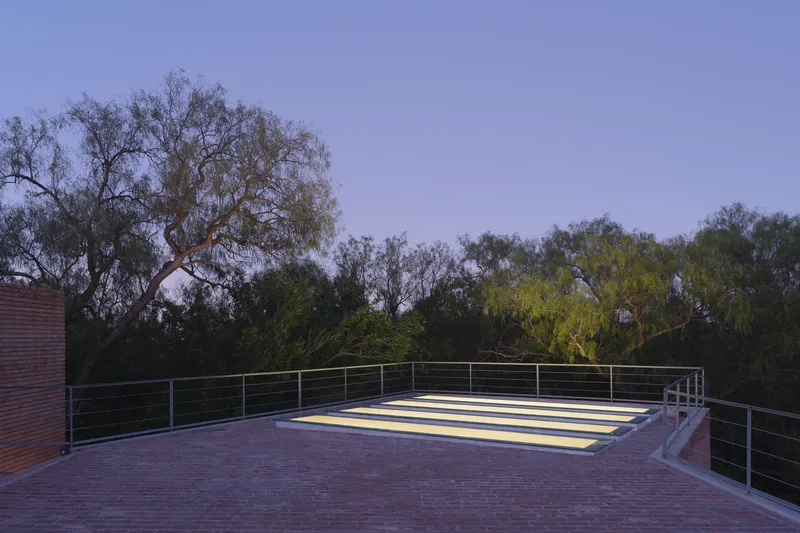
The slatted skylight running between the volumes is the building's spine. It floods the central painting space with diffused light while remaining nearly invisible from the forest floor. The flat roofs, visible only from the air, carry a terrace with cable railings where Cambre can survey the canopy and, presumably, consider his next canvas.
The Five-Metre Studio and Its Light
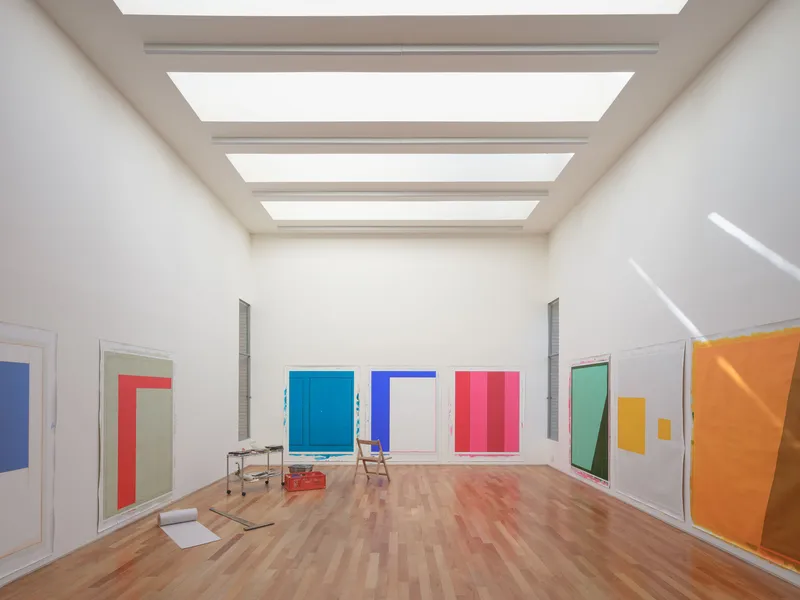
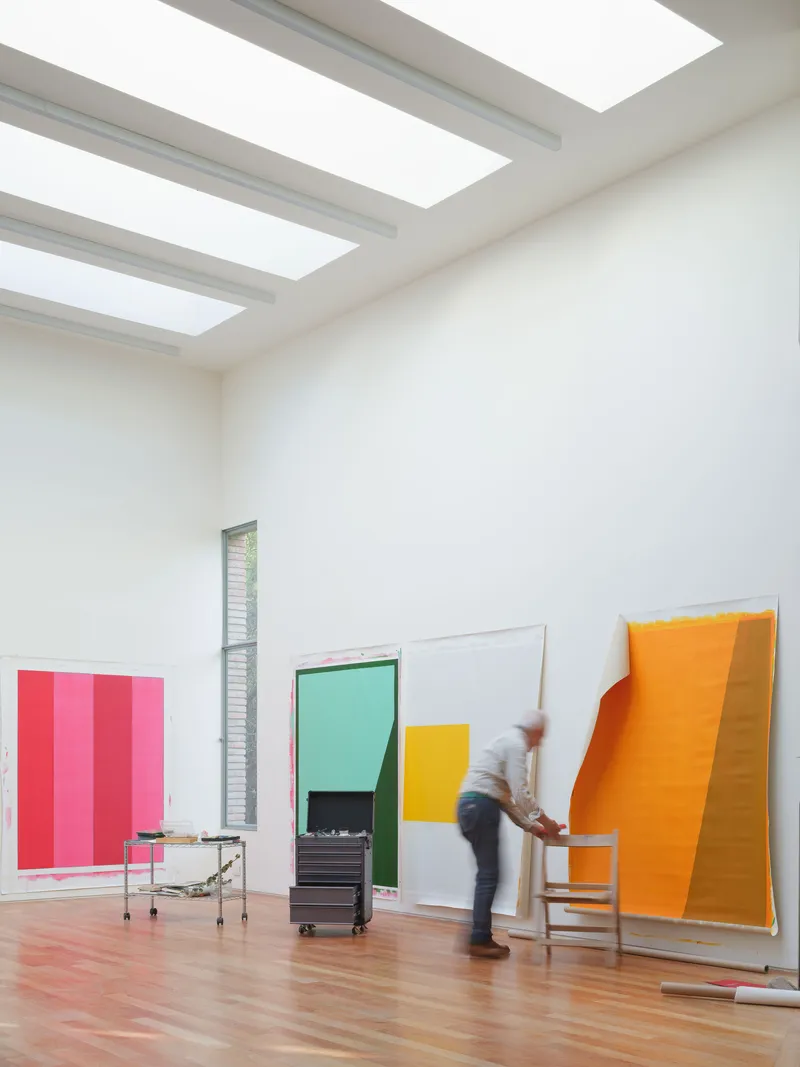
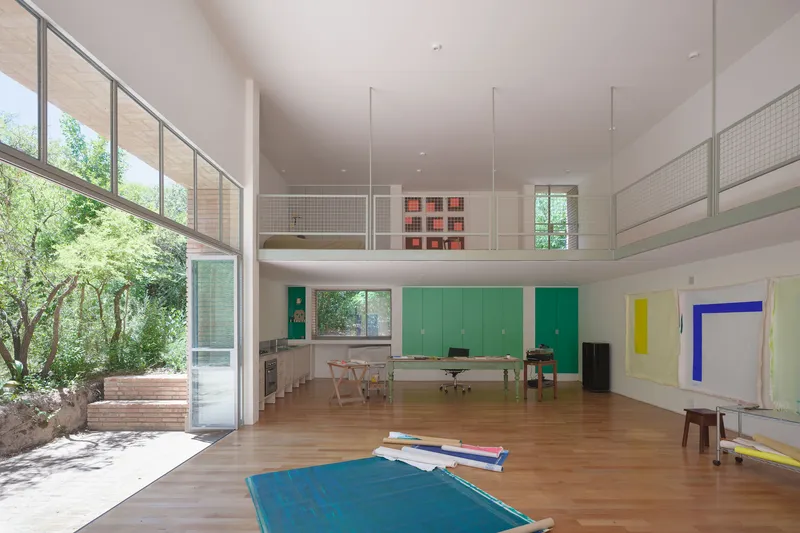
The heart of the project is the double-height painting space. Four parallel skylights run the length of the ceiling, casting even, gallery-quality light across polished timber floors. Canvases lean against white walls, large-format geometric compositions in Cambre's characteristic palette of saturated colour fields. The room functions equally well as studio and exhibition space, which is a pragmatic stroke: the artist can work and present without moving a single piece.
A wire-mesh mezzanine railing allows the bedroom level above to borrow the same volume and light. Standing on the upper level, you look down over the studio and out through a doorway that frames green foliage in a tight vertical rectangle. The architects treat every opening as a composition, and it shows. There is no casual glazing here.
Where the Studio Meets the Forest
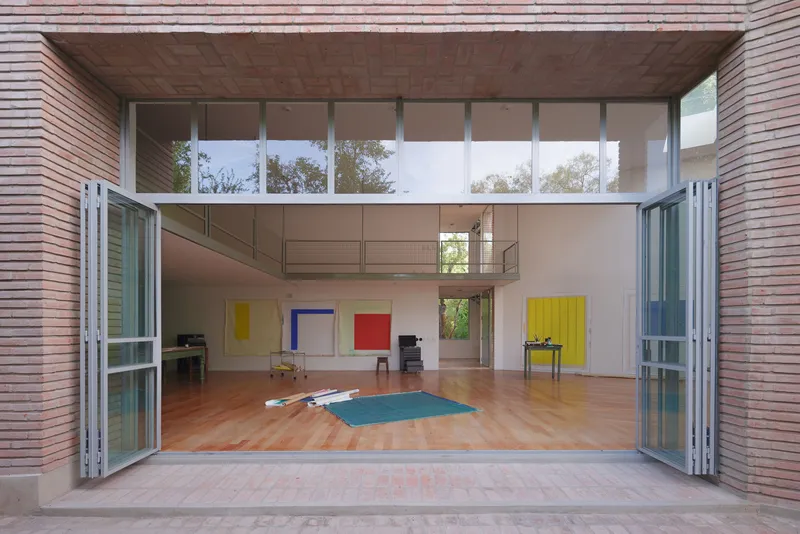
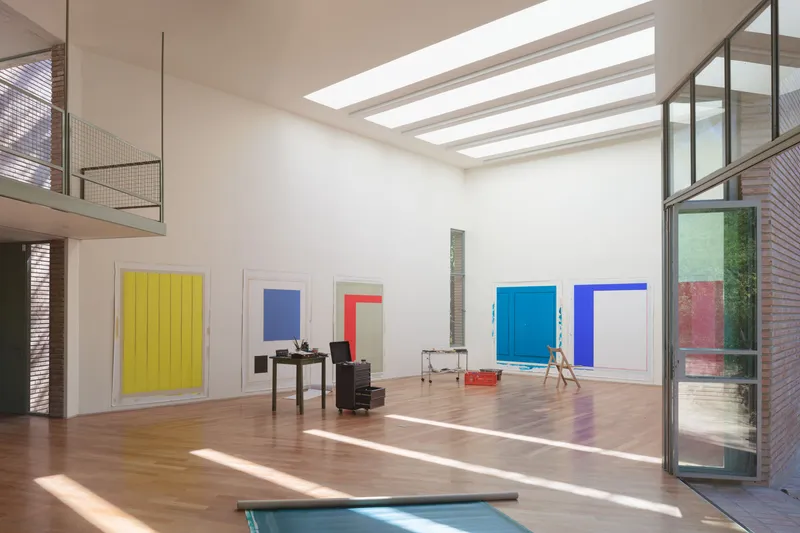
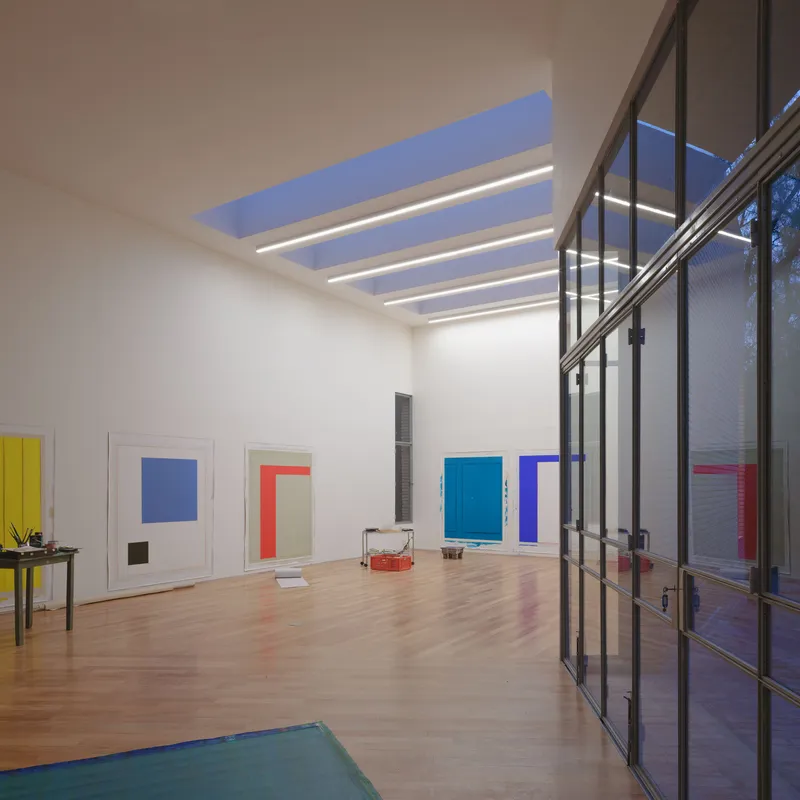
The folding steel-and-glass doors along one wall of the painting space are the mechanism that collapses the boundary between indoors and out. When fully open, the studio floor extends visually onto a brick-paved courtyard and into the trees beyond. This is the moment the building delivers on its founding ambition: the feeling of painting outdoors with the option of closing everything up when conditions change.
At dusk, with the skylight bands glowing overhead and the doors thrown wide, the interior becomes a lantern within the forest. The pivoting steel panels catch the last light, and the space acquires a theatrical quality that the photographs capture well. It is a building designed to perform at the edges of the day, when the light is most interesting and the forest most atmospheric.
Brick, Timber, and the Courtyard Between
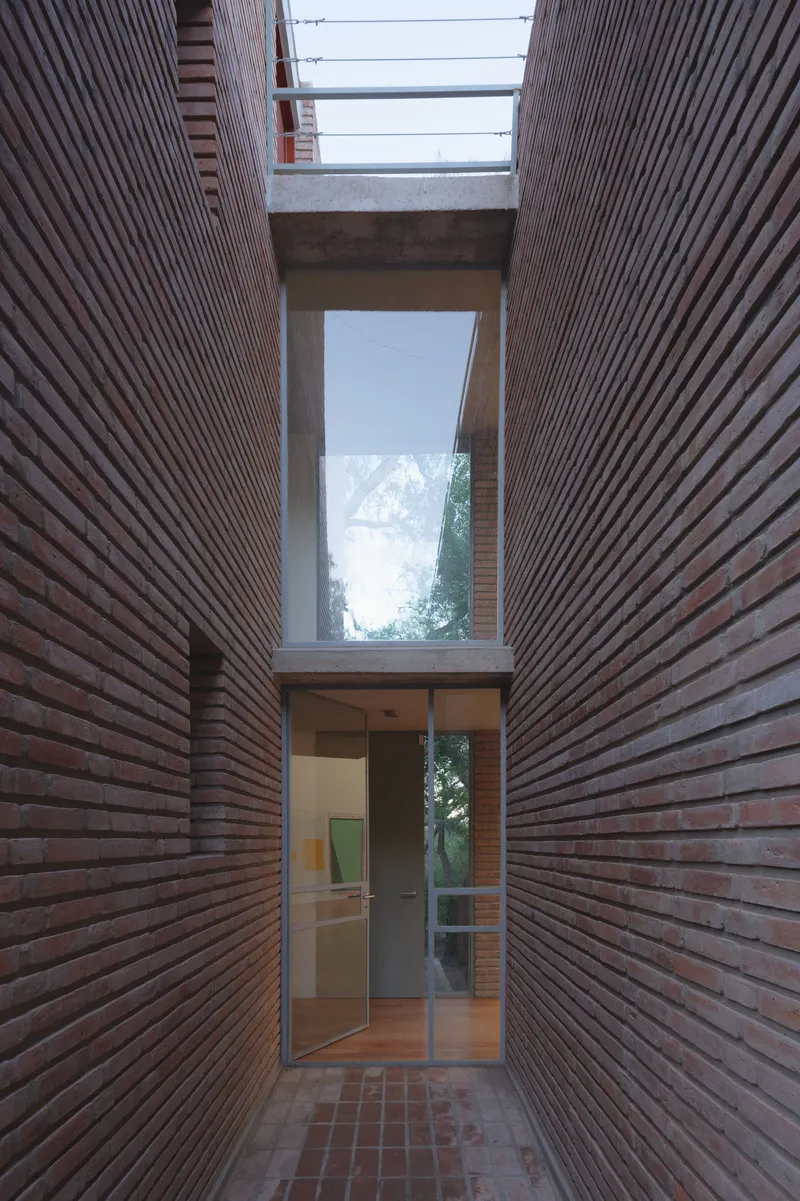
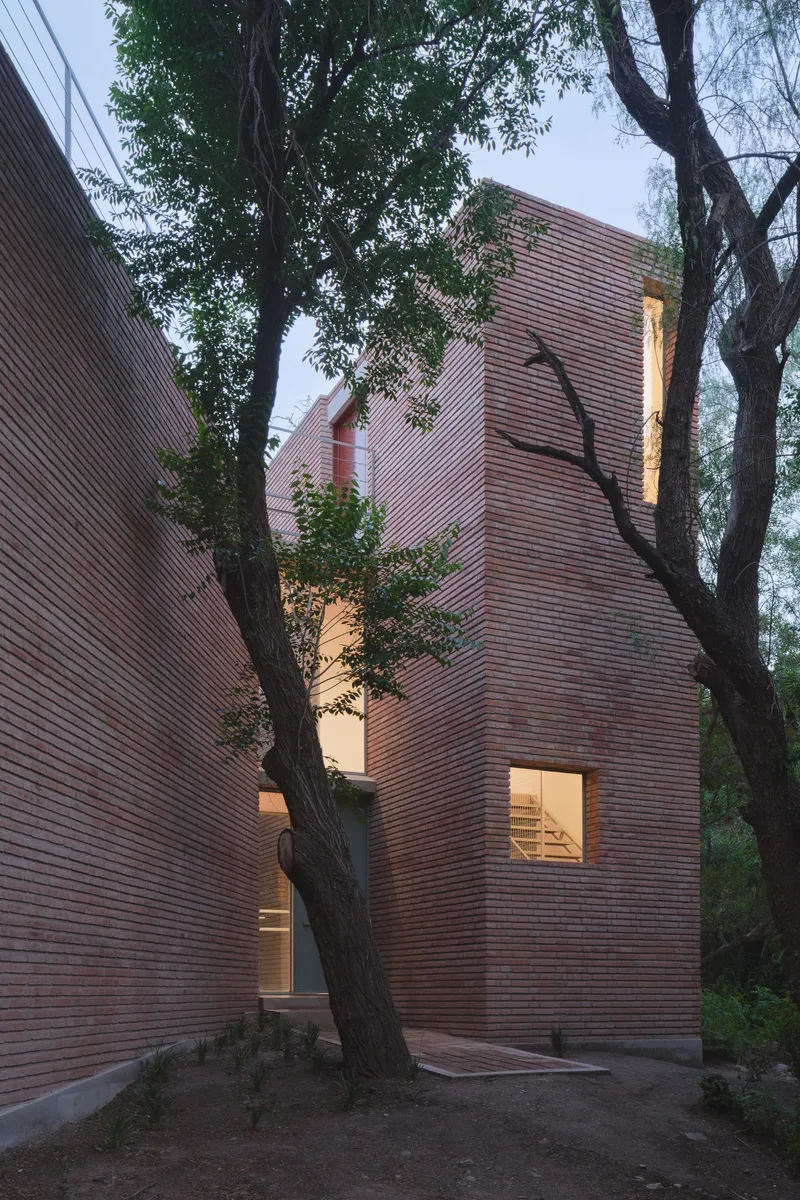
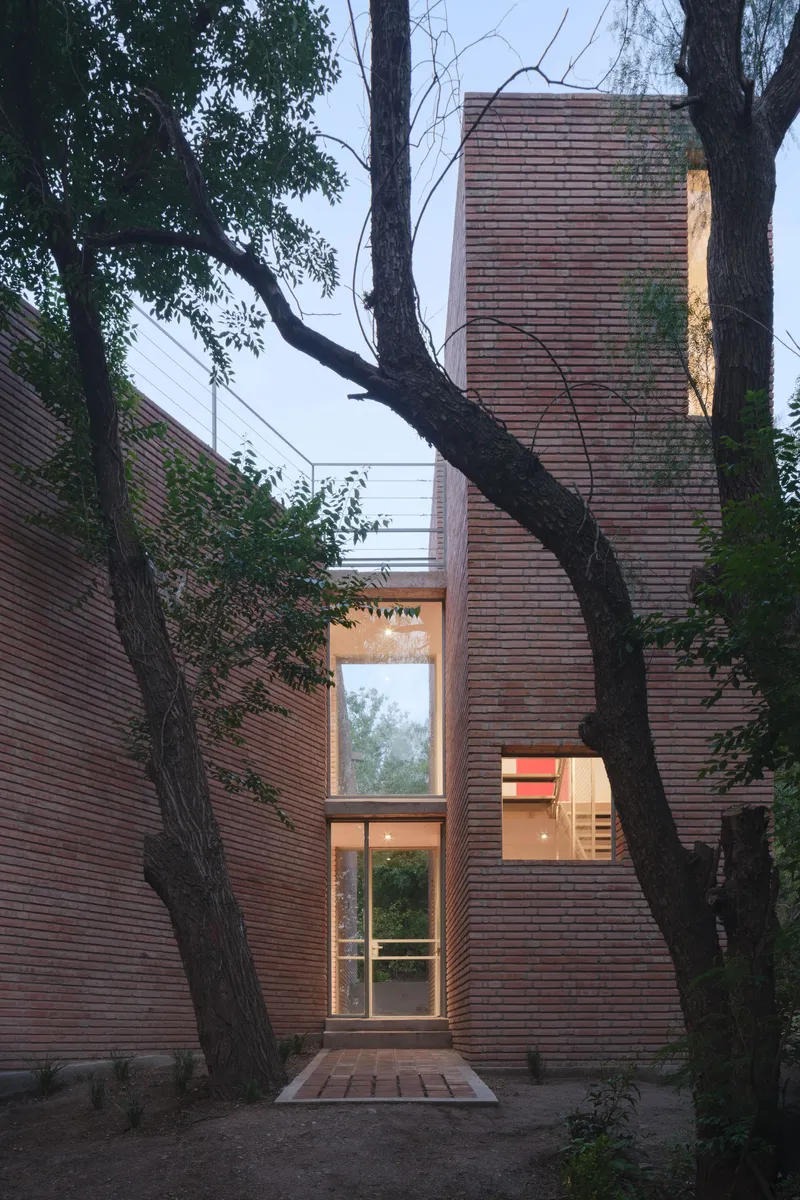
Material choices are deliberately restrained. Brick dominates the exterior of the main volumes, while horizontal timber slats clad the connecting elements and the entry facade. The contrast creates a clear hierarchy: the heavy, permanent studio core versus the lighter, more permeable circulation zones. A narrow brick-paved courtyard between timber-clad walls funnels visitors toward glazed doors and a slice of sky above, compressing space before releasing it into the tall studio.
The timber cladding ages well in this climate, its silver-grey patina eventually matching the bark of surrounding algarrobo trunks. Inside, natural wood floors and white walls provide a neutral backdrop for Cambre's chromatic work. The sole exception is the kitchenette's green cabinet doors, a playful note that suggests the artist's hand in the interior decisions.
Living Above, Working Below
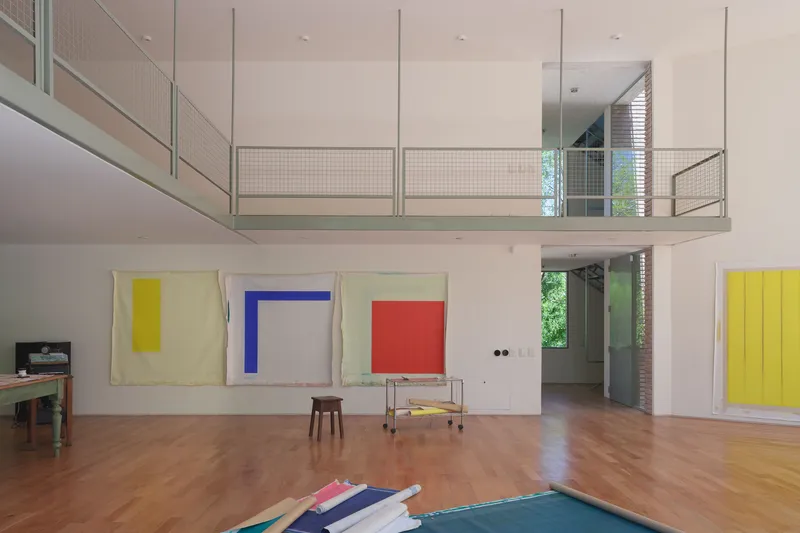
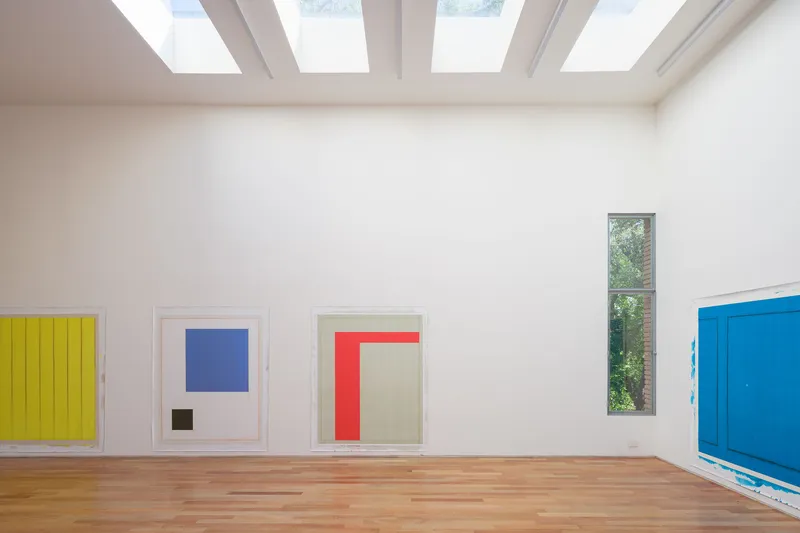
The mezzanine bedroom overlooks the double-height studio through a wire-mesh balustrade, borrowing its volume without intruding on the workspace. Below, a rectangular zone holds the kitchen, storage, and a long work table, the domestic engine that keeps the atelier self-sufficient during extended stays. The arrangement is compact but not cramped; every function has been given exactly the space it needs and no more.
On the roof, a terrace with horizontal brick paving and cable railings offers a final register of habitation. The illuminated skylight panel glows at the artist's feet, a reminder that the room below is always ready. It is a spare, considered sequence from forest floor to canopy level, and the building reads as a vertical journey as much as a plan.
Plans and Drawings
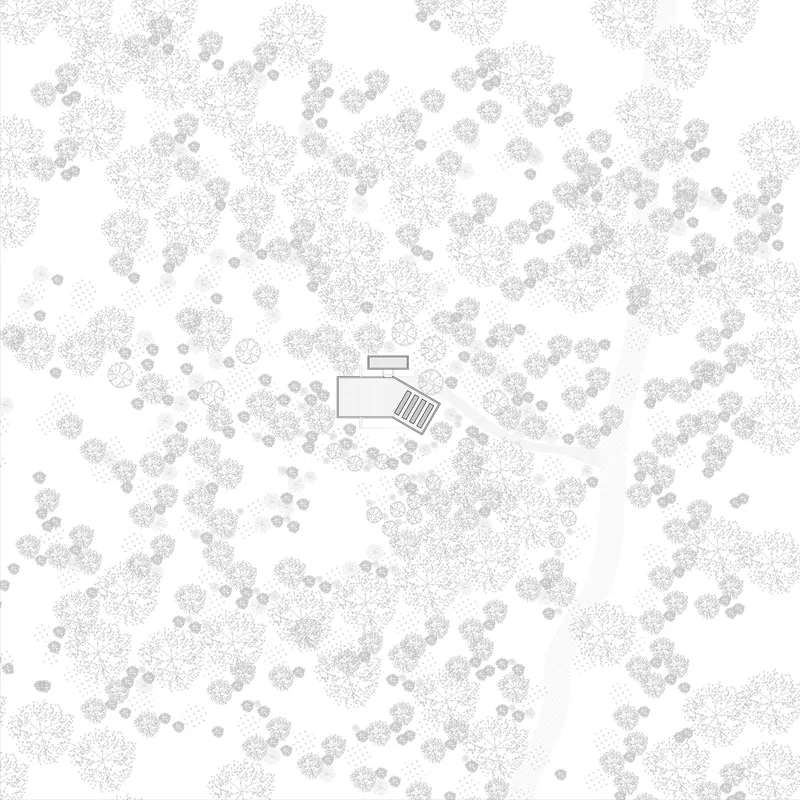
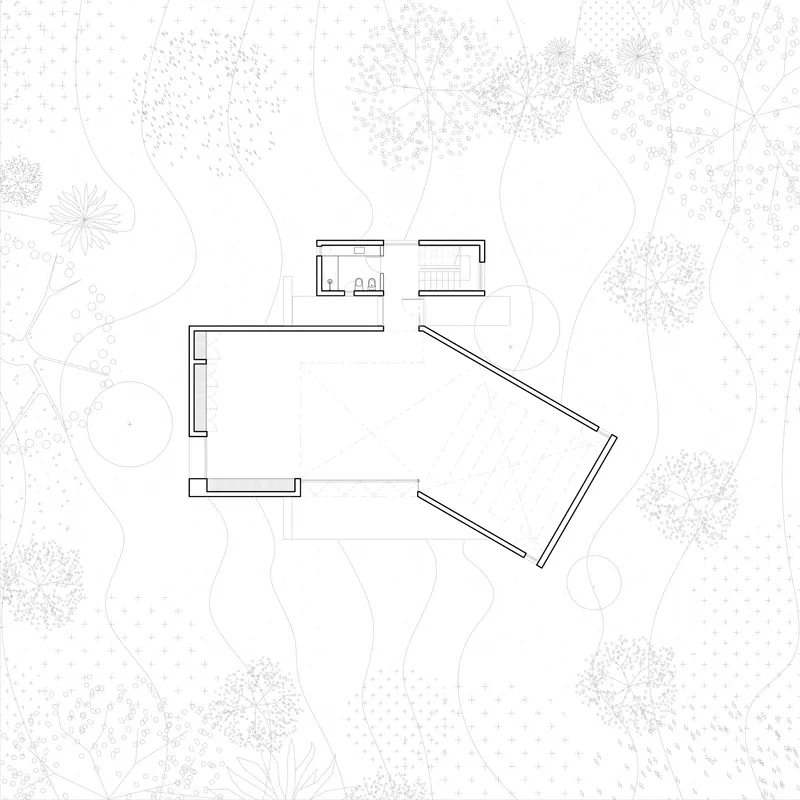
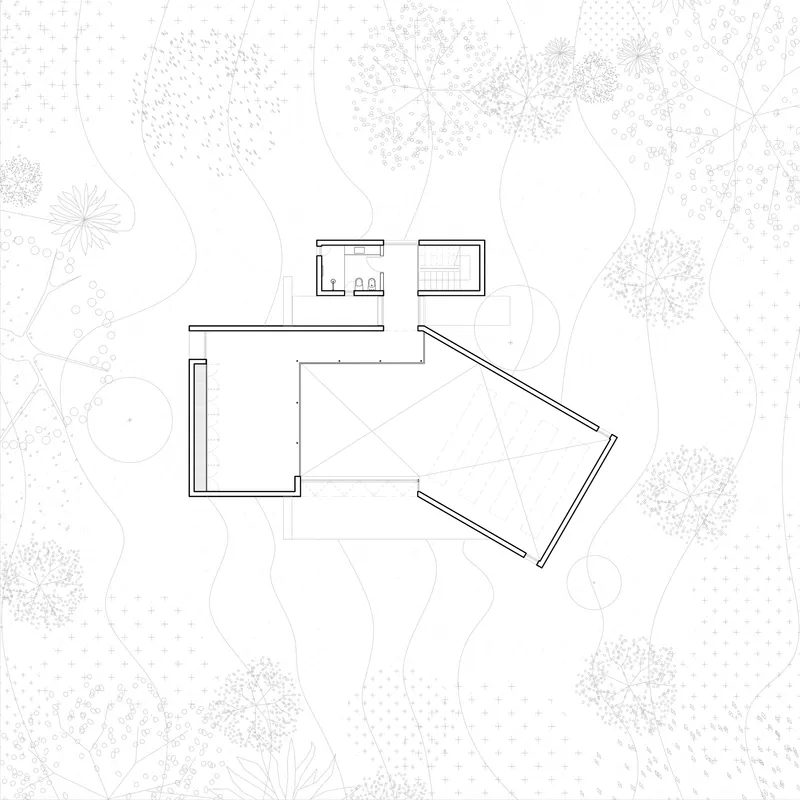
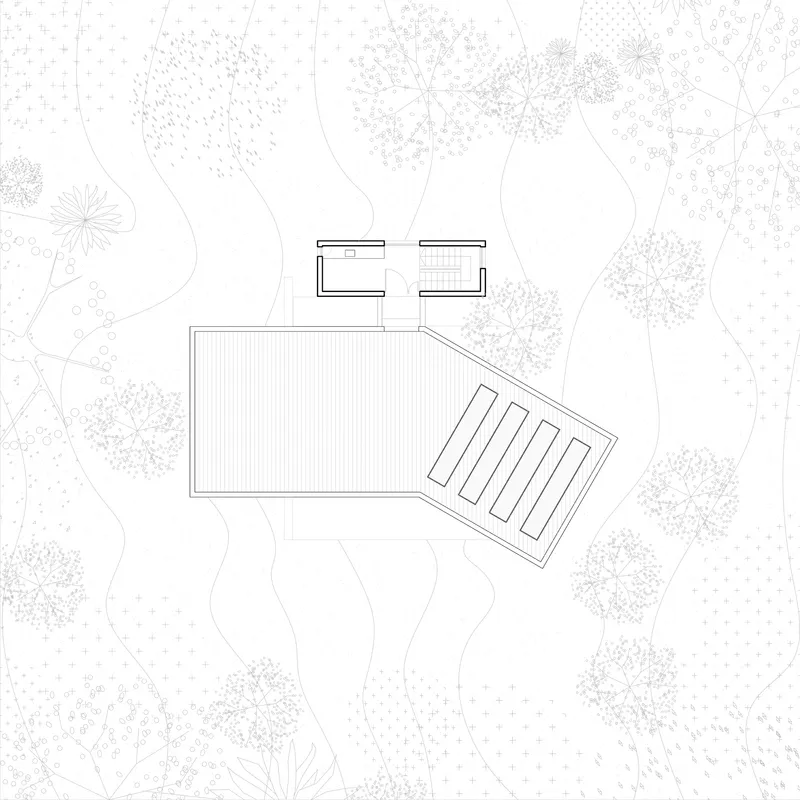
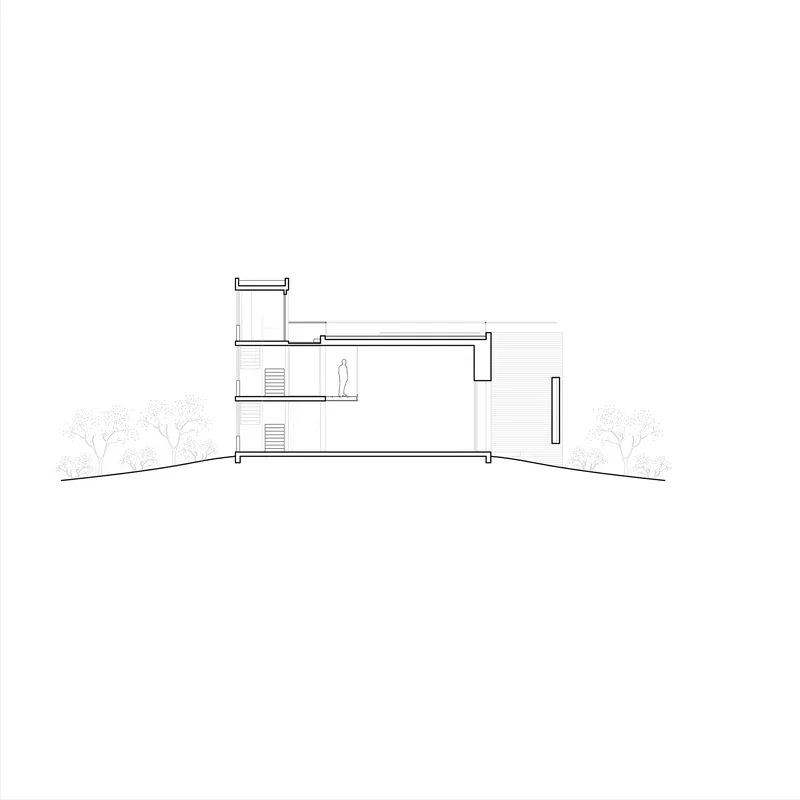
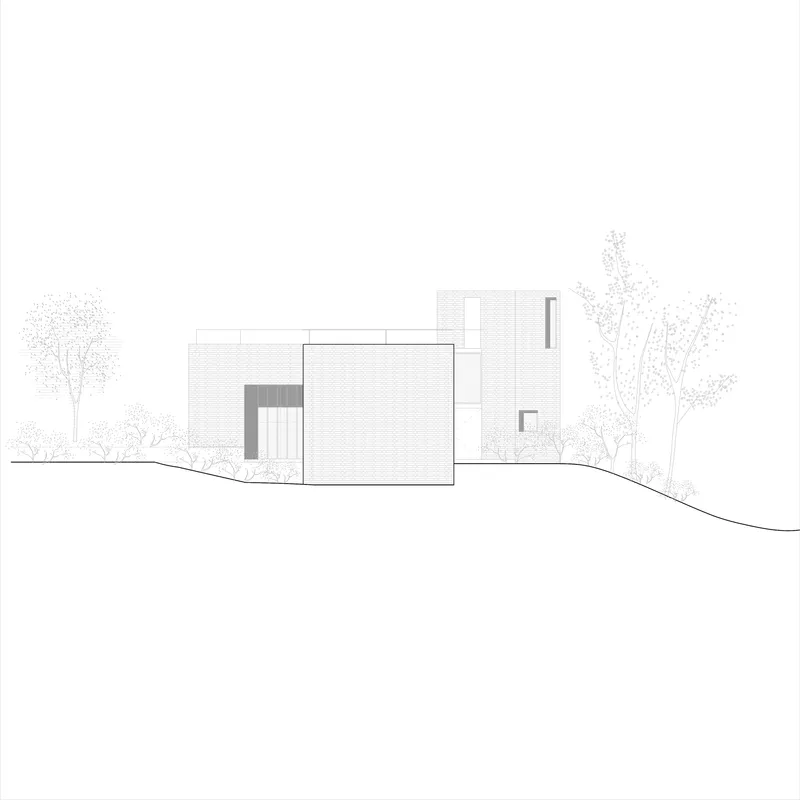
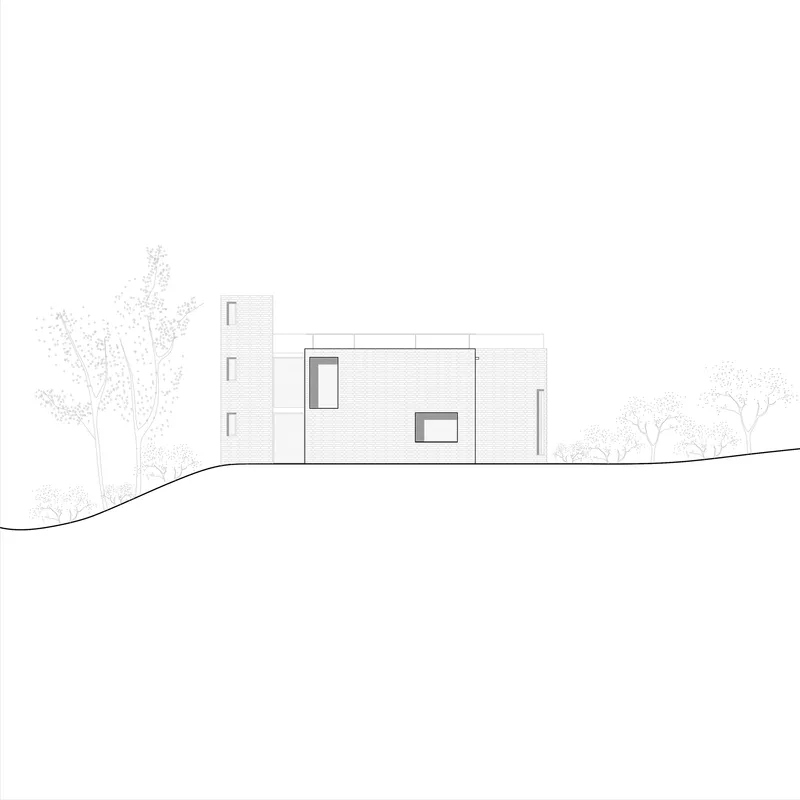
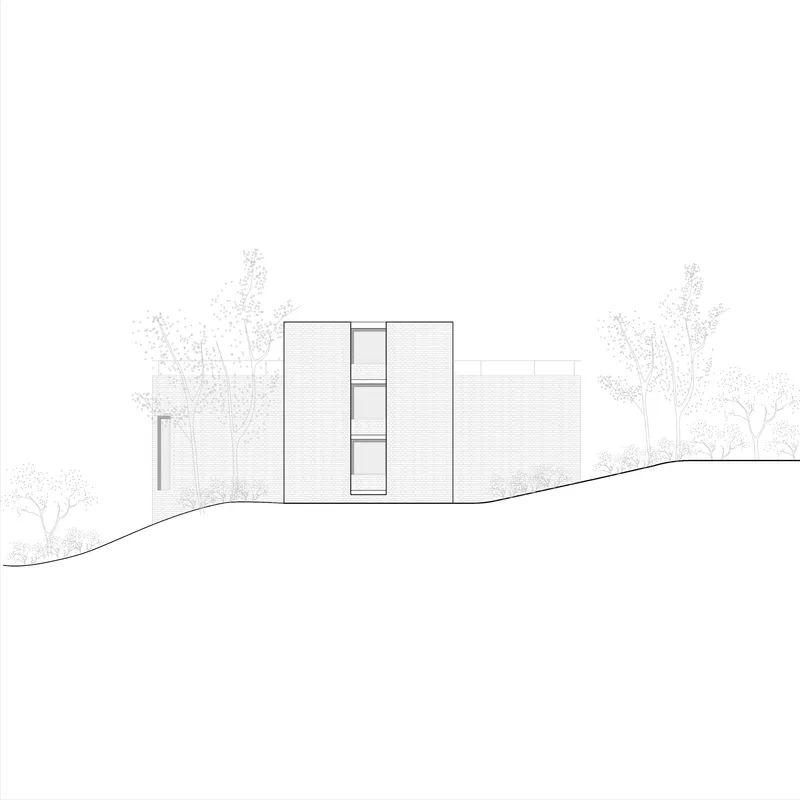
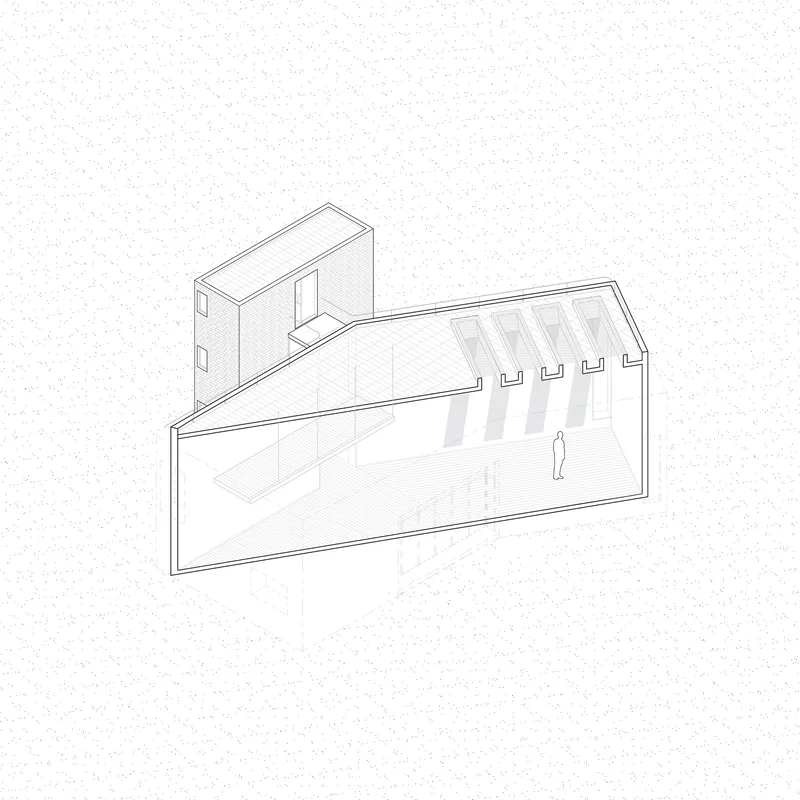
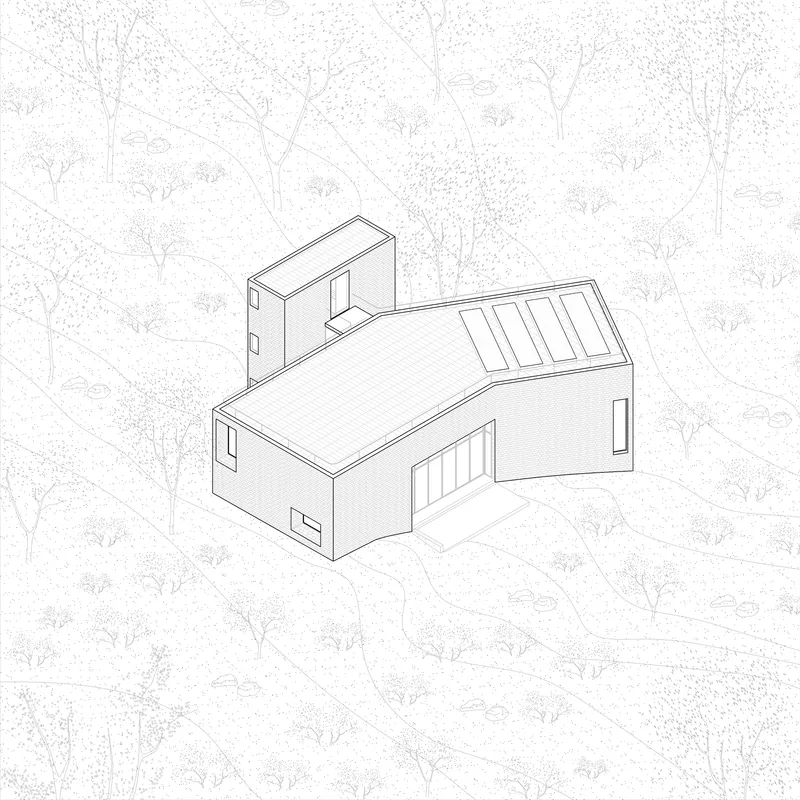
The site plan reveals how deliberately the building is positioned within its clearing, angled to preserve the largest trees while channeling views toward the mountain slopes. The rotation between the two primary volumes generates a courtyard that appears almost incidental in plan but is, in fact, the spatial hinge of the entire project. Floor plans show the economy of the layout: services compressed into compact boxes, the painting space given maximum uninterrupted area, and the mezzanine bedroom hovering above like a loft in a converted warehouse.
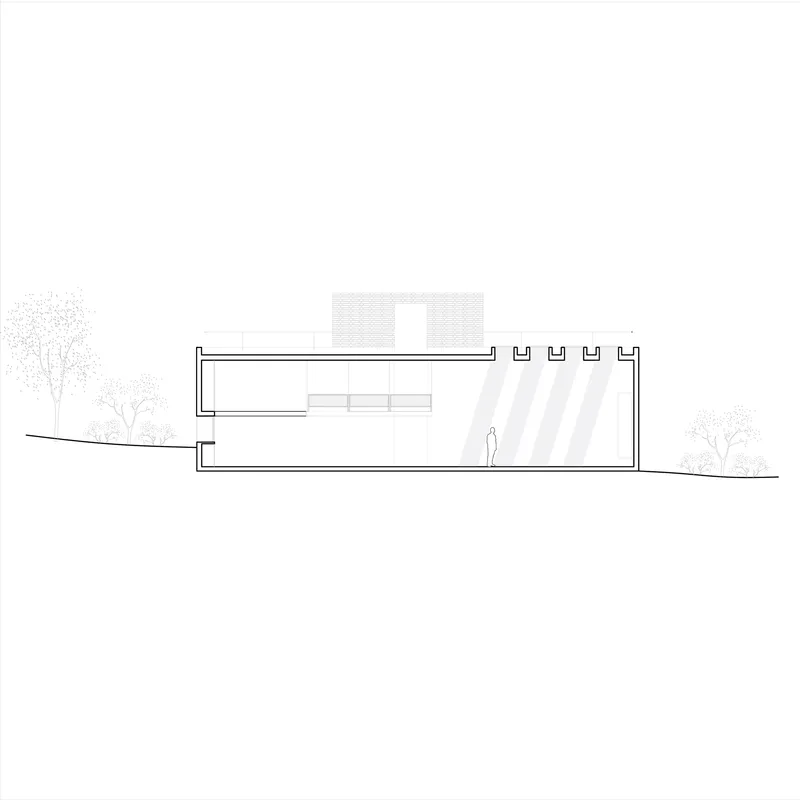
The sections are particularly revealing. They show the five-metre ceiling height of the studio in relation to the three-story tower, making clear that these two elements share a similar total height but distribute it very differently. The axonometric drawings confirm what the photographs suggest: the clerestory openings are the building's primary light strategy, tuned to deliver consistent illumination regardless of sun angle. The elevations demonstrate how the scattered window openings create rhythm across otherwise austere brick facades, each puncture a deliberate response to what lies beyond.
Why This Project Matters
Artist studios present a specific architectural challenge: they must serve a practice that is both intensely private and ultimately public. Esteras Perrote navigates this tension by designing a building that works as a sealed, light-controlled workspace and, moments later, as a permeable pavilion open to the trees. The geometric operation of rotating two rectangles is simple on paper, but its spatial consequences are rich. It produces a courtyard, a tower, a bridge, and a clearing that together give a single artist the range of environments that a much larger institution would provide.
Atelier Cambre also offers a lesson in site specificity that goes beyond lip service. The building sits at 1,200 metres between two seasonal watercourses, among species that exist only in this ecological zone. Its brick absorbs the colour of the surrounding earth; its timber will eventually match the bark of adjacent trees. For Juan José Cambre, the atelier is not a retreat from the city so much as an instrument calibrated to the particular qualities of this mountain clearing, a place where the landscape does not merely surround the work but actively enters it through every skylight, frame, and open door.
Atelier Cambre by Esteras Perrote (Lucía Esteras, Gonzalo Perrote). Los Cocos, Córdoba, Argentina. Completed 2025. Photography by Javier Agustín Rojas.
About the Studio
Share Your Own Work on uni.xyz
If projects like this are the kind of work you want to make, uni.xyz is a place to publish your own, find collaborators, and enter design competitions.


Popular Articles
Popular articles from the community

Opera by the Sea Estonia: Three Shells Dissolving Architecture into Tallinn's Coastline
A winning opera house proposal replaces monumental form with interconnected shells that blur the boundary between building, park and Baltic Sea.
Tsunami Convergenics: Turning Catastrophic Ocean Forces into Underwater Housing Infrastructure
A speculative underwater settlement off the coast of Onagawa, Japan, treats tsunamis and typhoons as energy sources rather than threats.

Manzana Morphosis: Stretching Barcelona's Grid into a Living Landscape for 2050
A radical reworking of the Eixample manzana turns density into a tool for generous public space, vertical ecology, and environmental performance.
Extended Shell: Retrofitting Kolkata's Balconies as Living Urban Thresholds
A modular retrofit system recovers the social and environmental intelligence of Kolkata's historic verandas for contemporary Park Street residents.

Similar Reads
You might also enjoy these articles

Bao Huynh Watercolor Atelier: A Serene Art Retreat in Hội An
Bao Huynh Watercolor Atelier in Hội An blends multifunctional art spaces, sustainable design, local materials, and family-friendly living in a serene environment.

Atelier Macri Concept Store Interior Design by CASE-REAL
Atelier Macri store features a "ko" counter, walnut wood details, cork displays, blending retail, gallery, and seamless customer experiences.

Manuel Vargas Izquierdo Stadium and High-Performance Sports Center: Architectural Excellence in Jalpa de Méndez
The Manuel Vargas Izquierdo Stadium blends sustainable design, inclusive sports facilities, and cultural-inspired architecture, revitalizing Jalpa de Méndez’s public spaces.

KAKR Buluh Awar Hall: Revitalizing Community and Ecology Through Bamboo Architecture
Community built bamboo hall revitalizes Buluh Awar village, empowering youth, restoring ecology, celebrating vernacular craftsmanship through sustainable architecture and culture.

Explore Atelier Competitions
Discover active competitions in this discipline

Challenge to reimagine the Iron Throne

Photograph architecture without architects

Illustrate the lost glory of Angkor Wat - Render Challenge

Design challenge to reuse E-waste
Comments (0)
Please login or sign up to add comments
No comments yet. Be the first to comment!