

Estúdio Vinicius Macêdo and Novais Arquitetura Bury a Lakeside Club Beneath Its Own Landscape
A split-level social pavilion on 206 meters of lagoon shore in Aquiraz, Brazil, puts the horizon above the roofline.


Clubhouses in resort developments tend to announce themselves. They stand at the center of a masterplan, big and visible, demanding attention from the roadside. At Quintas do Lago Praia dos Coqueiros in Aquiraz, Brazil, Estúdio Vinicius Macêdo and Novais Arquitetura took the opposite approach: they pushed the building down into the sloping terrain so that the lagoon, not the architecture, remains the thing you see first.
The result is a 1,185 square meter facility that reads from above as a terraced landscape of concrete, timber, and palm groves, while from below it opens into a generous sequence of social, recreational, and wellness spaces stretched along 206 meters of lagoon shoreline. Lead architects Vinicius Macêdo and Lucas Novais organized the program across two levels connected by a cylindrical timber staircase tower, the one vertical gesture in an otherwise aggressively horizontal composition. The real design move here is not a single spectacular form but a disciplined refusal to compete with the water.
Terracing the Threshold


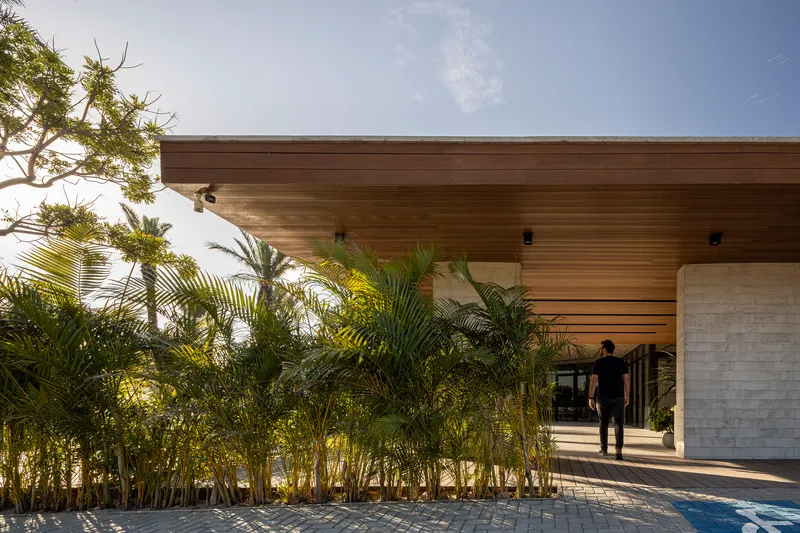
The upper level functions as a linear plaza: a public-facing promenade that extends from the sidewalk toward the lagoon's edge. Tiered concrete planes step down through planted islands of native vegetation, creating a sequence of landings that feel more like a civic park than a private amenity. A cylindrical timber lookout tower punctuates one end, giving residents a high vantage point without adding a heavy mass to the skyline.
The approach from the street passes along a limestone wall sheltered by a deep timber soffit, filtering direct sunlight while framing views of coconut palms. Rather than a lobby or gate, entry is a transition from pavement to garden, from urban sidewalk to sloped landscape. Underground wiring throughout the development keeps the visual field clean, a small detail that reinforces the architects' commitment to letting the terrain speak.
Concrete and Timber in Dialogue
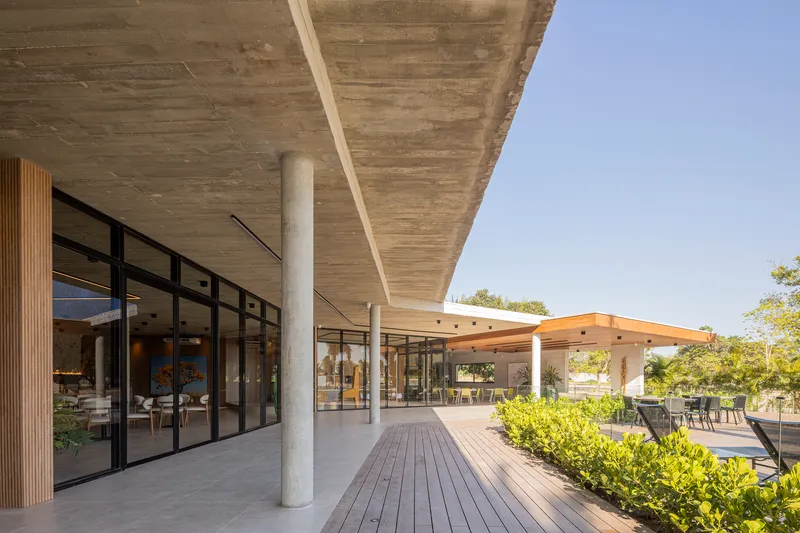


The material palette is deliberately restrained: board-formed concrete for structure and primary surfaces, timber for cladding, soffits, and the stair tower screen. The formwork imprints on the concrete ceilings are left exposed, giving the soffits a grain that echoes the wood around them. Cylindrical concrete columns carry the roof slabs with a clarity that recalls mid-century Brazilian pavilion architecture without resorting to pastiche.
At dusk the relationship between the two materials shifts. Warm linear ceiling lights trace the timber soffits of covered terraces, and the concrete takes on a cooler tone against the deepening sky. The architects treated the covered outdoor zones as the primary social spaces, not the enclosed rooms, which is an honest response to Ceará's climate and the obvious desire to be near the water.
The Spiral Core
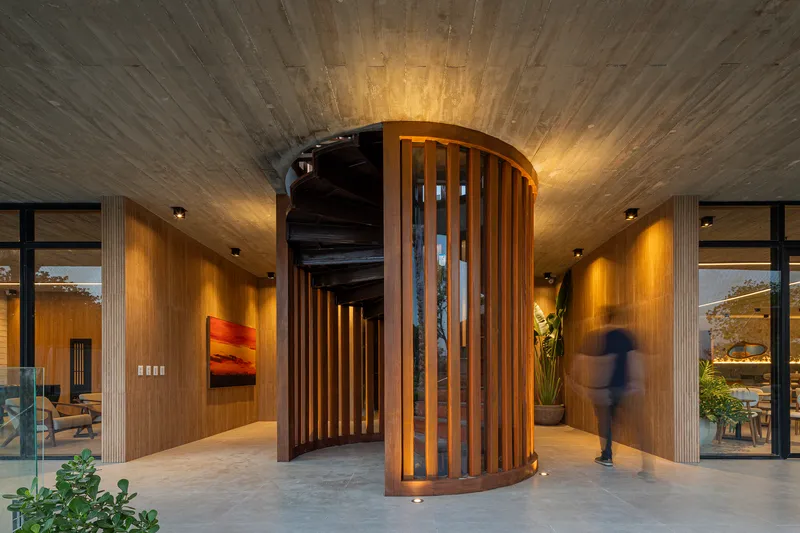
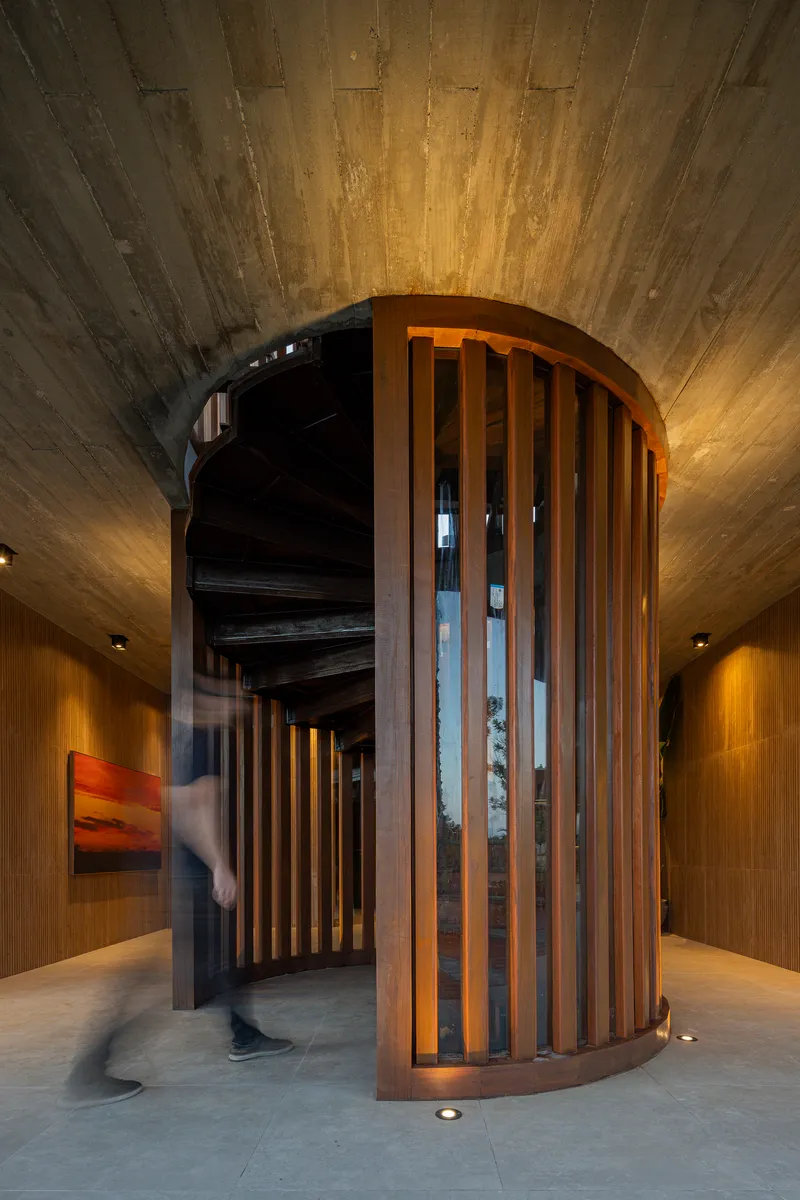
Connecting the upper plaza to the lower recreation level, a cylindrical staircase wrapped in vertical timber slats serves as the project's lone iconic element. The vaulted timber ceiling inside the cylinder adds a warmth that contrasts with the raw concrete outside. It is a vertical event in a building that otherwise resists verticality, and it works precisely because the architects didn't repeat the gesture elsewhere.
The slat screen filters light into the stairwell throughout the day, casting shifting stripe patterns on the concrete steps. From the exterior, the tower reads as a lantern at night and a solid timber drum during the day. It is the wayfinding anchor for the entire complex.
Lower Level: Social Program Below Grade


Descending to the lower level reveals the density of the program hidden beneath the terraced landscape. A gourmet bar backed by a river stone wall sits under board-formed concrete ceilings. Nearby, a recreation room with pool and card tables enjoys horizontal strip windows that keep the space connected to the vegetation outside without flooding it with direct sun. A dining area with yellow chairs beneath a slatted timber ceiling offers a more casual register.
The decision to tuck all of this below the upper plaza line means that from the lagoon you see a low, glazed facade rather than a multi-story clubhouse. It is the kind of sectional discipline that pays off in the lived experience: residents using the pool or dining terrace look out at water and palm canopy, not at the back of a building.
Wellness Rooms and the Glazed Edge


The fitness room occupies a privileged corner of the lower level, with floor-to-ceiling glazing overlooking dense vegetation. Working out on a treadmill while staring at a coconut grove is not a bad sell for a residential development. The equipment area opposite uses concrete and timber walls as a backdrop for weight racks and neon signage, a slightly more industrial tone that breaks up the material serenity elsewhere.
Steel-framed glass doors in the dining wing fold open to the poolside terrace, collapsing the boundary between interior and exterior. Wide window frames throughout were sized not for structural minimalism but for maximum views of native vegetation, a pragmatic move that doubles as a passive ventilation strategy in Ceará's warm climate.
Pool, Landscape, and the Lagoon Beyond

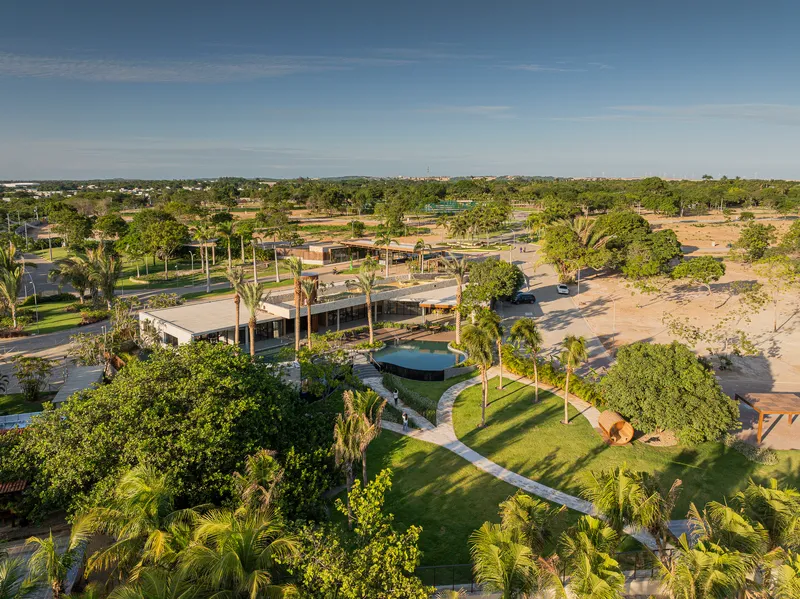

The organic-edged infinity pool curves along the glazed facade, its water line aligned to merge visually with the lagoon in the distance. At twilight the reflection doubles the low pavilion, producing the project's most photogenic moment. But the pool is more than scenography: it connects to an outdoor terrace, a boardwalk with orchards, and a pier extending onto the lagoon, forming a continuous sequence of aquatic and landscape experiences.
The development also includes a natural pool built from rocks, pebbles, and quartz sand, the first of its kind in the state of Ceará. Three beach tennis courts, a kids' room, coworking spaces, and meditation zones round out the amenity list. The coconut grove along the shoreline is preserved and integrated into the landscape plan rather than cleared, a choice that lends the new construction an air of having always been there.
Plans and Drawings


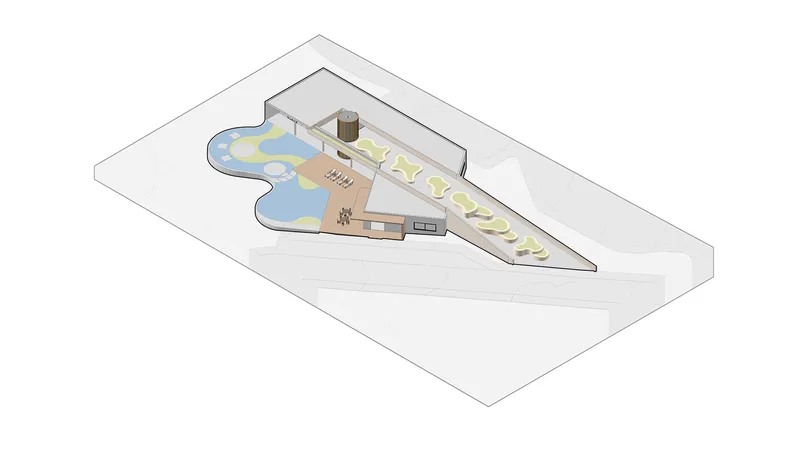
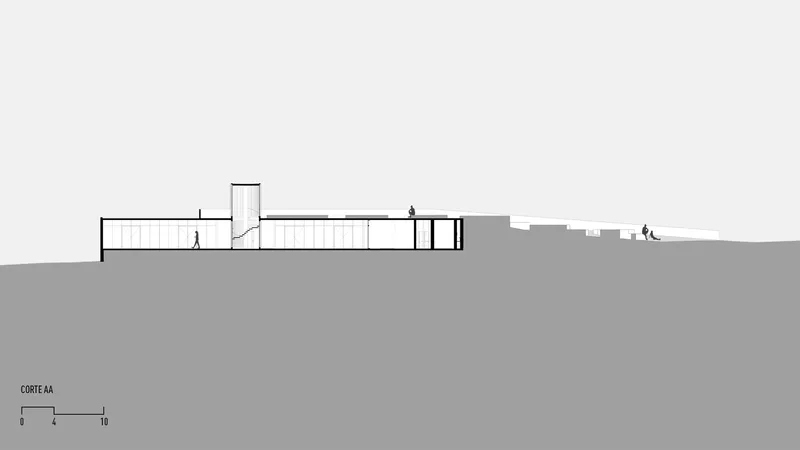
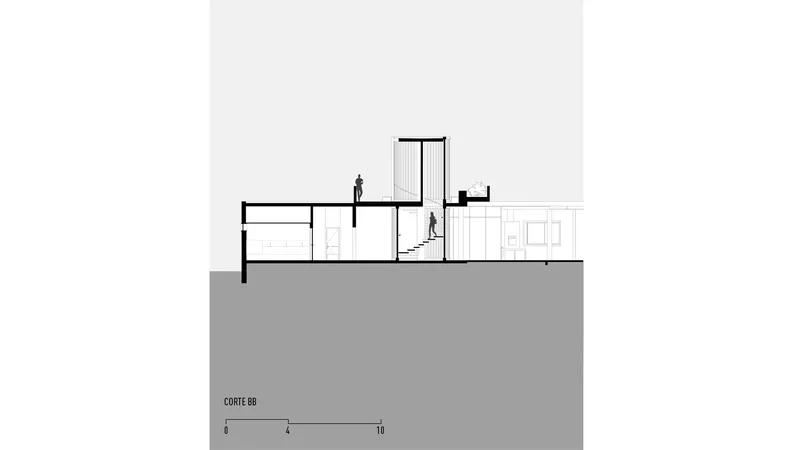
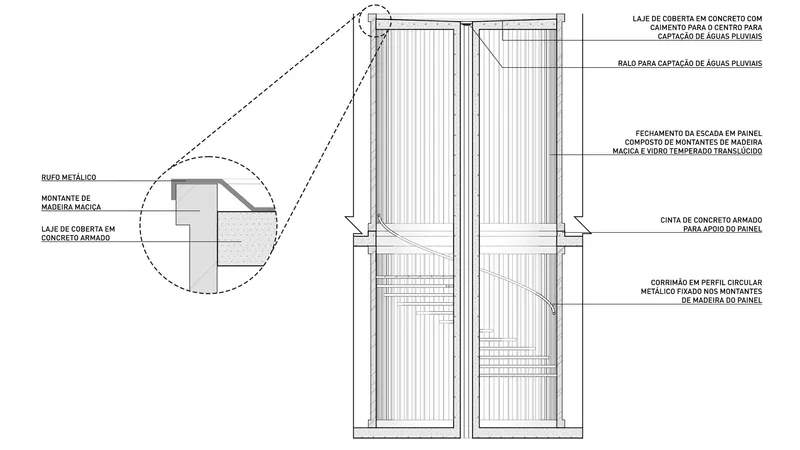

The ground floor plan confirms the angled geometry of the main wing, with the pool and landscaped courtyard occupying the space between the building and the lagoon edge. The upper floor plan reveals organic skylights punched through the roof slab, pulling natural light into the plaza level. Section drawings make the split-level strategy legible: the central tower element rises as the hinge between upper and lower volumes, and the slope of the site is exploited rather than leveled.
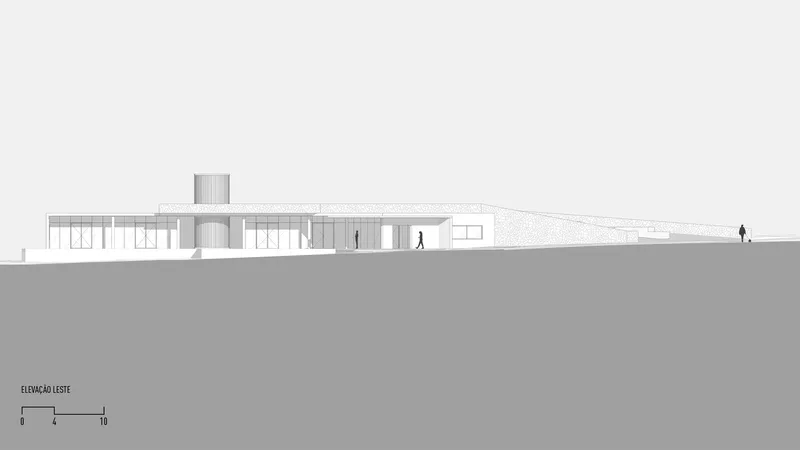
East and south elevations illustrate how low the building sits relative to its surroundings, with the horizontal bar barely rising above the tree canopy. A detail drawing of the composite panel system shows timber framing with translucent cladding, suggesting that some of the lighter enclosure elements were designed for rapid assembly. The axonometric pulls the whole composition together: curved pool, covered seating, and a linear row of planters that stitches the building into the ground plane.
Why This Project Matters
Lakeside Farms Coqueiros Beach succeeds because it treats its site as the primary design material. The lagoon, the coconut grove, and the slope of the land dictated the section, the massing, and the orientation of every social space. In a market where resort clubhouses compete for attention through scale and spectacle, Macêdo and Novais chose restraint, pushing the program below grade and letting the landscape occupy the top of the composition. That is a harder sell in renderings but a far better experience on the ground.
The project also demonstrates that a generous amenity program does not require a bulky building. By splitting the club across two levels and stretching it along the shore, the architects created variety and intimacy within a 1,185 square meter footprint. The cylindrical stair tower, the board-formed concrete ceilings, and the natural pool are all specific, well-resolved moves rather than applied gestures. It is a convincing argument that the best way to celebrate a landscape is to get out of its way.
Lakeside Farms Coqueiros Beach (Quintas do Lago Praia dos Coqueiros) by Estúdio Vinicius Macêdo and Novais Arquitetura. Aquiraz, Brazil. 1,185 m². Completed 2025. Photography by Felipe Petrovsky.
About the Studio
Share Your Own Work on uni.xyz
If projects like this are the kind of work you want to make, uni.xyz is a place to publish your own, find collaborators, and enter design competitions.


Popular Articles
Popular articles from the community


The Amber Palace Opera: A Geological Fiction Surfaces on Tallinn's Baltic Waterfront
Pierre Brillard reimagines a Baltic legend as a public landscape, opera house, and waterfront promenade rooted in Tallinn's coastal identity.
Opera by the Sea Estonia: Three Shells Dissolving Architecture into Tallinn's Coastline
A winning opera house proposal replaces monumental form with interconnected shells that blur the boundary between building, park and Baltic Sea.
Faces of the Soviet Avant-Garde: Turning Moscow's Street Names into an Open-Air Museum
A network of sculptural installations across a Moscow residential district transforms forgotten architect names into spatial encounters with cultural memor

Singing Woman: Contemporary Architecture Inspired by Estonia’s Voice and the Sea
Singing Woman turns Estonia’s song culture into flowing opera house architecture, blending public life, landscape, sea, and national memory.

Similar Reads
You might also enjoy these articles

Bao Huynh Watercolor Atelier: A Serene Art Retreat in Hội An
Bao Huynh Watercolor Atelier in Hội An blends multifunctional art spaces, sustainable design, local materials, and family-friendly living in a serene environment.

Atelier Macri Concept Store Interior Design by CASE-REAL
Atelier Macri store features a "ko" counter, walnut wood details, cork displays, blending retail, gallery, and seamless customer experiences.

Manuel Vargas Izquierdo Stadium and High-Performance Sports Center: Architectural Excellence in Jalpa de Méndez
The Manuel Vargas Izquierdo Stadium blends sustainable design, inclusive sports facilities, and cultural-inspired architecture, revitalizing Jalpa de Méndez’s public spaces.

KAKR Buluh Awar Hall: Revitalizing Community and Ecology Through Bamboo Architecture
Community built bamboo hall revitalizes Buluh Awar village, empowering youth, restoring ecology, celebrating vernacular craftsmanship through sustainable architecture and culture.

Comments (0)
Please login or sign up to add comments
No comments yet. Be the first to comment!