

FAB Architects and Unes Architectes Revive a 1930s Neighborhood Cinema in Clermont-Ferrand
A geotextile canopy and textile-lined auditorium restore Le Rio's identity as a communal alternative to the multiplex.


The neighborhood cinema is a building type that urban economics has spent decades trying to kill off. Multiplexes swallowed audiences, streaming swallowed the rest, and single-screen venues in postwar housing estates were left to quietly rot. Le Rio, a 400 m² cinema in Clermont-Ferrand's sprawl of 1960s social housing blocks, could have followed that trajectory. Instead, FAB Architects and Unes Architectes have returned it to active life with a renovation that peels the building back to its bones and reassembles it around a single conviction: a cinema should feel like a house, not a terminal.
The facts of the project are modest. The budget hovered around €780,000 excluding tax. The seating count actually dropped, from 159 to 149, to make room for wheelchair users and their companions. What makes the intervention worth studying is how the architects redistributed spatial intelligence across a tiny footprint: dissolving the boundary between forecourt and building with a suspended canopy, converting disused technical storage into a patio, and wrapping the auditorium in pleated textile that performs acoustically while conjuring a theatrical intimacy no multiplex can replicate.
A Canopy That Dissolves the Threshold
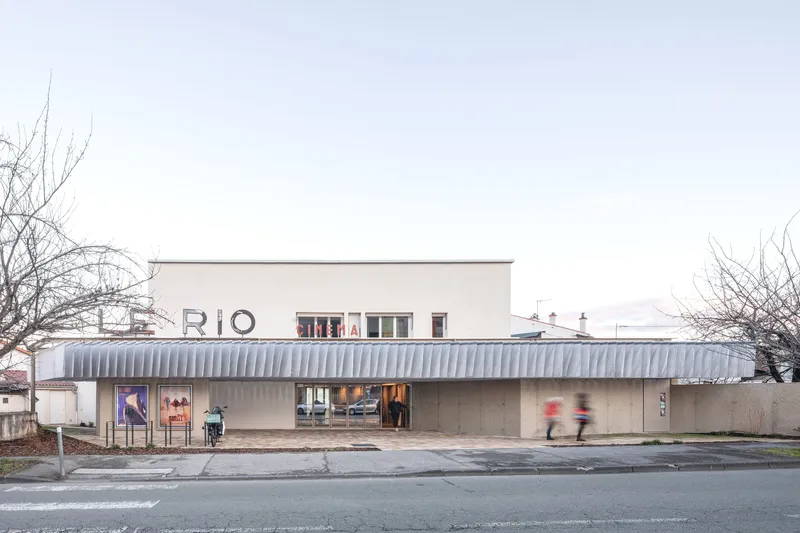
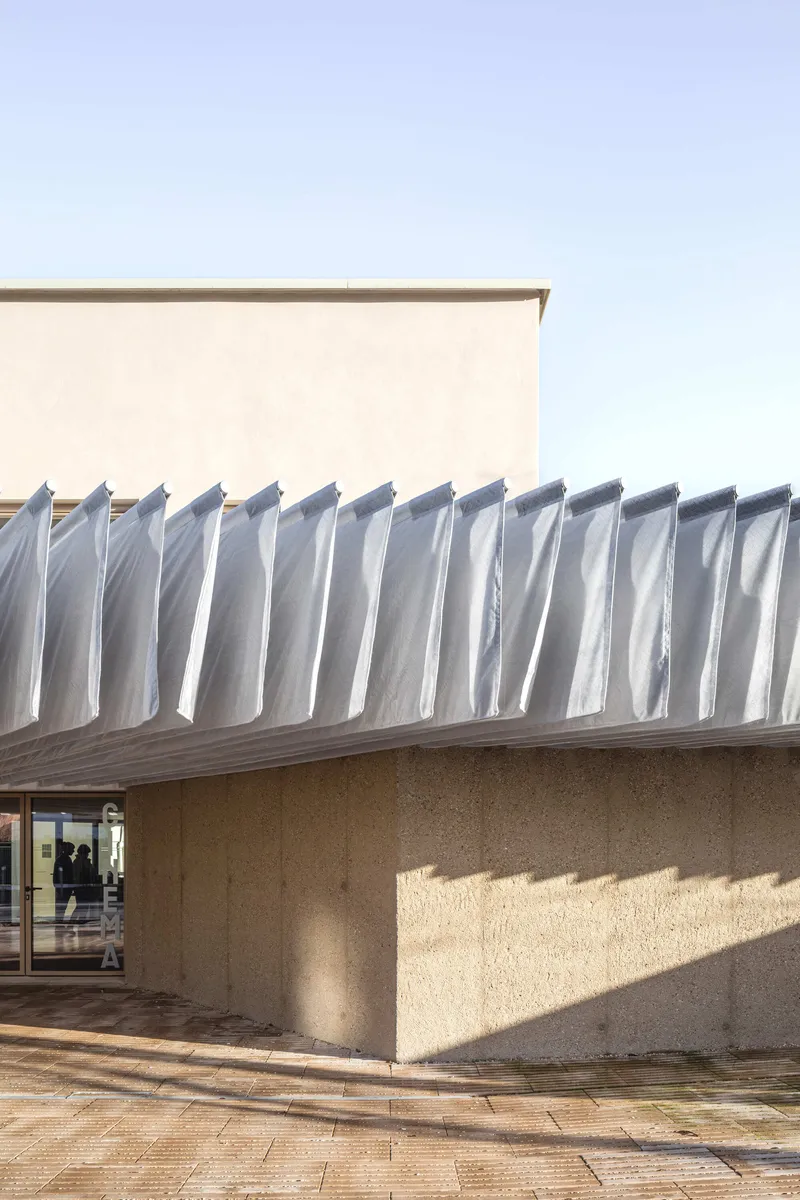
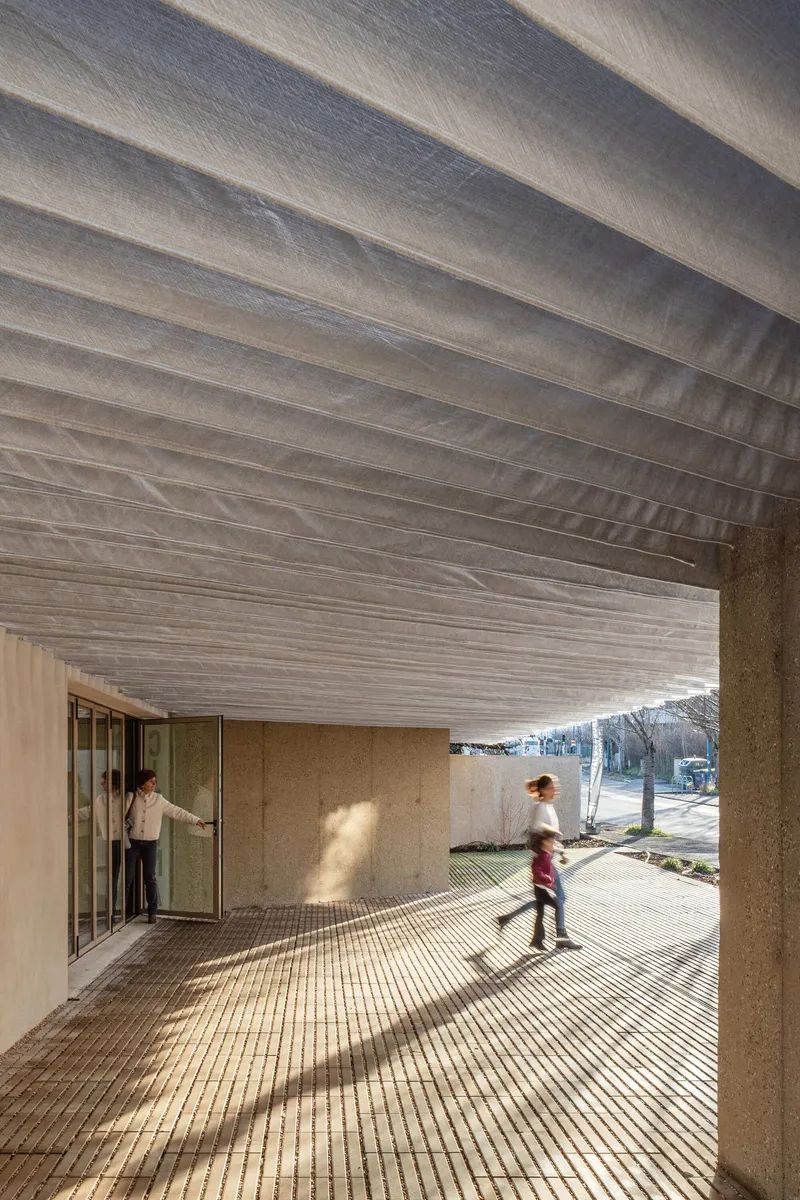
The most immediately legible move is the new canopy. Eighty geotextile fabrics, fixed to brackets and suspended from a corrugated metal structure, extend outward from the facade to create an open-air hall between the sidewalk and the entrance. The effect is generous: school groups can gather beneath it, passersby can pause, and the cinema announces itself to the street without resorting to signage or spectacle. In afternoon light, the folded metal throws sharp shadows across the concrete walls below, lending a graphic sharpness to an otherwise understated composition.
What the canopy really does is eliminate the awkward civic gap that single-screen cinemas always had: that dead zone between the street and the ticket desk where nobody wanted to linger. Here, the forecourt becomes programmable space. It is an antechamber that belongs neither fully to the city nor to the building, and it works precisely because of that ambiguity.
Night Presence
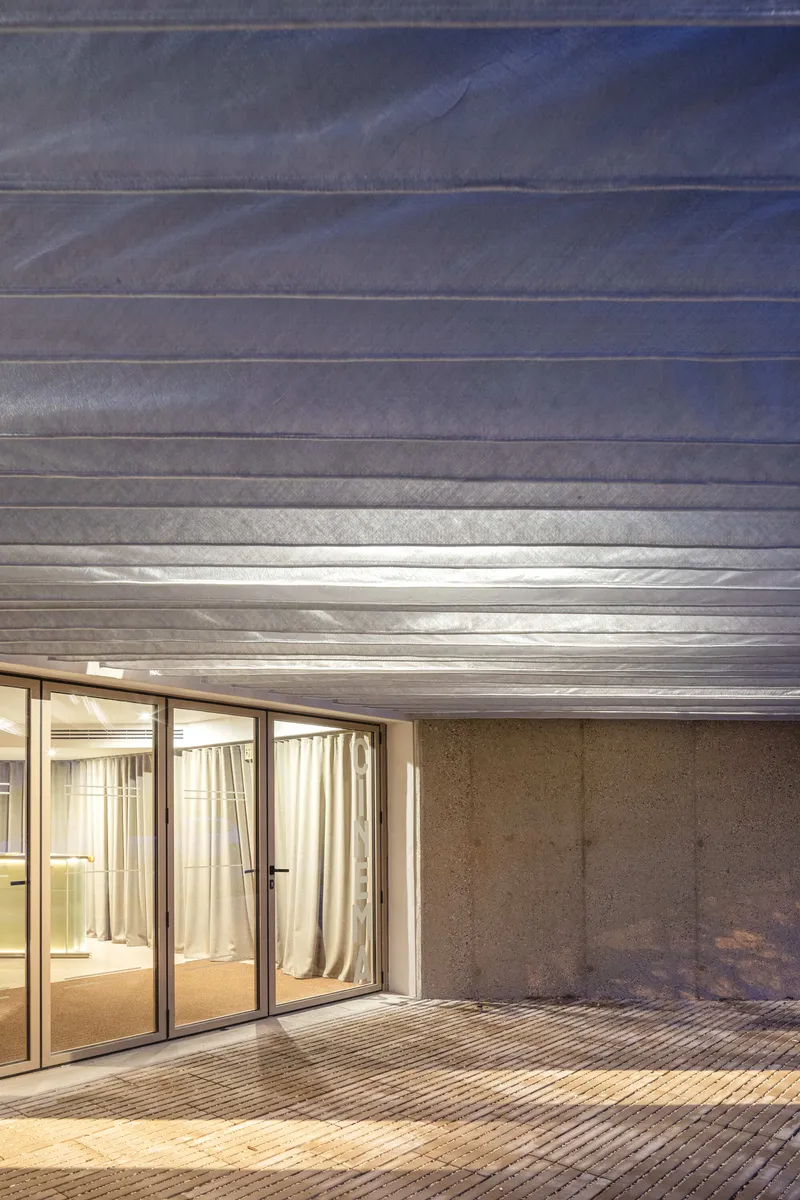
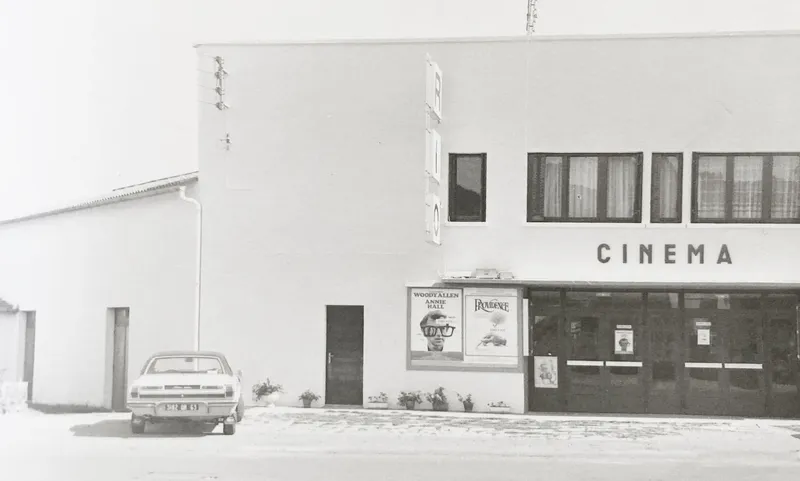
A cinema earns its keep at night, and Le Rio's renovation understands this. After dark, the underside of the canopy catches reflected light from the glazed entrance doors, turning the folded surface into a warm lantern above the sidewalk. The glass wall below reads as a lit vitrine, hinting at activity inside without overpowering the residential street. Compare this with the daytime shot of the white stucco facade: the building's original 1930s identity, clean and geometric, is still legible, but the new canopy gives it a temporal dimension. It changes mood with the clock.
For a cinema owned by CSE Michelin and operated under a free-loan agreement, this kind of visible activation matters. The building has to justify its presence to a neighborhood that could just as easily stream from home. A warm glow at dusk is not decoration; it is an argument.
The Auditorium as Textile Interior
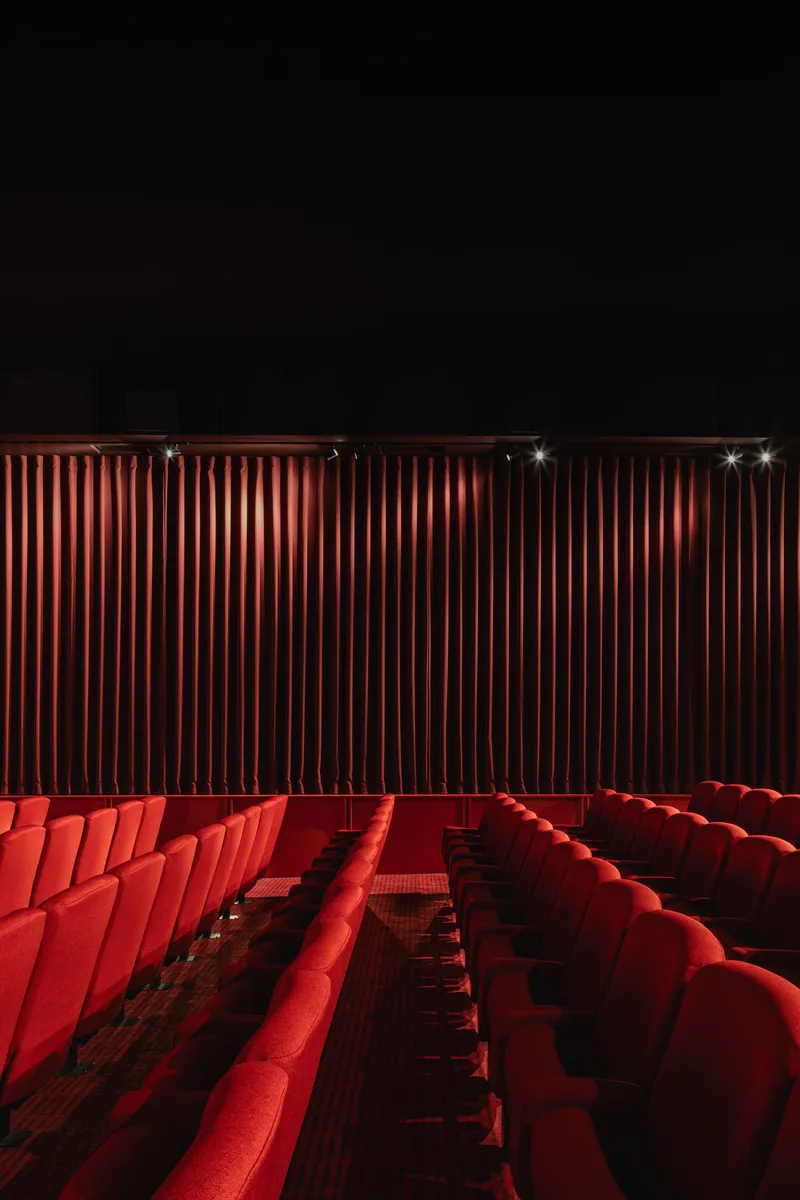
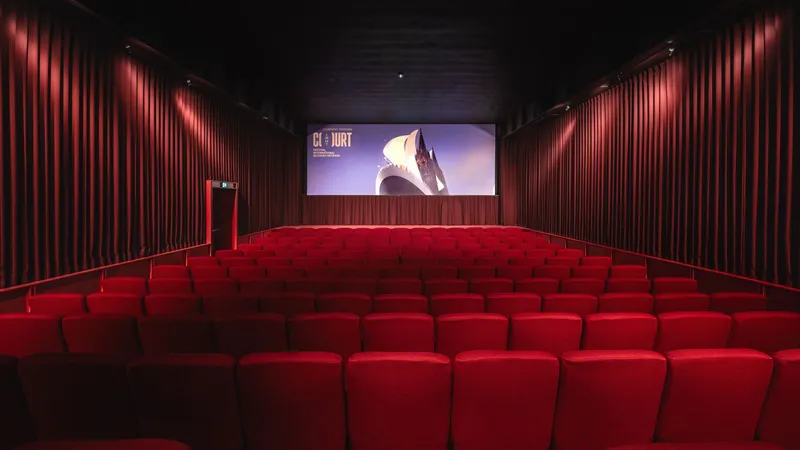
Inside the 149-seat auditorium, the architects leaned into the theater analogy. Pleated fabric is stretched across the walls like heavy curtains, creating a continuous ribbed surface that diffuses sound rather than bouncing it. The red and brick tones of the upholstery and custom carpet reinforce the enclosure, pulling the eye toward the screen while keeping the periphery soft and absorptive. Illuminated vertical wall panels punctuate the pleats with a rhythm that recalls stage wings.
The decision to use textile so extensively is both acoustic and atmospheric. Hard surfaces read as institutional; fabric reads as domestic. By wrapping the room in it, FAB Architects and Unes Architectes make the space feel smaller and more intimate than its 400 m² footprint would suggest. You sit in this room and feel held. That is the antithesis of the multiplex, and it is precisely the point. Originally created in 1962 by Nick Kechichian, the cinema now carries forward a lineage of personal, neighborhood-scale gathering that no franchise model can offer.
Plans and Drawings
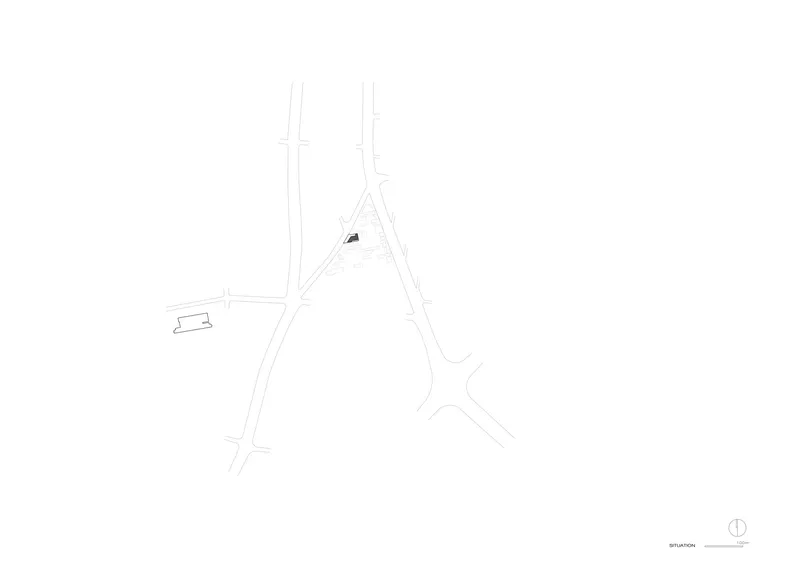
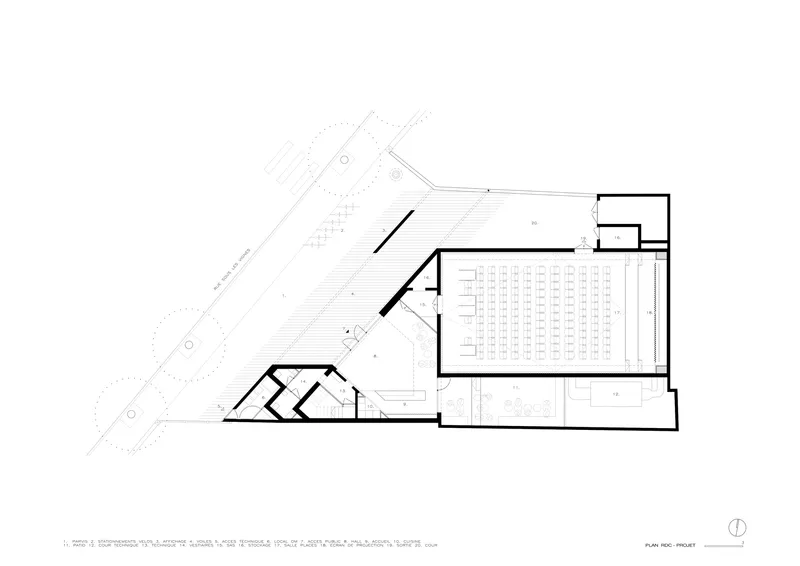
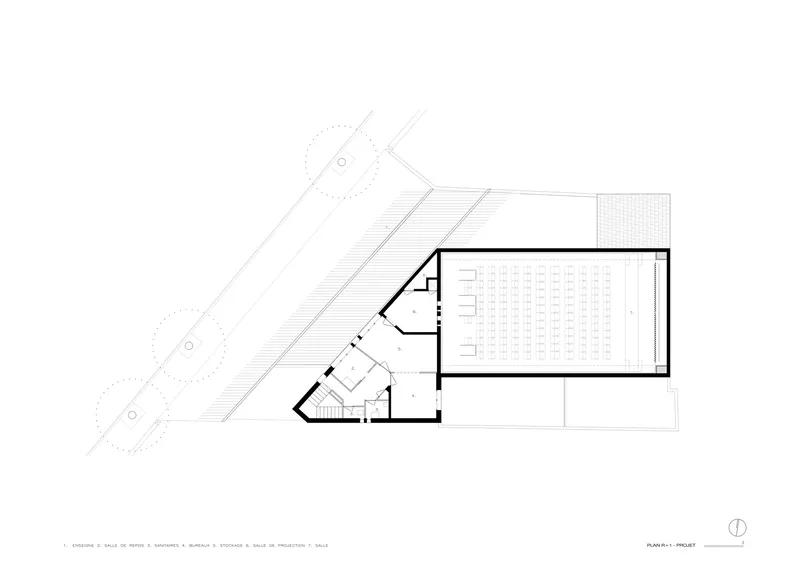
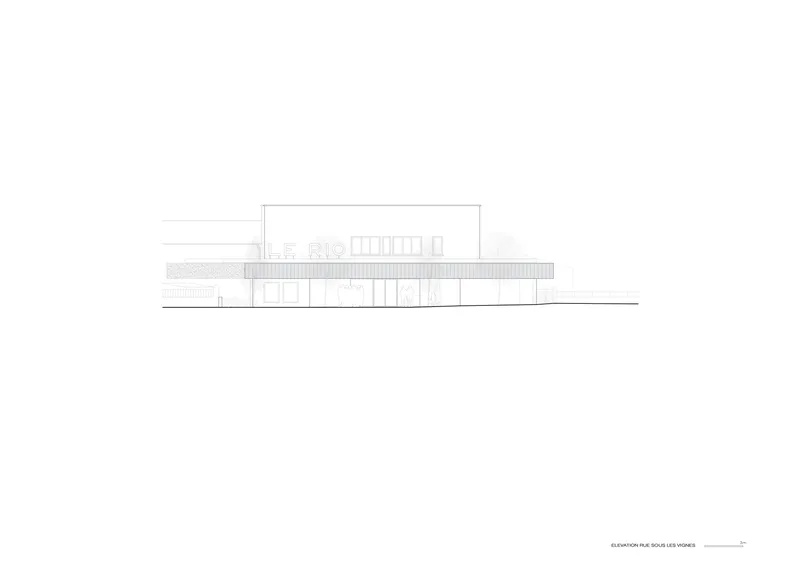
The site plan reveals Le Rio's position at an intersection, its angular footprint wedged into the urban grain of the surrounding streets. The floor plans show how the architects reorganized circulation around a central auditorium: the reception space now traverses the building, functioning as lobby, bar, and meeting space in rotation. Where former technical storage rooms once sat, a new patio introduces daylight and transparency into the plan, turning a leftover void into a social connector.
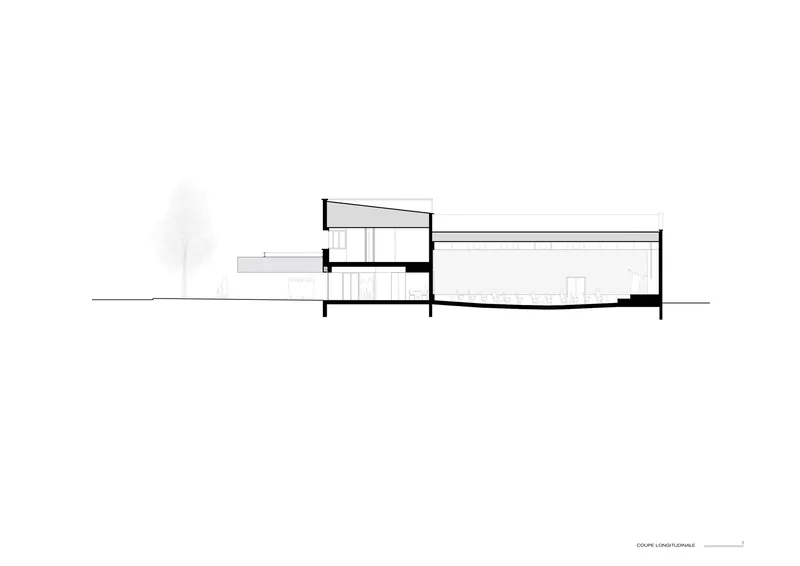
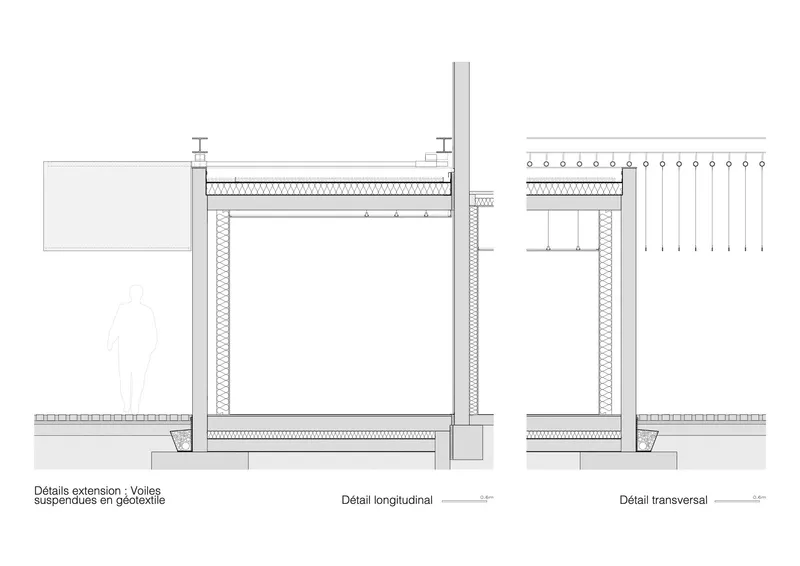
The longitudinal section is the most revealing drawing. A split-level interior accommodates the raked seating while a small extension at the rear pushes sanitary facilities outward, freeing modular space in the main volume. The construction detail drawings of the geotextile canopy are worth close attention: they show how the 80 fabric panels are fixed on brackets to the corrugated metal roof structure, creating the layered, semi-translucent effect visible from the street. The system is deliberately low-tech, repeatable, and repairable.
Why This Project Matters
Le Rio matters because it takes a building type that the market has abandoned and treats it as worthy of real architectural thought. FAB Architects and Unes Architectes did not simply renovate; they reframed what a neighborhood cinema can be. The reception doubles as a bar. The forecourt doubles as a gathering hall. The auditorium wraps itself in fabric and asks you to stay. Every move serves a double function because the budget demanded it, and the result is a building that is more generous than many projects costing five times as much.
In a broader context, the project is a case study in how to operate within constraints that might seem suffocating: a building you don't own, a neighborhood that has seen decades of disinvestment, a budget under €800,000. The architects responded by stripping the walls bare and working from there, tracing the original 1930s building and reinvesting the interstices of the parcel. The lesson is not that constraint breeds creativity, a platitude repeated so often it has lost all meaning. The lesson is that constraint, handled with precision, can produce a space that genuinely serves its community. That is harder, and rarer, than it sounds.
Neighborhood Cinema 'Le Rio' by FAB Architects and Unes Architectes, Clermont-Ferrand, France. 400 m², completed 2026. Photography by Salem Mostefaoui.
About the Studio
Share Your Own Work on uni.xyz
If projects like this are the kind of work you want to make, uni.xyz is a place to publish your own, find collaborators, and enter design competitions.


Popular Articles
Popular articles from the community


Manzana Morphosis: Stretching Barcelona's Grid into a Living Landscape for 2050
A radical reworking of the Eixample manzana turns density into a tool for generous public space, vertical ecology, and environmental performance.

Cloaked Colonization: A Mobile Underwater Habitat That Moves Like a Fish
Micah Abaya's shortlisted EHC Pacific entry reimagines ocean settlement as a dispersed network of self-sustaining architectural organisms.
Extended Shell: Retrofitting Kolkata's Balconies as Living Urban Thresholds
A modular retrofit system recovers the social and environmental intelligence of Kolkata's historic verandas for contemporary Park Street residents.

The Amber Palace Opera: A Geological Fiction Surfaces on Tallinn's Baltic Waterfront
Pierre Brillard reimagines a Baltic legend as a public landscape, opera house, and waterfront promenade rooted in Tallinn's coastal identity.

Similar Reads
You might also enjoy these articles

Pixel Gardens: One Repeated Module Stacked Into a Terraced Social Housing Tower for Famagusta
Salem Bader's shortlisted housing tower builds a vertical neighbourhood from one repeated module, offsetting units to carve terraces, light and air.

Bao Huynh Watercolor Atelier: A Serene Art Retreat in Hội An
Bao Huynh Watercolor Atelier in Hội An blends multifunctional art spaces, sustainable design, local materials, and family-friendly living in a serene environment.

Atelier Macri Concept Store Interior Design by CASE-REAL
Atelier Macri store features a "ko" counter, walnut wood details, cork displays, blending retail, gallery, and seamless customer experiences.

Manuel Vargas Izquierdo Stadium and High-Performance Sports Center: Architectural Excellence in Jalpa de Méndez
The Manuel Vargas Izquierdo Stadium blends sustainable design, inclusive sports facilities, and cultural-inspired architecture, revitalizing Jalpa de Méndez’s public spaces.


Comments (0)
Please login or sign up to add comments
No comments yet. Be the first to comment!