
Felipe Caboclo Arquitetura Nests a 10-Square-Meter Chapel into the Countryside Near São Paulo
A processional sequence of concrete, timber, and lavender distills sacred architecture to its elemental core in Itu, Brazil.


Ten square meters is barely enough for a bathroom. It is also, as Felipe Caboclo Arquitetura demonstrates with the Nest Chapel in Itu, Brazil, enough to hold the weight of the sacred. Sitting on a 2,000-square-meter lot adjacent to the firm's own Nest House, the chapel was built where the family had originally left open ground during construction of their rural residence. What fills that vacancy now is not a building that demands attention through scale but one that earns it through compression, material precision, and a slow choreography of arrival.
The project is interesting because it treats smallness as a theological condition, not a constraint. Caboclo cites Le Corbusier's triad of materials aspiring toward the divine, Tadao Ando's concrete chapels, and Richard Serra's sculptural steel works, but the result is not a pastiche of references. It is a building that understands the difference between enclosure and sanctuary. Every surface, every sightline, every shift in ceiling height participates in a single argument: that the sacred is produced by proportion, movement, and the disciplined interaction of light with matter.
Landscape as Liturgy

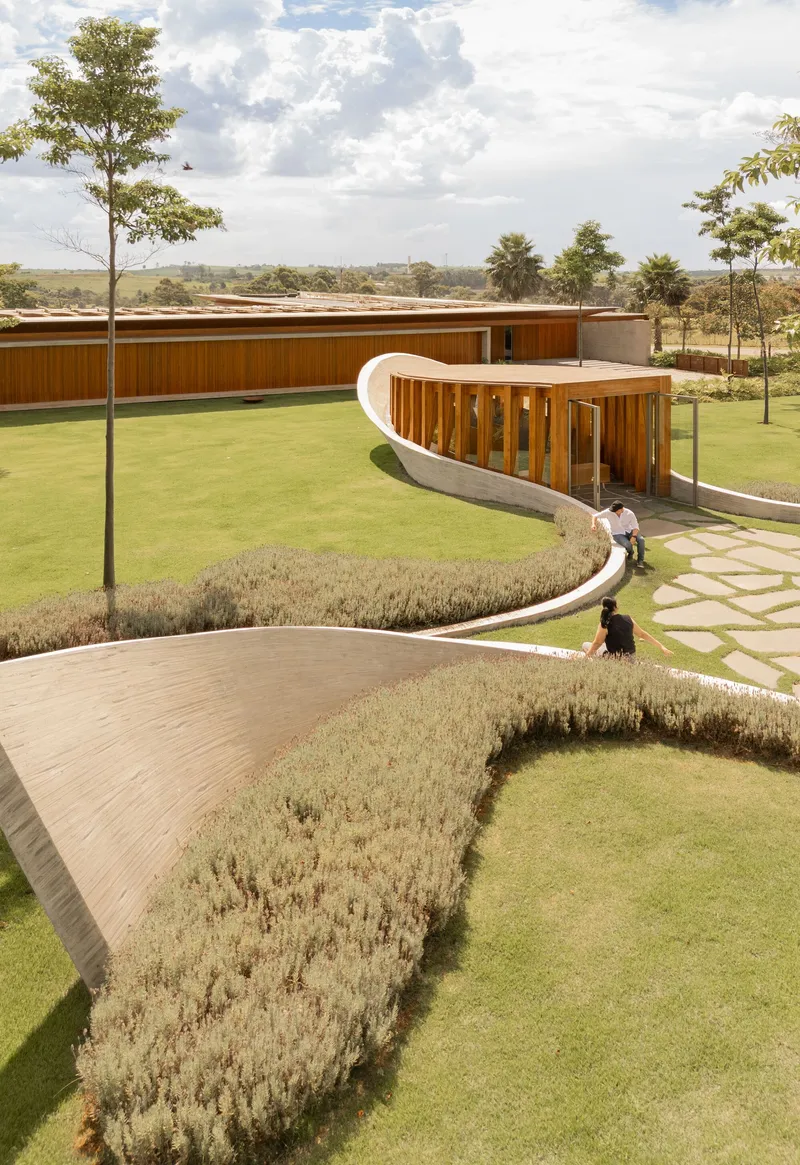

You do not simply walk up to the Nest Chapel. The approach is a lavender path that encircles the building, a single-species planting chosen for its chromatic consistency, scent, texture, and seasonal variation. It is a deliberate slowing device. The winding stone pathways and planted beds draw the body into a processional rhythm well before any threshold is crossed, turning the garden into a kind of open-air narthex.
Black São Gabriel granite, laid in a broken-stone pattern, extends seamlessly from exterior to interior, erasing the boundary between ground and floor. The garden is always in view through glazed surfaces, so even once you are inside the chapel, the landscape remains a participant. This is not ornamental planting. It is spatial infrastructure.
Concrete Walls That Read as Geology
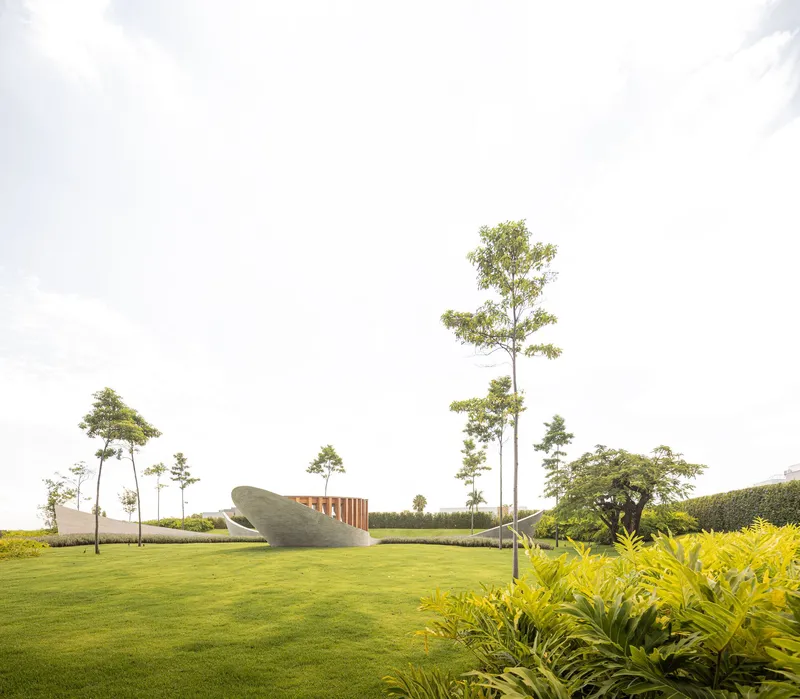


Two exposed concrete walls rise from the terrain with a hyperbolic geometry, their heights varying as they curve in plan. Five-centimeter timber formwork boards leave their imprint on every surface, a texture that intentionally references Varvito, the layered sedimentary stone native to Itu. The reference is not cosmetic. It roots the chapel in its geological context, giving the concrete a striated, almost fossil-like character that suggests deep time rather than fresh construction.
The walls function both as structure and as sculpture. They anchor the planted beds, define the courtyard, and channel movement toward the interior. Seen from across the lawn, they read as land forms, not architecture, which is precisely the point. The building emerges from the ground rather than sitting on it.
The Oval Volume and Its Timber Ceiling
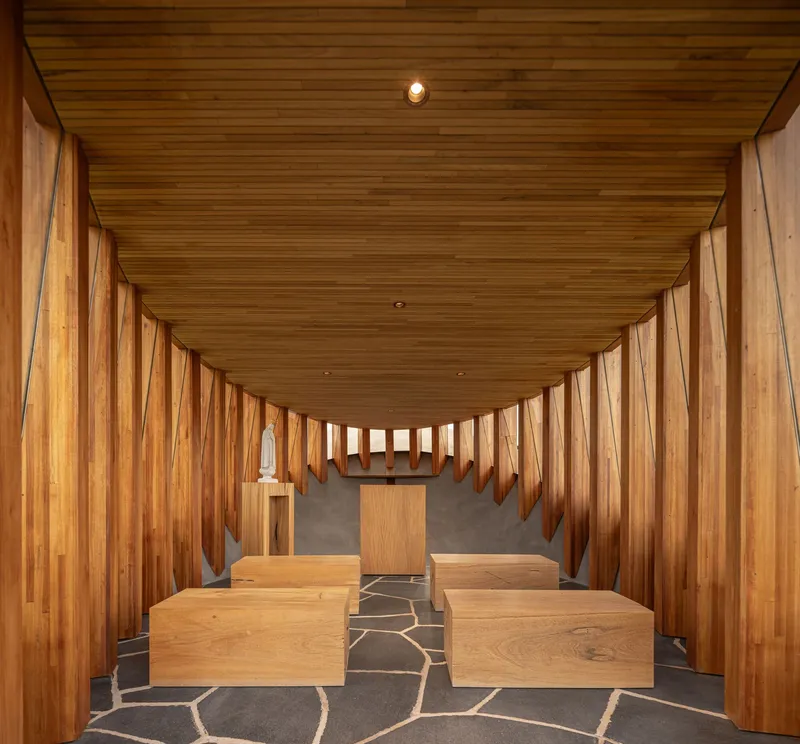


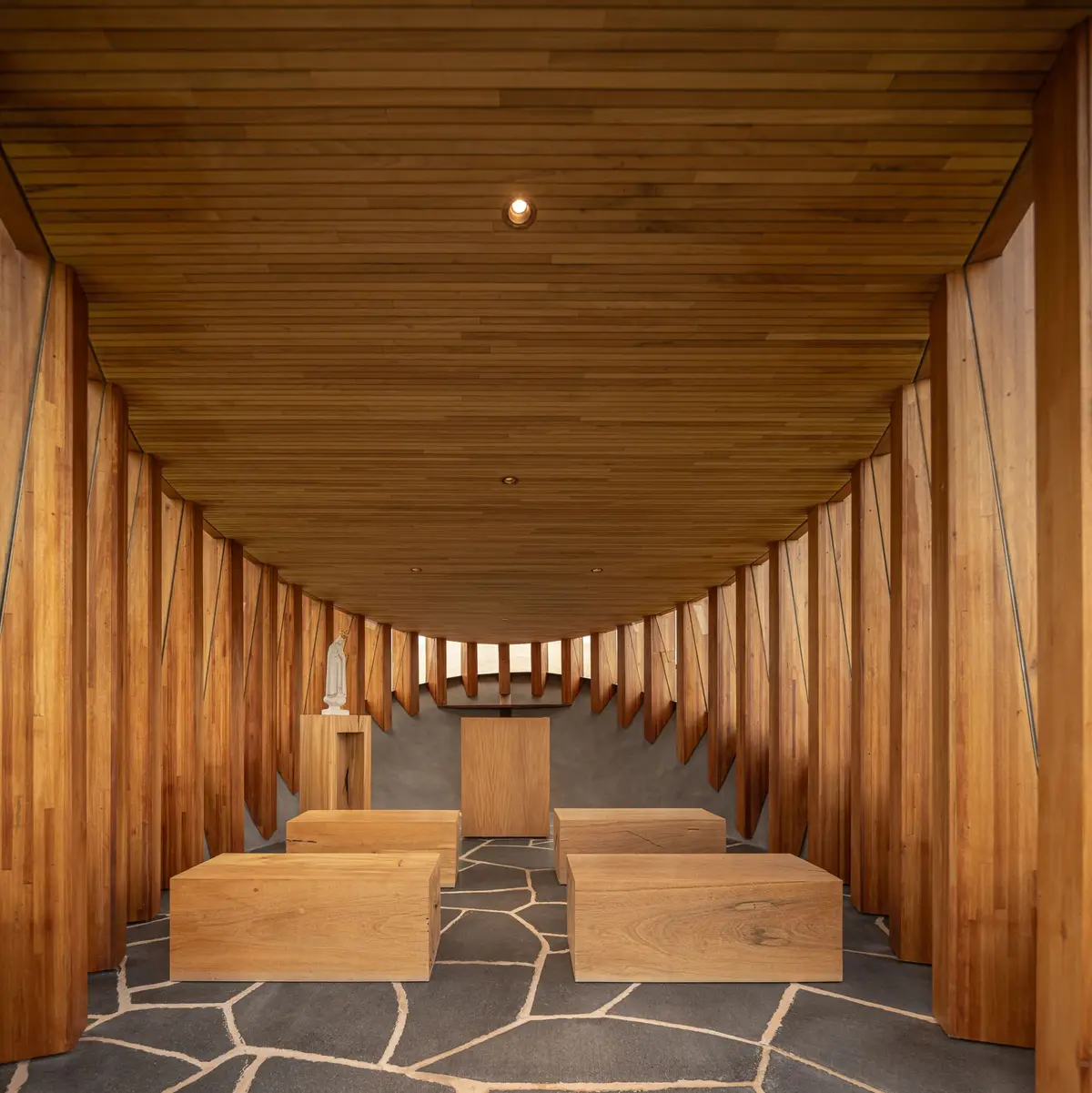
The prayer space itself is an oval volume formed by the convergence of concrete walls and laminated timber elements that rise from the floor to rest upon those curved walls. The ceiling is lined with Freijó wood slats that radiate outward from the center, creating a sense of upward pull even in a room with modest headroom. The slightly inclined roof channels rainwater outward while also directing the visitor's gaze toward the altar, a subtle but effective piece of sectional choreography.
Solid wood benches, a pulpit, and a totem furnish the space with the same material discipline found in the structure. Nothing competes. The palette is concrete, wood, stone, and light. Two operable glazed panes set at an angle allow cross ventilation, so the chapel breathes without mechanical assistance. The result is a room that feels both enclosed and porous, sheltered yet connected to the sky and garden.
Compression and Release
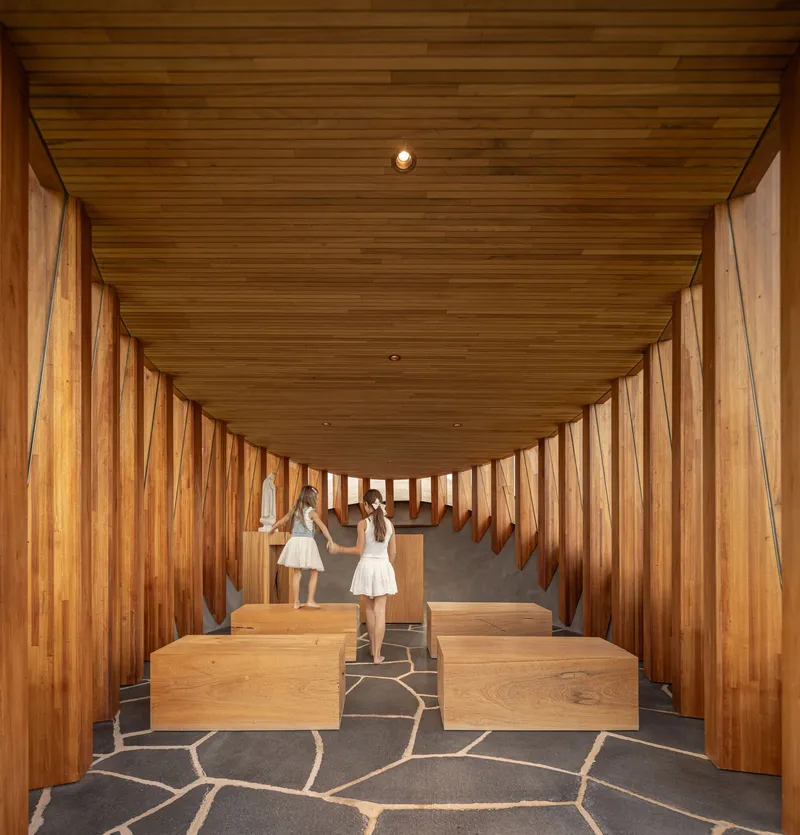


Caboclo orchestrates a gradual sequence of compression and release along the circulation path. The timber-lined corridor with its vertical slat walls and grey flagstone paving narrows as you descend toward the interior, forcing the body into a slower cadence. Then the oval volume opens, and the ceiling lifts. This is old liturgical logic, the kind of spatial sequence that cathedrals deploy across hundreds of meters, compressed here into a footprint smaller than many parking spaces.
At twilight, the effect intensifies. The timber slats glow with interior light, turning the chapel into a lantern within the landscape. The curved white entry walls frame the illuminated volume like cupped hands, and the stone pathway becomes a lit procession. Day and night offer two distinct experiences of the same building, which speaks to the care invested in every layer of the design.
Sculptural Presence on the Lawn


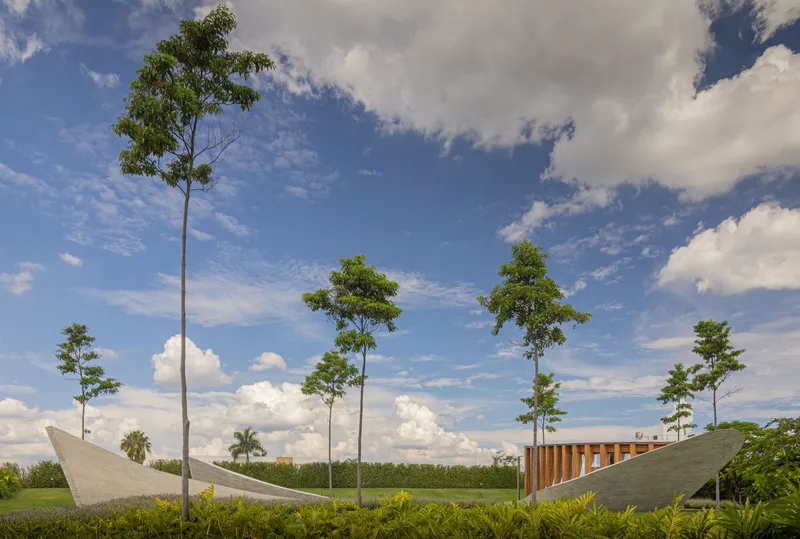
From a distance, the chapel reads as a piece of land art. The curved concrete forms anchoring the lawn among tall trees recall Serra's torqued steel ellipses, but here the material is poured rather than rolled, and the enclosure serves a social purpose. Visitors and the family move around and through these forms as if navigating a landscape sculpture, not entering a conventional building.
The vertical timber screens that wrap portions of the concrete form filter light and views, creating a moiré effect as you walk past. The building reveals itself differently from every angle, which is a lot to ask of ten square meters but is delivered convincingly here.
Dusk and the Architecture of Light


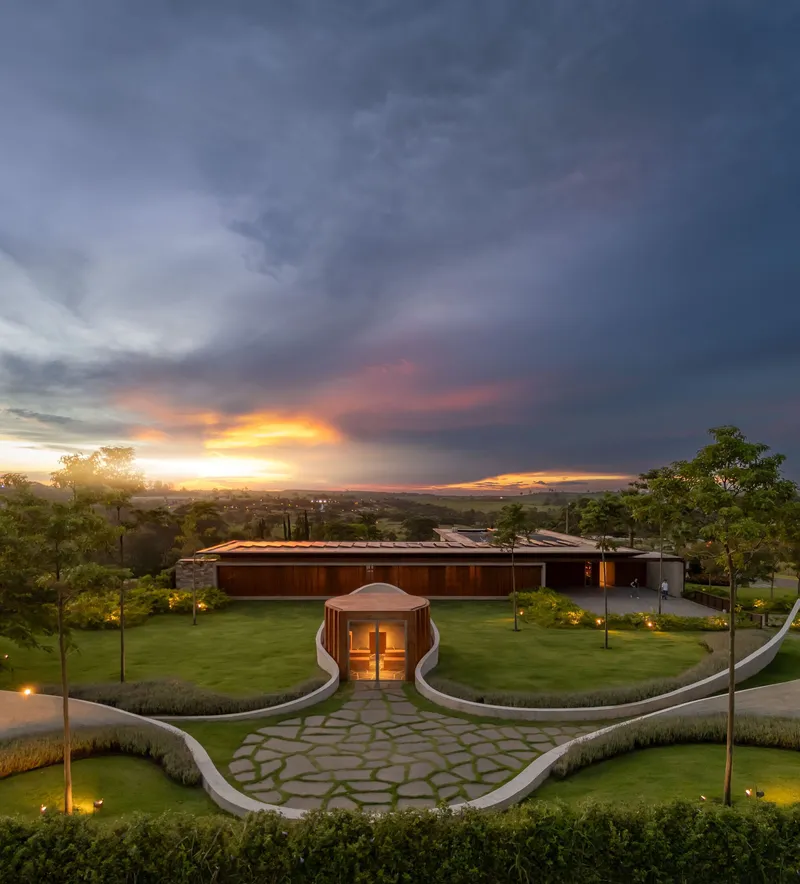
The evening photographs are not mere mood shots. They reveal a second building. Uplighting washes the curved concrete walls with warm tones, and the timber slat screens become translucent membranes. The symmetrical curving entry walls, almost invisible in bright daylight, become the dominant compositional element at sunset, framing a central axis that draws the eye toward the glowing pavilion.
Lighting in sacred architecture often defaults to drama. Here it defaults to intimacy. The chapel at dusk feels like a hearth, not a stage.
Plans and Drawings


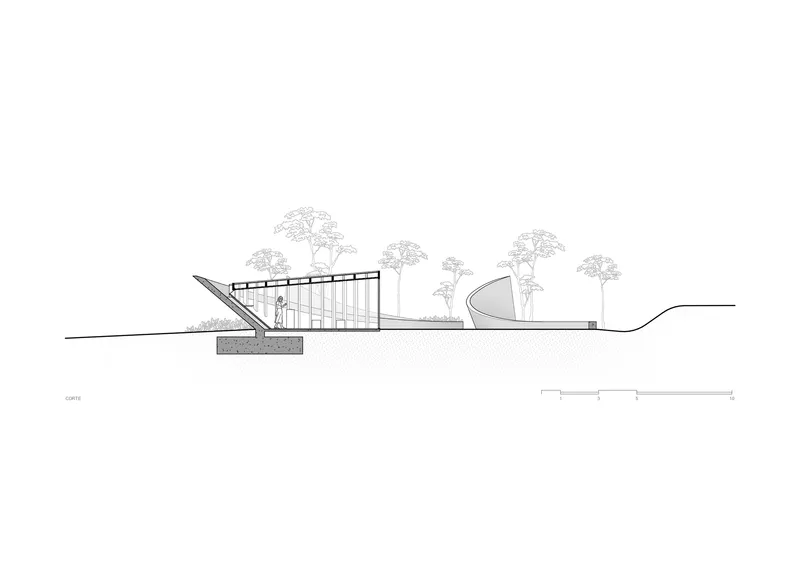


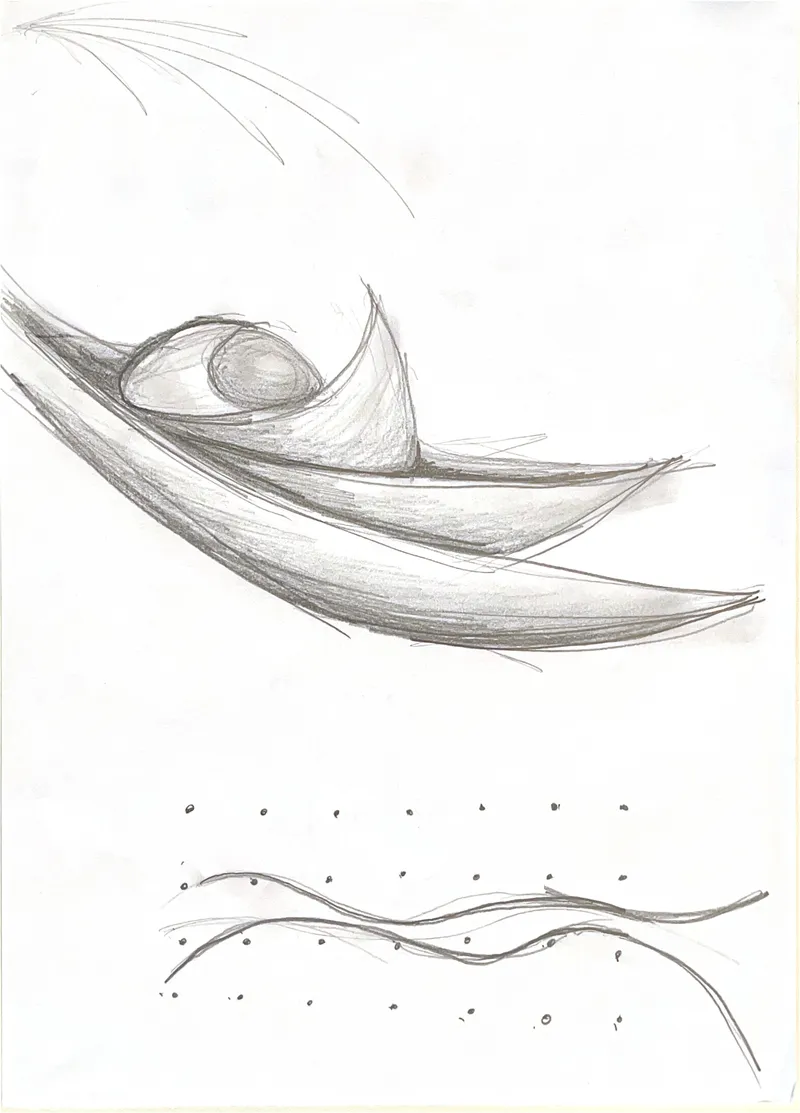
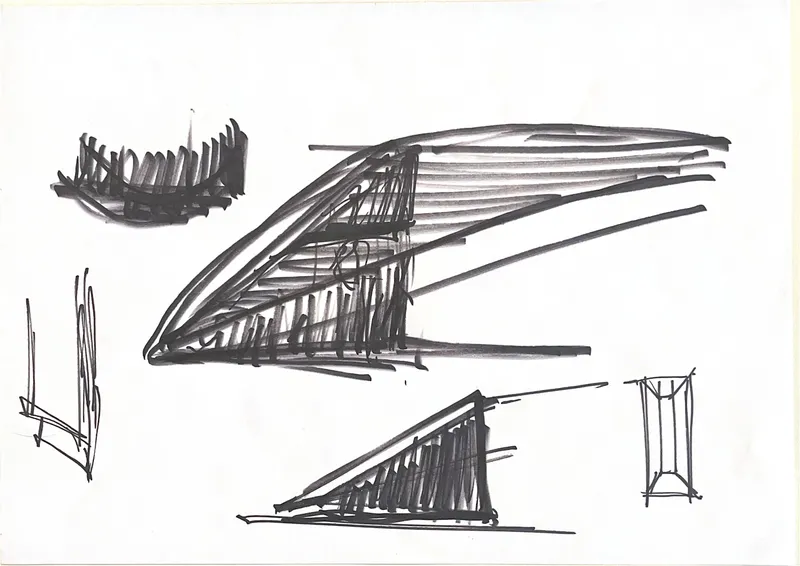

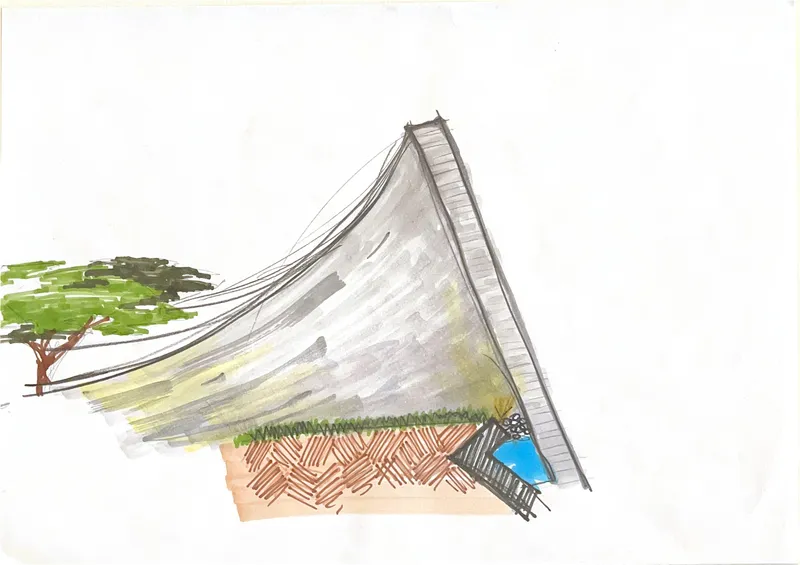
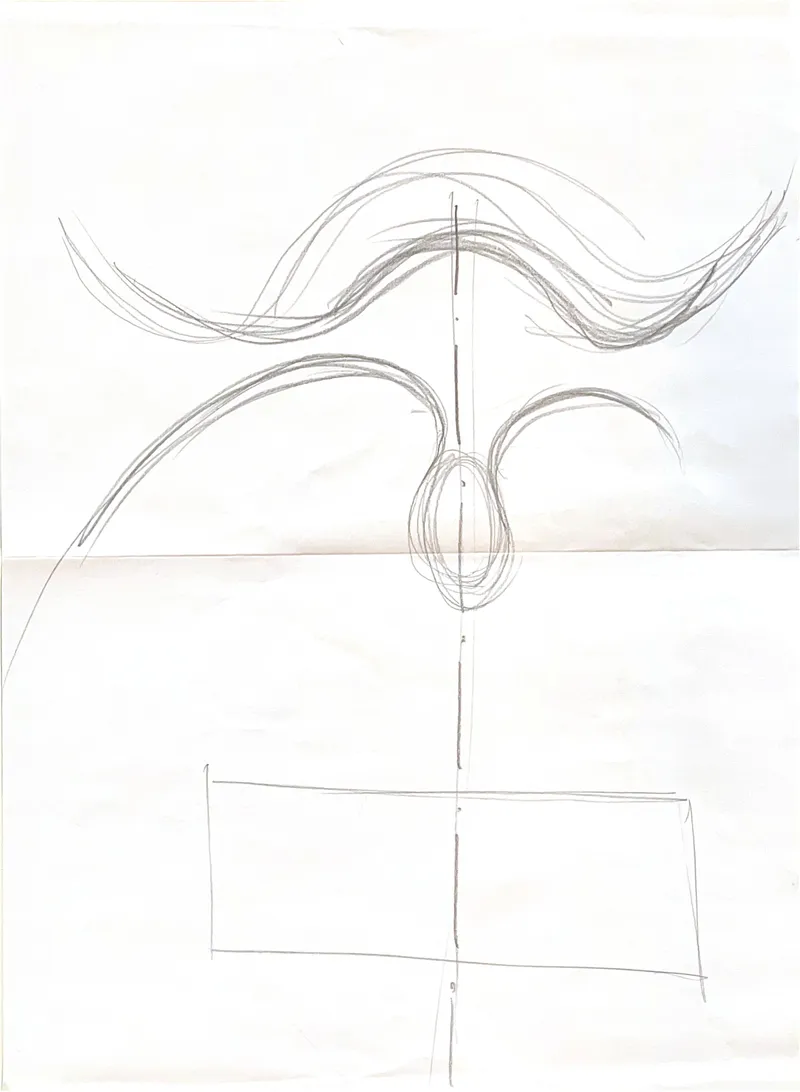
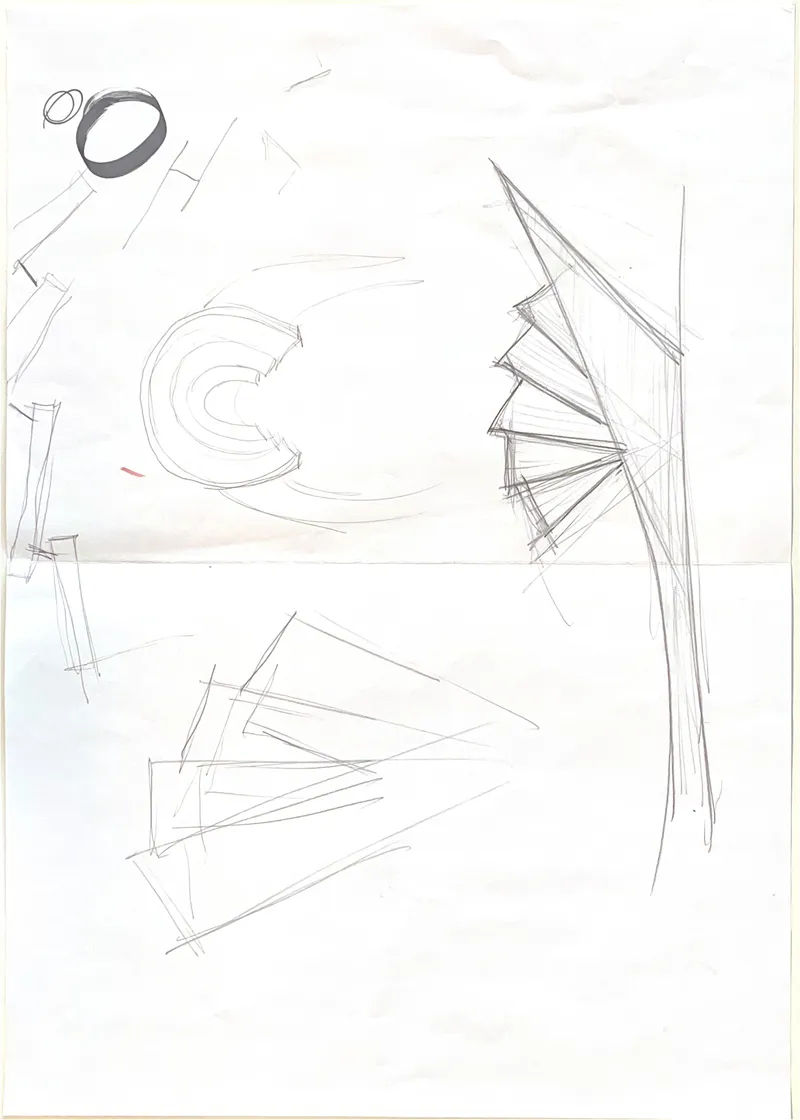
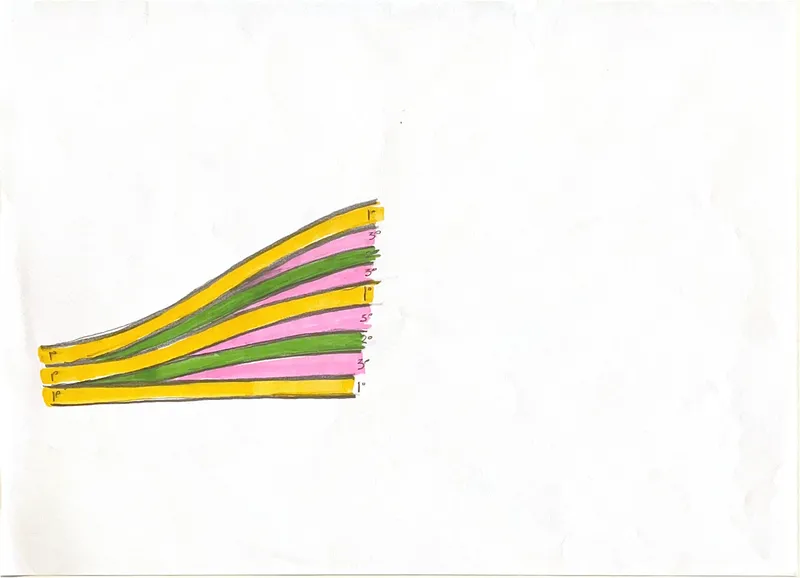
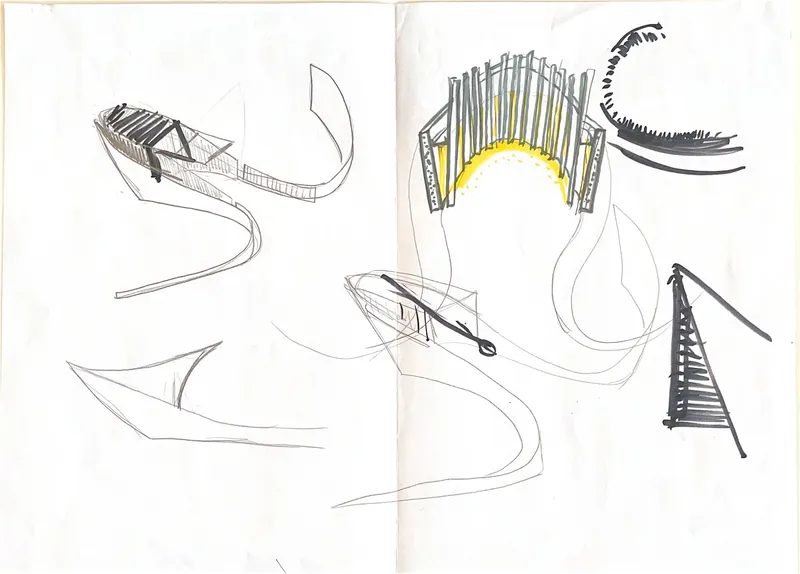


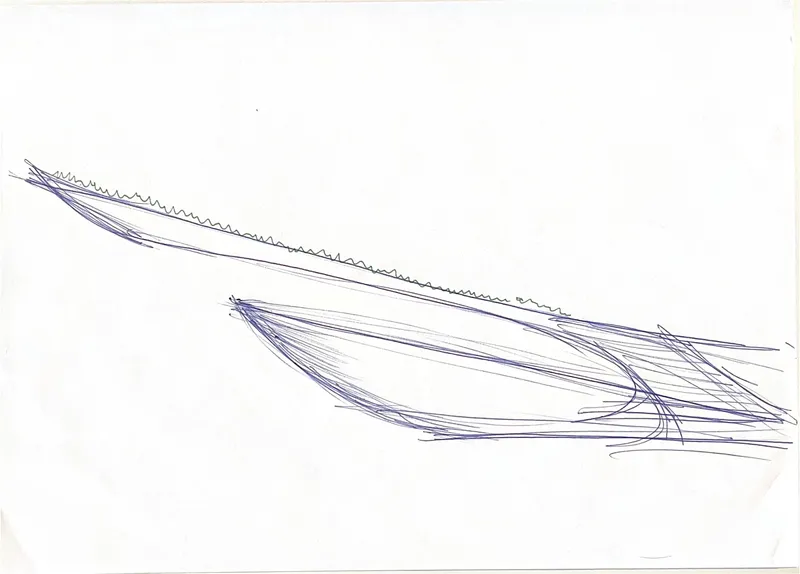
The plan drawing confirms the oval geometry of the prayer space and its relationship to the sinuous landscape walls that extend into the garden. What looks free-form from ground level is, in plan, a tightly controlled exercise in tangent lines and radii. The section reveals a partially buried volume with glazed walls and a planted canopy above, explaining why the chapel feels so grounded despite its modest footprint.
The sketches are particularly revealing. Early studies in blue pen and watercolor explore a range of angular and curvilinear roof forms before converging on the final flowing profile. The colored section detail showing stacked curved beams illustrates the laminated timber logic that produces the radial ceiling. These are not presentation drawings. They are thinking tools, and they show a design process that moved through dozens of formal propositions before arriving at the one that felt inevitable.
Why This Project Matters
Small sacred buildings have always punched above their weight in architectural culture, from Ronchamp to the Church of the Light. The Nest Chapel does not claim that lineage outright, but it operates in the same territory: the conviction that a room built with enough spatial intelligence can hold meaning far beyond its measurable dimensions. At ten square meters, this is arguably one of the smallest completed chapels of the decade, and yet it generates a richer spatial sequence than many buildings ten times its size.
What Felipe Caboclo gets right here is the relationship between building and ground. The São Gabriel granite floor that bleeds from outside to inside, the Varvito-referencing concrete texture, the lavender garden that operates as both threshold and frame: these are not decorative choices. They are structural decisions about where architecture ends and landscape begins, or rather, about refusing to draw that line at all. In a moment when sacred architecture often defaults to spectacle or nostalgia, the Nest Chapel offers a third option: quiet, rigorous, grounded specificity.
Nest Chapel by Felipe Caboclo Arquitetura. Itu, São Paulo, Brazil. 10 m². Completed 2024. Photography by Fernando Guerra | FG+SG and Felipe Caboclo Arquitetura.
About the Studio
Share Your Own Work on uni.xyz
If projects like this are the kind of work you want to make, uni.xyz is a place to publish your own, find collaborators, and enter design competitions.


Popular Articles
Popular articles from the community


Cube Design Draws an Ecological Corridor Between Two Shenzhen Hills with the Nankai Building
Beside Shenzhen's container docks, the Nankai Building pairs stacked balconies with a climbing green screen to connect two hillsides across its height.

Architekt Andreas Gruber Scatters 23 Dark Timber Chalets Across a South Tyrolean Forest Edge
In Molini di Tures, Amonti Chalets breaks a resort into a hamlet of gabled timber houses, with parking, storage and services pushed into the slope.

David Macias Steps a Doorless Stone and Plaster House Down a Tropical Colombian Hillside
In the humid hills of Colombia, Threshold House replaces the front door with an open void and terraces its 850 m² down the slope instead of fighting it.

LT2A and OPEN Architectes Thread a Brick and Glass High School Through a Wooded Belgian Campus
In Braine-l'Alleud, a 3,000 m² wing for Collège Cardinal Mercier pairs pale brick with a glazed colonnade, deferring to a small chapel and a dense wood.

Similar Reads
You might also enjoy these articles


LAVA Architecten Gives Vocational Education a Sawtooth-Roofed Face on a Mechelen School Campus
In Mechelen, Belgium, a 2,053 m² STEM school on a 6×6 m grid turns workshops and classrooms into rooms that can be rearranged as teaching changes.

KEMA Studio Turns a Derelict Marvila Attic into a 60 m² Lighthouse Apartment Above Lisbon
In Lisbon's Marvila district, a rebuilt roof, four skylights and two plywood volumes turn an unlivable attic into a bright home facing the Tagus.

Pixel Gardens: One Repeated Module Stacked Into a Terraced Social Housing Tower for Famagusta
Salem Bader's shortlisted housing tower builds a vertical neighbourhood from one repeated module, offsetting units to carve terraces, light and air.

Bao Huynh Watercolor Atelier: A Serene Art Retreat in Hội An
Bao Huynh Watercolor Atelier in Hội An blends multifunctional art spaces, sustainable design, local materials, and family-friendly living in a serene environment.

Explore Chapel Competitions
Discover active competitions in this discipline

Design Challenge - Contemporary interpretation of a religious complex

Challenge to design mud housing for contemporary communities
Comments (0)
Please login or sign up to add comments
No comments yet. Be the first to comment!