

Field Office Architecture Splits a Melbourne Terrace in Two to Let Light In
A Victorian filigree terrace in Fitzroy North finds new life through a carved courtyard, walnut joinery, and a philosophy rooted in ikigai.


Narrow Victorian terraces in inner Melbourne are among the most constrained typologies an architect can take on. East-west orientation, party walls on both sides, heritage overlays, and a footprint that barely admits a hallway, let alone natural light. At Fitzroy North Terrace, Field Office Architecture confronted exactly this condition and responded by doing something counterintuitive: they removed floor area. A previous renovation, completed fifteen years earlier, had tried to fill the site. It failed. Field Office stripped it out and started again with a plan that separates the dwelling into two distinct volumes linked by a north-facing courtyard.
The result is a house that reads as three acts. The heritage terrace at the front retains its ornate cornices, arched openings, and Victorian filigree balcony. Behind it, a contemporary two-storey volume houses the kitchen, dining, and upper bedrooms. And at the rear of the plot, a detached studio and garage clad in stained silver-top ash timber and reclaimed brick operates as a semi-autonomous guest suite. Between the front and middle volumes, a small courtyard punches light deep into the ground floor and transforms what would otherwise be a dark, corridor-like plan into something genuinely open. Field Office frames the project as an exercise in ikigai, the Japanese concept of purposeful living, and the architecture follows through: every element exists because it serves comfort, light, or daily ritual.
Two Volumes, One Street


From the street, the project is almost invisible. The original Victorian facade, with its cast-iron lacework and ivy climbing the brickwork, holds its place in a row of matching terraces. Walk down the adjacent laneway, though, and the new work reveals itself: a brick datum line extends along the boundary, marking the transition from public to private, while dark horizontal cladding cantilevers above to signal the upper storey addition. The contrast is deliberate and sharp. Ornament at the front, restraint at the back.
The rear elevation is where the project's dual personality becomes explicit. Reclaimed brick anchors the base, grounding the new addition in the materiality of its heritage context, while the black-clad upper volume floats above, its fine detailing and flush joints reading as a precise counterpoint to the weathered masonry below. It is a composition that respects the street without performing nostalgia.
The Courtyard as Engine

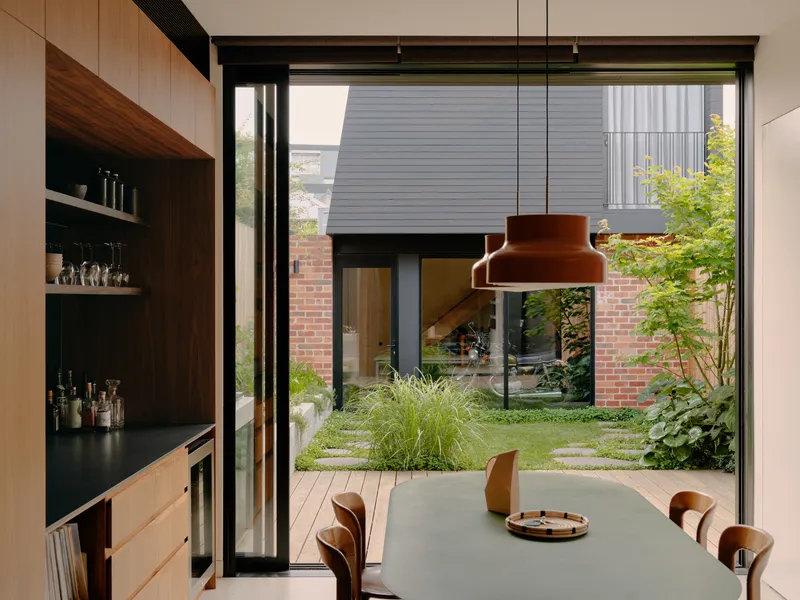

The north-facing courtyard is the single most important move in the project. By carving open space between the heritage front and the new rear volume, Field Office unlocked quality natural light for every ground-floor room. Concrete stepping stones thread through a lawn flanked by planted beds and climbing vines, giving the courtyard the character of a small garden rather than a light well. Deployable double-glazed doors on either side of this space can be thrown open in summer, promoting crossflow ventilation through the entire ground floor.
The courtyard is visible from the kitchen, the dining area, and the living spaces, which means it functions as a kind of visual anchor throughout the day. In a house this narrow, the temptation is to treat outdoor space as leftover. Here it is treated as the organizing principle. The biophilic strategy is not decorative; it directly reduces the home's reliance on mechanical cooling and artificial lighting.
Walnut and Terrazzo: A Material Language
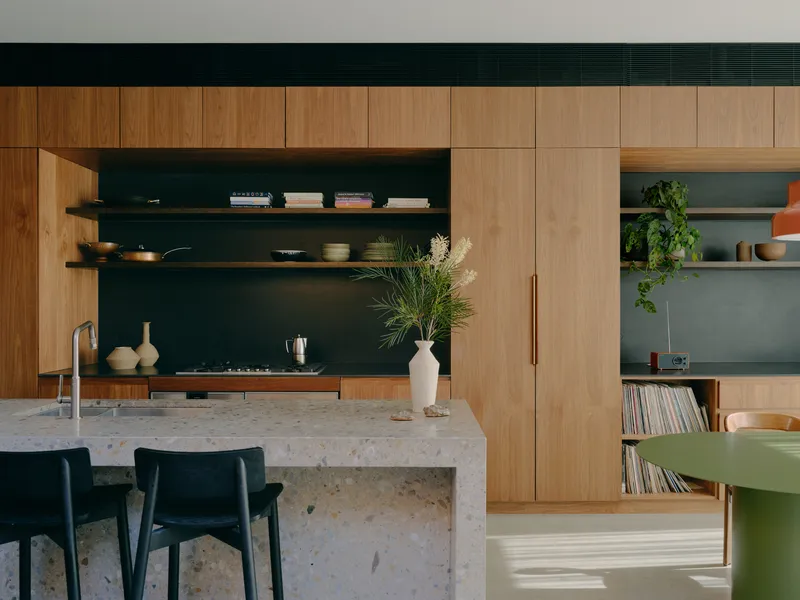
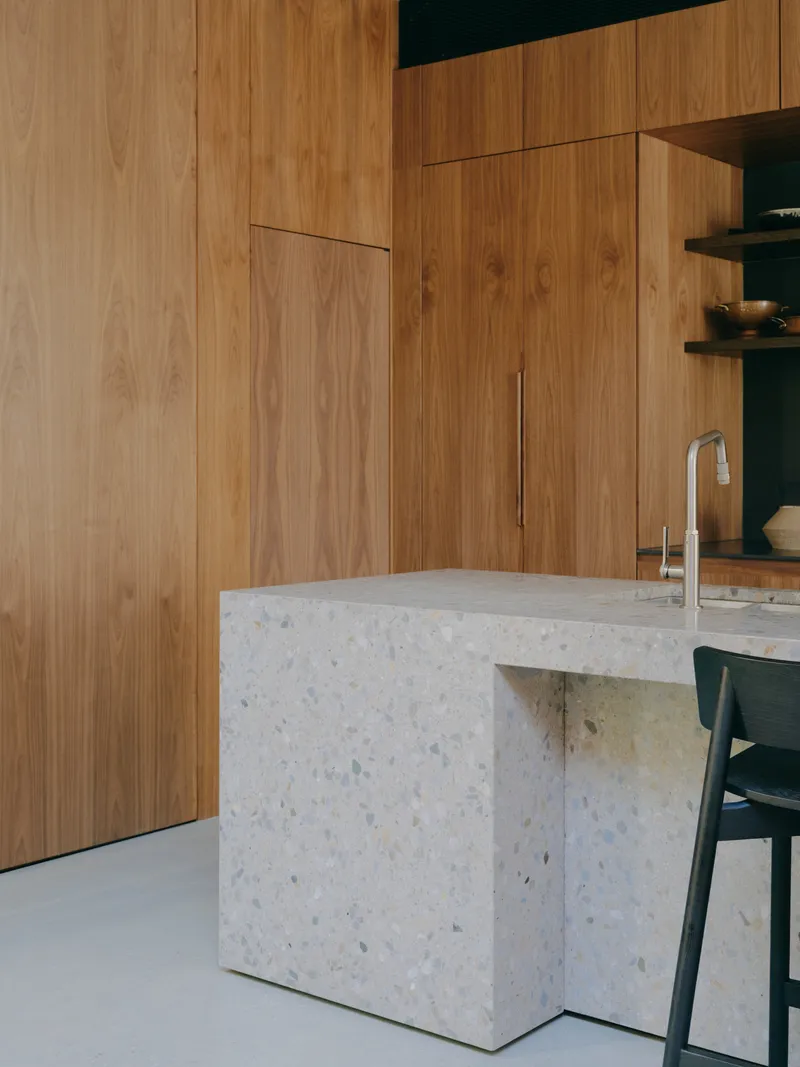
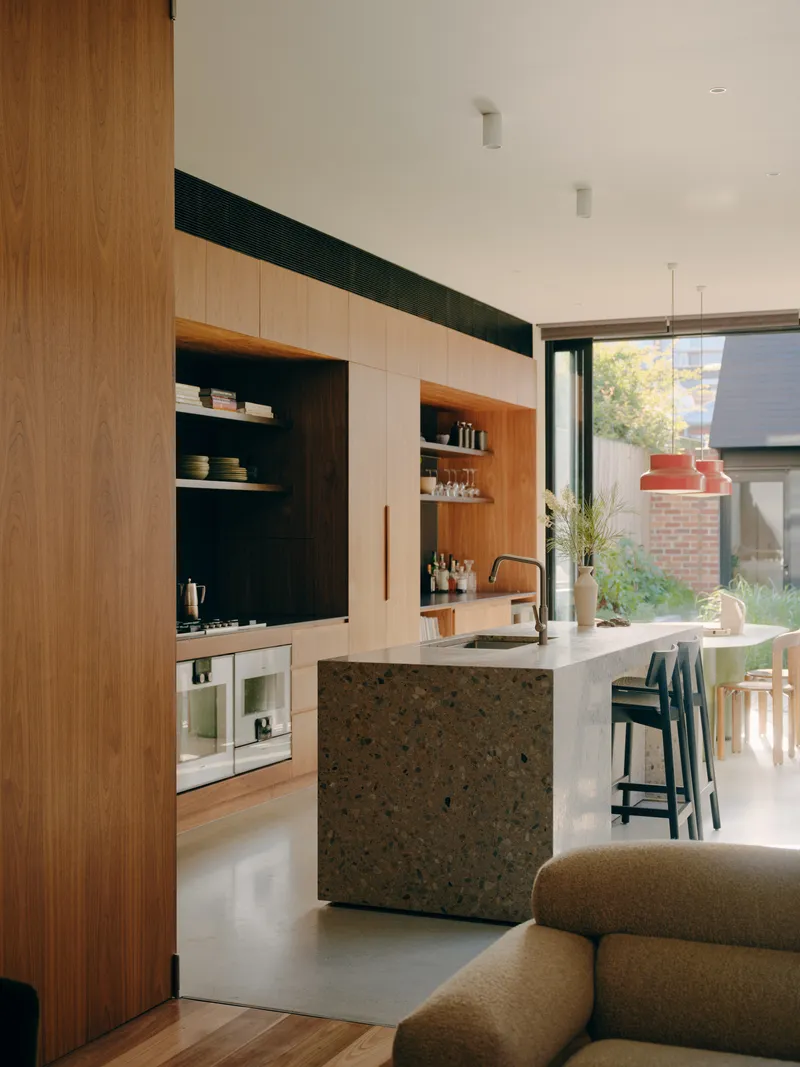
Inside, the material palette is disciplined but warm. Walnut veneer wraps bespoke joinery throughout the kitchen and bathrooms, its grain providing a continuous visual thread. The kitchen island, a substantial terrazzo waterfall bench, grounds the open plan and doubles as a social gathering point. Terrazzo appears again in the bathrooms, establishing a material consistency that elevates the interiors without relying on a wide palette. The effect is tactile rather than showy.
What makes the joinery compelling is its integration. Open shelving, cabinetry, and concealed storage are composed as a single wall system rather than discrete pieces. The timber ceiling band that runs through the kitchen ties the overhead plane to the vertical surfaces, creating a sense of enclosure that feels deliberate rather than compressed. On a narrow site, this kind of spatial discipline is essential.
Kitchen and Dining as the Social Core
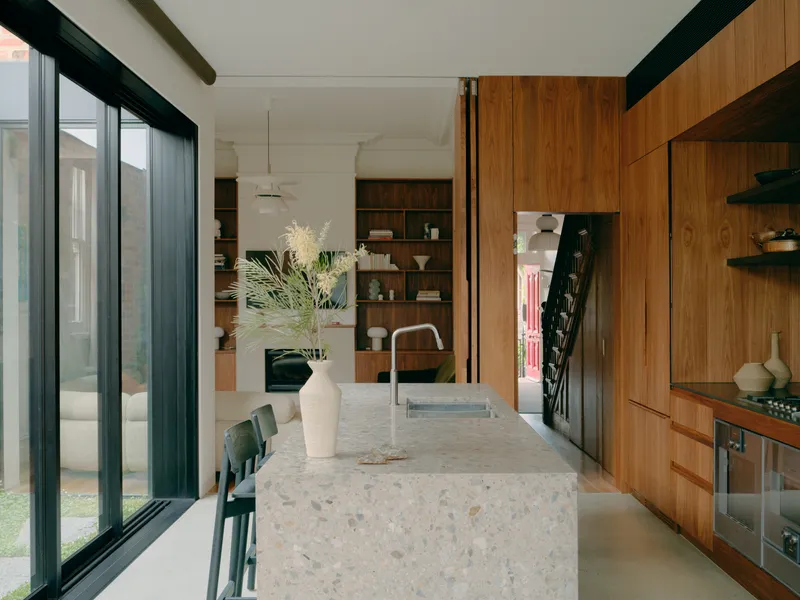

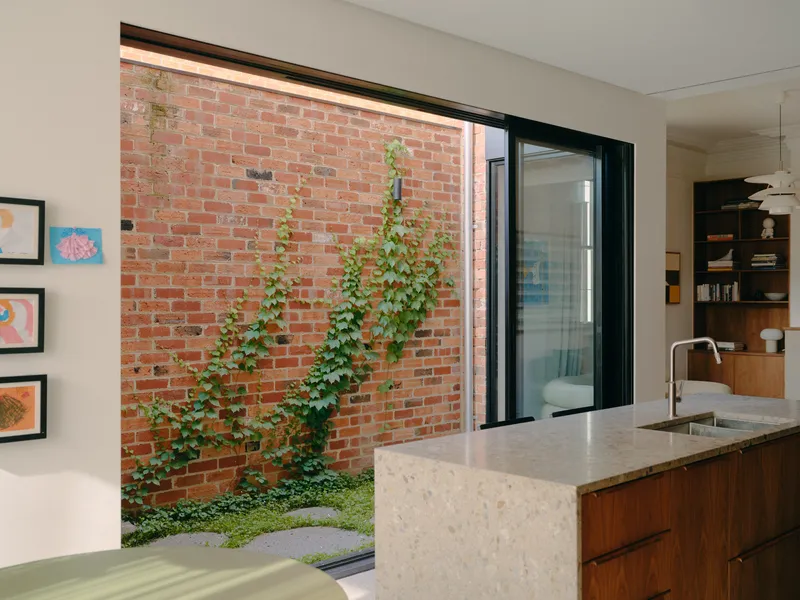
The kitchen and dining spaces occupy the ground floor of the new volume, positioned directly adjacent to the courtyard. Floor-to-ceiling glazing on the courtyard side dissolves the boundary between inside and out, while the opposite wall is lined with the walnut joinery system. A green cylindrical dining table and orange pendant lights introduce color sparingly, relying on individual objects rather than applied surface treatments to animate the room.
From the terrazzo island, you look directly into the brick-walled courtyard where climbing vines soften the masonry. The sightline is short but layered: burnished concrete floor, glass, planting, brick, sky. It compresses multiple conditions into a very tight depth of field, which is exactly the kind of perceptual richness that makes a small house feel expansive.
Living Spaces and the Heritage Rooms

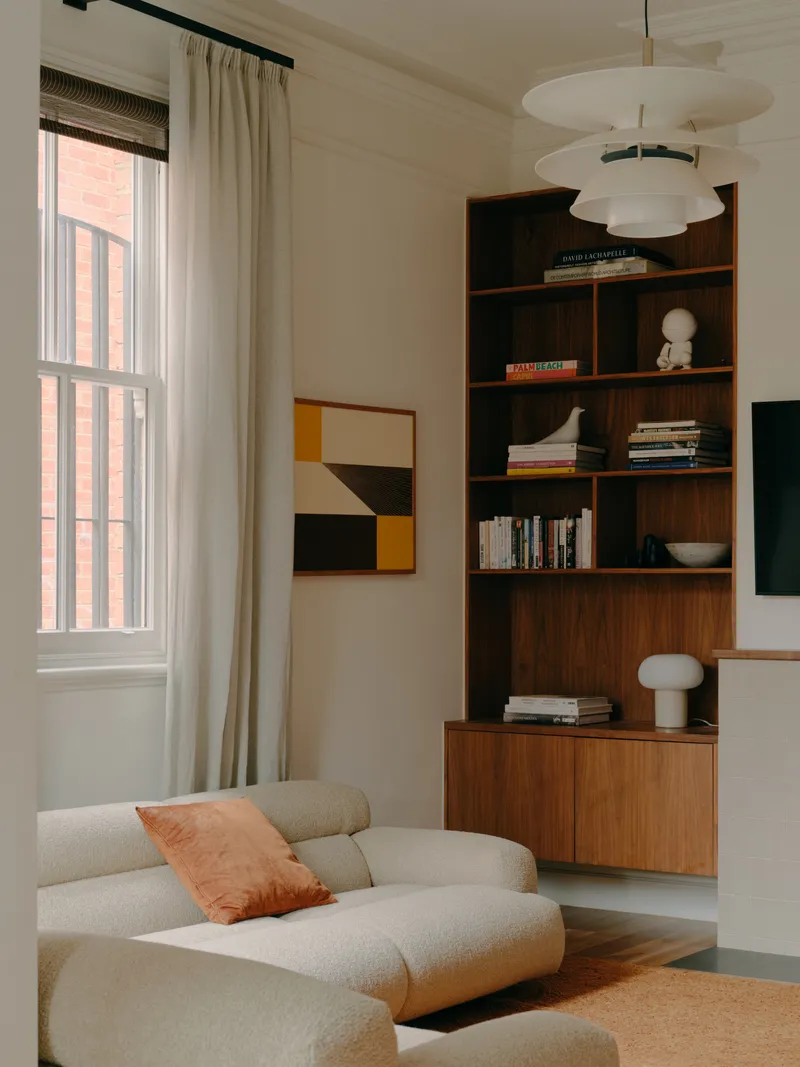
The front rooms of the original terrace have been revitalized rather than reinvented. Ornate cornices and arched openings remain in place, treated as features worth preserving rather than obstacles to a clean aesthetic. Field Office maintained the idiosyncrasies of the heritage-listed house, allowing the new work to defer to the old where it makes sense. A tall walnut shelving unit and tiered pendant light in the living room introduce contemporary furnishing without competing with the period detailing overhead.
Sheer curtains filter daylight into the dining space on the upper level, where the terrazzo table reappears and timber cabinetry lines the walls. The atmosphere here is quieter, more diffuse, distinct from the courtyard-facing openness of the ground floor. The house offers different registers of light and enclosure as you move through it, which is a mark of spatial intelligence on a plan this constrained.
Bathrooms as Material Studies


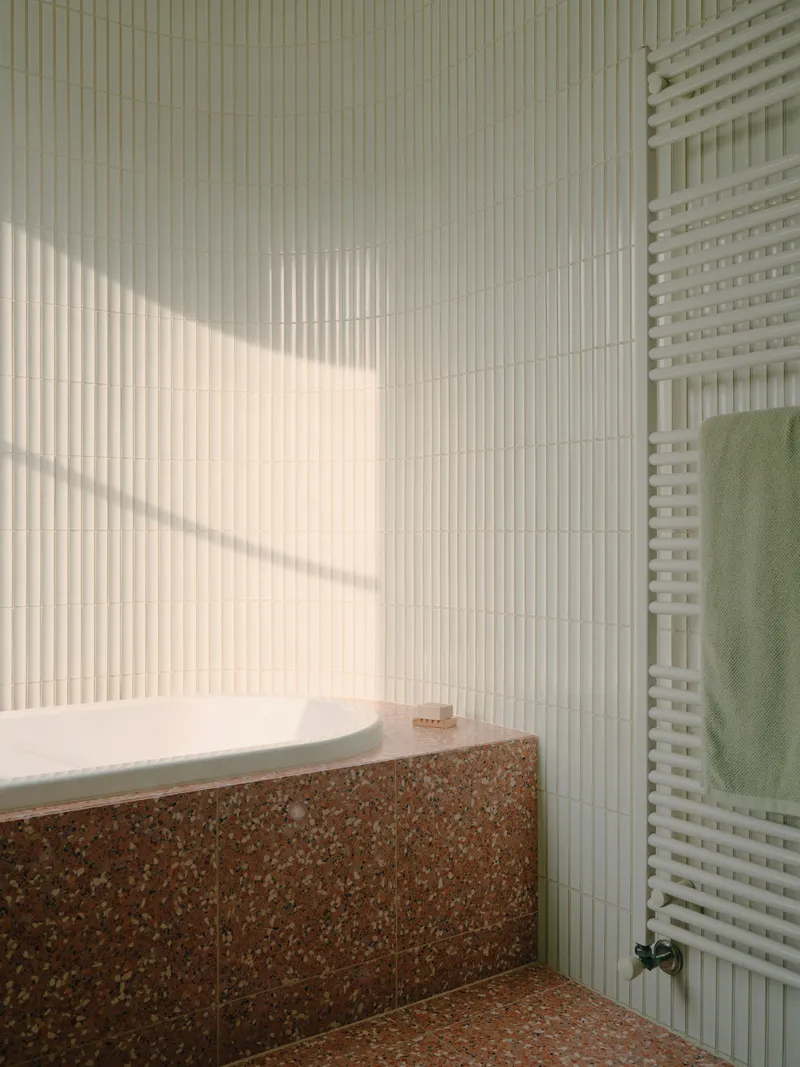
The bathrooms consolidate the project's material language into small, intensely detailed rooms. A floating walnut vanity with dual sinks sits beneath a full-height mirrored cabinet, amplifying the sense of width. Vertical ceramic tiles in muted tones run floor to ceiling, their format reinforcing the rooms' height. A cylindrical wall sconce near the window introduces a soft warm light that complements the afternoon sun.
The bathtub alcove is the most striking moment: terrazzo cladding wraps the tub surround and meets vertical tile at a clean joint, the afternoon light catching both surfaces at different angles. It is a genuinely considered composition, the kind of detail that suggests an architect who designs bathrooms as rooms rather than afterthoughts.
The Rear Studio and Landscape Edge


At the rear of the site, the dual-purpose studio and garage is clad in stained silver-top ash timber and reclaimed brick. This volume is autonomous, equipped with its own bathroom and wardrobe, designed to accommodate extended family visits without requiring visitors to pass through the main house. The timber slat fence, concrete planters, and espalier fruit trees along the laneway boundary soften the transition between the private garden and the public lane.
Landscape design by Andy Murray Landscape Design reinforces the project's biophilic ambition. Every planting decision, from the courtyard vines to the laneway fruit trees, serves a purpose beyond decoration: screening, food production, microclimate moderation. The landscape is not a layer applied after the architecture; it is threaded through the plan from the start.
Why This Project Matters
The Fitzroy North Terrace is not a loud project. It does not announce itself with a dramatic facade or a radical formal gesture. Its intelligence lies in subtraction: removing a failed renovation, carving out a courtyard, splitting the program into two volumes with breathing space between them. On a narrow east-west lot hemmed in by heritage constraints, that willingness to give up floor area in exchange for light, air, and connection to landscape is the most assertive design decision possible.
Field Office Architecture demonstrates here that the Victorian terrace, one of Melbourne's most ubiquitous housing types, still has room for genuine reinvention. The tight material palette, the passive climate strategy, the careful preservation of heritage character alongside unambiguously contemporary additions: these are not innovations in themselves, but their execution on this site, at this scale, with this level of joinery craft, sets a high standard. The project is a reminder that residential architecture in constrained urban contexts rewards patience and precision over spectacle.
Fitzroy North Terrace by Field Office Architecture. Located in Fitzroy North, Australia. Completed in 2023. Built by Frank Built. Landscape design by Andy Murray Landscape Design. Photography by Tom Ross.
About the Studio
Share Your Own Work on uni.xyz
If projects like this are the kind of work you want to make, uni.xyz is a place to publish your own, find collaborators, and enter design competitions.


Popular Articles
Popular articles from the community


ETEH Reworks the Shared Spaces of São Domingos School in Brazil Around Timber, Color and Hanging Plants
At São Domingos School in Brazil, 436 m² of hall, refectory and library are recast with timber joinery, a yellow and blue code and trailing greenery.


Aquadapt: An Underwater Habitat That Rewrites Its Rooms by the Hour
Curved modules ring the seabed while one shell shifts from breakfast room to cinema, farm and football pitch as residents' needs change.

Manzana Morphosis: Stretching Barcelona's Grid into a Living Landscape for 2050
A radical reworking of the Eixample manzana turns density into a tool for generous public space, vertical ecology, and environmental performance.

Singing Woman: An Opera House That Performs Before the Curtain Rises
Ovidiu Cristian Pavel's conceptual opera house translates Estonia's choral identity into a sculpted waterfront landmark facing the Baltic Sea.

Similar Reads
You might also enjoy these articles

LAVA Architecten Gives Vocational Education a Sawtooth-Roofed Face on a Mechelen School Campus
In Mechelen, Belgium, a 2,053 m² STEM school on a 6×6 m grid turns workshops and classrooms into rooms that can be rearranged as teaching changes.

KEMA Studio Turns a Derelict Marvila Attic into a 60 m² Lighthouse Apartment Above Lisbon
In Lisbon's Marvila district, a rebuilt roof, four skylights and two plywood volumes turn an unlivable attic into a bright home facing the Tagus.

Pixel Gardens: One Repeated Module Stacked Into a Terraced Social Housing Tower for Famagusta
Salem Bader's shortlisted housing tower builds a vertical neighbourhood from one repeated module, offsetting units to carve terraces, light and air.

Bao Huynh Watercolor Atelier: A Serene Art Retreat in Hội An
Bao Huynh Watercolor Atelier in Hội An blends multifunctional art spaces, sustainable design, local materials, and family-friendly living in a serene environment.

Explore Office Building Competitions
Discover active competitions in this discipline

Challenge to design luxury tourism on rails

VR headsets Storefront design competition

Designing a staircase for a client
Comments (0)
Please login or sign up to add comments
No comments yet. Be the first to comment!