

Flip the Dead Space: Turning Parking Structures into Engines of Urban Life
A shortlisted adaptive reuse proposal transforms monofunctional car storage into a layered public arena of cinema, coworking, and culture.


Parking garages are the quiet landlords of the contemporary city: they occupy prime real estate, generate almost no social value, and go largely unquestioned. Flip the Dead Space asks what happens when you strip that complacency away and force a parking structure to earn its place in the urban fabric. The answer, in this case, is a multi-level hybrid of automated car storage, retail kiosks, coworking pods, rooftop cinema, and planted terraces, all held together by a bold skeleton of red steel trusses.
Designed by Jeremy Lam, this shortlisted entry for the Yo Parking 2019 competition treats adaptive reuse not as a preservation exercise but as a provocation. Rather than mourning the parking typology, Lam flips its spatial logic: automated systems compress vehicular functions into efficient cores, liberating the remaining volume for human occupation. The result is a prototype for a post-automobile urbanism where infrastructure stops being background noise and starts performing as a social catalyst.
A Red Steel Skeleton Open to Cyclists, Pedestrians, and Weather
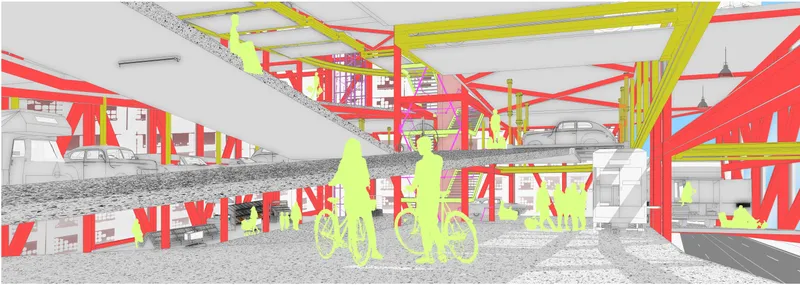
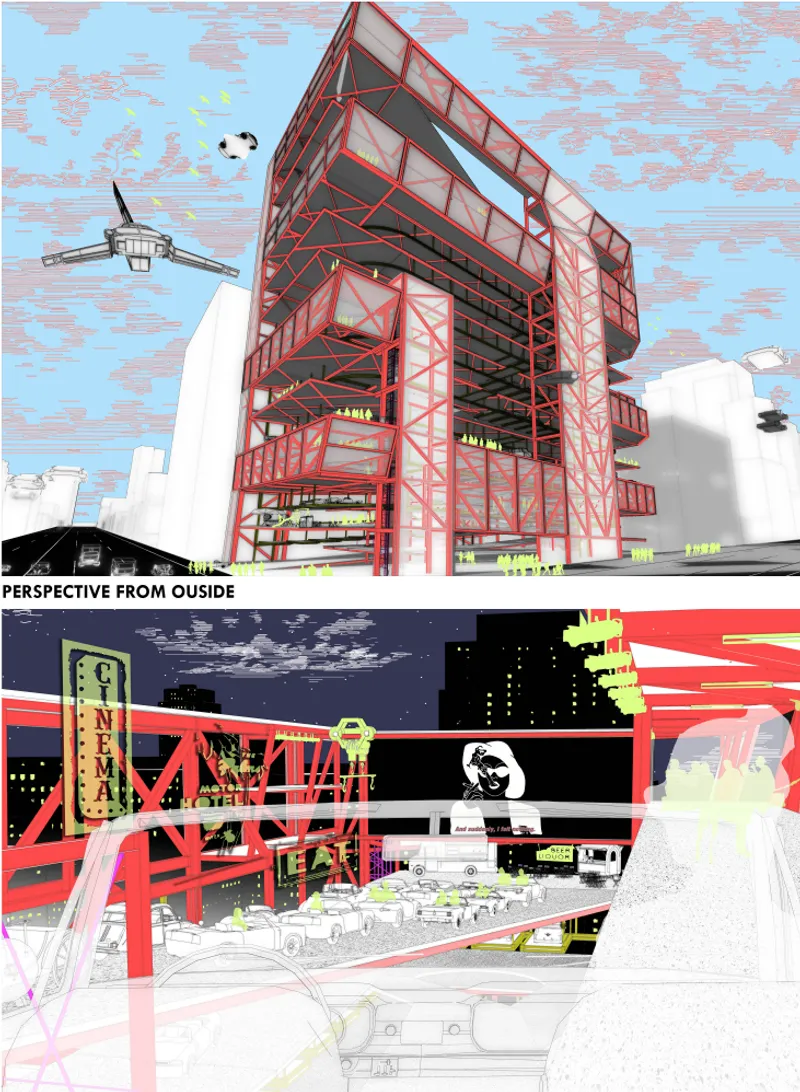
The sectional perspective immediately communicates the project's ambition: red and yellow structural frames carve out generous volumes through which cyclists and pedestrians circulate freely across multiple levels. There is no lobby, no threshold separating the street from the interior. People move through the building as if it were an extension of the sidewalk, which is precisely the point. Modular circulation ramps weave vertically through the grid, ensuring that the journey upward feels like a continuous urban promenade rather than a utilitarian climb.
The axonometric drawing reinforces this reading. Exposed floor plates and a systematic truss grid reveal how the structure can absorb different programmes without altering its primary framework. The steel skeleton is deliberately legible, almost pedagogical in its frankness, allowing future users and designers to read the logic of the building at a glance and imagine new configurations within it.
Planted Terraces and Zoned Bays Stacked Like a Vertical Neighbourhood
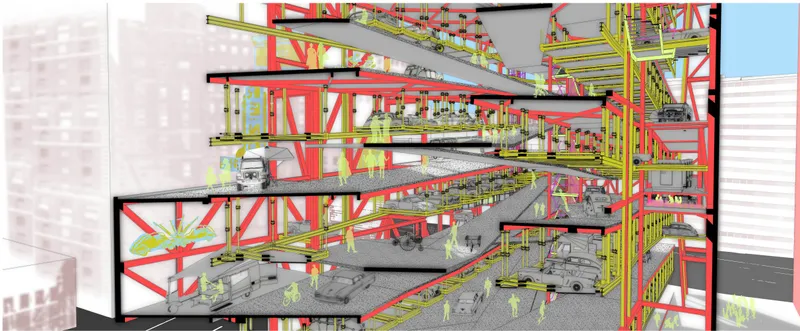
The full section drawing reveals the project's layered strategy with precision. Ground and intermediate levels host automated parking systems that efficiently organize vehicular movement, compressing car storage into tightly managed bays. Between these bays, planted terraces introduce greenery at every other level, softening the industrial character and creating microclimates within the open structure. Red and yellow structural elements code the different zones: automated processes, public areas, vertical transitions, and recreational platforms each get their own visual identity, making the building intuitive to navigate.
What makes this section compelling is the density of programme stacked without congestion. Retail kiosks, food vendors, social zones, and coworking pods occupy the interstitial spaces between parking cores and terraces. The translucent curtain wall system visible along the facade allows daylight to permeate deep into the structure while providing weather protection. It is a building that breathes.
A Rooftop Cinema That Turns Nostalgia into Nighttime Activation
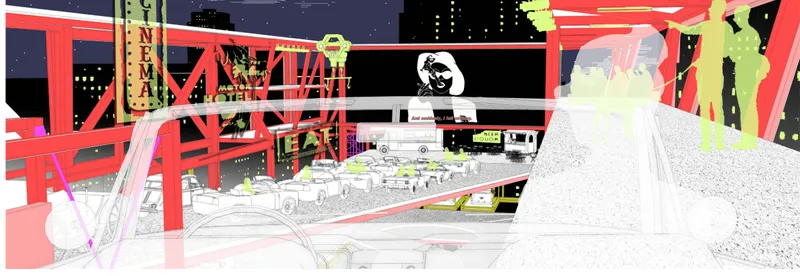
The interior night perspective is the project's most atmospheric image. Diagonal red bracing frames a cinema marquee glowing through the open steel framework, transforming what was once dead infrastructure into a charged social space after dark. The rooftop cinema borrows the format of the drive-in but democratizes its audience: pedestrians, cyclists, and car users share the experience equally. Adjacent spaces accommodate events, performances, or casual gathering, producing an overlap of formal and informal activity that feels genuinely urban.
Nighttime activation is a persistent weakness in parking typologies. They go dark when cars leave. Lam's cinema layer directly addresses this by giving the structure a reason to be occupied around the clock. The diagonal bracing, visible as bold red lines against the evening sky, doubles as architectural identity and structural necessity, a detail that speaks to the efficiency of the overall design logic.
Exploded Components: Brick Cores, Truss Systems, and Modular Lifts
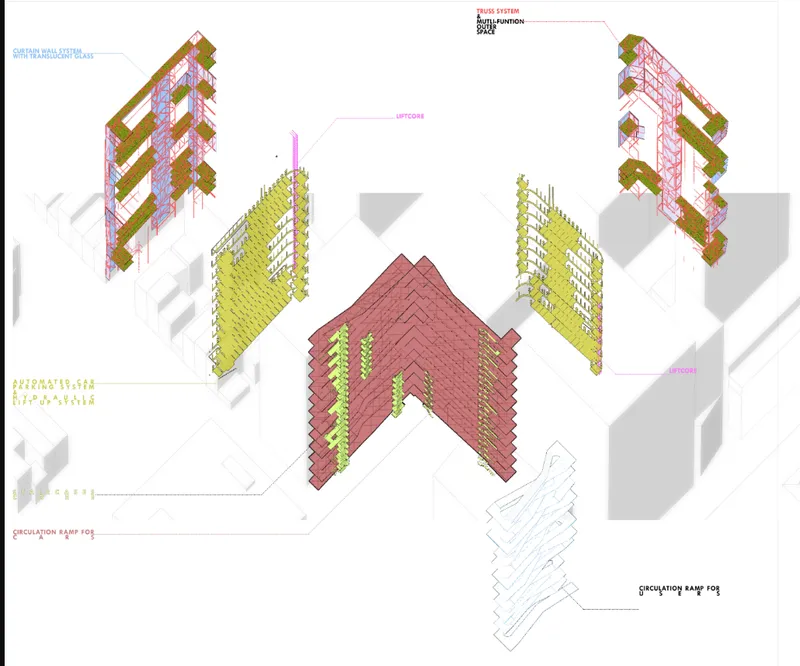
The exploded axonometric diagram lays bare the anatomy of the proposal. Red brick cores anchor the building's vertical circulation and automated lift systems. Yellow and red truss networks span between these cores, creating column-free floor plates that can be reconfigured as community needs shift. The modularity here is not theoretical; the diagram shows how components could be assembled, disassembled, or supplemented over time, supporting what Lam describes as a kinetic architecture responsive to evolving urban conditions.
The material palette is deliberately limited: steel, brick, glass. Each material has a clear role. Brick provides mass and thermal stability at the cores. Steel delivers spanning capacity and visual legibility in the trusses and bracing. Translucent curtain walls manage the boundary between inside and outside without sealing it off. Taken together, the components describe a building that is robust enough to last and loose enough to change.
Why This Project Matters
As car ownership patterns shift and urban land becomes ever more contested, cities are sitting on millions of square metres of parking infrastructure whose future is uncertain. Lam's proposal does not simply argue for demolition or token greening. It offers a systemic spatial strategy: automate the cars, free the volume, layer in human programme, and design a structure flexible enough to absorb whatever comes next. That combination of pragmatism and ambition makes it a credible prototype, not just a competition rendering.
More broadly, Flip the Dead Space demonstrates that adaptive reuse architecture is at its most powerful when it targets typologies everyone assumes are fixed. A parking garage does not have to be a parking garage. It can be a cinema, a market, a coworking hub, and a garden, all at once, if the structural logic is open enough to allow it. That is the project's core lesson, and it is one that cities would do well to absorb.
View the Full Project
About the Designers
Designer: Jeremy Lam
Enter a Design Competition on uni.xyz
uni.xyz runs architecture and design competitions year-round that reward proposals with spatial conviction and real site intelligence.
Project credits: Flip the dead space by Jeremy Lam Yo Parking 2019 (uni.xyz).


Popular Articles
Popular articles from the community


Cloaked Colonization: A Mobile Underwater Habitat That Moves Like a Fish
Micah Abaya's shortlisted EHC Pacific entry reimagines ocean settlement as a dispersed network of self-sustaining architectural organisms.

Temporary Home for Dogs: A Reversed Zoo Rethinks Animal Shelter Architecture
In Bucharest, a sinuous corridor and freed landscape flip the logic of containment, designing a shelter that works to make itself unnecessary.

Extended Shell: Retrofitting Kolkata's Balconies as Living Urban Thresholds
A modular retrofit system recovers the social and environmental intelligence of Kolkata's historic verandas for contemporary Park Street residents.

Singing Woman: Contemporary Architecture Inspired by Estonia’s Voice and the Sea
Singing Woman turns Estonia’s song culture into flowing opera house architecture, blending public life, landscape, sea, and national memory.

Similar Reads
You might also enjoy these articles

Day and Night Park: A Time-Based Urban Newsstand in Beijing
A temporary urban newsstand in Beijing blending travel, light, and reading through poetic colors, compact form, and community-focused design.

Modernist Patio Renovation in El Masnou, Barcelona by Oliver Segura Arquitectura + Cebrià Arquitectura
Modernist patio renovation blending tradition and innovation with a movable pool, leveled floors, and Catalan materials in El Masnou.

Alto Residencial Coop: Cooperative Housing Development in Santiago de Compostela by Carbajo Barrios Arquitectos
A linear cooperative housing complex blending white volumes and perforated metal façades, enhancing community living, natural light, privacy, and urban integration.
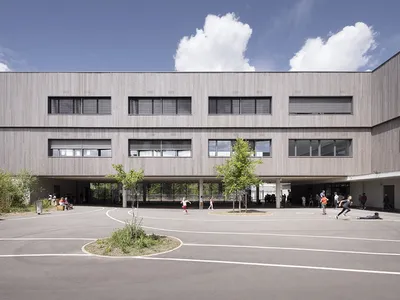
Vil Genis School by BPA ARCHITECTURE – Massy, France
Vil Genis School in Massy, France, features sustainable design, south-facing classrooms, community integration, accessible spaces, and modern educational architecture.

Comments (0)
Please login or sign up to add comments
No comments yet. Be the first to comment!