
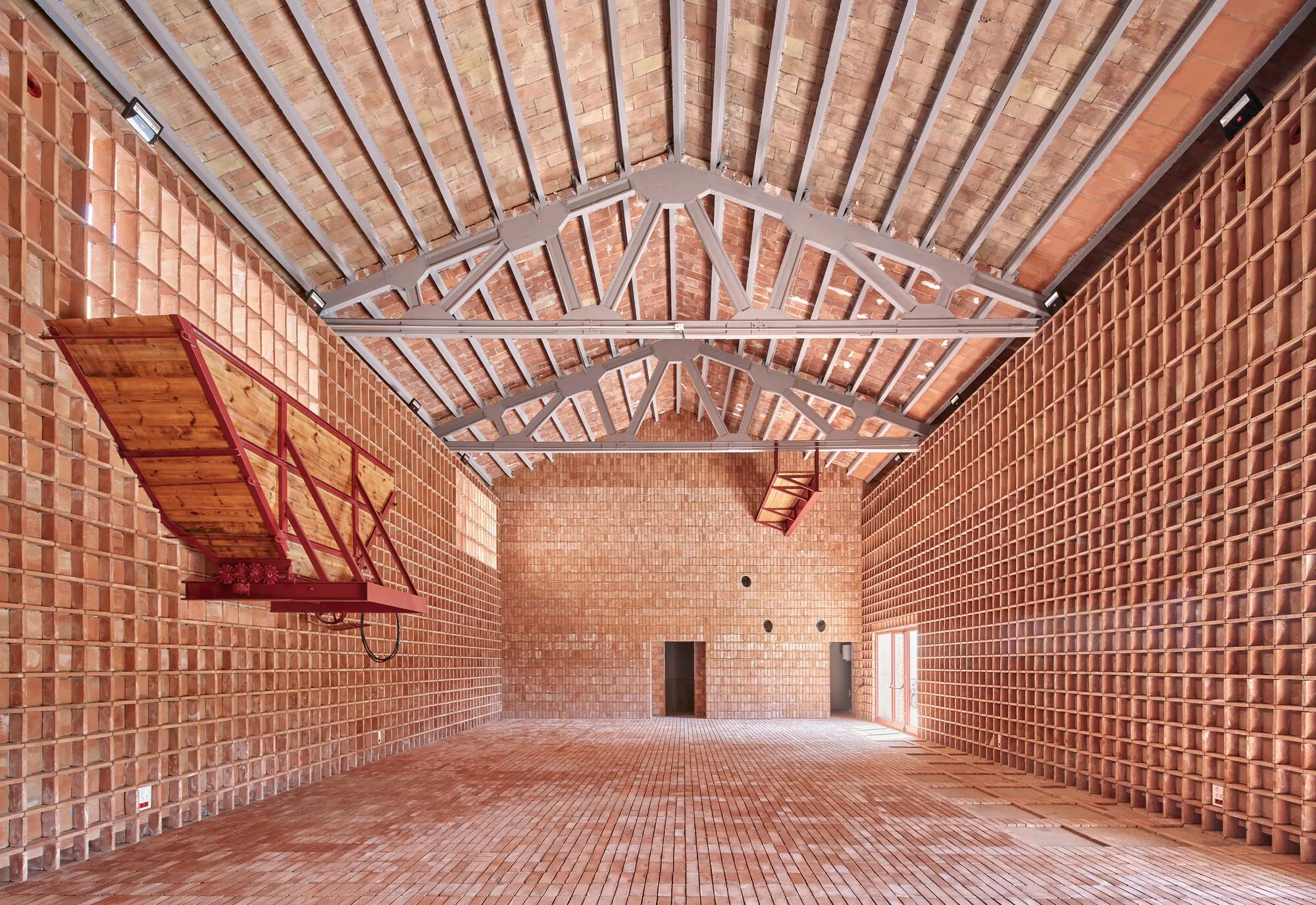
An Agricultural Cooperative Becomes a Cultural Hall
Camps Felip Arquitecturia transforms a cooperative building in Flix into a flexible cultural space through brick, steel, and careful restraint.


The best adaptive reuse projects don't try to erase what came before. They read the existing structure like a text and decide which sentences to keep, which to annotate, and which to let trail off. In Flix, a small town along the Ebro in Catalonia, Camps Felip Arquitecturia has taken a building from the local agricultural cooperative complex and turned it into a 425 square meter multipurpose cultural space. The result is a project that feels both ancient and alert, where heavy masonry walls and new steel interventions share the room without competing.
What makes this project worth studying is its disciplined material vocabulary: terracotta brick, red-painted steel, timber, and glass. Nothing else. The architects use these four elements to accomplish everything from structural reinforcement to environmental control to spatial drama. The perforated brick walls filter daylight. The steel trusses and balcony define program zones within a single volume. The glazed openings connect interior to courtyard. It's a project that gets a lot done with very little.
Brick as Both Skin and Screen
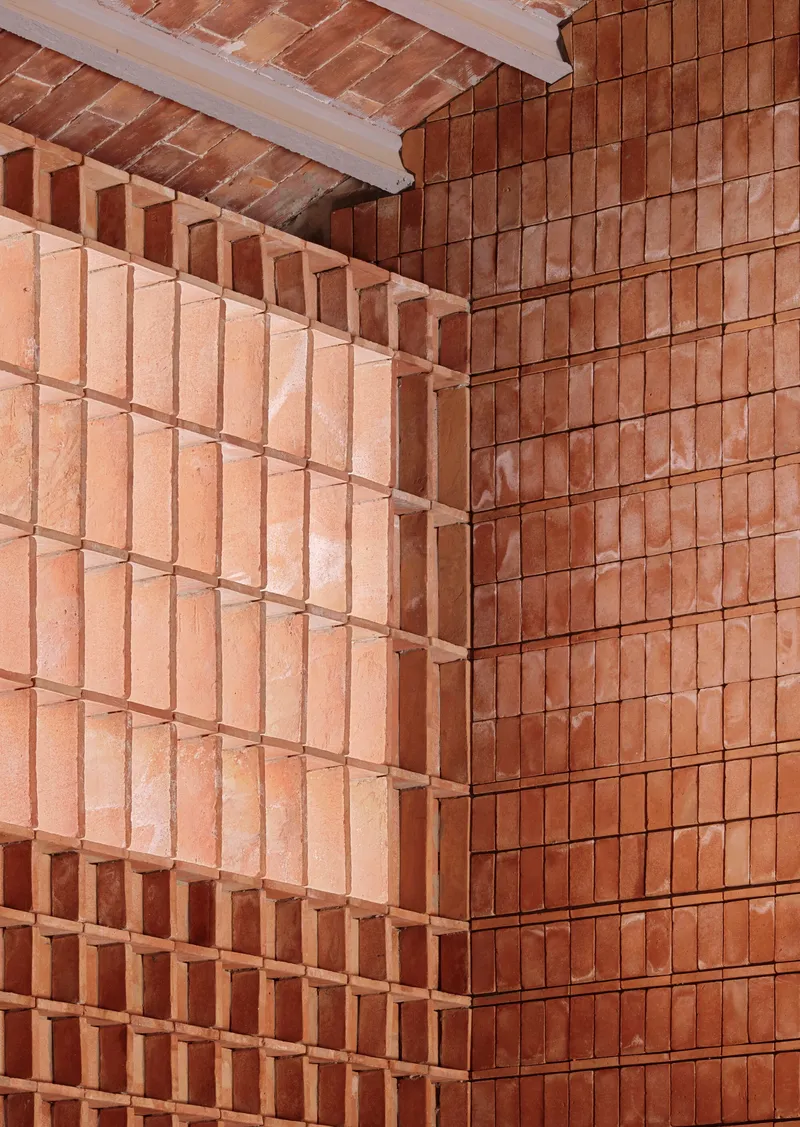

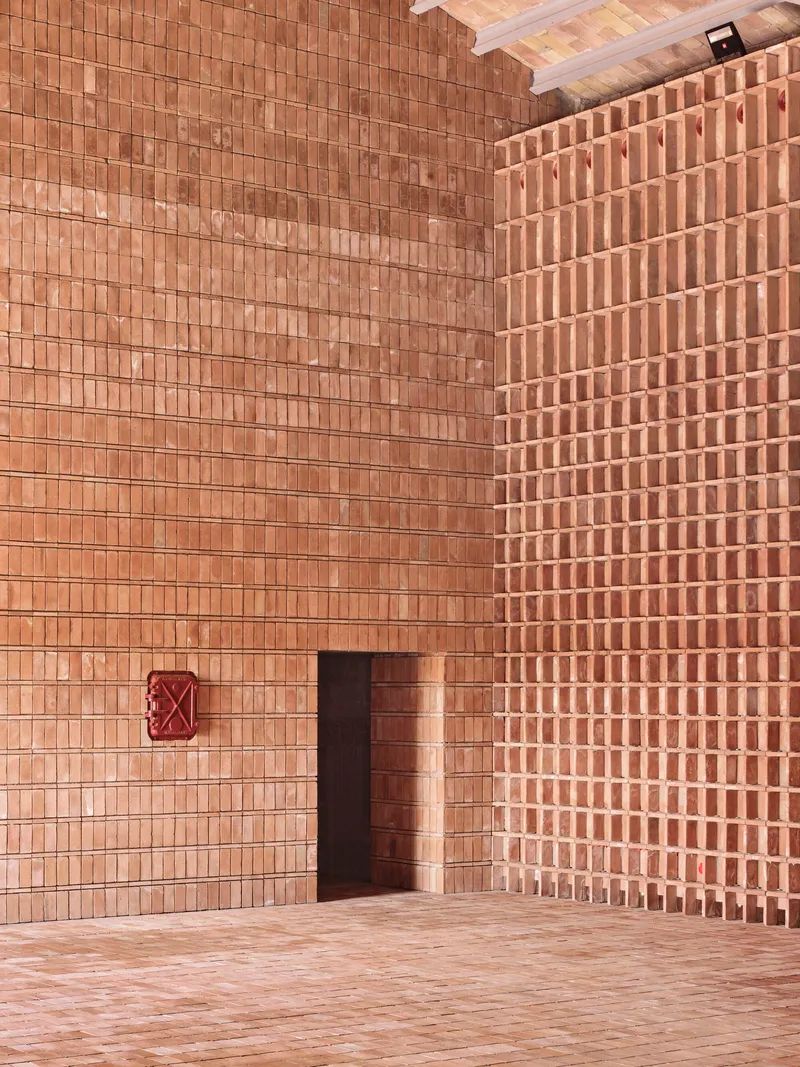
The brick walls here are not just enclosure. They are instruments. The architects deploy alternating coursing patterns, projecting courses, and varied tile orientations to create surfaces that shift between solid and porous. Up close, the walls reveal a tactile complexity: courses project and recess, tiles rotate, and openings appear in rhythmic intervals. The craftsmanship is not ornamental for its own sake. It controls light, ventilation, and privacy in a building that needs to serve multiple configurations.
The corner details are particularly telling. Where two facades meet, the textures and relief patterns differ, signaling the distinct character of each elevation. There is no attempt to wrap a single treatment uniformly around the volume. Each face responds to its orientation and its relationship to the street or courtyard.
The Street Facade and Its Red Steel Frame

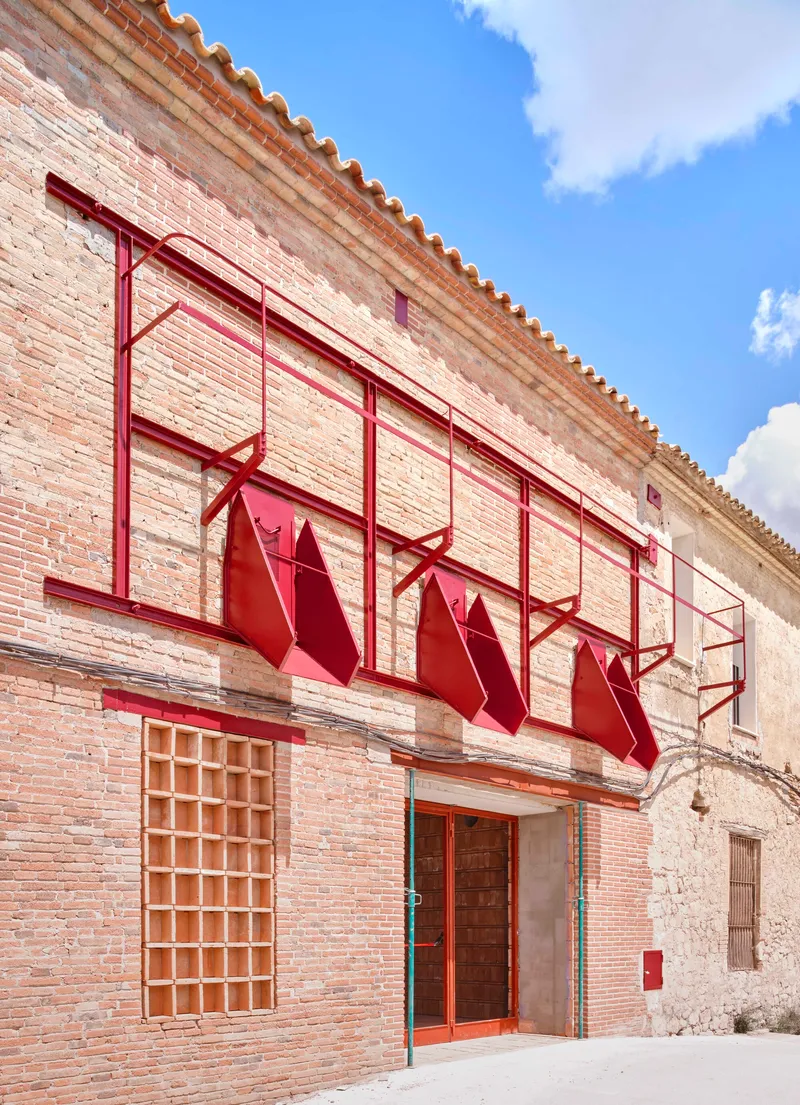

The public face of the building announces itself with a hybrid composition: a brick grid window above and glazed entry doors below, all framed by a red metal awning structure that reads as both functional shade device and graphic marker. The red metal is assertive without being aggressive. It signals the building's new public role within the cooperative complex without shouting over the surrounding masonry context.
At ground level, decorative red metal panels and terracotta mosaic tiles create a textured base zone. The folded metal panels under the terracotta tile roof add another layer of articulation. These are small moves, but they accumulate into a facade that rewards slow looking. The architects clearly understand that a civic building in a town like Flix earns its place through material generosity, not formal spectacle.
The Main Hall: Structure as Spatial Event

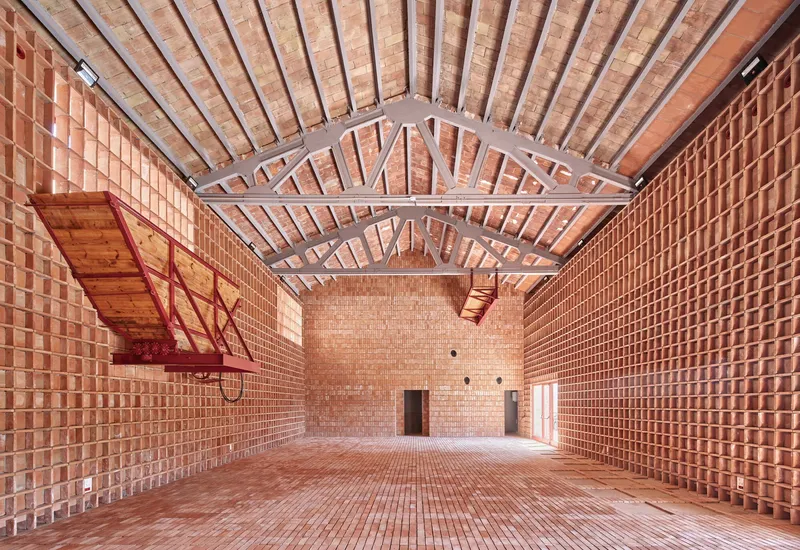

The interior hall is the heart of the project, and the architects let its structure do the talking. Exposed grey steel trusses span the width of the space beneath a vaulted tile ceiling, establishing a rhythm that organizes the room. In one configuration, the hall reads as a single generous volume. In another, the red steel balcony with its timber platform projects from the perforated brick wall, introducing a mezzanine level that can serve as a viewing gallery, a stage backdrop, or an intimate gathering space.
The interplay between the painted steel structure and the warm brick is the defining spatial experience. Daylight enters through the perforated walls in a soft, diffused wash, giving the interior a quality that shifts throughout the day. The timber trusses in the secondary space add a warmer register. This is not a white-box cultural space; it is a room with character, temperature, and grain.
Thresholds and Transitions
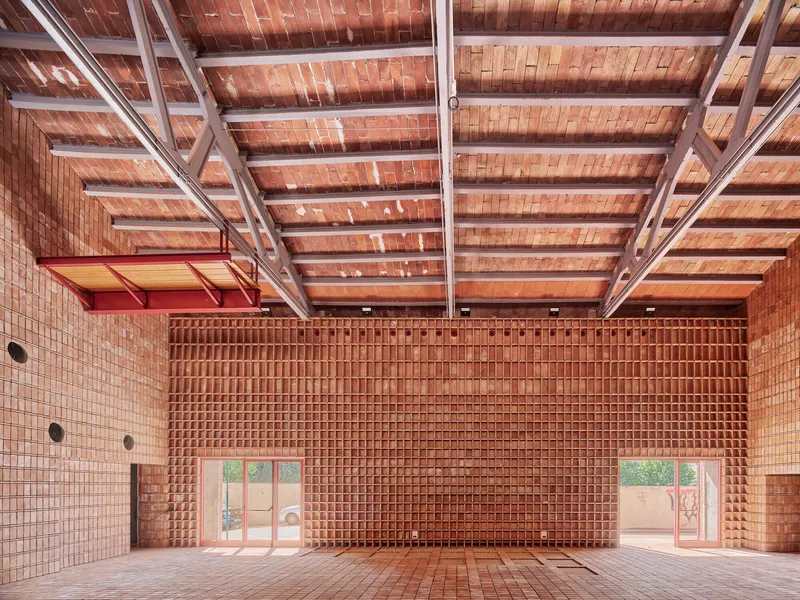
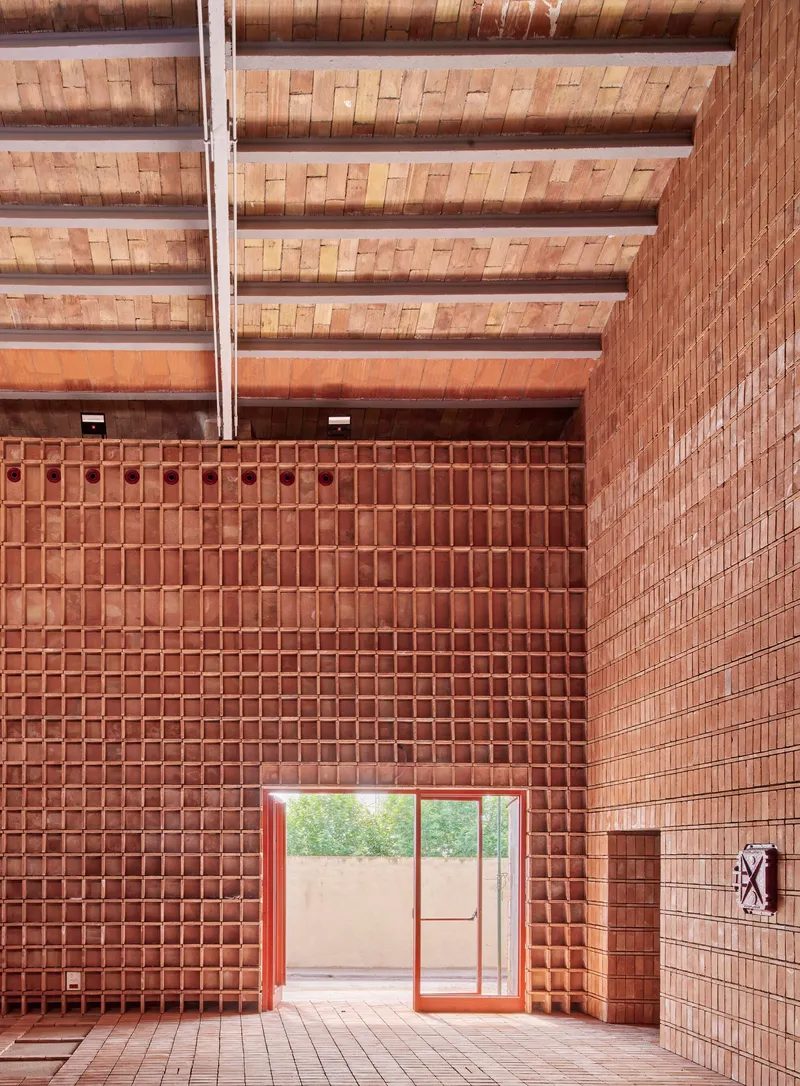

The glazed doors opening to the courtyard are more than exits. They are calibrated thresholds that dissolve the boundary between interior and exterior when the program demands it. The open-grid brick wall flanking the doorways softens the transition further, allowing views and breezes to pass through even when the doors are closed. A recessed doorway framed by a red metal ventilation grill adds a smaller, more intimate point of passage.
These moments of in-between space are where the project's intelligence shows most clearly. A cooperative building is inherently communal, and the architects have preserved that ethos by making the boundaries between inside and outside porous and inviting. You never feel locked in.
Ventilation and Environmental Detail

The curved brick wall with its three red ventilation grilles is a detail that encapsulates the project's approach. Rather than concealing mechanical systems behind drywall, the architects integrate environmental control into the architectural expression. The grilles are objects: painted the same red as the structural steel, sized and spaced with care, mounted in a wall whose curvature introduces a spatial softness into what might otherwise be a relentlessly orthogonal room.
In a Mediterranean climate, passive ventilation and thermal mass are not romantic gestures. They are practical necessities. The thick brick walls store coolness, the perforations encourage air movement, and the vaulted tile ceilings allow warm air to rise and exhaust. The building is working even when no one is watching.
Plans and Drawings

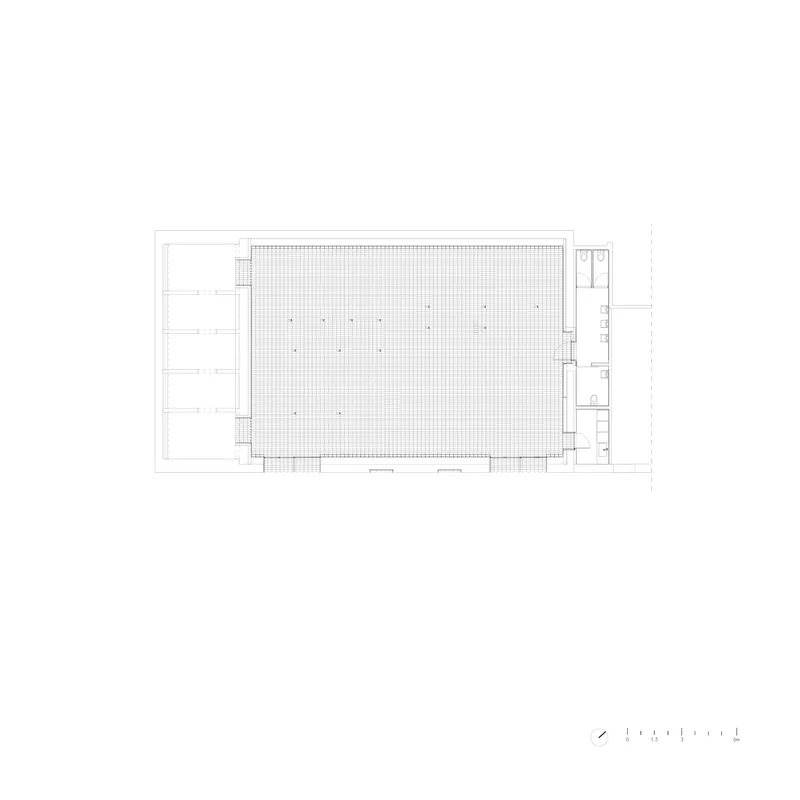

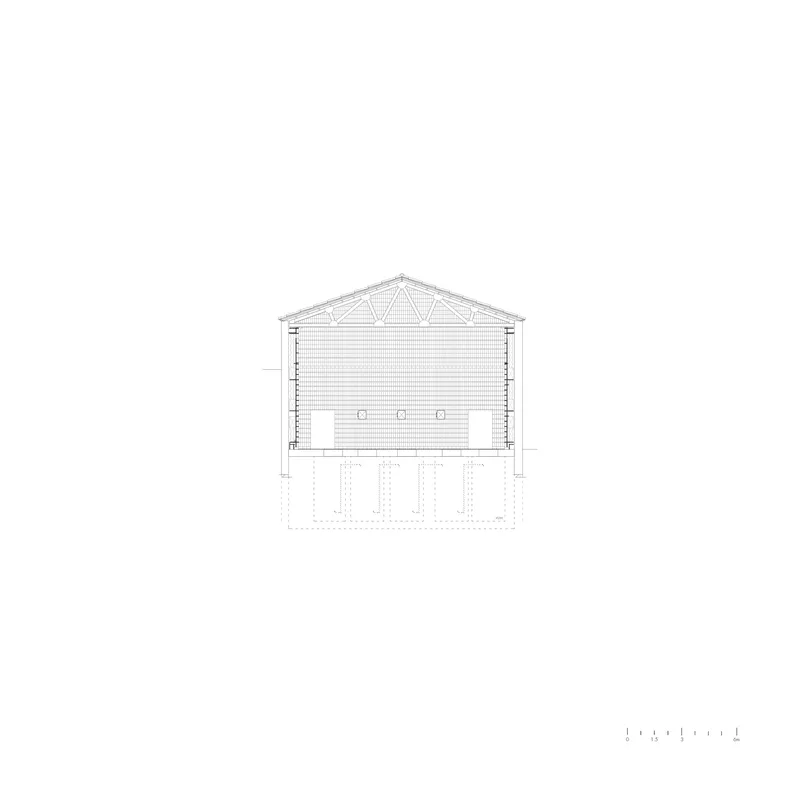


The drawings reveal the real ambition of this project: flexibility within a fixed shell. The site plan shows the building nested within the cooperative complex, connected to surrounding structures but operating as its own distinct volume. The floor plan is disarmingly simple: a large rectangular hall with service spaces pushed to the perimeter, leaving the center free for whatever program the community needs. Eight different furniture layout variations demonstrate the range, from assembly seating to workshop tables to open floor events.
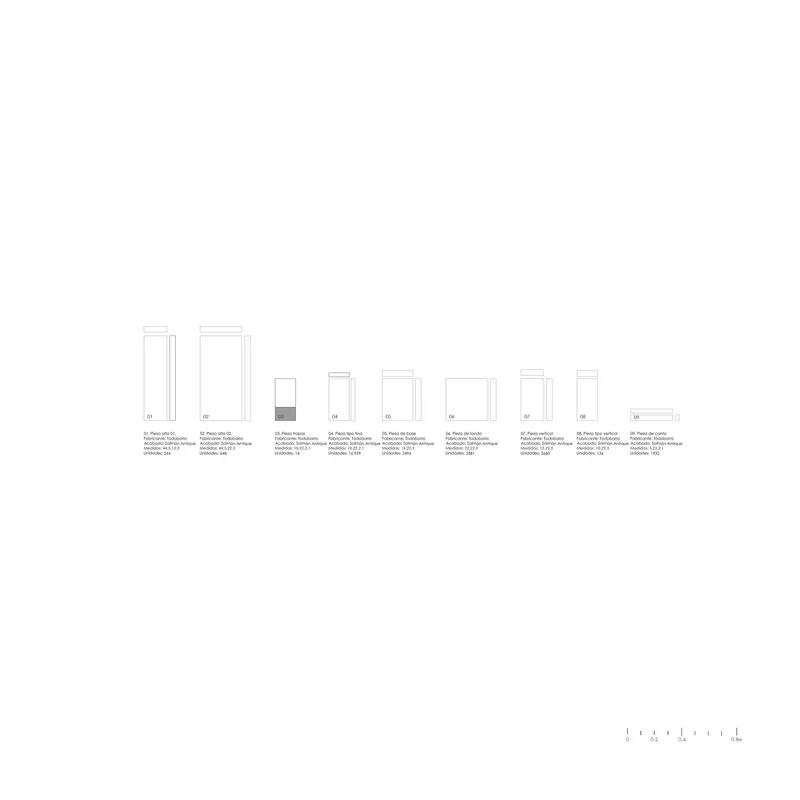
The sections confirm what the photographs suggest: a generous double-height space defined by its roof structure, with the gabled trusses establishing a civic scale. The exploded axonometric is especially revealing, pulling apart roof, truss, interior volume, and exterior walls to show how each layer operates independently while contributing to the whole. The facade studies, including a series of nine different module configurations, show an almost obsessive rigor in working out the brick screen variations. Every opening, every projecting course, every solid panel has been drawn and tested.
Why This Project Matters
Small towns across southern Europe are losing their civic infrastructure. Young people leave, cooperatives close, and buildings fall into disuse. The standard response is demolition and replacement, or worse, a renovation so generic it could be anywhere. What Camps Felip Arquitecturia has done in Flix is the opposite: a deeply site-specific transformation that respects the cooperative's material history while giving the building a new public life. The architecture does not nostalgize the past; it repurposes it.
At 425 square meters, this is not a large project. But its lessons scale up. The restrained material palette, the integration of environmental strategy into architectural expression, the flexibility of a single well-proportioned room: these are principles that apply to cultural buildings of any size. In a moment when adaptive reuse is often treated as a branding exercise, this project reminds us what it actually looks like when architects take an existing building seriously and make something genuinely better from what was already there.
Rehabilitation of the Agricultural Cooperative for a Multipurpose and Cultural Space in Flix by Camps Felip Arquitecturia (Josep Camps, Olga Felip). Tortosa, Spain. 425 m². Completed 2023. Photography by José Hevia.
About the Studio
Share Your Own Work on uni.xyz
If projects like this are the kind of work you want to make, uni.xyz is a place to publish your own, find collaborators, and enter design competitions.



Popular Articles
Popular articles from the community

AL-JANNAH: Sustainable Architecture and Permaculture for Afghan Widows
AL-JANNAH uses sustainable architecture and permaculture to create resilient oasis of housing, learning, work and renewal for Afghan widows.

Co-Life: Senior Housing Design That Reconnects Older Adults With the City
Co-Life reimagines senior housing design through healing gardens, shared streets, workshops, and a sustainable community across generations.

The Earth Pod: 3D Printed Homes for Resilient Refugee Communities
The Earth Pod reimagines refugee housing through 3D printed homes made from clay, combining resilience, self-sufficiency, and rapid shelter.

The Musturak Paradise: Senior Living Architecture for a Connected Future in Temara, Morocco
The Musturak Paradise reimagines senior living architecture in Temara via private homes, social spaces, culture, community, and shared care.
Similar Reads
You might also enjoy these articles

Bao Huynh Watercolor Atelier: A Serene Art Retreat in Hội An
Bao Huynh Watercolor Atelier in Hội An blends multifunctional art spaces, sustainable design, local materials, and family-friendly living in a serene environment.

Atelier Macri Concept Store Interior Design by CASE-REAL
Atelier Macri store features a "ko" counter, walnut wood details, cork displays, blending retail, gallery, and seamless customer experiences.

Manuel Vargas Izquierdo Stadium and High-Performance Sports Center: Architectural Excellence in Jalpa de Méndez
The Manuel Vargas Izquierdo Stadium blends sustainable design, inclusive sports facilities, and cultural-inspired architecture, revitalizing Jalpa de Méndez’s public spaces.

KAKR Buluh Awar Hall: Revitalizing Community and Ecology Through Bamboo Architecture
Community built bamboo hall revitalizes Buluh Awar village, empowering youth, restoring ecology, celebrating vernacular craftsmanship through sustainable architecture and culture.



Comments (0)
Please login or sign up to add comments
No comments yet. Be the first to comment!