
Francois Brugel and Atelier RITA Convert a Parisian Military Bakery into a 438-Bed Emergency Shelter
A former armed forces bakery on a decommissioned barracks site near the gates of Paris becomes a dignified refuge for nearly 450 people.


Emergency shelters rarely make architecture headlines, and when they do, the coverage tends to lean on sentimentality rather than substance. La Boulangerie, a 10,600 m² rehabilitation of a former military bakery on the decommissioned Caserne Gley in Paris, deserves attention for a different reason. Designed by Francois Brugel Architectes Associes and Atelier RITA, the project takes a building that had been deteriorating since 2004, when it was first pressed into service as a cold-weather overflow shelter, and turns it into a genuinely considered piece of architecture that accommodates 438 people across three distinct programs: an emergency shelter, a stabilization center, and an integration center.
What makes this project interesting is not altruism but rigor. With a construction budget of 10 million euros for nearly 9,000 m² of usable floor area, the architects had to be ruthlessly economical. The material palette they settled on, dominated by terracotta block, exposed concrete, and painted steel, is honest to the point of bluntness. Yet the spatial quality throughout, from the double-height entrance hall to the individual rooms, suggests that the design team treated economy as a discipline rather than a concession. The building is also the setting for La vie de Souleymane (2024), a film depicting 48 hours in the life of a shelter resident, which was shot among the 400 bunk beds of the previous, dilapidated iteration. The new architecture is, in part, a response to the conditions that film made visible.
A Military Shell Made Civic
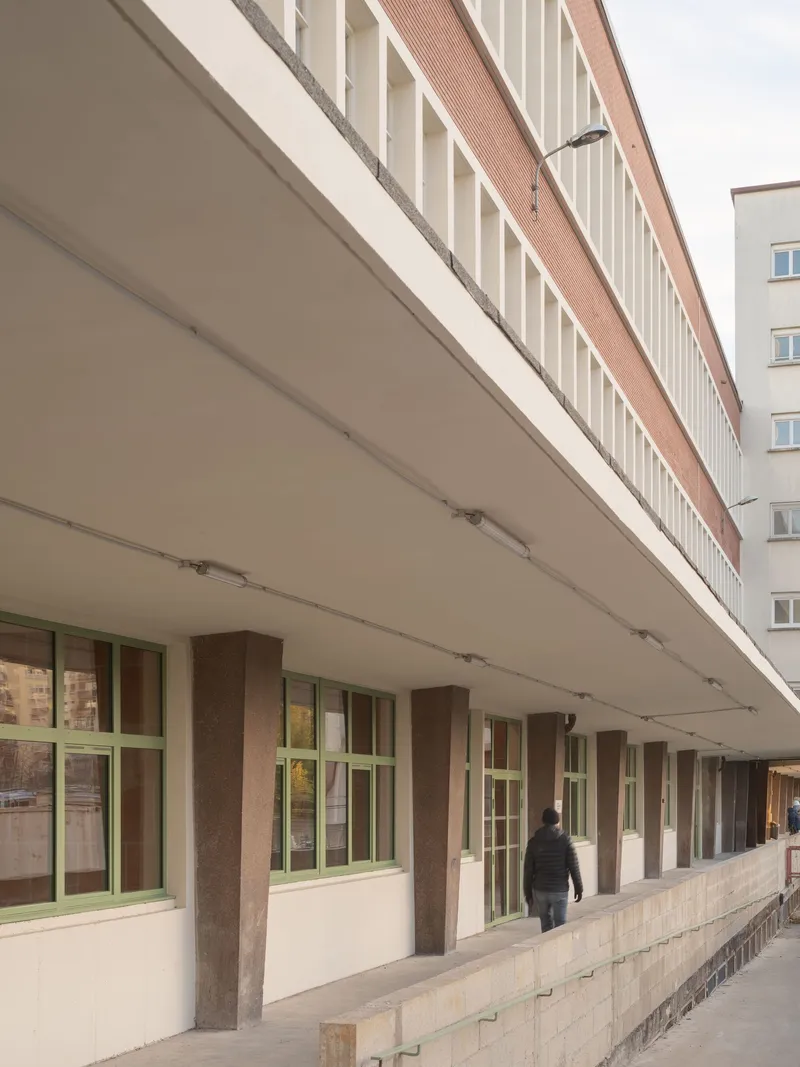
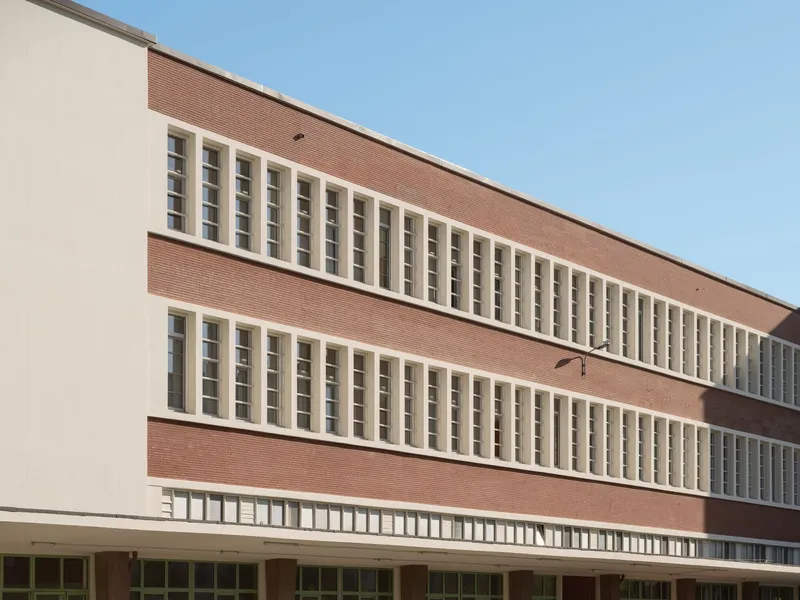
The Caserne Gley sits on two hectares of Ministry of Defense land liberated in 2004. The bakery building itself is a long, utilitarian volume typical of French military infrastructure: thick walls, high ceilings, deep floor plates. The exterior alternates between bands of original brick and new stucco, punctuated by vertical strips of glazing that break the barracks monotony. A covered walkway with concrete columns and green-framed windows runs along one edge, establishing a transitional zone between the public street and the interior life of the shelter.
The architects chose not to disguise the building's institutional bones. Instead, they amplified the existing structural order, cleaning up the concrete frame and letting the rhythm of columns and bays organize the new program. The result reads less like a makeover and more like a renegotiation of the building's terms.
Arrival and Common Ground
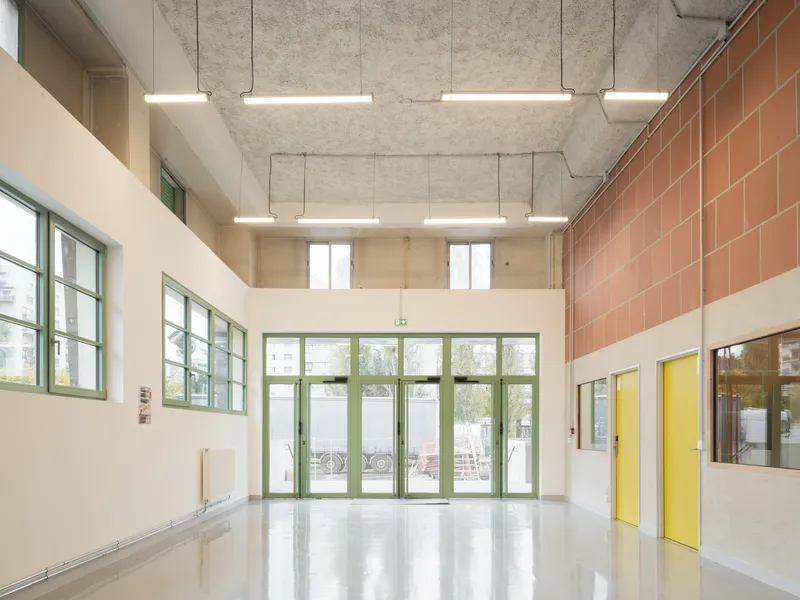


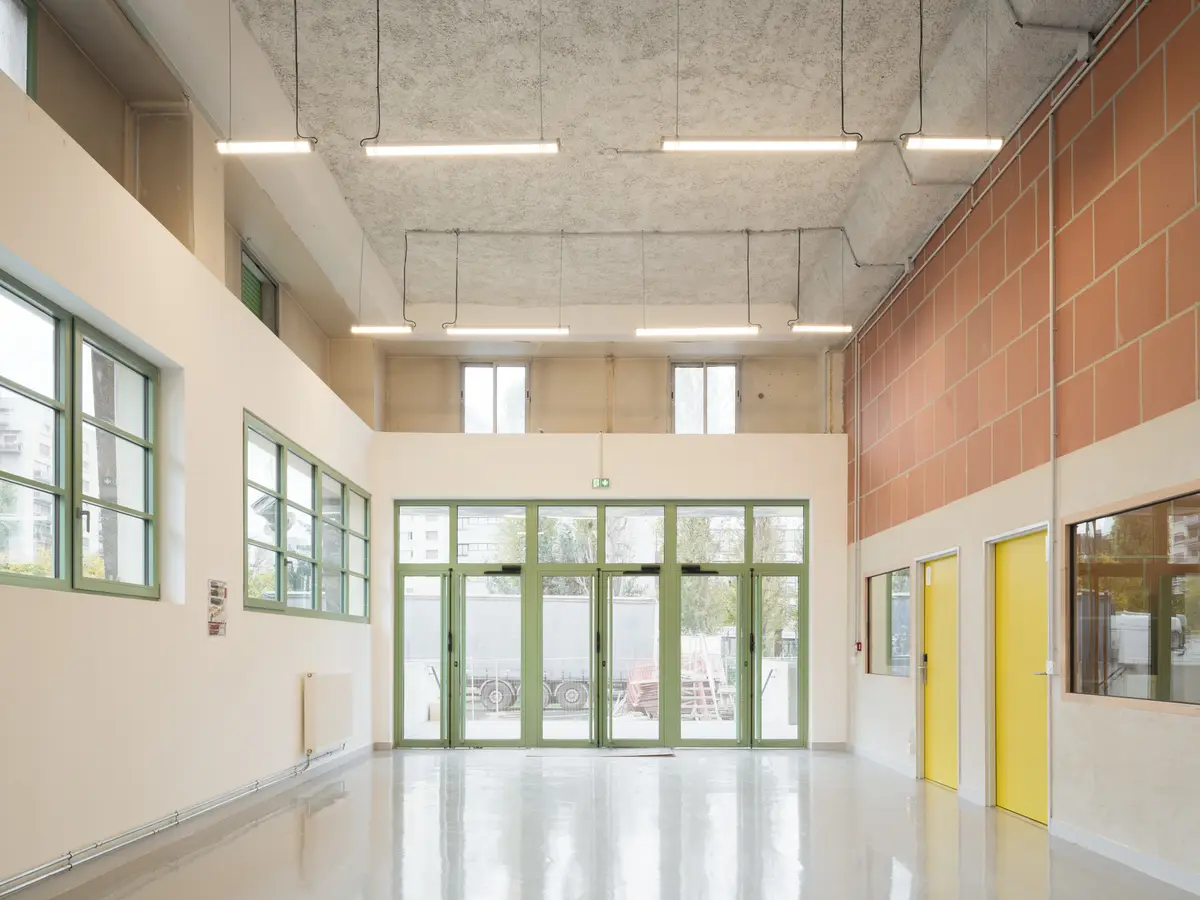
The entrance hall is the project's most generous gesture: a double-height space with green-glazed doors, suspended linear lighting, and an exposed concrete ceiling that gives the room a civic weight unusual for a shelter. Terracotta tile walls and a polished white floor carry through into the adjacent circulation spaces, establishing a material continuity that resists the piecemeal feel common to institutional renovations.
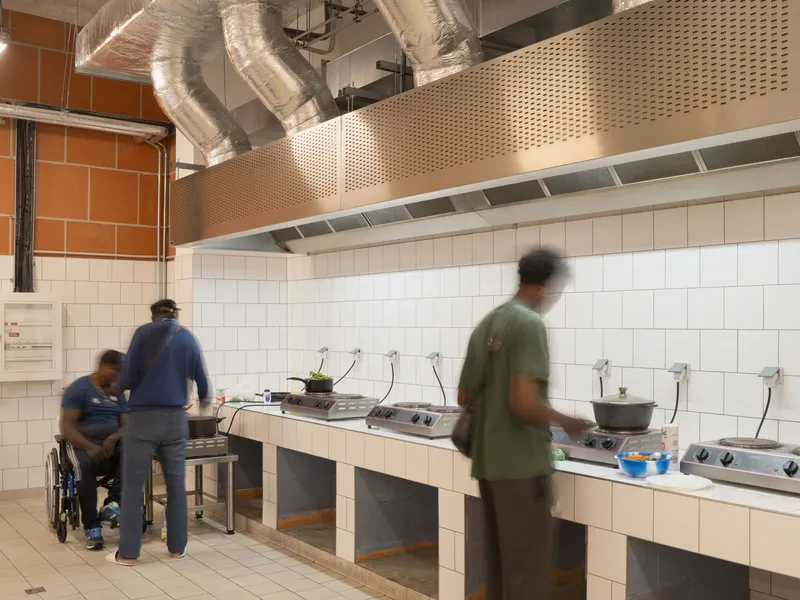
The dining hall extends this logic. Rows of tables sit beneath exposed ductwork and concrete columns, flanked by the same terracotta surfaces. A commercial kitchen with white subway tile and perforated metal hoods serves the space, and the fact that residents were photographed actively cooking suggests the program supports a degree of agency rather than passive reception. The consistency of material language from entrance to dining hall to corridor is the project's quiet argument: that continuity of design equals continuity of dignity.
The Material Economy of Terracotta and Concrete
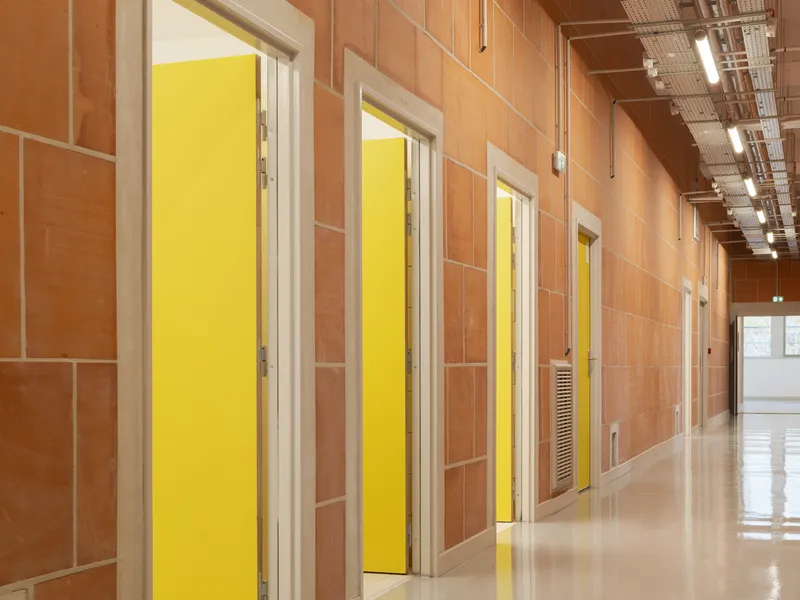
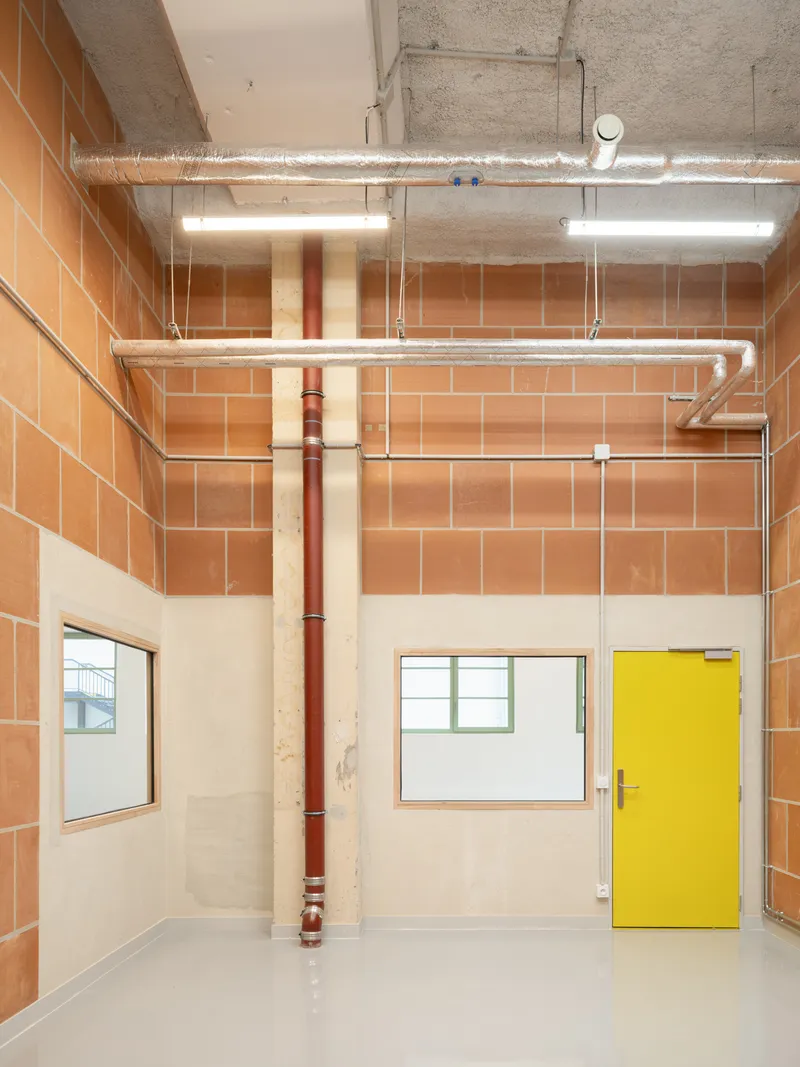
Terracotta block does enormous work here. It appears as partition walls, corridor linings, and room enclosures, left unfinished with its characteristic warm orange tone providing both thermal mass and visual texture. Against this, the architects deploy yellow-painted steel doors and green window frames as chromatic accents. The color choices are bold enough to register without tipping into patronizing cheerfulness.
Exposed concrete ceilings run throughout, carrying mechanical services in full view. Red drainage pipes, cable trays, and ductwork are left visible and organized rather than hidden. At roughly 1,100 euros per square meter, the budget left no room for suspended ceilings or decorative finishes. The architects turned that constraint into legibility: you can read exactly how the building works, and that transparency feels appropriate for a public institution.
Rooms That Are Rooms
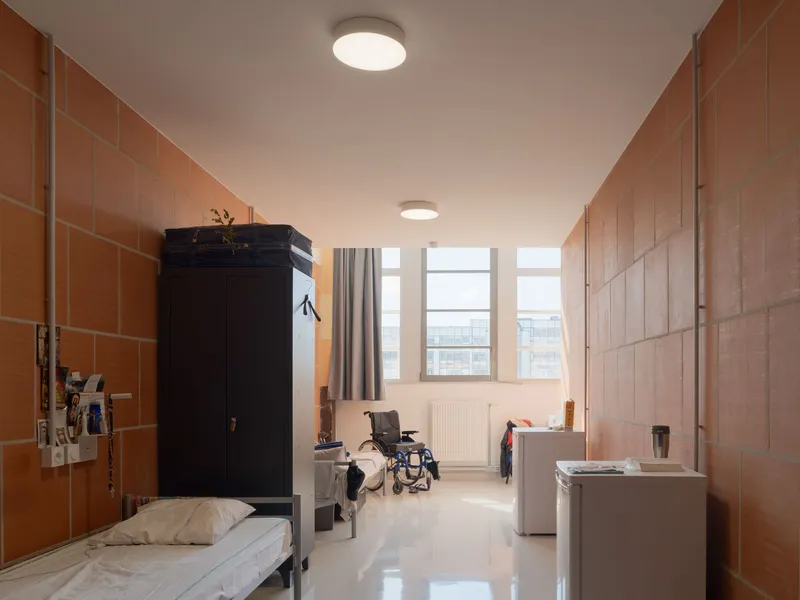
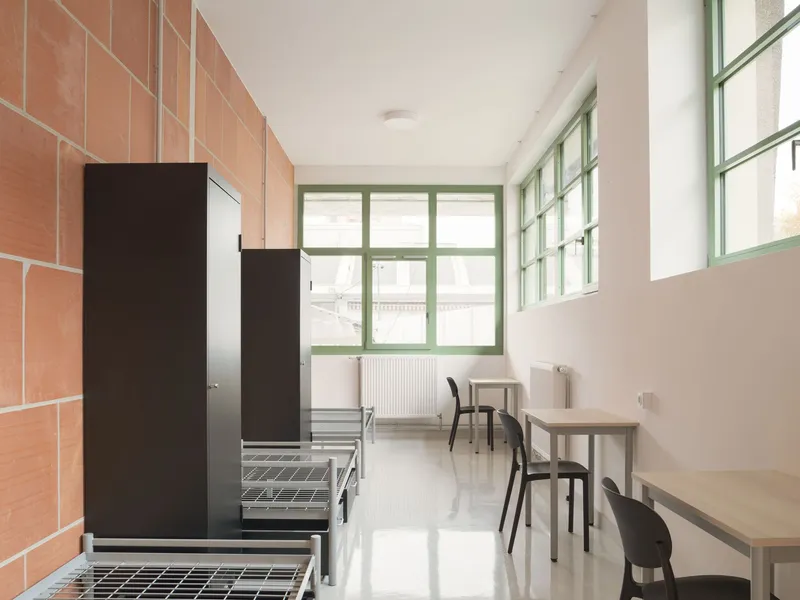
The previous shelter crammed 400 bunk beds into open halls. The rehabilitation replaces that with cellular rooms, each enclosed by terracotta walls with its own window and door. A metal bed frame, a black wardrobe, a chair: the furnishing is minimal but the spatial proposition is clear. These are rooms, not berths. The wheelchair visible in one photograph is a reminder that the program accommodates people with mobility needs, an often-overlooked requirement in emergency housing.
The rooms overlooking adjacent buildings through green-framed windows connect residents to the urban context outside. It is a small thing, a view, but in a building type that often treats its occupants as problems to be managed, the provision of natural light and sightlines to the city is a conscious architectural decision. The three accommodation types, emergency, stabilization, and integration, function independently but share the building's ground floor, allowing different populations to coexist without institutional segregation.
Construction as Evidence

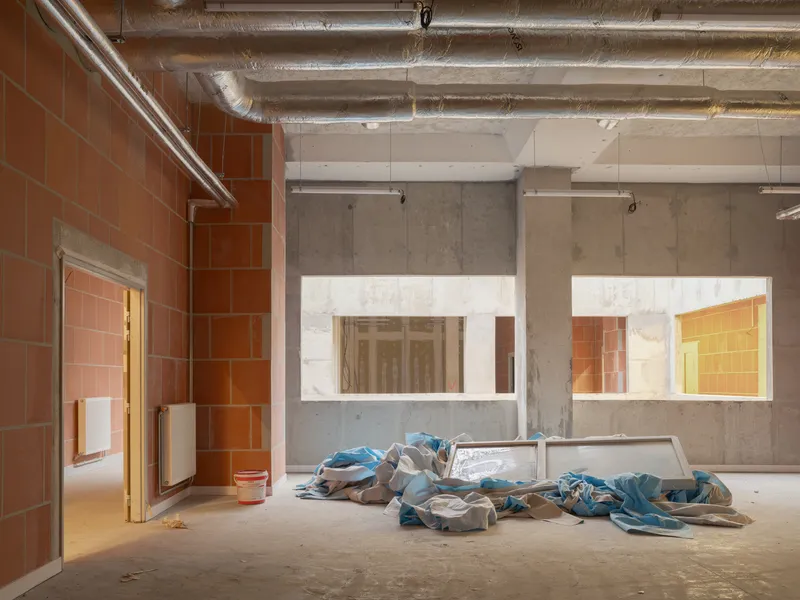
Construction photographs reveal the building mid-transformation: timber beams bracing new concrete work, terracotta blocks rising between existing columns, ductwork threaded through a skeleton that is simultaneously old and new. These images are valuable because they show the degree to which the project is a heavy rehabilitation rather than a new build. The existing structure, with its deep floor plates and high ceilings that were previously impossible to insulate, had to be subdivided and insulated without demolishing the frame.
The construction debris visible on the floor, the exposed rebar, the provisional lighting: these are the unglamorous realities of working inside an occupied site with a tight budget. The first phase, inaugurated in December, delivered 135 of the eventual 438 places, suggesting a phased approach that kept portions of the shelter operational during construction.
Plans and Drawings
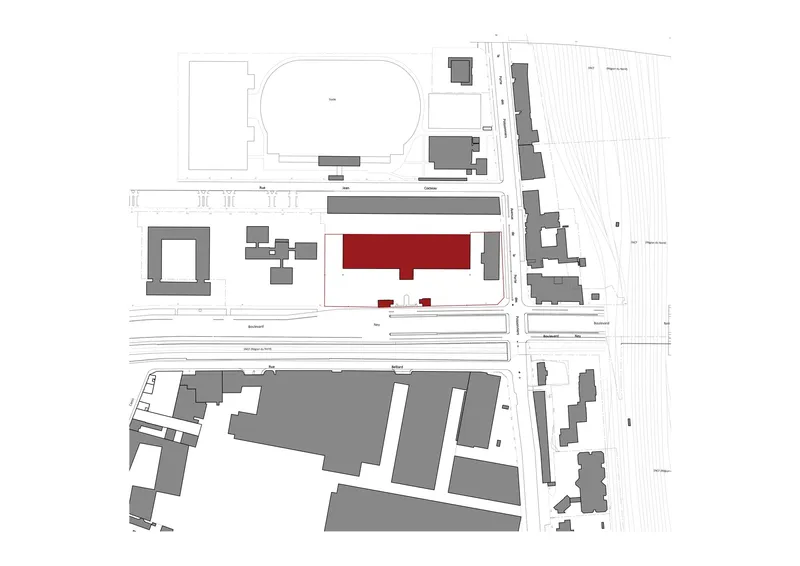

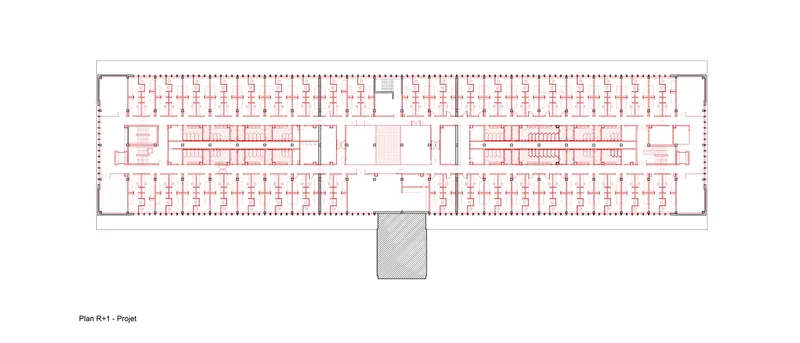


The site plan locates the building as a long red rectangle set among grey urban fabric and railway lines, confirming its peripheral position at the gates of Paris. The floor plans reveal two distinct organizational logics. The ground floor is a large open hall subdivided by columns into communal zones highlighted in yellow, presumably dining and reception areas. Upper floors switch to a tight cellular arrangement: repetitive rooms flanking central corridors, drawn in red linework that emphasizes their serial repetition.
Two section drawings complete the picture. One shows four levels with a basement below grade, confirming the building's substantial vertical dimension. The other reveals the double-height glazed entrance volume at center, rendered in blue, which acts as the spatial hinge between the emergency shelter wing and the stabilization center. The sections make clear how much vertical space the original military structure provided, and how the architects carved usable floors from what was essentially a single tall volume.
Why This Project Matters
Emergency shelters are the architecture profession's blind spot. They house some of the most vulnerable people in any city, yet they are almost always designed by bureaucratic process rather than by architects with spatial ambitions. La Boulangerie is not a luxury project, and it does not pretend to solve homelessness. What it does is demonstrate that a shelter can be more than a warehouse for bodies. Terracotta walls, natural light, individual rooms, a legible entrance sequence: these are basic architectural provisions, not extravagances, and the fact that they feel remarkable here says more about the profession's neglect of this building type than about the project's exceptionalism.
Francois Brugel Architectes Associes and Atelier RITA have produced a building that respects its residents without romanticizing their situation. The film La vie de Souleymane documented what the building was: rows of bunk beds in a crumbling military shell. The architecture now documents what it could be. For 10 million euros and 9,000 square meters, that is a serious achievement, and a serious reproach to every city that claims shelters cannot be designed well because the money is not there.
'La Boulangerie' Emergency Shelter, designed by Francois Brugel Architectes Associes and Atelier RITA. Paris, France. 10,600 m². Completed 2025. Photography by Jared Chulski and Francois Brugel Architectes Associes.
About the Studio
Atelier RITA
Official website of Atelier RITA, one of the studios behind this project.
atelierrita.orgShare Your Own Work on uni.xyz
If projects like this are the kind of work you want to make, uni.xyz is a place to publish your own, find collaborators, and enter design competitions.


Popular Articles
Popular articles from the community


Opera by the Sea Estonia: Three Shells Dissolving Architecture into Tallinn's Coastline
A winning opera house proposal replaces monumental form with interconnected shells that blur the boundary between building, park and Baltic Sea.

Singing Woman: Contemporary Architecture Inspired by Estonia’s Voice and the Sea
Singing Woman turns Estonia’s song culture into flowing opera house architecture, blending public life, landscape, sea, and national memory.

Tsunami Convergenics: Turning Catastrophic Ocean Forces into Underwater Housing Infrastructure
A speculative underwater settlement off the coast of Onagawa, Japan, treats tsunamis and typhoons as energy sources rather than threats.

Cloaked Colonization: A Mobile Underwater Habitat That Moves Like a Fish
Micah Abaya's shortlisted EHC Pacific entry reimagines ocean settlement as a dispersed network of self-sustaining architectural organisms.

Similar Reads
You might also enjoy these articles

Bao Huynh Watercolor Atelier: A Serene Art Retreat in Hội An
Bao Huynh Watercolor Atelier in Hội An blends multifunctional art spaces, sustainable design, local materials, and family-friendly living in a serene environment.

Atelier Macri Concept Store Interior Design by CASE-REAL
Atelier Macri store features a "ko" counter, walnut wood details, cork displays, blending retail, gallery, and seamless customer experiences.

Manuel Vargas Izquierdo Stadium and High-Performance Sports Center: Architectural Excellence in Jalpa de Méndez
The Manuel Vargas Izquierdo Stadium blends sustainable design, inclusive sports facilities, and cultural-inspired architecture, revitalizing Jalpa de Méndez’s public spaces.

KAKR Buluh Awar Hall: Revitalizing Community and Ecology Through Bamboo Architecture
Community built bamboo hall revitalizes Buluh Awar village, empowering youth, restoring ecology, celebrating vernacular craftsmanship through sustainable architecture and culture.

Explore Emergency Shelter Competitions
Discover active competitions in this discipline

Challenge to reimagine the Iron Throne

Photograph architecture without architects

Illustrate the lost glory of Angkor Wat - Render Challenge

Design challenge to reuse E-waste
Comments (0)
Please login or sign up to add comments
No comments yet. Be the first to comment!