
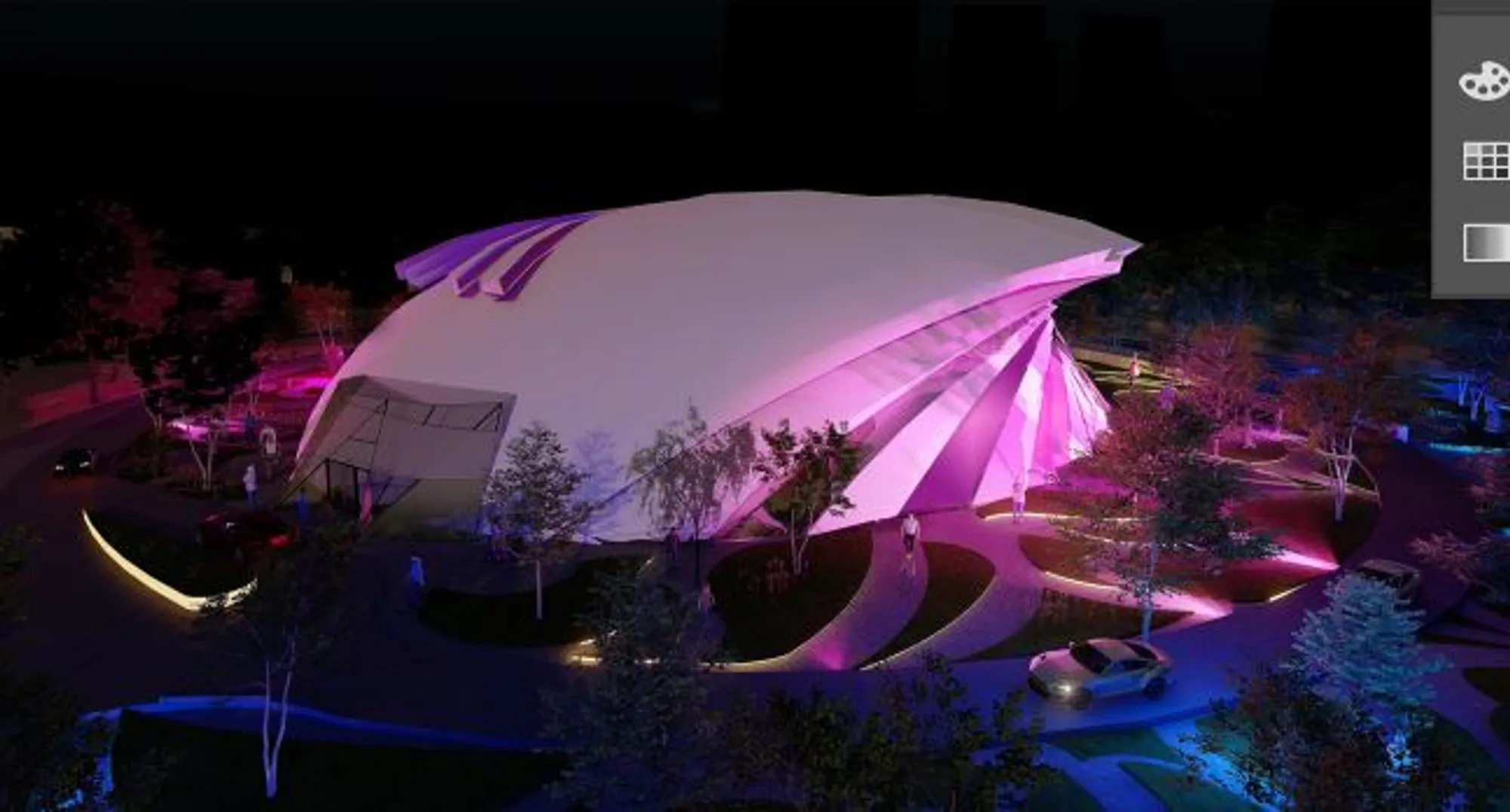
GAMERINA
Where the future of gaming is

When we started considering E-Sports as a design issue, we were unaware of the complexities of electronic games. By conducting a study and uncovering the essence of what distinguishes E-Sports from all other sports, it became clear that it was a path we wanted to examine. We began with a comprehensive review of three case studies to determine how to complete the project architecturally and functionally. We then chose to investigate the influence of the internet on the gaming industry to fuel our project.
The progress of gaming throughout the years has been quick and spectacular to witness, spurred by the widespread availability of internet connectivity. The ability of video games to bring people together cannot be underestimated, and with the advent of the internet, gaming began to realize its true social and competitive potential. We started by looking at recent improvements on the Internet and one of its most exciting technologies, 5G. Gamerina was created with the intention of exciting viewers' senses by making them feel as though they were within the game being exhibited.
During the early phases of the project, our ideas and concepts were generated on a basic level with the intention of being enhanced and developed as the project progressed, as well as adjusting to real-time changes in the E-Sports Industry. The structure passed through several phases during the design process. Originally, we planned to place the competition arena in the center, where all of the attention would be centered, and then place all of the functions around it. We even began to explore the dark aspects of gaming addiction and how it can ruin a gamer's life, and our approach became apparent, so we decided to include an addiction treatment center in our design and offer a space to get away from the screen and rest.
We became fascinated with the concept of creating the building mixed-use by incorporating every existing component of E-Sports, plus a bit more, after partaking in several conceptual and entry-level schematic design approaches. With the continued expansion of the E-Sports industry, every design option becomes more reasonable. When considering the design characteristics that may be included in the structure, we began with the most known functions.
After identifying the building's core, we adapted the façade to reflect the inner space by giving it a more dynamic, parametric, and rounded shape.
SITE ANALYSIS
Being in Dubai Sports City which is a famous multi-venue sports complex in Dubai. It represents a strategic location as the city’s goal is to become a regional and become a global hub for hosting gaming events. This gaming goal will offer opportunities for more engagement to gamers, creators, as well as spectators.
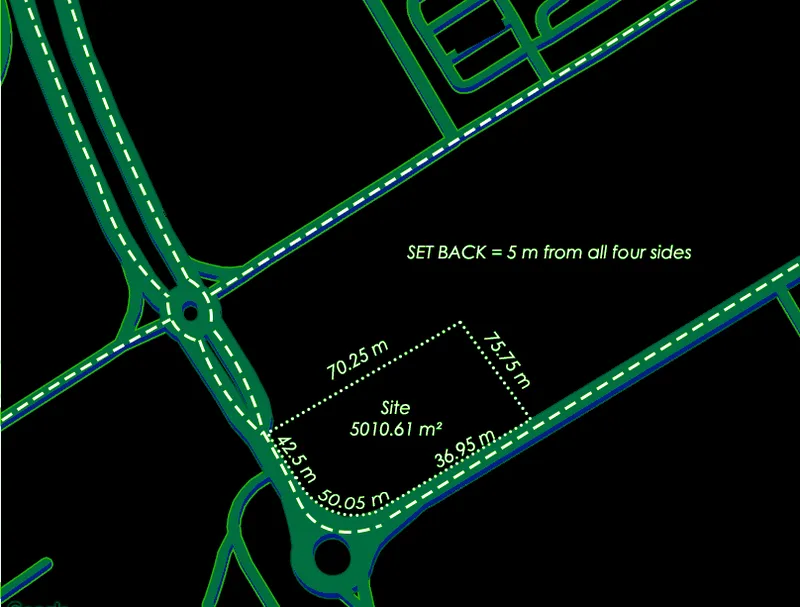
As shown below the site is clearly located in an area that is home to various schools, universities as well as other residential communities which will for sure serve as an enjoyable attraction point for students. This shows that it will be visited by various types of people. In addition, the presence of economic tourism and entertainment facilities in the site region will highly increase the demand for gaming services.

CONCEPT
Starting off with the concept, in the E-gaming world the wireless network plays an important role. Therefore, we began to align multiple curves on top of each other at an equal distance which creates an illusion of movement (steps 1 & 2). In addition, we applied the centralized illusion into our plans as well to further indicate the competition arena is in the middle with the functions revolving around it (step 3).

Moving on to the form development, we continued with our 2D conceptual shape (step 1). We started playing with the angle between each shape to create more visual interest (step 2). Ultimately, we added the two parts of the model to finally create the final product as shown below (steps 3 & 4).

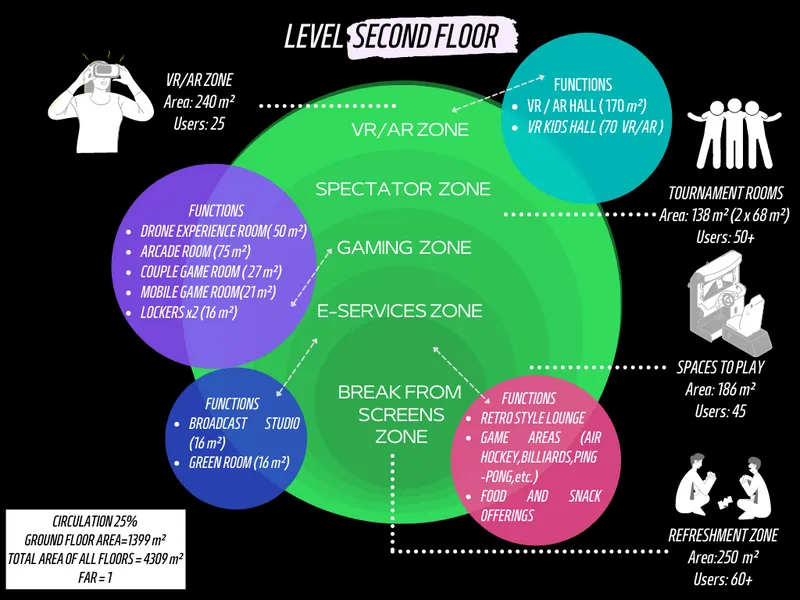
Our main mission was to serve the project in terms of competition, learning, and social. By also dividing the zones depending on their working hours as shown below
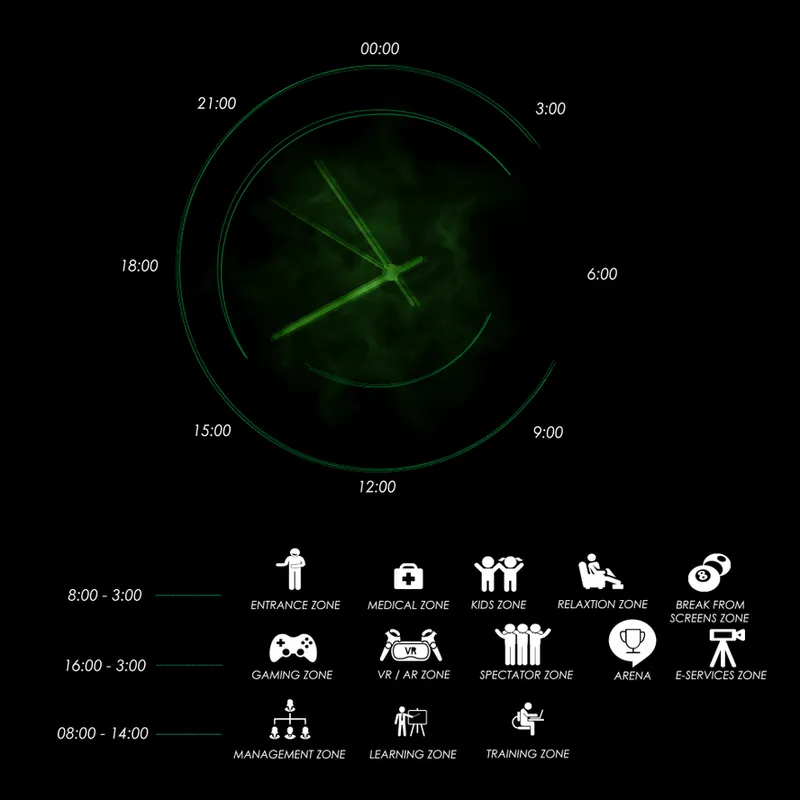
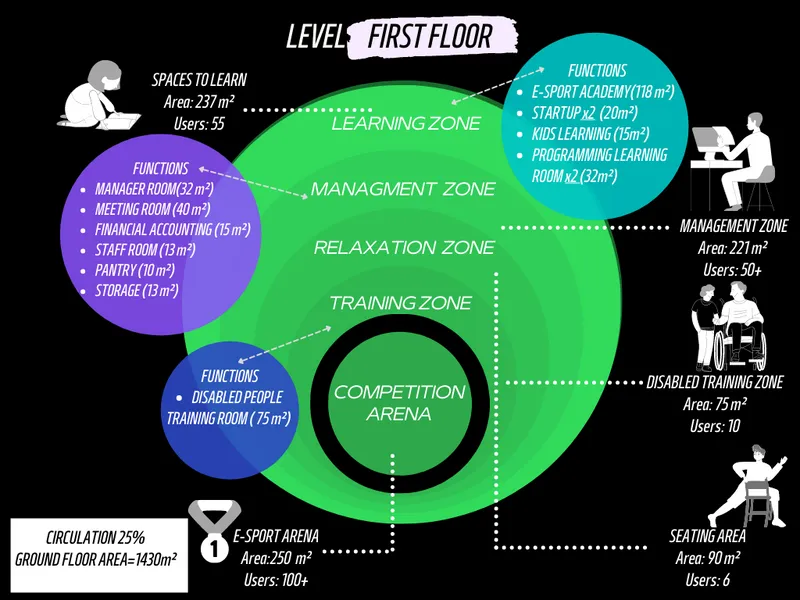
Initially, we divided our functions into different zones which include relaxation, medical, learning, management, training, playing, and most importantly the VR zone along with the spectator area in the center which is the main competition arena.




Popular Articles
Popular articles from the community


Lunar Spiral: Space Architecture Shaped by the Mathematics of the Universe
Lunar Spiral reimagines space architecture through Fibonacci geometry, lunar regolith, levitating habitats, and self-sustaining Moon living.

The Musturak Paradise: Senior Living Architecture for a Connected Future in Temara, Morocco
The Musturak Paradise reimagines senior living architecture in Temara via private homes, social spaces, culture, community, and shared care.

Co-life: Sustainable Architecture for Age-Friendly Community Living
Co-life reimagines sustainable architecture for seniors through courtyards, rammed earth, shared gardens, and spaces designed for belonging.

The Earth Pod: 3D Printed Homes for Resilient Refugee Communities
The Earth Pod reimagines refugee housing through 3D printed homes made from clay, combining resilience, self-sufficiency, and rapid shelter.


Similar Reads
You might also enjoy these articles
The Rhythm of Seasons
A Farmers' Market Connecting Nature and the City

More Than a Building-Designing a Living System
More Than a Building-Designing a Living System
Base Beyond
DESERT COMPOUND ARID: TOURISM OF ABSENCE AND ABUNDANCE

Explore Virtual Reality Competitions
Discover active competitions in this discipline




Challenge to reimagine the Iron Throne


Photograph architecture without architects


Illustrate the lost glory of Angkor Wat - Render Challenge


Design challenge to reuse E-waste
Comments (0)
Please login or sign up to add comments
No comments yet. Be the first to comment!