
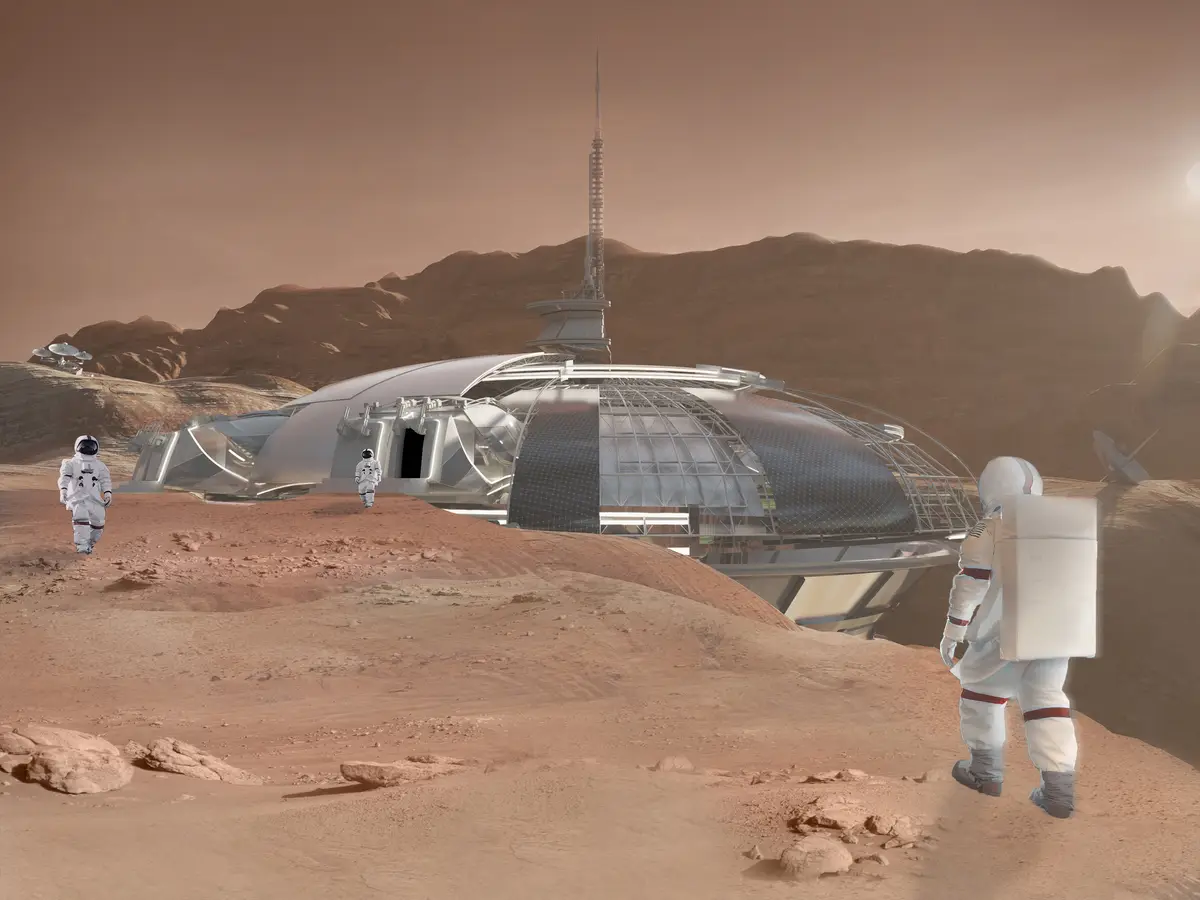
Genesis v.2
Project Brief

Genesis v.2 is a Housing Colony for 40 occupants in Mars. It takes the natural Crater forms on Mars to create a base for the future housing colony. The units are adjustable and can fit in different dimensions of Craters with minimal footprint. The project shows the incomplete aesthetic quality of newly developing knowledge towards the future and establishes a system that might adjust to new scenarios.
NASA sent a sample-return probe to a neutral zone between earth and sun to collect solar wind particles and bring the earth to analyze. It was aimed to gain a better understanding of our cosmic origins. The probe collected samples for almost two years, however, the parachute did not deploy after it hit the atmosphere and it crash-landed in Utah. As a result of a few rescued examined samples, NASA believes that the sun and its inner planets might have been formed differently than previously thought. Genesis was searching for our cosmic origins and now Genesis v.2 aims at continuing the glorious mission of its ancestor, spreading our origins to another cosmic planet and focusing on connecting humankind to another solar system, eventually.
Ever since we learned that Mars has water, we have fantasized about going to Mars and living there. Now that we consume earth’s resources way before we should every year, we might have to move to another planet and recreate our existence there sooner. Although first Genesis did not accomplish its mission fully, Genesis v.2 aims at recreating our origins in Mars and keeps the search for it as the first Genesis. However, humans have to be careful and cherish every resource we have this time. If there will be a second chance on Mars, it should appreciate the nature, and existence of the planet. Humankind shouldn’t consume more than they produce. They need to always be open to changes and be willing to give up the luxury habits that kill the planet. The aim must be to always produce and leave the least mark possible.
Humans’ curiosity about space became tangible with the idea of colonization on Mars. The idea has been on the agenda for years now and the reason is that Mars is the planet that is believed to support life a long time ago. Although it contains a form of liquid water, yet the atmospheric pressure doesn’t allow it to exist in water form; it is frozen, and once interacts with the atmosphere, it evaporates into gasoline. More than that, Mars' atmosphere, which is considerably thin, is known to lay the ground for high levels of radiation. This stems from such a thin atmosphere allowing the SEP (Solar Event Particles) and GCR (Galactic Cosmic Rays) to reach the Martian surface. Therefore, the resources are limited and conditions require well-thought protective and productive solutions for a long life span in the Red Planet.
Taking the above mentioned issues, Genesis v.2 aims at providing maximum possible production for the colony with the minimum resources. To achieve this goal, the conceptual development embraces an adaptive/dynamic approach for the settlement, letting the structure respond to the changes in light, temperature, and other weather conditions through repositioning its parts. This ever-lasting search of Genesis v.2 for finding the best location is to serve the production within its system, where various sustainable energy technologies as well as biofuel production via algae farming.
Craters as bases
There are different shapes and sizes of circular Craters on Mars. These are formations of volcanic activity and remain as a key character of the Martian surface. This project takes advantage of the key character of Mars and utilizes this geometric formation as a main form of the architecture. One of the key points to the concept is the awareness towards humans being just at the beginning of a journey to Mars. The framework of the project, therefore, shows the incomplete quality of newly developing knowledge towards the future and establishes a system that might adjust to new scenarios.
Minimal Footprint
Genesis v.2 uses the minimum footprint for a strong connection to Mars. While craters are utilized as a shell to protect the colony from radiation and meteorites, the Connection Joint acts as the only footprint of the design. Like the sizes of the crater, the architecture can adapt to different radiuses and different numbers of inhabitants, which is the main characteristic of the form and gives it an adaptive quality that can be copied into several sizes based on need. As the living conditions are severe and quite extreme, additions can be made within a single hub as well, more living units, protective shell panels or solar panels can be added according to system requirements. Another benefit of settling into existing circular craters is to create filters for radiation due to being lower than surface, as well as helping to have the least footprint and no manipulation on land.
Production
At the very middle of Genesis v.2, moving and rotating along the central column, technical units play an essential role in the maintenance of the life cycle. Both units have specific functions in terms of sustainable production, one focusing on water and the other on food. The water unit has three main roles: processing the ice layer collected from the surface of Mars into usable water, purifying this Martian water and the settlement's dirty wastewater, and creating a water cycle between the hydroponic system of the vertical garden below. The food unit, on the other side, includes a greenhouse to achieve the needed food production for the community, and a place to cook and prepare the foods to be transferred for the use of the inhabitants through the robots within each living unit. While gaining the advantage of 360° rotation for receiving the best light they needed for their operations, the movement across the vertical axis provides the units to have access to the outer level when needed as well as to the storage level for transferring the production.
Inner Atmosphere
Ice layers on the habitation structures are considered as one of the most efficient local materials for Martian colonies due to their high protection value against radiation which, as indicated, is a crucial problem in Mars. These layers are built on-site, providing ease from material transfer from Earth to Mars. The process of ice layer production starts through a special technique of achieving water from its frozen state via pressurizing, infusing this water into the molds, and finally achieving a new ice layer through temperature change that has the form of its mold. Genesis v.2 utilizes these ice layers both in the shell structure and on the interior units. Despite its advantageous radiation property, this layer still needs protection against outer weather conditions to avoid any phase change in the frozen water. Considering also the need for an extra layer of insulation for the interiors, another layer of CO2 pockets is added to the ice layer. Alongside these, ice layers also are suitable to be used as fuels for the spaceship, which doubles the fuel storage and makes the material the first choice in this project.
Genesis v.2 is designed to be a sustainable prototype for a unitized and adaptable form of living in the human being’s journey to Mars. With an ideal to increase possible production for the colony with the minimum resources, the project takes advantage of unitized pieces to provide solutions for multiple different scales.


Popular Articles
Popular articles from the community


The Amber Palace Opera: A Geological Fiction Surfaces on Tallinn's Baltic Waterfront
Pierre Brillard reimagines a Baltic legend as a public landscape, opera house, and waterfront promenade rooted in Tallinn's coastal identity.

Opera by the Sea Estonia: Three Shells Dissolving Architecture into Tallinn's Coastline
A winning opera house proposal replaces monumental form with interconnected shells that blur the boundary between building, park and Baltic Sea.

Singing Woman: An Opera House That Performs Before the Curtain Rises
Ovidiu Cristian Pavel's conceptual opera house translates Estonia's choral identity into a sculpted waterfront landmark facing the Baltic Sea.

Manzana Morphosis: Stretching Barcelona's Grid into a Living Landscape for 2050
A radical reworking of the Eixample manzana turns density into a tool for generous public space, vertical ecology, and environmental performance.

Similar Reads
You might also enjoy these articles

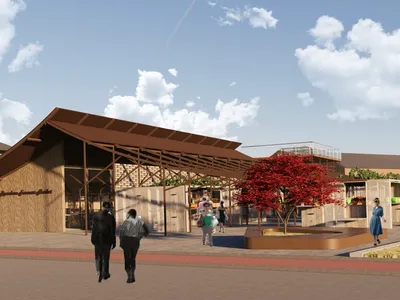
The Rhythm of Seasons
A Farmers' Market Connecting Nature and the City

More Than a Building-Designing a Living System
More Than a Building-Designing a Living System
Base Beyond
DESERT COMPOUND ARID: TOURISM OF ABSENCE AND ABUNDANCE


Comments (0)
Please login or sign up to add comments
No comments yet. Be the first to comment!