

Gimme Shelter Solutions Plants a Modular Self-Build Prototype in a Swedish Forest
On the island of Väddö, architect Emelie Holmberg fuses barn vernacular and Japanese minimalism into a 40 m² expandable woodland dwelling.


The pandemic changed a lot of things, but one of the more quietly radical shifts was the way it forced architects to reconsider what a dwelling actually needs to be. Gimme Shelter Solutions, founded by Swedish architect Emelie Holmberg, took that question seriously: the result is a 40 m² prototype on the island of Väddö, Sweden, that splits living and sleeping into two prefabricated timber volumes connected by a sheltered outdoor corridor. It is not a luxury cabin. It is not a weekend retreat dressed up as architecture. It is a proposition for how housing could work differently, built by the people who will live in it.
What makes this project genuinely interesting is the tension between its humility and its ambition. At 40 square meters total, split between a 32 m² living unit and a 10 m² bedroom, the building is almost absurdly small. But the modular system behind it is designed to grow, Lego-like, as families expand or needs change. The sliding timber screens reference both Swedish agricultural buildings and Japanese shoji, and they do real work: modulating light, privacy, and the boundary between inside and forest. Completed in 2021, the project reads less as a finished house and more as a proof of concept for a different kind of domesticity.
Forest as Room


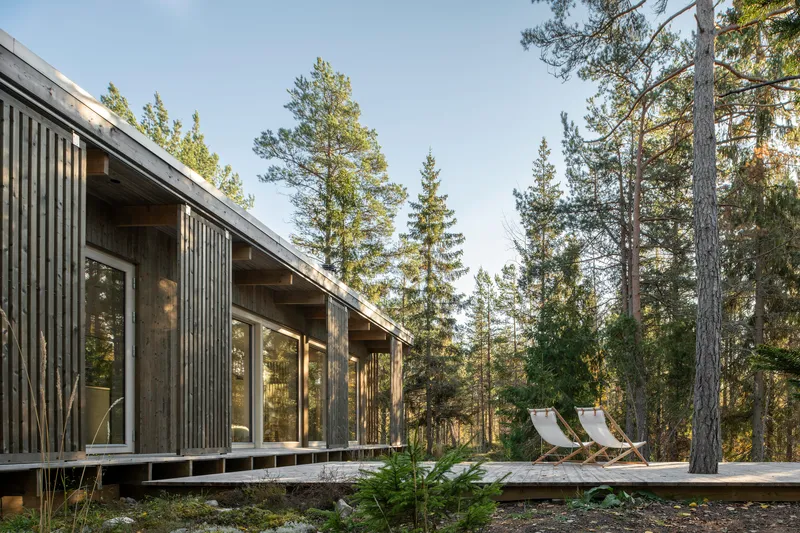
The cabin perches on a glacial rock outcrop, lifted just enough to leave the root systems and ground plane undisturbed. From above, a timber boardwalk threads through the trees like a path that decided to become architecture. The site strategy is restrained to the point of being almost invisible: no grading, no clearing, no assertion of the building over its context. Pine trunks press in close to the deck, and the canopy filters whatever light reaches the interior.
Holmberg treats the surrounding woodland not as scenery but as an extension of the domestic program. Two lounge chairs on the open deck are as much a living room as anything behind glass. The deliberate compactness of the built volumes forces life outward, into the space between trees. It is a tactic as old as the Swedish stuga tradition, but here it is systematized and made replicable.
Screens That Do the Heavy Lifting
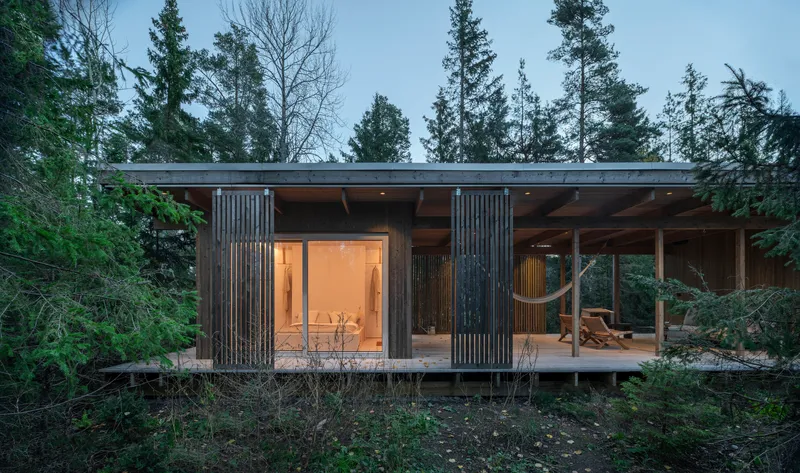
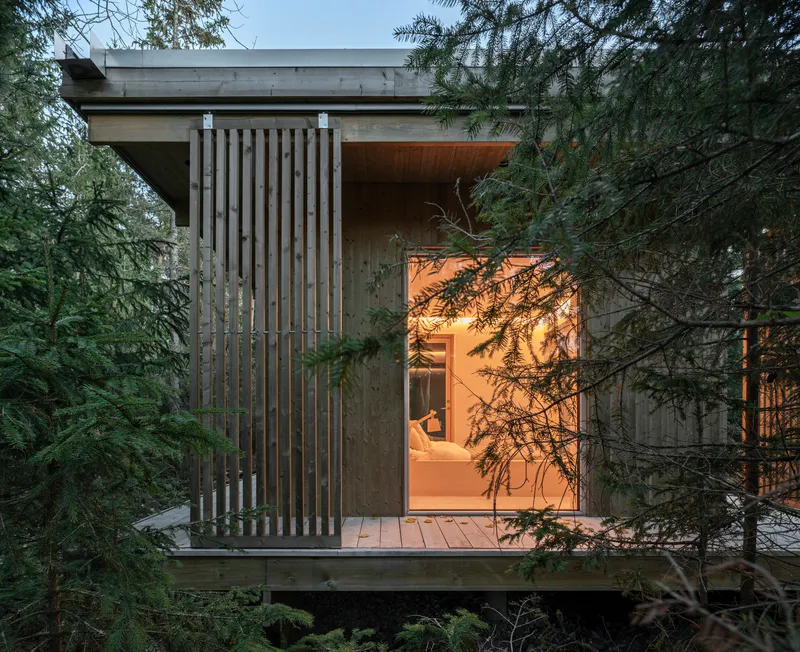
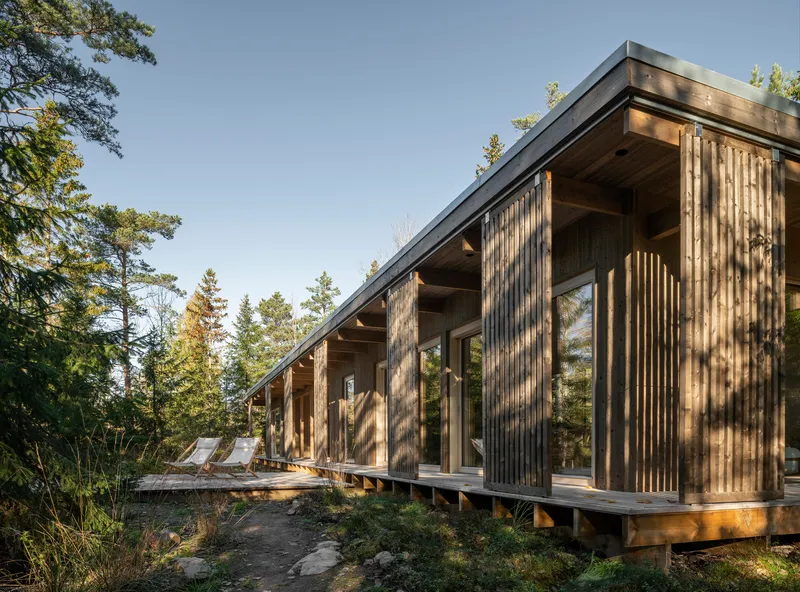
The vertical timber slat screens are the signature move, and they earn it. Alternating with floor-to-ceiling glass panels, they create a facade that is simultaneously open and protected. At dusk, the cabin glows through the slats like a lantern set into the forest. During the day, the screens break harsh light into dappled patterns that rhyme with the pine canopy overhead. They slide, which means the ratio of exposure to enclosure is never fixed.
The reference to Swedish barns is legible but not literal. Agricultural buildings on this part of the coast have long used slatted timber walls for ventilation, allowing air to cure hay while keeping rain at bay. Holmberg borrows that logic and crosses it with the spatial ambiguity of Japanese architecture, where a wall is never quite a wall and a window is never quite a window. The result is a facade that performs thermally, visually, and psychologically, all without any moving parts more complicated than a track and roller.
The Space Between
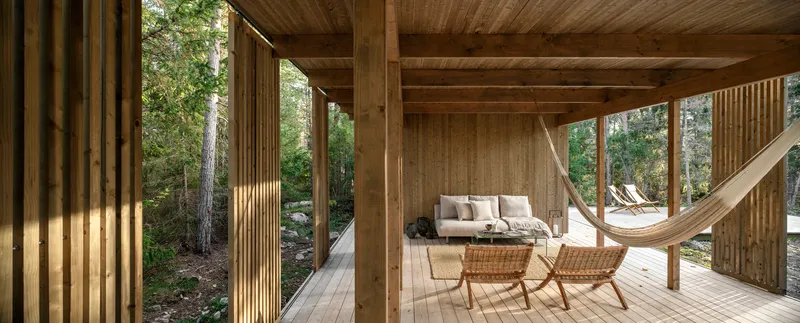
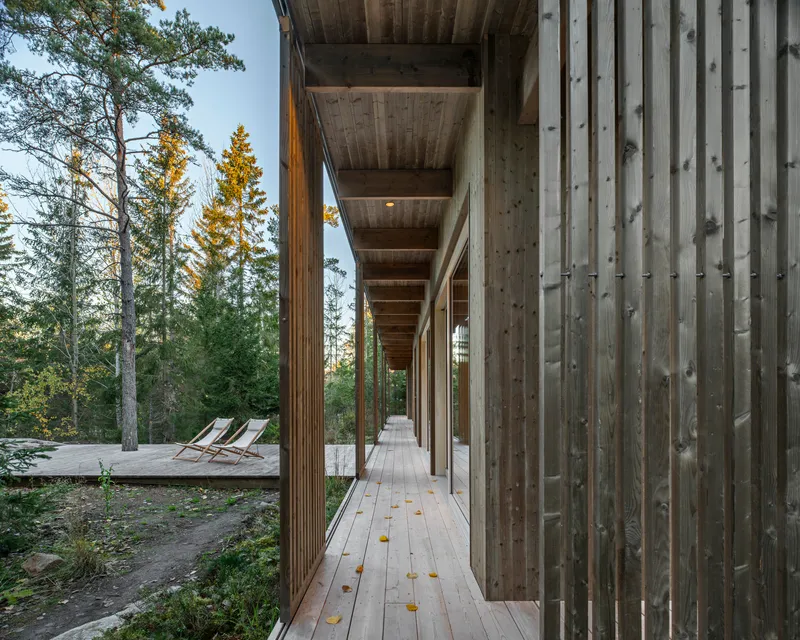

The covered corridor linking the two volumes is arguably the most important space in the project. It is neither inside nor outside, neither circulation nor room, and it does more to define the character of the dwelling than either enclosed volume. A hammock strung between columns, autumn leaves scattered on the decking, low sunlight raking through the surrounding conifers: these are the moments that make the project feel inhabited rather than merely designed.
Splitting the program into two separate structures and then reconnecting them with a roofed walkway is a strategy borrowed from traditional Nordic farmsteads, where outbuildings were clustered rather than consolidated. Here it serves a more contemporary purpose. By separating sleeping from living, Holmberg creates the psychological distance that a 40 m² box could never provide. You walk outside to go to bed. That small act of passage through air and weather turns a compact dwelling into something that feels expansive.
Living Inside


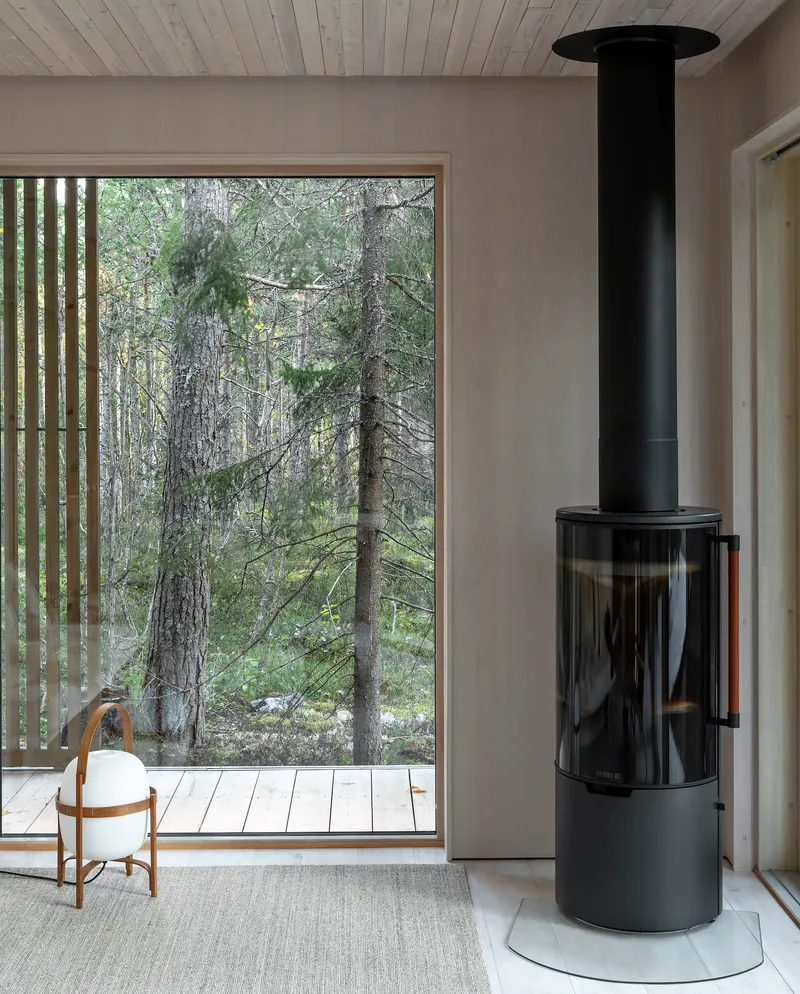
The interior is disciplined but warm. A stainless steel kitchen island anchors the open living and dining area, and vertical timber screens filter daylight from multiple directions. A freestanding black cylindrical wood stove sits beside a full-height window, its minimal form a deliberate counterpoint to the organic chaos of the forest outside. The stove is part of the fossil-free energy strategy: heating only the square meters you are actually using, rather than conditioning an entire house.
Floor-to-ceiling glass dominates the living volume, turning the pine forest into a kind of moving wallpaper. But the palette stays restrained: pale timber planks on the ceiling, similar tones on the floor, no color accents competing with the greens and grays outside. It is the Scandinavian minimal interior done with enough conviction to avoid feeling like a catalog page.
Intimate Rooms
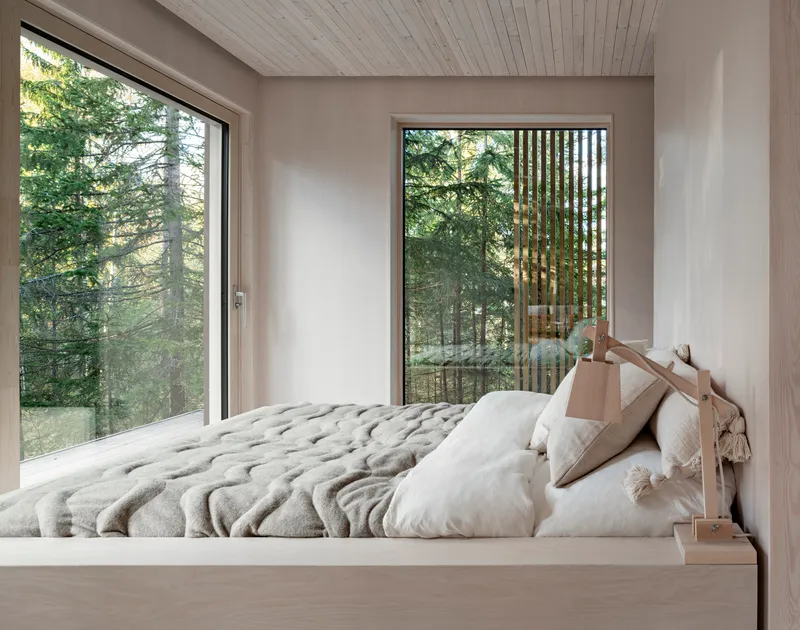
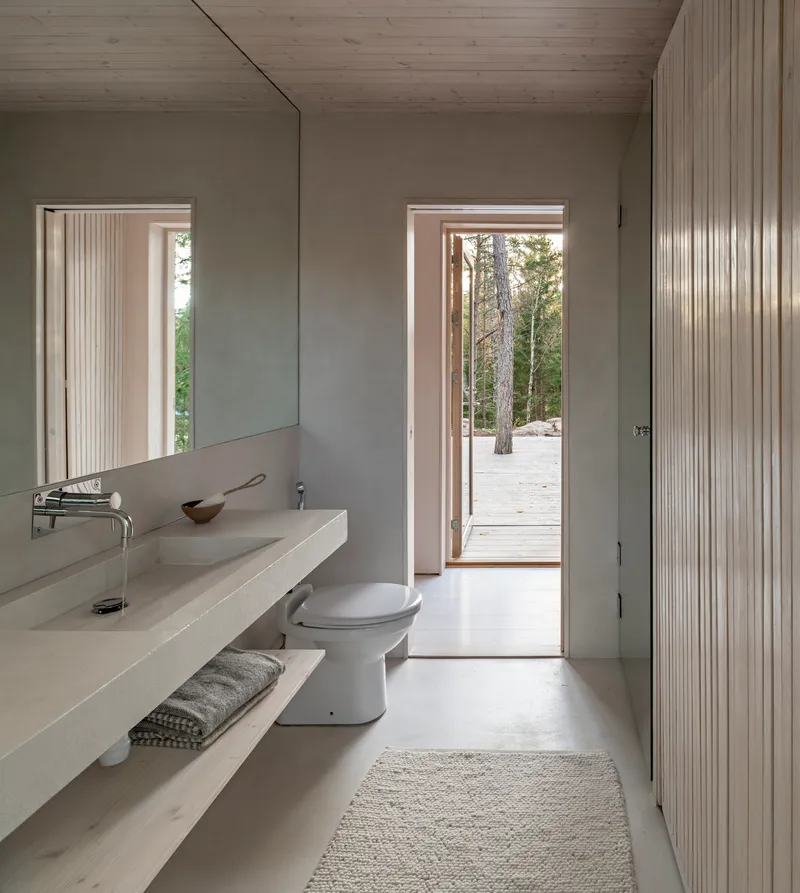
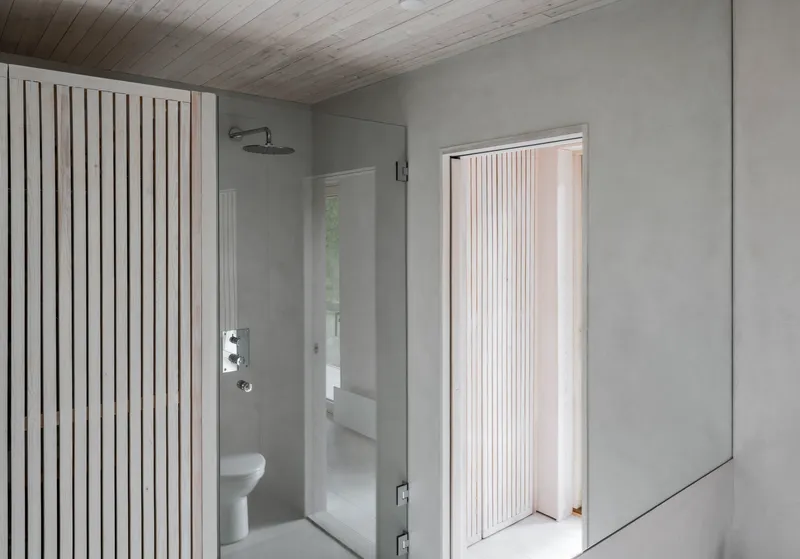
The bedroom sits on a timber platform, floor-to-ceiling windows wrapping the corner so you wake up staring into pine forest. It is 10 square meters, and that is enough. A cast concrete vanity in the bathroom adds the only moment of material heaviness to the entire project. Elsewhere, the bathroom uses the same vertical timber slats as the exterior, blurring the line between outside and in even in the most private room of the house.
These spaces demonstrate Holmberg's argument in miniature. You do not need a large bedroom if the forest is your garden. You do not need a large bathroom if a glass shower enclosure opens to views of birch trees. The compact dimensions are not a compromise but a design decision, one that only works because the relationship to the landscape has been so carefully calibrated.
The Porch as Architecture
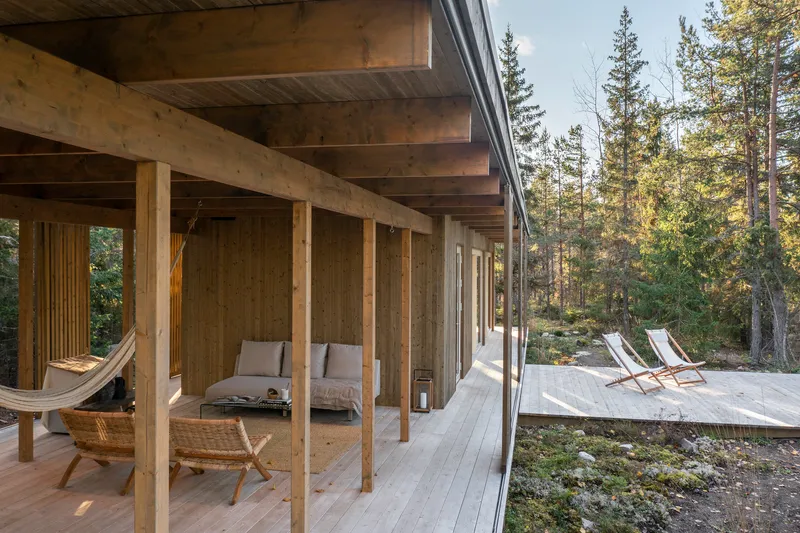


Several images dwell on the covered deck spaces, and they deserve it. The exposed timber columns and beams create a rhythm that echoes the surrounding tree trunks, and the plank ceiling provides just enough overhead enclosure to define these zones as rooms without walls. A hammock and folding chairs at dusk, a glazed bedroom door opening onto a leaf-covered deck: the project is at its best when it dissolves the distinction between furniture and architecture, between dwelling and landscape.
Plans and Drawings


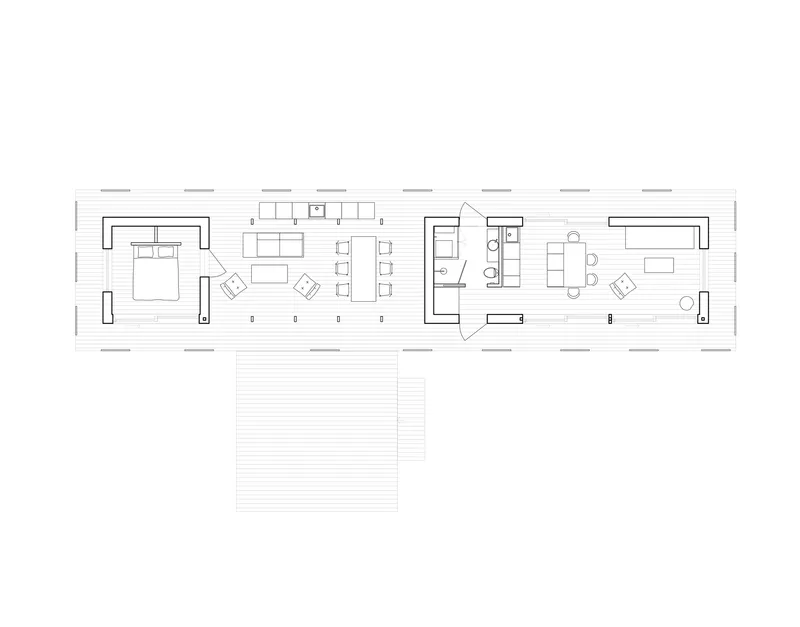
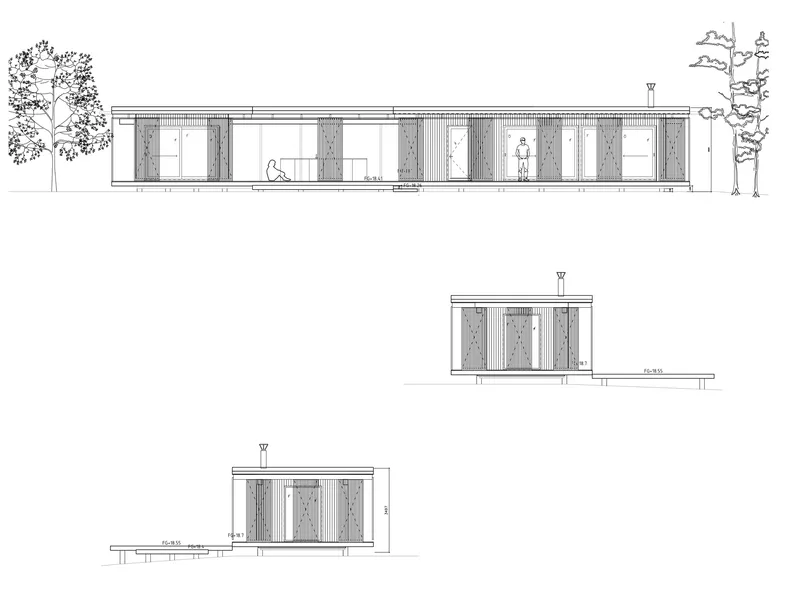

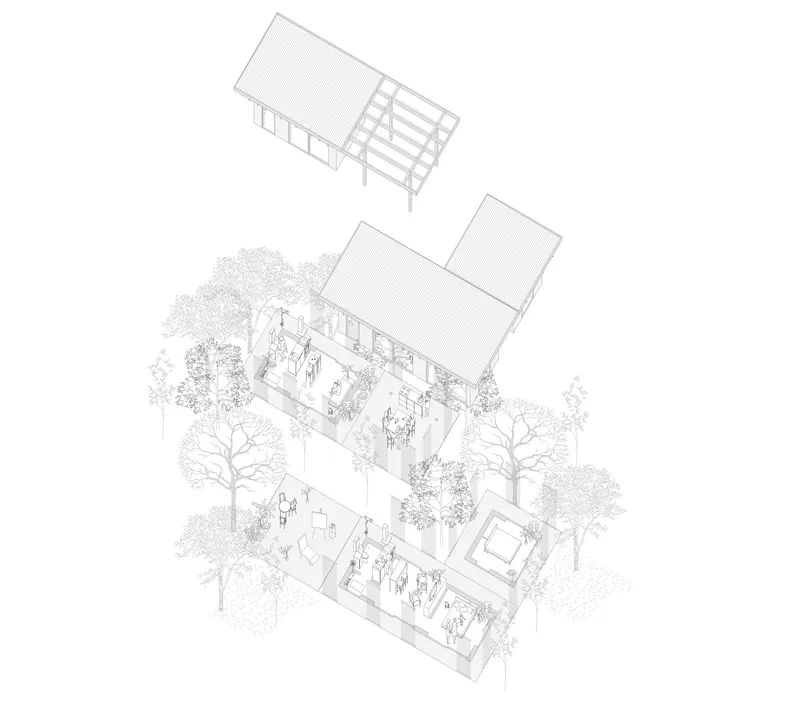
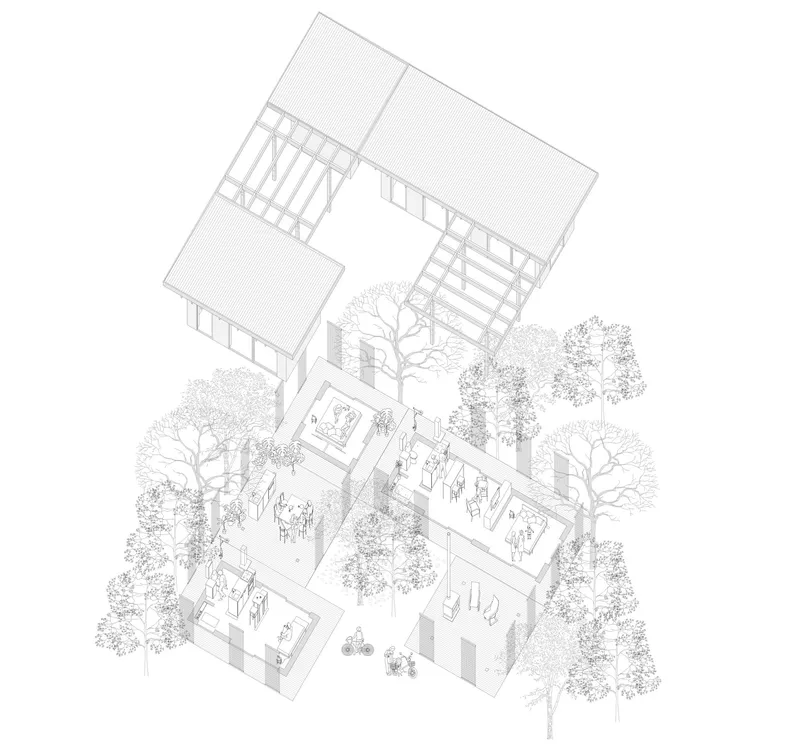
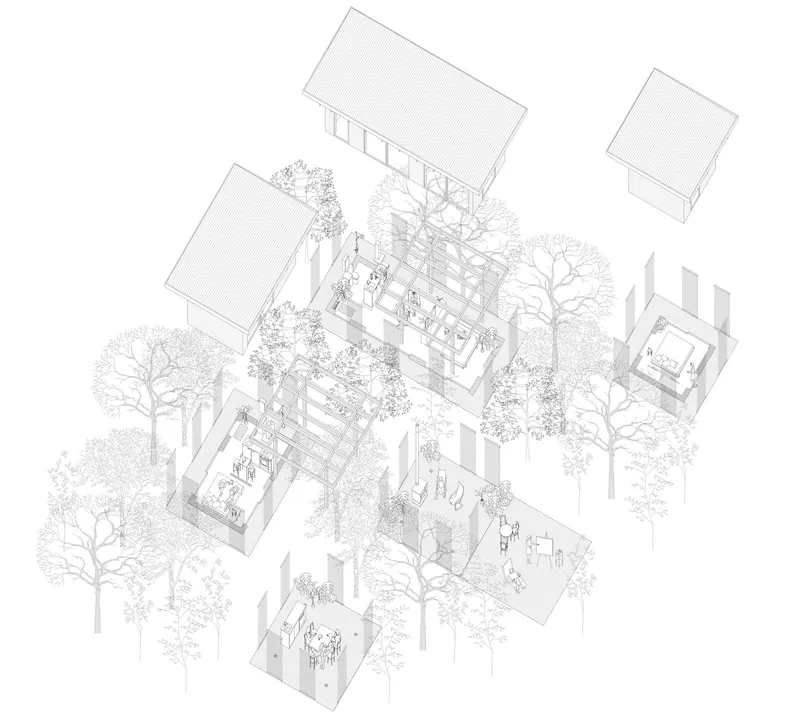
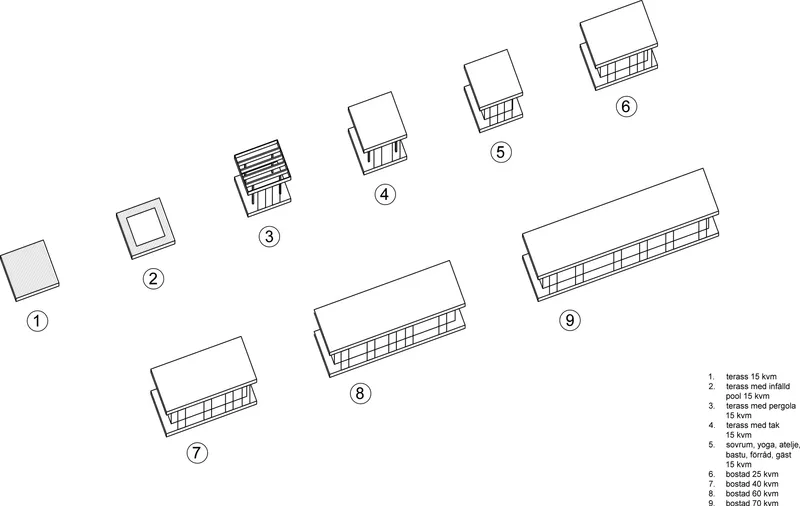
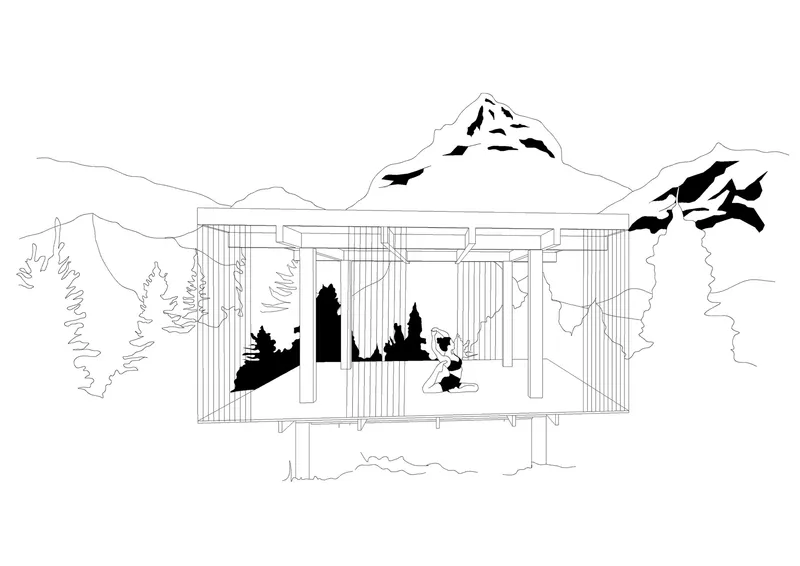
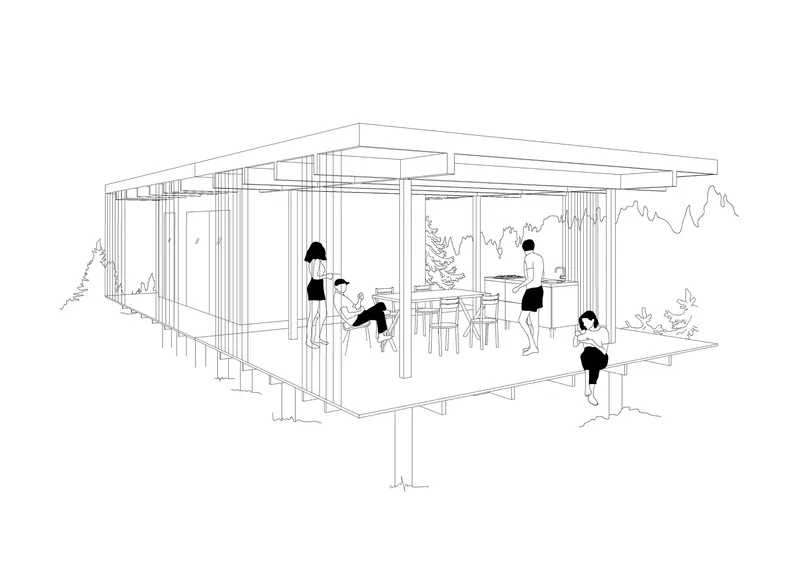
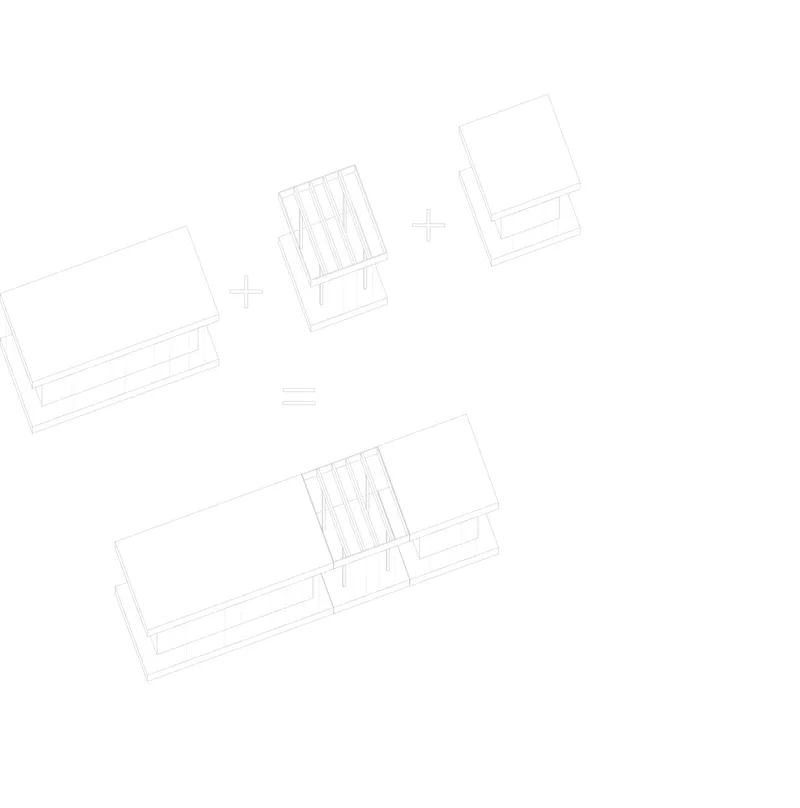

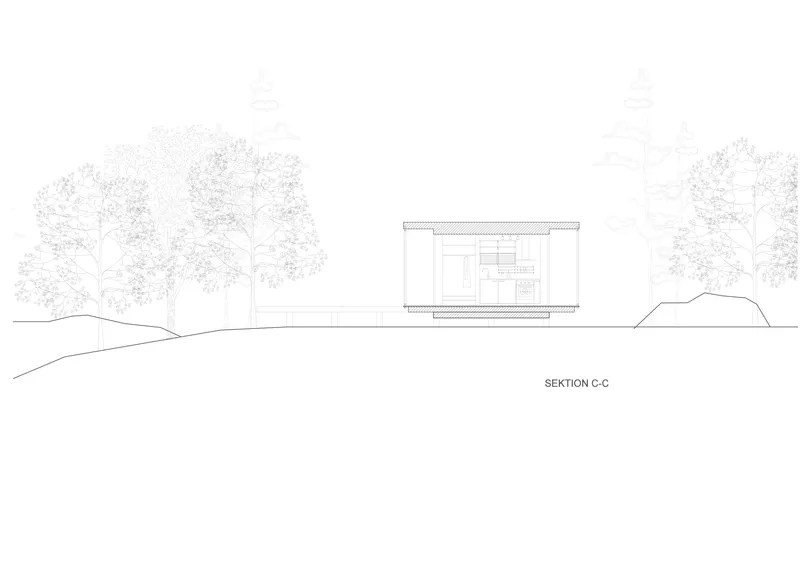
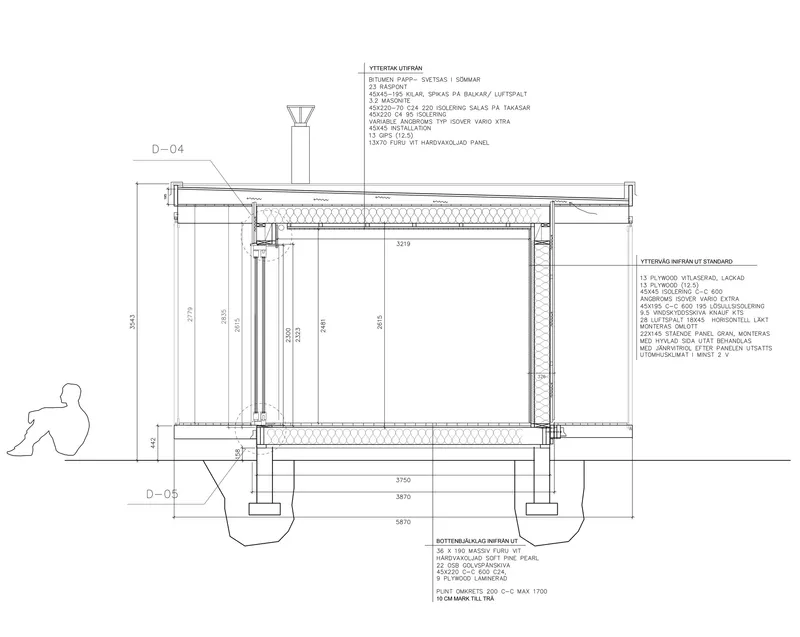
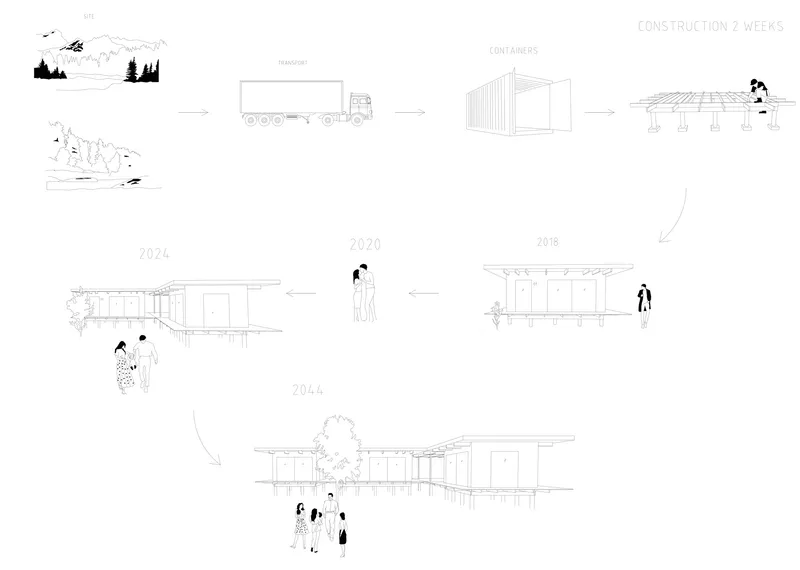
The drawing set reveals the full ambition of the project beyond this single prototype. Site plans show the two rectangular volumes arranged on sloping terrain with decks bridging between them. The floor plan confirms the elongated layout: bedroom at one end, living and dining at the other, with the outdoor deck as connective tissue. Elevation drawings show the alternating rhythm of solid screen and transparent glass that gives the facade its lantern quality.
The axonometric drawings are where things get expansive. They show how the L-shaped pavilion volumes could multiply, how interior spaces relate to the roof framing, and how different configurations might cluster around central courtyards. A diagram of nine numbered building typologies reveals the system's range, from small studios to larger family dwellings. Section drawings show both the elevated pilotis condition and the flat-roof profile set into sloping terrain. A wall section detail exposes the insulation layers, structural columns, and foundation with commendable precision. Most compelling is the timeline diagram illustrating the construction sequence: container delivery, assembly, and completion, making the self-build process legible as a design decision rather than a budget constraint.
Why This Project Matters
The contemporary housing crisis does not lack for proposed solutions. What it lacks are solutions that are simultaneously affordable, beautiful, and architecturally serious. Gimme Shelter Solutions occupies that narrow territory with real conviction. The modular system is not a gimmick but a genuine construction methodology: prefabricated volumes that arrive on site, can be assembled by their future inhabitants, and can expand over time as circumstances change. The fossil-free energy strategy and the incremental heating logic address environmental concerns without turning the project into a sustainability lecture.
More than anything, this project matters because it reframes smallness as a design opportunity rather than a limitation. Forty square meters sounds like a compromise until you see how Holmberg uses the forest, the in-between spaces, and the sliding screens to produce a dwelling that feels generous and specific. The barn references and Japanese influences are not stylistic affectations; they are structural ideas about how walls can breathe and how buildings can sit lightly on the land. If the modular system scales as intended, the prototype on Väddö could become one of the more consequential small buildings completed in Scandinavia in recent years.
Gimme Shelter by Gimme Shelter Solutions, lead architect Emelie Holmberg. Väddö, Sweden. 40 m². Completed 2021. Photography by James Silverman.
About the Studio
Share Your Own Work on uni.xyz
If projects like this are the kind of work you want to make, uni.xyz is a place to publish your own, find collaborators, and enter design competitions.


Popular Articles
Popular articles from the community


Juan García Correa, John González and Claudia Rueda Sink a Circular Amphitheater into a Manizales Engineering Building
On the La Nubia campus in Manizales, Colombia, the S1 Building folds labs and offices into a hillside of ramped lawns that double as a campus route.

Architekt Andreas Gruber Scatters 23 Dark Timber Chalets Across a South Tyrolean Forest Edge
In Molini di Tures, Amonti Chalets breaks a resort into a hamlet of gabled timber houses, with parking, storage and services pushed into the slope.

LT2A and OPEN Architectes Thread a Brick and Glass High School Through a Wooded Belgian Campus
In Braine-l'Alleud, a 3,000 m² wing for Collège Cardinal Mercier pairs pale brick with a glazed colonnade, deferring to a small chapel and a dense wood.

Jaramillo Van Sluys Arquitectura and Urbanismo Turn a Demolished Registry Lot in Quito into an Orchard Plaza
In Quito's Centro Histórico, a 2,800 m² plaza exposes the San Agustín convent wall and redraws its lost Augustinian orchard in volcanic stone.

Similar Reads
You might also enjoy these articles


LAVA Architecten Gives Vocational Education a Sawtooth-Roofed Face on a Mechelen School Campus
In Mechelen, Belgium, a 2,053 m² STEM school on a 6×6 m grid turns workshops and classrooms into rooms that can be rearranged as teaching changes.

KEMA Studio Turns a Derelict Marvila Attic into a 60 m² Lighthouse Apartment Above Lisbon
In Lisbon's Marvila district, a rebuilt roof, four skylights and two plywood volumes turn an unlivable attic into a bright home facing the Tagus.

Pixel Gardens: One Repeated Module Stacked Into a Terraced Social Housing Tower for Famagusta
Salem Bader's shortlisted housing tower builds a vertical neighbourhood from one repeated module, offsetting units to carve terraces, light and air.

Bao Huynh Watercolor Atelier: A Serene Art Retreat in Hội An
Bao Huynh Watercolor Atelier in Hội An blends multifunctional art spaces, sustainable design, local materials, and family-friendly living in a serene environment.

Explore Shelter Competitions
Discover active competitions in this discipline

Challenge to design mud housing for contemporary communities

Challenge to reimagine the Iron Throne

Photograph architecture without architects

Illustrate the lost glory of Angkor Wat - Render Challenge
Comments (0)
Please login or sign up to add comments
No comments yet. Be the first to comment!