
Tetsuo Yamaji Architects Stacks a Timber Box Atop a Steel Tower to Make Japan's Tallest Wooden Skyscraper
At 56 meters in Tokyo's Ginza district, the Takagi Building surpasses a 380-year-old height record using hybrid steel and timber construction.


For 380 years, the five-storey pagoda at Tō-ji Temple in Kyoto held the title of Japan's tallest wooden structure at 55 meters. Now, a 12-storey commercial building on a narrow lot in Ginza has quietly overtaken it. Designed by Tetsuo Yamaji Architects, the Ginza Takagi Building (known as Ginza Wooden Box) reaches 56 meters by placing four floors of timber construction on top of eight floors of steel frame. It is not a pure timber tower; it is something arguably more interesting: an honest hybrid that uses wood where it can perform and steel where it must, all within the constraints of one of the world's most expensive and tightly packed commercial districts.
What makes this project genuinely significant is not the height record itself but the method. The timber upper section does not rely on contractor-approved proprietary systems or require a separate structural evaluation for mid-rise mixed construction. That means it can be replicated. Ginza's urban fabric is defined by narrow, deep plots inherited from Edo-period machiya layouts, and the building type that dominates these plots is the small to mid-scale multi-tenant commercial block. Tetsuo Yamaji has designed a proof of concept that fits precisely into that typology, suggesting that timber high-rises in Japan need not be headline-grabbing megaprojects. They can be ordinary buildings that happen to be extraordinary.
A Wooden Crown on a Steel Body
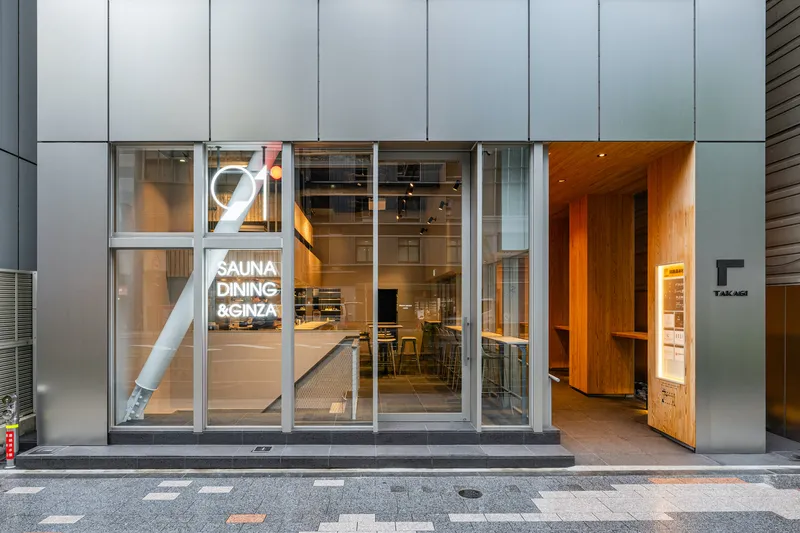
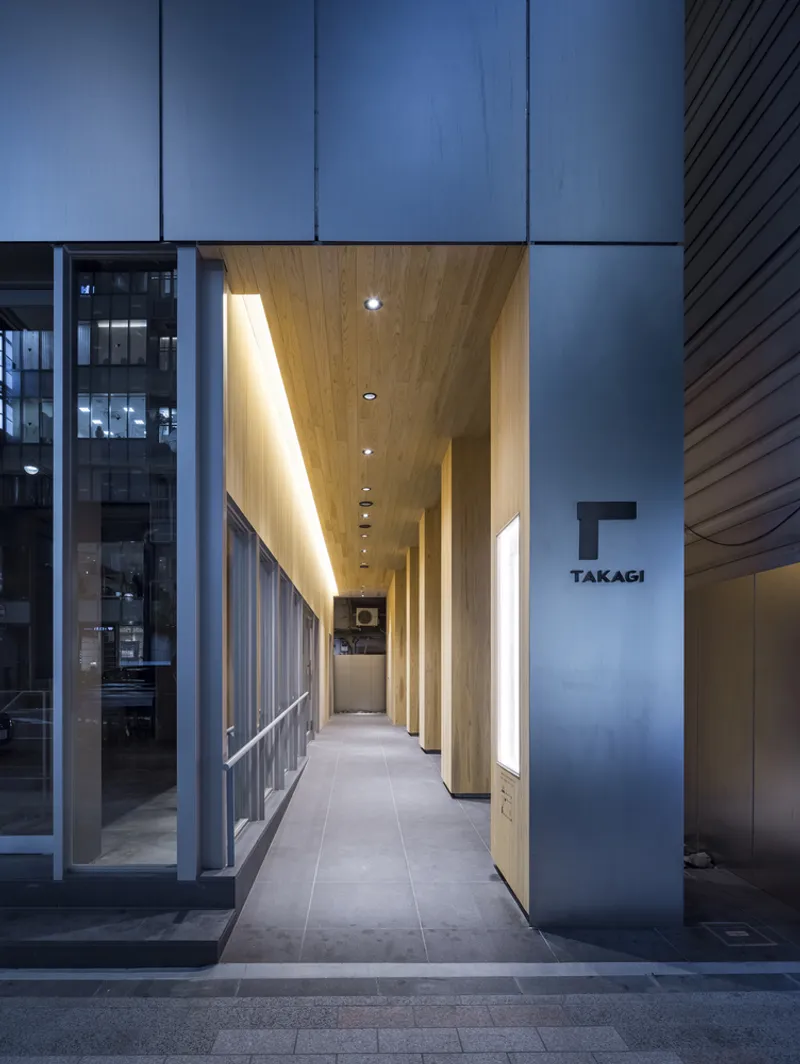
At street level, the Ginza Takagi Building reads as a fairly conventional commercial block: grey panel cladding, full-height glazing, and a controlled entrance sequence. The ground floor and basement contain eateries, while a retail floor sits above them, followed by five floors of office space. It is only from the ninth floor upward that the building's identity shifts. Japanese cedar from the Tama area of Tokyo wraps the exterior of the upper four floors, announcing the timber structure within. The visual effect is startlingly direct: a wooden box placed on top of a modern office building, with no attempt to disguise the seam.
The entrance sequence, visible at twilight, hints at what is above. Timber-lined doorways and ceilings introduce the material at ground level, acting as a prelude. Cedar from the same Tama source is used for interior finishes on the lower floors, creating continuity even though the structure at this level is steel.
Timber Engineering and Fire Resistance
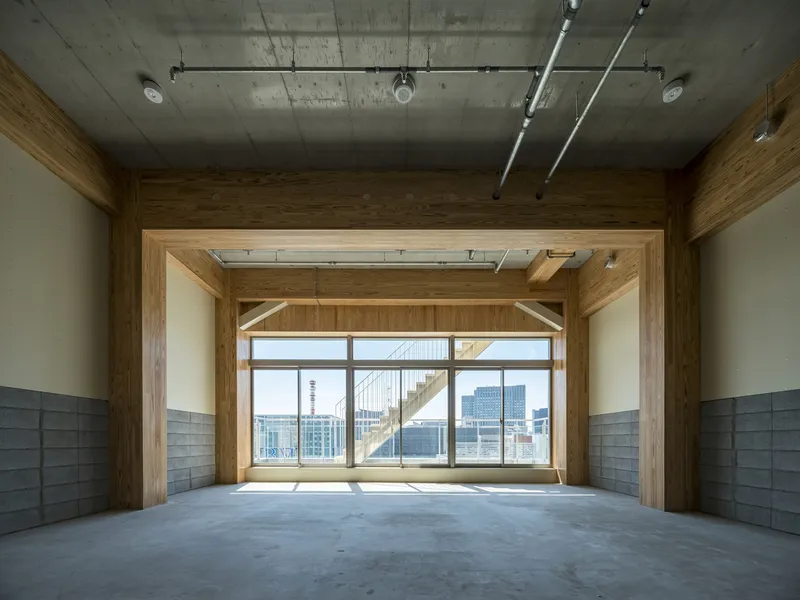
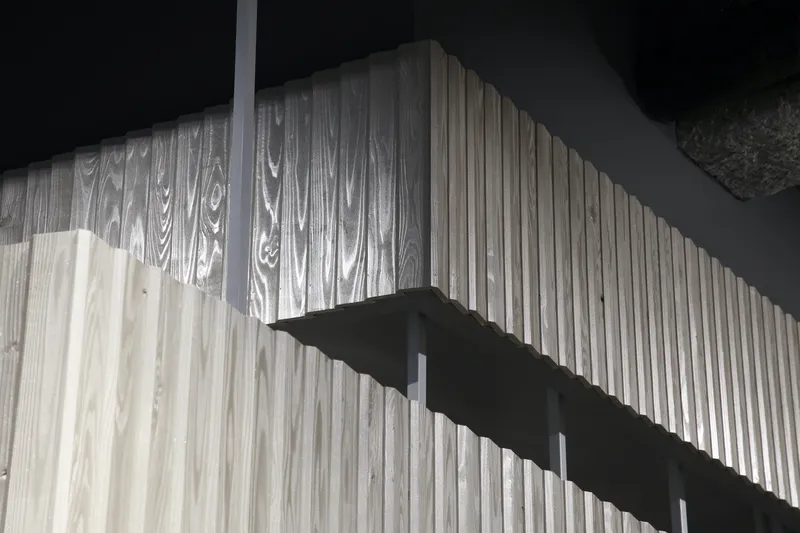
The upper four floors use COOL WOOD by Shelter for their columns and beams, a system that achieves a certified one-hour fire resistance rating. Each load-bearing timber member is clad in two layers of 21mm reinforced gypsum board, then finished with a 20mm timber surface. The result is a fire-rated assembly that still looks and feels like wood from the inside. Connections between the timber frame and the steel structure below are handled through drift-pin joints with inserted steel plates. At the base of each timber column, steel columns extend 500mm above beam level, with base plates and gusset plates forming the transition. These connections were measured and adjusted on site, a bespoke process that ensured precision between two fundamentally different structural systems.
The exposed timber framing visible in the interior spaces is not decorative. It is the structure, with the fire-resistant cladding detailed so that it remains continuous across joints. The fact that this system does not require a separate structural evaluation for mid-to-high-rise mixed timber buildings is a regulatory achievement as much as an engineering one.
Rooftop and Upper Floor Program
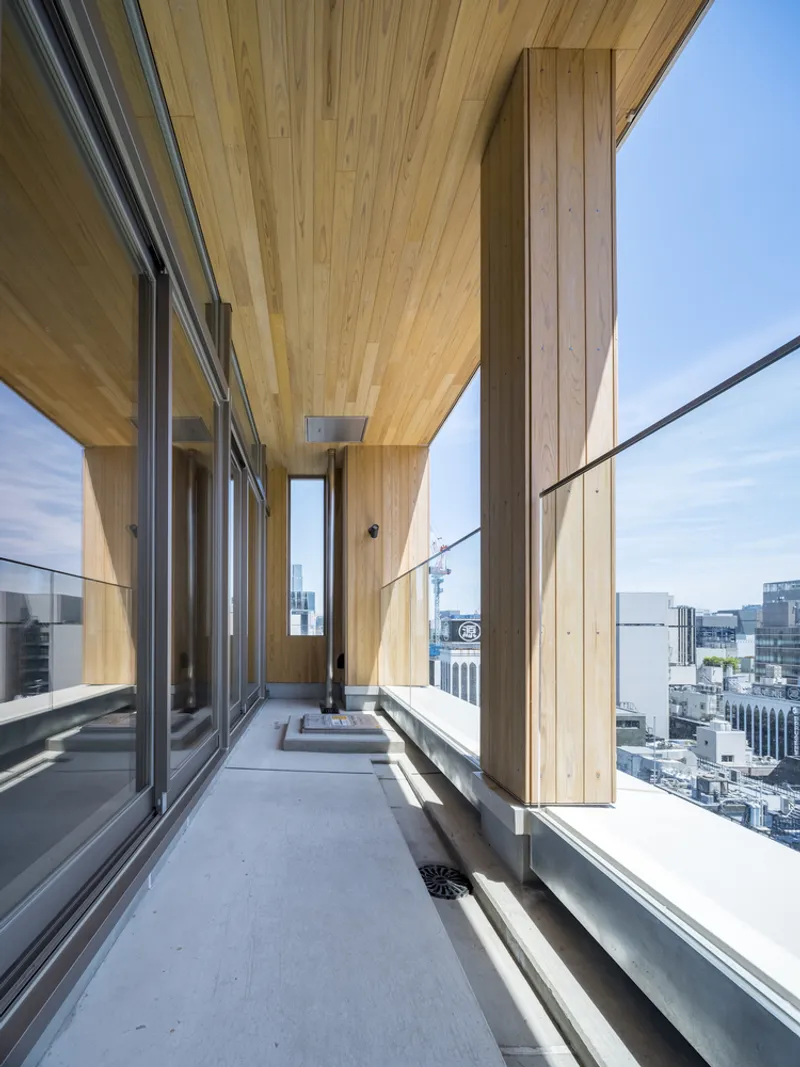
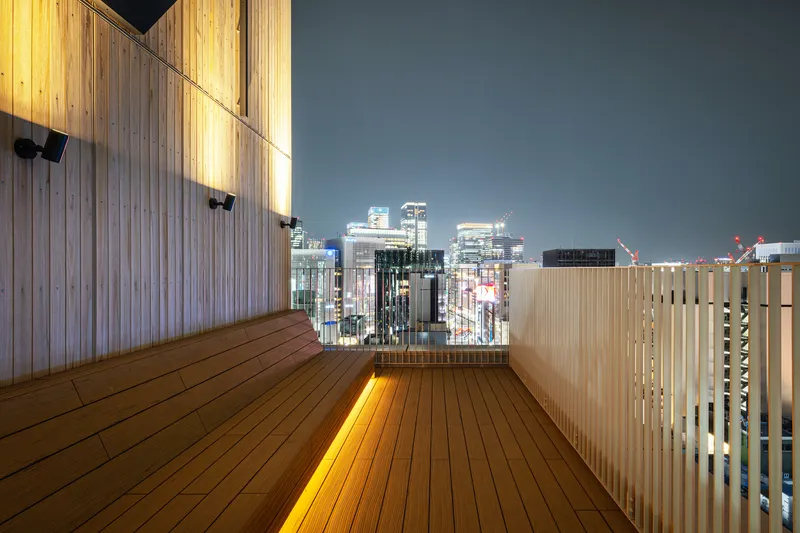
The timber floors house the building's most public and experiential programs. Floors nine and ten contain restaurants, while floors eleven and twelve, along with the rooftop, are occupied by a sauna facility. Each timber floor incorporates a balcony, and the roof terrace provides panoramic views of the surrounding urban skyline. These open-air elements reference the alley-like spatial character of traditional Ginza, where narrow passages between buildings lead to hidden shops and galleries. In the Takagi Building, these passages have been rotated vertical: you move upward through the building to find its most intimate and surprising spaces.
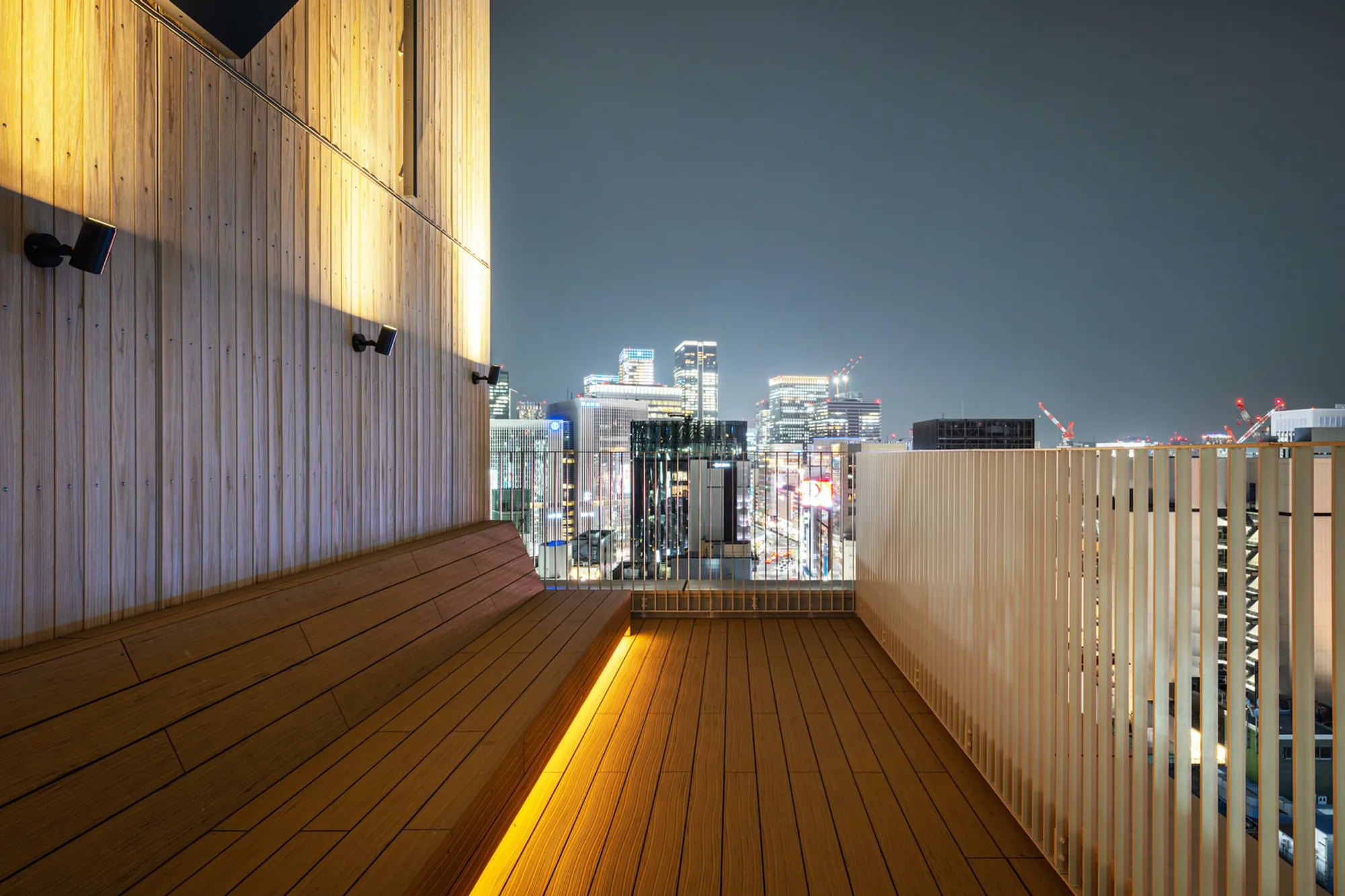
The rooftop terraces, finished in timber decking with vertical slat screening, create a sheltered outdoor room at 56 meters. At dusk, the illuminated cityscape becomes the backdrop. The timber soffit overhead extends the material language of the interior outward, making the rooftop feel less like a utilitarian add-on and more like the culmination of the building's spatial sequence.
A Sauna in the Sky
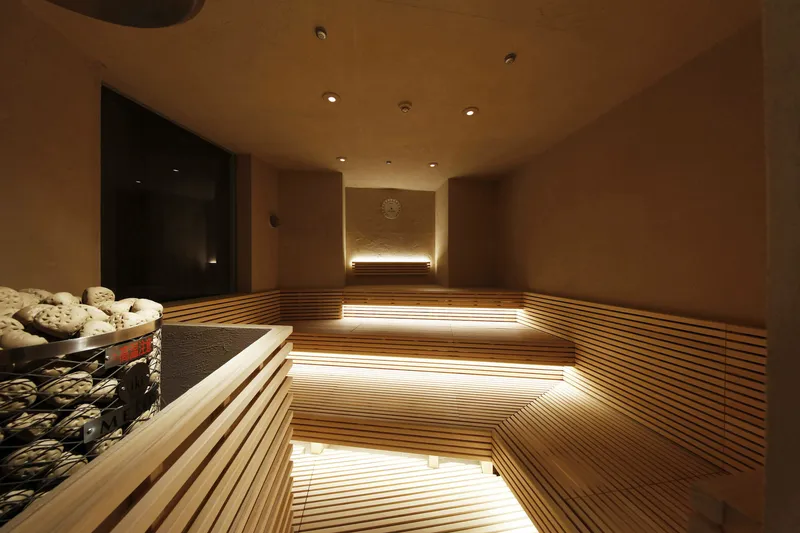
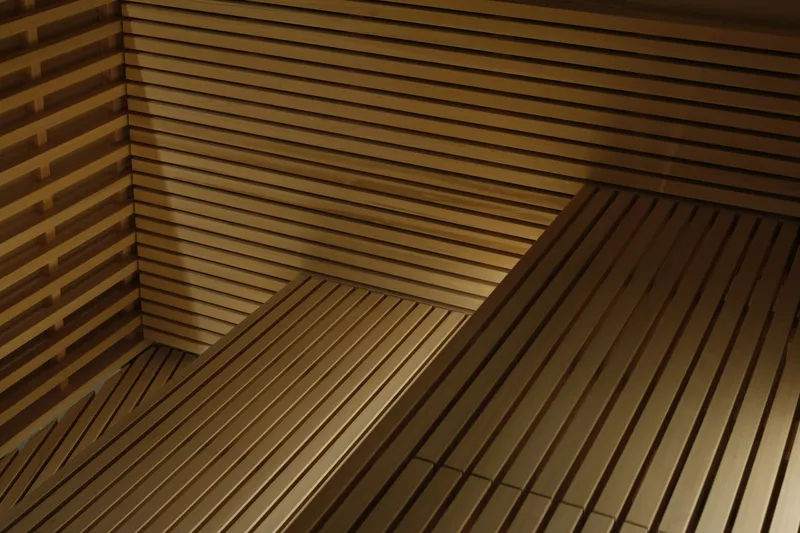
The sauna facility occupying the top two floors and rooftop is the building's most unexpected program. Tiered timber benches with integrated linear lighting beneath each level create a warm, enveloping atmosphere. The material here is not merely aesthetic; wood performs better than most materials in high-heat, high-humidity environments, and the choice of Tama cedar gives the space a scent and tactile quality that no synthetic material can replicate.
There is something fitting about a sauna at the top of Japan's tallest wooden skyscraper. It is the program where the qualities of wood are most immediately felt by the body: heat, texture, fragrance, moisture absorption. Placing it at the crown of the building ensures that the timber structure is not just seen but physically experienced.
Dining and Commercial Interiors
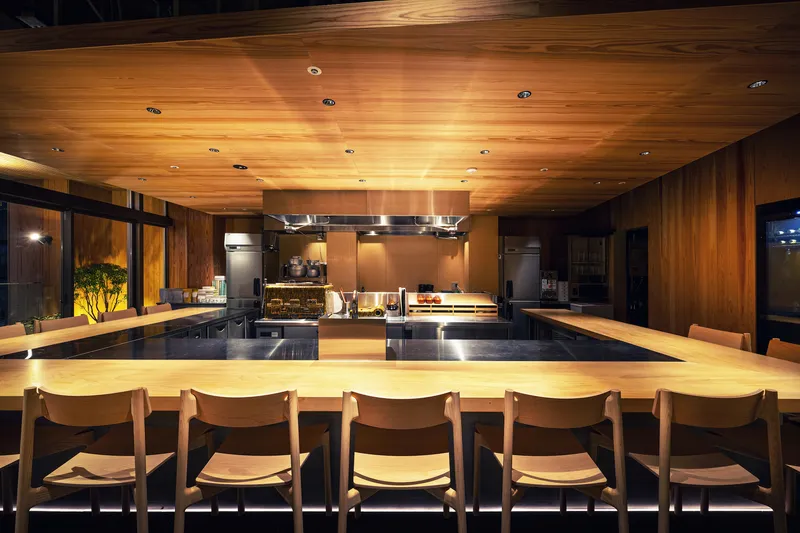
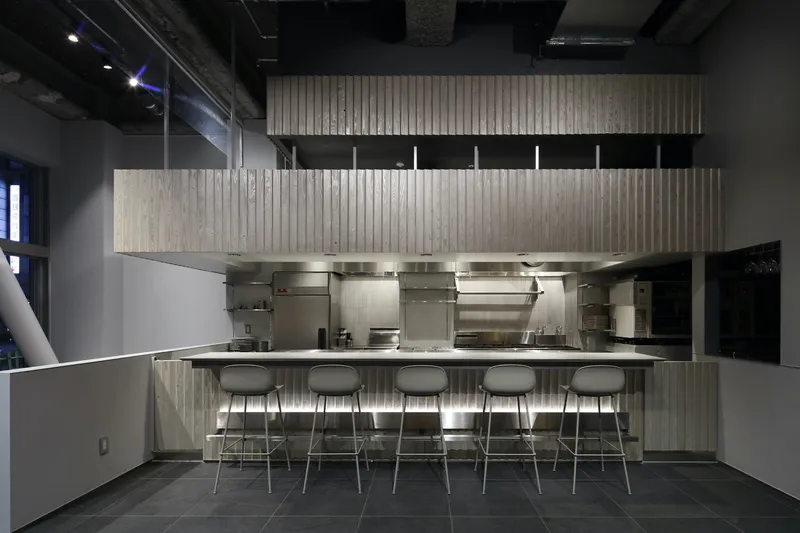
The restaurant floors demonstrate a careful calibration of warmth and restraint. Dining counters sit beneath timber ceilings with warm downlighting, while commercial kitchens pair stainless steel equipment with vertical timber cladding. The material palette is limited but effective: wood against metal, warm against cool. Bar seating facing open kitchens follows a tradition deeply rooted in Japanese dining culture, where the preparation of food is part of the experience.
These interiors avoid the common trap of treating timber as a luxury veneer. The wood here is structural, functional, and regional. It comes from forests 50 kilometers west of the building site. The 110 cubic meters of local timber used in the project stores approximately 65 tons of CO₂ while reducing emissions associated with processing and long-distance transport.
The Middle Floors: Steel, Concrete, and Pragmatism
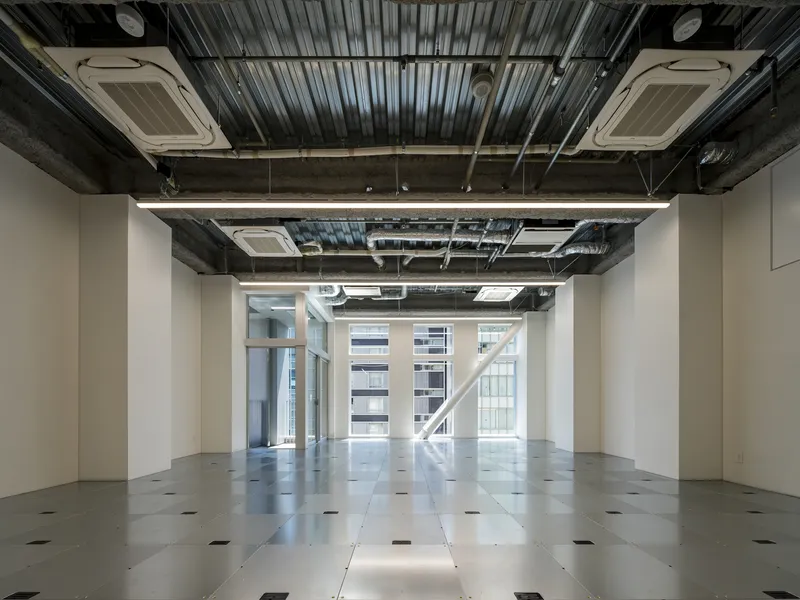
The office floors between the second and eighth levels are unapologetically utilitarian. Exposed corrugated metal ceilings, ceiling cassettes, and polished concrete floors create the kind of flexible, open-plan workspace that tenants can adapt to their needs. There is no attempt to make these floors feel like the timber levels above. They are what they are: efficient, rentable square meters in one of Tokyo's most valuable commercial addresses.
This honesty about program and material is one of the building's strengths. A fully timber-framed tower on this site was considered and rejected due to fireproofing, structural, and cost constraints. Rather than forcing timber into a role it could not play at every level, the design team chose legibility: concrete in the basement, steel in the middle, wood at the top. Each material does its job.
Why This Project Matters
The Ginza Takagi Building replaces the Aruya Photo Studio (Ariga Shashinkan), a cultural landmark that closed in 2015. The site carries weight. Its predecessor was frequented by literary figures including Yasunari Kawabata and Yukio Mishima. Building something meaningful here was not optional; it was expected. Tetsuo Yamaji has responded not with nostalgia but with a forward-looking argument: that the narrow, deep Ginza plot can accommodate a new kind of urban timber building, one that revitalizes local forestry, stores carbon, and proves that mid-rise hybrid construction is replicable without bespoke structural evaluations.
Japan's timber ambitions are accelerating. Mitsui Fudosan's 84-meter Nihonbashi project is scheduled for 2026, and Tokio Marine's 100-meter headquarters for 2028. But those are corporate megaprojects with resources to match. What Tetsuo Yamaji has demonstrated at 56 meters is arguably more consequential: a scalable model for the thousands of ordinary commercial buildings that define Japan's cities. If the Tō-ji pagoda was a statement of spiritual aspiration, the Ginza Wooden Box is a statement of practical possibility. Three hundred and eighty years of history was not surpassed by spectacle; it was surpassed by a building type that could be built again tomorrow, on the next narrow lot over.
Ginza Wooden Box (Ginza Takagi Building) by Tetsuo Yamaji Architects. Ginza, Chuo, Tokyo, Japan. 119.57 m². Completed 2023, inaugurated May 2024. Photographs by Hiroyuki Hirai.
About the Studio
Share Your Own Work on uni.xyz
If projects like this are the kind of work you want to make, uni.xyz is a place to publish your own, find collaborators, and enter design competitions.



Popular Articles
Popular articles from the community


The Musturak Paradise: Senior Living Architecture for a Connected Future in Temara, Morocco
The Musturak Paradise reimagines senior living architecture in Temara via private homes, social spaces, culture, community, and shared care.

Co-Life: Senior Housing Design That Reconnects Older Adults With the City
Co-Life reimagines senior housing design through healing gardens, shared streets, workshops, and a sustainable community across generations.

The Earth Pod: 3D Printed Homes for Resilient Refugee Communities
The Earth Pod reimagines refugee housing through 3D printed homes made from clay, combining resilience, self-sufficiency, and rapid shelter.

Play: Fragments of Their World
Familiar architecture becomes modular playground design, creating safe spaces where displaced children can learn, connect, imagine and play.


Similar Reads
You might also enjoy these articles


Hodi-Mandai Geram
Project Function: Preservation and revitalization of the Intangible heritage and socio-spatial identity of the Hodi by Housing, Cultural Memory Center, Sacred Grove, landscape, local tourism economy


Olio Towers: A Mid-Rise for Performers That Fuses Housing, Rehearsal, and Stage
Located blocks from Houston's Theater District, this modular tower stacks living units around a central performance atrium.

Oasis: Modular Green Housing Carved into Dhaka's Urban Fabric
A shortlisted Plugin Housing entry reclaims unauthorized settlements in Dhaka with stepped concrete volumes, green roofs, and ventilation-driven design.

Black Hole: A Floating Megastructure for the Post-Physical Era
Emiliano Mazzarotto envisions a spherical, self-scaling arena where e-sports, digital hotels, and holographic stadiums replace traditional public space.

Explore Tall Building Competitions
Discover active competitions in this discipline



Challenge to reimagine the Iron Throne


Photograph architecture without architects


Illustrate the lost glory of Angkor Wat - Render Challenge


Design challenge to reuse E-waste
Comments (0)
Please login or sign up to add comments
No comments yet. Be the first to comment!