
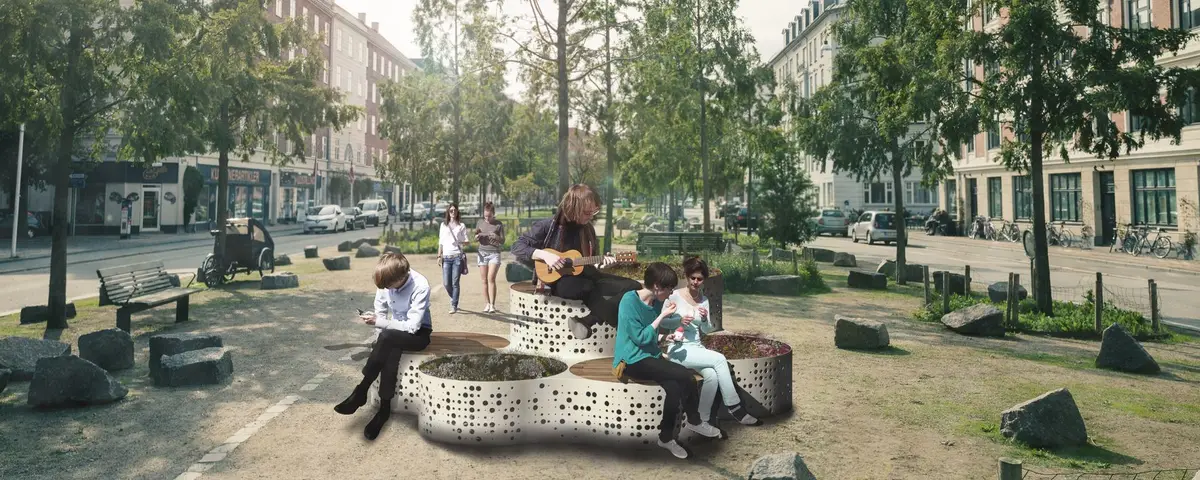
Grobund: Urban Benches That Double as Insect Hotels
A modular seating system merges biophilic design with pollinator habitat, turning leftover city spaces into networked urban biotopes.


What if every park bench in a city was also a functioning ecosystem? Grobund answers that question with disarming simplicity: a modular bench that shelters solitary bees in bamboo inserts, attracts butterflies with flowering Phlox and Echinos, and houses ladybirds in organic nesting slots. The result is urban furniture that doesn't just occupy public space but actively regenerates it, turning residual patches of pavement into nodes of biodiversity.
Designed by Slava Ivanov and Marius Costan, Grobund received an Honorable Mention at the Urbanscape 2018 competition. The project reframes the conversation around urban furniture by fusing it with ecological infrastructure, proposing a scalable network of insect hotels and micro-biotopes that could thread through any city willing to treat pollinators as stakeholders in public space.
Three Layers, One Circular Module
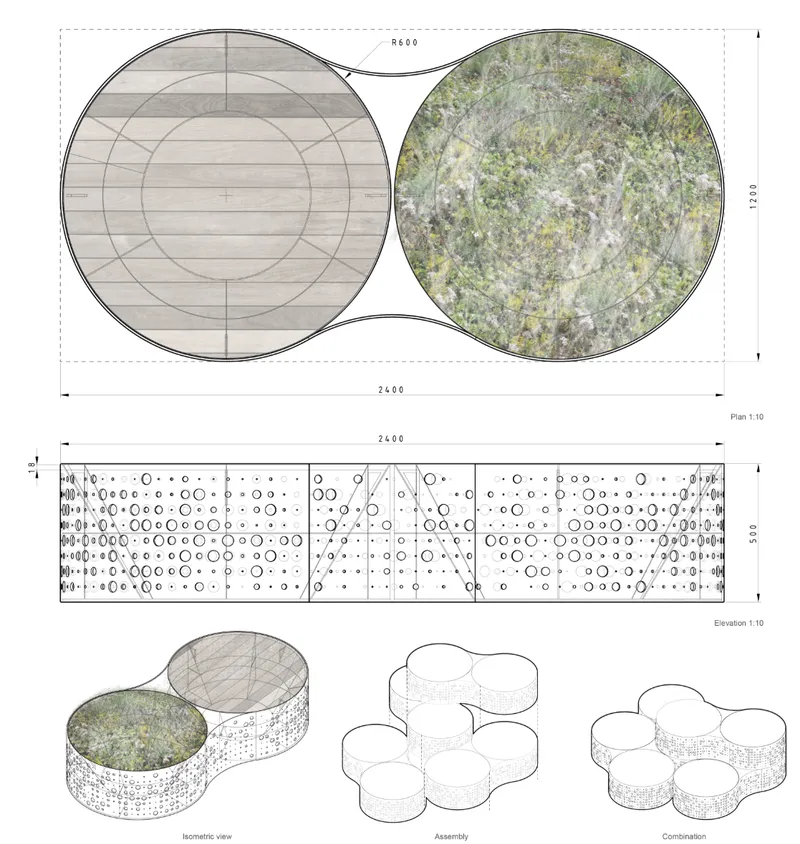
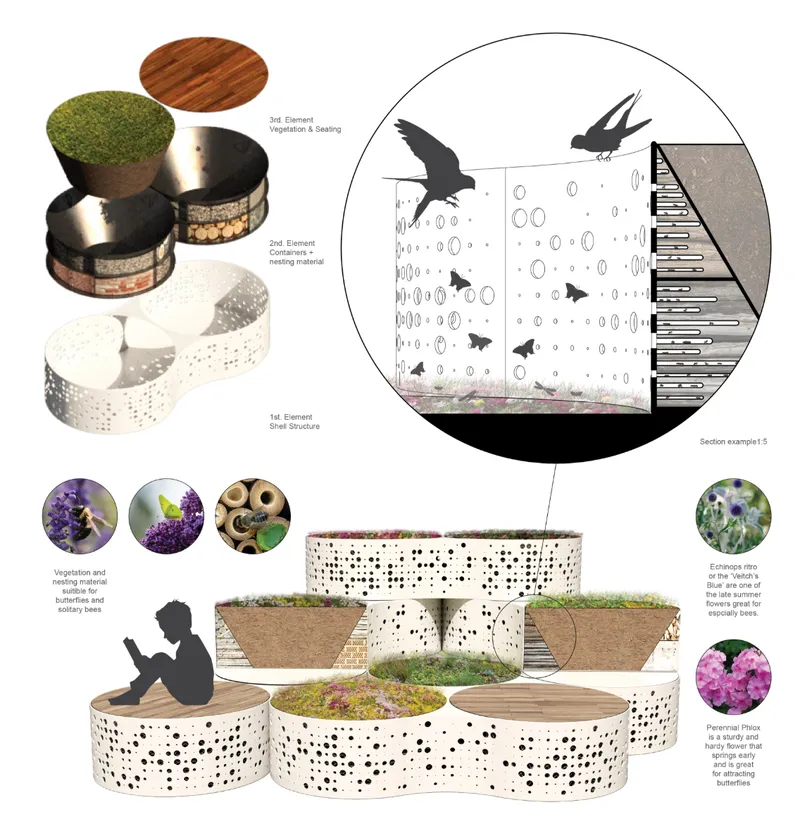
The technical drawings and exploded diagrams reveal a clean tripartite logic. A perforated shell base, fabricated from lightweight recycled material, forms the outer enclosure. Its perforations are not decorative; they are calibrated entry points for insects, allowing passage into an inner layer of compartments filled with species-specific nesting materials like drilled wood and bamboo. The top layer switches between dual-purpose seating surfaces in durable beech wood and vegetation covers that support microhabitats for plants. This stacking sequence means every module can be configured as a seat, a planter, or a hybrid of both.
What makes this system genuinely useful rather than merely clever is its modularity. Individual units can stand alone or cluster together, forming larger biotopic assemblies that scale from a single street corner to an entire district corridor. The circular plan geometry keeps the footprint compact while maximizing the perimeter available for insect access, a small detail that speaks to how seriously the designers treated the non-human users of this furniture.
Low-Carbon Materials and Stormwater Logic
Grobund's material palette is deliberately restrained. Recycled content in the perforated shell keeps embodied carbon low, and the lightweight construction reduces emissions during transport and installation. Beech wood seating surfaces resist decay without chemical treatment, extending the lifespan of each unit. Integrated vegetation does more than provide habitat: planted modules intercept rainfall, slowing runoff and helping manage stormwater at the micro scale. In aggregate, a network of these benches acts as a distributed green infrastructure system, chipping away at the urban heat island effect one node at a time.
A Green Corridor Woven Between Buildings
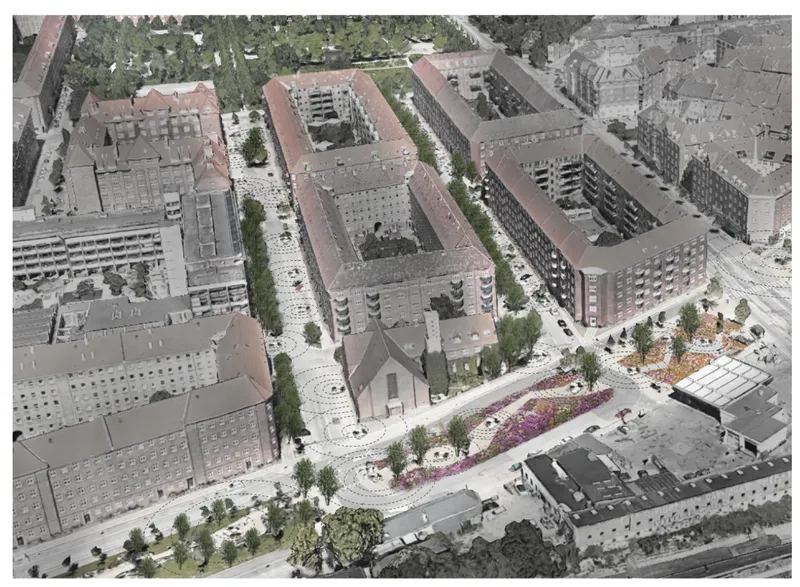
The aerial rendering shows what Grobund looks like at the urban scale: a curved linear park threading between residential blocks, lined with planted beds and pedestrian paths. The modular units are no longer isolated objects; they become the connective tissue of a green corridor that links pockets of habitat across the neighborhood. Ivanov and Costan frame this as a move toward what they call "bio(divers)cities," an urban model in which small biotopes, connected through modular furniture, form ecological networks that enhance both biodiversity and human well-being.
The ambition here aligns with UN Sustainable Development Goals for climate action, responsible consumption, and life on land. But the rendering also communicates something less quantifiable: the simple pleasure of walking through a neighborhood where public seating is alive, where benches hum with pollinators and soften the hard edges of residential blocks with flowering plants. The corridor is not just infrastructure; it is an argument for a different quality of everyday urban life.
Why This Project Matters
Pollinator decline is one of those crises that feels abstract until you look at the numbers. Grobund makes it tangible by embedding the response into the most ordinary element of public space: a bench. The project does not ask cities to set aside new parkland or rezone districts; it asks them to upgrade the furniture they were going to install anyway. That pragmatism is its greatest strength. A modular unit that supports solitary bees, manages stormwater, and seats two people is not a utopian proposition. It is a procurement decision.
Ivanov and Costan demonstrate that ecological design does not require monumental gestures. It requires systemic thinking applied at the scale of everyday objects. Grobund turns benches into habitats, streets into corridors, and cities into ecosystems, one circular module at a time. For a competition entry, that is a remarkably actionable idea.
View the Full Project
About the Designers
Designers: Slava Ivanov, Marius Costan
Enter a Design Competition on uni.xyz
uni.xyz runs architecture and design competitions year-round that reward proposals with spatial conviction and real site intelligence.
Project credits: Grobund - Insect Hotels & Urban Biotopes by Slava Ivanov, Marius Costan Urbanscape 2018 (uni.xyz).


Popular Articles
Popular articles from the community

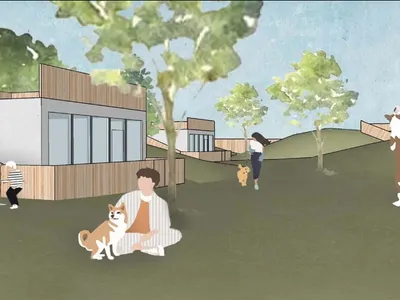
Temporary Home for Dogs: A Reversed Zoo Rethinks Animal Shelter Architecture
In Bucharest, a sinuous corridor and freed landscape flip the logic of containment, designing a shelter that works to make itself unnecessary.
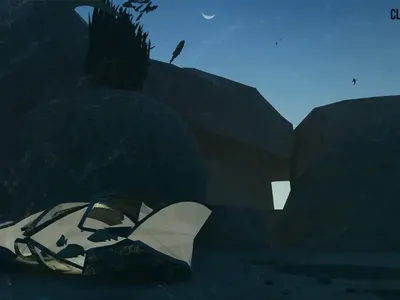
Cloaked Colonization: A Mobile Underwater Habitat That Moves Like a Fish
Micah Abaya's shortlisted EHC Pacific entry reimagines ocean settlement as a dispersed network of self-sustaining architectural organisms.

Singing Woman: An Opera House That Performs Before the Curtain Rises
Ovidiu Cristian Pavel's conceptual opera house translates Estonia's choral identity into a sculpted waterfront landmark facing the Baltic Sea.

Faces of the Soviet Avant-Garde: Turning Moscow's Street Names into an Open-Air Museum
A network of sculptural installations across a Moscow residential district transforms forgotten architect names into spatial encounters with cultural memor

Similar Reads
You might also enjoy these articles

Play: Fragments of Their World: Remembered Architecture Rebuilt as a Modular Playground for Refugee Camps
Tom Gardner abstracts domes, arches and towers from the homelands of displaced families into a kit of child-scaled play parts for camp settlements.
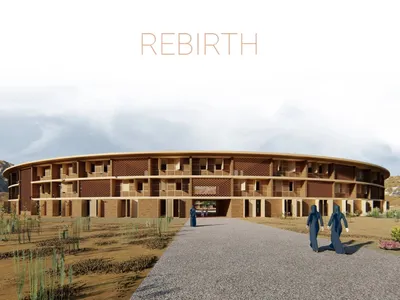
REBIRTH: A Circular Settlement Where Afghan Widows and Their Children Rebuild Life Together
A shortlisted Resile entry turns the circle into a protective ring of timber and brick, gathering homes, classrooms and gardens around a shared landscape.
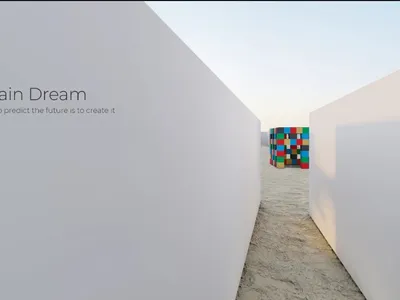
The Main Dream: A Recycled Plastic Kit That Lets Refugee Children Build Their Own Playground
Thirty-centimetre interlocking cubes that connect on three axes turn play into construction, letting children author the spaces they occupy.

Lunar Spiral: A Fibonacci-Driven Moon Settlement Rising from Shackleton Crater
Golden-spiral geometry organises buried infrastructure and orbiting habitable spheres into a lunar base designed to grow as life on the Moon expands.


Comments (0)
Please login or sign up to add comments
No comments yet. Be the first to comment!