
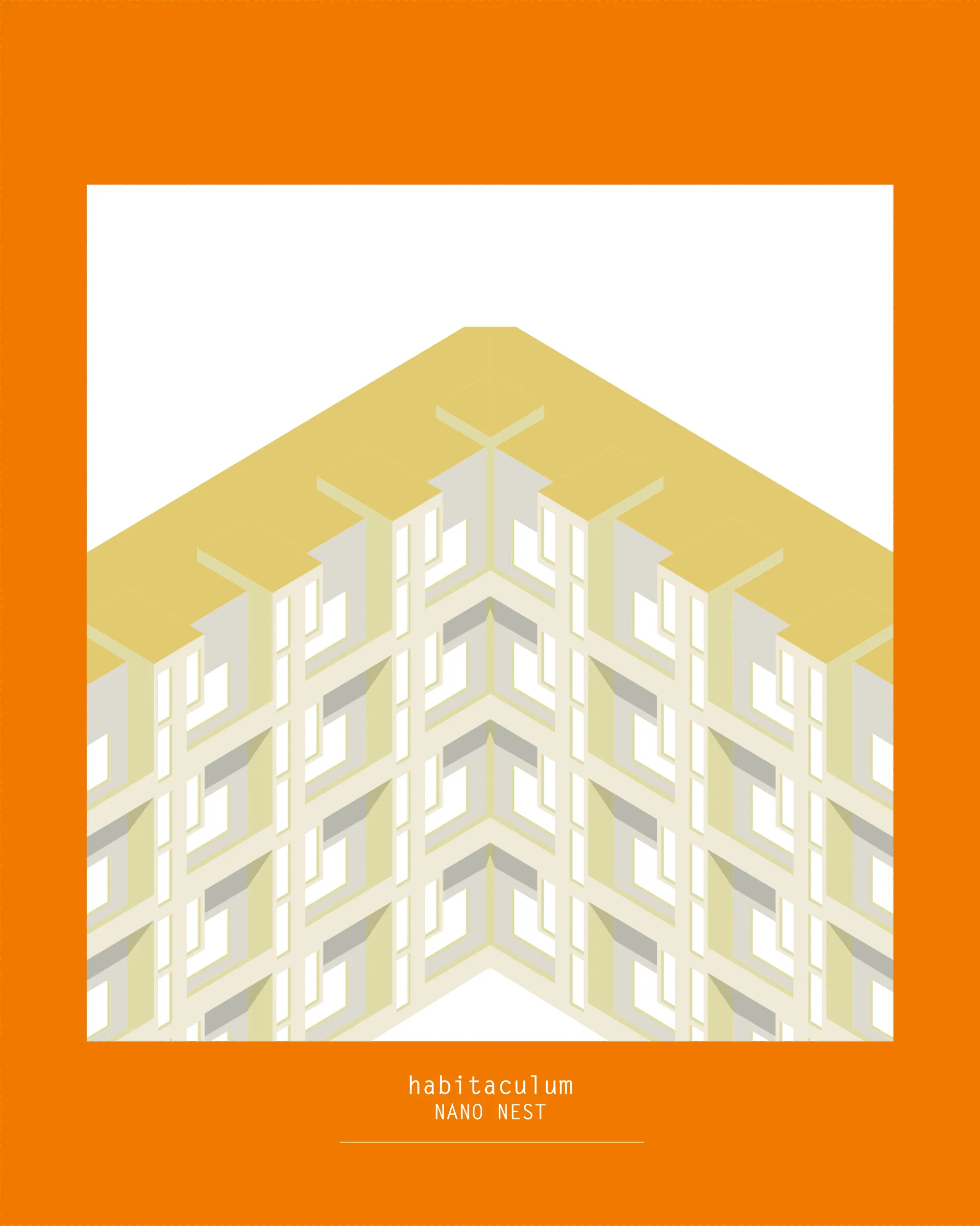
Habitaculum
A 125m3 Cabin for 3

Due to the adversities that the city of Lisbon and its inhabitants live more and more, new ways of living are also created (domestic and urban),new challenges are faced.
The reality is that the city is "suffering" from a mass tourism wave, causing the growth of rents in city centre, leading to de exodus of local inhabitants to the city outskirts. This creates segregating conditions within the elderly population (that remain living in city centres with very low rents by law), and the new inhabitants of city centre.
In response to this challenge, we’re stimulated to imagine domestic and urban spaces that solve the various problematics of city developments and contemporary lives of populations. Our result parts from a reflection on a dwelling system, specified to persons that, although not knowing each other, having different ages and lifestyles, inhabit the same spaces in a harmonious way. Also, this tipology that we propose, should become a model that embraces the more varied characters and lifestyles.
We started from the thought of a cell (house) that when connected to more of the same cells, creates a common organism (aggregated houses), and like that a materialised community of characters inhabiting within that same system/organism.
The House - Is organised through a core and heights.
-The core expresses itself as a central element in the house. It contains the confection, sanitary and vertical communications of dwelling, and simultaneously projects the social and individual zones and habits. There’s a geometry that orders the space and its orientation, distribution and conception, even its communication and significance.
-The heights express the distinction and hierarchy of the spaces and the corresponding order attributed to each. Therefore the lower zone of the house contains the “public” and communicative spaces of fluent and active moments. Whilst the upper zone contains the individual, private spaces.
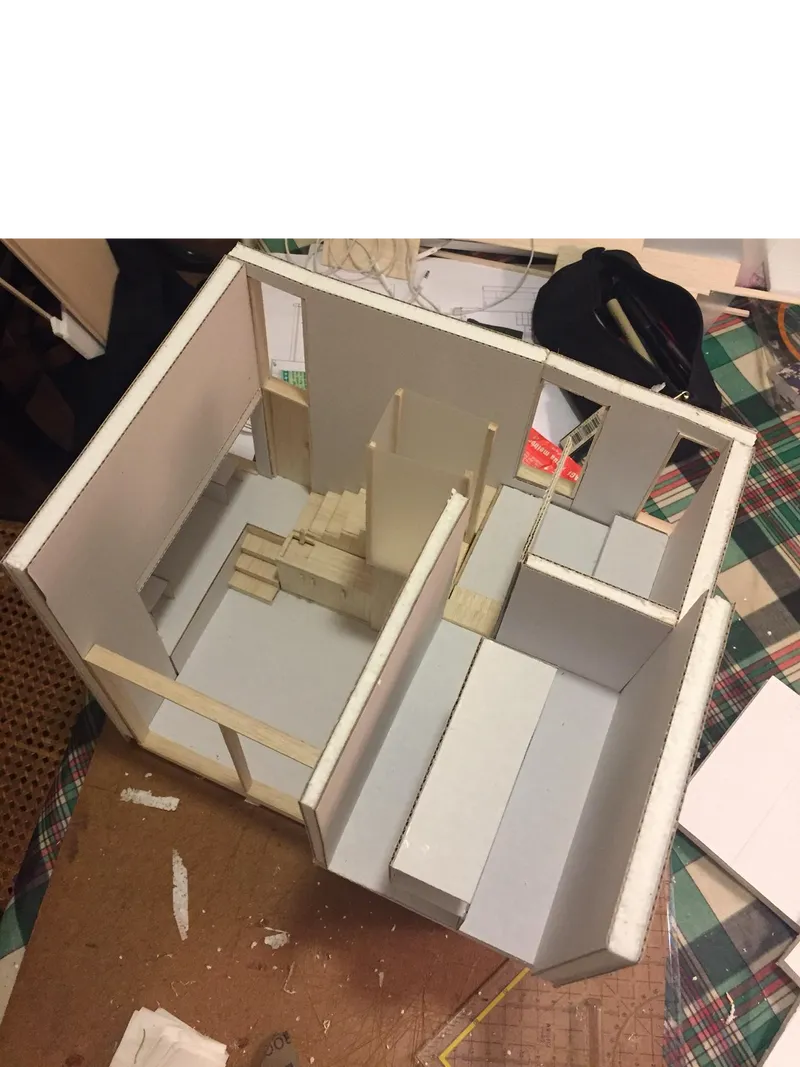
-The public zone of the house includes 3 different areas that accommodate each, either exclusive use to the characters, or according to the manipulation of the spaces, a common environment among them. The working space, feels like a big alcove for studying, has the possibility to close itself from the living/confection space right next to it, creating a calm productive environment. The living/confection/eating space, a meter bellow the working space contains an area for social activity coexisting right next to the core. Its equipped with a hygiene space, kitchen and transforming timber elements that support activities like cooking, sitting and eating. The opening on the opposite plan of the core leads to the balcony of the house. The balcony is an element that plays a role in Portuguese culture and architecture. It expresses the extension of the living and social activity of the characters bringing the outside environment inside the house.Right next to it, and 4 steps up, there’s a niche devoted to peace and creation. It’s also separable from the living/confection zone, making it calm and privative to the user and his/hers creations, meditations.
-For the upper private zone there was a concern of creating and providing individual resting spaces for each character. These are articulated also around the core. The core in the upper private zone holds the water/showering and cloth changing zone, that in the same way, distributes to the rest of the individual resting spaces. The resting spaces are equipped with storage space and transforming timber elements that enable characters to their private activities and singularity.
In a more technical matter, there was the concern of the comfort of the house and its system. The access is performed through galleries which contain common vegetable gardens with typical herbs from Portugal. These are watered through a system or rainwater collector that provides to the galleries and balconies. The house provides a system of cross ventilation, improving the air quality of the house. The design of the house protects the inside from intensive heat during the hot months due to the sun amplitude. In the winter months allows the projection of “winters sun” inside the house, reducing the need of mechanical heating or cooling.
The finishing elements of the house, such as the platband and ashlars are made with lioz limestone, typical from Lisbon/Sintra, found in vernacular architecture.
The timber elements are provided from eucalyptus trees, which are very abundant in Portugal. This timber is pretty versatile, it has a high resistance to rotting and it’s 100% renewable.
The insulation, acoustic and thermal, consists in Portuguese cork, which is highly efficient and 100% natural. For the pavements and bathroom walls, the chosen element were Portuguese ceramic tiles. These tiles are a very important and cultural element of the country. They’re mechanically resistant and durable, therefore, adequate to confection and humid zones, also fire and water resistant.
Caring for the versatility of the spaces projected in parallel with the fast development of cities and life habits, these spaces offer a wide path for possibilities of dwelling, with the more varied kind of characters. This leads it to a bigger endurance in the city in therms of use and its mutation within. Also, the care taken about material qualities and constructive system and its adequate solution to the kind of project and place, provides a larger longevity to the house/building itself.
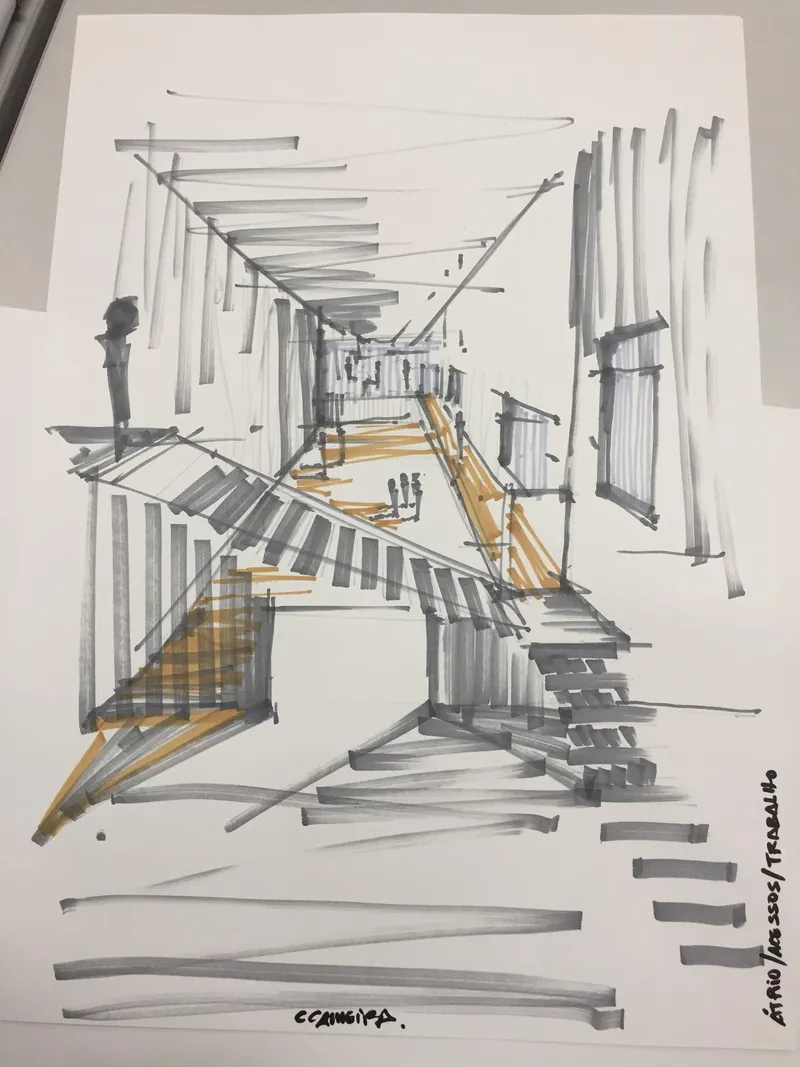
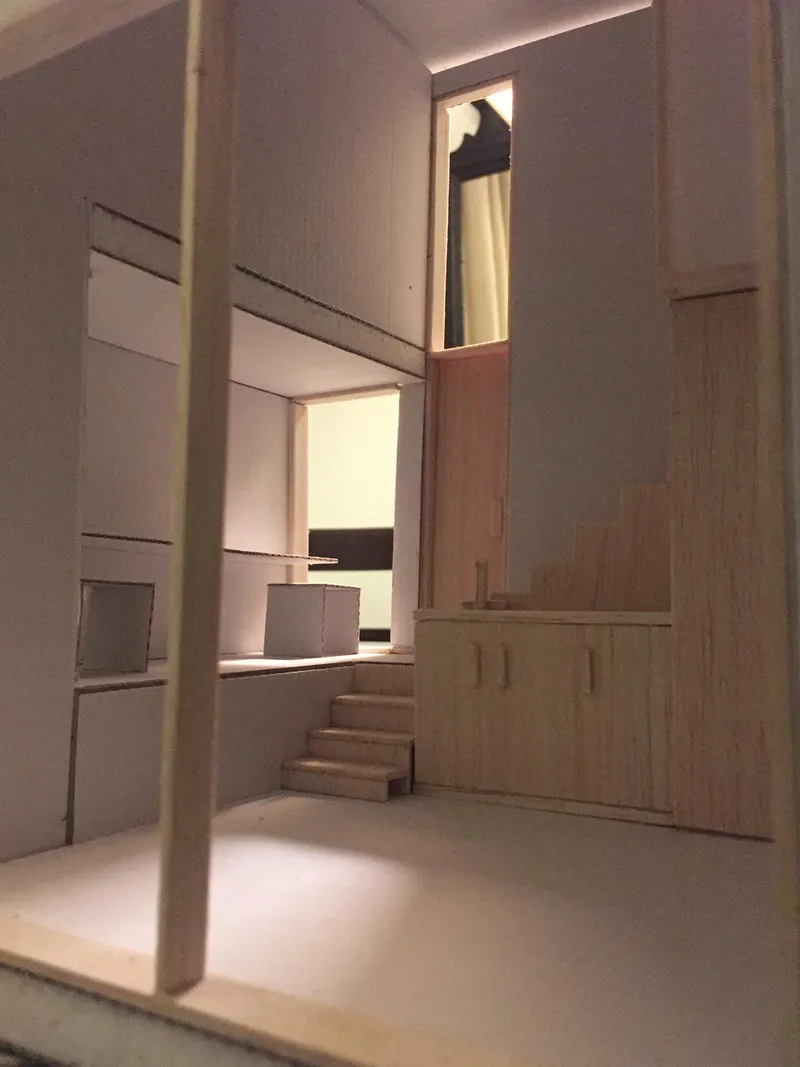 living/working space
model 1:20
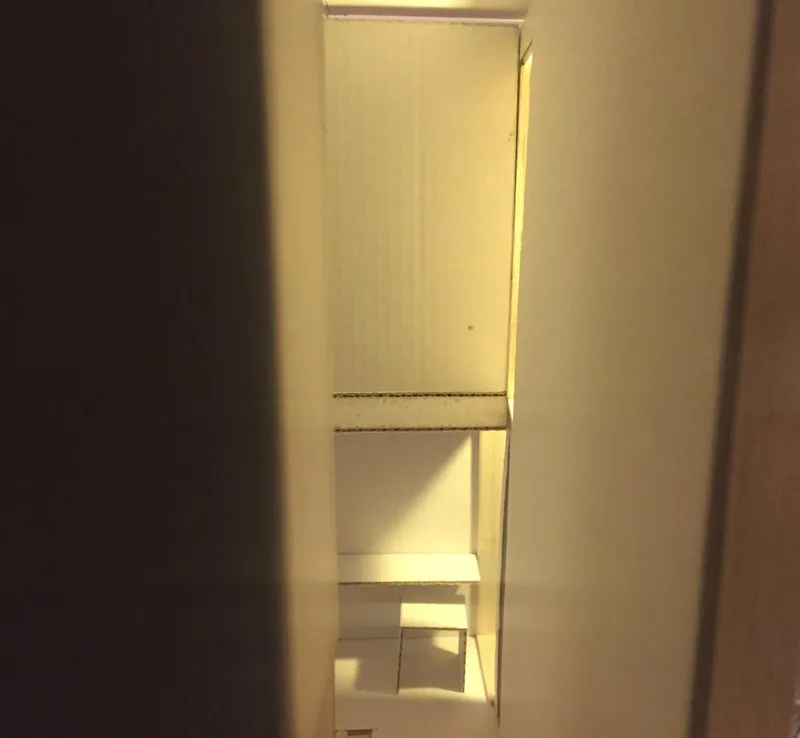
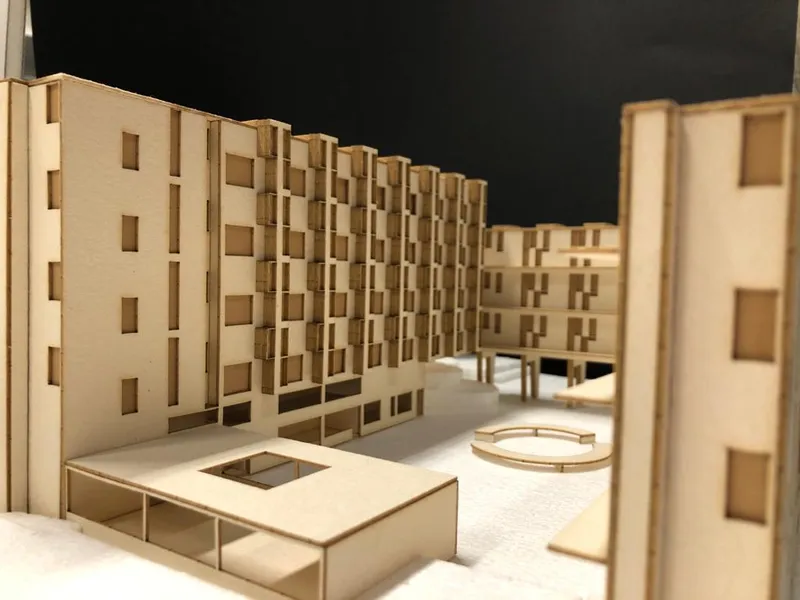 houses aggregation
 model 1:200
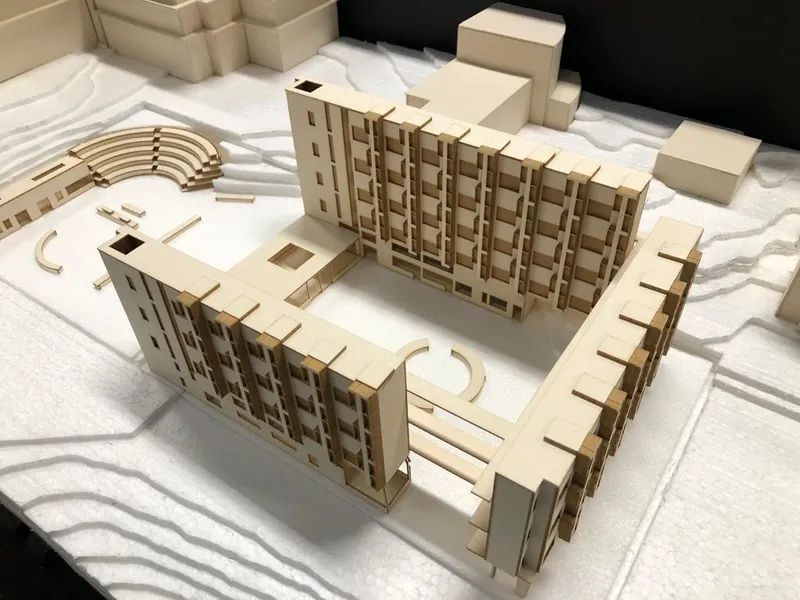 urban space and houses aggregation
 model 1:200


Popular Articles
Popular articles from the community


Riyadh For All: Intergenerational Urban Design for Active Aging in Rabat
Riyadh For All reimagines urban design in Rabat with intergenerational co-living, adaptive courtyards, and Moroccan cultural exchange today.

Co-life: Sustainable Architecture for Age-Friendly Community Living
Co-life reimagines sustainable architecture for seniors through courtyards, rammed earth, shared gardens, and spaces designed for belonging.

Lunar Spiral: Space Architecture Shaped by the Mathematics of the Universe
Lunar Spiral reimagines space architecture through Fibonacci geometry, lunar regolith, levitating habitats, and self-sustaining Moon living.

Play: Fragments of Their World
Familiar architecture becomes modular playground design, creating safe spaces where displaced children can learn, connect, imagine and play.

Similar Reads
You might also enjoy these articles

Day and Night Park: A Time-Based Urban Newsstand in Beijing
A temporary urban newsstand in Beijing blending travel, light, and reading through poetic colors, compact form, and community-focused design.

Modernist Patio Renovation in El Masnou, Barcelona by Oliver Segura Arquitectura + Cebrià Arquitectura
Modernist patio renovation blending tradition and innovation with a movable pool, leveled floors, and Catalan materials in El Masnou.

Alto Residencial Coop: Cooperative Housing Development in Santiago de Compostela by Carbajo Barrios Arquitectos
A linear cooperative housing complex blending white volumes and perforated metal façades, enhancing community living, natural light, privacy, and urban integration.
Vil Genis School by BPA ARCHITECTURE – Massy, France
Vil Genis School in Massy, France, features sustainable design, south-facing classrooms, community integration, accessible spaces, and modern educational architecture.

Explore Tiny House Competitions
Discover active competitions in this discipline




Challenge to reimagine the Iron Throne


Photograph architecture without architects


Illustrate the lost glory of Angkor Wat - Render Challenge


Design challenge to reuse E-waste
Comments (0)
Please login or sign up to add comments
No comments yet. Be the first to comment!