
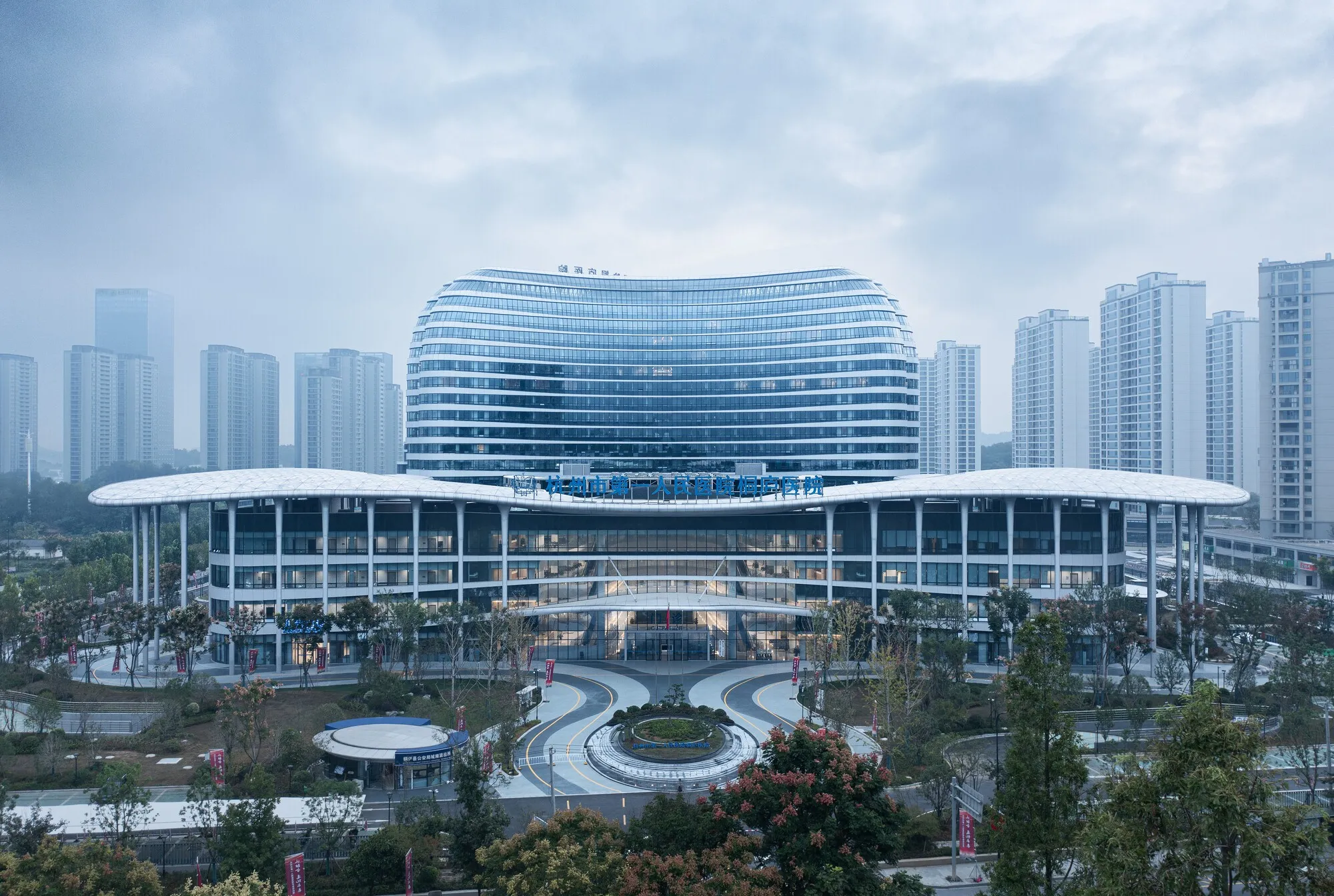
Hangzhou First People's Hospital Tonglu Branch by UAD — A Green, Smart, and Human-Centered Hospital Design
A sustainable, steel-structured hospital in Hangzhou by UAD blending nature, innovation, and human-centered design for efficient, healing healthcare spaces.


A Vision for Future Healthcare Architecture
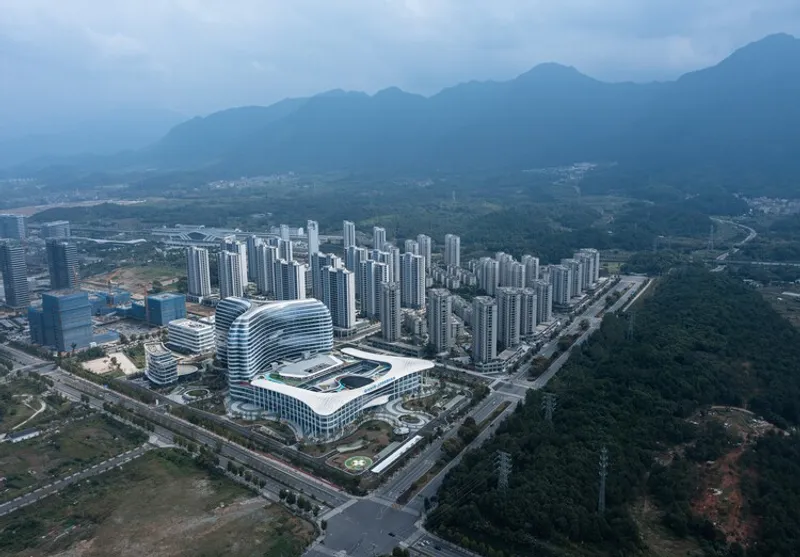
The Hangzhou First People's Hospital Tonglu Branch by UAD is a pioneering example of modern healthcare architecture integrating green building principles, sustainability, and human-centered design. Located in the High-Speed Rail Future City of Tonglu County, the hospital sits beside the Hangzhou-Huangshan High-Speed Railway and draws inspiration from the serene Chinese masterpiece Dwelling in the Fuchun Mountains.
With a total construction area of approximately 202,000 square meters, including 1,100 beds, this Grade-A tertiary hospital is one of the largest and most advanced medical facilities in the region. It also proudly holds the Three-Star Green Building Certification, China’s highest standard for sustainable construction.


Design Philosophy — Nature, Healing, and Innovation
The project began before the global pandemic in 2019, at a time when public health infrastructure was becoming increasingly vital. Its design reflects the balance between technological advancement and natural integration, with the hospital acting as a “Green Clover” — a symbol of growth, resilience, and renewal.
To address overcrowding in provincial hospitals, the Tonglu Branch was strategically planned to elevate county-level medical services while embracing Tonglu’s lush mountain landscape. The site’s natural setting and fluid topography influenced the building’s organic form, creating a hospital that harmonizes with its environment rather than dominating it.
The Clover-Shaped Design Concept
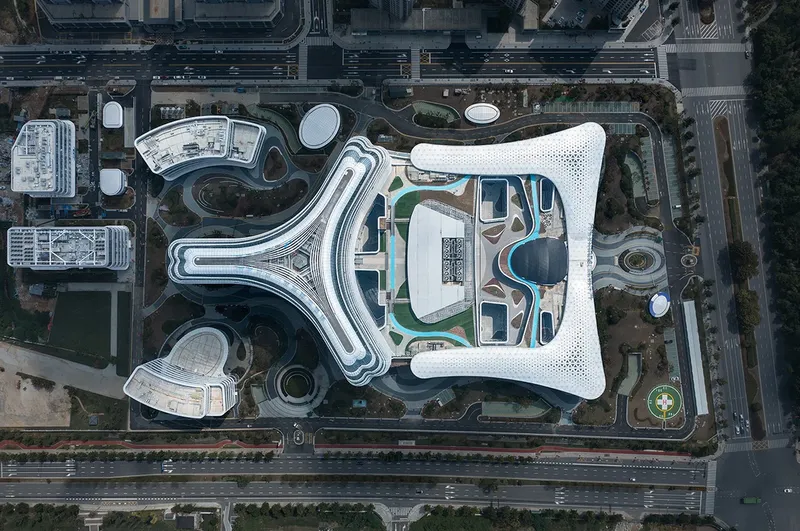
Due to the site’s narrow, elongated shape and a 35° deviation from true north-south orientation, UAD developed an innovative clover-shaped nursing unit layout. Each “leaf” of the clover houses one of three nursing units, radiating from a central shared core and elevator lobby.
This layout allows maximum daylight, natural ventilation, and operational efficiency, improving patient comfort and reducing energy consumption. The design also supports Multi-Disciplinary Team (MDT) collaboration, enabling flexibility for future expansion and new healthcare technologies.
The central “medical street” links three main functional zones — the outpatient building, medical technology center, and inpatient building — providing seamless circulation and intuitive navigation for staff and visitors alike.

Architectural Expression — Flowing Form and Modern Identity
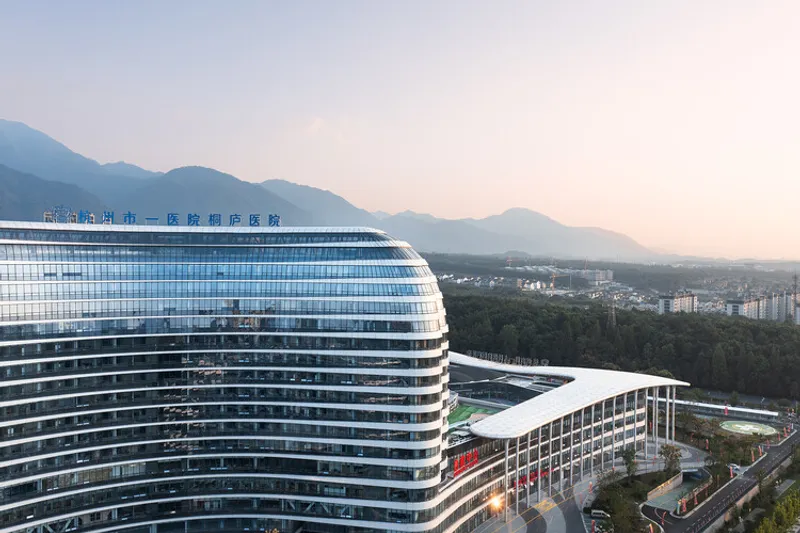
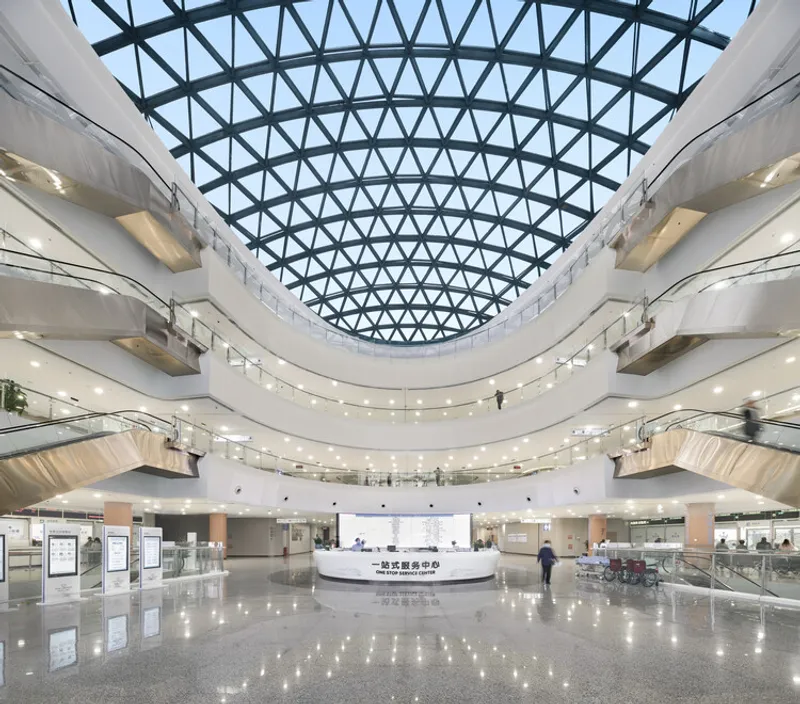
The architectural form draws from the fluid brushstrokes of Dwelling in the Fuchun Mountains. The leaf-shaped main building features gentle curves that evoke the natural landscape of Tonglu, while silver gradient aluminum panels and blue-gray glass façades represent a dialogue between tradition and modernity.
A spacious, column-free outpatient hall and a bright, interconnected medical street guide visitors through the complex with clarity and openness. Natural light filters through large windows, enhancing wayfinding while reducing psychological stress — a key factor in patient healing.


Human-Centered Healing Spaces
Modern hospital design goes beyond pure functionality. UAD’s approach prioritizes user experience, mental comfort, and social interaction.
- Colonnades and cantilevered roofs create shaded, rain-protected walkways, forming transitional “gray spaces” that blend interior and exterior environments.
- Courtyards filled with natural light separate outpatient departments, offering calm waiting zones and improving air circulation.
- Three shared sunlit lounges between nursing units serve as relaxation spaces for families and medical staff, fostering warmth and community within a clinical environment.
Every spatial decision supports UAD’s vision of a “service-oriented healing environment” rather than a cold, mechanical medical facility.
Sustainability — China’s First Fully Steel-Structured Three-Star Green Hospital
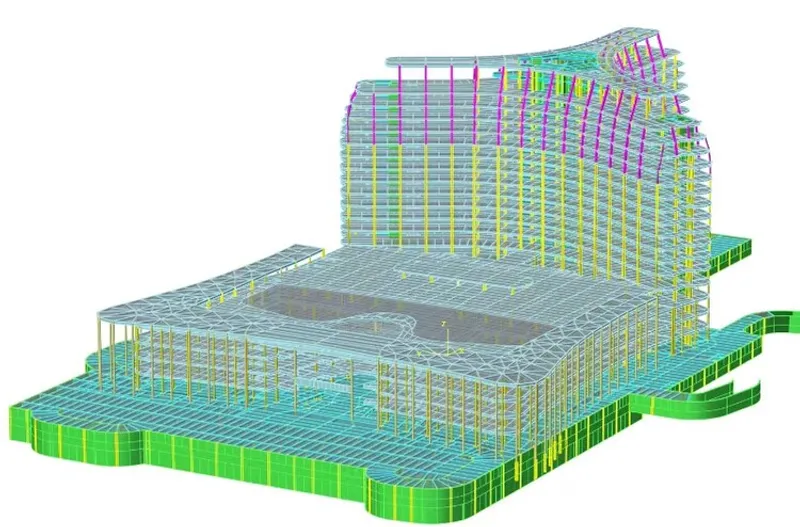
In response to rapid construction needs and environmental concerns in the post-pandemic era, UAD implemented a full steel structure system. Compared with concrete, steel offers faster construction, greater flexibility, and significantly lower carbon emissions.
The modular steel system ensures adaptability for future medical upgrades while minimizing waste. Despite its scale, the project met strict Three-Star Green Building criteria — emphasizing energy efficiency, material reuse, water management, and indoor environmental quality.

Cost Efficiency and Smart Optimization
While the design features gentle curvatures and sleek futuristic aesthetics, UAD maintained strict budget discipline. By optimizing façade curvature, standardizing modular spaces, and refining construction detailing, the team achieved a state-of-the-art steel hospital at minimal cost.
This cost-effective yet sophisticated approach demonstrates how sustainability and design excellence can coexist, offering a benchmark for public healthcare architecture across China.
The Hangzhou First People’s Hospital Tonglu Branch represents a new generation of hospitals — one where nature, innovation, and humanity intersect. Through its thoughtful form, sustainable construction, and focus on human wellbeing, UAD redefines what a healing space can be in the 21st century.
This project is not just a medical facility; it is a landmark of resilience and progress, blending Chinese cultural essence with global architectural innovation.

All the photographs are works of Qiang Zhao, Qingshan Wu



Popular Articles
Popular articles from the community


EW PARK: Sustainable Architecture Reimagines the Future of Urban Parking
EW PARK reimagines city parking as a modular wooden tower combining automation, solar energy, electric mobility, and adaptable urban design.

Co-life: Sustainable Architecture for Age-Friendly Community Living
Co-life reimagines sustainable architecture for seniors through courtyards, rammed earth, shared gardens, and spaces designed for belonging.

Riyadh For All: Intergenerational Urban Design for Active Aging in Rabat
Riyadh For All reimagines urban design in Rabat with intergenerational co-living, adaptive courtyards, and Moroccan cultural exchange today.

The Ocean Hive: Sustainable Architecture for a Self-Sufficient Civilization at Sea
The Ocean Hive imagines sustainable architecture at sea, where modular habitats, algae, wave power and ocean waste sustain a growing colony.


Similar Reads
You might also enjoy these articles


Hodi-Mandai Geram
Project Function: Preservation and revitalization of the Intangible heritage and socio-spatial identity of the Hodi by Housing, Cultural Memory Center, Sacred Grove, landscape, local tourism economy


Olio Towers: A Mid-Rise for Performers That Fuses Housing, Rehearsal, and Stage
Located blocks from Houston's Theater District, this modular tower stacks living units around a central performance atrium.

Oasis: Modular Green Housing Carved into Dhaka's Urban Fabric
A shortlisted Plugin Housing entry reclaims unauthorized settlements in Dhaka with stepped concrete volumes, green roofs, and ventilation-driven design.

Black Hole: A Floating Megastructure for the Post-Physical Era
Emiliano Mazzarotto envisions a spherical, self-scaling arena where e-sports, digital hotels, and holographic stadiums replace traditional public space.

Explore Hospitality Building Competitions
Discover active competitions in this discipline



Challenge to reimagine the Iron Throne


Photograph architecture without architects


Illustrate the lost glory of Angkor Wat - Render Challenge


Design challenge to reuse E-waste
Comments (0)
Please login or sign up to add comments
No comments yet. Be the first to comment!