
Healing, Redefined.
An essay on the new approach towards everyday healing spaces.

Building holistically and with nature is the cornerstone of healing architecture. Today, the need for healing architecture to be incorporated into everyday life is more prevalent than ever. With most of the world still recovering from the effects of the COVID pandemic, designing spaces that not only entertain and delight but also heal, will not only help promote the paradigm shift exposed by the pandemic but also pave the way for the next step in addressing the new needs of our society. Healing architecture, both for laymen and architects/designers have always been designated spaces for healing (i.e., hospitals, rehabilitation centers, psychiatric facilities, etc.). The trouble with these facilities is the perennial stigma that accompanies such words. It was only a few decades ago when the architecture profession dabbled in adapting the healing space typology to the needs of modern-day society. This adaptation aided not only in the removal of the stigma surrounding these spaces but also helped develop a new typology in the process. Simply put, the practice of creating isolated spaces dedicated specifically for healing purposes is obsolete. Nowadays, our profession focuses on weaving these spaces better into the urban fabric, whether by the location, zoning, or the overall design. While admirable, the focus to weave better healing spaces is only the beginning of the larger trend.
It is no secret that the COVID pandemic exposed society’s mental health issues in a very pragmatic way. It showed that mental health issues (caused by various sources) are not something to be ashamed of, and as a result, the stigma surrounding the issue lessened dramatically. While this event is a major victory and a great leap forward for our society, what would the design implications be for such an event? In my opinion, it might mean a paradigm shift towards more holistic mixed-use developments as opposed to the monolithic single-use development introduced by the Industrial Revolution. It might also mean incorporating more green spaces and nature into our everyday buildings. Our society (since the Industrial Revolution) has essentially been taught to revolt against the idea of large greenspaces or ‘naturescapes’ within everyday spaces (offices, malls, airports, etc.) but designs like the Changi Airport in Singapore (that incorporate nature) rebel at this ideology. Simply put, I believe that a good next step to acknowledging the need for better, more generation-appropriate design is incorporating nature into the new trend. After all, a plethora of studies has shown that healing spaces have been proven to improve the treatment of patients (both physical and mental ailments). Furthermore, exposure to nature has also been proven to boost physical and mental health, thereby cementing at least a theoretical foothold that merits implementation.
Another concrete step to creating healing spaces in everyday settings is by introducing more light and more open spaces to our designs. Additionally, the presence of open spaces in our architecture allows for more contribution to the space by the community, which has three major effects, most of which rely on community building as a healing avenue. First, social imprinting: allowing the community to dictate what they want to situate in the open space allows for better ownership of the space which is a good steppingstone for community building. Second, community/artistic expression: building on the premise of social imprinting, community expression allows the appreciation of different aspects of their community - this aspect deals with a more macroscopic lens of the urban fabric that may not be privy to the designer. On top of that, the community may need to rally support for a cause from time to time, and having a dedicated space that’s accessible to them can be a great help. Finally, a break from the mundane: this aspect relies specifically on the premise and trend that open spaces can be used for essentially anything. On the weekdays, it can be used as a temporary exhibit space for local artists, while on the weekends it can be used as a farmer’s market or as a pop-up market. Simply put, other than the usual solutions of adding more greeneries, letting nature in, and adding more light, we can use the sociological aspect of community building and social imprinting to our advantage and to create a more apt version of what a healing space is. This solution gives a more concrete solution to mental health issues such as depression, anxiety, etc., by creating stronger communities through the influence of architecture.
The best thing about the solutions posed is that they can extend beyond architecture and into the realms of urban design, urban landscape, and land use. Instead of just creating buildings and structures that not only house the appropriate healing spaces (such as clinics, therapy centers, etc.) but also add the everyday healing initiative we so desperately need, why not incorporate that philosophy into the urban realm? Why not slowly influence the urban fabric to re-welcome nature into our cities to live in better symbiosis? Why stop with buildings when we can design entire cities to have spaces to decompress and simply be with family and friends? Why not allow for the creation of better communities through a new urban fabric?
In this scenario, we can focus more on holistic living instead of the over-simplified ‘grind’ mentality that has taken over and is the cause of a myriad of mental health issues beginning with depression and anxiety. The new wave of this philosophical paradigm can bridge the gap between the old mentality of people, cities, and urban fabrics, to something more apt for the current generation and possibly the generations ahead. As they say, the built environment is responsible for shaping society and, to an extent, the future. Why not create a positive influence by giving the new paradigm a concrete footing in contemporary architecture?
In conclusion, the philosophy posed that building holistically and with nature incorporated into the design is not the end-all-be-all solution. It is the start of the solution but not the entire solution. If we aid this philosophy intending to create architecture that influences community building and holistic living while also incorporating more healing spaces into the urban fabric of cities, then we may well be on our way to creating a better society for today and an even brighter future for tomorrow.



Popular Articles
Popular articles from the community

Indiesalon Carves a Plywood Cave into a Seoul Bistro's Second Floor
Munhwa Bistro's second Seongsu branch wraps diners in a laminated timber vault laced with colored light and mirror illusions.
OMCM arquitectos Builds a Summer House in Paraguay from Quarry Waste Blocks and Three Sacred Trees
In the young hillside neighborhood of Altos, a 696-square-meter concrete volume hovers on six pillars around three preserved native Yvyraju trees.
BLDUS Turns a 250-Square-Foot Screened Porch into a Pine Forest Temple in East Hampton
A gabled cedar pavilion mimics the rhythm of surrounding pines, anchoring a 1990s wooded home to its hollow in Long Island.
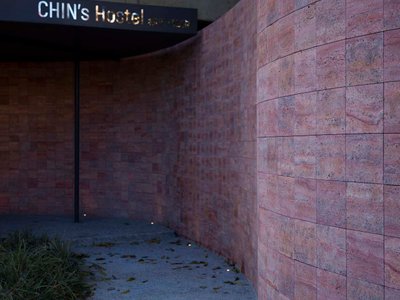
VEIVE Architects Builds a Mountain Hostel That Disappears into a Hangzhou Hillside
On the Huihang Ancient Trail in Xiangjian Village, a shelter of wood, steel, and rammed earth roots itself in the rural landscape.


Similar Reads
You might also enjoy these articles

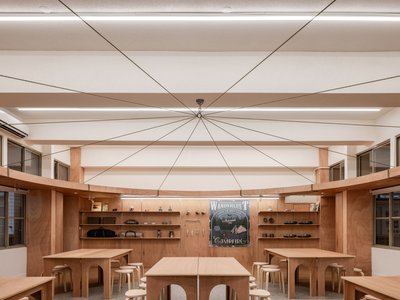
317studio Turns an 87 m² Classroom into a Forest Clearing for Scouts in New Taipei City
A rope canopy, student-made specimens, and campfire geometry replace rows of desks in this Scouting classroom in Xizhi District.
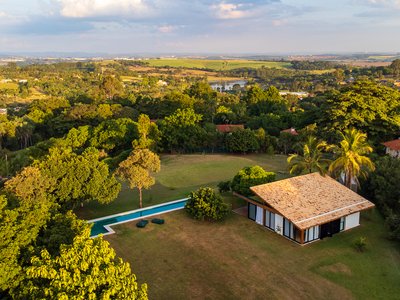
24 7 Arquitetura Builds a Timber Pavilion as a Family's First Act on a 5,000 m² Brazilian Plot
In Jaguariúna, a prefabricated glulam house nestles among mature trees as the opening move of a larger residential masterplan.
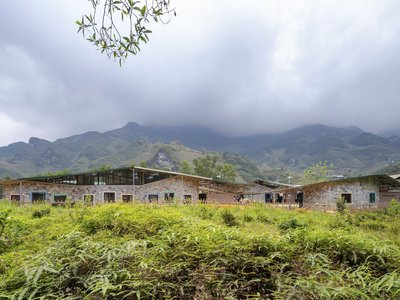
1+1>2 Architects Build a School from 900 Blocks of Hmong Stone on Vietnam's Rocky Plateau
On a barren valley in Ha Giang province, a community quarried its own stone to raise a kindergarten and primary school rooted in Hmong identity.
100A Associates Builds a Volcanic Stone Retreat on Jeju Island Rooted in Ritual and Restraint
Watarstay [Wa:Tar] in Bongseong-ri channels Jeju's basalt, reed, and hemp into a 150 m² hospitality space shaped by contemplation.


Explore Journalism Competitions
Discover active competitions in this discipline




The Global Benchmark for Architecture Dissertation Awards


Challenge to design an Ayurvedic Treatment Center
Comments (0)
Please login or sign up to add comments
No comments yet. Be the first to comment!