
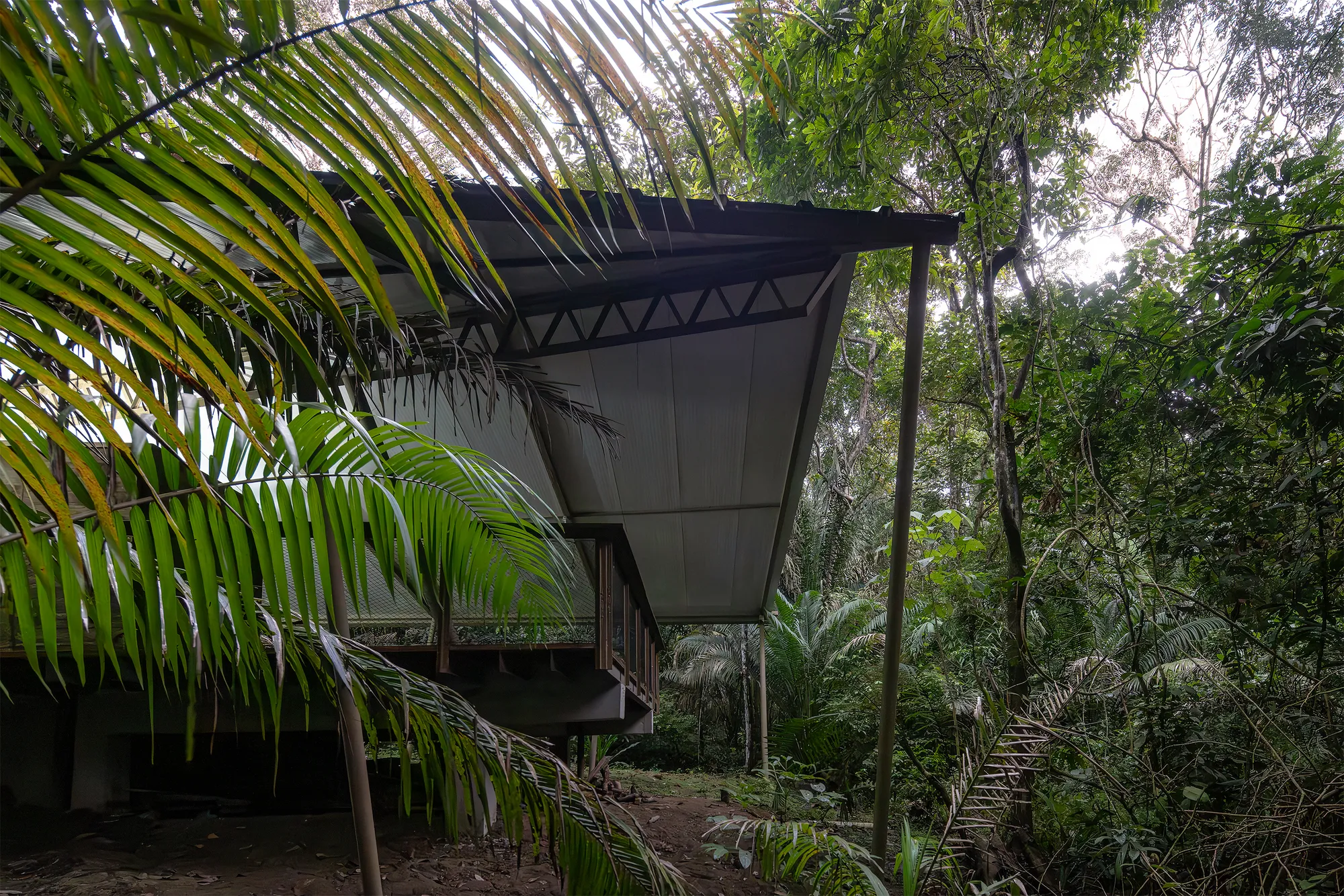
Héctor Ayarza and Estudio Garúa Lift a Training Center into Panama's Rainforest Canopy
A 135-square-meter pavilion in Gamboa floats above the jungle floor on concrete piers, learning from the forest rather than competing with it.


Architecture in the tropics confronts a fundamental tension: how to provide shelter without destroying the thing that makes the place worth inhabiting. In Gamboa, a small settlement on the edge of the Panama Canal surrounded by some of the densest rainforest in Central America, Héctor Ayarza and Estudio Garúa answer this question by lifting the entire building off the ground. Their Tour Guide Training Center, completed in 2023 at just 135 square meters, perches on slender concrete piers above the forest floor, threading its long body through existing tree trunks rather than clearing them.
The result is a project that refuses the colonial logic of clearing and grading. Instead of imposing geometry on the landscape, the building defers to the topography, the root systems, and the canopy above. It is a genuine piece of infrastructure for ecological education, and its most persuasive argument is the way it disappears. From a distance, its roof barely registers above the treetops. Up close, the structure reads as a series of careful negotiations between steel, concrete, and jungle.
Ascending into the Canopy

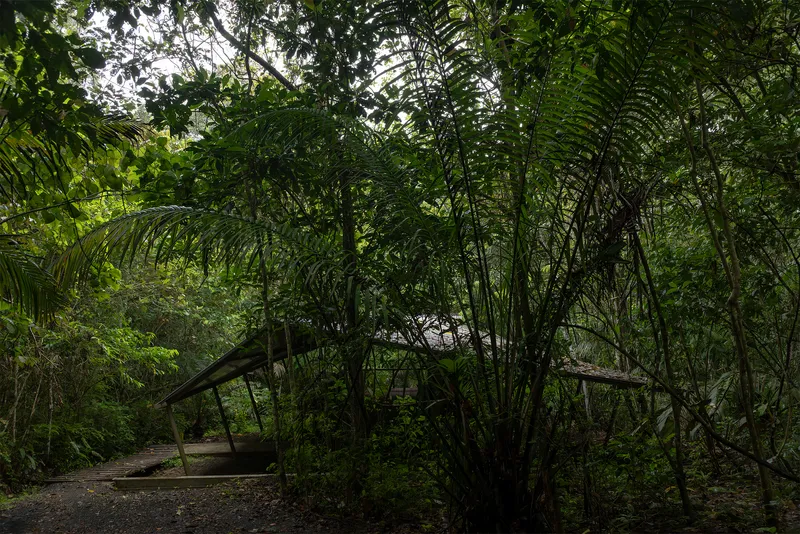
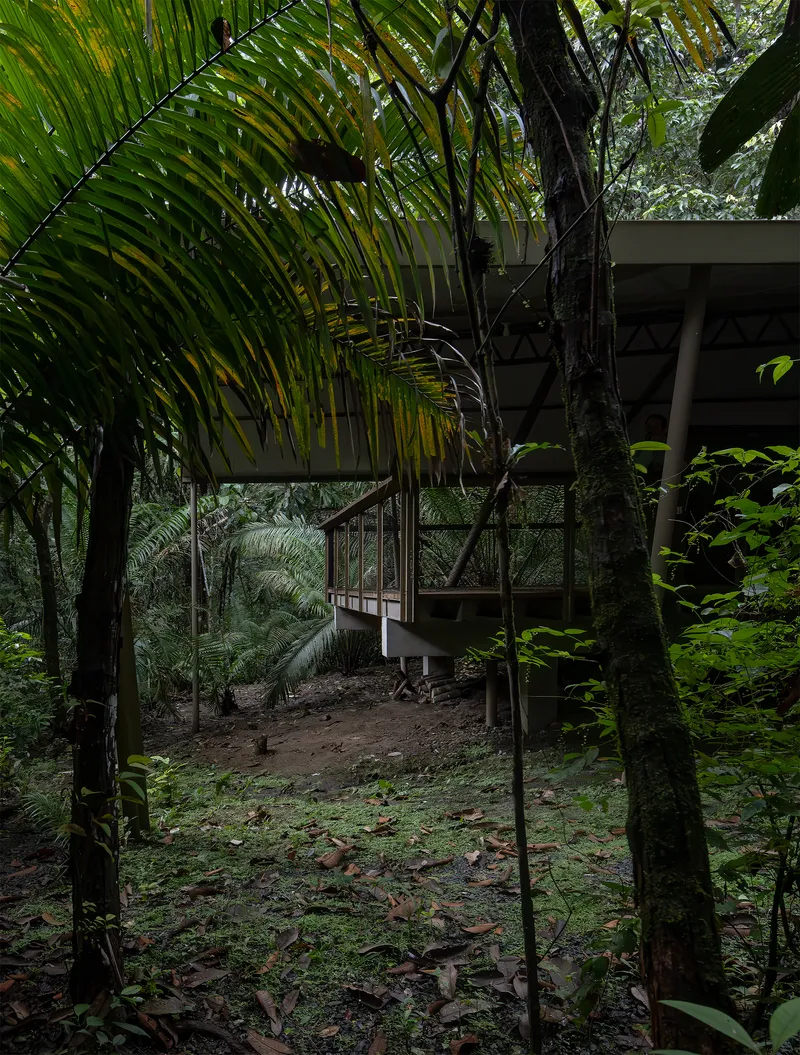
Arriving at the building means following a timber boardwalk that threads through the understory, rising slowly from grade into the canopy. The sequence is deliberately immersive. Palms, bamboo, and ferns press in from both sides, and the elevated walkway keeps foot traffic from compacting the soil or disrupting root networks below. A steel staircase then climbs through moss-covered trunks to the platform above.
This approach sequence does serious work. It reframes the act of entering a building as an act of entering an ecosystem, priming the tour guides who will train here to think about the forest as a subject rather than a backdrop. The architecture is not a destination so much as a threshold.
Structure as Negotiation
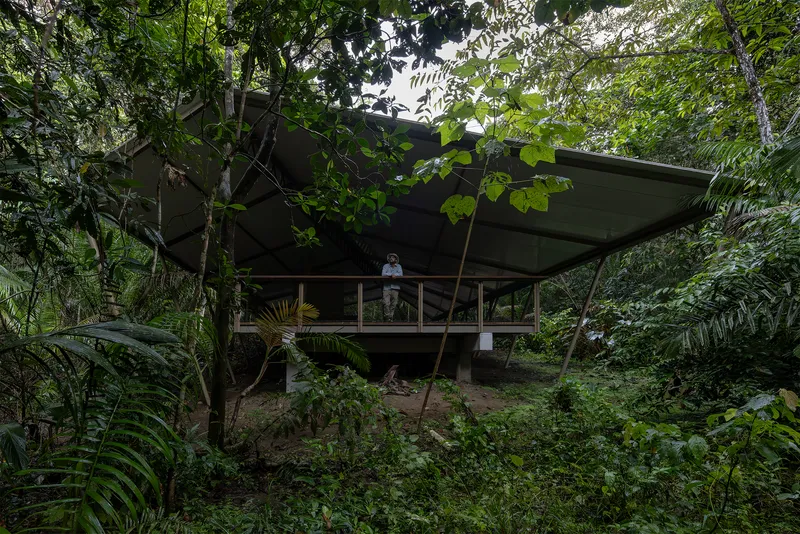

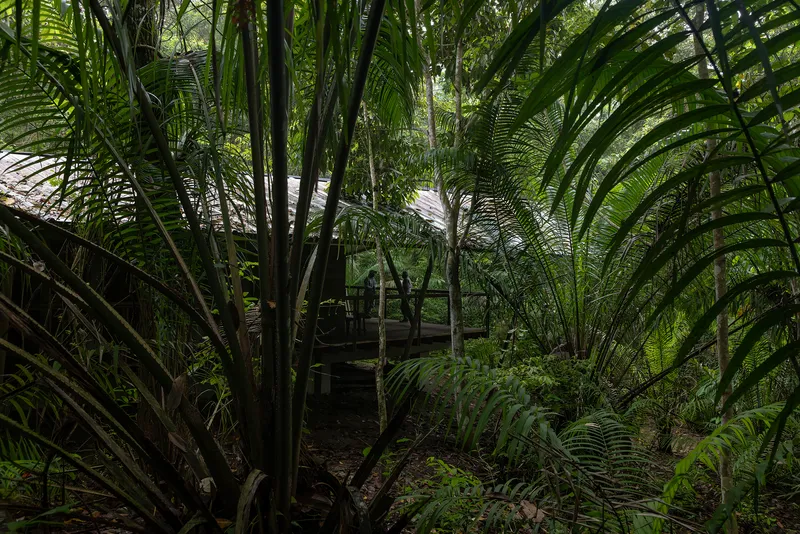
The building's structural strategy is its most consequential design decision. Concrete piers raise the platform several meters above grade, allowing the forest floor to continue undisturbed beneath. A steel truss roof, angular and lightweight, spans between these piers without touching a single tree. The butterfly profile of the roof channels rainwater away from the occupied spaces while leaving wide openings to the canopy on either side.
There is nothing accidental about the column placement. Each pier responds to the positions of existing trees, which means the structural grid is irregular. This is the kind of design constraint that adds cost and complexity, but it also produces a building that genuinely coexists with its site. The piers read as a new species of trunk among many.
Life on the Platform


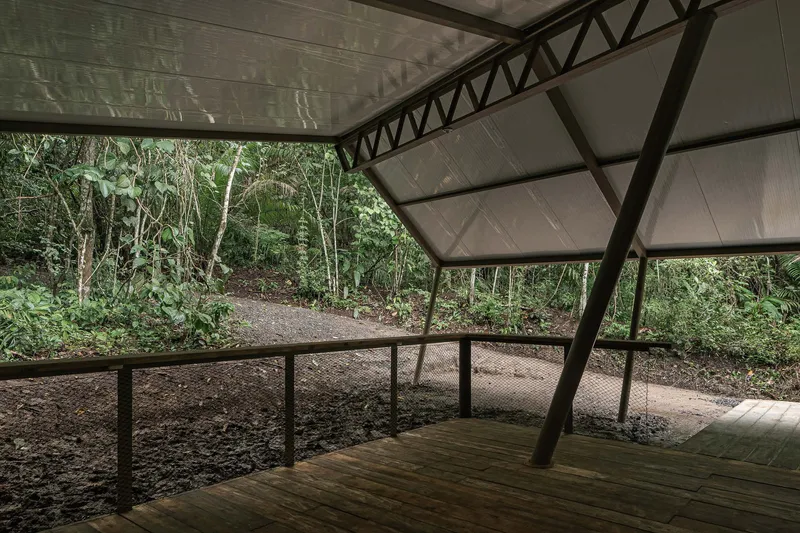
The interior platform is spartan but not austere. Reclaimed wood flooring runs the length of the main deck, anchored by a compact timber service core that contains the building's minimal utility functions. Exposed steel trusses overhead support translucent roofing panels that filter daylight into a soft, even glow. A triangulated truss ceiling gives the covered terrace a rhythmic, almost skeletal quality that contrasts with the organic chaos of the jungle beyond the mesh enclosures.
The mesh screens are a smart move. They keep insects out while maintaining visual and atmospheric continuity with the forest. There is no glass wall separating interior from exterior, just a gradient from fully covered to fully open. The building breathes.
The Forest as Wall


From the covered terraces and cantilevered decks, every view terminates in vegetation. Palm fronds at eye level, a hillside dropping away beneath the railing, the understory visible through the concrete beams below your feet. The building has no facade in the conventional sense because the forest provides all the enclosure it needs. This is not a metaphor: the trees literally screen the building from wind, direct sun, and visual exposure.
A concrete bench running along one edge suggests a place for contemplation, or perhaps for a guide-in-training to sit and sketch species. The metal railings and diagonal steel supports frame specific views without directing them. You look where the canopy opens, not where the architect points.
Disappearing from Above


The aerial view is the project's most quietly radical image. The angled roof sits within the canopy like a fallen leaf caught in the branches. From the distant mountain view, the building is nearly invisible, just a faint geometric edge among kilometers of unbroken green. This is not humility for its own sake. A training center for rainforest guides should demonstrate, through its own form, that human presence in the forest does not require domination.
Compare this to the typical eco-lodge or visitor center that proudly photographs its "green" credentials from a drone. Here, the drone shot is proof of restraint, not spectacle.
Dusk and the Glass Volume


At dusk, the glass-enclosed volume at one end of the building glows through the tree trunks, a lantern signaling human presence without overwhelming the darkness of the jungle. The cantilevered roof extends beyond the glass line, protecting it from rain while allowing the volume to read as a lightweight, transparent element distinct from the heavier open terraces.
The open-air platform at the opposite end, with its steel truss roof and metal railings, feels more exposed, almost like a ship's deck in a green sea. The architects calibrate the degree of enclosure along the building's length, from fully glazed to fully open, giving instructors flexibility in how they use the space through different weather conditions and times of day.
Plans and Drawings
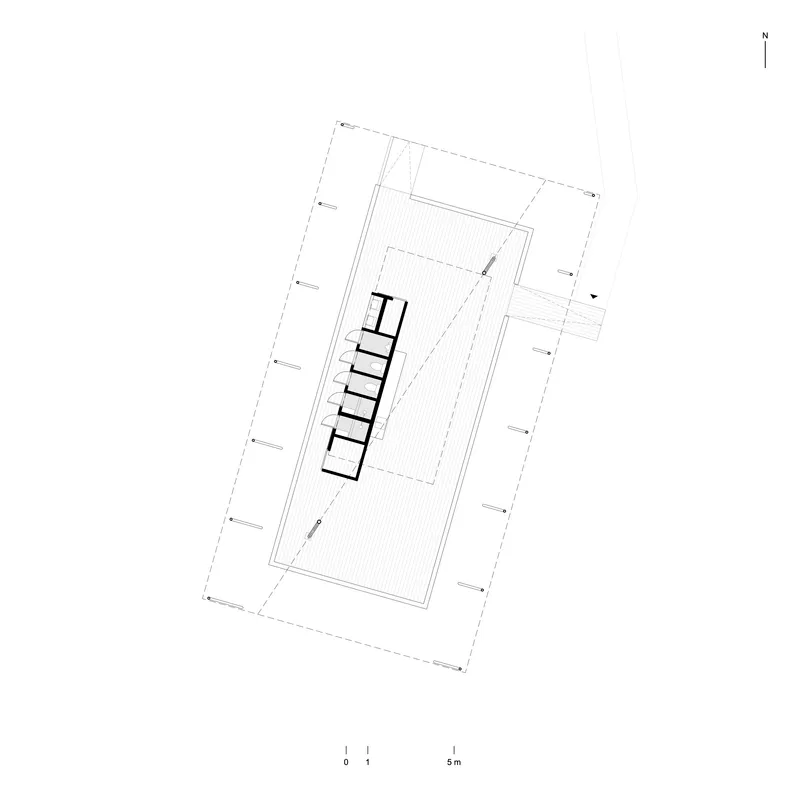
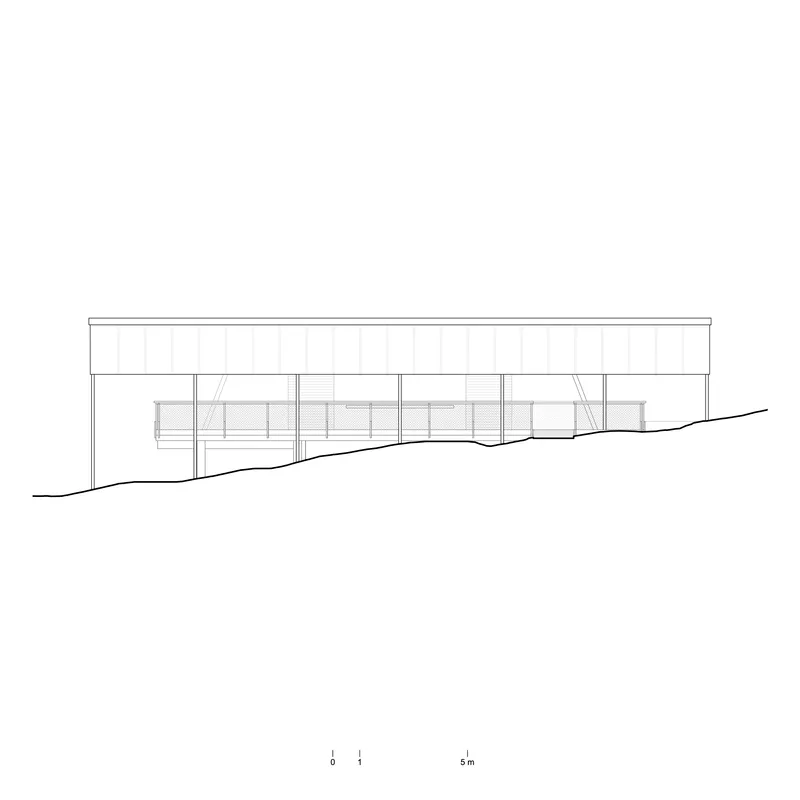
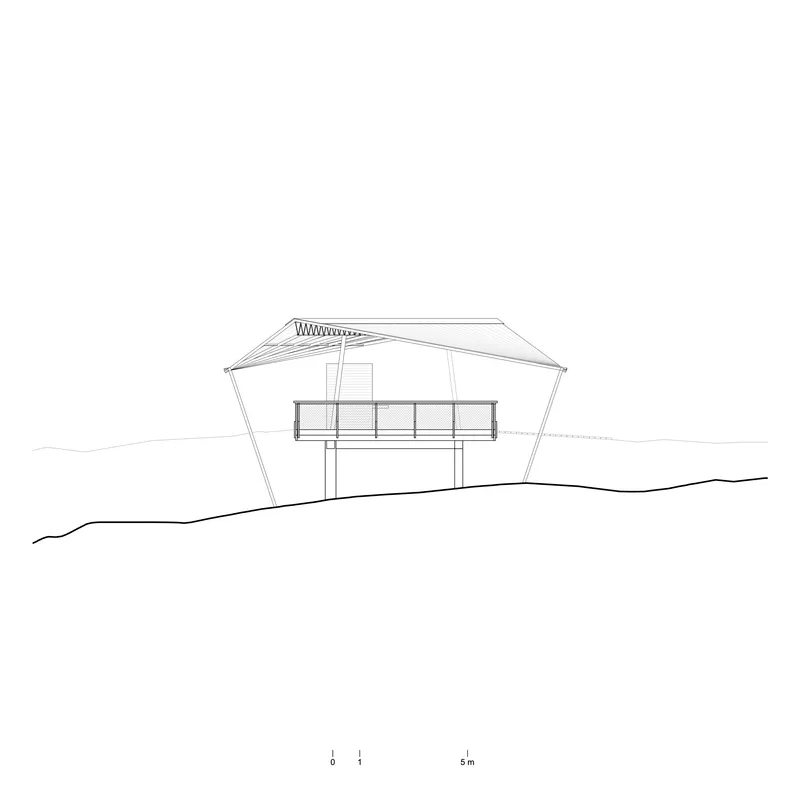
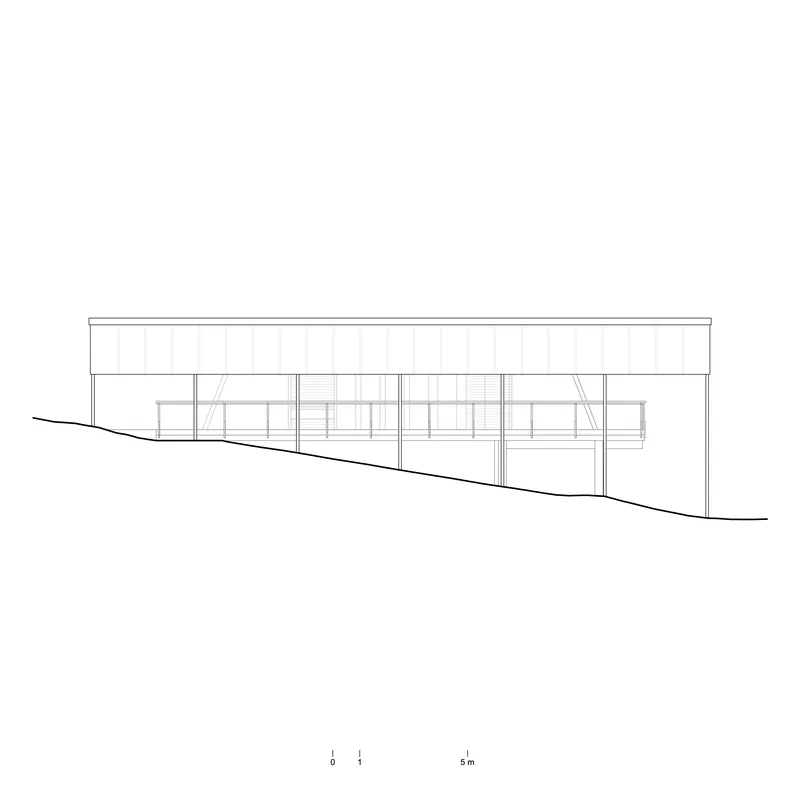

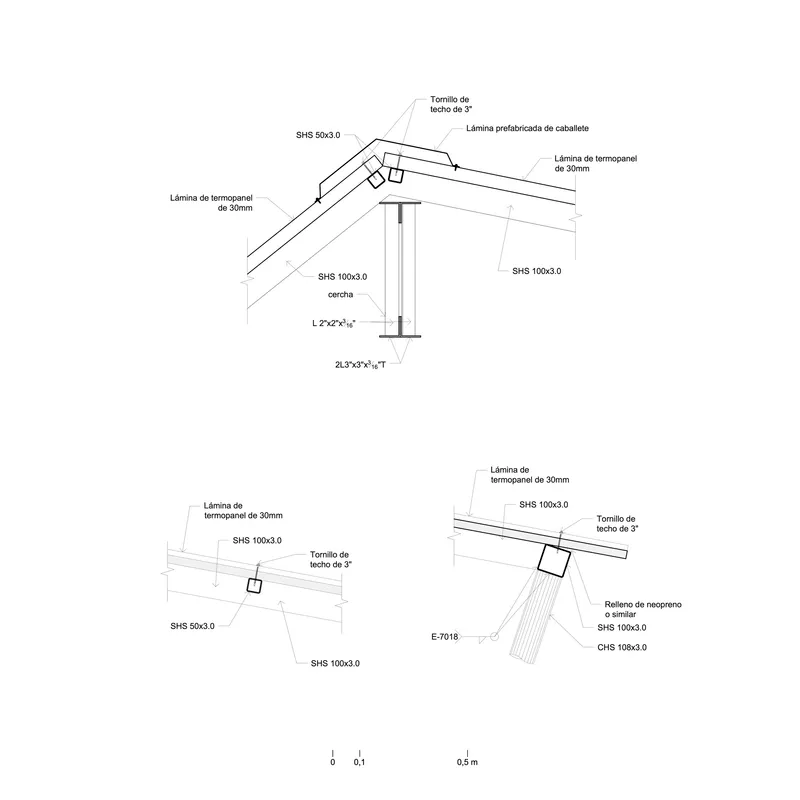

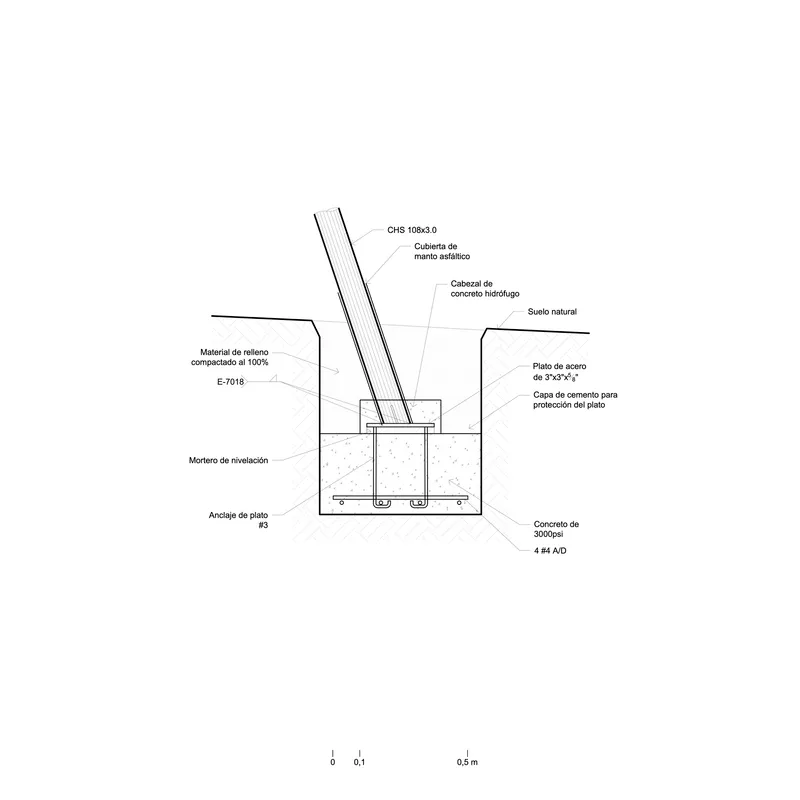
The roof plan confirms the building's linear logic: a single rectangular volume with five skylights punched along one flank to introduce light where the canopy is densest. The elevation drawings reveal how the structure follows the slope, its concrete piers stepping down the hillside while the roofline maintains a consistent gable. Sections show the relationship between the occupied platform, the open air beneath it, and the grade below, making visible just how much forest floor the building leaves intact.
The construction details are worth studying. The steel column connections, thermopanel roof assemblies, and concrete pier bases are drawn with a precision that suggests the architects cared as much about buildability in a remote site as they did about spatial poetry. A detail of the steel column base anchored into a concrete foundation over natural soil is a small drawing that tells a large story about where the building ends and the ground begins.
Why This Project Matters
The Refuge in the Rainforest operates at a scale that many architecture publications would ignore: 135 square meters, a handful of concrete piers, a steel roof. But the intelligence of the project is inversely proportional to its size. Héctor Ayarza and Estudio Garúa demonstrate that tropical architecture does not need to clear, grade, and plant a green roof to call itself ecological. The real work is in what you choose not to disturb.
For a building dedicated to training people who will interpret and protect the Panamanian rainforest, this is the right pedagogy. The structure itself is a lesson in coexistence: light on the ground, open to the air, calibrated to the canopy, and willing to vanish. It suggests that the most responsible thing architecture can do in a place like Gamboa is not to make a statement, but to make room.
Refuge in the Rainforest, Tour Guide Training Center, designed by Héctor Ayarza and Estudio Garúa. Located in Gamboa, Panama. 135 m². Completed in 2023. Photography by JAG Studio and Alfredo Martiz.
About the Studio
Share Your Own Work on uni.xyz
If projects like this are the kind of work you want to make, uni.xyz is a place to publish your own, find collaborators, and enter design competitions.




Popular Articles
Popular articles from the community


The Earth Pod: 3D Printed Homes for Resilient Refugee Communities
The Earth Pod reimagines refugee housing through 3D printed homes made from clay, combining resilience, self-sufficiency, and rapid shelter.

The Musturak Paradise: Senior Living Architecture for a Connected Future in Temara, Morocco
The Musturak Paradise reimagines senior living architecture in Temara via private homes, social spaces, culture, community, and shared care.

The Ocean Hive: Sustainable Architecture for a Self-Sufficient Civilization at Sea
The Ocean Hive imagines sustainable architecture at sea, where modular habitats, algae, wave power and ocean waste sustain a growing colony.

Riyadh For All: Intergenerational Urban Design for Active Aging in Rabat
Riyadh For All reimagines urban design in Rabat with intergenerational co-living, adaptive courtyards, and Moroccan cultural exchange today.

Similar Reads
You might also enjoy these articles

Bao Huynh Watercolor Atelier: A Serene Art Retreat in Hội An
Bao Huynh Watercolor Atelier in Hội An blends multifunctional art spaces, sustainable design, local materials, and family-friendly living in a serene environment.

Atelier Macri Concept Store Interior Design by CASE-REAL
Atelier Macri store features a "ko" counter, walnut wood details, cork displays, blending retail, gallery, and seamless customer experiences.

Manuel Vargas Izquierdo Stadium and High-Performance Sports Center: Architectural Excellence in Jalpa de Méndez
The Manuel Vargas Izquierdo Stadium blends sustainable design, inclusive sports facilities, and cultural-inspired architecture, revitalizing Jalpa de Méndez’s public spaces.

KAKR Buluh Awar Hall: Revitalizing Community and Ecology Through Bamboo Architecture
Community built bamboo hall revitalizes Buluh Awar village, empowering youth, restoring ecology, celebrating vernacular craftsmanship through sustainable architecture and culture.

Comments (0)
Please login or sign up to add comments
No comments yet. Be the first to comment!