

Helix: Stacking Barcelona's Grid Into a Spiraling Vertical City
A helical tower set in 2070 Eixample reimagines courtyard urbanism as a climate-responsive, transit-integrated vertical ecosystem.


What if Barcelona's famous Eixample grid, that meticulous 19th-century plan of chamfered blocks and interior courtyards, could be rotated 90 degrees and stacked into the sky? Helix takes that proposition literally. Set in 2070, the project reimagines the horizontal urban fabric of one of Europe's most legible city plans as a spiraling vertical habitat, complete with sky parks, air taxi docks, and a biomimetic core wrapped in living moss. It is a tower that thinks of itself as a neighborhood, not a building.
Designed by R Thirth and Design Bank, Helix was shortlisted in the Hybrid Futures '19 - Work x Fly competition. The brief called for architecture that fuses working, living, and aerial mobility into a single high-density proposition. Sited within Eixample and calibrated against Barcelona's predicted 100-year sea rise map, Helix responds not only to the competition's speculative prompt but also to real geophysical risk, positioning itself near anticipated hyperloop transit lines, aerial taxi lanes, and maritime trade routes.
Eixample Turned Vertical: Grid Logic in a Helical Form
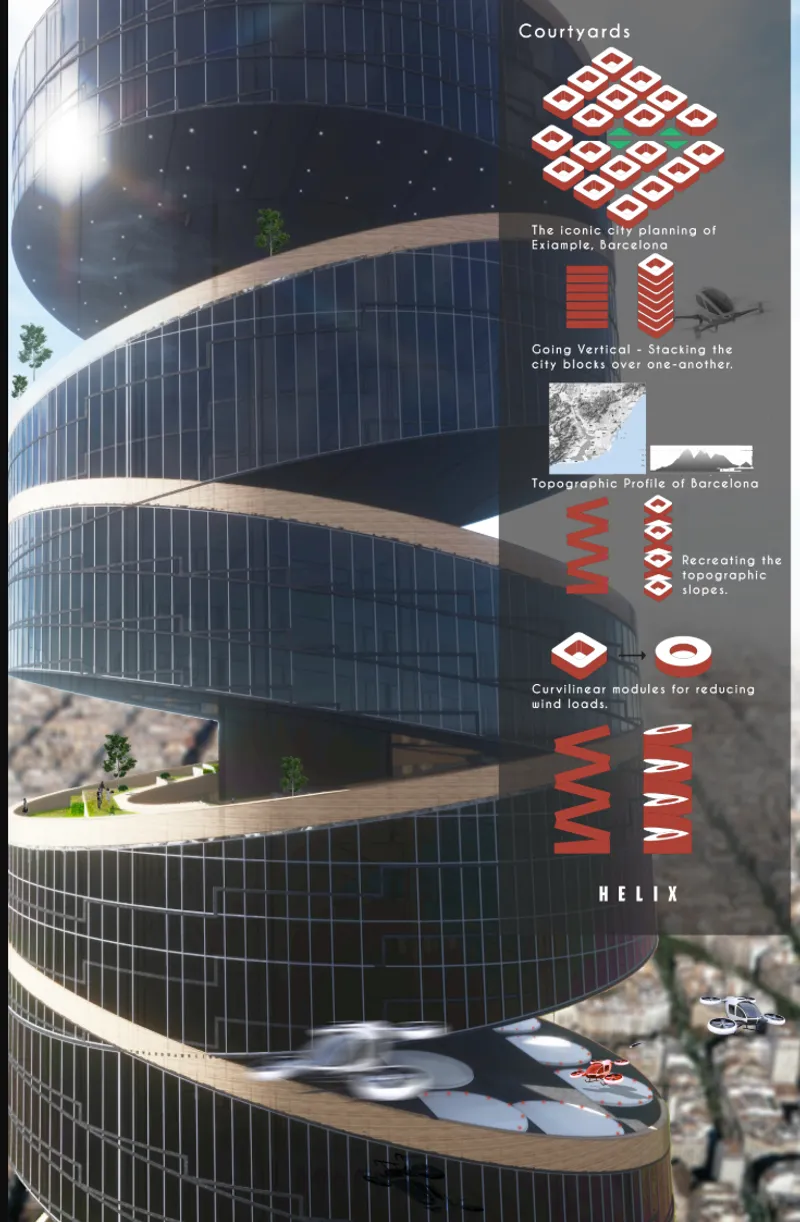
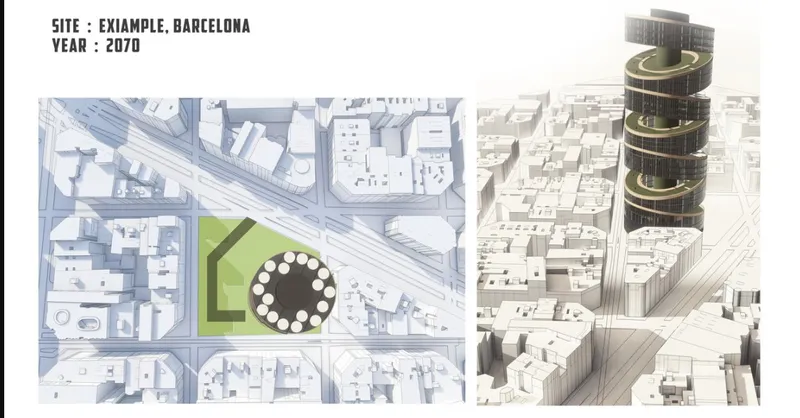
The tower's helical formation is not arbitrary geometry. Each stacked block corresponds to a courtyard unit from the Eixample plan, rotated incrementally as it rises. The spiral profile does real physical work: it mirrors Barcelona's topographic contours, reduces wind load on the facade, and limits cumulative heat gain across the tower's height. The facade itself deploys transparent aluminum panels for thermal regulation alongside movable solar elements that track the sun's path to maximize energy harvesting. In rendered views, the effect reads as a lattice of planted terraces wrapping around a crystalline core, the whole form appearing to unwind gently toward the sky.
The site plan reveals how the cylindrical footprint nestles into the existing urban block, respecting the Eixample's orthogonal discipline at ground level while departing from it overhead. Concept diagrams trace the logic from grid to spiral, showing how the designers extracted spatial order rather than imposing a foreign shape. It is a careful argument: the tower earns its form through the genealogy of the city it inhabits.
Graphene Landing Pads and the Air-Station Terraces
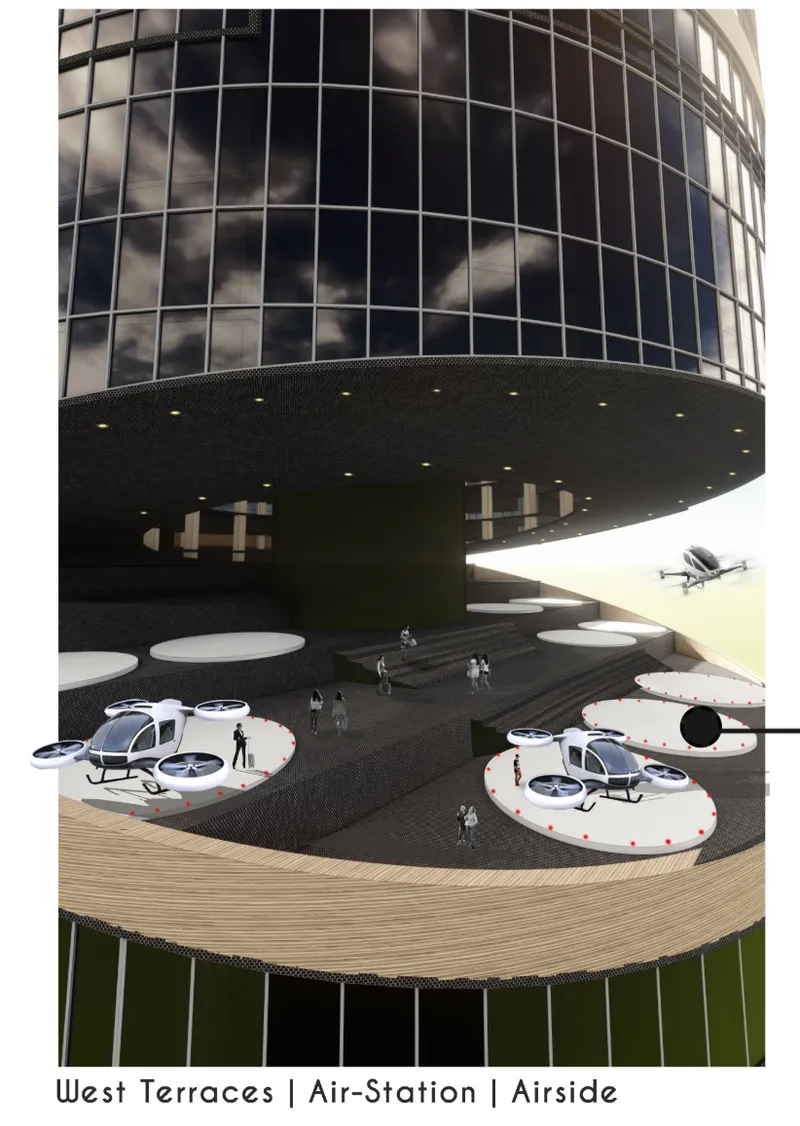
At ground level, circular landing pads sit beneath the curved glass facade, serving as docking zones for air taxis and drones. The designers specify graphene-based surfaces for these pads, a material choice that signals both structural lightness and electrical conductivity for future charging infrastructure. The air-stations are embedded primarily on south and west terraces, where solar exposure is greatest, aligning mobility hardware with energy generation in a single move. The rendered ground-level view shows how these zones are treated as public thresholds, not restricted service areas, blurring the line between transit infrastructure and civic space.
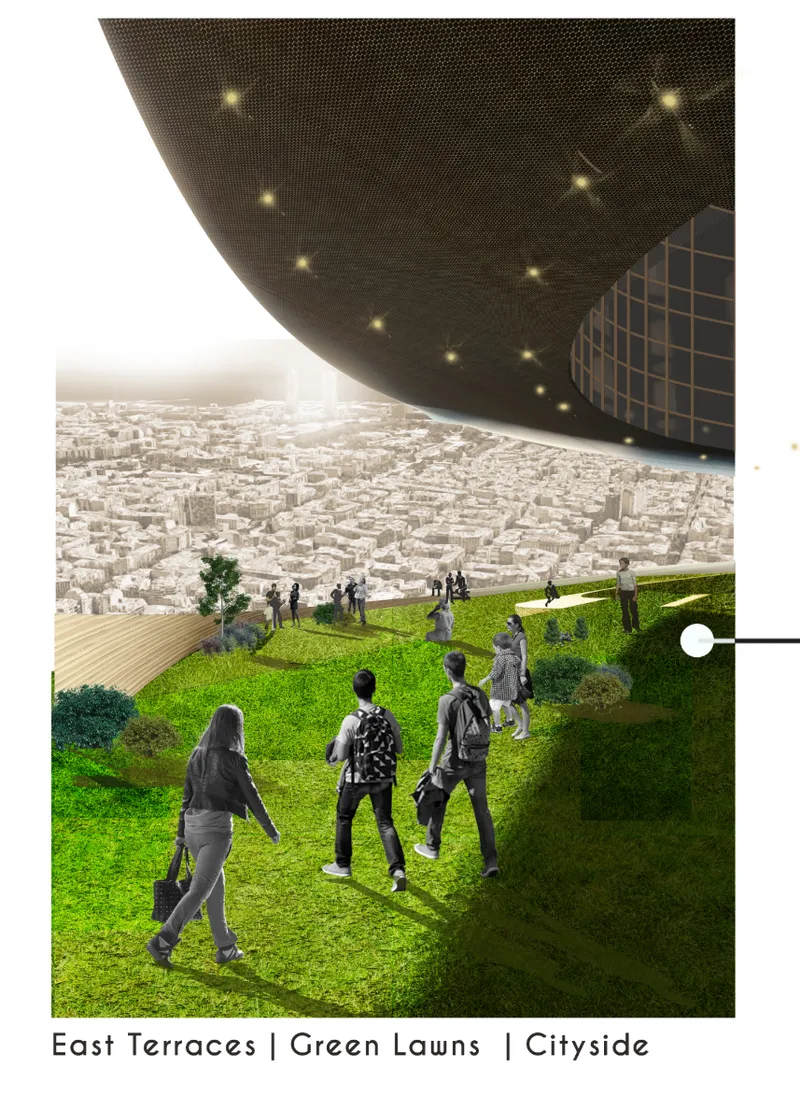
Higher up, grass-covered terraces extend beneath cantilevered volumes, creating inhabitable outdoor rooms at altitude. People are shown walking through these spaces at dusk, the underside of the tower looming overhead like a sheltering canopy. These intermediate-level sky parks are described as the building's "breathing lungs," accessible to both residents and workers. The image communicates something important about the project's ambitions: even in a tower of this density and programmatic complexity, the ground plane is not the only place where public life happens.
A Timber and Graphene Skeleton with a Living Core
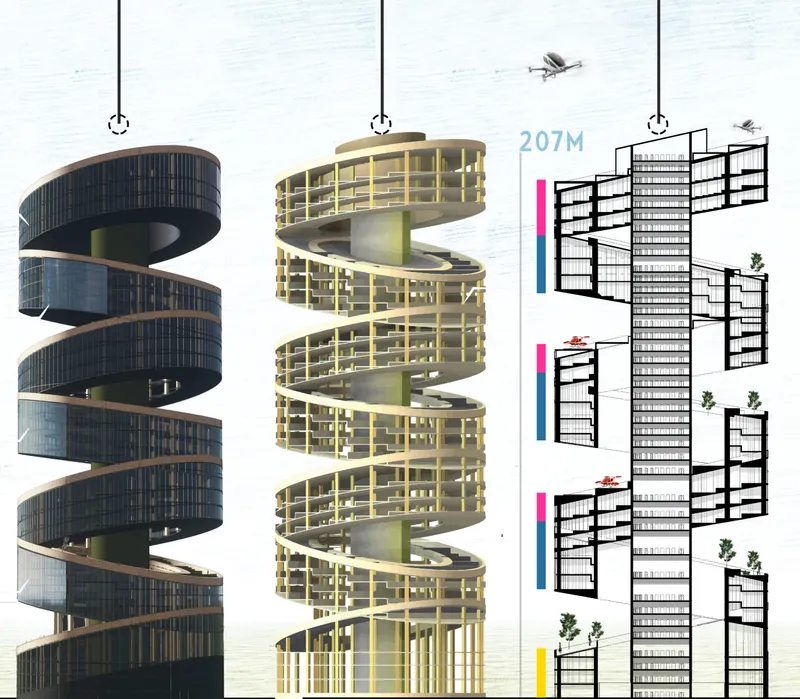
Section drawings reveal the internal anatomy of Helix. A braced tube system constructed from cross-laminated timber and 3D-printed graphene-reinforced elements provides structural integrity while keeping the embodied carbon profile lower than a conventional steel or concrete frame. At the center sits a cylindrical core that the designers describe as functioning "like a trunk of a tree," both structurally and symbolically. This core is cloaked in living moss and air-purifying plants, forming a vertical bioskin that actively filters airborne pollutants. It handles vertical circulation, spatial anchoring for the stacked programs, and ecological performance simultaneously.
The vertical zoning is legible in section: commercial functions occupy the ground and lower levels, office modules with biophilic integration sit on multiple mid-levels, and the air-station terraces punctuate the tower's south and west faces. Rendered exterior views alongside the sections show helicopters and air taxis approaching docking zones, giving a sense of scale that underscores just how large this proposition is. The helical stacking is clearest in these drawings, each floor plate offset from the one below, generating the spiral that defines the silhouette.
Resilience as a Design Driver, Not an Afterthought
Helix is sited with deliberate attention to long-term environmental risk. The designers consulted Barcelona's predicted 100-year sea rise map and positioned the tower in alignment with future infrastructure networks, including hyperloop corridors and maritime routes. The architectural form responds to both the micro topography of the site and macro mobility trends, ensuring that the building does not simply occupy land but actively interfaces with the trajectories of people, goods, and climate. Modular expansion is embedded in the concept, suggesting that the tower could grow incrementally rather than requiring a single monolithic construction phase.
Why This Project Matters
The most compelling aspect of Helix is not its speculative technology or its 2070 timeline. It is the insistence that vertical architecture should inherit the spatial intelligence of the horizontal city it replaces. By grounding the tower's geometry in Eixample's grid, the designers avoid the trap that snares many supertall proposals: producing a spectacular object that has no relationship to the place it stands. Here, the spiral is not style; it is an argument about continuity between urban fabric and vertical form.
The project also demonstrates how multi-scalar thinking can hold a single design together. From the graphene chemistry of a landing pad to the 100-year sea rise projection shaping site selection, Helix operates across material, architectural, and territorial scales without losing coherence. For a competition entry by young designers, that range of ambition, matched with legible diagrammatic logic and a consistent material narrative, is exactly the kind of propositional work that pushes the discipline forward.
View the Full Project
About the Designers
Designers: R Thirth, Design Bank
Enter a Design Competition on uni.xyz
uni.xyz runs architecture and design competitions year-round that reward proposals with spatial conviction and real site intelligence.
Project credits: Helix by R Thirth, Design Bank Hybrid Futures '19 - Work x Fly (uni.xyz).


Popular Articles
Popular articles from the community


Manzana Morphosis: Stretching Barcelona's Grid into a Living Landscape for 2050
A radical reworking of the Eixample manzana turns density into a tool for generous public space, vertical ecology, and environmental performance.

Faces of the Soviet Avant-Garde: Turning Moscow's Street Names into an Open-Air Museum
A network of sculptural installations across a Moscow residential district transforms forgotten architect names into spatial encounters with cultural memor

Opera by the Sea Estonia: Three Shells Dissolving Architecture into Tallinn's Coastline
A winning opera house proposal replaces monumental form with interconnected shells that blur the boundary between building, park and Baltic Sea.

Opera on the Sea: Driftwood Logic Shapes a Timber Opera House on Estonia's Coast
Trevor Orgill's opera house translates the entangled drift of floating timber into a civic building where wood, water, and music converge.

Similar Reads
You might also enjoy these articles

Shakur's House: Exposed Brick as an Interior Organiser in a 168 m² Mashhad Residence
Brick moves indoors in this Mashhad residence, where masonry walls, glass partitions and teal planes sequence a compact home without closing it off.

Day and Night Park: A Time-Based Urban Newsstand in Beijing
A temporary urban newsstand in Beijing blending travel, light, and reading through poetic colors, compact form, and community-focused design.

Modernist Patio Renovation in El Masnou, Barcelona by Oliver Segura Arquitectura + Cebrià Arquitectura
Modernist patio renovation blending tradition and innovation with a movable pool, leveled floors, and Catalan materials in El Masnou.

Alto Residencial Coop: Cooperative Housing Development in Santiago de Compostela by Carbajo Barrios Arquitectos
A linear cooperative housing complex blending white volumes and perforated metal façades, enhancing community living, natural light, privacy, and urban integration.

Comments (0)
Please login or sign up to add comments
No comments yet. Be the first to comment!