
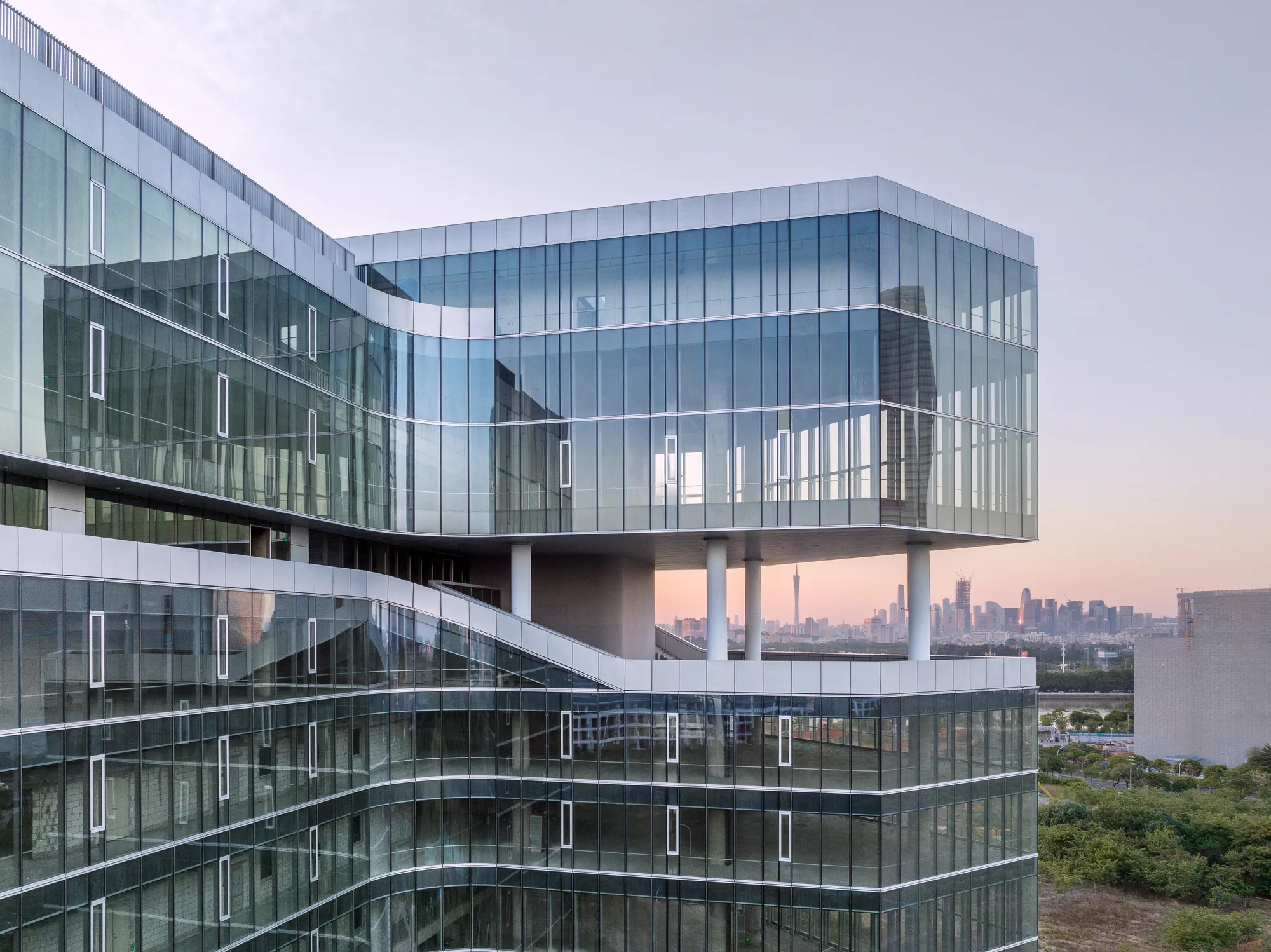
HENN Weaves Labs and Offices into an X-Shaped Tower on Guangzhou's Bio Island
A 59,000 square meter innovation center stacks three floating volumes over sky gardens on the Pearl River Delta's biotech hub.


Guangzhou's Bio Island sits in the Pearl River Delta as the city's densest cluster of biomedical research, a place where proximity between disciplines is not a nice-to-have but a competitive advantage. When Chuang Jing Med commissioned HENN to design a 59,000 square meter innovation center here, the brief demanded something that barely exists as a settled typology: a vertical building that houses wet labs, dry labs, collaborative offices, exhibition space, and public program under one roof, all without the hermetic separation that typically keeps researchers and business teams in different buildings.
What HENN delivered, completed in 2022, a full year ahead of schedule, is an X-shaped plan split into three stacked volumes separated by multi-story open-air terraces. The firm calls the concept "Knowledge Weave," and the name is more descriptive than aspirational. Each arm of the X alternates between laboratory and workspace functions, while every intersection becomes a communal zone. The result is a building where you cannot move between wings without passing through shared space, a plan that turns circulation into collision.
The X Plan and Its Logic
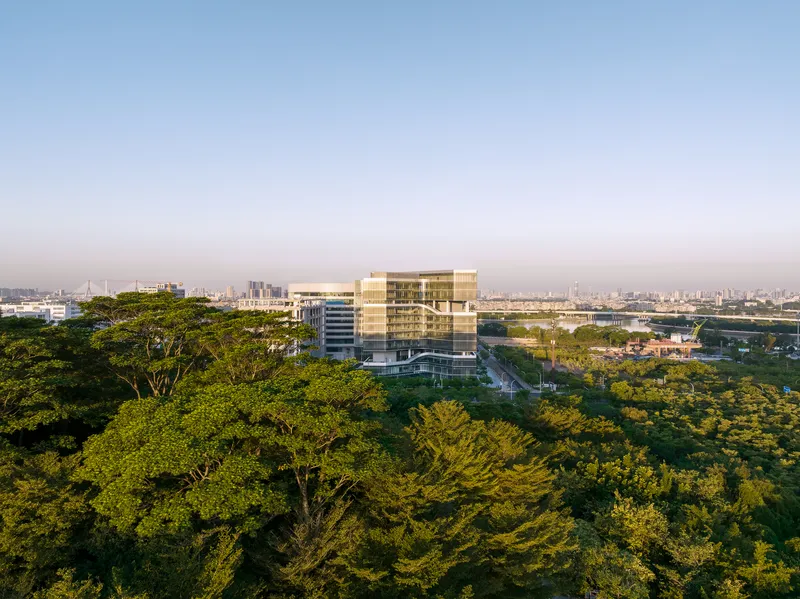

From the air the building reads as a pinwheel, four radiating bars angled off a central spine on a square plot. The geometry is not decorative. An X plan on this footprint means daylight reaches deep into every wing and every workspace gets a vista in at least two directions. The inside corners where the arms meet are curved, softening the intersections into generous communal pockets, while the outer edges stay sharp and angular, giving the facade a taut profile against the island's canopy of trees.
The structural grid shifts density depending on program. Laboratory wings carry a tighter column spacing to support heavier floor loads and equipment, while office wings open up to longer spans and more flexible layouts. It is a subtle decision that never registers visually from outside but determines how each wing feels and functions internally.
Three Volumes, Three Programs


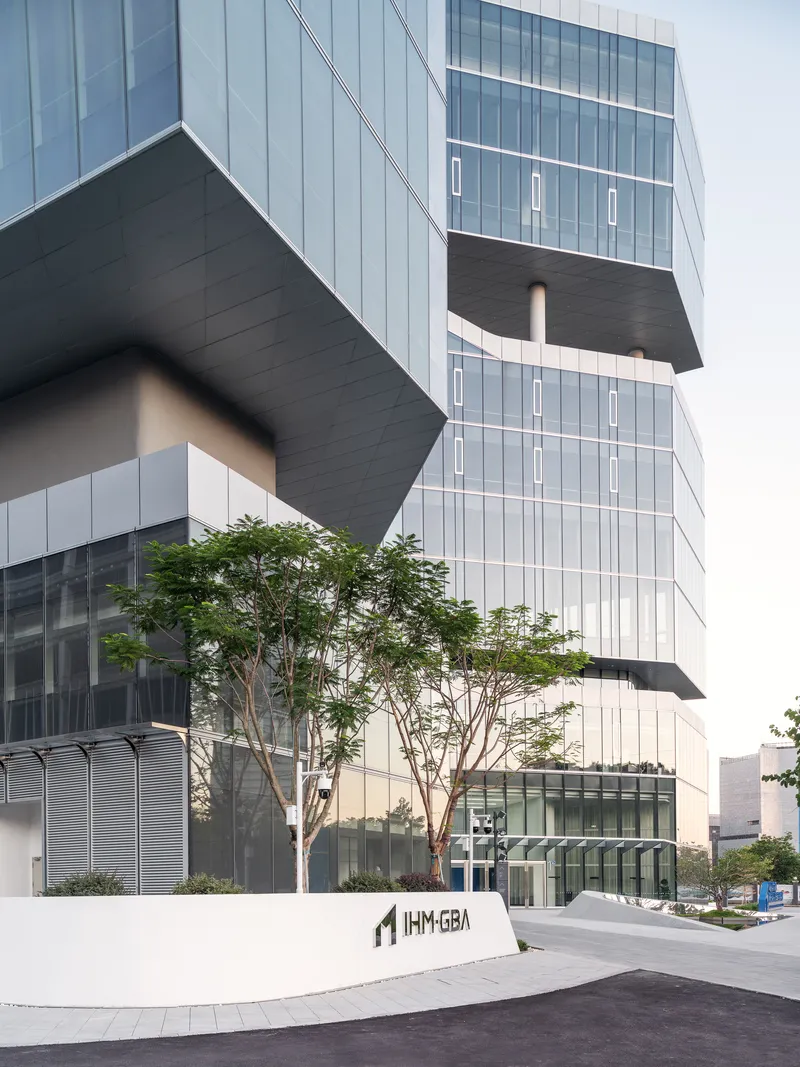
The stacking strategy splits the building into three legible bands. The lower volume hosts public functions: a lobby, exhibition hall, show lab, and café, all oriented toward the street and the island's pedestrian network. The middle volume is the operational core, holding laboratories, meeting rooms, and multipurpose spaces. The top floor is reserved for headquarters offices. Between each band, multi-story open-air terraces act as sky gardens, punching voids through the mass and giving the facade its distinctive rhythm of solid, void, solid.
At dusk, the contrast between the translucent and transparent facade panels becomes most legible. Recessed glazed surfaces sit behind projecting slabs with dark horizontal bands, while outward-facing panels shift to a vertical rhythm of white translucent elements. The effect is a building that changes register depending on the angle and the light, never reading as a single monolithic block.
Ground Level and Public Interface
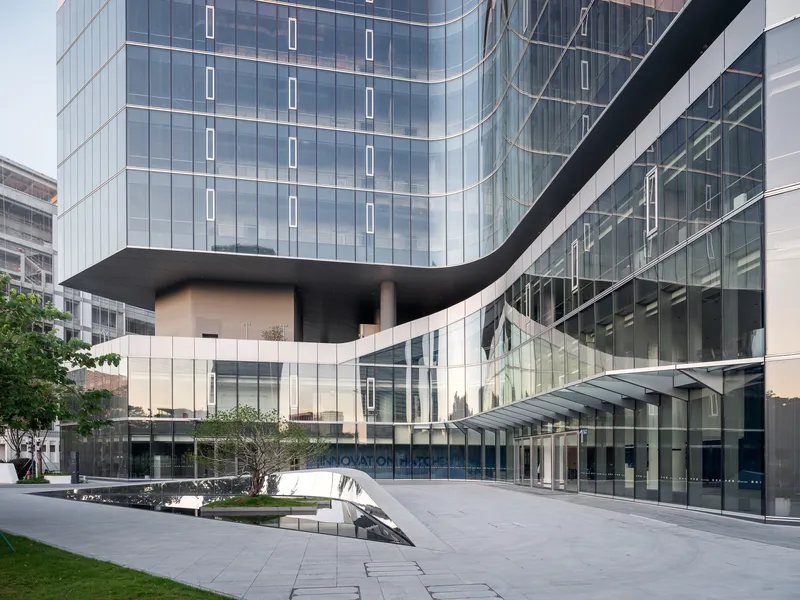

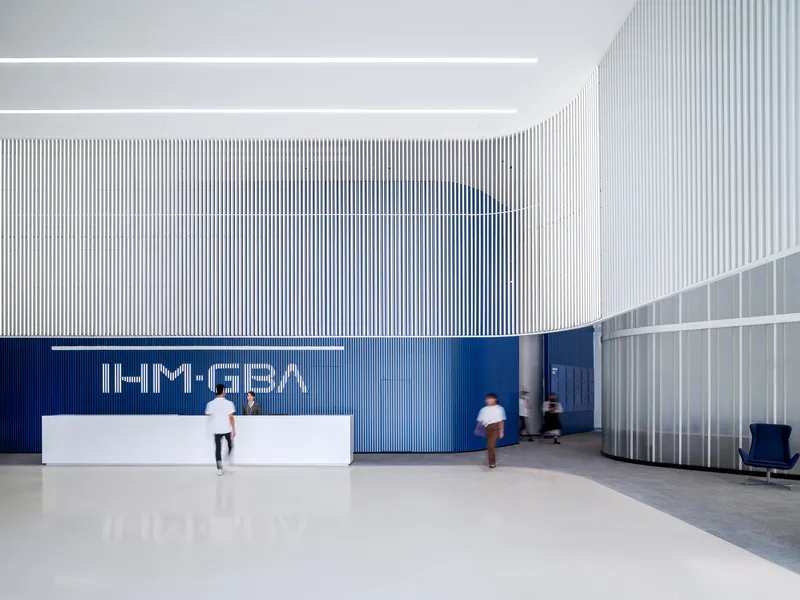
The ground plane is where the building meets Bio Island's streetscape, and HENN treats it as a threshold rather than a barrier. A curved entry canopy sweeps over a reflective water feature, drawing pedestrians from the tree-lined plaza into a double-height lobby with tiered wooden seating. The reception area pairs white corrugated wall panels with a single blue accent wall, a restrained palette that lets the scale of the space do the work.
Landscape architects Hezhan Design shaped the surrounding grounds into a dense canopy that, from aerial views, makes the glass volumes appear to emerge from forest rather than from a biotech park. It is a deliberate inversion: the building is massive, but its setting insists on a green, human-scaled arrival.
Interior Circulation as Social Infrastructure
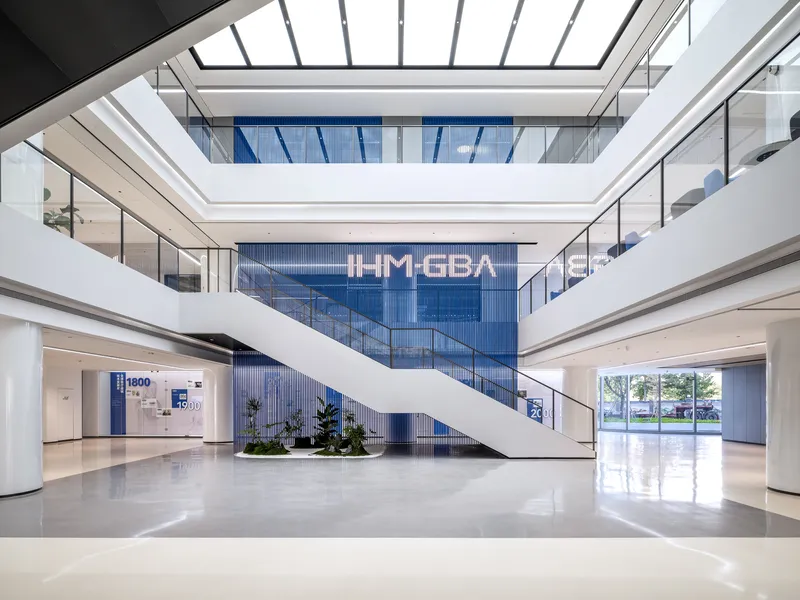

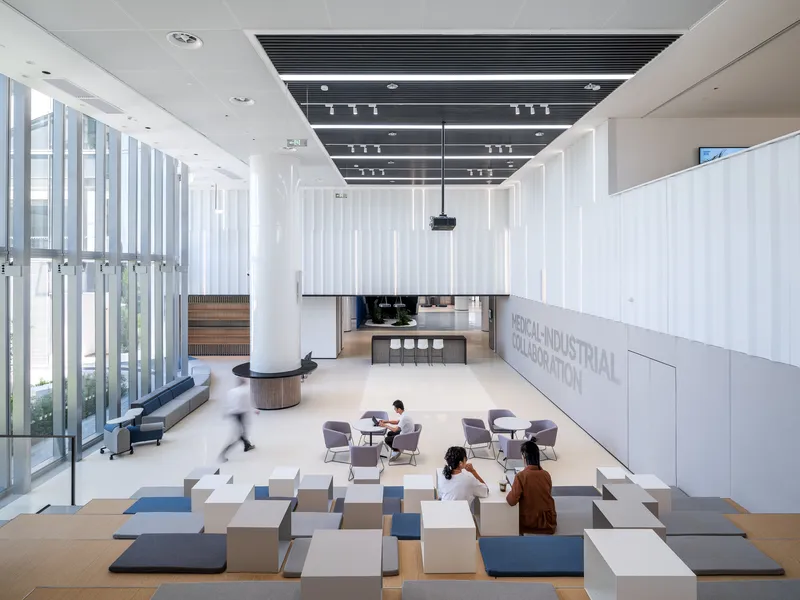
The interior stakes its argument on movement. A multi-story atrium with a diagonal white staircase under a skylight connects public and semi-public levels. Elsewhere, stairs descend past a blue corrugated wall into gathering areas, and a double-height space on an upper level hosts modular floor cushions and a suspended projection screen. These are not afterthoughts or leftover volumes. They are the connective tissue that the X plan generates at every intersection, designed to make chance encounters between lab researchers and office staff unavoidable.
The shifting double-height spaces create a vertical rhythm that breaks the monotony of stacked floor plates. You are rarely more than one level away from a moment where the ceiling lifts and the plan opens, a quality that keeps orientation intuitive in a building this large.
Sky Gardens and Outdoor Rooms
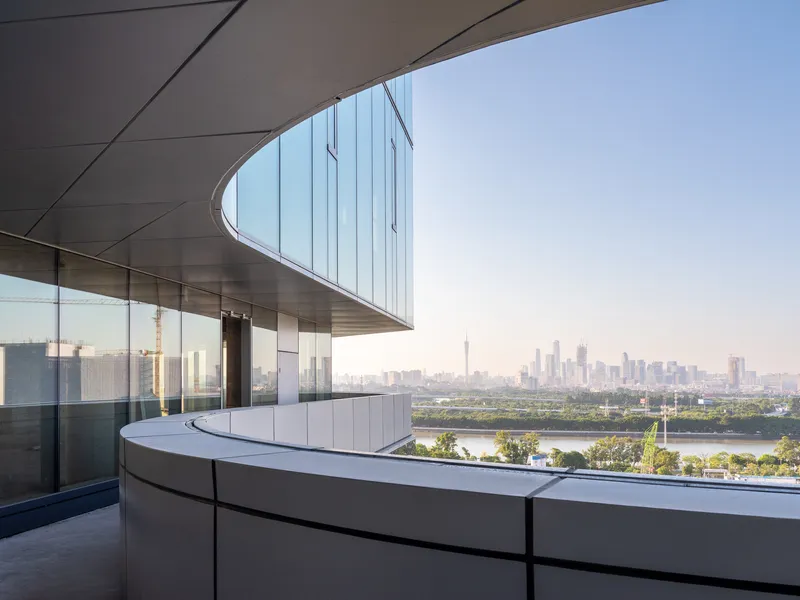
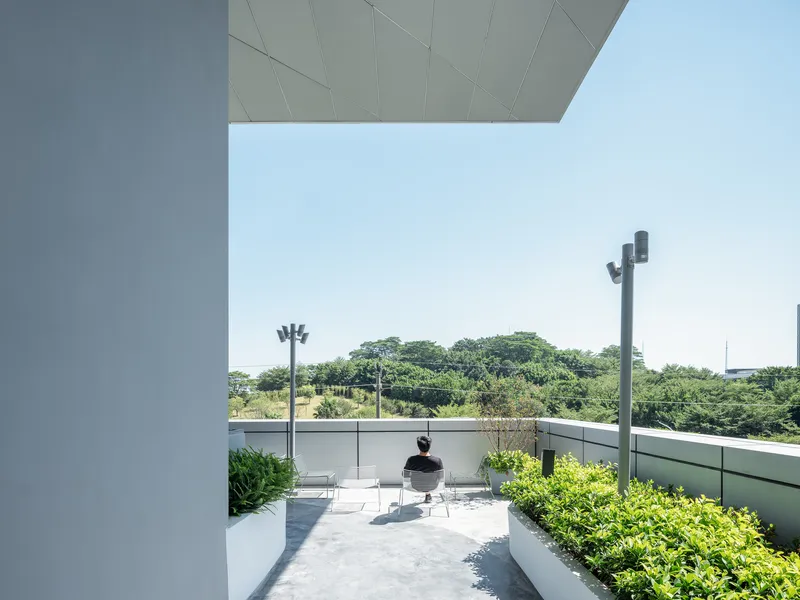
The open-air terraces between stacked volumes are the building's most distinctive spatial move. Projecting slabs frame views of the Pearl River and Guangzhou's skyline, while planted beds and seating turn these outdoor rooms into usable space rather than architectural gestures visible only in section drawings. In a subtropical climate where natural ventilation is a genuine energy strategy, these voids pull air through the building's mass and reduce reliance on mechanical systems.
Facade consultants SuP Ingenieure GmbH engineered the relationship between the glazed curtain wall and the projecting canopies to manage solar gain across orientations, a critical detail on an island where each arm of the X faces a different compass point. The curved canopy overhangs on the terraces double as solar shading, keeping outdoor seating comfortable even in Guangzhou's intense summers.
Plans and Drawings


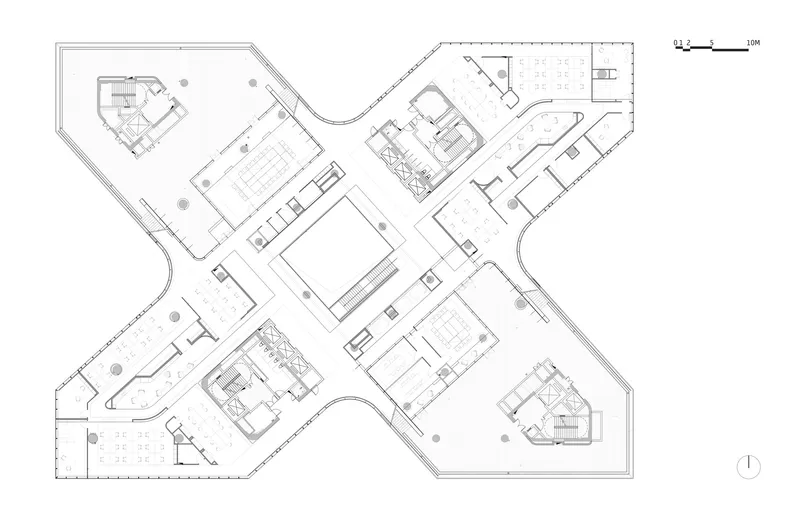
The floor plans reveal how the X radiates from a compact central core. On lower levels the arms are broader and more interconnected, hosting the public and laboratory programs that benefit from open adjacencies. Higher up, the wings narrow and the column grid loosens, shifting toward office layouts that prize flexibility. Interior courtyards appear at the junctions, pulling light down through the mass and providing orientation cues on floors that could otherwise feel labyrinthine.


The axonometric drawings of the curved elevated walkway and staircase detail how HENN connects the stacked volumes without relying solely on elevator cores. These sculptural circulation elements are glazed on their outer faces, making vertical movement a moment of exposure to the exterior rather than a sealed-off transition. The section drawing confirms the double-height rhythm and shows how interior furnishings are distributed to differentiate lab benches from lounge seating within the same structural bay.
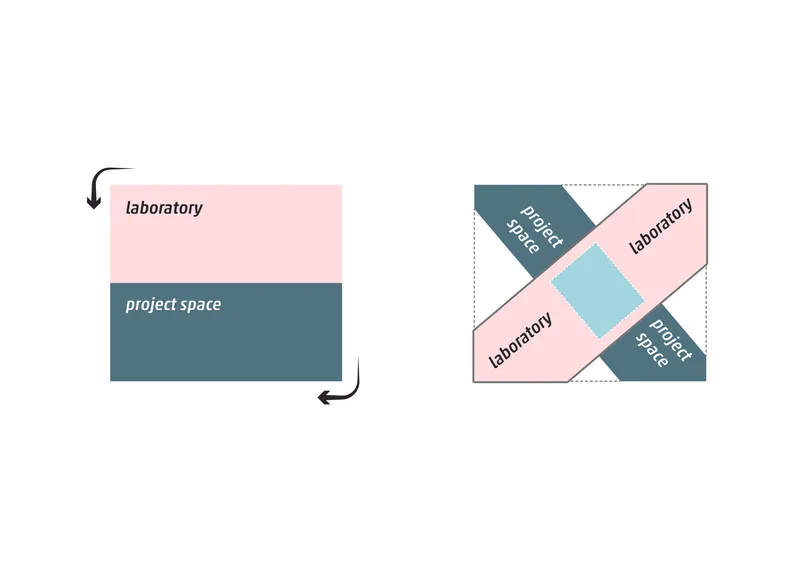

The rotational diagram makes explicit what the plan implies: laboratory zones and project space zones are offset by 90 degrees at each level, so every arm of the X alternates function as it rises. The exploded axonometric color-codes three tiers: display at the base, development in the middle, headquarters at the top. Read together, these drawings show a building organized not by department but by degree of publicness, with the most open programs closest to the ground and the most focused work at the top.
Why This Project Matters
The innovation center typology is still searching for its spatial identity. Too often, buildings that claim to foster interdisciplinary work default to open-plan floors with a coffee bar on the ground level and call it collaboration. HENN's X plan is a genuine structural proposition: it forces program overlap at every intersection, guarantees daylight and ventilation to deep floor plates, and creates outdoor rooms that are usable in a subtropical climate. The decision to separate the building into three floating volumes, each with distinct program identities, keeps a 59,000 square meter mass from reading or functioning as a single slab.
On Bio Island, where biotech firms compete for talent and proximity, the building makes an argument that architecture can do more than house equipment. By weaving wet labs, offices, exhibition spaces, and sky gardens into a single interlocking form, HENN delivers a prototype for vertical research campuses that takes climate, circulation, and social encounter seriously. Completed a year early, it also demonstrates that geometric ambition and construction efficiency are not mutually exclusive.
Innovation Center for High-Performance Medical Devices (IHM·GBA) by HENN, in collaboration with Guangzhou Design Institute Group Co. Ltd. Located on Bio Island, Guangzhou, China. 59,000 m². Completed 2022. Landscape by Hezhan Design. Facade by SuP Ingenieure GmbH. Lighting by RDI. Photography by Fangfang Tian.
About the Studio
Share Your Own Work on uni.xyz
If projects like this are the kind of work you want to make, uni.xyz is a place to publish your own, find collaborators, and enter design competitions.



Popular Articles
Popular articles from the community

AL-JANNAH: Sustainable Architecture and Permaculture for Afghan Widows
AL-JANNAH uses sustainable architecture and permaculture to create resilient oasis of housing, learning, work and renewal for Afghan widows.

Riyadh For All: Intergenerational Urban Design for Active Aging in Rabat
Riyadh For All reimagines urban design in Rabat with intergenerational co-living, adaptive courtyards, and Moroccan cultural exchange today.

The Earth Pod: 3D Printed Homes for Resilient Refugee Communities
The Earth Pod reimagines refugee housing through 3D printed homes made from clay, combining resilience, self-sufficiency, and rapid shelter.

Co-Life: Senior Housing Design That Reconnects Older Adults With the City
Co-Life reimagines senior housing design through healing gardens, shared streets, workshops, and a sustainable community across generations.

Similar Reads
You might also enjoy these articles

Bao Huynh Watercolor Atelier: A Serene Art Retreat in Hội An
Bao Huynh Watercolor Atelier in Hội An blends multifunctional art spaces, sustainable design, local materials, and family-friendly living in a serene environment.

Atelier Macri Concept Store Interior Design by CASE-REAL
Atelier Macri store features a "ko" counter, walnut wood details, cork displays, blending retail, gallery, and seamless customer experiences.

Manuel Vargas Izquierdo Stadium and High-Performance Sports Center: Architectural Excellence in Jalpa de Méndez
The Manuel Vargas Izquierdo Stadium blends sustainable design, inclusive sports facilities, and cultural-inspired architecture, revitalizing Jalpa de Méndez’s public spaces.

KAKR Buluh Awar Hall: Revitalizing Community and Ecology Through Bamboo Architecture
Community built bamboo hall revitalizes Buluh Awar village, empowering youth, restoring ecology, celebrating vernacular craftsmanship through sustainable architecture and culture.


Explore Innovation & Business Competitions
Discover active competitions in this discipline



Challenge to reimagine the Iron Throne


Photograph architecture without architects


Illustrate the lost glory of Angkor Wat - Render Challenge


Design challenge to reuse E-waste
Comments (0)
Please login or sign up to add comments
No comments yet. Be the first to comment!