
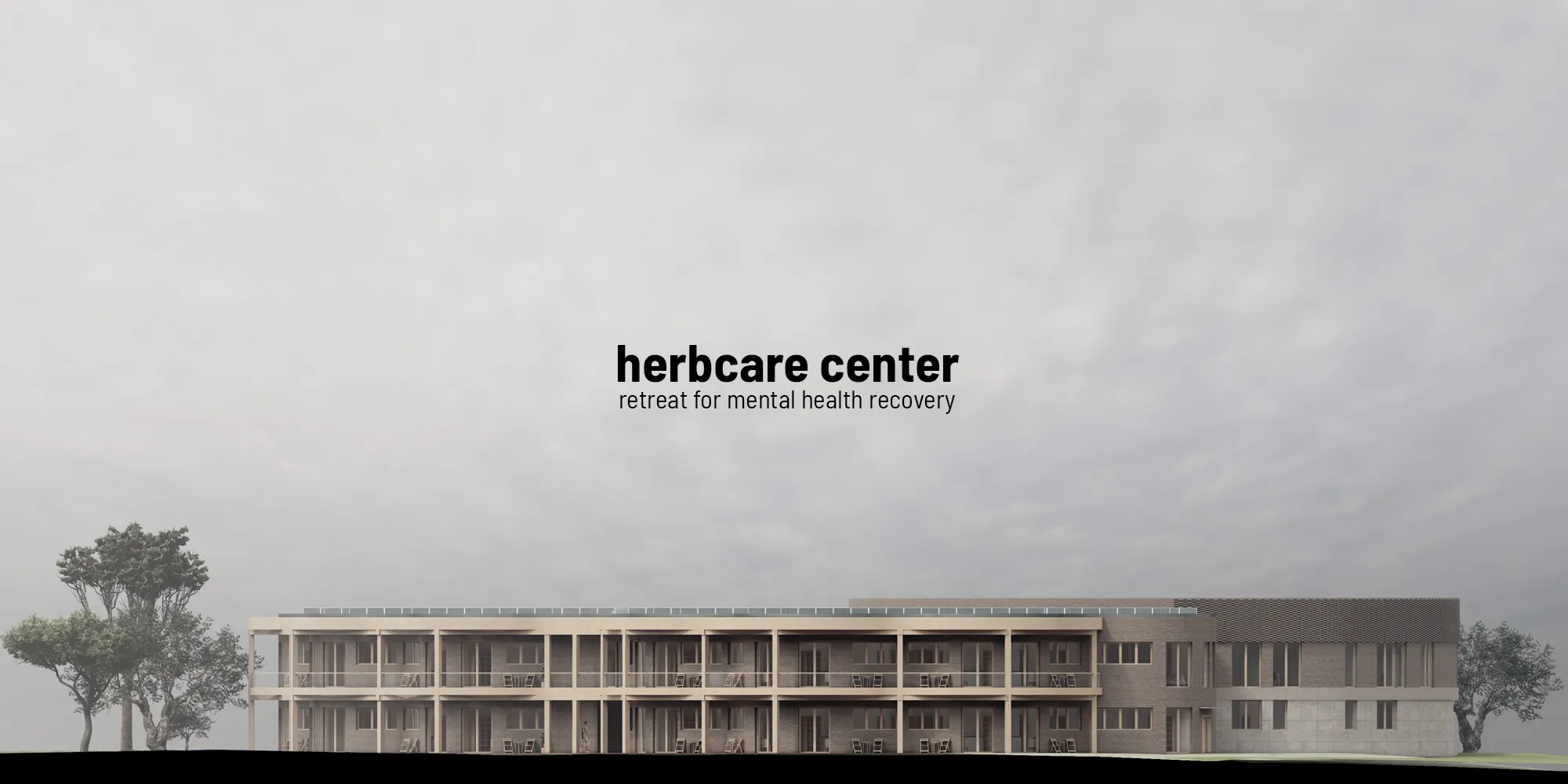
herbcare center
Main subject of the project is the Herbcare Center – retreat for mental health recovery.

An important issue at the design stage was to pay attention to the needs of people after treatment and to provide them with a place to properly convalesce. The main design idea was to create a place to grow herbs with healing properties. Working on the cultivation of herbs has a positive effect on the convalescence process of people through physical work performed in their care. The project refers to the history of the place through the use of brick as a facade material and the creation of workshop rooms for classes in pottery and painting ceramics.
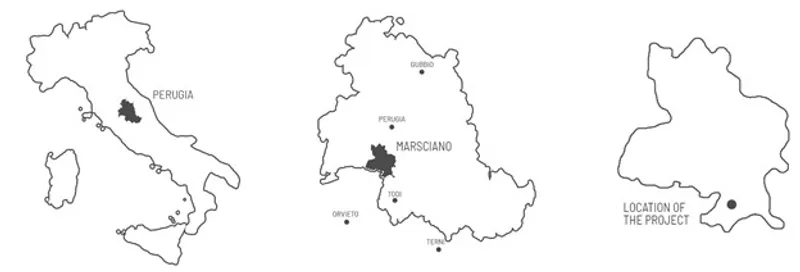
The designed building is located in the Italian town of Marsciano, in the Umbria region, in the Perugia province. The plot is located on Ascenso Riccieri Street, in the central part of the city. Marsciano is a small town known for its brick production.
This work presents a project of a convalesce center for people after psychiatric treatment. The building was designed to accelerate the regeneration of users. It goes beyond the concept of traditional convalescence centers. The project creates a community space with places for rest and recreation, which provides comfort and supports recovery. The property has green areas that allow you to relax in the fresh air, meditate, practice yoga or simply contemplate in the vicinity of nature. Due to the use of large windows, these activities are also possible inside the building.
It differs from the classic convalesce centers by meeting assumptions such as:
- engages senses
Involving all the senses significantly speeds up convalescence after psychiatric treatment. Herbal oils in the company of soothing sounds of nature effectively help in reducing stress and mental distancing from the "everyday" world.
- implements idea of placebo architecture
The designed center, through sensorics, biophilia, the use of daylight and the placement of healing gardens within the project, stimulates neurochemicals, which has a positive effect on well-being and psychological balance.
- provides safe and functional space
The project meets the required standards and is designed in accordance with the applicable regulations. When creating the center, good architectural practices were taken into account and the building was optimized in terms of functionality and user comfort.
- uses the elements of nature for therapeutic purposes
Designed recovery center allows contact with the vegetation through the healing gardens. Therapy using elements of nature helps in reducing stress, treating depression and accelerating the recovery process. Plants, the cultivation of which has been planned as part of the therapy, in the designed building: thyme, rosemary, lavender, basil, wild garlic, St. John’s wort, caraway, lemon balm, mint.

The convalesce center presented in this work has been designed in such a way as to recall nature and facilitate relaxation and rest. The project involves creation of a common herb garden as a representative part of the facility. In the middle of this garden there is a herb drying room.
The designed facility does not pose a threat to the natural environment and fits into its surroundings. On the roof of the building are installed solar panels, which use solar radiation to produce energy. Additionally, umbrellas collecting rainwater and tanks for its storage are located on the premises of the facility. Roof is covered with a retention mat, which reduces the amount of water used for plants growing. The project is adapted to the needs of people with disabilities.
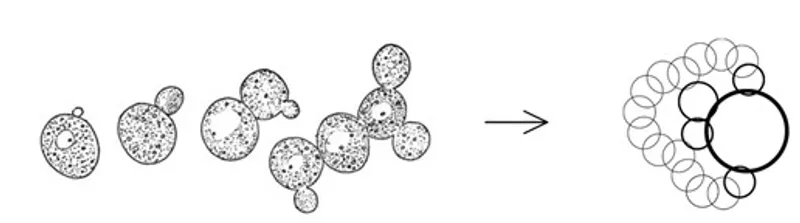
The form of the building was inspired by nature, its oval shapes and the processes of organism growth such as budding. The building has a clearly marked center that stands out from the rest of its parts. This is its main part, of which the "remaining" "other relations, the state in its shape, but clearly different in size. The outer walls took oval, repeating shapes. The center is located in 3 places with the rest of the building, thus creating a coherent "organism".
The building is designed for 50 residents. There is a single room with a kitchenette and a private bathroom for each resident. On the ground floor of the building, the main functional zones are separated: the entrance zone, administrative rooms, kitchen facilities with an adjacent dining room, rooms for employees working on the facility, living rooms, a workshop and a multimedia room. On the 1st floor there will be space for: a winter herb garden, a library, medical consultation rooms, relaxation zones, living rooms, a recreation and workshop room. There is a car park with technical rooms on the underground floor. The roof area is intended for greenery and a photovoltaic installation.
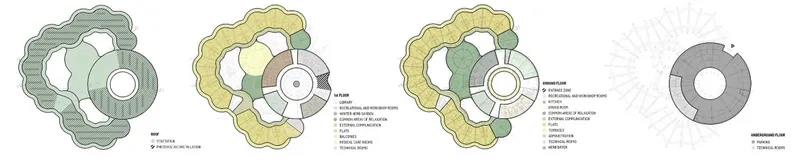
The designed center allows communing with the vegetation through the healing gardens designed there. Circulation in the building takes place around them.
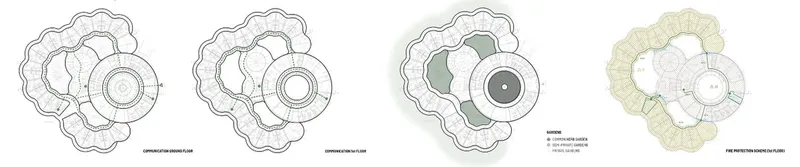
Natural materials locally found in the region were used. Wood was used for the main construction. Brick was used on the facade due to the historical character of the town. Also used is travertine in the form of tiles.
The main entrance to the building is on the eastern side. A newly designed pedestrian and bicycle route leads directly to it. The place for storing waste is located outside the building, next to the pedestrian and driveway. A hardened access from the building has been provided. Waste storage places and parking spaces have been placed at appropriate distances from the windows of rooms intended for permanent residence of people. High vegetation has been designed in places that are unfavorable so as to provide the users of the facility with visual comfort. The project provides employees of the facility with 19 parking spaces in the underground garage and 26 above-ground parking spaces for guests. Parking spaces have been designed, accessible directly from the street and from the planned 6-meter-wide pedestrian and traffic route. From the existing street, there is a pedestrian and road route that serves as an entrance to the underground garage. Three semi-private gardens have been designed to which residents have access from an open corridor and private gardens accessible directly from the rooms. Medicinal herbs are planned to be grown in the gardens.
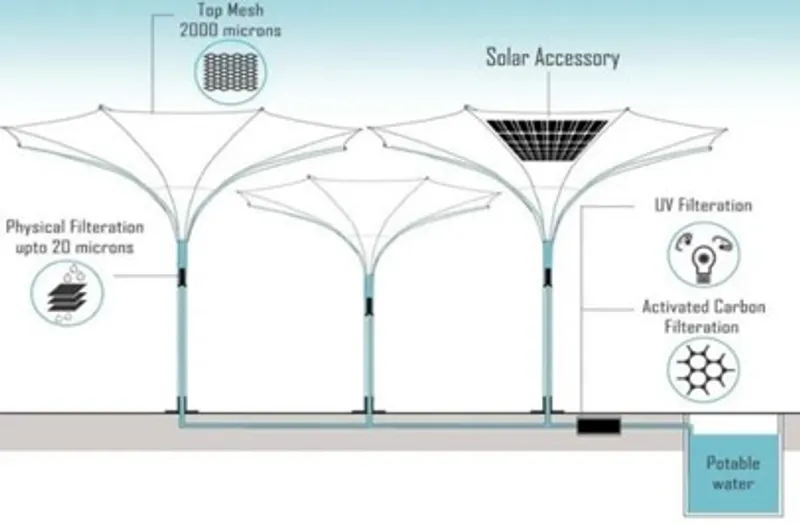
The project involves the installation of inverted umbrellas to collect rainwater in the gardens and the location of storage reservoirs underground. In addition to collecting water, they also have a shading function, so you can place lounge furniture under them. The picture shows an example of a rainwater reservoir - Ulta Chaata. This tank additionally has a solar installation and a filter.
In the designed building, external wooden door frames and wooden window frames were used. The external facade was covered with brick and travertine stone slabs in the entrance area. Gypsum plaster and wooden boards were used to finish the interior walls. Wooden ceiling slabs are also the finish of the ceilings on the above-ground storeys. Internal floors are finished with wood flooring and tiles in technical rooms and bathrooms. Wooden terrace boards were used on the terraces. Concrete is used on the underground floor. Fall layers in the flat roofs have been designed to drain rainwater to the gully. Downpipes ɸ150 and ɸ90 are placed in separate risers of the building and in insulation layers. Rainwater is discharged into retention reservoirs. The roof over the entrance area was obtained by using an arcade. The function of roofing the garden exits are balconies designed on the upper storey.




Popular Articles
Popular articles from the community


Hill & Cross Opera: Sculptural Opera House Architecture Shaped by Tallinn’s Landscape and Identity
Hill & Cross Opera reimagines opera house architecture in Tallinn through its sculptural hill, civic plaza, glass wave and a luminous cross.

Riyadh For All: Intergenerational Urban Design for Active Aging in Rabat
Riyadh For All reimagines urban design in Rabat with intergenerational co-living, adaptive courtyards, and Moroccan cultural exchange today.

Co-life: Sustainable Architecture for Age-Friendly Community Living
Co-life reimagines sustainable architecture for seniors through courtyards, rammed earth, shared gardens, and spaces designed for belonging.

The Ocean Hive: Sustainable Architecture for a Self-Sufficient Civilization at Sea
The Ocean Hive imagines sustainable architecture at sea, where modular habitats, algae, wave power and ocean waste sustain a growing colony.


Similar Reads
You might also enjoy these articles

Day and Night Park: A Time-Based Urban Newsstand in Beijing
A temporary urban newsstand in Beijing blending travel, light, and reading through poetic colors, compact form, and community-focused design.

Modernist Patio Renovation in El Masnou, Barcelona by Oliver Segura Arquitectura + Cebrià Arquitectura
Modernist patio renovation blending tradition and innovation with a movable pool, leveled floors, and Catalan materials in El Masnou.
Alto Residencial Coop: Cooperative Housing Development in Santiago de Compostela by Carbajo Barrios Arquitectos
A linear cooperative housing complex blending white volumes and perforated metal façades, enhancing community living, natural light, privacy, and urban integration.
Vil Genis School by BPA ARCHITECTURE – Massy, France
Vil Genis School in Massy, France, features sustainable design, south-facing classrooms, community integration, accessible spaces, and modern educational architecture.

Comments (0)
Please login or sign up to add comments
No comments yet. Be the first to comment!