
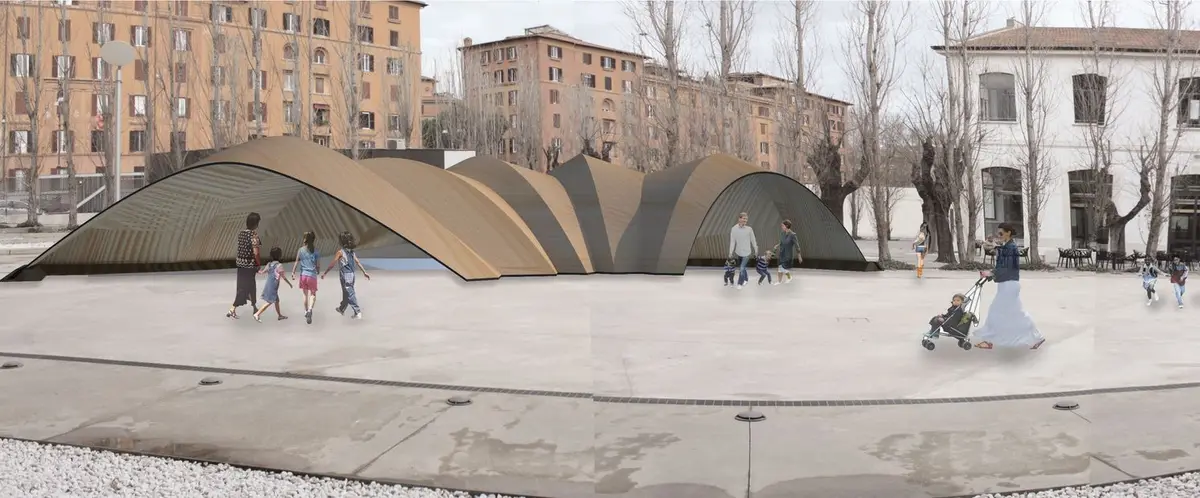
HIGROW: Programming Wood to Build Architecture That Breathes with Humidity
A lightweight shell system that uses the hygroscopic intelligence of wood to create architecture responding autonomously to climate.


What if a building could inhale moisture from the air and reshape itself in response? HIGROW abandons the conventional premise that materials are inert substrates waiting for mechanical systems to animate them. Instead, the project treats wood as programmable matter, exploiting its natural tendency to absorb and release moisture as the sole engine of architectural transformation. The result is a temporary lightweight shell that tightens in dry conditions, relaxes in humidity, and modulates its own curvature and enclosure without a single actuator, sensor, or control board.
Developed by Luigi Olivieri and shortlisted for UnIATA '18, HIGROW sits at the intersection of material science and speculative construction. The research proposes a modular shell system whose geometry, structure, and environmental behavior all emerge from one source: the intrinsic hygroscopic properties of wood fiber. It is a thesis that reframes architecture not as a fixed artifact, but as a living system calibrated to climate, time, and use.
A Shell That Derives Stability from Curvature, Not Rigidity
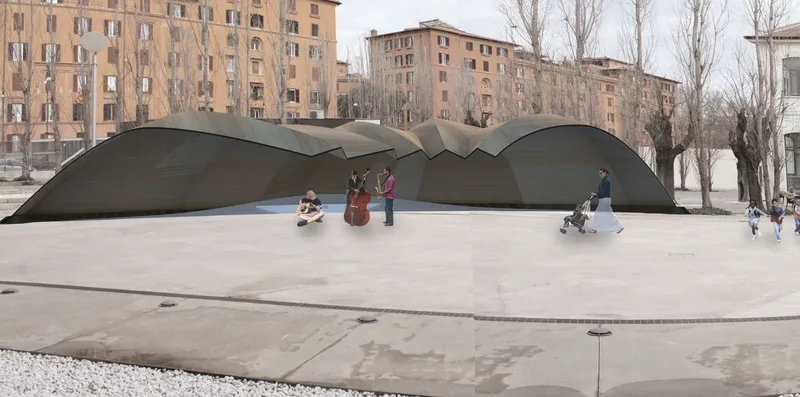
HIGROW's architectural form is a lightweight shell whose geometry is dictated not by structural hierarchy but by material logic. The research explores Gaussian curvature, both positive and negative, investigating how continuous shell surfaces can be approximated through modular wooden components. Rather than assembling a rigid frame and cladding it, the shell derives its stability from curvature and material continuity. Complex doubly curved surfaces are fragmented into planar or singly curved elements that can be fabricated simply yet still maintain overall spatial coherence. The conical, ribbed shell form reveals how geometric precision and material flexibility coexist: the structure can adapt subtly over time as moisture levels fluctuate, making it a system that is always in process.
Material Intelligence at the Cellular Scale
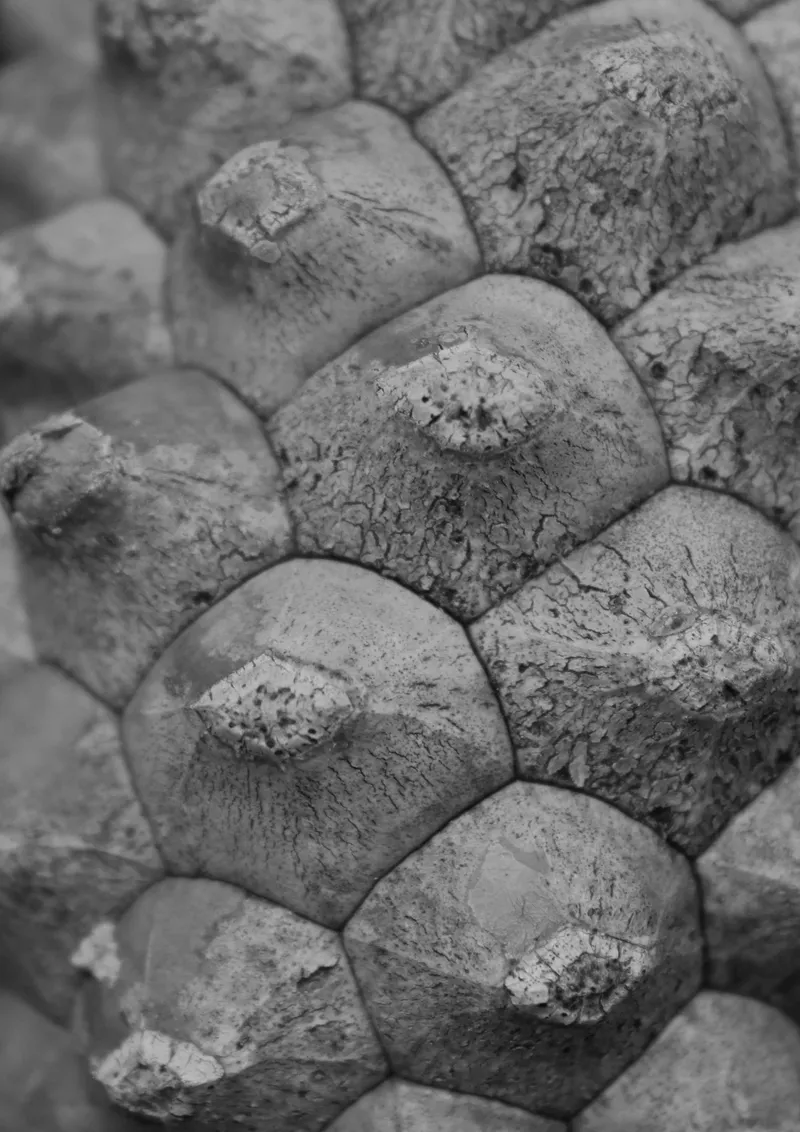
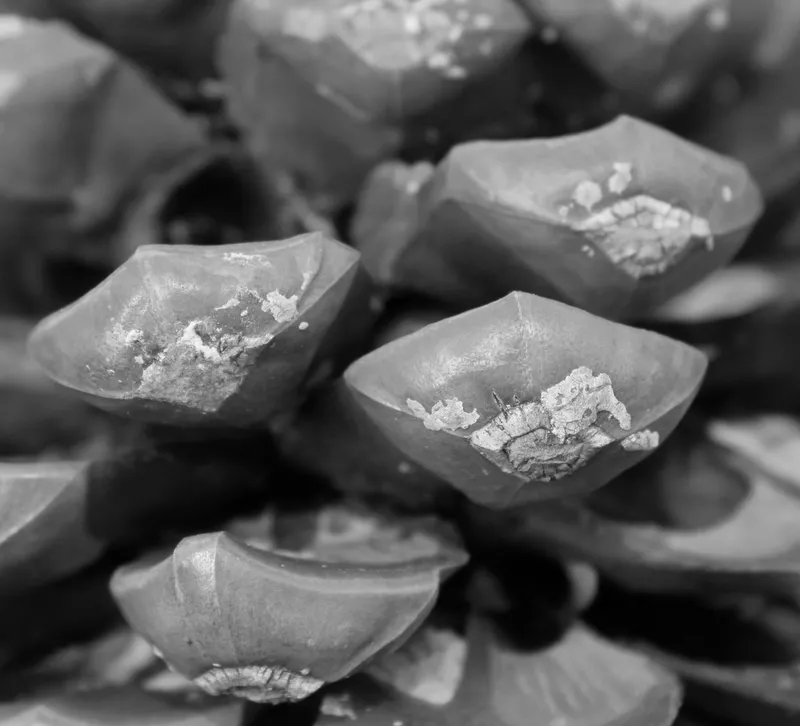
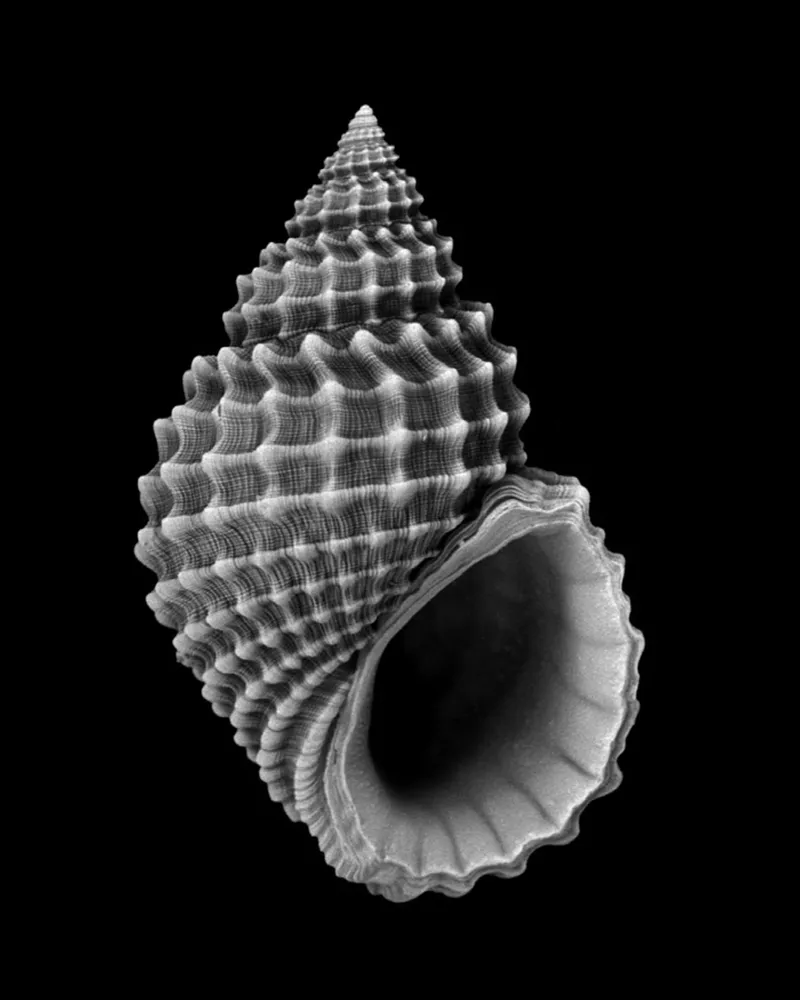
The conceptual foundation of HIGROW is the idea that performance can be embedded in matter itself. The project draws parallels with aggregate and crystalline material behaviors, studying how form can emerge from internal structure rather than external imposition. By carefully calibrating grain orientation, thickness, and curvature of each wooden component, Olivieri transforms hygroscopic movement into a predictable design parameter. Moisture content becomes the primary input; controlled deformation becomes the output. Architecture, in this framework, is never fully defined at the drawing stage. It evolves through continuous environmental interaction.
The approach operates simultaneously across three scales. At the micro scale, wood fiber orientation and surface texture govern moisture absorption and release. At the meso scale, individual modules translate that material movement into structural deformation. At the macro scale, the entire shell responds as a unified architectural system. This hierarchy ensures that environmental responsiveness is not an add-on feature but a condition embedded at every level of the design.
From Fiber to Pavilion: Prototyping Responsive Construction
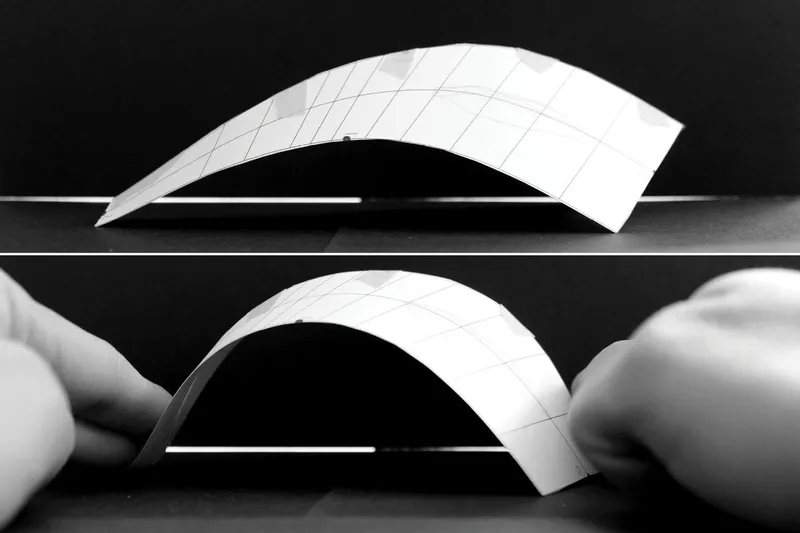
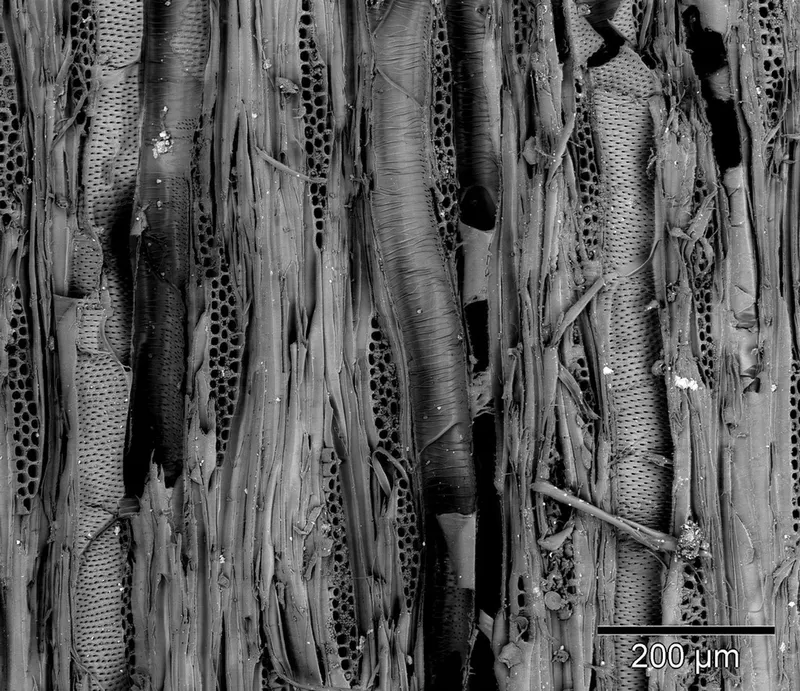
The physical model of HIGROW makes the research tangible. A gridded curved shell arches over a flat base, demonstrating how modular planar elements can be assembled into a continuous surface with structural depth. The grid is not decorative; it maps the logic of fragmentation that allows complex curvature to be built from simple parts. Viewed alongside a microscopic cross-section of wood grain, the project's multi-scalar ambition becomes clear. The cellular structure of vessels and fibers visible under magnification is the same mechanism that, scaled up through calibrated module design, produces a pavilion capable of passive climatic response.
In dry conditions, the shell tightens and draws inward. In humid environments, it relaxes and expands. These transformations are gradual and continuous, aligning architectural performance with natural cycles rather than abrupt mechanical switching. The shell modulates openness, curvature, and spatial enclosure as a direct consequence of weather, making the building itself a kind of climate instrument.
Why This Project Matters
HIGROW challenges the assumption that responsive architecture requires electronic systems. By locating intelligence in the material itself, the project proposes a model for temporary construction that minimizes energy consumption and mechanical complexity while maximizing environmental engagement. It belongs to a growing lineage of research, from Achim Menges' HygroSkin pavilion onward, that insists material behavior is not a problem to be solved but a resource to be designed with.
For designers working at the edge of material science and construction, Olivieri's thesis offers a clear proposition: if you understand what wood already wants to do, you can program architecture without writing a single line of code. The implications extend well beyond pavilion design. Any context where lightweight, adaptable, low-energy enclosure is needed, from disaster relief shelters to seasonal market structures, could benefit from the principles HIGROW establishes. It is a compelling argument that the smartest buildings may turn out to be the ones made from the simplest materials.
View the Full Project
About the Designers
Designer: Luigi Olivieri
Enter a Design Competition on uni.xyz
uni.xyz runs architecture and design competitions year-round that reward proposals with spatial conviction and real site intelligence.
Project credits: HIGROW – Hygroscopic proprieties of wood used as programmable matter in lightweight construction by Luigi Olivieri UnIATA ’18 (uni.xyz).


Popular Articles
Popular articles from the community


Cloaked Colonization: A Mobile Underwater Habitat That Moves Like a Fish
Micah Abaya's shortlisted EHC Pacific entry reimagines ocean settlement as a dispersed network of self-sustaining architectural organisms.

Faces of the Soviet Avant-Garde: Turning Moscow's Street Names into an Open-Air Museum
A network of sculptural installations across a Moscow residential district transforms forgotten architect names into spatial encounters with cultural memor

Manzana Morphosis: Stretching Barcelona's Grid into a Living Landscape for 2050
A radical reworking of the Eixample manzana turns density into a tool for generous public space, vertical ecology, and environmental performance.

Opera on the Sea: Driftwood Logic Shapes a Timber Opera House on Estonia's Coast
Trevor Orgill's opera house translates the entangled drift of floating timber into a civic building where wood, water, and music converge.

Similar Reads
You might also enjoy these articles
Sustainable Architecture Design: Embracing Nature and Modernity at Villa Solsidan
The article explores Villa Solsidan by AndrénFogelström, showcasing its sustainable architecture design and integration with the natural surroundings in Saltsjöbaden, Sweden.
Scientific and Educational Monitoring Center of the Yenisei, Krasnoyarsk
Architecture as an instrument for ecological research, education, and environmental awareness along Russia’s largest river.
Development of Andretta Artist’s Village, Palampur, Himachal Pradesh, India
Reimagining Andretta as a living cultural landscape where art, architecture, and community converge to shape a global creative village.
Street Children Rehabilitation Center: A Model of Social Architecture for Community Rehabilitation
An inclusive social architecture project that transforms streets into nurturing environments, restoring dignity, identity, and opportunity for vulnerable children.

Explore Conceptual Architecture Competitions
Discover active competitions in this discipline

Challenge to reimagine the Iron Throne

Photograph architecture without architects

Illustrate the lost glory of Angkor Wat - Render Challenge

Design challenge to reuse E-waste
Comments (0)
Please login or sign up to add comments
No comments yet. Be the first to comment!