
HOK Converts a Stove Factory Into a Law Firm HQ
Brown and Crouppen's new headquarters in St. Louis proves that adaptive reuse can rival the comfort of home while preserving industrial grit.


The premise sounds like a punchline: a personal injury law firm moves into a century-old stove factory. But Brown and Crouppen's new headquarters on King's Hill in St. Louis, designed by HOK, is one of the more convincing adaptive reuse office projects completed in 2024. The building, a robust red brick warehouse with the bones of Midwestern industry, has been gutted and reframed as a workplace organized around a simple provocation: can an office feel as good as staying home?
HOK's answer leans on the factory's existing character rather than suppressing it. Exposed timber ceilings, painted white brick, heavy trusses, and polished concrete floors do the atmospheric heavy lifting. The design layers in domestic and social zones (lounges, gardens, event spaces) alongside conventional workstations, creating a gradient from public to private that borrows more from hospitality than from corporate interiors. The result is a headquarters that feels loose and generous without tipping into the hollow playfulness that plagues so many tech-adjacent offices.
Industrial Shell, Preserved and Amplified


The street-facing facade tells you almost everything about HOK's strategy. The original red brick warehouse, with its oversized industrial windows and unadorned masonry, has been kept largely intact. There is no cladding overlay, no attempt to rebrand the exterior as something sleek. The building reads as what it is: a factory that has been cleaned up and given new purpose.
At dusk, the glass-fronted additions and a modest tower element glow against the railroad tracks, signaling contemporary occupation without competing with the industrial silhouette. It is a respectful move, and a smart one for a neighborhood where authenticity still carries weight.
Arrival and Lobby as Social Theater
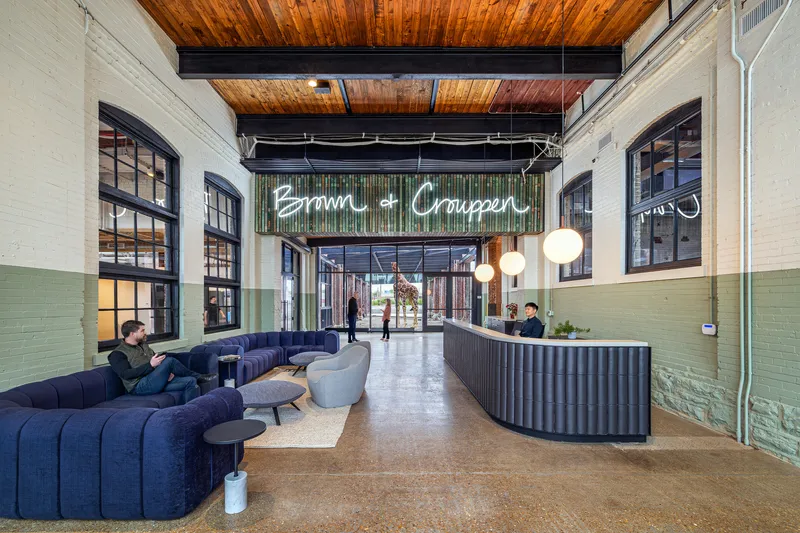
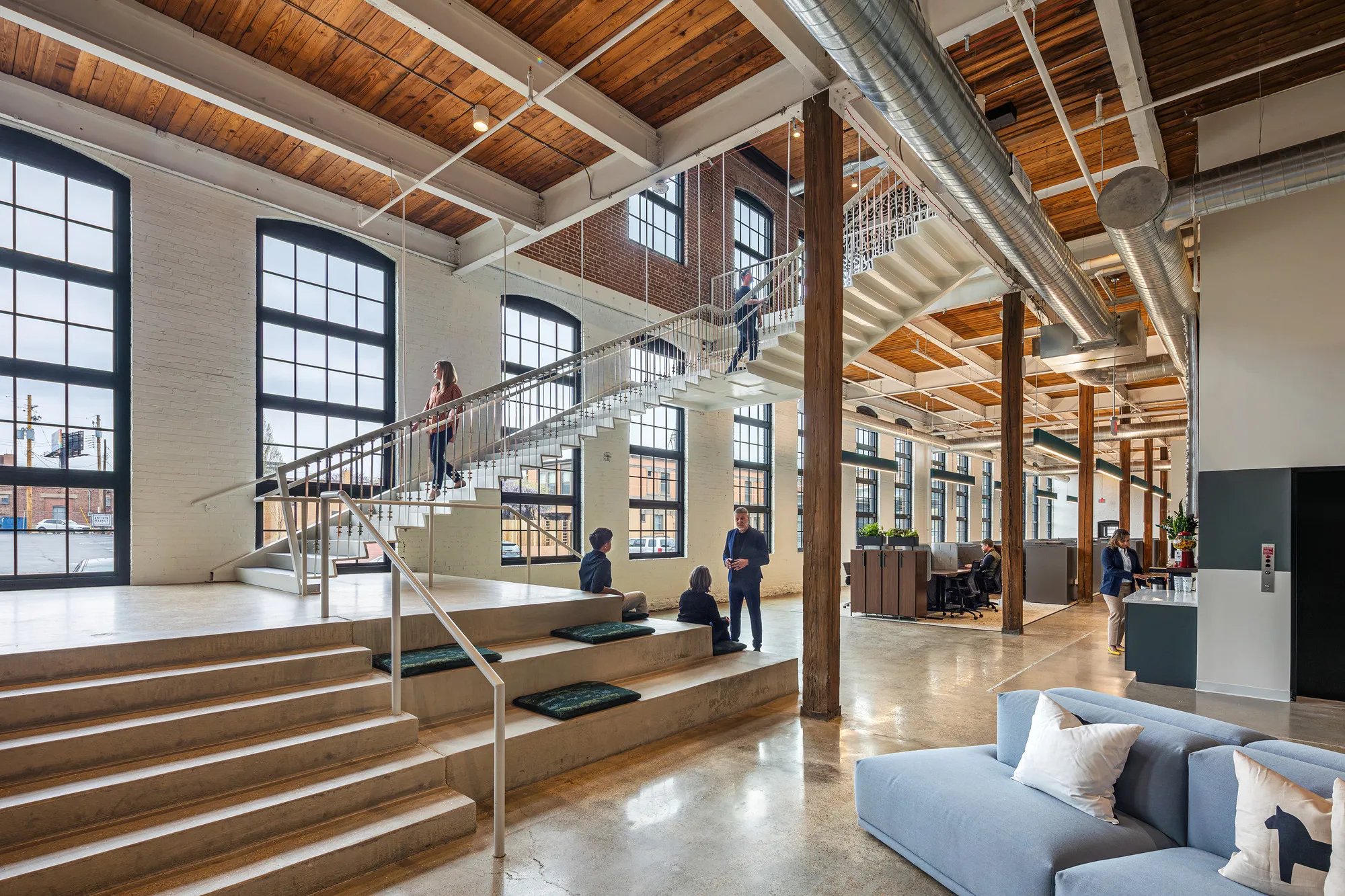
The lobby is the project's showpiece and its thesis statement. A curved corrugated reception desk sits beneath neon signage, flanked by painted brick walls and polished concrete. It is welcoming without being precious, signaling a firm that wants to be approachable rather than intimidating. The material palette here, raw and warm at the same time, sets the tone for everything that follows.
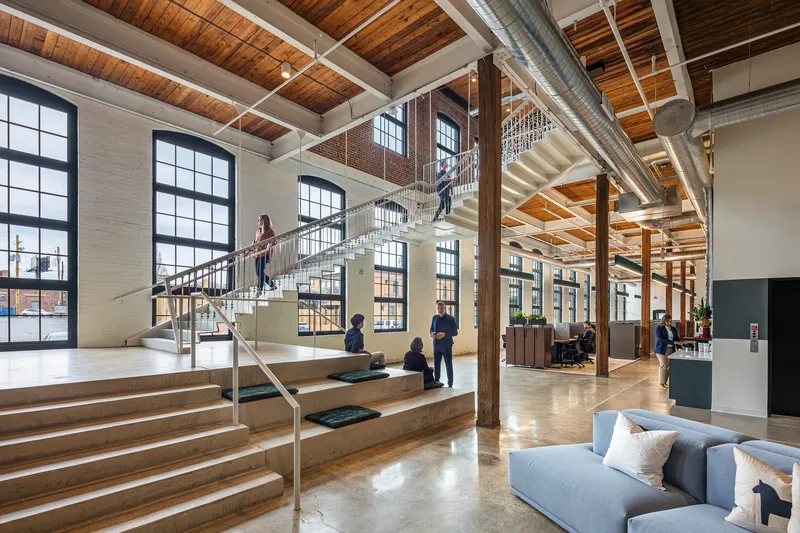
The multi-level lobby space, anchored by a steel and wood staircase and framed by heavy timber columns, functions as a kind of indoor town square. People gather on the stairs, lean against railings, look down from upper levels. The staircase is not just circulation; it is social infrastructure. HOK has positioned it so that casual encounters are inevitable, which is exactly the kind of move that justifies the expense of adaptive reuse over a clean-sheet build.
The Open Floor: Trusses, Turf, and Transparency

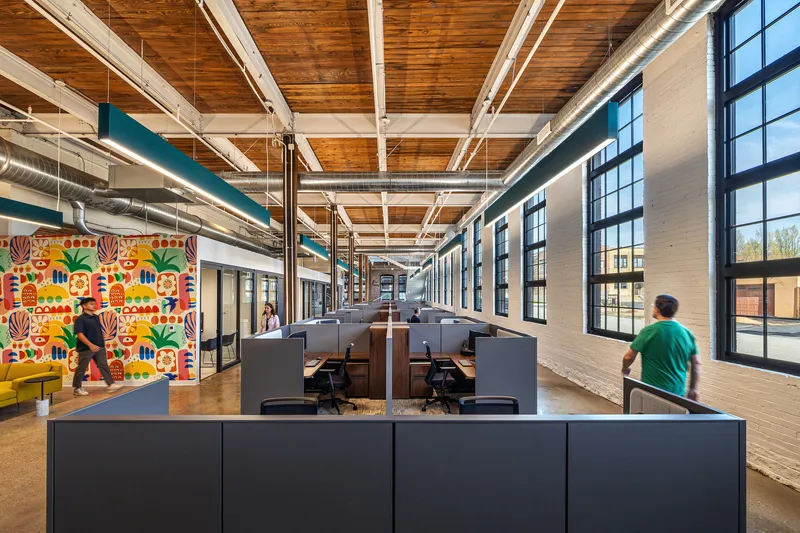
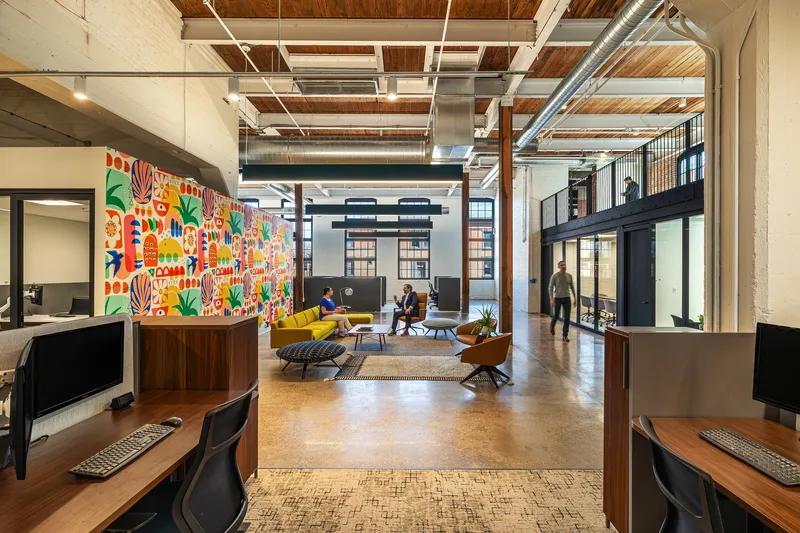
The main open office floors exploit the factory's structural generosity. White-painted trusses span wide bays, and the original timber ceiling is left exposed, giving the workspace a loft quality that no suspended grid could replicate. Transparent bubble pods offer semi-private focus zones without carving up the plan, and patches of artificial turf introduce a tactile break from the hard surfaces.
A long corridor view reveals the full extent of the floor plate: workstations line one side, colorful graphic murals animate the walls, and natural light pours through the oversized windows. A separate lounge area, fitted with pendant lights and a bold patterned mural, provides a decompression zone that feels distinct from the work floor despite sharing its structural envelope. The palette is consistent, warm timber and white surfaces, but each zone has enough identity to prevent the monotony that large open plans often produce.
Detail Moments: Brick, Steel, and Borrowed Light


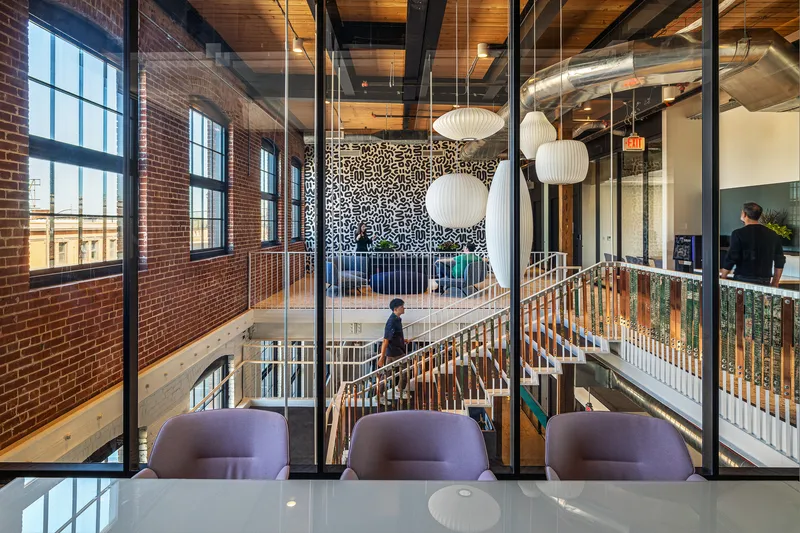
HOK is careful with the smaller moments. A double-height workspace features suspended black sculptural forms against painted white brick, turning what could be dead vertical space into a visual event. Glazed corridors with black steel frames run alongside conference rooms where the original brick has been left exposed, creating a dialogue between old and new that never feels forced.
Upper-level meeting rooms overlook the open stairwell, borrowing light and activity from the floors below. Timber railings and pendant lamps maintain the domestic register that runs through the entire project. These are not flashy interventions, but they demonstrate a consistency of thought that holds the design together across its varied program.
Plans and Drawings
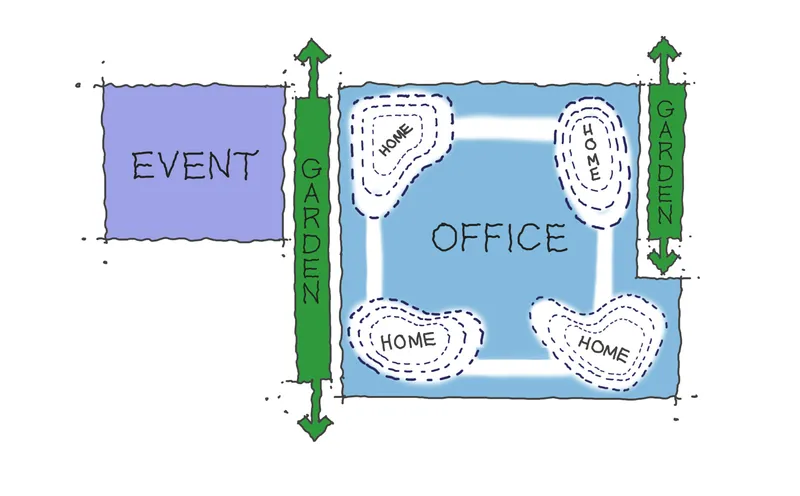

The organizational diagram makes HOK's zoning strategy legible. The plan is structured around four conceptual zones: event, office, garden, and home, with circulation arrows indicating how occupants flow between them. The intent is clear: work is just one mode among several, and the building should support all of them without forcing people through a single corridor.
The sectional drawing reveals how the interior program stacks across multiple levels, from parking below to a roof terrace above. The section also shows how HOK took advantage of the factory's generous floor-to-floor heights to insert mezzanines and double-height volumes without feeling cramped. It is a smart use of what was already there, and it explains the spatial variety that the photographs capture.
Why This Project Matters
The return-to-office debate has made workplace design a live issue again, and Brown and Crouppen's headquarters offers a genuine argument. Rather than competing on amenity gimmicks, HOK built the case around atmosphere: the warmth of timber, the scale of industrial trusses, the social pull of a generous staircase. The adaptive reuse approach did not just preserve a piece of St. Louis heritage; it gave the firm a workplace identity that no glass-box lease space could match.
For a profession that often treats adaptive reuse as a branding exercise, this project is a reminder that the strategy works best when the existing building is genuinely allowed to lead. The stove factory's bones, its brick, its structure, its proportions, are not obstacles to overcome. They are the design. HOK understood that, and the result is one of the more persuasive office conversions in recent memory.
Brown and Crouppen King's Hill Headquarters by HOK, located in St. Louis, United States. Completed in 2024. Photography by Sam Fentress.
About the Studio
Share Your Own Work on uni.xyz
If projects like this are the kind of work you want to make, uni.xyz is a place to publish your own, find collaborators, and enter design competitions.



Popular Articles
Popular articles from the community


Hill & Cross Opera: Sculptural Opera House Architecture Shaped by Tallinn’s Landscape and Identity
Hill & Cross Opera reimagines opera house architecture in Tallinn through its sculptural hill, civic plaza, glass wave and a luminous cross.

Co-life: Sustainable Architecture for Age-Friendly Community Living
Co-life reimagines sustainable architecture for seniors through courtyards, rammed earth, shared gardens, and spaces designed for belonging.

AL-JANNAH: Sustainable Architecture and Permaculture for Afghan Widows
AL-JANNAH uses sustainable architecture and permaculture to create resilient oasis of housing, learning, work and renewal for Afghan widows.

Conexión: Biophilic Design Reimagines High-Rise Living in Hong Kong
Conexión reimagines high-rise living in Hong Kong through biophilic design, green facades, shared spaces, daylight, water and nature within.

Similar Reads
You might also enjoy these articles

Bao Huynh Watercolor Atelier: A Serene Art Retreat in Hội An
Bao Huynh Watercolor Atelier in Hội An blends multifunctional art spaces, sustainable design, local materials, and family-friendly living in a serene environment.

Atelier Macri Concept Store Interior Design by CASE-REAL
Atelier Macri store features a "ko" counter, walnut wood details, cork displays, blending retail, gallery, and seamless customer experiences.

Manuel Vargas Izquierdo Stadium and High-Performance Sports Center: Architectural Excellence in Jalpa de Méndez
The Manuel Vargas Izquierdo Stadium blends sustainable design, inclusive sports facilities, and cultural-inspired architecture, revitalizing Jalpa de Méndez’s public spaces.

KAKR Buluh Awar Hall: Revitalizing Community and Ecology Through Bamboo Architecture
Community built bamboo hall revitalizes Buluh Awar village, empowering youth, restoring ecology, celebrating vernacular craftsmanship through sustainable architecture and culture.





Comments (0)
Please login or sign up to add comments
No comments yet. Be the first to comment!