
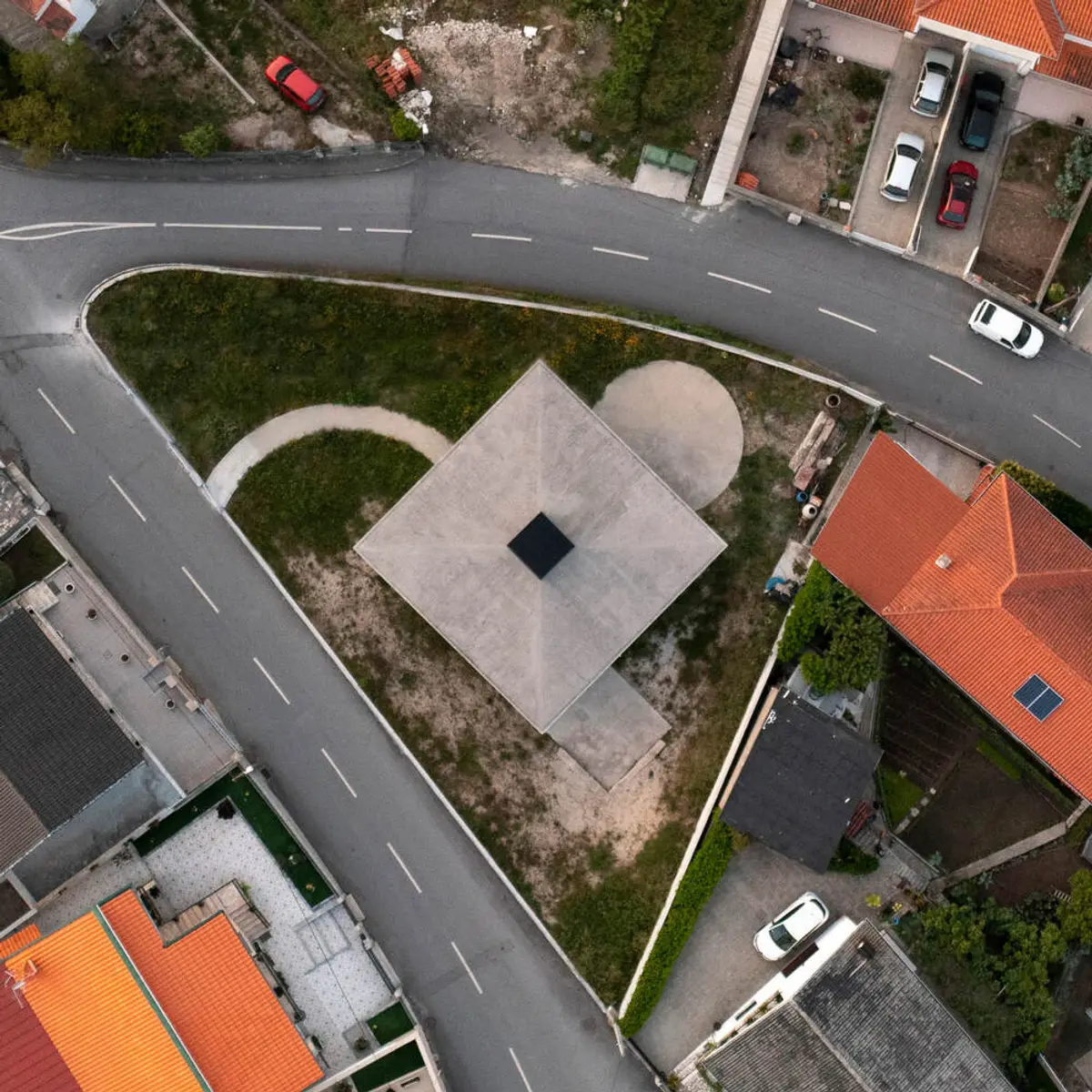
fala Places a Diamond-Plan House for Three Generations in a Portuguese Village
A square plan rotated to the cardinal points organizes private and communal life under a pyramidal roof in Marco de Canaveses, Portugal.


A house that serves three generations of a single family risks becoming either a miniature apartment block or a patronizing open plan. fala sidesteps both traps with a building whose geometry is deceptively simple: a square rotated 45 degrees so its corners aim at the four cardinal directions, topped by a pyramidal roof that makes every elevation equally important. Completed in 2021 on a corner plot in Marco de Canaveses, the 175 square meter dwelling treats multigenerational cohabitation not as a compromise but as a spatial puzzle whose solution yields something genuinely theatrical.
What makes the project compelling is how it refuses to separate private rooms from shared space with a corridor or a floor change. Instead, each generation's private domain has a distinct, apparently arbitrary shape that carves into the square plan, and the communal living area is literally the leftover: the negative of those private geometries. The result is a house where no room is subordinate and where the act of gathering feels like inhabiting the space that architecture itself made possible.
Five Elevations, Equal Weight
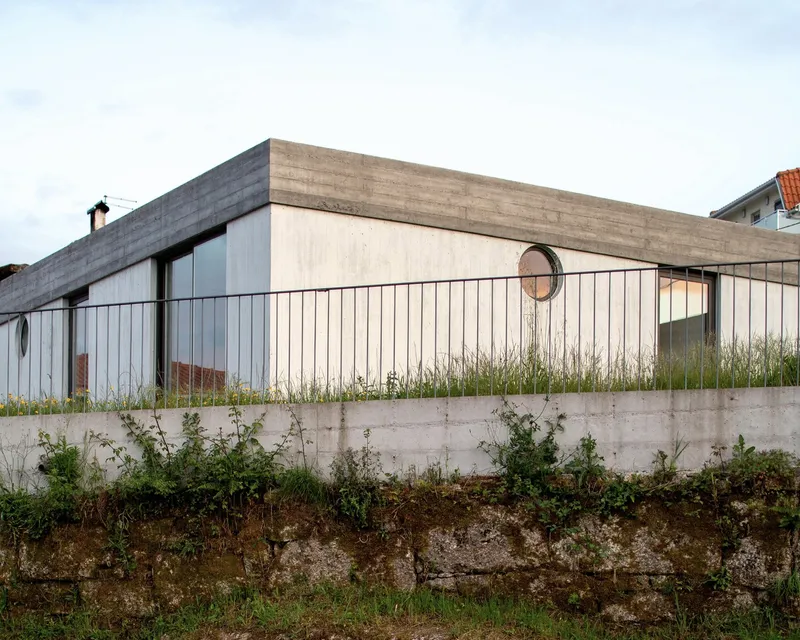
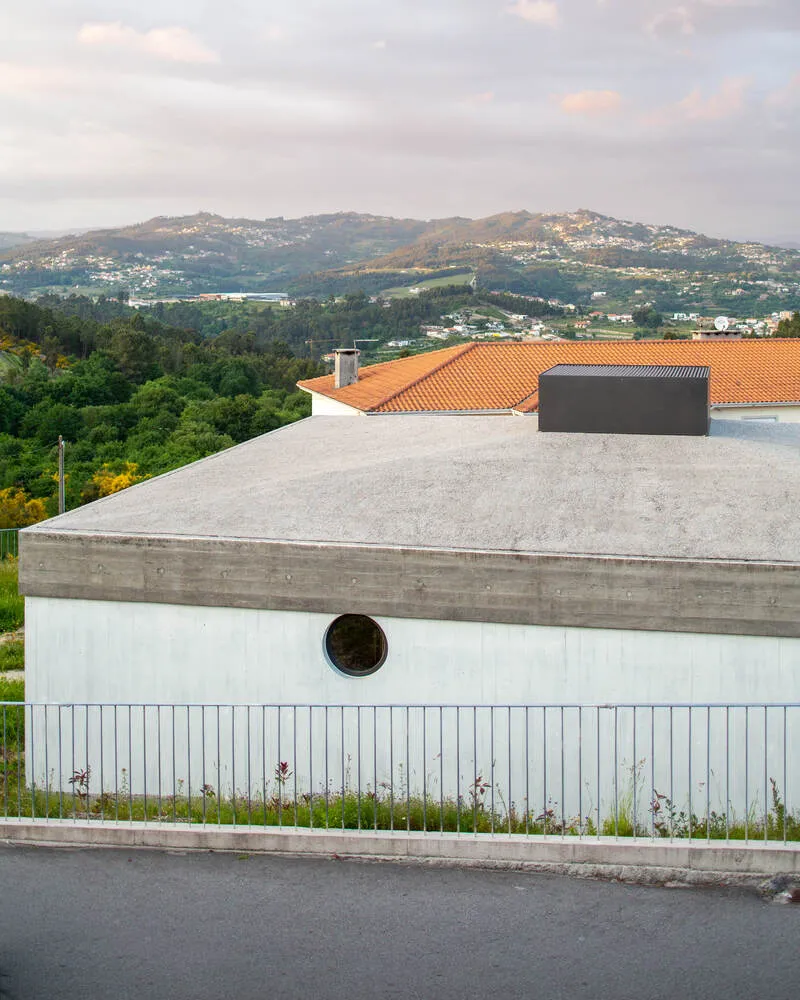
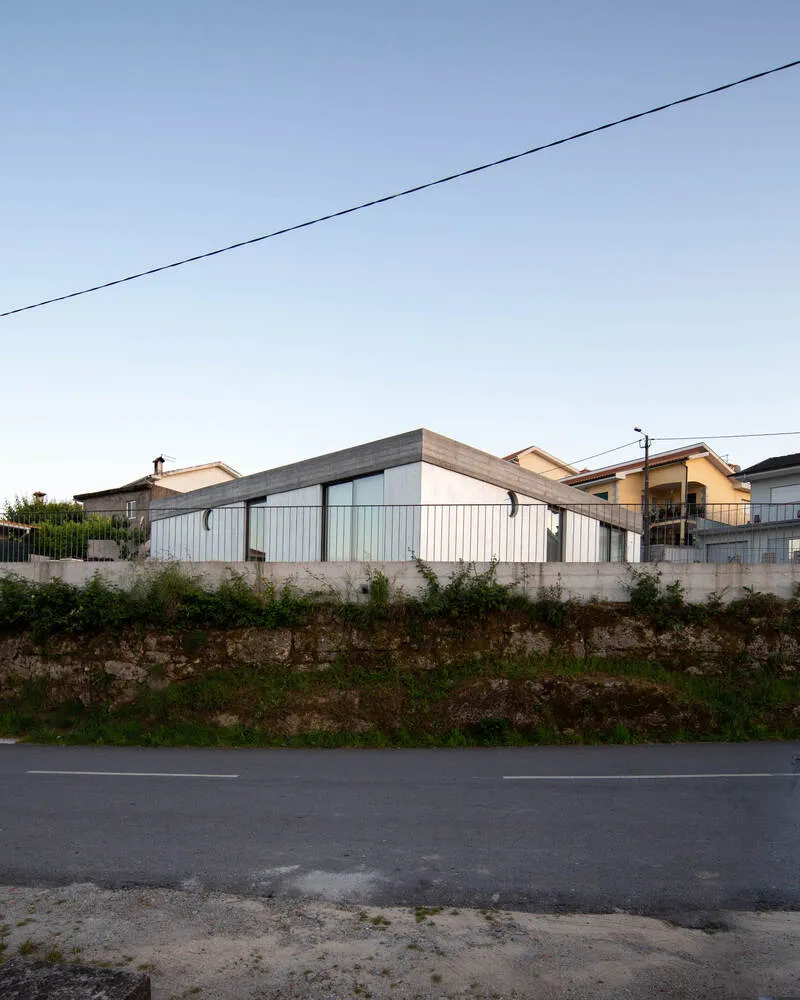
Most houses have a front and a back. fala gave this one five elevations and insisted on treating each with the same care. The decision is a consequence of the diamond plan: because the corners face the cardinal directions, pedestrians and neighbors encounter the building from oblique angles that make a single "main facade" irrelevant. Horizontal and vertical timber cladding, concrete bands, and corrugated metal wrap the volume in a material sequence that changes character with each turn.
The fenestration strategy reinforces this even-handedness. Large square windows and smaller circular portholes are distributed around the perimeter without privileging one orientation. The round openings, in particular, punctuate the timber and concrete surfaces like oversized peepholes, hinting at interior life without revealing it. The effect is sculptural: the house reads as an object placed in the landscape, not a wall pushed to the street edge.
A Concrete Crown Among Terracotta Roofs
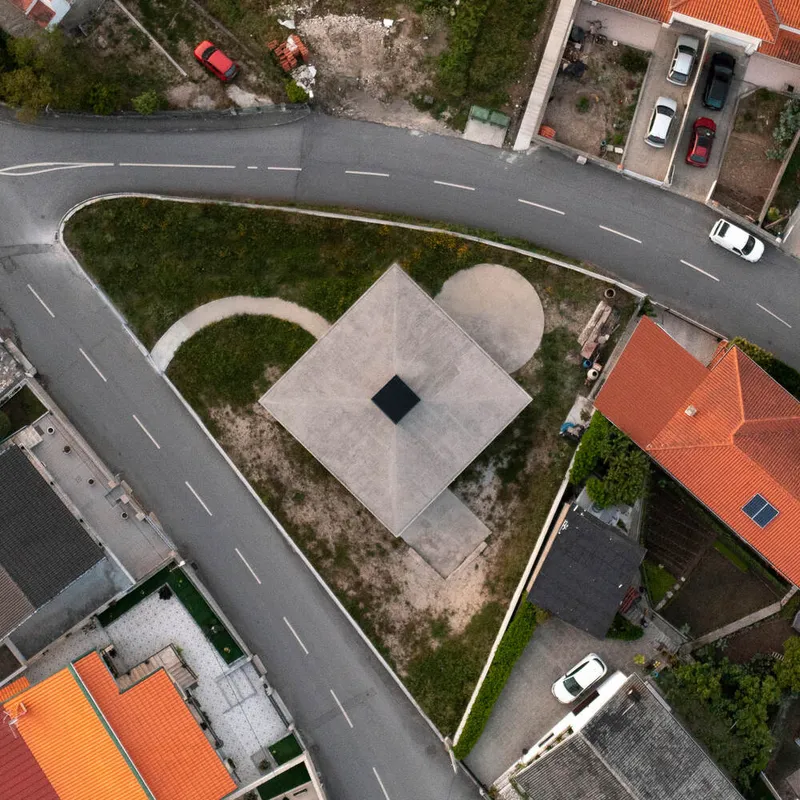
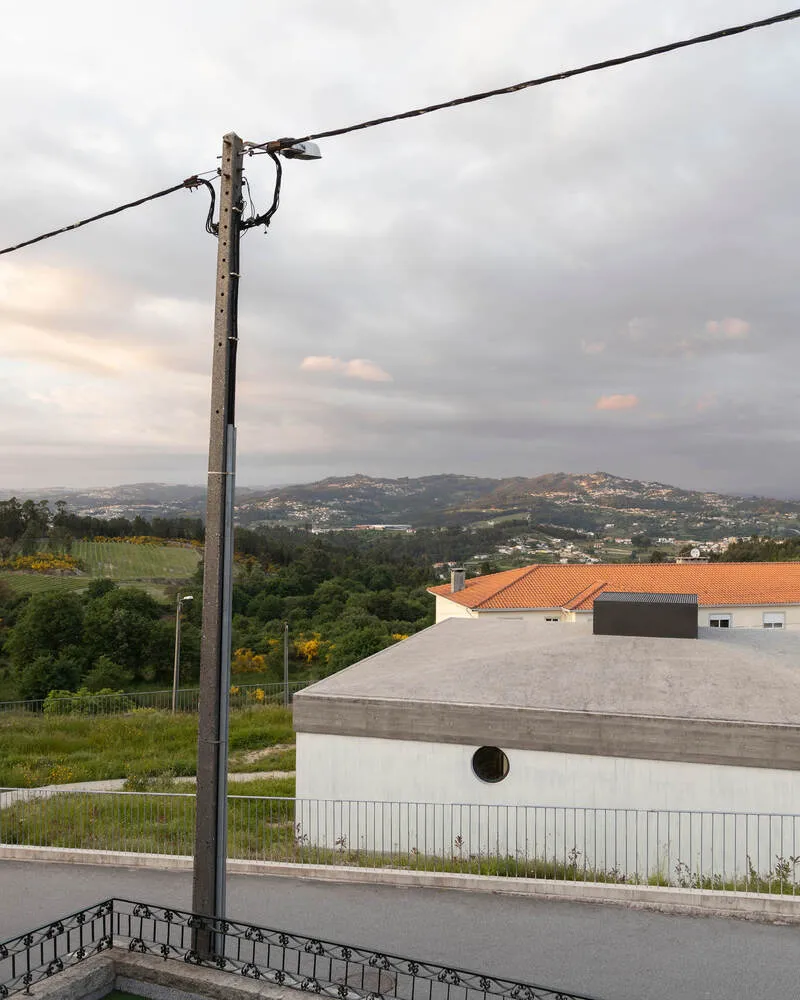
Seen from above, the pyramidal roof sits among the neighborhood's terracotta tiles like a grey gemstone in a copper setting. A centered skylight crowns the apex, pulling light down into the communal heart of the plan. The angled corner volumes visible from the drone view confirm how precisely the geometry has been executed: each fold of the roof corresponds to a shift in the plan below.
The exposed grey concrete that defines the roof and retaining walls is the building's most assertive material move. It announces the house as contemporary without resorting to glass curtain walls or cantilevered heroics. At street level, the concrete base anchors the lighter timber and metal cladding above, grounding the composition against the sloped terrain of the site.
Context and Terrain
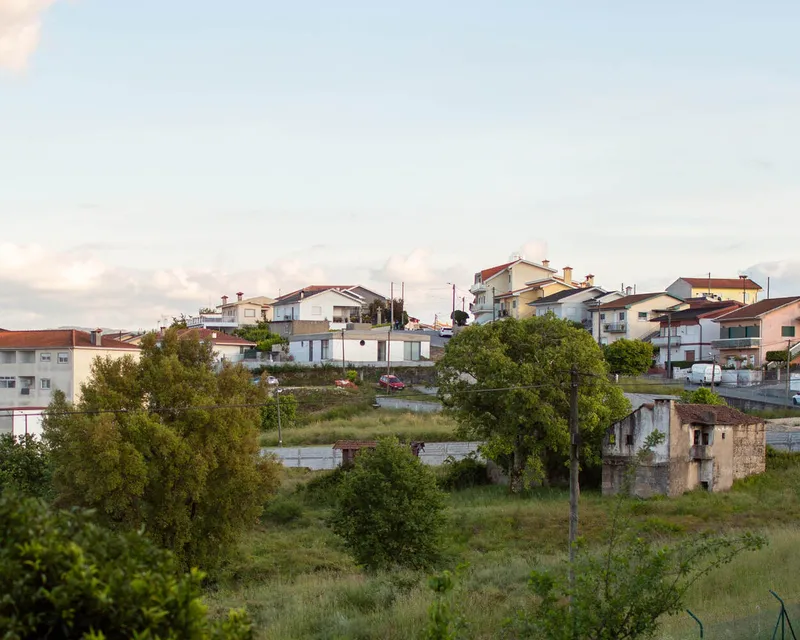
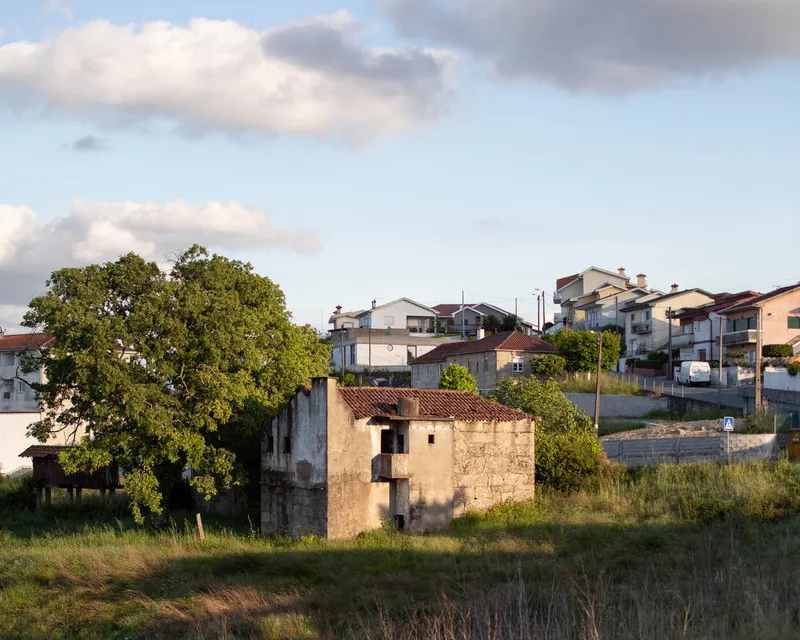
Marco de Canaveses is not a museum village. It is a working Portuguese town where older farmhouses with tile roofs sit next to suburban infill, and the landscape climbs steeply from the river valley. fala's house acknowledges this layered context without mimicking it. The overgrown foreground and the adjacent abandoned farmhouse with its mature oak tree frame the new volume as one more episode in a long sequence of construction, not as an alien arrival.
The 800 square meter site gives the 175 square meter building room to breathe. Rather than consuming the lot, the house occupies its corner position and lets the remaining land absorb the grade change. Concrete retaining walls negotiate the slope, doubling as exterior surfaces that extend the building's material language into the ground itself.
Interior Logic: Column, Floor, Light
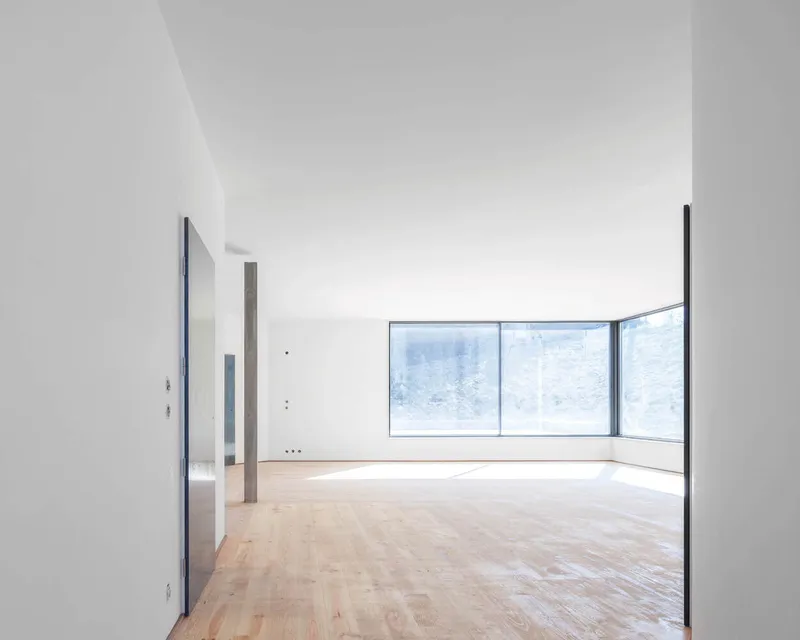
Inside, fala deploys a limited palette of white-painted concrete walls and oak parquet flooring to keep the spatial drama in the geometry, not the finishes. The corner glazing visible in the interior shots frames precise views of the retaining wall and garden, turning the perimeter into a series of controlled landscapes rather than panoramic openness.
The most provocative interior gesture is the rough concrete column that stands in the communal living area without touching the ceiling. It carries no structural load. Instead, it acts as a conceptual anchor: a point from which the wooden floor planks radiate centrifugally, marking the boundary between different domestic activities. The column is simultaneously absurd and essential, a piece of scenography that reminds inhabitants they are sharing a single, unified space even as they cook, read, or watch television in different zones.
fala describes the relationship between private and communal programs as inducing a "theatrical domestic environment," and the description is apt. The oddly shaped private rooms, each tailored to one generation, push and pull against the square envelope. What remains is a living area whose plan could not have been drawn first; it only exists because the private geometries were subtracted from it. That inversion of the normal design sequence, where common space is typically planned first and bedrooms fill the gaps, gives the house its distinctive spatial charge.
Why This Project Matters
Multigenerational housing is a growing necessity across Southern Europe, where economic pressures and aging populations push families back under one roof. Most architectural responses treat the problem as a zoning exercise: split the house into self-contained units and call it done. fala's House for Three Generations takes the opposite approach, arguing that the tension between private identity and collective life is itself a design resource. The irregular private rooms give each generation a space that feels uniquely theirs, while the shared area, shaped by those very irregularities, becomes an unpredictable commons that rewards daily discovery.
The project also demonstrates that geometric rigor and domestic warmth are not opposites. The diamond plan, the pyramidal roof, the non-structural column, and the centrifugal flooring are all formal decisions with real experiential consequences: they determine where light falls, how sound travels, and where people pause. In a discipline that too often separates formal invention from lived comfort, fala proves that the two can be the same thing.
House for Three Generations by fala, Marco de Canaveses, Portugal. 175 m², completed 2021. Engineering by Paulo Sousa; contractor ASV. Photography by Ivo Tavares Studio, Ricardo Loureiro, and Giulietta Margot.
About the Studio
Share Your Own Work on uni.xyz
If projects like this are the kind of work you want to make, uni.xyz is a place to publish your own, find collaborators, and enter design competitions.


Popular Articles
Popular articles from the community


Extended Shell: Retrofitting Kolkata's Balconies as Living Urban Thresholds
A modular retrofit system recovers the social and environmental intelligence of Kolkata's historic verandas for contemporary Park Street residents.

Faces of the Soviet Avant-Garde: Turning Moscow's Street Names into an Open-Air Museum
A network of sculptural installations across a Moscow residential district transforms forgotten architect names into spatial encounters with cultural memor

Singing Woman: Contemporary Architecture Inspired by Estonia’s Voice and the Sea
Singing Woman turns Estonia’s song culture into flowing opera house architecture, blending public life, landscape, sea, and national memory.

The Amber Palace Opera: A Geological Fiction Surfaces on Tallinn's Baltic Waterfront
Pierre Brillard reimagines a Baltic legend as a public landscape, opera house, and waterfront promenade rooted in Tallinn's coastal identity.

Similar Reads
You might also enjoy these articles


Hodi-Mandai Geram
Project Function: Preservation and revitalization of the Intangible heritage and socio-spatial identity of the Hodi by Housing, Cultural Memory Center, Sacred Grove, landscape, local tourism economy


Olio Towers: A Mid-Rise for Performers That Fuses Housing, Rehearsal, and Stage
Located blocks from Houston's Theater District, this modular tower stacks living units around a central performance atrium.

Oasis: Modular Green Housing Carved into Dhaka's Urban Fabric
A shortlisted Plugin Housing entry reclaims unauthorized settlements in Dhaka with stepped concrete volumes, green roofs, and ventilation-driven design.

Black Hole: A Floating Megastructure for the Post-Physical Era
Emiliano Mazzarotto envisions a spherical, self-scaling arena where e-sports, digital hotels, and holographic stadiums replace traditional public space.

Explore Architecture Competitions
Discover active competitions in this discipline

Challenge to reimagine the Iron Throne

Photograph architecture without architects

Illustrate the lost glory of Angkor Wat - Render Challenge

Design challenge to reuse E-waste
Comments (0)
Please login or sign up to add comments
No comments yet. Be the first to comment!