

House MM Stretches a Timber Roof Across the Quiet
Equipe Lamas designs a single-story, 630 m² residence in São Paulo's interior where an expansive timber structure mediates between domestic life and tropic


There is a certain discipline to building a single-story house at 630 square meters. The temptation to stack vertically, to compress the footprint and claim more garden, is enormous. Equipe Lamas, led by Samuel Lamas, refused that impulse for House MM in São José do Rio Pardo, a mid-sized city in the interior of São Paulo state. The result is a house that unfolds horizontally beneath a commanding gabled roof, its exposed timber trusses becoming the dominant architectural gesture. Everything else, the white masonry walls, the perforated brick screens, the lattice panels, plays a supporting role to that sheltering canopy.
What makes House MM genuinely compelling is the way it treats threshold and transition as the real program of the house. Rather than drawing a hard line between indoors and outdoors, the design proliferates covered walkways, screened passages, and terraces that belong to neither fully. The roof overhangs far beyond the enclosed rooms, creating inhabitable shade. You move from pool deck to dining room to courtyard without ever feeling like you've crossed a wall. In a climate that rewards shade and ventilation over insulation and enclosure, this is architecture doing exactly what it should.
The Roof as Main Character
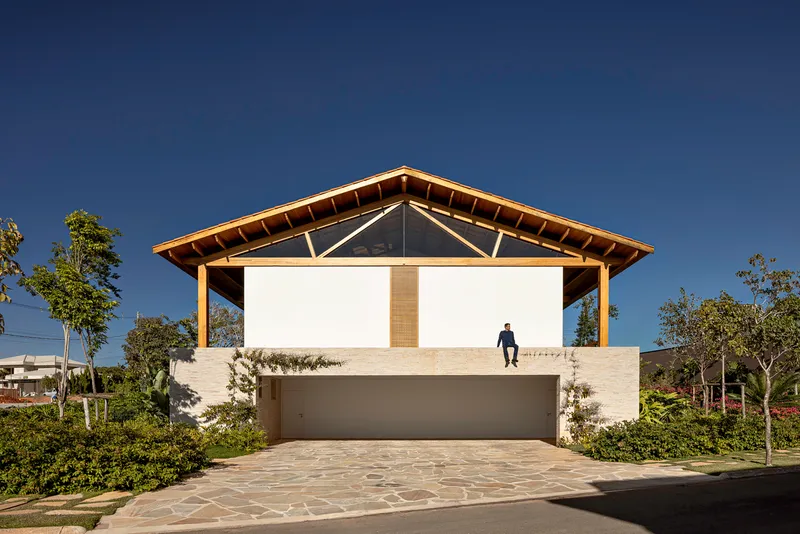
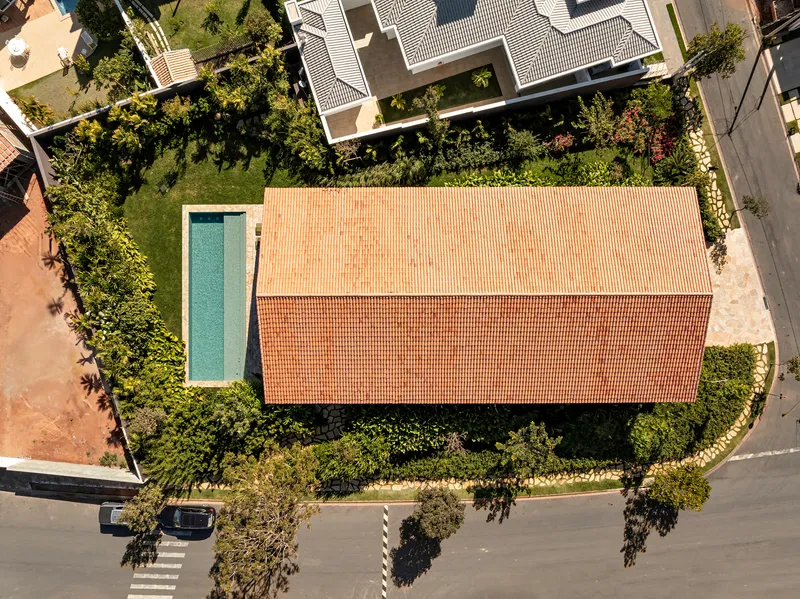
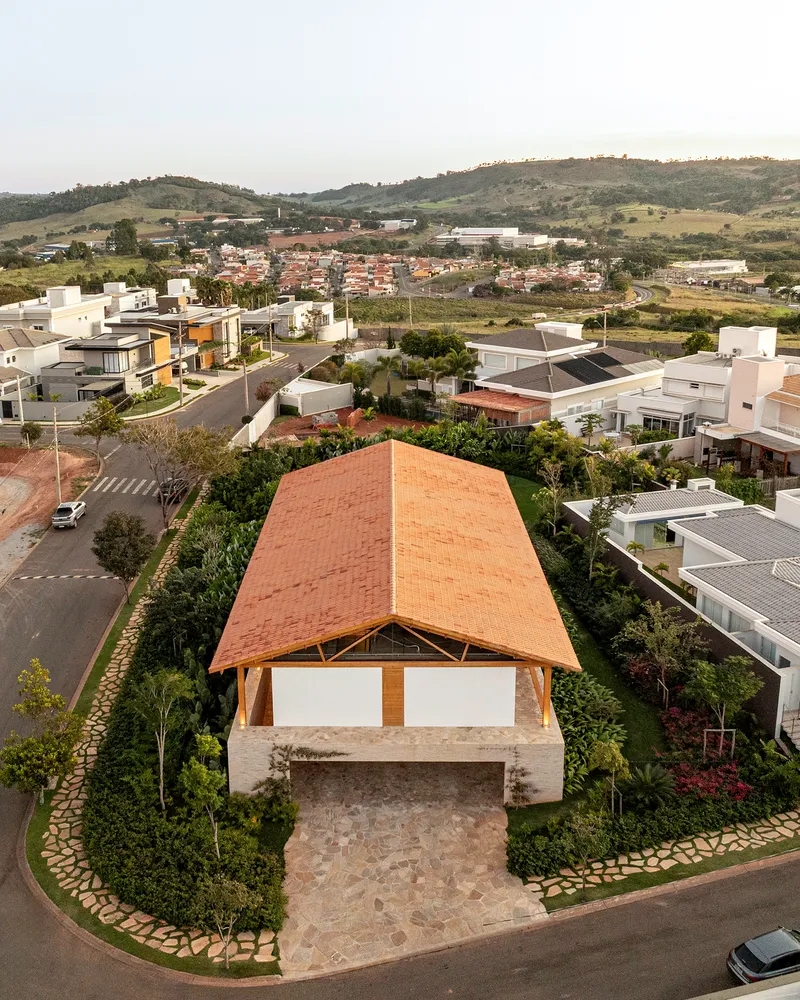
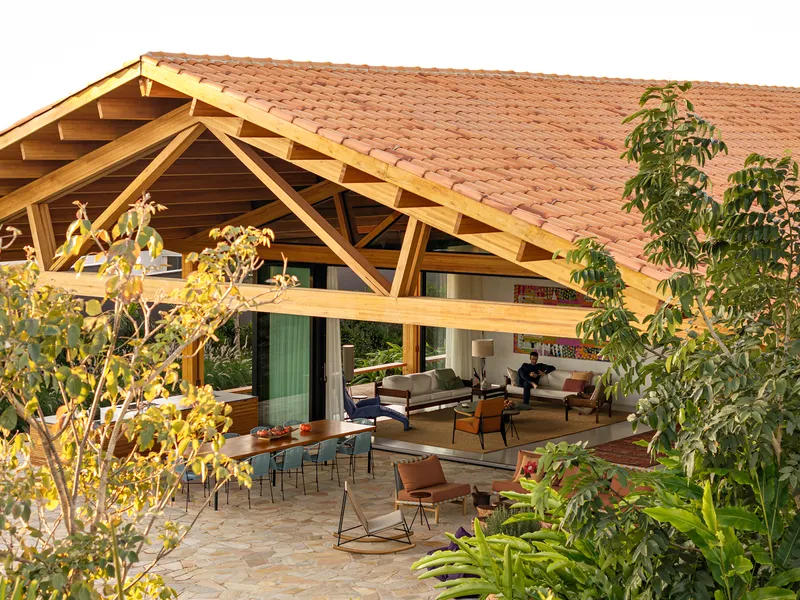
From the street, House MM presents a low, pitched roofline clad in clay tiles, its timber structure frankly exposed at the eaves and gable ends. The aerial views confirm what you sense from the ground: this is a house organized by its roof. The long, rectangular volume with its generous overhangs reads almost like a rural shed translated into domestic terms, nestled among mature trees and backed by a rectangular pool.
The choice of clay tiles is worth noting. In a market saturated with flat concrete roofs and standing-seam metal, the pitched terracotta roof connects House MM to the vernacular building traditions of São Paulo's interior. It's not nostalgic; the proportions are too clean, the spans too confident. But it acknowledges a lineage, and that acknowledgment gives the house weight.
Screens, Lattices, and Filtered Light
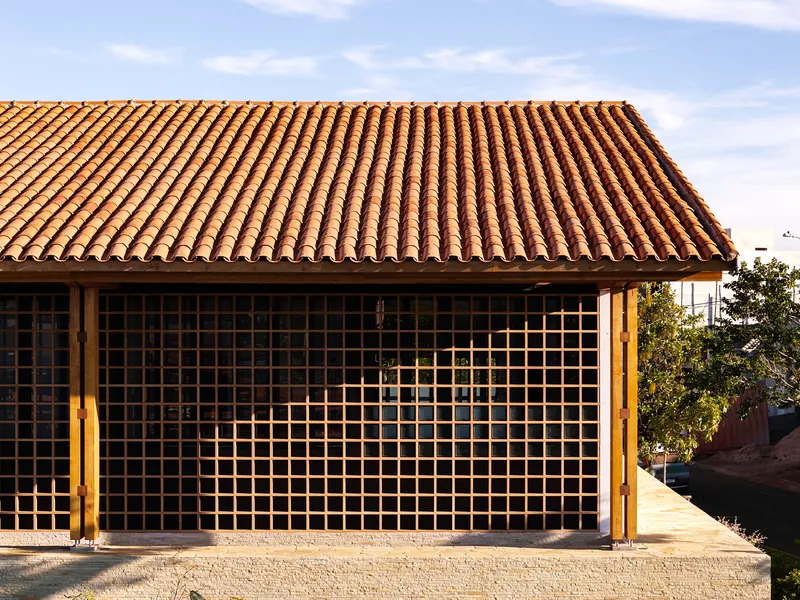
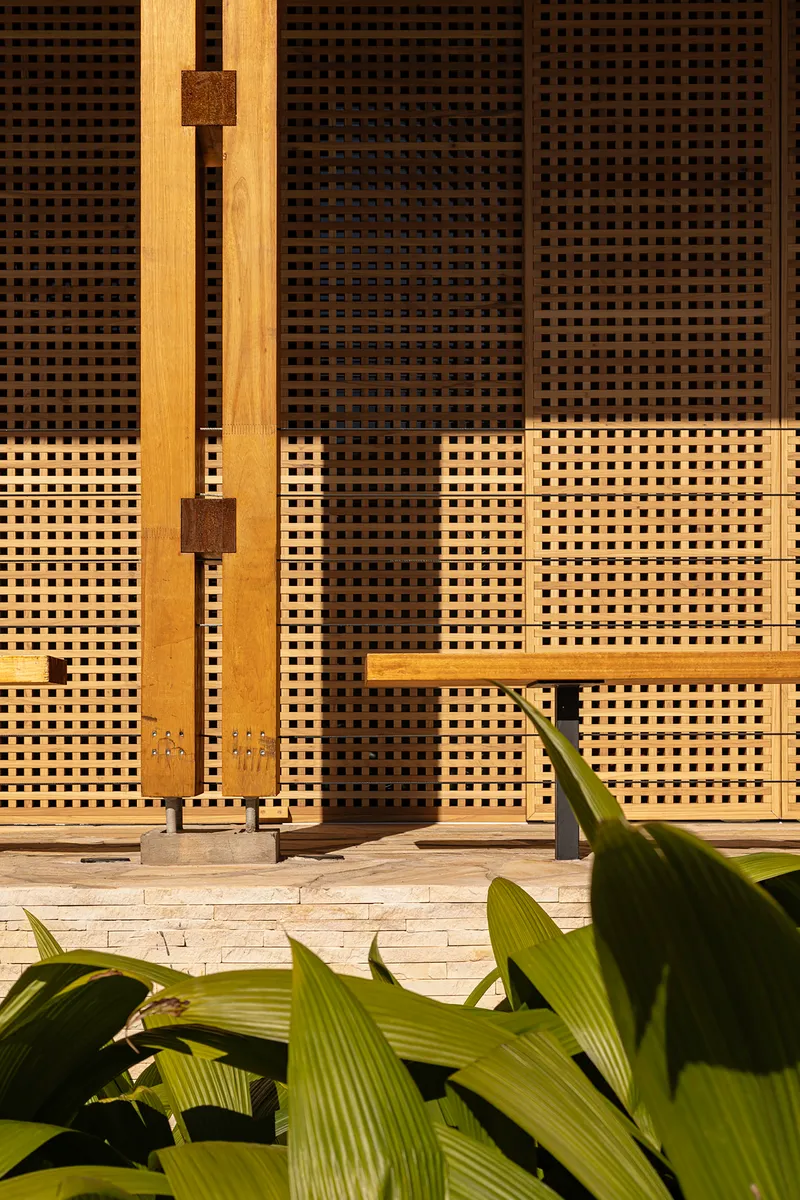
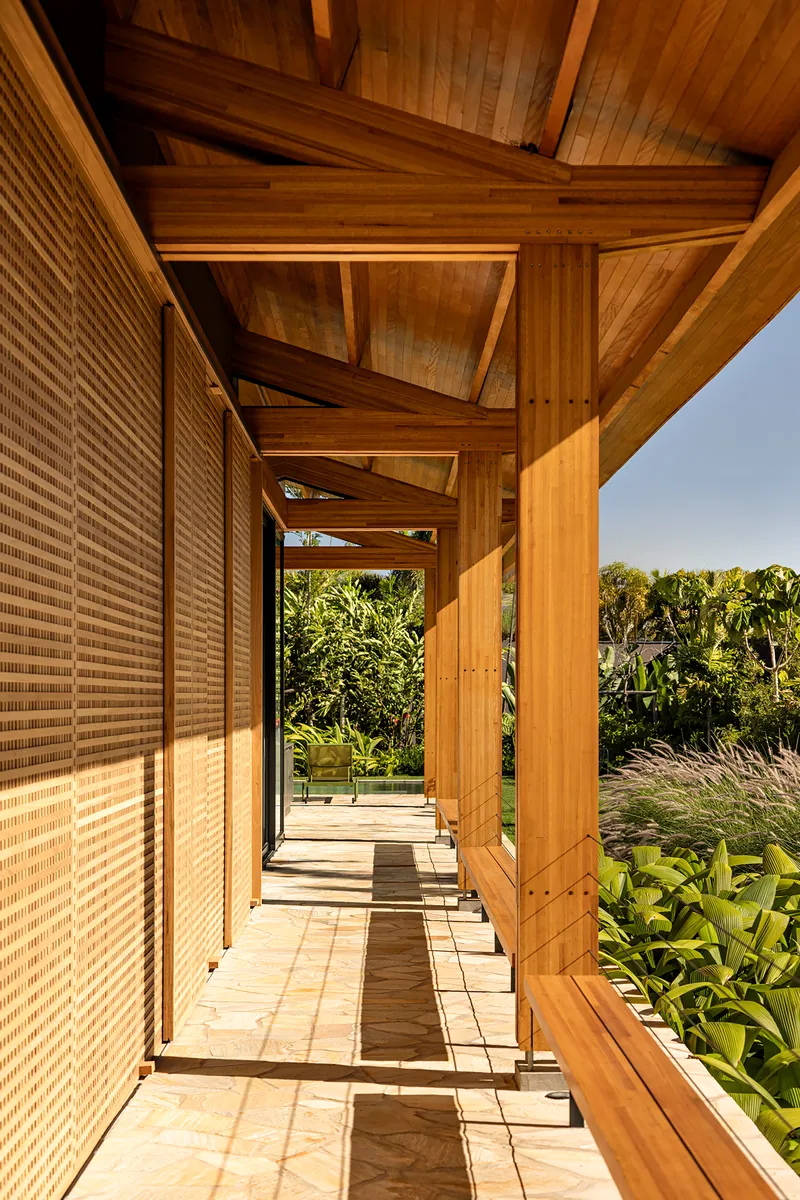
The facades of House MM are never simply walls. They are layered assemblies of timber lattice, woven panels, and perforated brick that filter sunlight and ventilation simultaneously. Up close, the woven lattice panels have a textile quality, casting intricate dappled shadows onto sandstone pavers below. These are passive environmental devices that also happen to be beautiful, doing real thermal work while giving the elevations rhythmic depth.
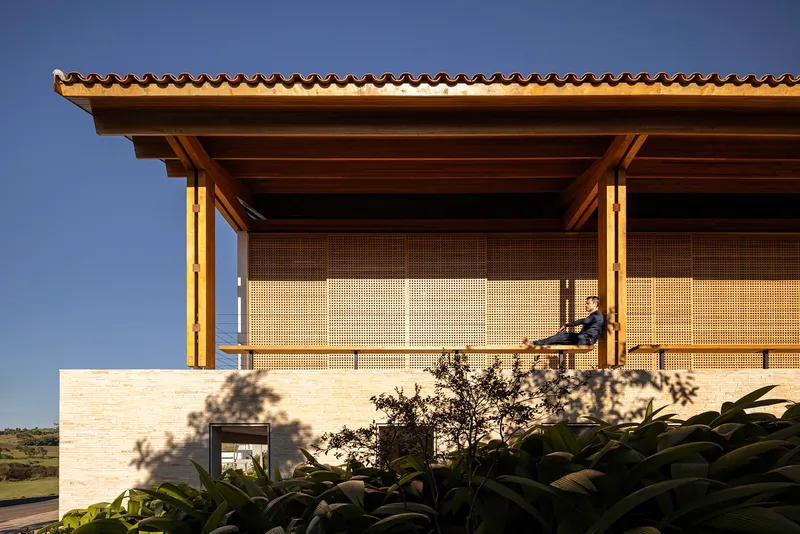
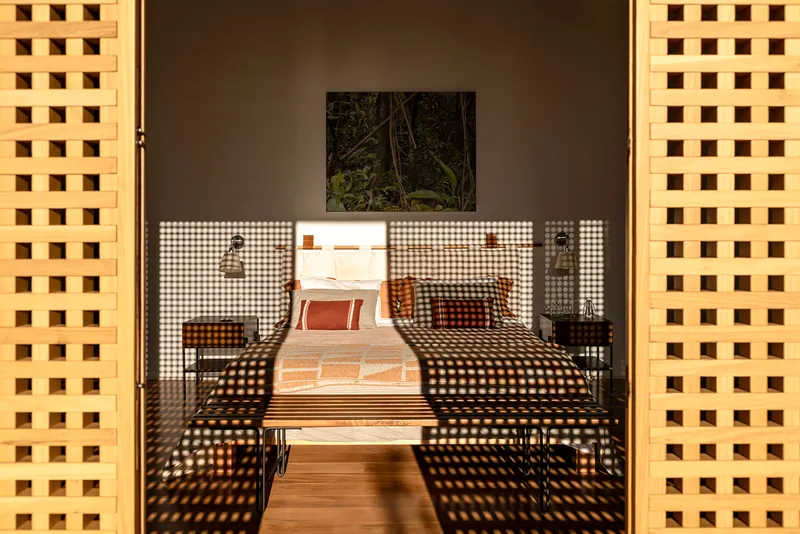
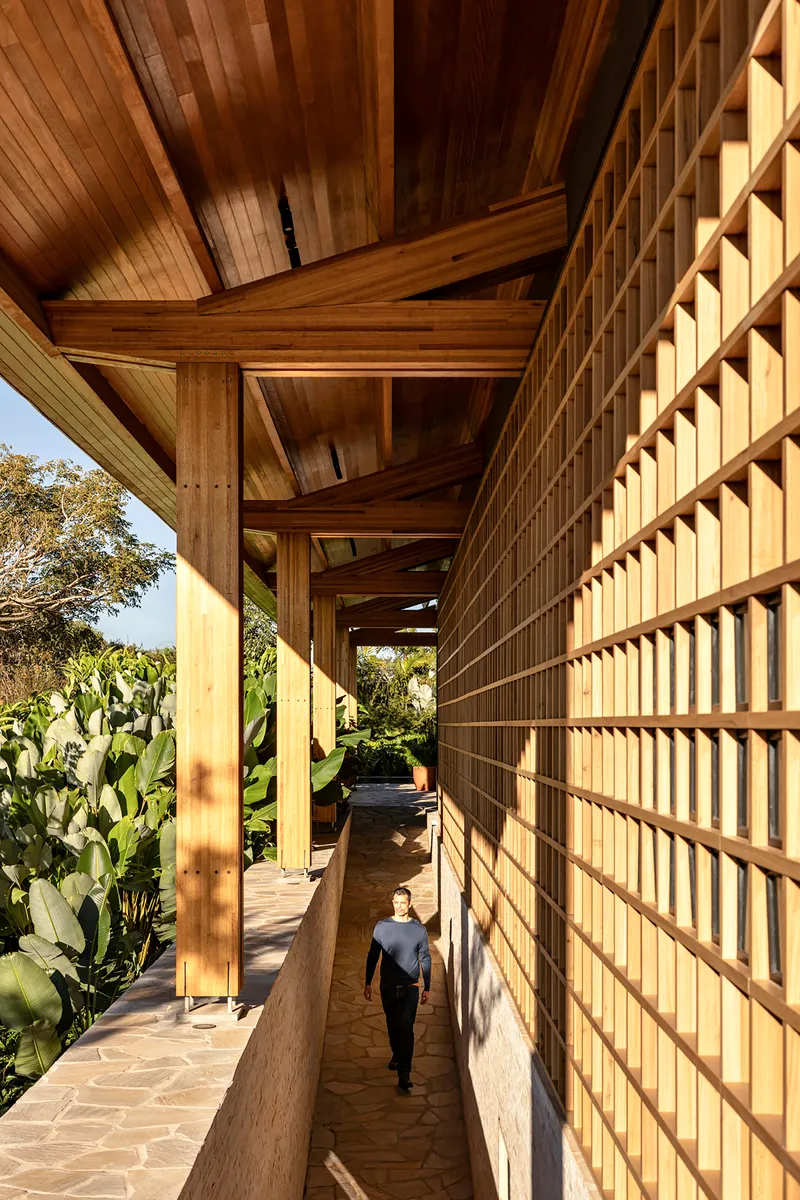
The perforated brick screens deserve particular attention. At dusk, the upper terrace glows through these panels like a lantern, the regular pattern of voids turning the masonry into a luminous scrim. In the bedrooms, yellow-toned brick with chequered openings throws geometric shadows across the interior, creating a constantly shifting pattern tied to the sun's path. Samuel Lamas treats these screens not as decorative elements but as instruments for calibrating the relationship between inside and outside.
Living Under Exposed Trusses
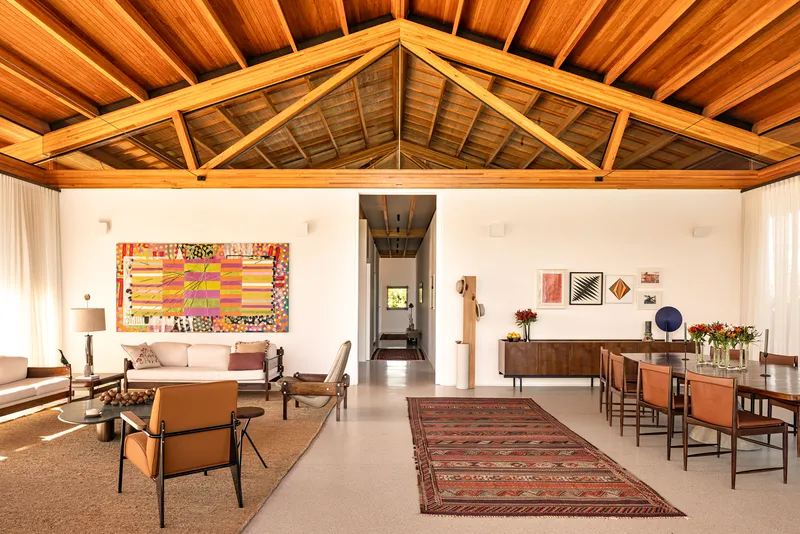
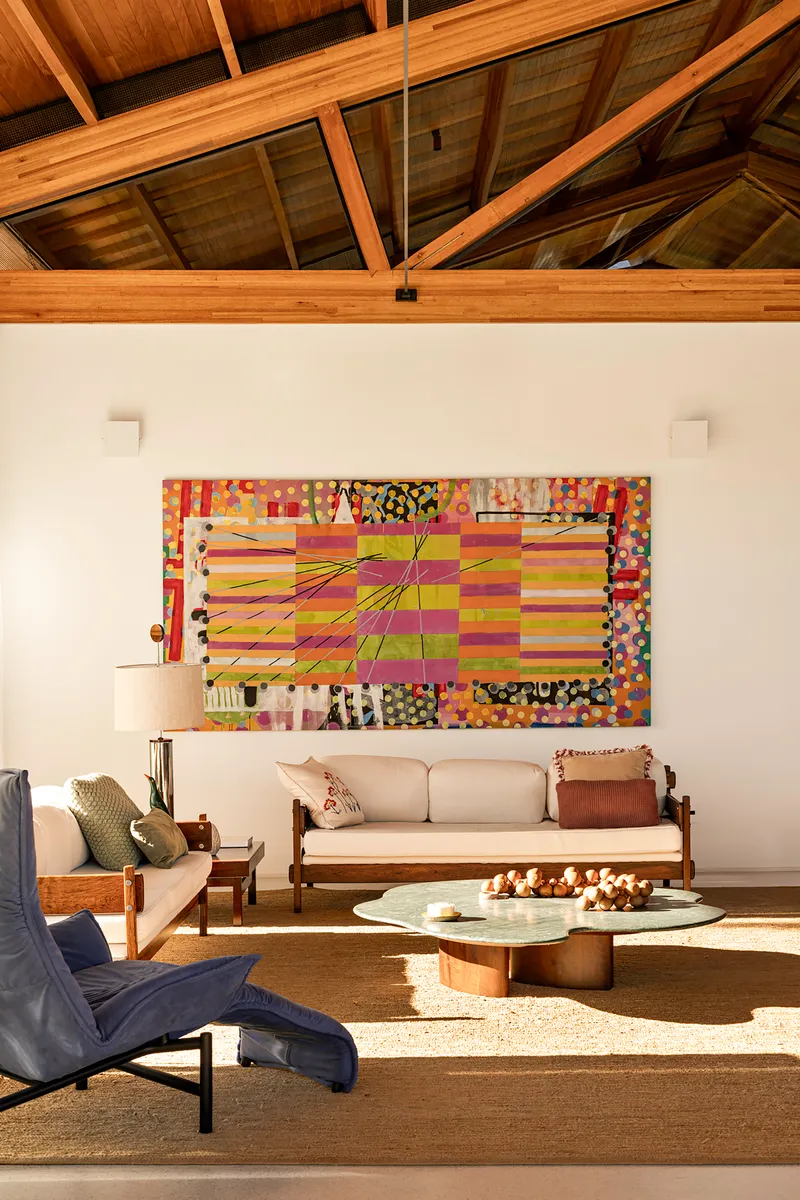
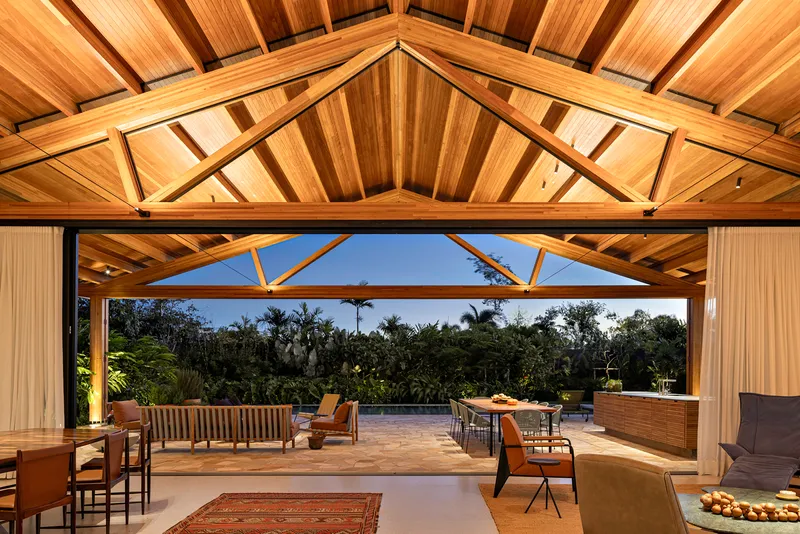
The open-plan living and dining area is the spatial heart of the house, and the exposed timber trusses overhead define its character entirely. Tongue-and-groove ceiling planks span between the trusses, their warm grain contrasting with the cool white of the walls below. The structure is not hidden or apologized for; it is the ceiling.
At dusk, the living room looking out to the garden achieves a particular quality. The low sofa, the abstract artwork, the slender truss members catching the last light: the room feels generous without being cavernous, because the pitched ceiling provides vertical relief while the horizontal datum of furniture and window sills keeps things grounded. This is a room that would feel entirely different with a flat ceiling, and the architects clearly understood that.
Thresholds and Covered Passages
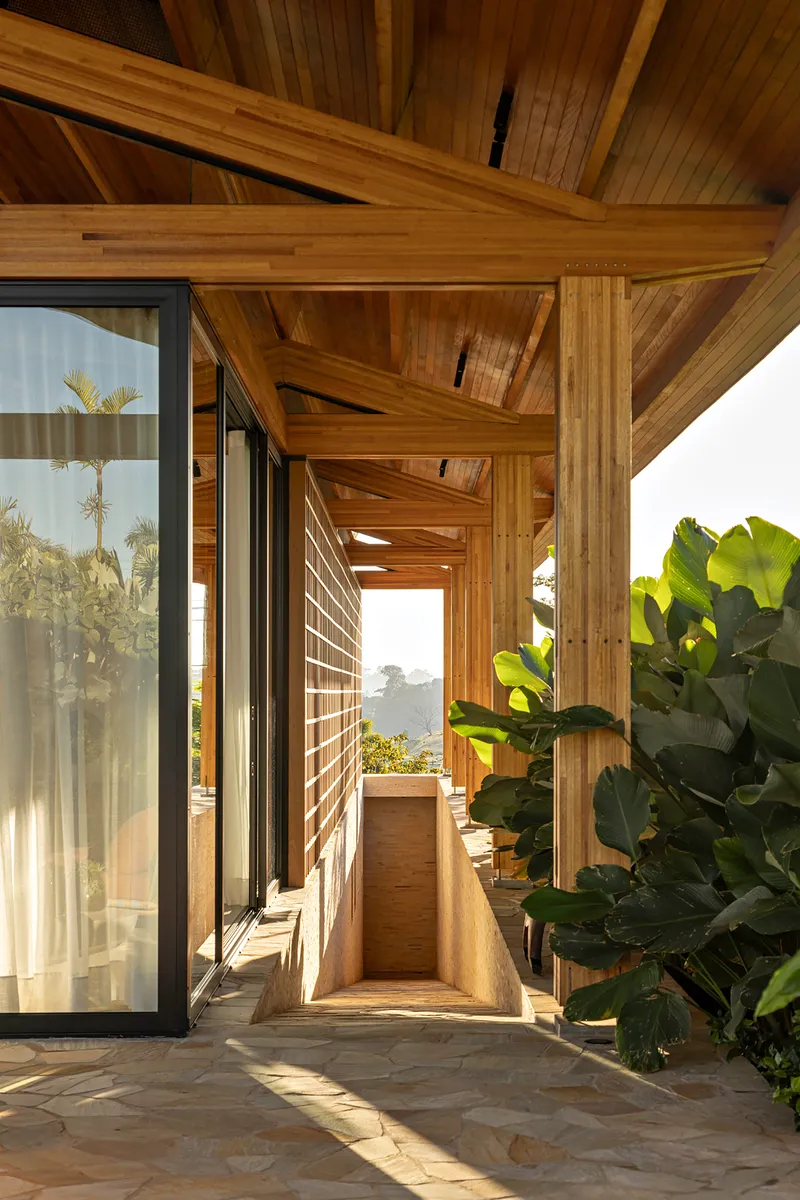
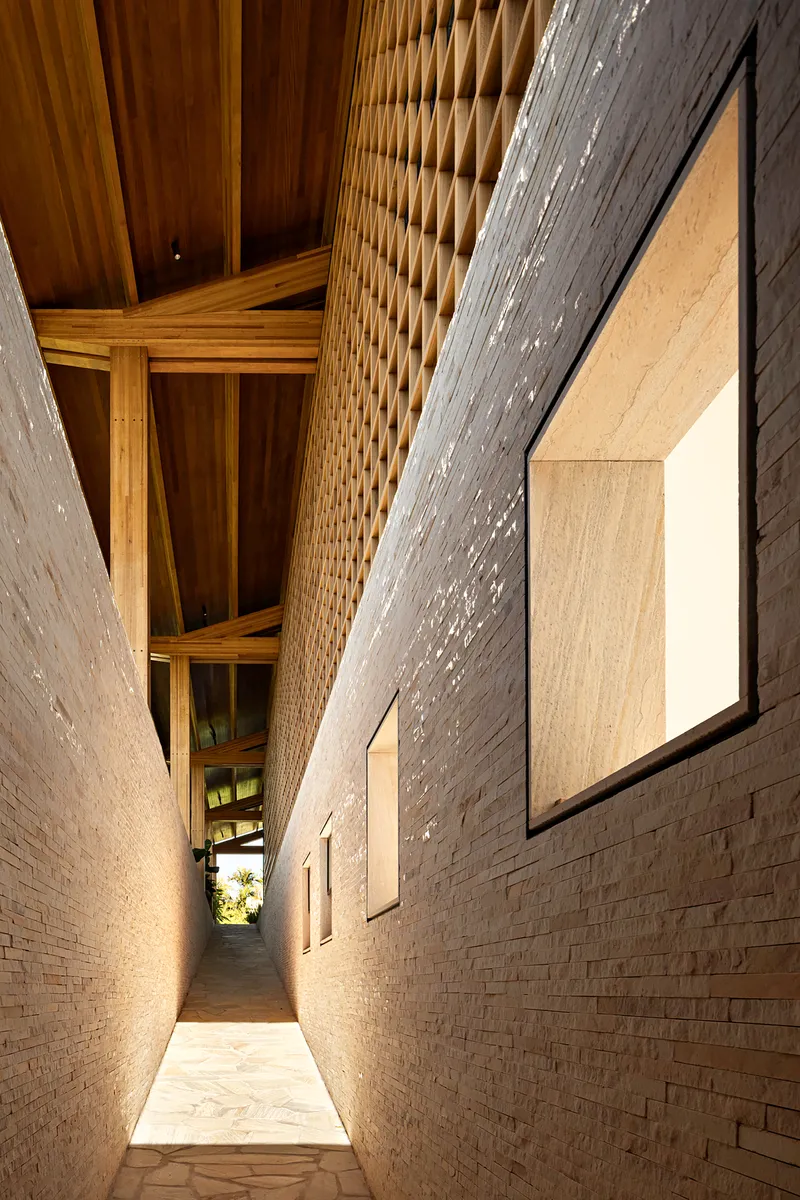
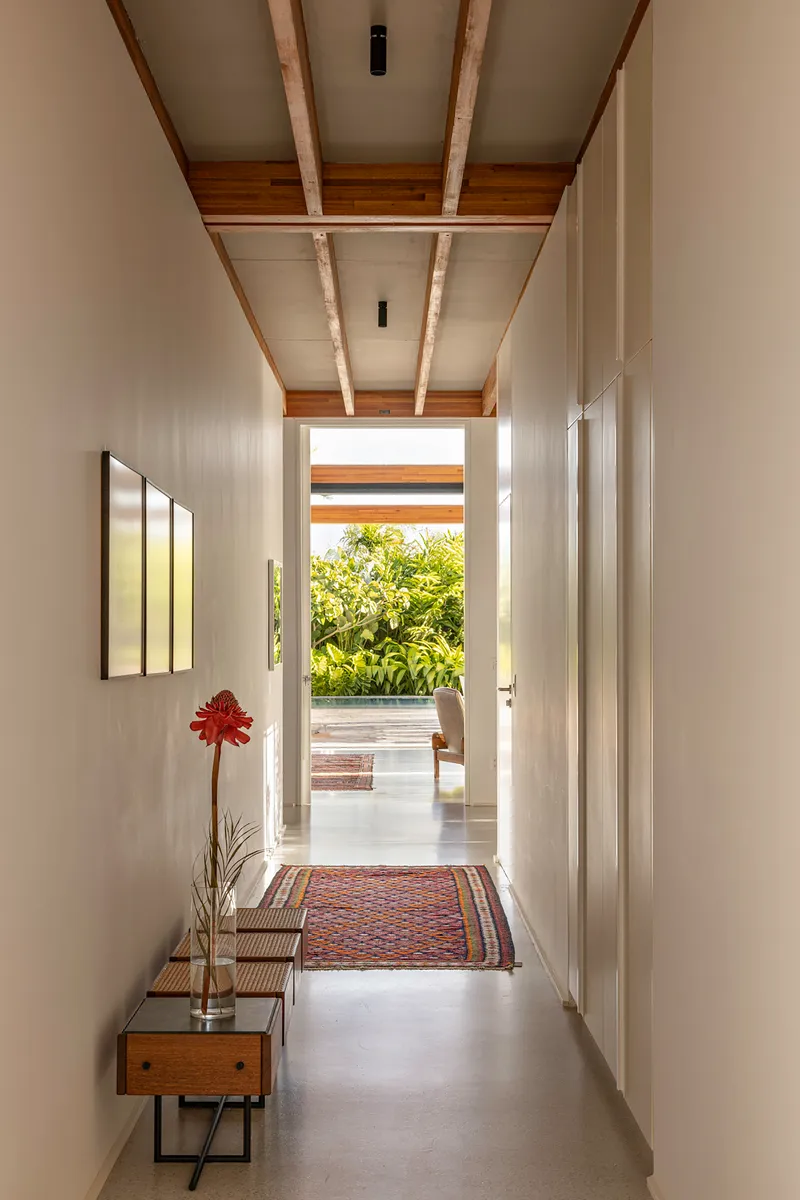
House MM is a house of corridors and passages, each one distinct. A covered walkway with horizontal slatted screens frames banana leaves in a careful composition that feels almost staged but is simply the result of placing structure next to tropical planting and letting the sun do the rest. A narrow passage between pale brick walls compresses space dramatically, then opens to a view of the garden or sky.
These in-between spaces account for a surprising amount of the house's usable area, and they represent the project's strongest argument. In tropical climates, the covered outdoor room is not a luxury but a necessity. Equipe Lamas gives these zones the same attention to material and proportion as the enclosed rooms, refusing the common tendency to treat circulation as leftover space.
Garden, Pool, and the Outdoor Rooms
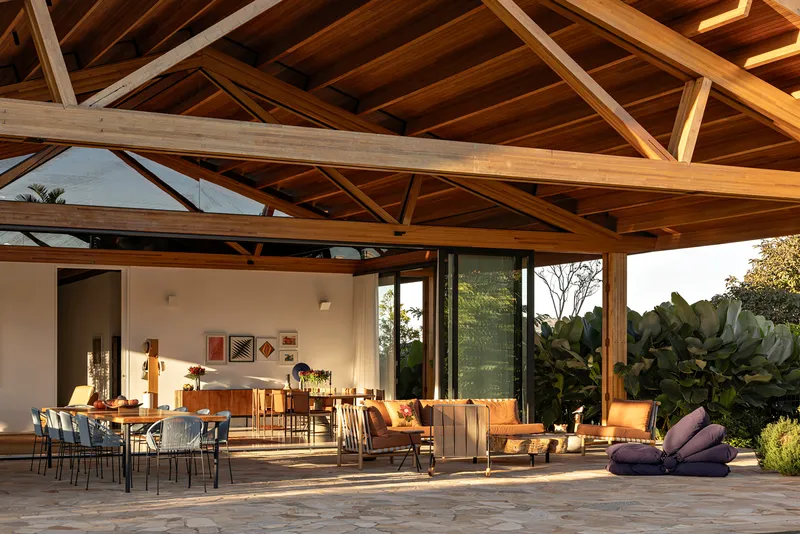
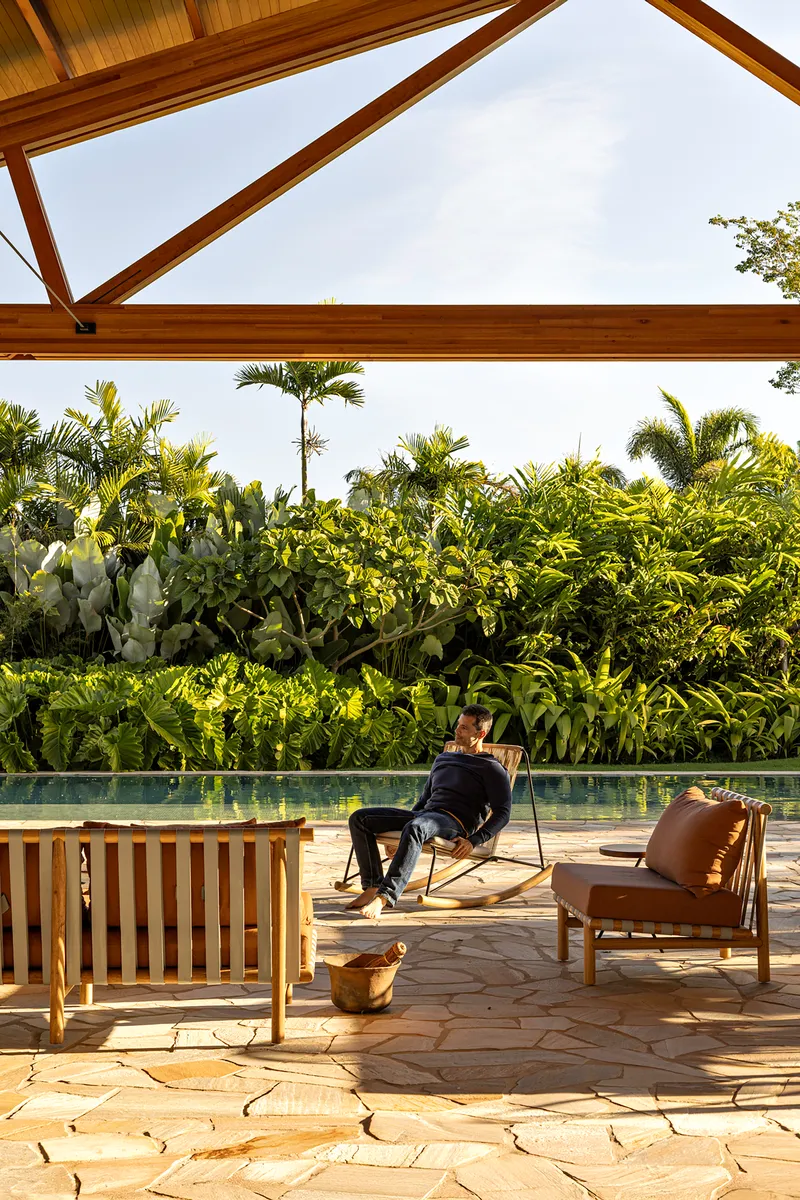
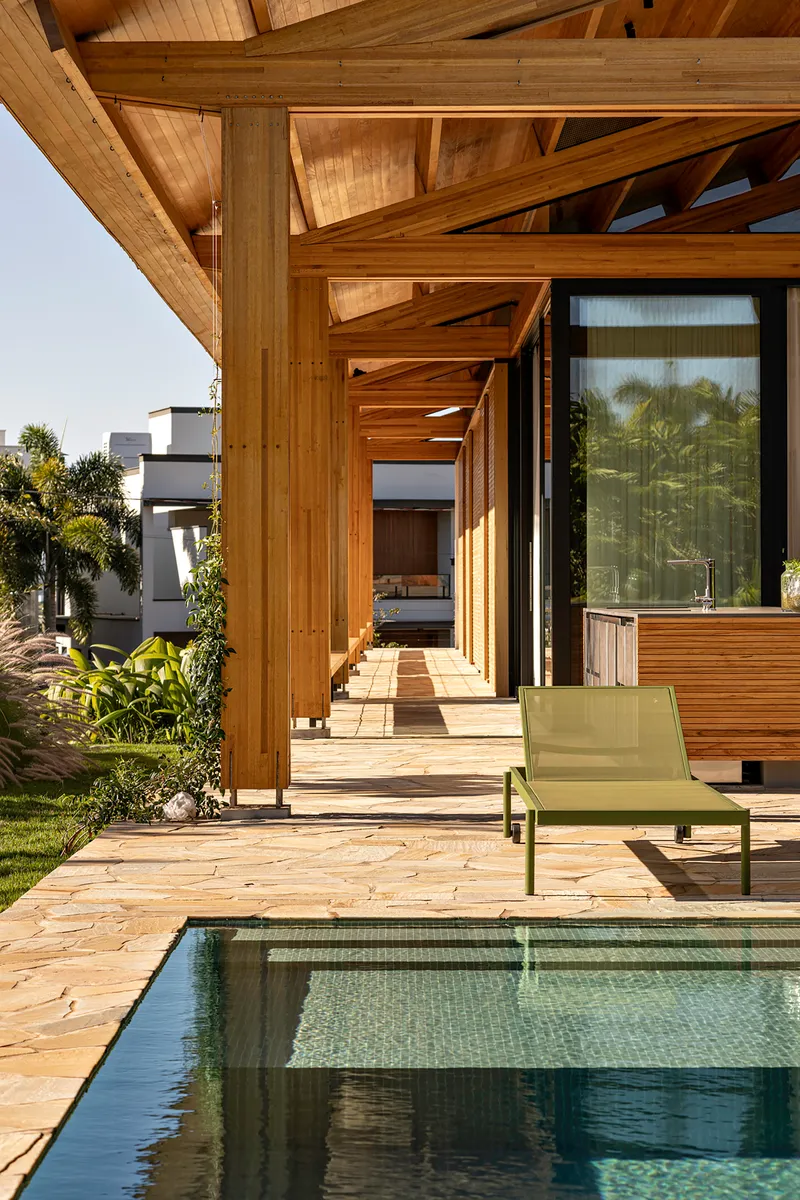
The covered terraces adjacent to the pool are among the most resolved spaces in the project. Stone paving, timber benches, and dense tropical planting compose a scene where the boundary of the house essentially dissolves. The swimming pool acts as a reflecting surface, doubling the roof's profile and amplifying the sense of calm. A smaller secondary pool sits near a green lounge chair, suggesting the architects designed not one outdoor room but several, each scaled to different modes of occupation.
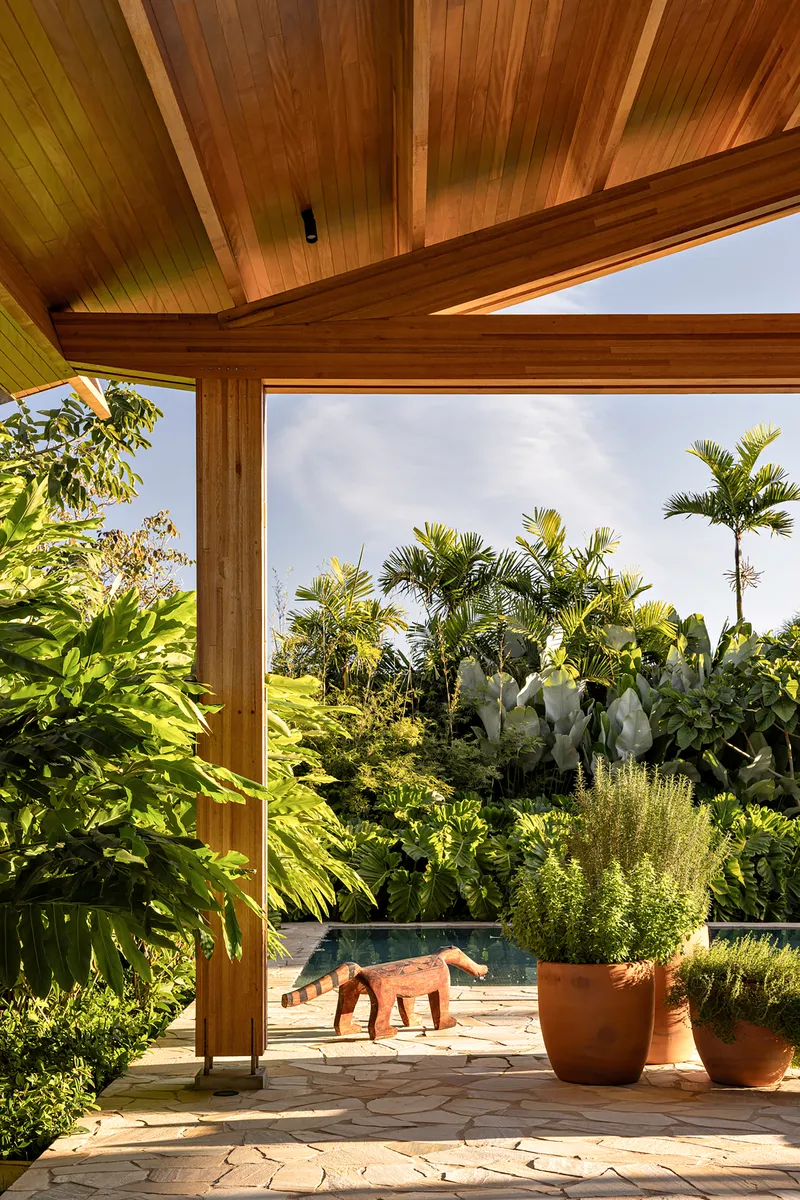
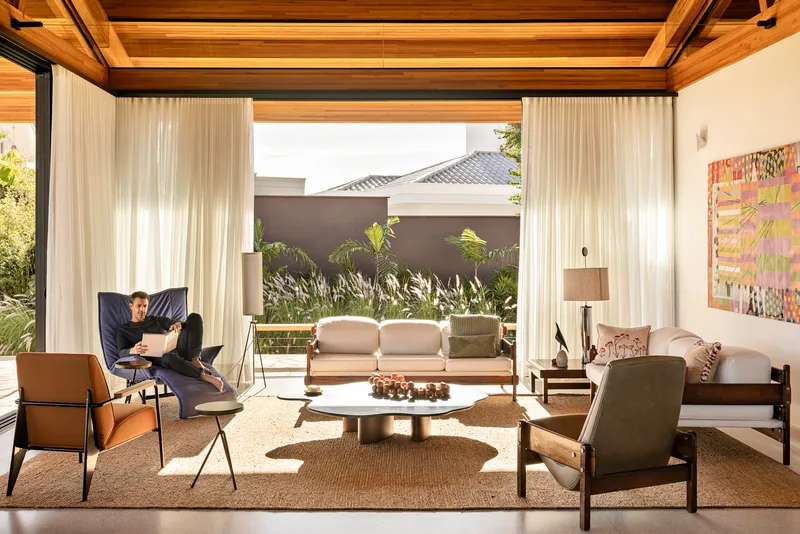
The planting is integral, not cosmetic. Banana palms, tropical shrubs, and mature trees form dense green walls that provide privacy, shade, and humidity moderation. The courtyards pull this landscape into the interior of the plan, so that even from the living room you are looking through floor-to-ceiling openings at planted ground. A figure sits reading in one courtyard, and the image says everything about how this house is meant to be used: slowly, quietly, in proximity to green.
Interior Details and Material Palette
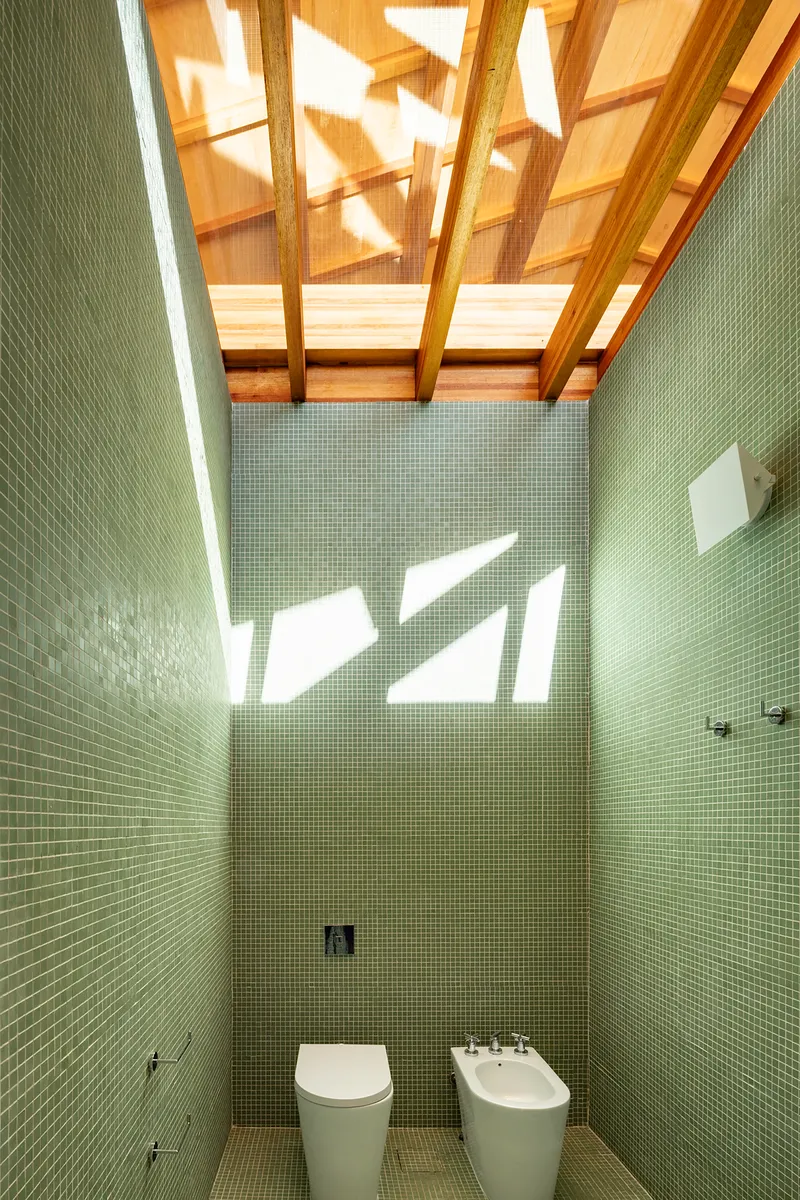
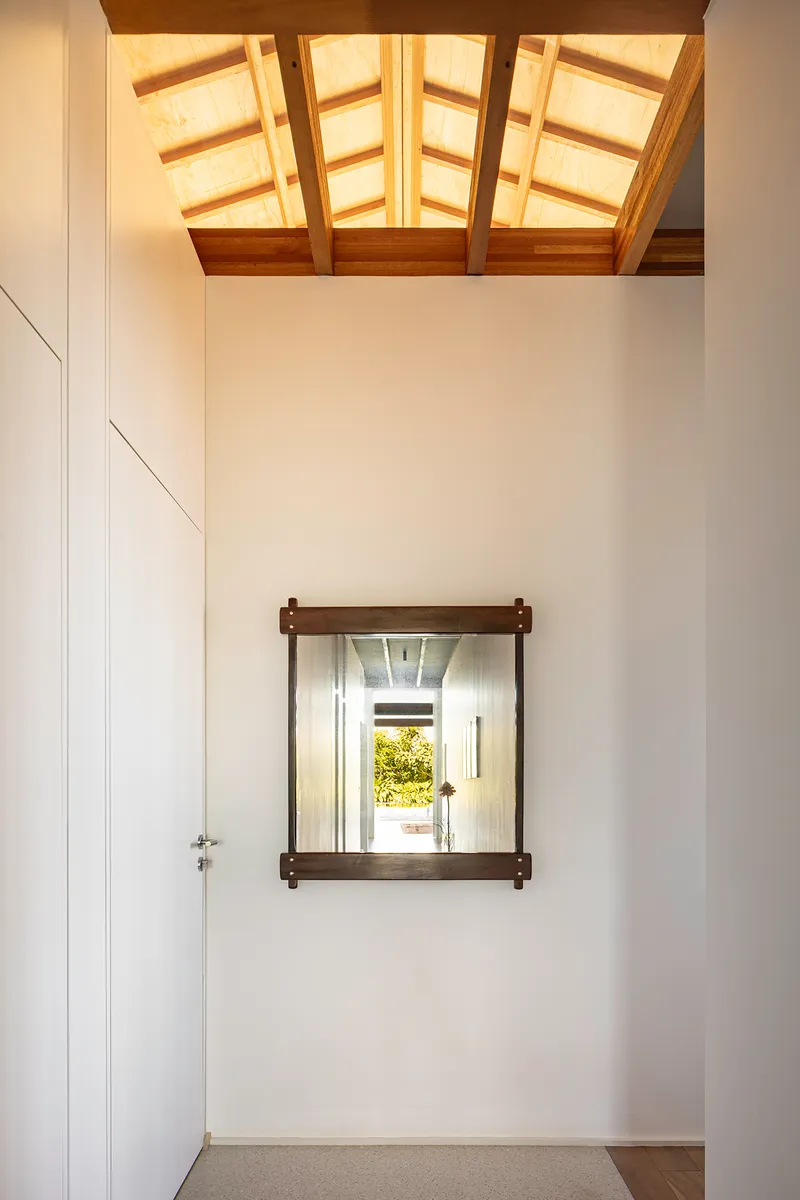
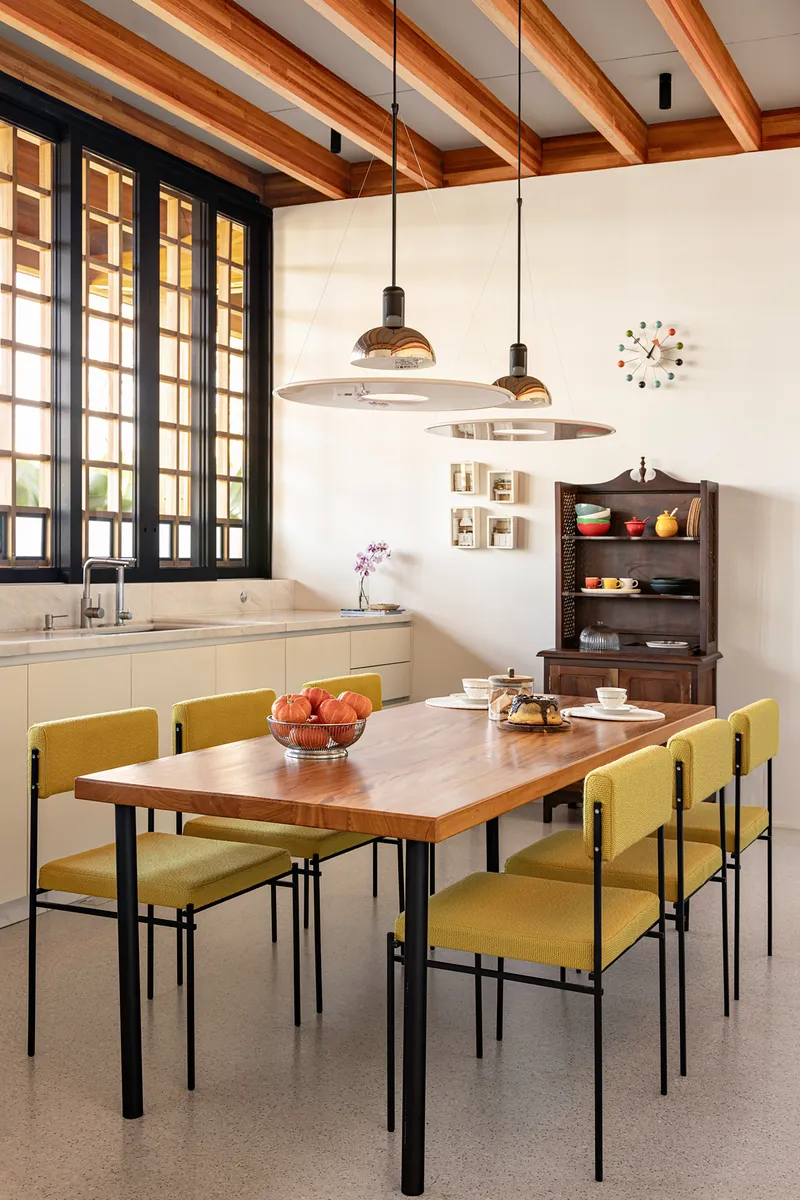
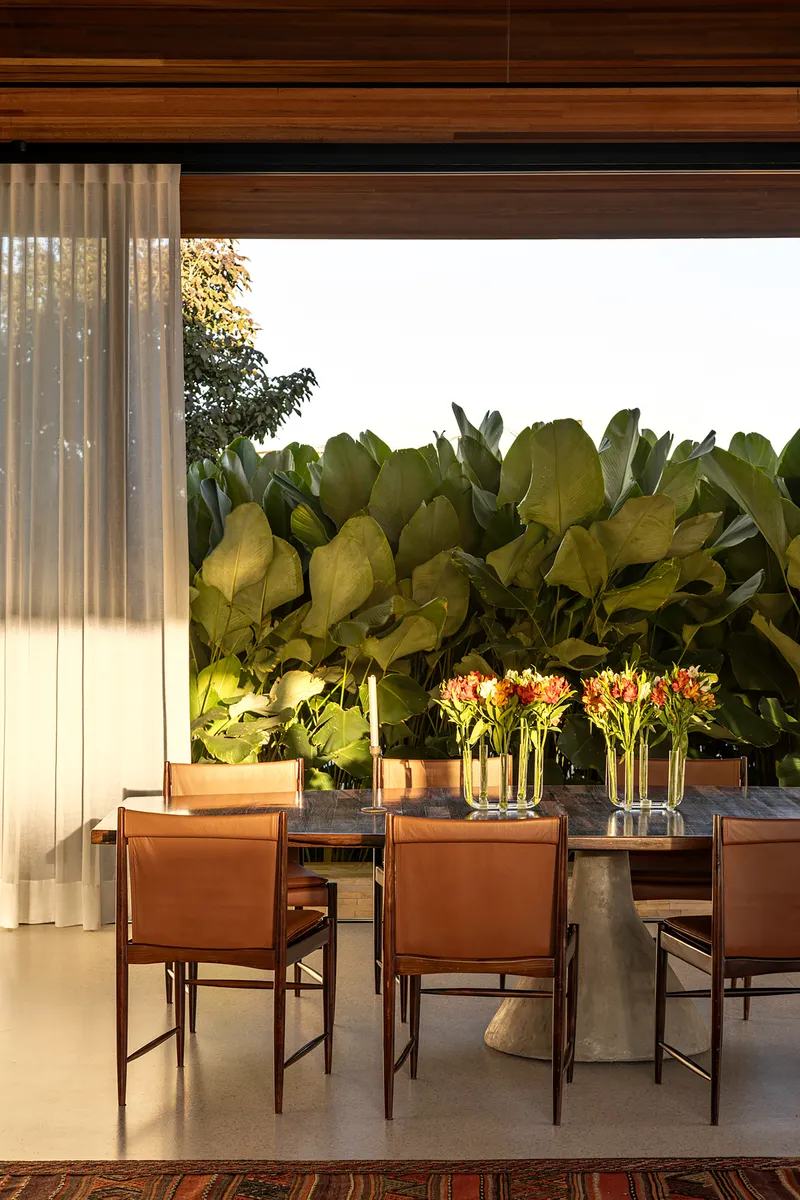
The material palette inside House MM is restrained but confident. A bathroom clad in green mosaic tile with skylights cutting geometric light patterns overhead provides one of the project's most photogenic moments, but it also demonstrates a willingness to use color where it counts. White walls, timber ceilings, and dark-framed windows form the baseline, with moments of olive upholstery at the dining table or the green tile in the bath providing carefully placed accents.
The dining area, with its timber table and gridded windows set beneath exposed beams, achieves a quiet sophistication. Large-leaved plants press against the glass in the adjacent seating area, catching late afternoon sun. The interior never competes with the landscape; instead, it creates a neutral backdrop against which the changing light and garden views become the primary experience.
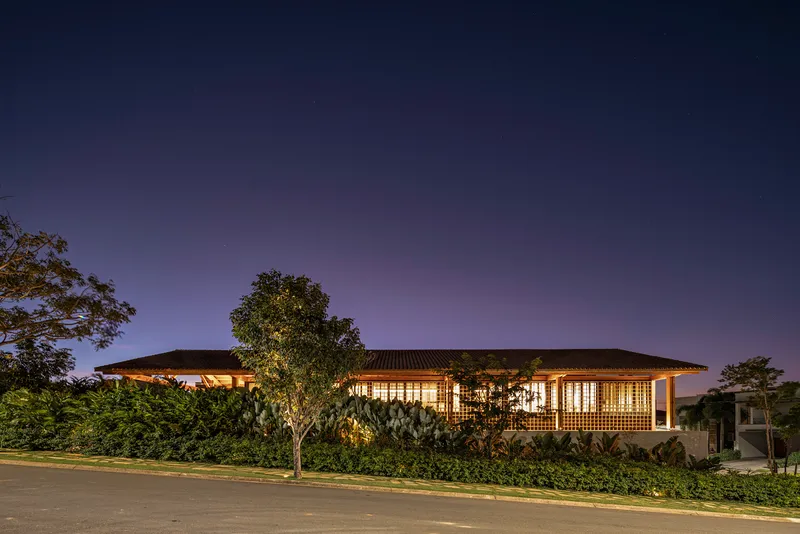
At night, the glazed street facade reveals the house's interior warmth. The low-pitched roof hovers above an illuminated living volume, and the contrast between the solid, screened masses and the transparent openings gives the elevation a graphic clarity. This is a house designed to perform well across the full cycle of the day.
Plans and Drawings
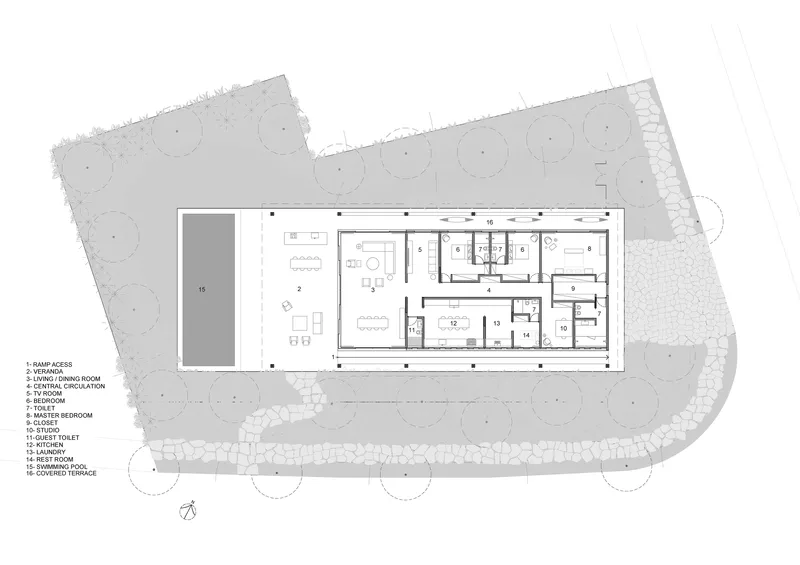
The floor plan confirms the house's organizational logic: a rectangular layout with central living spaces flanked by service and private rooms. The plan is legible and direct, with the social spaces positioned to open onto the garden and pool to the rear, while the street-facing elevation remains more protected. Circulation routes along the edges of the plan, through those screened and covered walkways, giving the house a processional quality despite its single-story format.
Why This Project Matters
House MM is not trying to reinvent the Brazilian house. It is trying to get it right, using techniques and materials that have been tested by decades of practice in the region and refining them with contemporary precision. The timber structure, the clay tile roof, the perforated screens, the courtyard plan: none of these are novel in isolation. Their synthesis here, at this scale, with this level of craft, is what earns attention. Equipe Lamas demonstrates that architectural intelligence often lies not in invention but in integration.
In a period when sustainability discourse often fixates on technological systems and certification checklists, House MM offers a counter-argument rooted in form and material. Deep overhangs, cross-ventilation through lattice and screen, thermal mass from masonry, shaded outdoor rooms: these are strategies that cost less to maintain and last longer than most mechanical systems. The house proposes that the most durable green strategy for tropical residential architecture might simply be good architecture, attentively made.
House MM by Equipe Lamas (lead architect: Samuel Lamas). São José do Rio Pardo, Brazil. 630 m². Completed 2025. Photography by Joana França.
About the Studio
Share Your Own Work on uni.xyz
If projects like this are the kind of work you want to make, uni.xyz is a place to publish your own, find collaborators, and enter design competitions.


Popular Articles
Popular articles from the community


Extended Shell: Retrofitting Kolkata's Balconies as Living Urban Thresholds
A modular retrofit system recovers the social and environmental intelligence of Kolkata's historic verandas for contemporary Park Street residents.

Faces of the Soviet Avant-Garde: Turning Moscow's Street Names into an Open-Air Museum
A network of sculptural installations across a Moscow residential district transforms forgotten architect names into spatial encounters with cultural memor

Manzana Morphosis: Stretching Barcelona's Grid into a Living Landscape for 2050
A radical reworking of the Eixample manzana turns density into a tool for generous public space, vertical ecology, and environmental performance.

Tsunami Convergenics: Turning Catastrophic Ocean Forces into Underwater Housing Infrastructure
A speculative underwater settlement off the coast of Onagawa, Japan, treats tsunamis and typhoons as energy sources rather than threats.

Similar Reads
You might also enjoy these articles

Bao Huynh Watercolor Atelier: A Serene Art Retreat in Hội An
Bao Huynh Watercolor Atelier in Hội An blends multifunctional art spaces, sustainable design, local materials, and family-friendly living in a serene environment.

Atelier Macri Concept Store Interior Design by CASE-REAL
Atelier Macri store features a "ko" counter, walnut wood details, cork displays, blending retail, gallery, and seamless customer experiences.

Manuel Vargas Izquierdo Stadium and High-Performance Sports Center: Architectural Excellence in Jalpa de Méndez
The Manuel Vargas Izquierdo Stadium blends sustainable design, inclusive sports facilities, and cultural-inspired architecture, revitalizing Jalpa de Méndez’s public spaces.

KAKR Buluh Awar Hall: Revitalizing Community and Ecology Through Bamboo Architecture
Community built bamboo hall revitalizes Buluh Awar village, empowering youth, restoring ecology, celebrating vernacular craftsmanship through sustainable architecture and culture.


Comments (0)
Please login or sign up to add comments
No comments yet. Be the first to comment!