
128 Arquitectura y Diseño Urbano Rebuilds a Tabasco Market with Concrete Vaults and Brick Lattice
In Huimanguillo, a deteriorating public market gives way to a climate-responsive civic building shaped by tropical humidity.


In the western lowlands of Tabasco, where relative humidity can reach 95%, buildings corrode fast. The old José Mercedes Gamas Public Market in Huimanguillo had reached the point of structural failure, its steel superstructure eaten away by decades of tropical moisture. 128 Arquitectura y Diseño Urbano, led by Fernando Tepichin Jasso, was tasked not just with replacing the building but with proving that a public market in this climate could be durable, dignified, and passively cooled. The result, completed in 2021 under the federal Urban Improvement Programme, is a 2,975 m² civic structure that treats ventilation as architecture and brick as both skin and ornament.
What makes this project worth studying is not the program, which is familiar, but the precision with which material and section respond to a punishing environment. Every major design decision here, from the barrel vault roof to the brick latticework perimeter, traces back to one problem: how to keep air moving through a dense commercial building on the edge of a small Mexican town. The market doubles as an urban landmark and community gathering space, but its real achievement is structural honesty in a context where most public buildings surrender to corrugated metal and hope for the best.
Vaulted Roofline as Identity
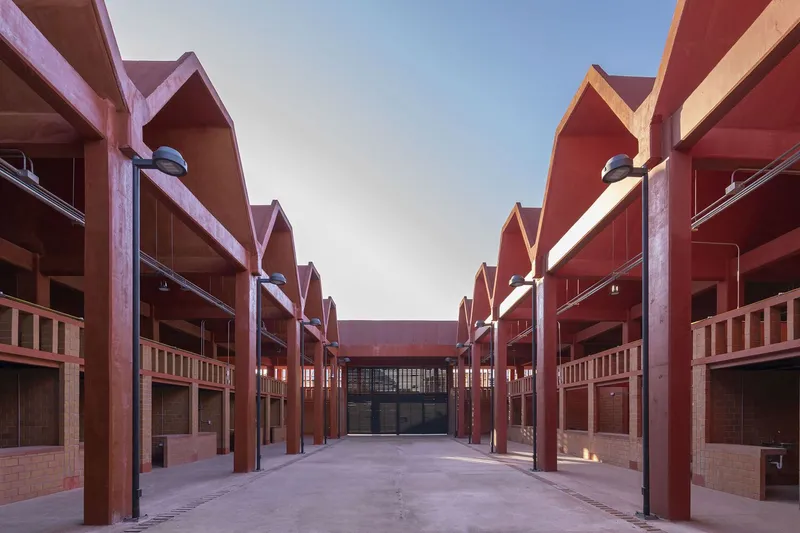
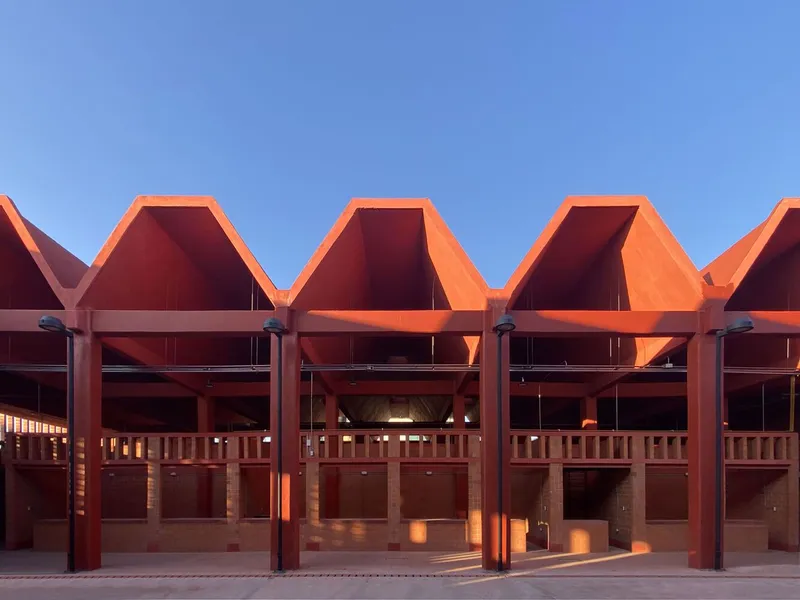
The roof is the building's signature. A succession of straight-sided barrel vaults in concrete shell construction rises 3.15 meters above the top of the commercial stalls, which themselves stand at 4.90 meters. Seen from the central courtyard at dusk, the repeated pentagonal gable forms read almost like a sawtooth factory roof reinterpreted for a civic program. The generous height is not stylistic indulgence; it is the primary mechanism for allowing hot, humid air to rise and evacuate.
Glazing panels set below the vault peaks admit daylight deep into the double-height public circulation areas while the steel structural frame holds the concrete shells with visible logic. There is no suspended ceiling hiding the work. The structure is the architecture, and the warm evening light that catches the underside of these vaults turns an honest construction decision into something genuinely atmospheric.
Brick Latticework and the Breathing Envelope
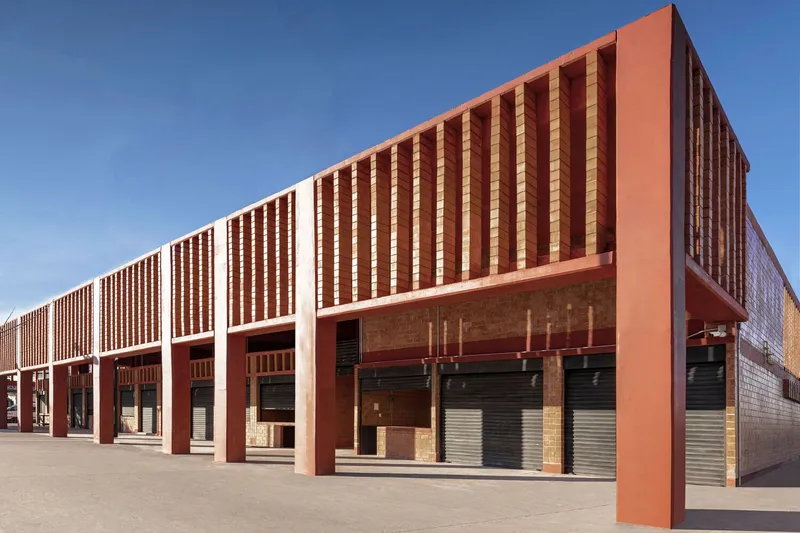
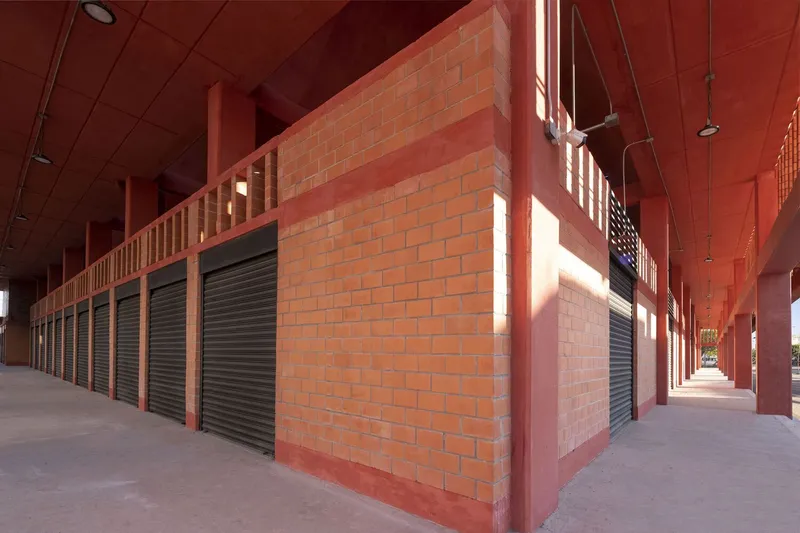
The perimeter portico wraps the north, south, and west facades in a screen of exposed brick latticework that functions as the building's outer envelope. It is porous by design. Continuous permanent openings in the brickwork allow cross ventilation without mechanical assistance, and the pattern creates a semi-transparent boundary between the market's interior and the street. The brick banding visible along the long facade gives the building a vertical rhythm that breaks up what could have been a monotonous commercial frontage.
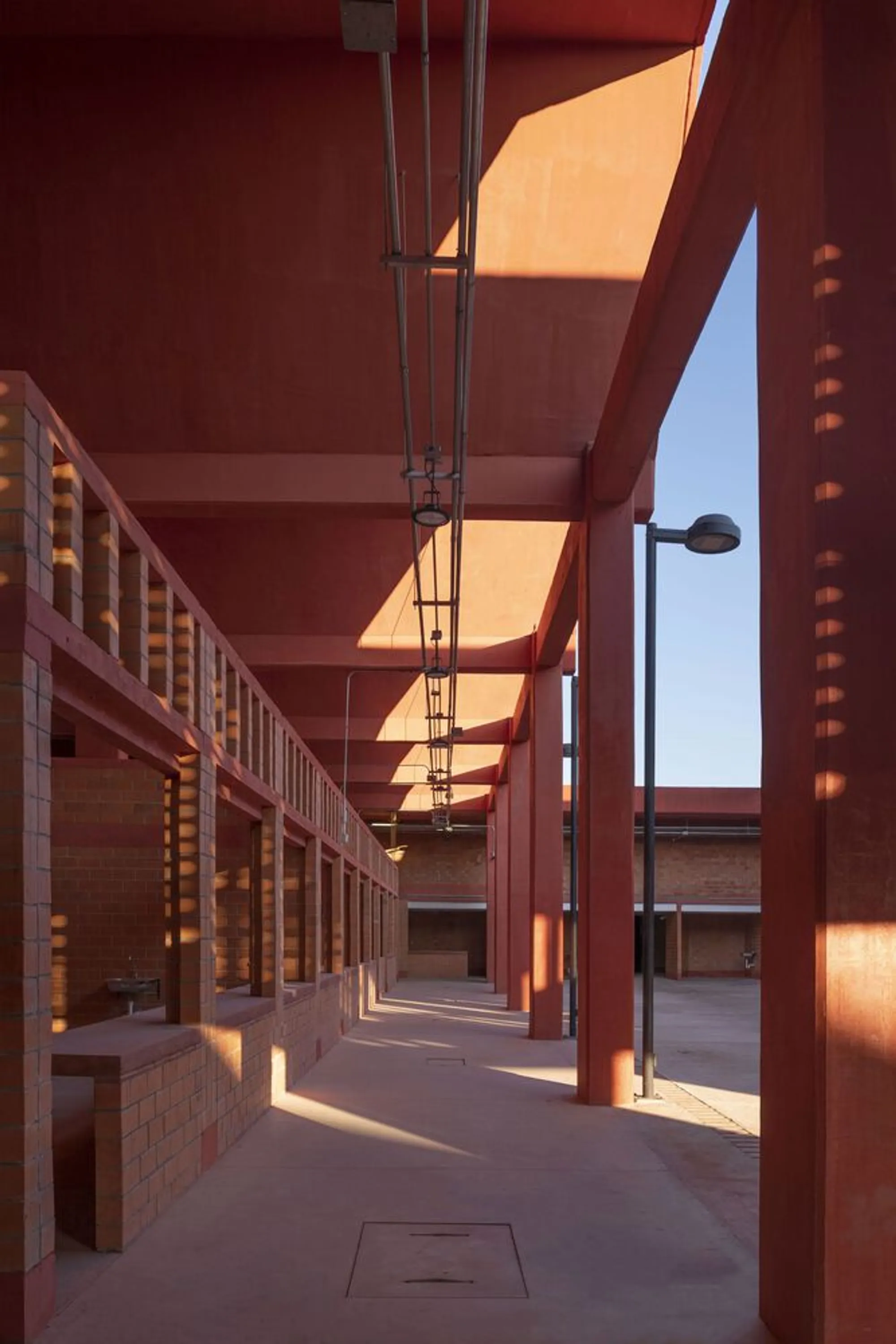
Inside the covered corridors, the interplay between solid brick walls, steel columns, and roller shutters produces sharp shadow lines that shift throughout the day. The painted ceiling plane in these passages is deliberately plain, letting the patterning of light do the decorative work. This is a building that understands shade as a material in its own right, which in a tropical climate is arguably the most valuable material of all.
The Courtyard as Organizational Core
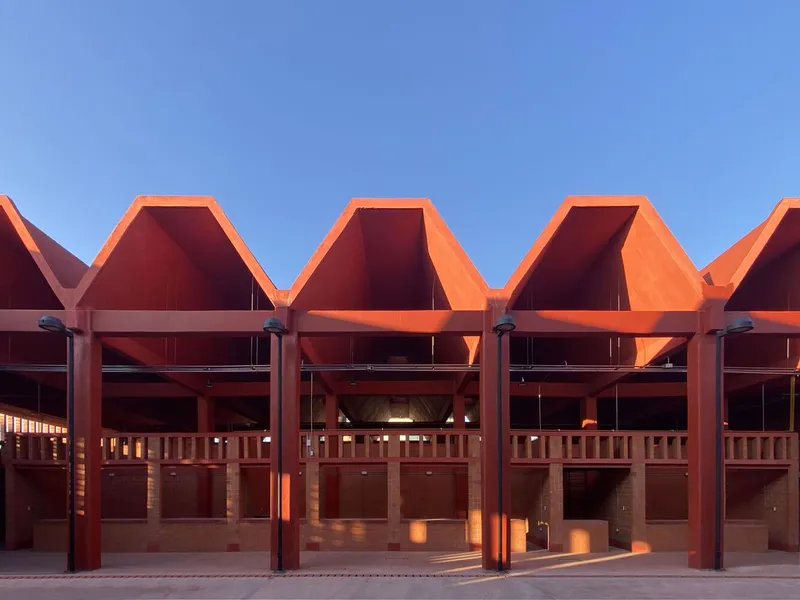
A central rectangular courtyard splits the market into two symmetrical blocks of commercial stalls, each with a ground floor and an upper mezzanine. The courtyard is not a leftover void; it is the engine of the building's environmental strategy. Porticos line its long sides, channeling air from the open perimeter through the market's core and out through the vaulted roof above. The arrangement also guarantees that no stall is far from natural light, a condition that matters for a building type where vendors spend entire days indoors.
The decision to match the original market's stall count and configuration was pragmatic. Vendors in Mexican public markets often hold generational tenure over their spaces, and any redesign that reshuffled the layout would have faced serious resistance. By preserving the commercial geography while completely rethinking the envelope and structure, 128 Arquitectura managed to deliver a new building that felt, to its users, like a continuation rather than a disruption.
Steel, Concrete, and the Long Game Against Humidity
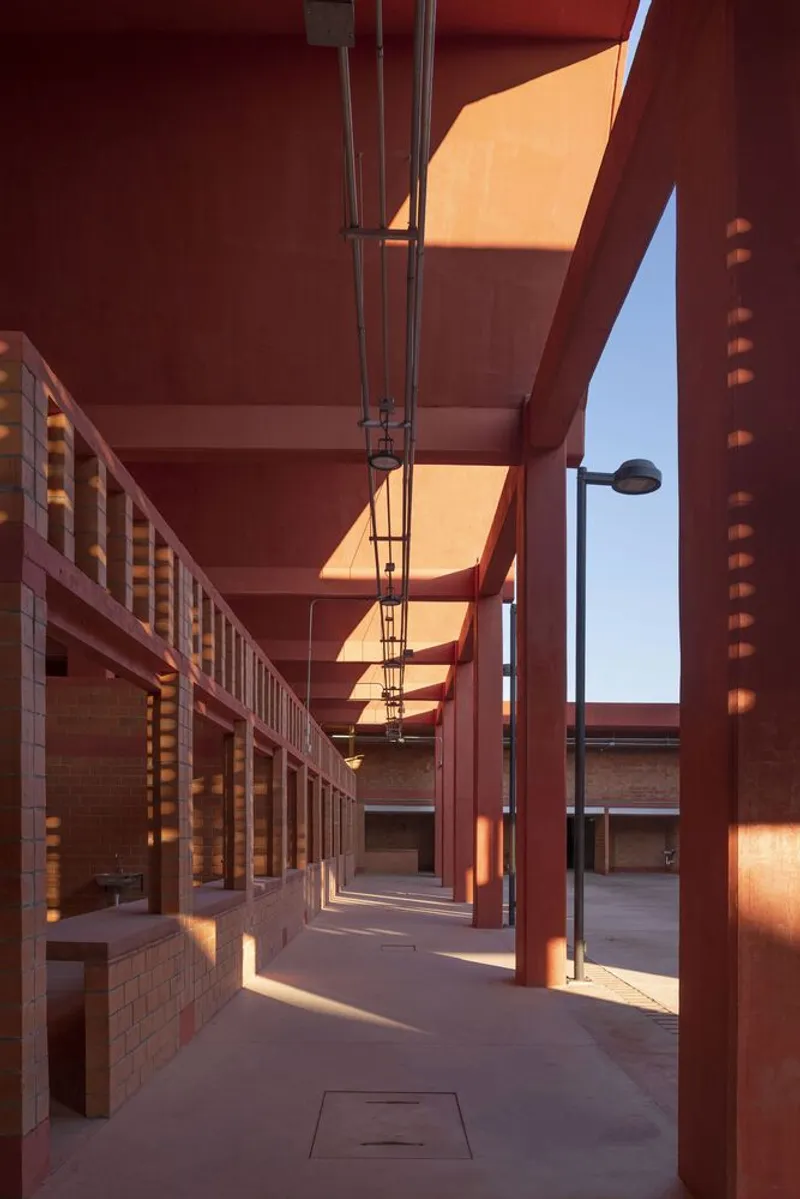
The old market failed because its materials could not survive the climate. The replacement had to be built around a different assumption: that 95% humidity is not an anomaly but a permanent condition. The concrete shell vaults, the exposed brick, and the steel frame are each chosen for durability against moisture. Naturally pigmented concrete on the exterior avoids the maintenance trap of painted surfaces that peel and stain in tropical weather. The steel beams and columns visible throughout the colonnades are exposed and accessible for inspection, a detail that acknowledges future maintenance rather than hiding the need for it.
The colonnade at the building's edge, where steel beams create diagonal shadow patterns at sunset, is the kind of space that earns a building its reputation in a town. It is simultaneously a covered walkway, a ventilation channel, and a place to linger. That triple function, achieved without mechanical systems, is the project's strongest argument for climate-responsive public architecture in hot, humid regions.
Why This Project Matters
Public markets are among the most undervalued building types in Latin American architecture. They serve massive populations daily, they anchor local economies, and they are frequently left to deteriorate until they become dangerous. The Huimanguillo Market demonstrates that replacing a failing public building does not require a spectacle. It requires a sober reading of climate, a respect for existing commercial patterns, and materials that can outlast the conditions that destroyed the predecessor.
128 Arquitectura y Diseño Urbano delivered a building that is legible, repairable, and comfortable without air conditioning in one of Mexico's most humid states. The barrel vaults give it a civic presence that distinguishes it from the corrugated roofscapes around it, but the real design intelligence is in the section: the stacking of mezzanine, double-height circulation, and vaulted roof that turns the entire building into a passive ventilation device. In a moment when sustainability discourse often gravitates toward high-tech solutions, this is a useful reminder that brick, concrete, and generous ceiling heights can do a remarkable amount of work.
Huimanguillo Market (José Mercedes Gamas Public Market) by 128 Arquitectura y Diseño Urbano. Huimanguillo, Tabasco, Mexico. 2,975 m². Completed 2021. Photography by Alejandro Gutiérrez.
About the Studio
Share Your Own Work on uni.xyz
If projects like this are the kind of work you want to make, uni.xyz is a place to publish your own, find collaborators, and enter design competitions.




Popular Articles
Popular articles from the community


Hill & Cross Opera: Sculptural Opera House Architecture Shaped by Tallinn’s Landscape and Identity
Hill & Cross Opera reimagines opera house architecture in Tallinn through its sculptural hill, civic plaza, glass wave and a luminous cross.

Riyadh For All: Intergenerational Urban Design for Active Aging in Rabat
Riyadh For All reimagines urban design in Rabat with intergenerational co-living, adaptive courtyards, and Moroccan cultural exchange today.

The Earth Pod: 3D Printed Homes for Resilient Refugee Communities
The Earth Pod reimagines refugee housing through 3D printed homes made from clay, combining resilience, self-sufficiency, and rapid shelter.

Conexión: Biophilic Design Reimagines High-Rise Living in Hong Kong
Conexión reimagines high-rise living in Hong Kong through biophilic design, green facades, shared spaces, daylight, water and nature within.


Similar Reads
You might also enjoy these articles


Hodi-Mandai Geram
Project Function: Preservation and revitalization of the Intangible heritage and socio-spatial identity of the Hodi by Housing, Cultural Memory Center, Sacred Grove, landscape, local tourism economy


Olio Towers: A Mid-Rise for Performers That Fuses Housing, Rehearsal, and Stage
Located blocks from Houston's Theater District, this modular tower stacks living units around a central performance atrium.

Oasis: Modular Green Housing Carved into Dhaka's Urban Fabric
A shortlisted Plugin Housing entry reclaims unauthorized settlements in Dhaka with stepped concrete volumes, green roofs, and ventilation-driven design.

Black Hole: A Floating Megastructure for the Post-Physical Era
Emiliano Mazzarotto envisions a spherical, self-scaling arena where e-sports, digital hotels, and holographic stadiums replace traditional public space.

Explore Mexican Design Competitions
Discover active competitions in this discipline



Challenge to reimagine the Iron Throne


Photograph architecture without architects


Illustrate the lost glory of Angkor Wat - Render Challenge


Design challenge to reuse E-waste
Comments (0)
Please login or sign up to add comments
No comments yet. Be the first to comment!