

Hume World: Turning Drainage Pipes into Modular Urban Infrastructure
A kit-of-parts system repurposes hume pipes and recycled metal sheets into bus stops, seating, planters, and public promenades for Indian cities.


Every Indian city is full of hume pipes. They sit in drainage trenches and plumbing yards, unremarkable cylinders of reinforced cement concrete. Hume World asks a disarmingly simple question: what if these pipes became the building blocks of public space? The answer is a modular kit-of-parts system that assembles ordinary infrastructure into bus shelters, street libraries, benches, planters, and vendor kiosks, all without specialized fabrication or expensive materials.
Designed by Aangi Shah and Niki Shah, the project was a Runner-up at Urbanscape 2018, the uni.xyz architectural competition. The brief asked designers to rethink urban landscapes, and Shah and Shah responded by looking not at what cities lack but at what they already have in abundance. Their proposal turns overlooked infrastructural stock into economic, ecological, and inclusive interventions for growing cities.
Cylindrical Shelters Along the Boulevard
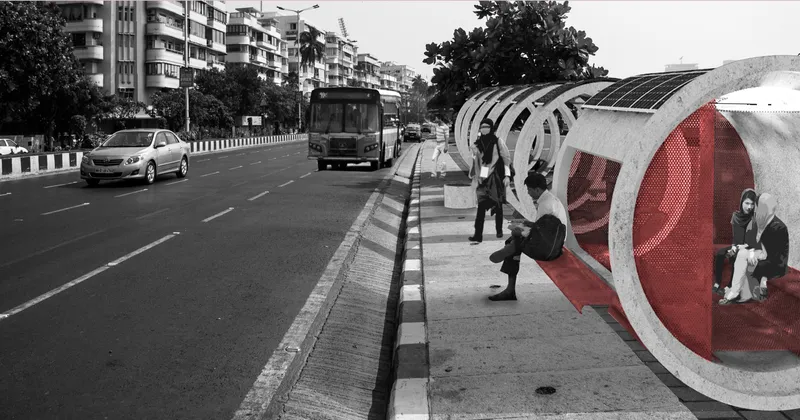
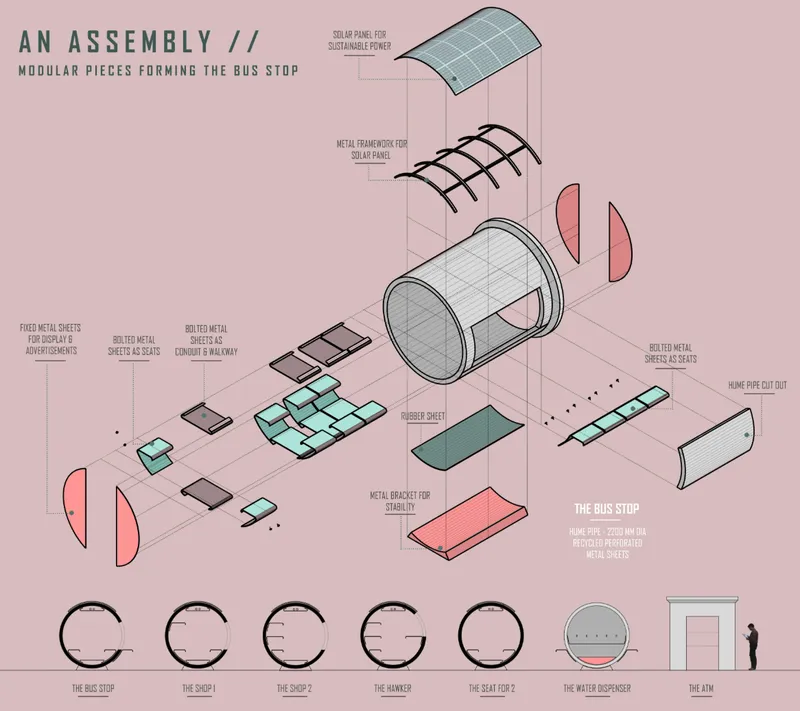
The bus shelter is the flagship assembly. Hume pipes of varied diameters are arranged in a row along the street edge, their cylindrical profiles immediately recognizable yet completely transformed in function. Curved solar panel roofs span between the pipes, providing shade and renewable energy simultaneously. Red perforated metal sheets, recycled and shaped into end walls, close off the cylinders while allowing airflow and filtered light. The exploded axonometric drawing reveals how few components are involved: pipes, a metal frame, bolted sheet panels, and solar modules. Everything is assembled, not cast. Everything can be disassembled and reconfigured.
The perforated sheets deserve attention on their own terms. By reducing material usage by 50% compared to solid panels, they cut costs and weight. During monsoon season, rainwater passes through the perforations rather than pooling on surfaces, a practical detail that matters enormously in Indian urban conditions. The same sheets double as advertisement panels, turning maintenance costs into potential revenue for municipal bodies.
Street Libraries and Play Zones from the Same Kit
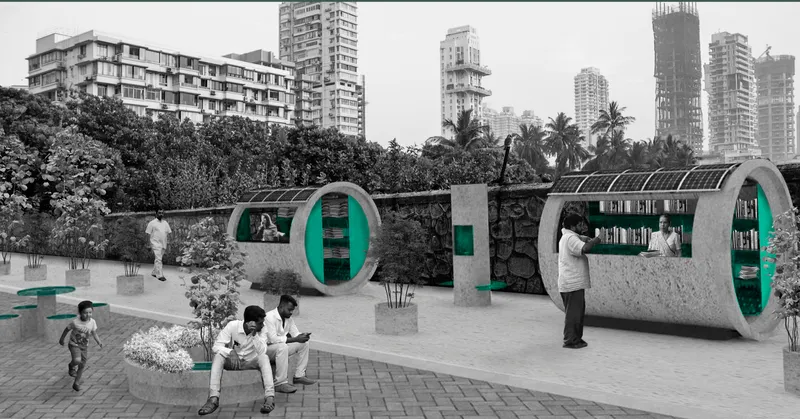
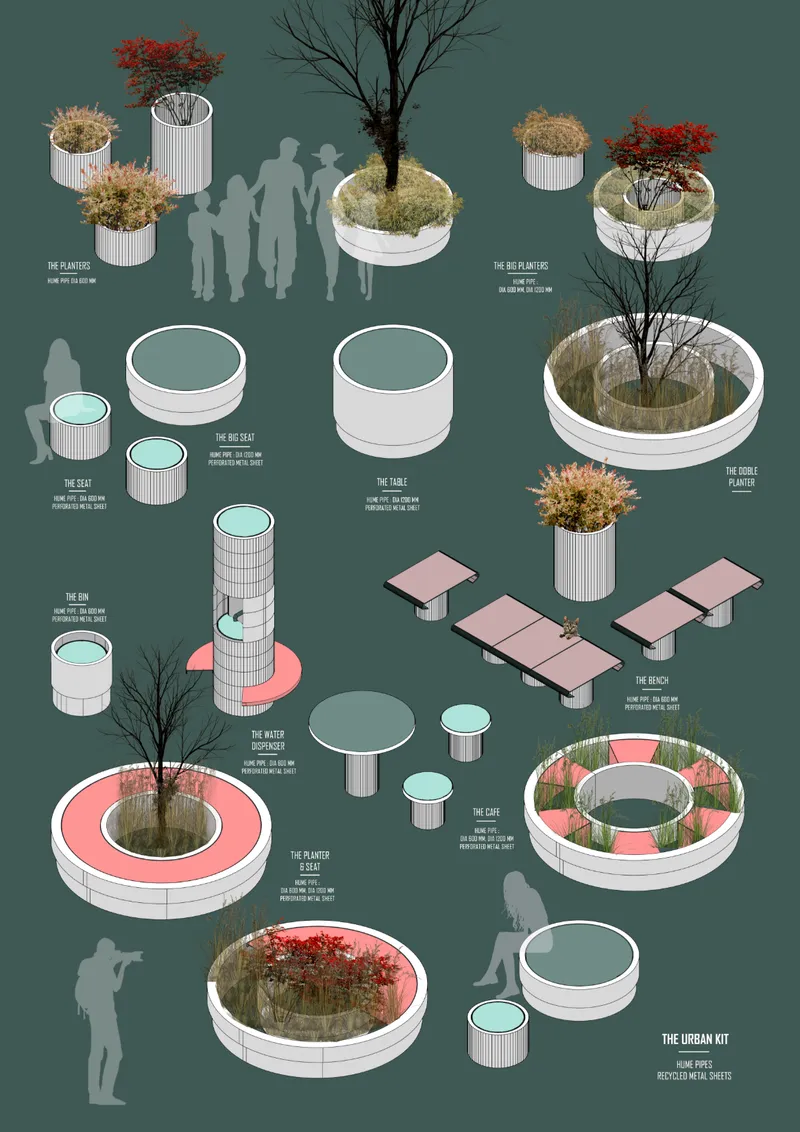
The system's real power shows when the same components produce entirely different programs. In a public plaza, hume pipes become street libraries: green shelving is fitted inside the cylinders, turning them into open-air reading nooks where children browse books at arm's reach. Adjacent modules serve as seating. The isometric drawing catalogs the range of urban furniture that the kit produces: planters, benches, tree rings, and bins, all scaled against human silhouettes to show how the pipe diameters relate to the body.
This is where the informal sector enters the design. The modularity is intentionally loose enough to accommodate street vendors who can set up temporary shops within or between pipe clusters, or community groups who can reconfigure elements for gatherings. The designers are not prescribing a single layout; they are distributing a vocabulary that the city can speak in many dialects.
Barrel Roofs and Curved Seating at Multiple Scales
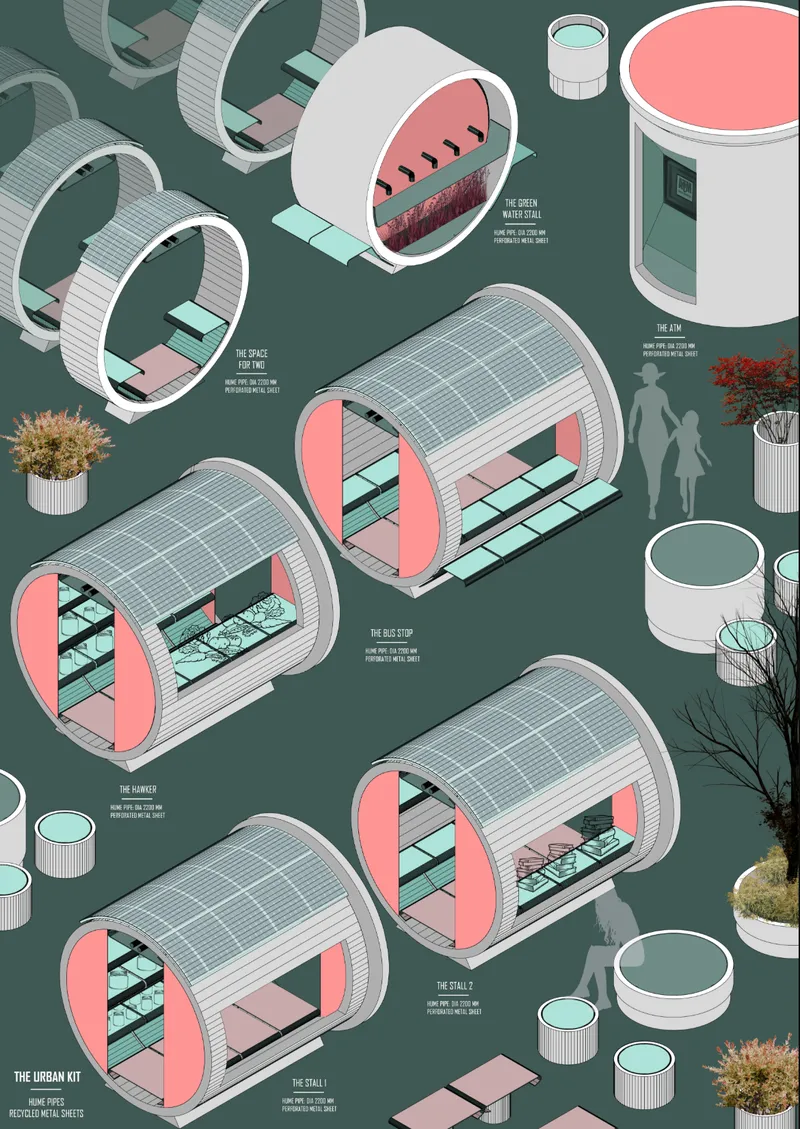
The isometric configuration drawing lays out multiple bus shelter variants side by side, each with barrel roofs formed by the pipe geometry and pink curved seating elements tucked beneath. Cylindrical planters punctuate the arrangements, introducing greenery into concrete-heavy streetscapes. What holds the composition together visually is the consistency of the cylinder: every element shares the same formal DNA because every element derives from the same industrial product. Scale varies, program varies, but the aesthetic language remains coherent.
Promenades and Streetscape Integration
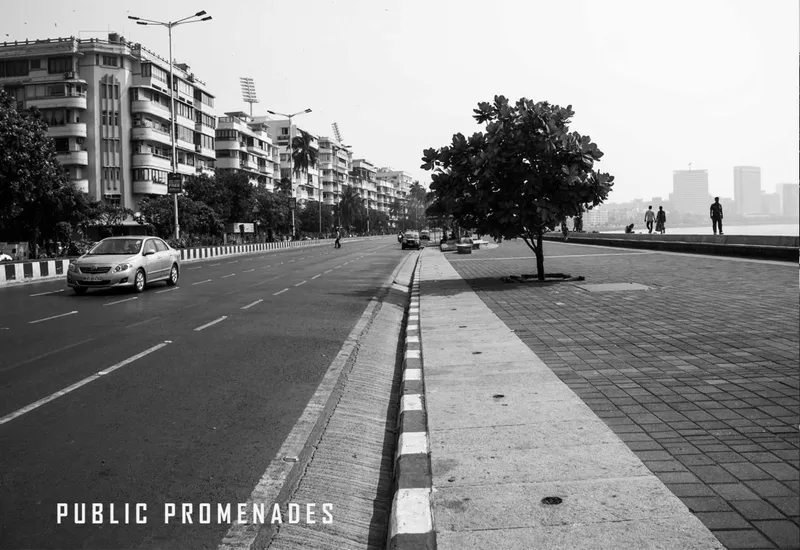

Zoomed out to the scale of the street, the modules populate a wide pedestrian promenade flanked by trees and apartment blocks. The paved walkway is generous, and the hume pipe installations line its edges, providing rhythm and utility without cluttering the path. At the boulevard scale, curved concrete bus shelters with red perforated metal screens become landmarks. Pedestrians orient themselves by these cylindrical markers, which are visible from a distance because their geometry contrasts with the orthogonal grid of surrounding buildings.
The material logic holds up at every zoom level. Reinforced cement concrete resists harsh weather, discourages theft due to minimal resale value, and requires no specialized maintenance. These are not glamorous qualities, but they are the qualities that determine whether urban furniture survives its first year in an Indian city. The designers understand that durability is a form of sustainability more potent than any green certification.
Why This Project Matters
Hume World succeeds because it refuses the premise that better cities require better materials. Instead, it works with what is already manufactured at scale, already affordable, and already proven to last. The design intelligence lies in the assembly logic, not in the components themselves. By treating hume pipes and recycled metal sheets as an architectural kit rather than civil engineering waste, Shah and Shah reframe the relationship between infrastructure and public life.
The project also offers a rare thing in speculative urbanism: a credible path to implementation. The components exist. The fabrication is simple. The cost is low. The modularity means a municipality could start with a single bus stop and expand to a promenade without retooling. For cities that cannot afford bespoke urban design but desperately need functional public space, this kind of thinking is not just interesting; it is necessary.
View the Full Project
About the Designers
Designers: Aangi Shah, Niki Shah
Enter a Design Competition on uni.xyz
uni.xyz runs architecture and design competitions year-round that reward proposals with spatial conviction and real site intelligence.
Project credits: Hume World by Aangi Shah, Niki Shah Urbanscape 2018 (uni.xyz).


Popular Articles
Popular articles from the community


Opera by the Sea Estonia: Three Shells Dissolving Architecture into Tallinn's Coastline
A winning opera house proposal replaces monumental form with interconnected shells that blur the boundary between building, park and Baltic Sea.

The Amber Palace Opera: A Geological Fiction Surfaces on Tallinn's Baltic Waterfront
Pierre Brillard reimagines a Baltic legend as a public landscape, opera house, and waterfront promenade rooted in Tallinn's coastal identity.

Faces of the Soviet Avant-Garde: Turning Moscow's Street Names into an Open-Air Museum
A network of sculptural installations across a Moscow residential district transforms forgotten architect names into spatial encounters with cultural memor

Tsunami Convergenics: Turning Catastrophic Ocean Forces into Underwater Housing Infrastructure
A speculative underwater settlement off the coast of Onagawa, Japan, treats tsunamis and typhoons as energy sources rather than threats.

Similar Reads
You might also enjoy these articles

Play: Fragments of Their World: Remembered Architecture Rebuilt as a Modular Playground for Refugee Camps
Tom Gardner abstracts domes, arches and towers from the homelands of displaced families into a kit of child-scaled play parts for camp settlements.
REBIRTH: A Circular Settlement Where Afghan Widows and Their Children Rebuild Life Together
A shortlisted Resile entry turns the circle into a protective ring of timber and brick, gathering homes, classrooms and gardens around a shared landscape.
The Main Dream: A Recycled Plastic Kit That Lets Refugee Children Build Their Own Playground
Thirty-centimetre interlocking cubes that connect on three axes turn play into construction, letting children author the spaces they occupy.

Lunar Spiral: A Fibonacci-Driven Moon Settlement Rising from Shackleton Crater
Golden-spiral geometry organises buried infrastructure and orbiting habitable spheres into a lunar base designed to grow as life on the Moon expands.


Comments (0)
Please login or sign up to add comments
No comments yet. Be the first to comment!