
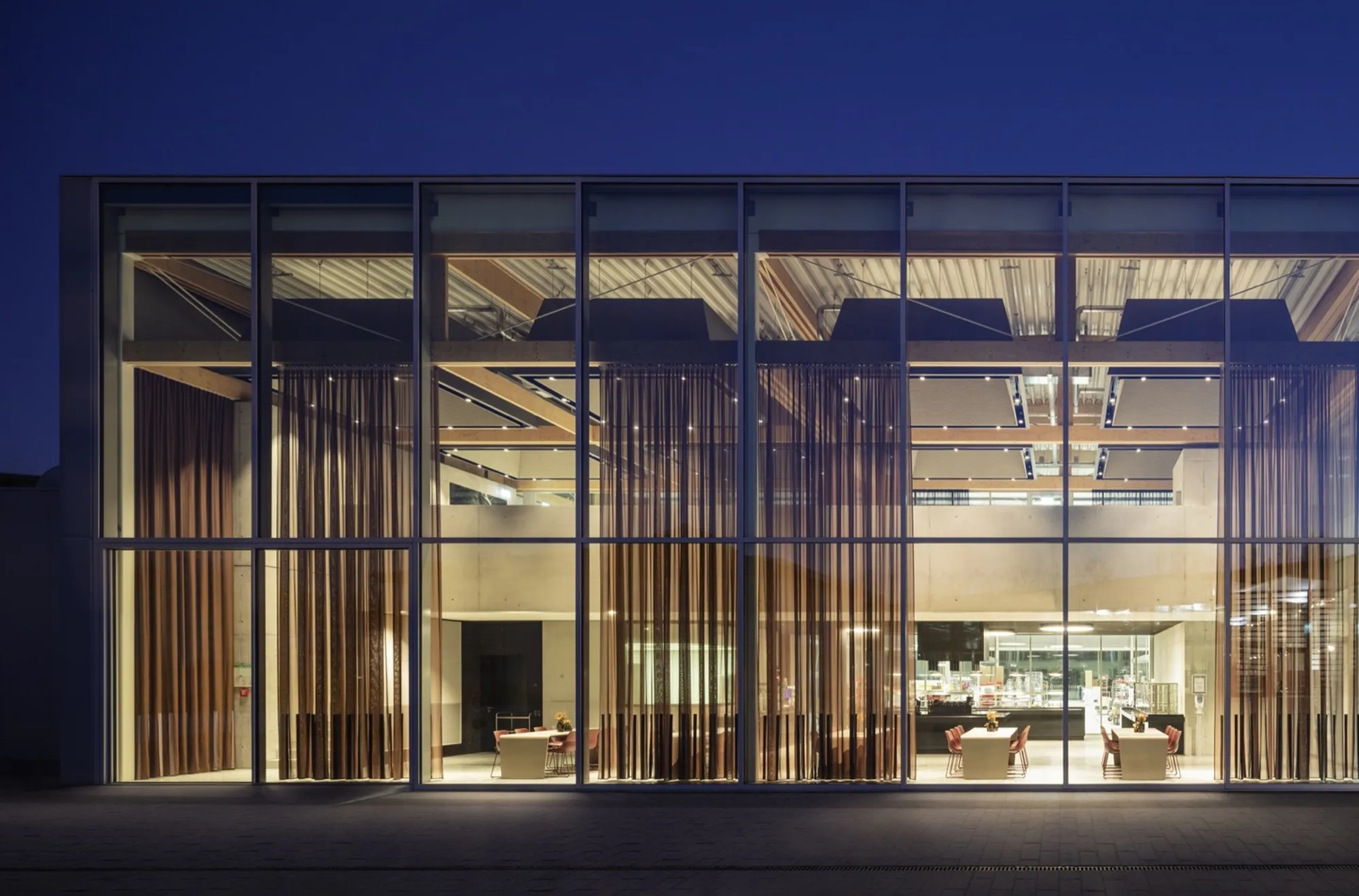
HENN Builds Brunner a Factory Where Office Workers and Production Lines Share One Timber Roof
A hybrid innovation center in southern Germany dissolves the boundary between white-collar workspace and industrial production hall.


The typical factory campus segregates its functions. Office towers face the road; production sheds hide behind them. Brunner, the German furniture manufacturer, asked HENN to reject that hierarchy entirely. The result is a building where desks, meeting rooms, a cafeteria, a library, and a full-scale production warehouse all sit beneath a single, continuous timber roof structure. Rather than stacking these uses vertically or isolating them in separate pavilions, the architecture treats every program as an equal citizen of one long, transparent volume.
What makes the Brunner Innovation Factory genuinely interesting is not merely that it combines office and industrial space, which plenty of projects claim to do. It is the degree to which the building's structure and skin expose that combination to both its occupants and the street. Glazed facades reveal the production hall as clearly as the entrance lobby. Elevated walkways let office workers watch furniture being assembled below. The timber grid overhead reads as one room, even when curtains, mesh screens, and glass partitions carve it into zones. The building is an argument that manufacturing is not something to hide.
A Glass Envelope That Refuses to Hide the Factory
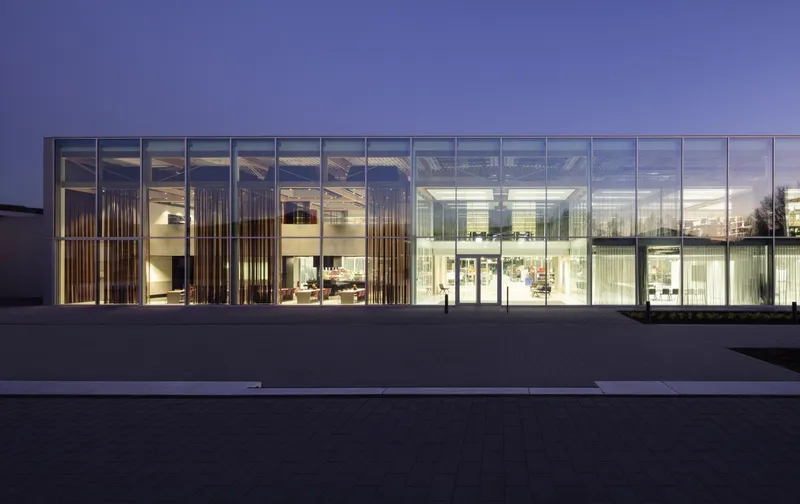


The long elevations are almost entirely glazed, screened by vertical timber slats that modulate solar gain without obscuring views inward. At dusk, the building glows like an inhabited display case. The slat rhythm picks up the cadence of the structural bays inside, giving the facade a depth that a flat curtain wall would lack. HENN treats transparency not as a corporate branding gesture but as a functional choice: daylight floods the production floor, and passersby register the activity within.
The screening panels do double duty. During the day they soften glare on workstations near the perimeter. At night they filter artificial light into warm, striped bands that give the building a civic presence on what is otherwise a quiet residential edge. The effect is restrained, nothing like the flashy media facades that dominate contemporary industrial architecture.
The Courtyard and the Reflecting Pool

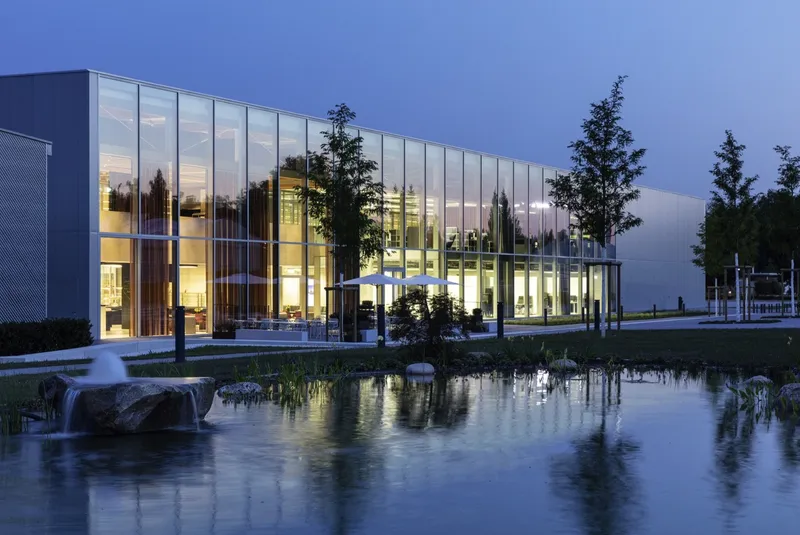
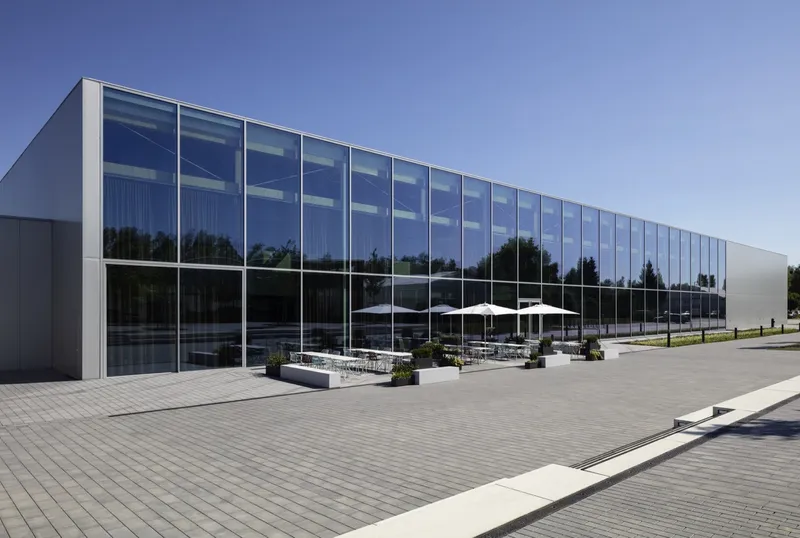
Between volumes, HENN carves out a paved courtyard that functions as an outdoor extension of the cafeteria and a decompression zone between production and office life. White umbrellas, planters, and simple outdoor furniture give it the character of a small public square rather than a corporate terrace. The reflecting pool at the far end sharpens the twilight image of the glass wall, doubling the building's luminous presence.
These landscape moves are modest but precise. They create moments of pause in a program that could easily feel relentless. Workers stepping out for lunch register a clear shift in atmosphere, one that does not require crossing a parking lot or walking to a separate amenity block.
Timber Structure as Unifying Device
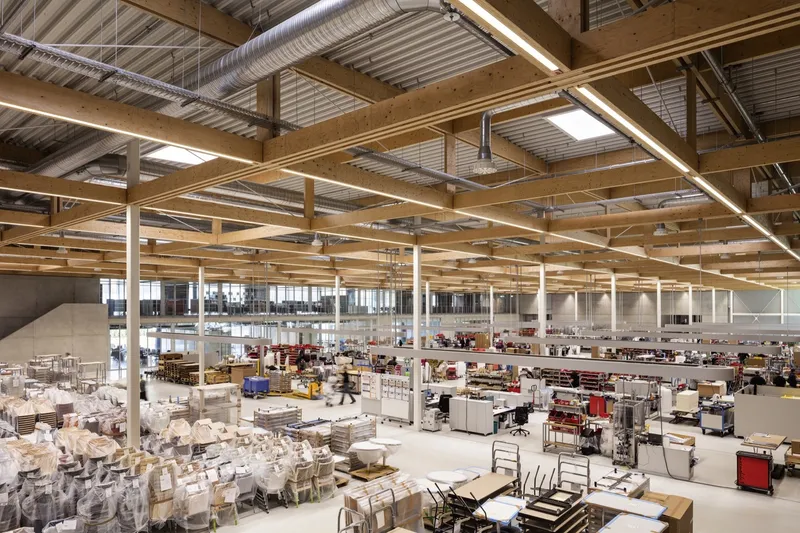
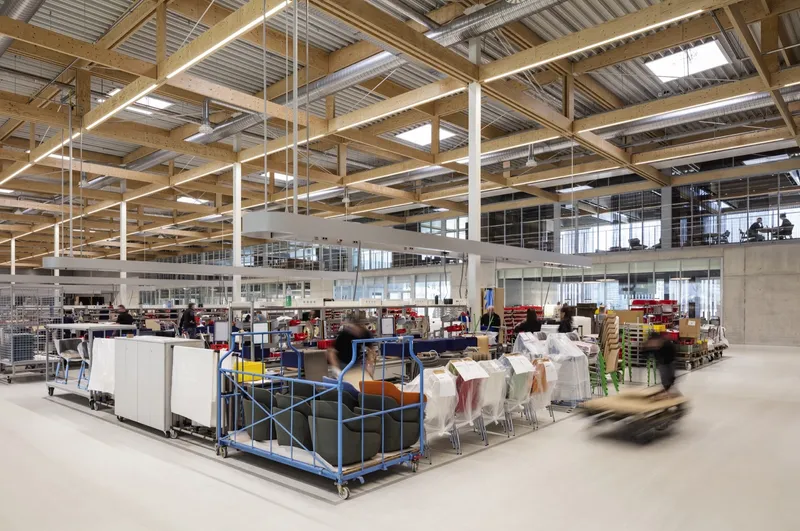
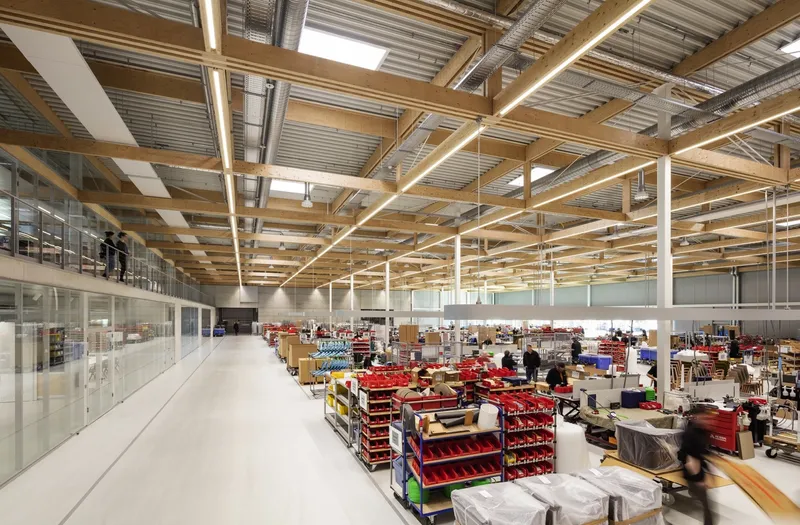
The exposed timber beam grid is the project's strongest spatial move. It runs continuously across the production hall, the warehouse, and the office zones, knitting programs together overhead. Corrugated metal decking sits above the beams, creating a ceiling plane that is legible as industrial yet warm in tone. The grid is not decorative; it is the primary structure, and it sets a bay rhythm that organizes everything below it, from workstation clusters to storage racks.
Sustainability credentials aside, the timber choice has an immediate perceptual payoff. A steel-framed shed of equivalent span would feel anonymous. Here, the wood grain and joint detailing give the interior a craft quality that mirrors Brunner's own product ethos. The roof structure becomes a kind of branding through construction logic rather than signage.
Production and Office, Face to Face
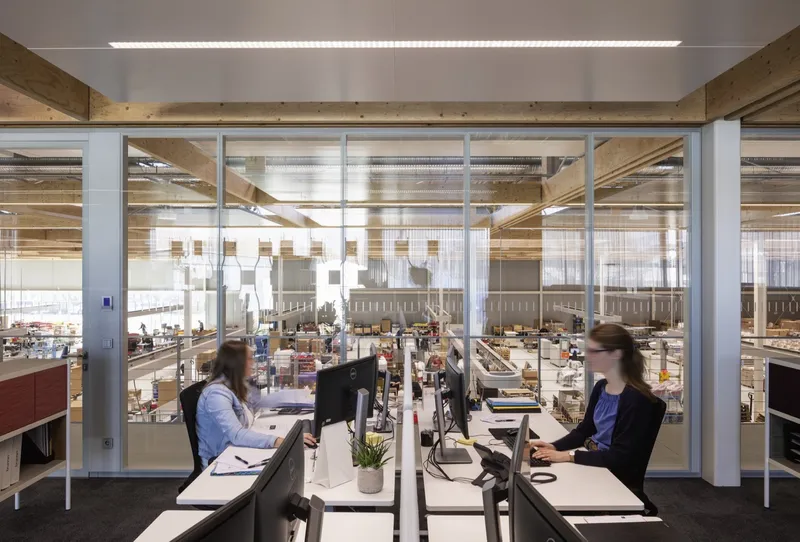
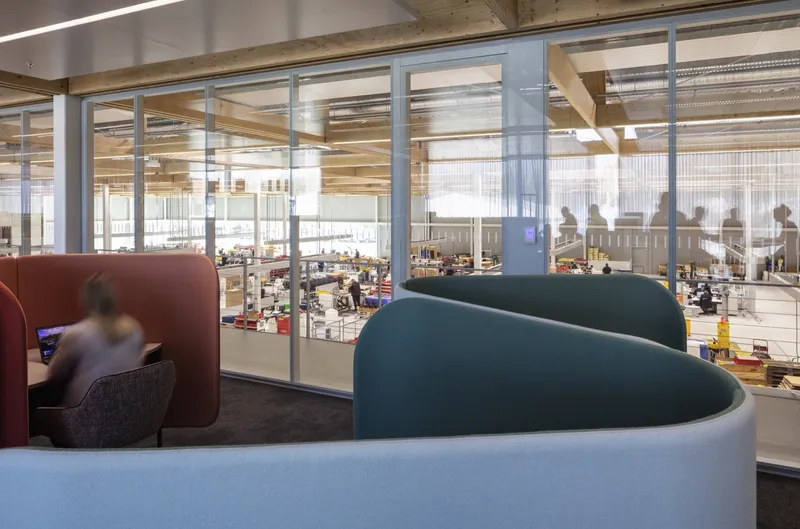
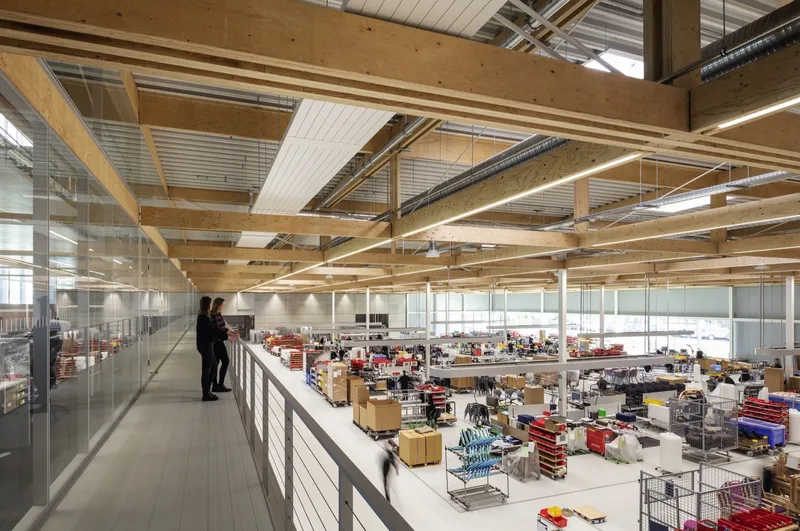
The building's most provocative detail is how it positions office workers in direct visual contact with the production floor. Elevated walkways and glass-railed corridors create overlook points where designers can watch prototypes being assembled. Lounge nooks with curved upholstered partitions frame the warehouse below like a stage. This is not surveillance; it is integration. The design assumes that understanding how things are made improves how they are designed.
HENN stops short of eliminating all separation. Glass partitions and changes in floor level maintain acoustic and environmental boundaries where they are necessary. But the visual connection is never broken. Even the conference rooms that face inward orient their glazing toward the workshop, not toward a garden.
Soft Boundaries: Curtains, Mesh, and Terrazzo
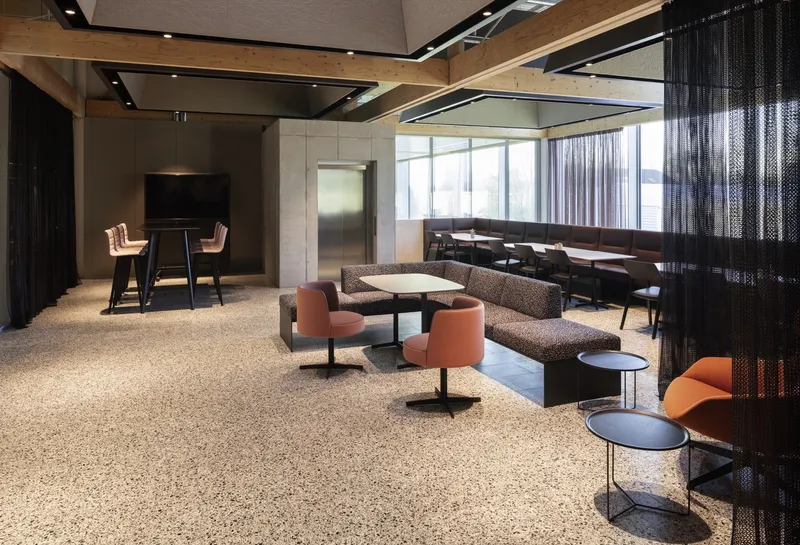
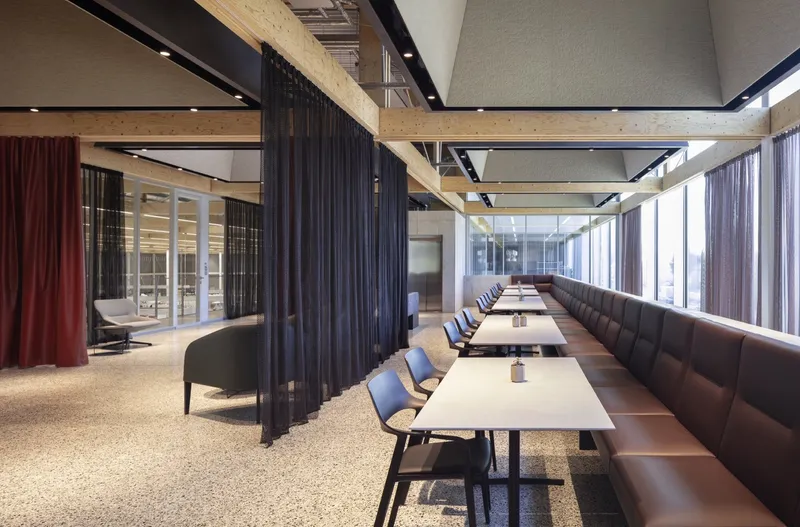
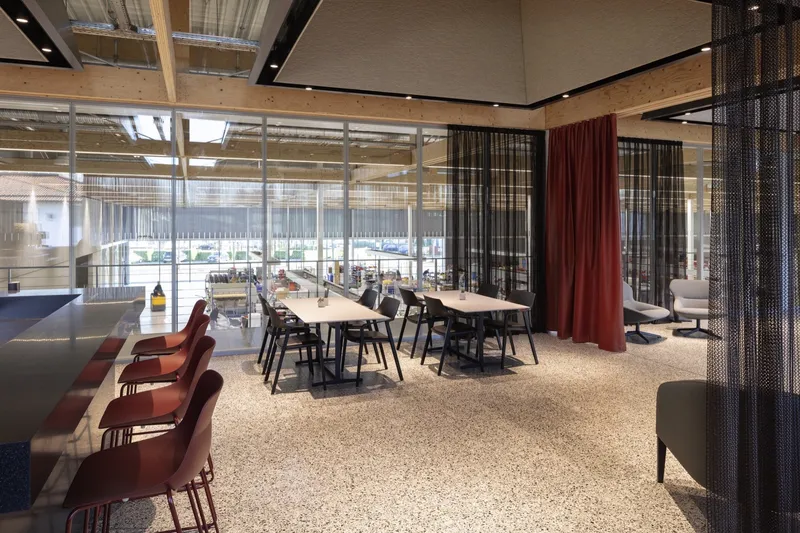
Within the open plan, HENN subdivides space using deliberately lightweight elements. Colored fabric curtains, metal mesh screens, and changes in flooring material (terrazzo replaces concrete in social zones) signal transitions without erecting walls. The cafeteria's banquette seating and timber beam rhythm carve out intimate dining zones that still read as part of the larger volume. The lounge areas use salmon-toned upholstery and terrazzo to establish a residential warmth that contrasts with the raw ceiling above.
This layering is practical. A furniture company needs to reconfigure its showroom and production layout regularly. Curtains and movable tables accommodate that. But the material palette also argues for a workplace that treats comfort and industrial rigor as compatible rather than opposed.
Meeting and Making
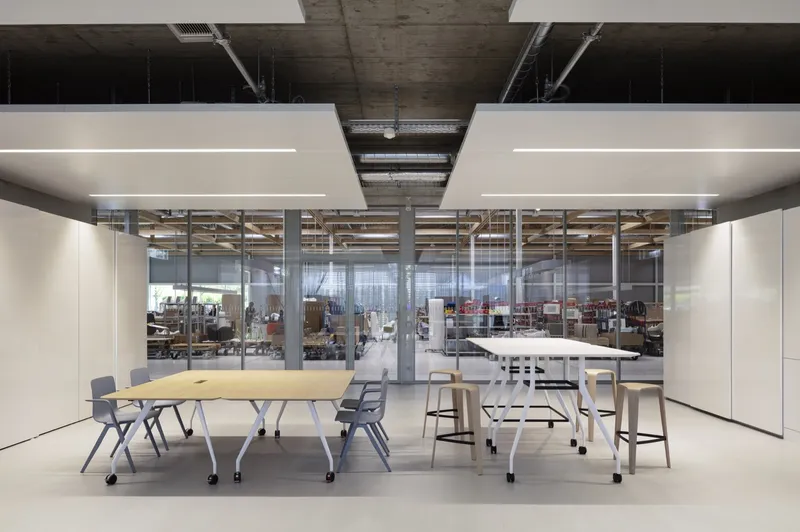
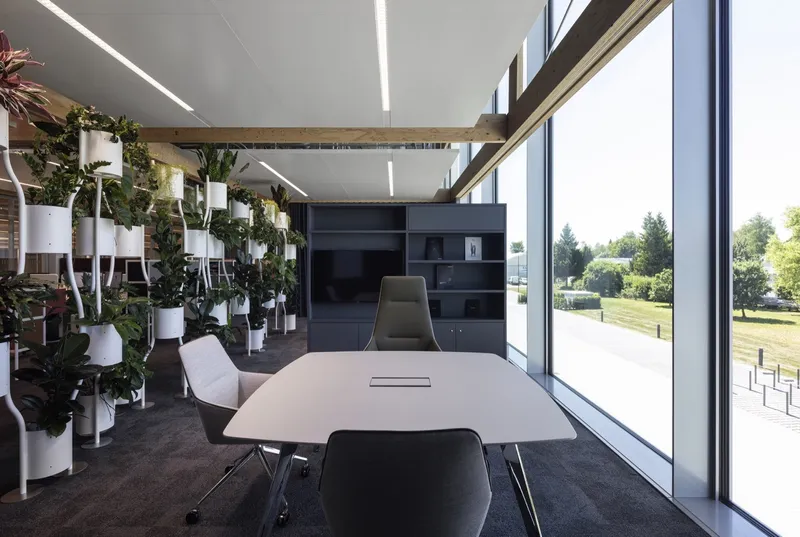
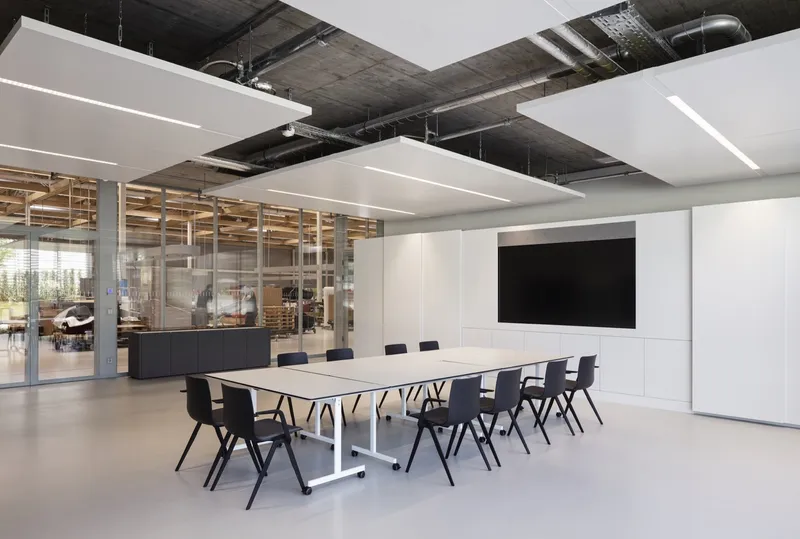
The meeting rooms demonstrate how seriously the architects took the hybrid brief. Some face outward through floor-to-ceiling glazing onto a green lawn, with vertical planters softening the interior wall. Others are inserted directly beside the workshop, their glass partitions giving participants a live view of production activity. Acoustic panels float beneath the exposed concrete ceiling in one room, while another relies on heavy curtains to manage sound. Each room is tuned to its adjacency rather than stamped from a corporate template.
Facade Variations: Metal, Glass, and the Loading Dock
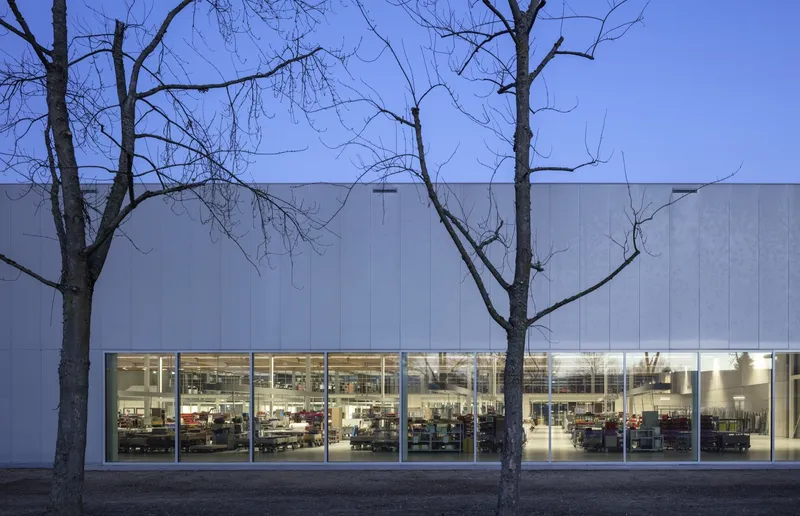
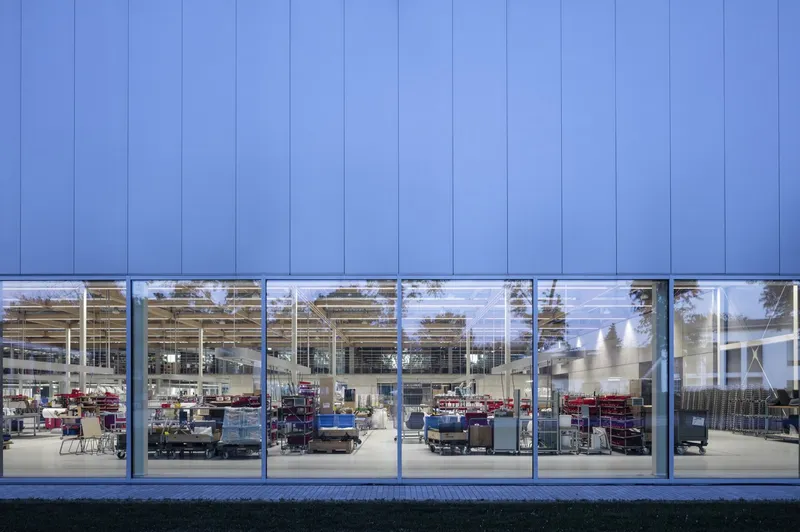
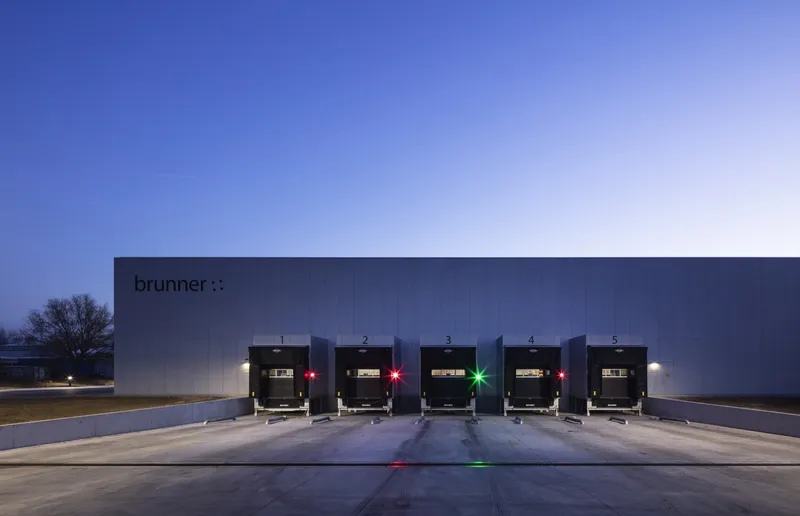
Not every elevation is transparent. The rear and service faces switch to blue metal panel cladding with horizontal ribbon windows that expose just enough of the double-height interior to maintain the building's ethos of visibility. The loading dock, with its five numbered bays and red-green indicator lights, is treated with the same material care as the entrance facade. HENN does not relegate logistics to an afterthought; it frames them as part of the building's identity.
The transition between metal panel and full glazing is handled cleanly. Where the two meet, the curtain wall's mullion rhythm carries through, preventing the facade from reading as two unrelated buildings bolted together. It is a small detail that makes a significant difference in how the complex holds together as a whole.
Plans and Drawings
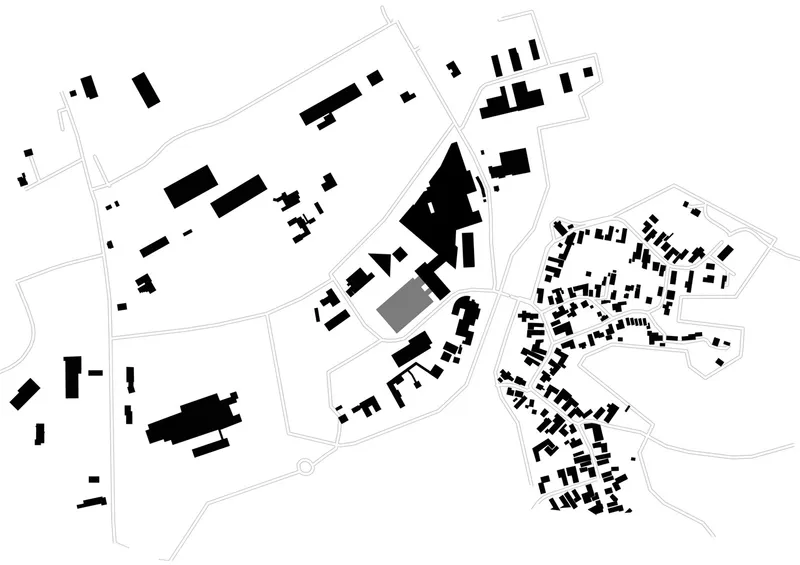
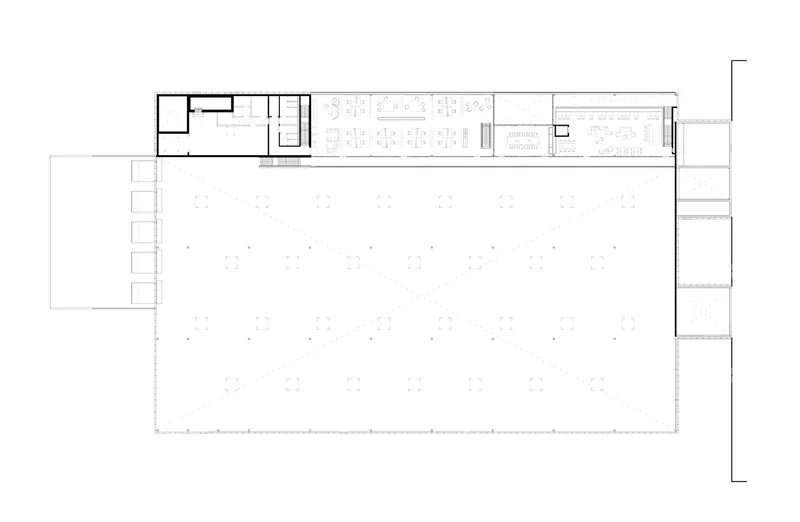
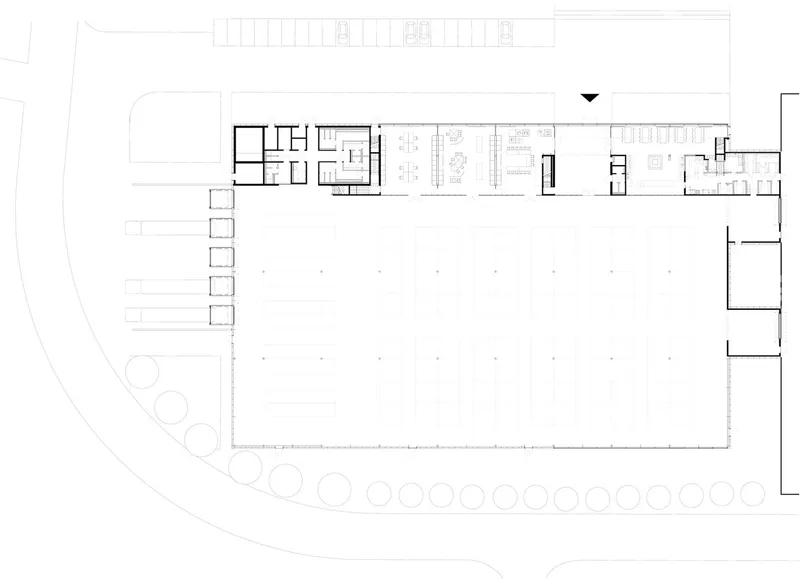
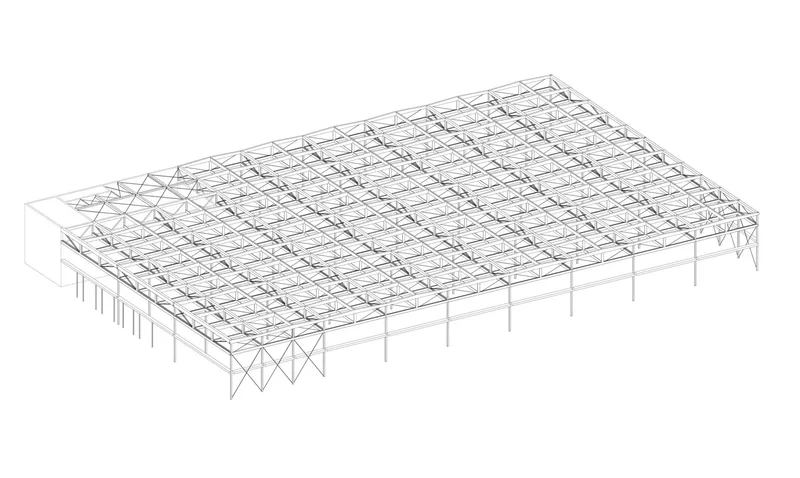
The site plan reveals how the building sits within a residential neighborhood, its elongated footprint oriented to minimize shadow impact on adjacent properties. The floor plans confirm the open-hall strategy: the production workshop occupies the largest single zone, with enclosed offices and support spaces docked along one edge rather than scattered through the plan. Curved landscape elements and a row of trees buffer the site boundary.
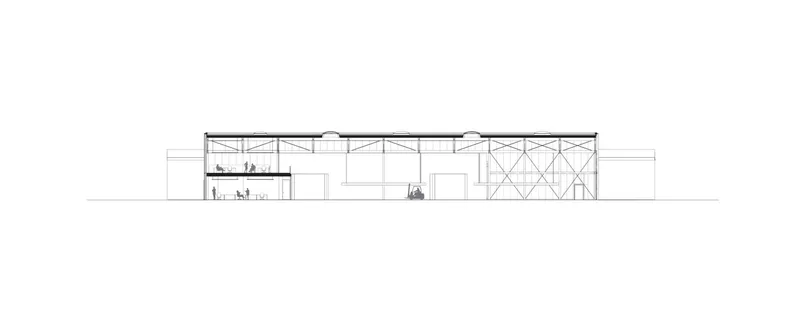
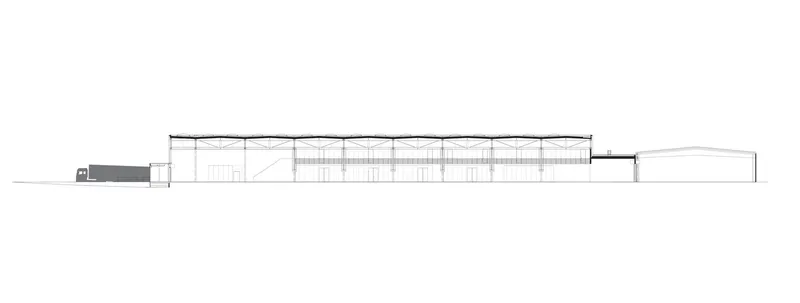
The sections are especially informative. The repetitive structural bays of the timber grid are legible in profile, as is the diagonal bracing that stabilizes the frame at its ends. A sloped volume at one edge suggests a transition to a different program or loading condition. The axonometric drawing of the roof structure isolates the grid, confirming that the columns and beams are the building's primary architectural expression, not merely its engineering.
Why This Project Matters
The Brunner Innovation Factory matters because it takes a building type that is almost always invisible, the manufacturer's production facility, and gives it the spatial ambition usually reserved for museums and corporate headquarters. By placing production, design, and administration under one roof and making them mutually visible, HENN rejects the organizational apartheid that has defined factory architecture for a century. The building does not romanticize labor; it simply refuses to segregate it.
For architects working on hybrid programs, the lesson here is in the details. The timber roof that unifies without homogenizing. The curtain and mesh partitions that subdivide without enclosing. The facade that reveals everything, including the loading dock. These are not radical moves individually, but assembled together they describe a workplace that is genuinely integrated. That is harder to achieve than it looks, and the Brunner Innovation Factory achieves it with notable discipline.
Brunner Innovation Factory by HENN. Photography by HGEsch.
About the Studio
Share Your Own Work on uni.xyz
If projects like this are the kind of work you want to make, uni.xyz is a place to publish your own, find collaborators, and enter design competitions.



Popular Articles
Popular articles from the community


Co-life: Sustainable Architecture for Age-Friendly Community Living
Co-life reimagines sustainable architecture for seniors through courtyards, rammed earth, shared gardens, and spaces designed for belonging.

Co-Life: Senior Housing Design That Reconnects Older Adults With the City
Co-Life reimagines senior housing design through healing gardens, shared streets, workshops, and a sustainable community across generations.

Hill & Cross Opera: Sculptural Opera House Architecture Shaped by Tallinn’s Landscape and Identity
Hill & Cross Opera reimagines opera house architecture in Tallinn through its sculptural hill, civic plaza, glass wave and a luminous cross.

Riyadh For All: Intergenerational Urban Design for Active Aging in Rabat
Riyadh For All reimagines urban design in Rabat with intergenerational co-living, adaptive courtyards, and Moroccan cultural exchange today.


Similar Reads
You might also enjoy these articles


FAMM Arquitectura Organizes Ten Villas Around Courtyards and Jungle in Nosara, Costa Rica
El Molino pairs two elongated volumes with deep overhangs and timber louvers to build a compact coastal community five minutes from the beach.

Oscar Niemeyer's Ibirapuera Park Pavilions Define São Paulo's Cultural Identity in Concrete and Curve
A constellation of modernist volumes set within São Paulo's most important urban park, conceived for the city's 400th anniversary in 1954.
How Henri Picq's 1889 Paris Pavilion Traveled 11,000 Kilometers to Become Santiago's Artequín Museum
A prefabricated iron and glass pavilion built for the Paris Universal Exposition found a second life as a children's art museum in Chile.

Sanjay Puri Architects Wraps a Jaipur Office Tower in Capsule-Shaped Green Buffers
A nine-level climate-responsive workplace near Jaipur Airport uses stacked planter terraces and aluminium screens to fight 40°C heat.


Explore Architecture Competitions
Discover active competitions in this discipline



Challenge to reimagine the Iron Throne


Photograph architecture without architects


Illustrate the lost glory of Angkor Wat - Render Challenge


Design challenge to reuse E-waste
Comments (0)
Please login or sign up to add comments
No comments yet. Be the first to comment!