
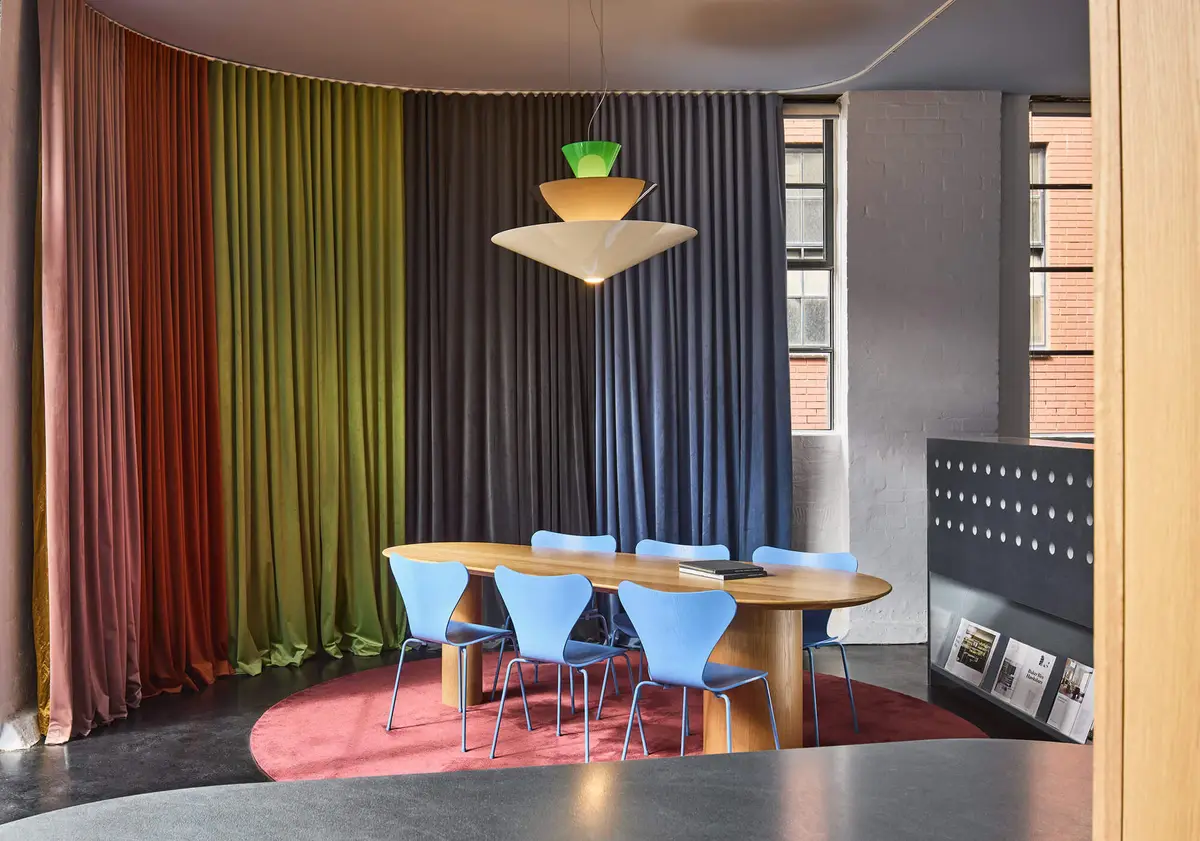
IF Architecture Designs Its Own Collingwood Studio as a Textile-Wrapped Incubator for Ideas
A 90-square-metre office in Melbourne's Collingwood uses layered curtains and color to turn a compact footprint into a laboratory for design.


Designing your own studio is one of the most revealing things an architect can do. Strip away the client brief, the compromises, the budget negotiations with someone else's priorities, and what remains is a direct statement of values. For IF Architecture, that statement turns out to be a 90-square-metre space in Melbourne's Collingwood that treats color, texture, and softness not as decoration but as primary spatial tools.
The studio functions as office, meeting room, and testing ground, all at once. Rather than partition a small footprint with walls, the practice uses curtains in shifting gradients of terracotta, pink, gold, green, and charcoal to define zones that can be reconfigured on the fly. It is a space that refuses to be static, and in doing so it becomes an argument: that flexibility and atmosphere are not opposites of rigor, but expressions of it.
Color as Structure
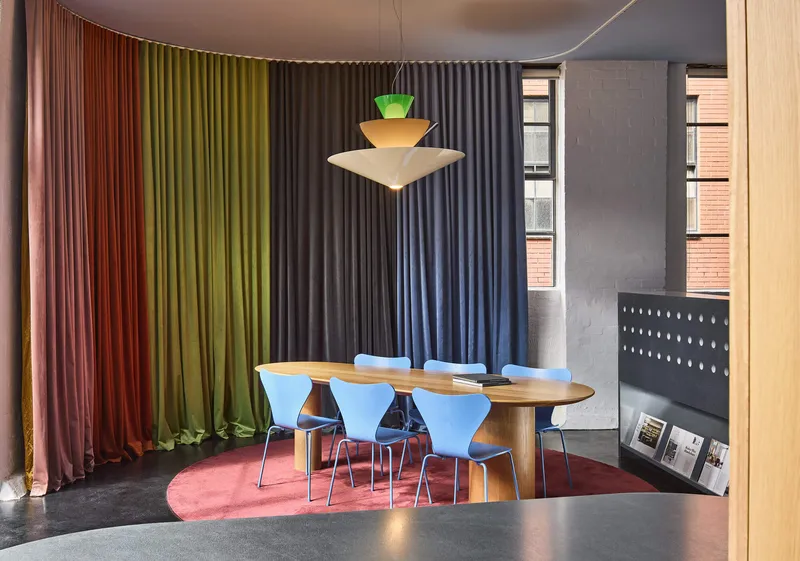
The most striking move here is the gradient curtain wall that runs through the workspace, shifting from warm terracotta through mossy green to deep charcoal. It reads less like a divider and more like a landscape, establishing depth and orientation in a room that could easily feel flat. The curtains are not supplementary to the architecture. They are the architecture, or at least the primary mechanism by which one part of the studio feels distinct from another.
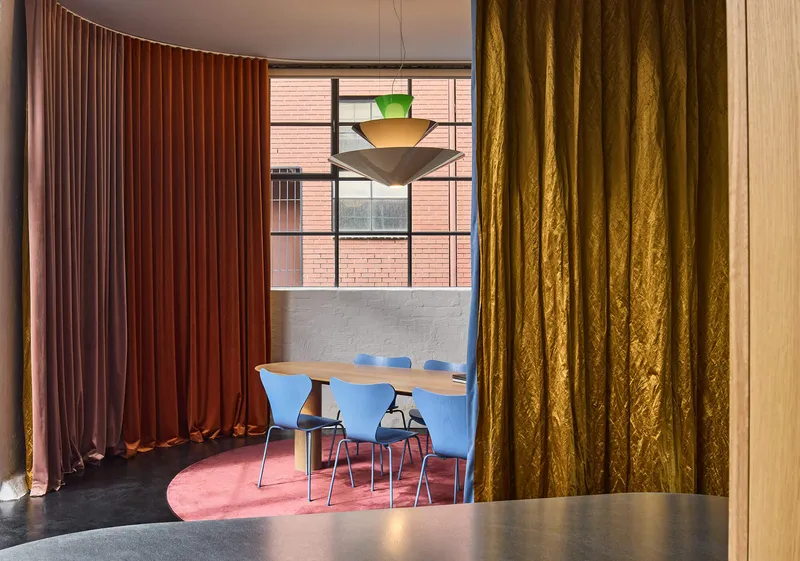
Viewed through a gold curtain panel, the layered textile partitions create a sense of passage between zones that no drywall partition could replicate. Light filters through differently depending on the fabric weight and hue, which means the character of each area changes throughout the day. The effect is cinematic without being theatrical.
The Meeting Room as Stage Set

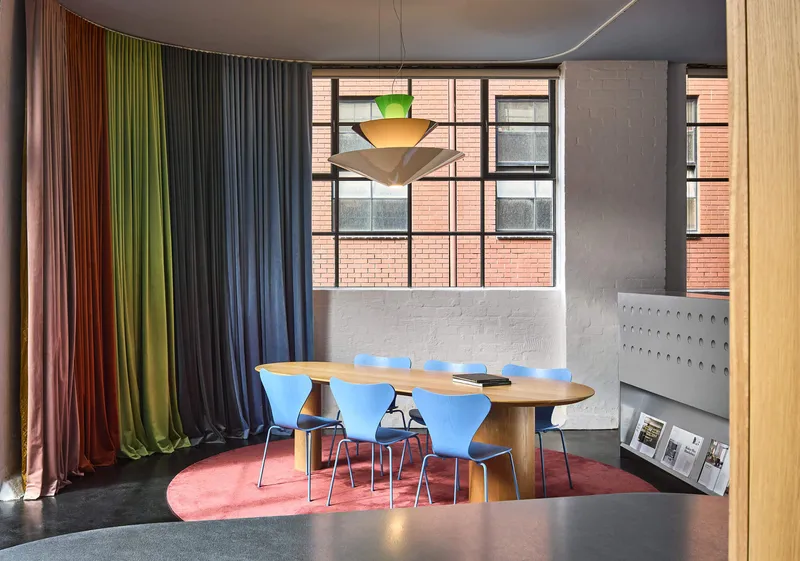
Two meeting areas anchor the plan, and each has a personality. The conference room with its oval table and blue chairs sits on a circular pink rug beneath industrial windows, a composition that feels deliberate down to the last detail. The rug defines the zone the way a spotlight defines an actor. There is no ambiguity about where you sit or what this space is for.
The second meeting area takes a warmer, more enveloping approach. Multicolored curtains frame a timber table beneath a tiered pendant light, creating an intimacy that the larger conference setting deliberately avoids. It is the difference between a boardroom and a salon, and having both in 90 square metres is a quiet feat of spatial economy.
Detailing the Hard Edges

Not everything here is soft. A perforated metal balustrade paired with warm timber cabinetry introduces a more industrial register that grounds the curtain work. Below, a magazine display shelf signals the studio's interest in curation and reference, a small gesture that tells you this is a practice that reads as much as it draws. The perforation pattern lets light through while adding visual texture at a finer grain than the curtains.
The tension between these harder elements and the surrounding textiles is productive. Without the metal and timber, the space might tip into softness to the point of losing definition. Without the curtains, it would be just another converted Collingwood warehouse. The balance is what makes it specific.
Plans and Drawings

The floor plan confirms what the photographs suggest: the studio is essentially one room, organized by furniture clusters and curtain lines rather than walls. Workstations occupy the central zone, with the circular meeting table at one end and bathroom facilities tucked to one side. The plan is almost aggressively open, which makes the curtain strategy legible as a design decision rather than a workaround. Every soft partition exists because someone chose it over a wall.
Why This Project Matters
Architect-designed studios tend to fall into two camps: the pristine white gallery that says "we are serious" or the rough industrial shell that says "we are cool." IF Architecture's Collingwood space refuses both clichés. It uses color and textile with the kind of intentionality usually reserved for structural decisions, and it does so in a footprint small enough that every choice is visible and accountable.
More broadly, the project makes a case for softness as a legitimate architectural material. Curtains are cheap, reconfigurable, and sensorially rich, yet they rarely feature in conversations about spatial innovation. This studio suggests they should. When the boundary between two zones can be pulled open or drawn shut, when light and color shift with the hour, the architecture becomes less of a fixed object and more of a living instrument. At 90 square metres, that is no small achievement.
IF Architecture Studio by IF Architecture, Collingwood, Victoria, Australia. 90 m². Completed 2025. Photography by Sharyn Cairns.
About the Studio
Share Your Own Work on uni.xyz
If projects like this are the kind of work you want to make, uni.xyz is a place to publish your own, find collaborators, and enter design competitions.


Popular Articles
Popular articles from the community


Singing Woman: Contemporary Architecture Inspired by Estonia’s Voice and the Sea
Singing Woman turns Estonia’s song culture into flowing opera house architecture, blending public life, landscape, sea, and national memory.

Manzana Morphosis: Stretching Barcelona's Grid into a Living Landscape for 2050
A radical reworking of the Eixample manzana turns density into a tool for generous public space, vertical ecology, and environmental performance.

Temporary Home for Dogs: A Reversed Zoo Rethinks Animal Shelter Architecture
In Bucharest, a sinuous corridor and freed landscape flip the logic of containment, designing a shelter that works to make itself unnecessary.

Opera on the Sea: Driftwood Logic Shapes a Timber Opera House on Estonia's Coast
Trevor Orgill's opera house translates the entangled drift of floating timber into a civic building where wood, water, and music converge.

Similar Reads
You might also enjoy these articles

Bao Huynh Watercolor Atelier: A Serene Art Retreat in Hội An
Bao Huynh Watercolor Atelier in Hội An blends multifunctional art spaces, sustainable design, local materials, and family-friendly living in a serene environment.

Atelier Macri Concept Store Interior Design by CASE-REAL
Atelier Macri store features a "ko" counter, walnut wood details, cork displays, blending retail, gallery, and seamless customer experiences.

Manuel Vargas Izquierdo Stadium and High-Performance Sports Center: Architectural Excellence in Jalpa de Méndez
The Manuel Vargas Izquierdo Stadium blends sustainable design, inclusive sports facilities, and cultural-inspired architecture, revitalizing Jalpa de Méndez’s public spaces.
KAKR Buluh Awar Hall: Revitalizing Community and Ecology Through Bamboo Architecture
Community built bamboo hall revitalizes Buluh Awar village, empowering youth, restoring ecology, celebrating vernacular craftsmanship through sustainable architecture and culture.

Comments (0)
Please login or sign up to add comments
No comments yet. Be the first to comment!