

Francisca Sottomayor and Fahrenheit.Works Build a Living Kitchen Where Plants Cook Alongside People
A multispecies dining installation in Porto transforms a communal table into a working ecosystem of herbs, fire, and shared meals.


What happens when you refuse to separate the garden from the kitchen, the table from the planter, the meal from the ecology that produced it? In Porto, Francisca Sottomayor and Fahrenheit.Works, led by architect Jeremy Morris, answered that question with a temporary installation that collapses all those boundaries into a single object: a long, undulating, white-cast communal table perforated with living plants, embedded cooking platforms, and water features. The table is not a metaphor for cohabitation. It is cohabitation, functioning simultaneously as dining surface, herb garden, fire pit, and irrigation channel.
Completed in 2025, the Live Multispecies Kitchen takes seriously an idea that most architectural projects only gesture toward: that humans and non-human organisms can share domestic infrastructure without one being subordinated to the other. The lavender grows through the tabletop, not in a decorative pot beside it. The fire sits on stacked bricks among the flowers, not in a separate appliance. The result is an installation that feels genuinely radical in its simplicity, a piece of temporary architecture that reframes the daily act of eating as an interspecies negotiation.
A Table That Is Also a Landscape
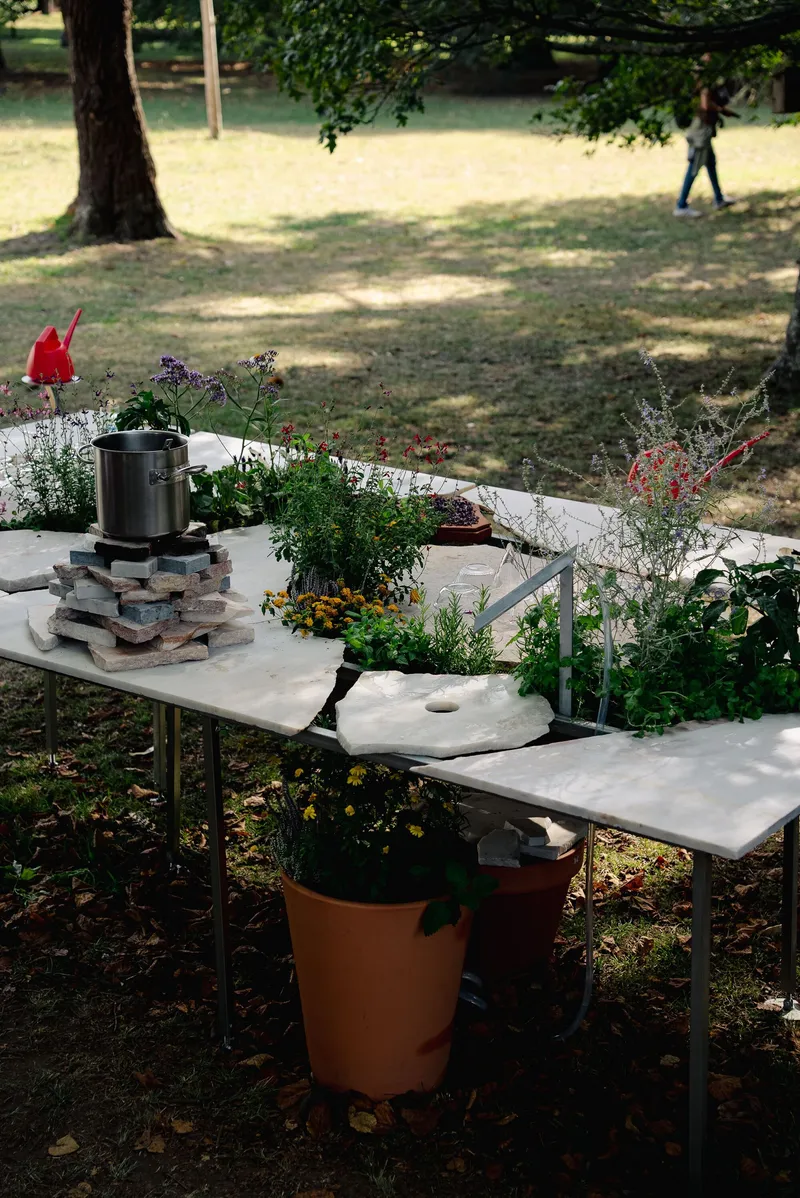
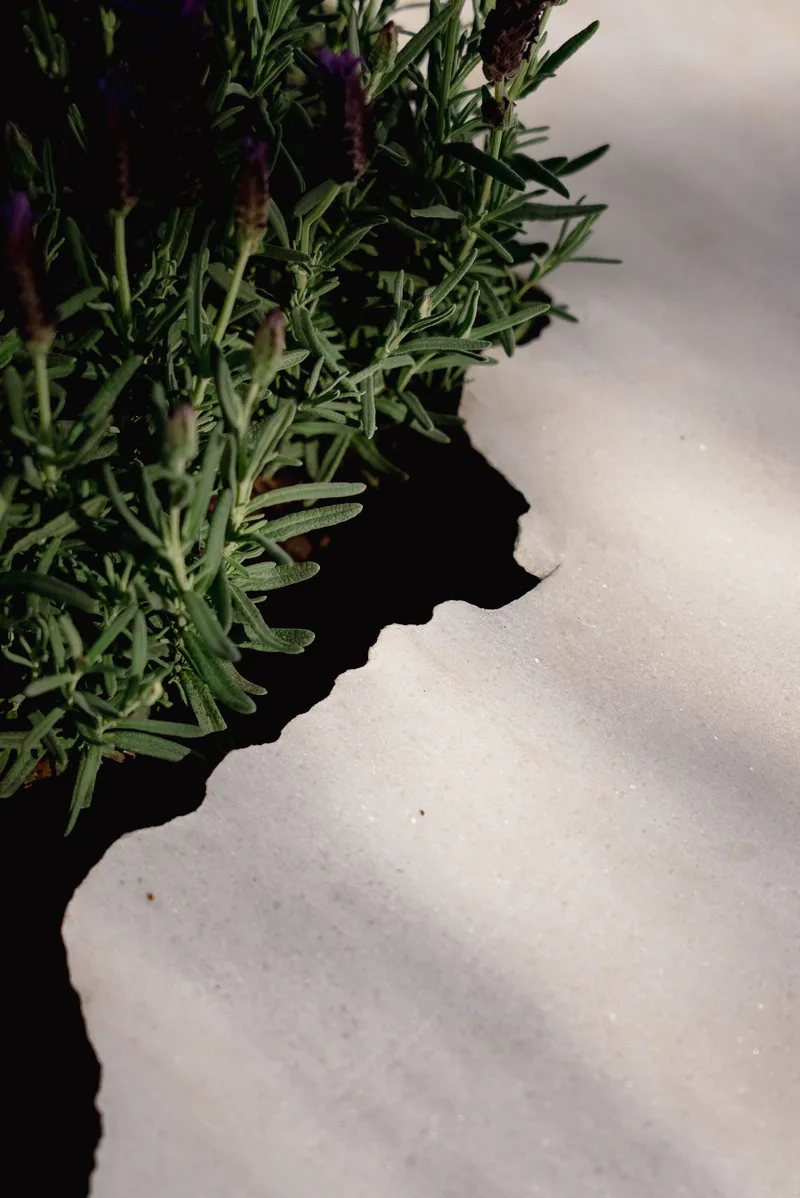
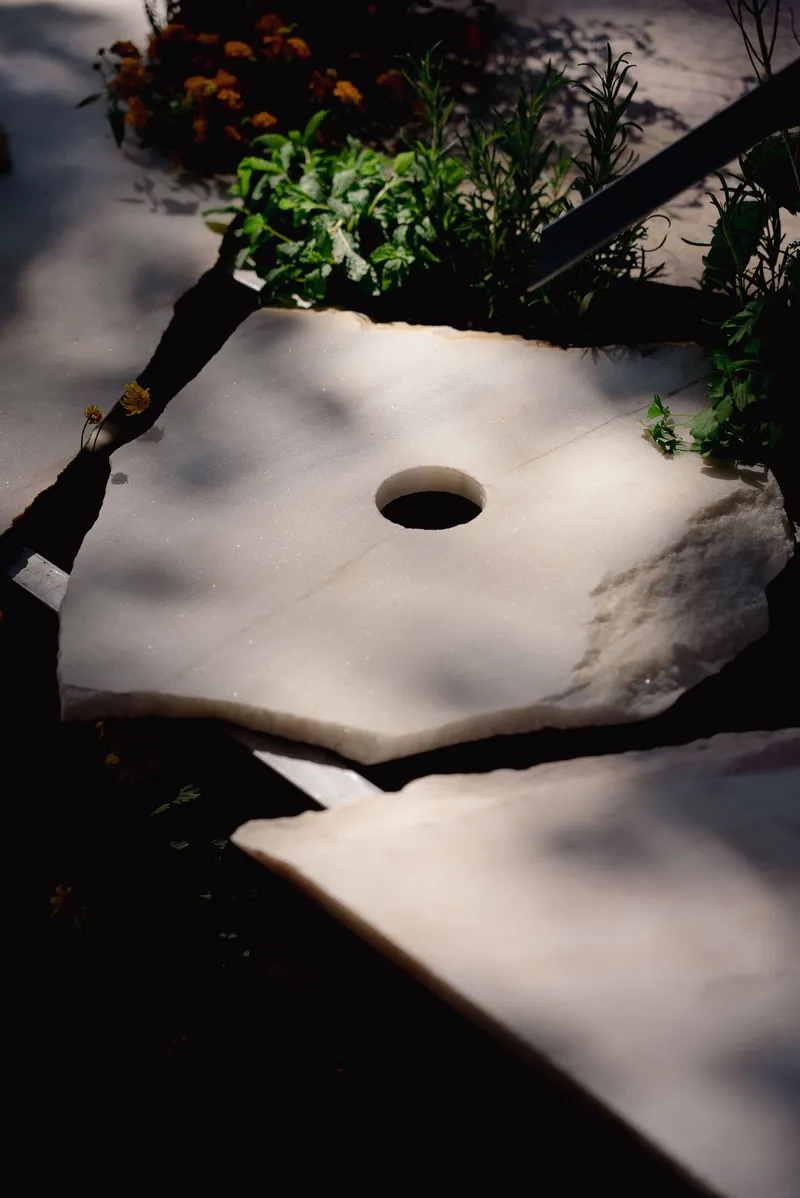
The installation's central element is a long, freeform table cast in white that reads more as topography than furniture. Irregular openings are cut directly through the surface, each one filled with soil and planted with lavender, microgreens, or herbs. Circular drainage holes punctuate the plane, turning rainwater into a resource rather than a nuisance. The white surface amplifies every shadow, every leaf edge, every crumb, making the biological activity on the table visually undeniable.
This is not a raised bed with a shelf attached. The planting and the eating happen at the same elevation, in the same material, which forces users to navigate around living things rather than clearing them out of the way. It is a small but meaningful inversion of how we typically organize space around food.
Cooking on Stacked Stone
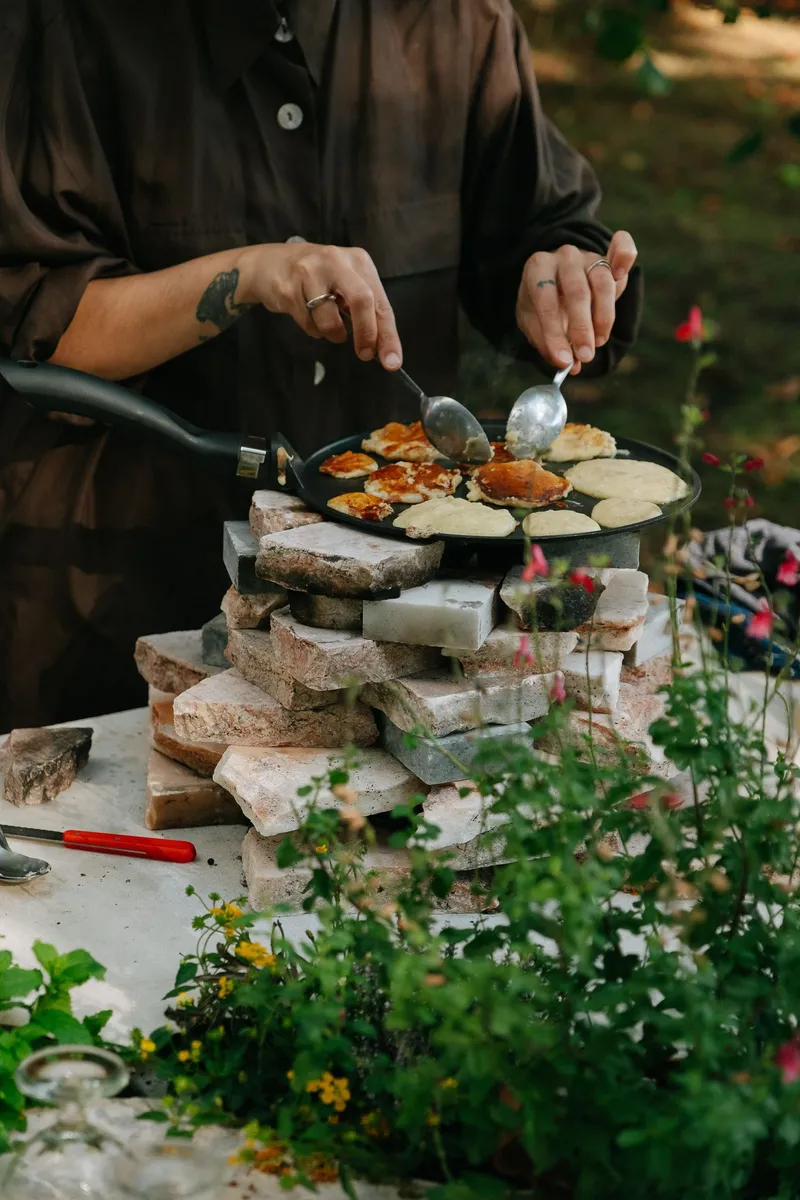
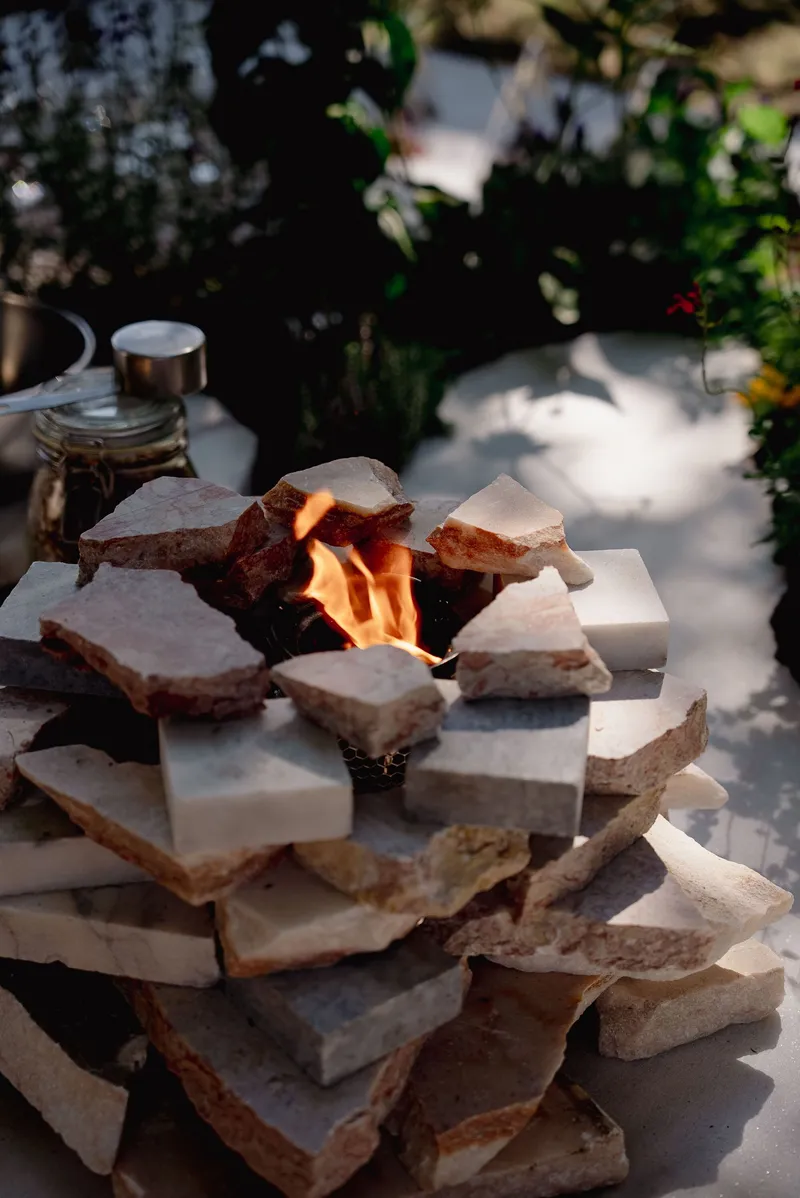
The cooking stations are deliberately primitive: bricks stacked into low platforms that support flat griddles and open flames. There is no gas line, no stainless steel, no extraction hood. Fire simply happens on the table among the plants and glassware, and the meal takes shape in full view. Hands press flatbread on a hot surface while flower petals blow across the work area. The smoke drifts through the same canopy that shades the diners.
By stripping the cooking apparatus down to elemental materials, Sottomayor and Morris make the act of preparing food feel participatory and exposed. You cannot cook here without being aware of the herbs at your elbow, the flame a foot from a terracotta pot of greens, the entire fragile choreography of the ecosystem you are eating within.
Ingredients at the Point of Use
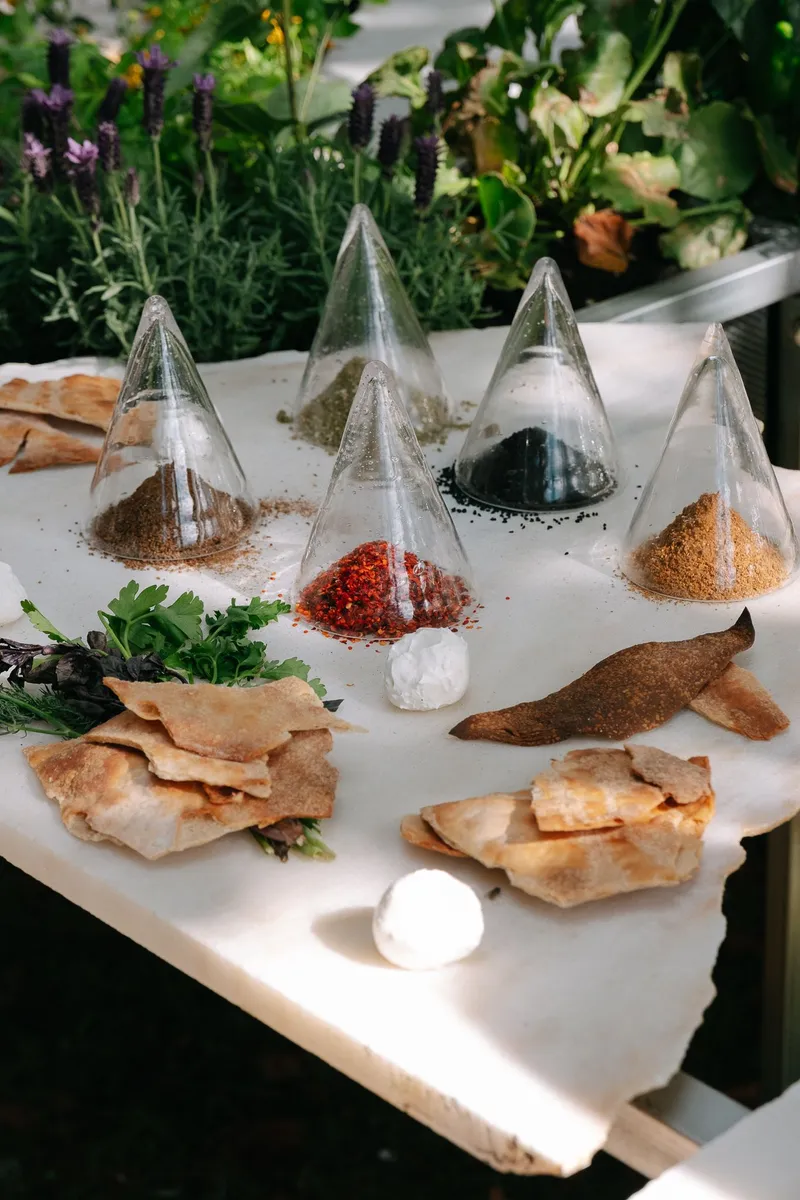
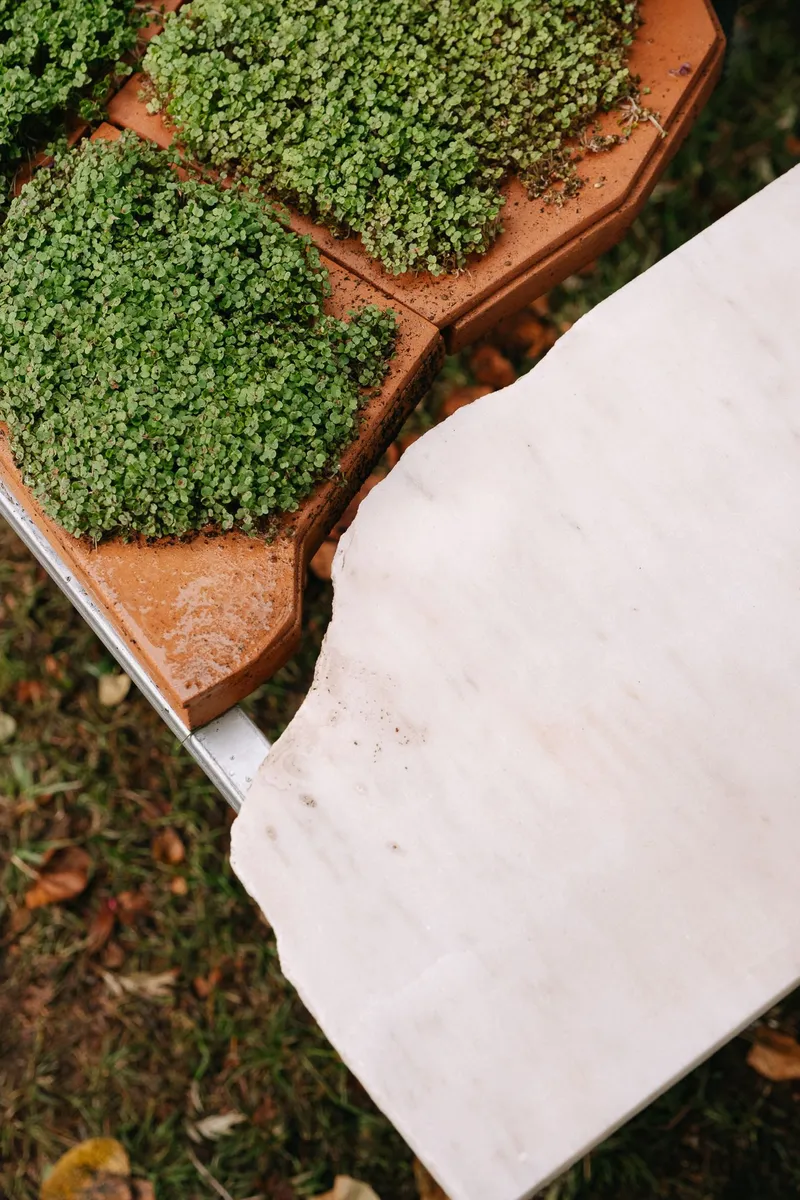
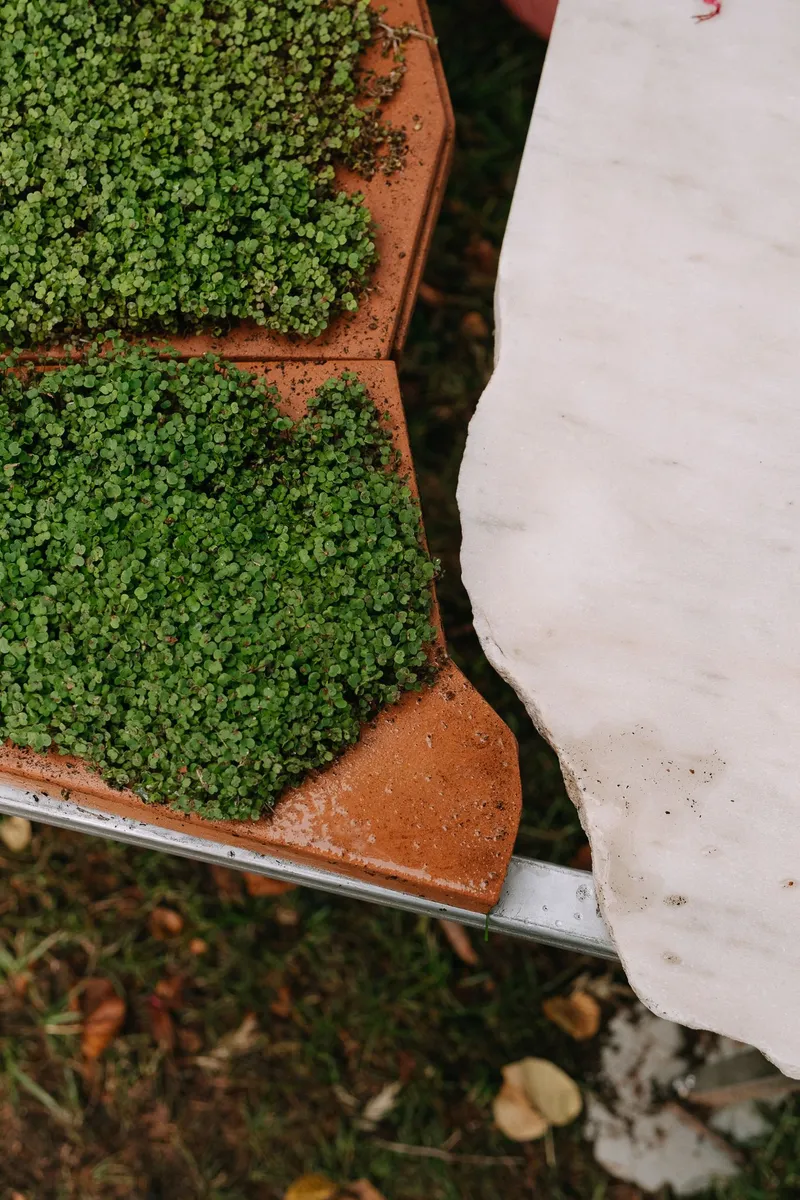
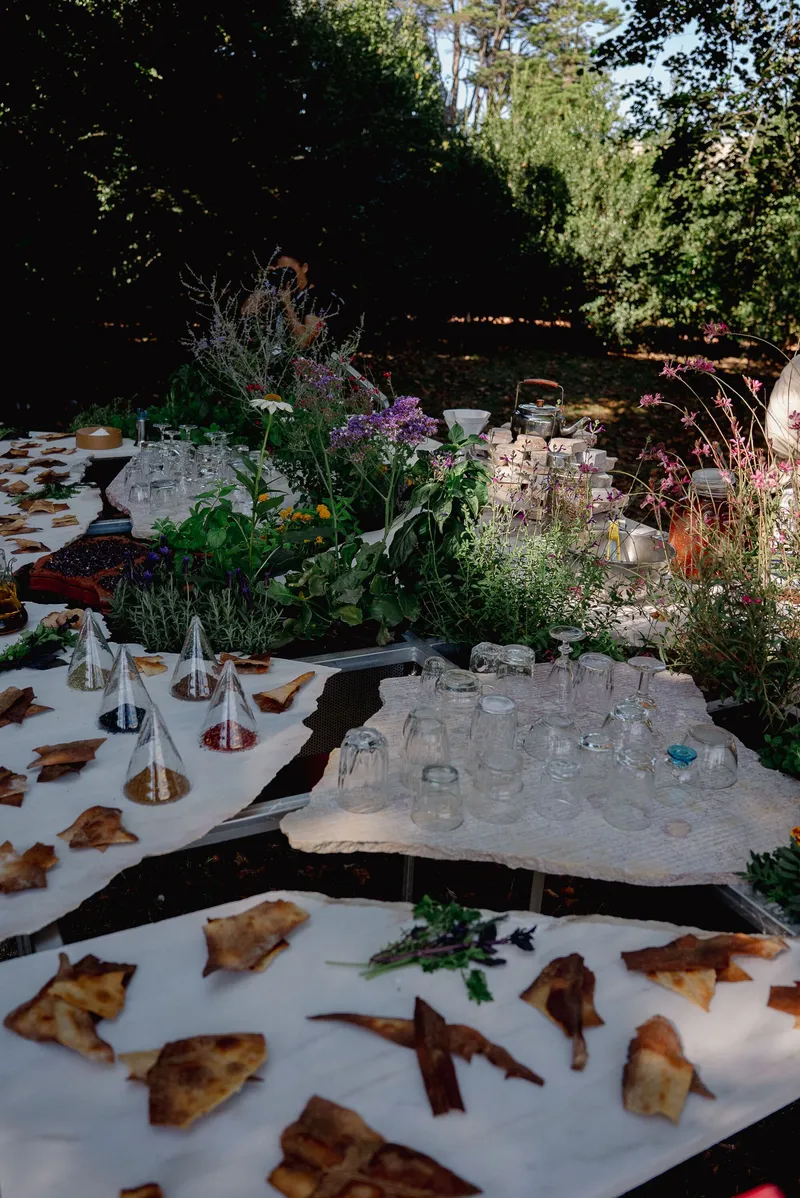
Glass pyramid vessels filled with spices and dried herbs sit directly on the table alongside terracotta trays of sprouting microgreens. The display is not decorative. These are active ingredients, placed where they will be used, eliminating the logistical separation between pantry and plate that defines conventional kitchens. The spice vessels catch light like architectural models, their triangular profiles turning seasoning into spectacle.
Terracotta pots of microgreens rest on the table edge as casually as a napkin holder would in any other outdoor dining setup. The material choice matters: terracotta breathes, wicks moisture, and ages gracefully outdoors. It belongs to the same family of low-tech, earth-derived materials as the stacked brick cooking platforms, giving the entire installation a coherent material logic rooted in clay and fire.
The Communal Gathering
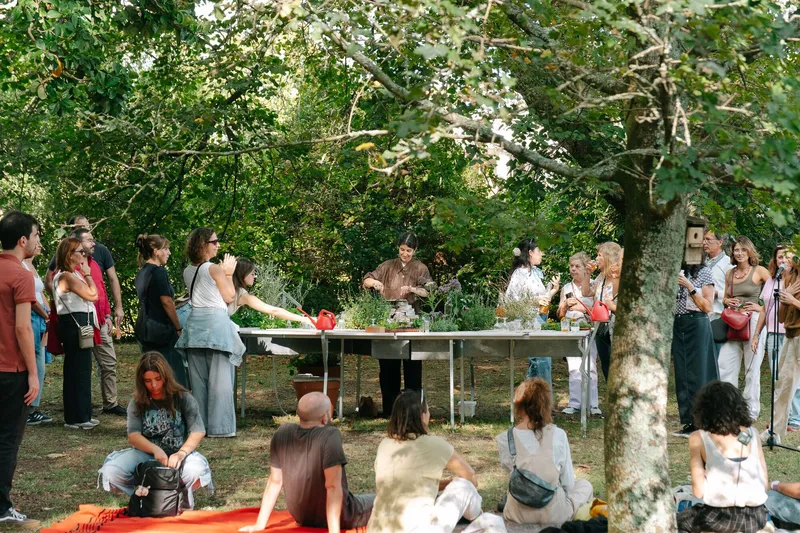
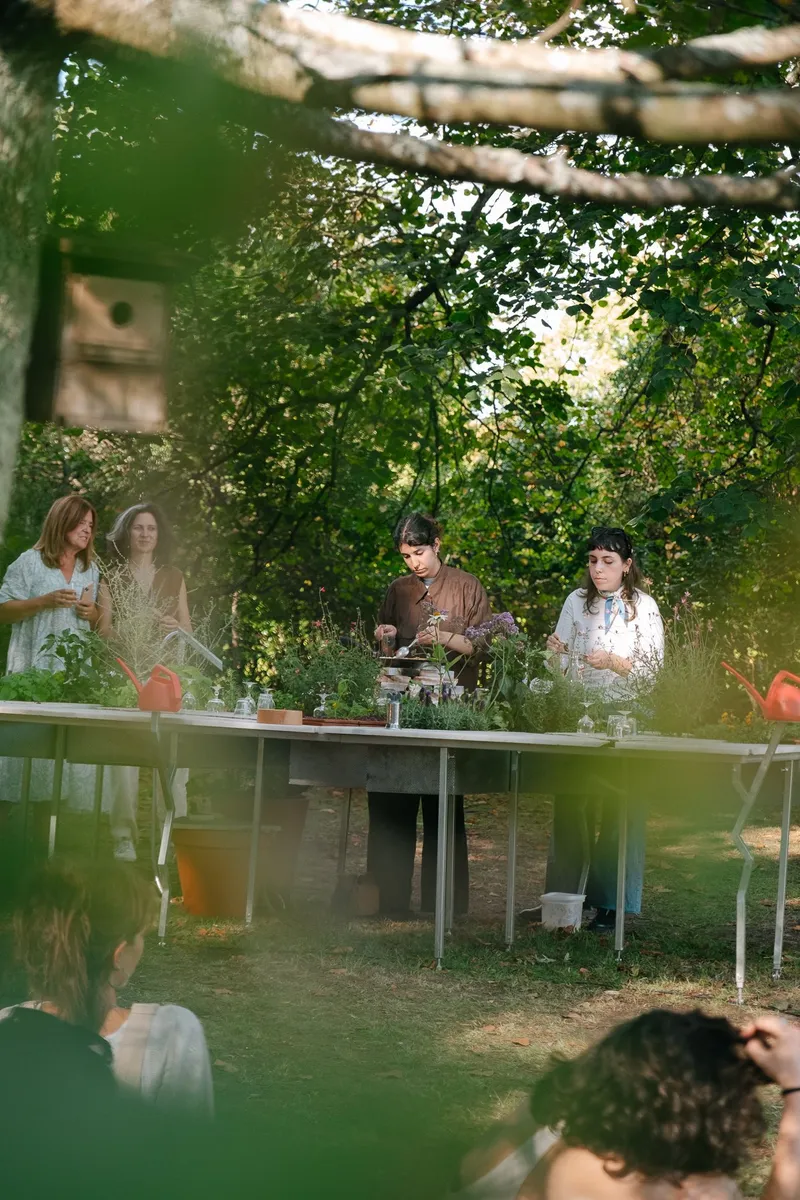
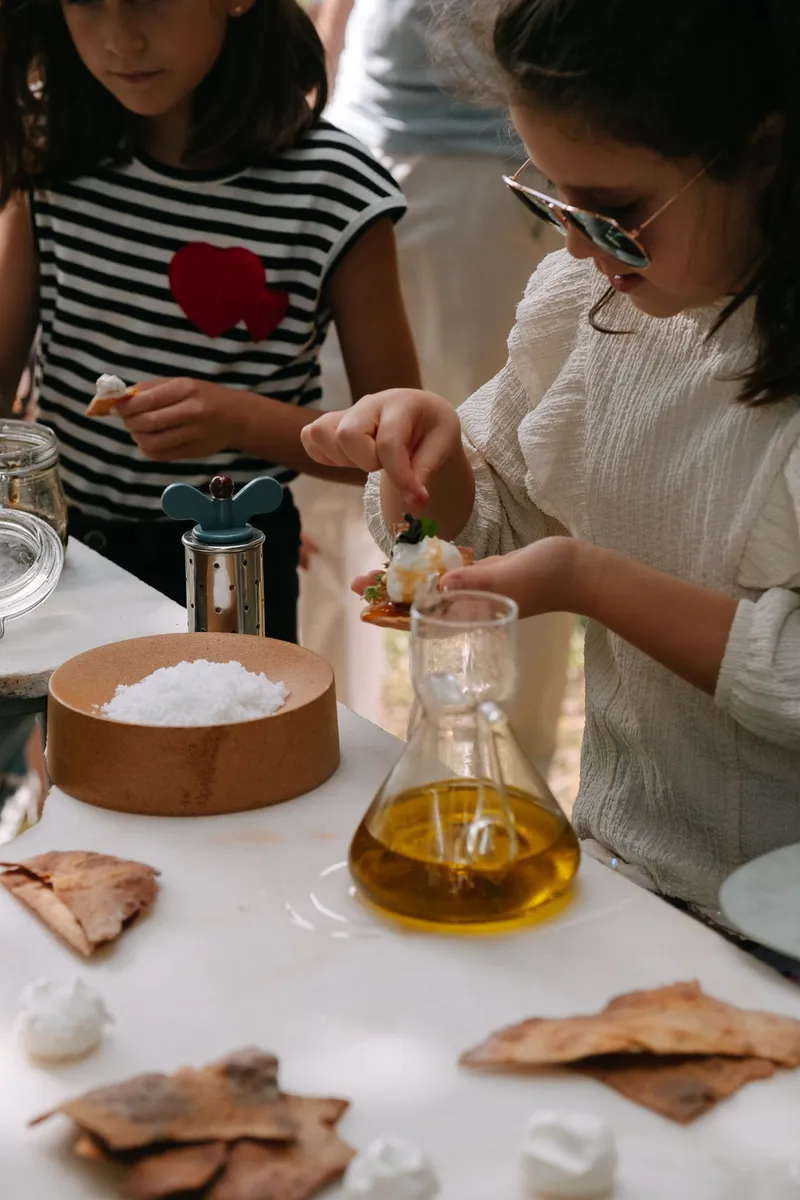
The installation is activated by people, and the images of the project in use are more revealing than any rendering could be. Adults gather under vine-covered timber pergolas in dappled afternoon light. Children prepare food with olive oil and salt, their hands on the same surface where lavender grows. The atmosphere is convivial without being staged, and the architecture recedes just enough to let the social ritual take center stage.
What emerges is a picture of shared labor. Nobody here is a passive diner. The table demands tending: plants need water, fire needs stoking, bread needs turning. The design distributes responsibility across everyone present, which is arguably the most radical proposition the project makes. In a culture that has industrialized cooking into a solitary act performed behind a kitchen island, this installation insists on collective participation.
Texture, Light, and the Details That Linger
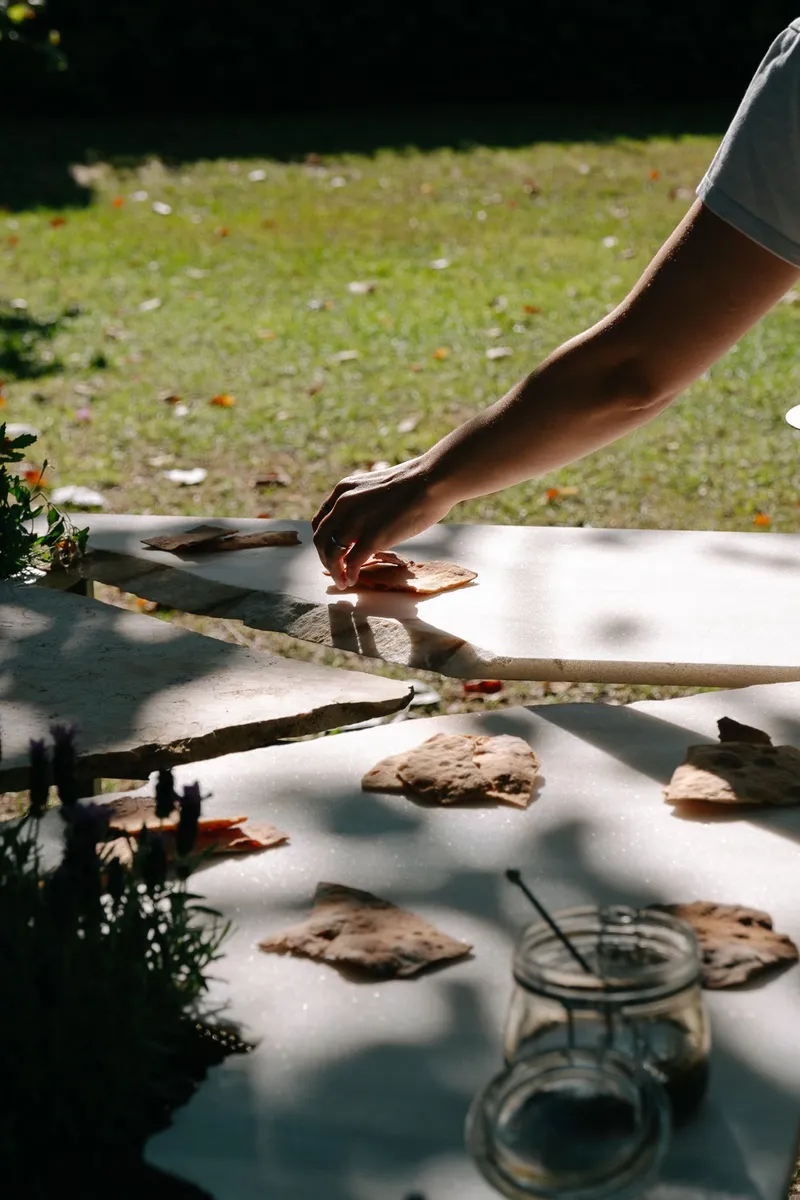
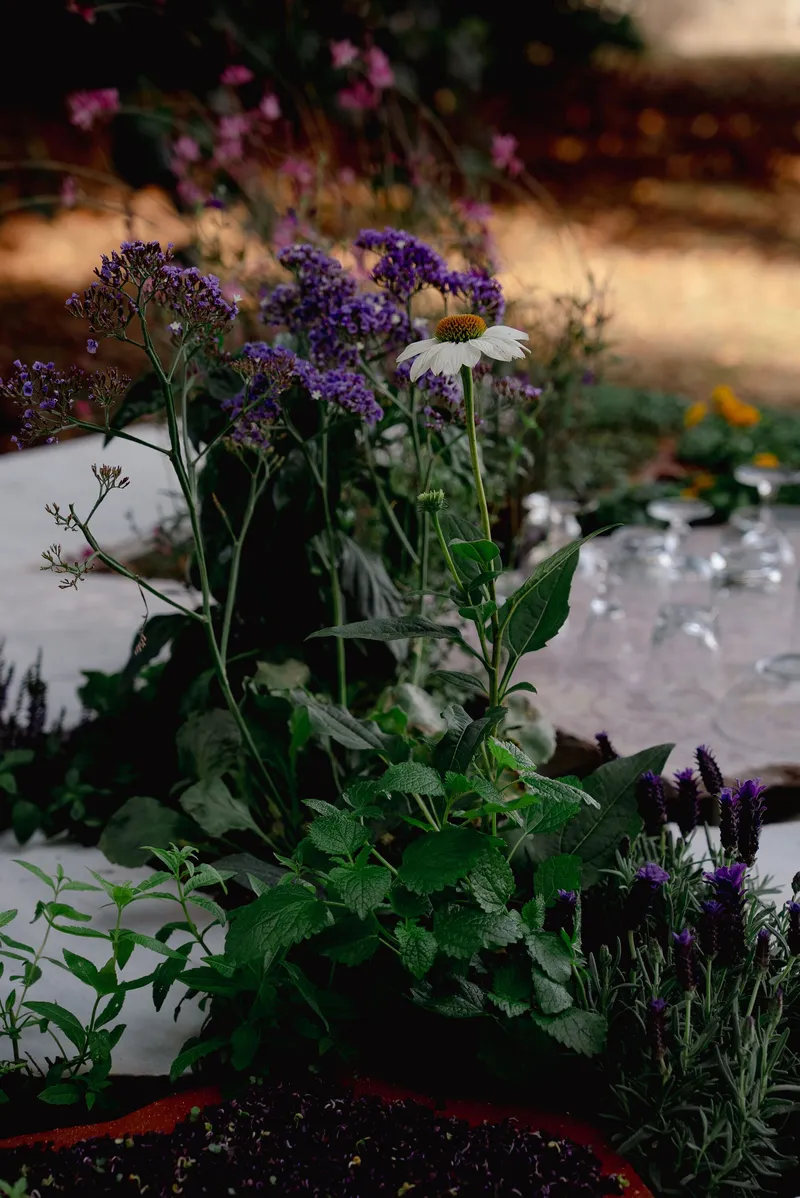
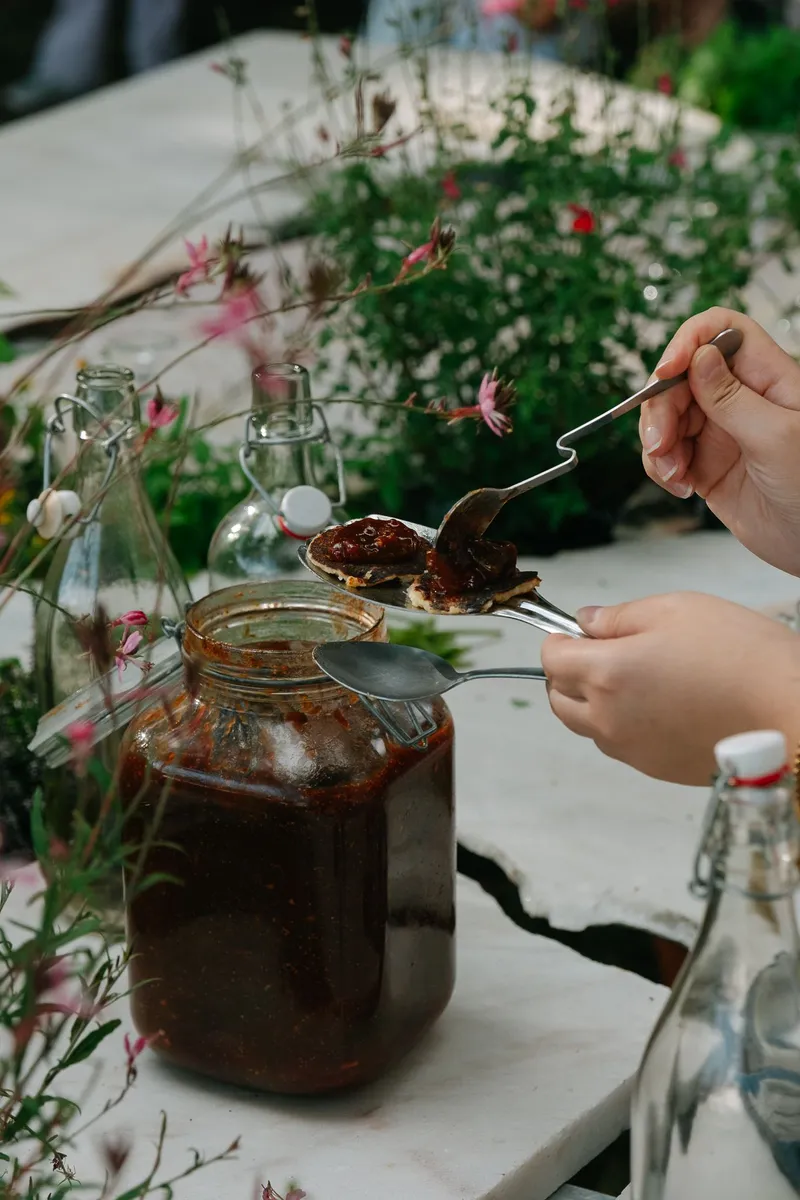
Some of the most affecting moments in the installation are the smallest. A hand holds a fork over a jar of preserves while wildflowers blur in the background. Flatbread sits on the white painted surface with petals scattered across the lawn behind it. Purple flowering stems and white daisies rest in glass containers catching warm sunlight. These are not accessories to the architecture; they are the architecture, evidence that the installation succeeds in creating a genuine habitat rather than a stage set.
The white surface acts as a canvas for all this biological activity. Every splash of color, every shadow, every stain from oil or soil registers clearly against it. Over the course of the installation's life, the table would accumulate the marks of use, becoming a record of every meal and every growth cycle it hosted. Temporary architecture rarely gets the chance to patinate, but this piece was clearly designed with that possibility in mind.
Infrastructure as Afterthought, by Design
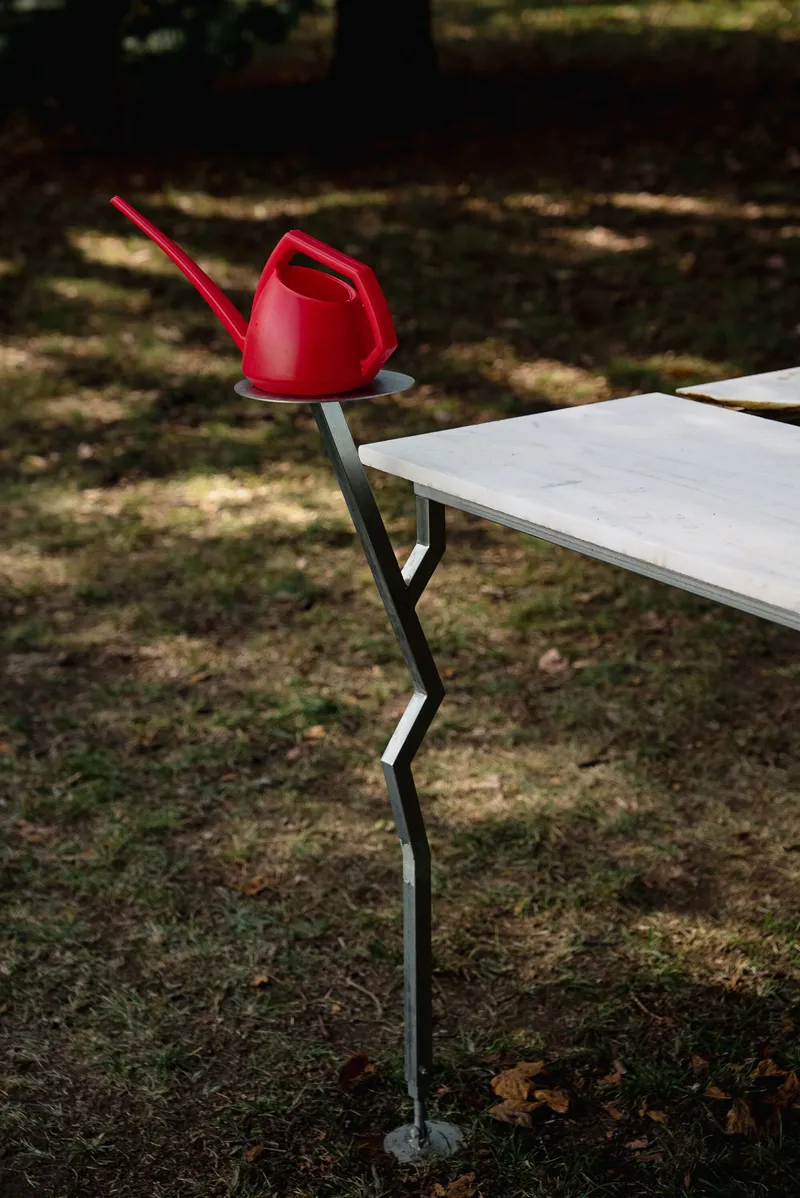
A red watering can resting on the zigzagging steel support structure reveals the deliberately low-tech servicing strategy. There are no drip irrigation timers, no concealed plumbing. The plants get watered by hand, by whoever is present. The steel legs that support the table are simple, angular, and functional, giving the heavy white surface a sense of lightness where it meets the ground.
At dusk, the full sweep of the table becomes visible: a long, sinuous white form populated with food preparations and herb plantings, glowing against the darkening park. The undulating plan prevents the table from reading as a conventional banquet layout and instead suggests a river, a garden wall, a contour line. It is a shape that invites you to walk along it, discover what is growing at the next bend, and find your own place within its length.
Plans and Drawings
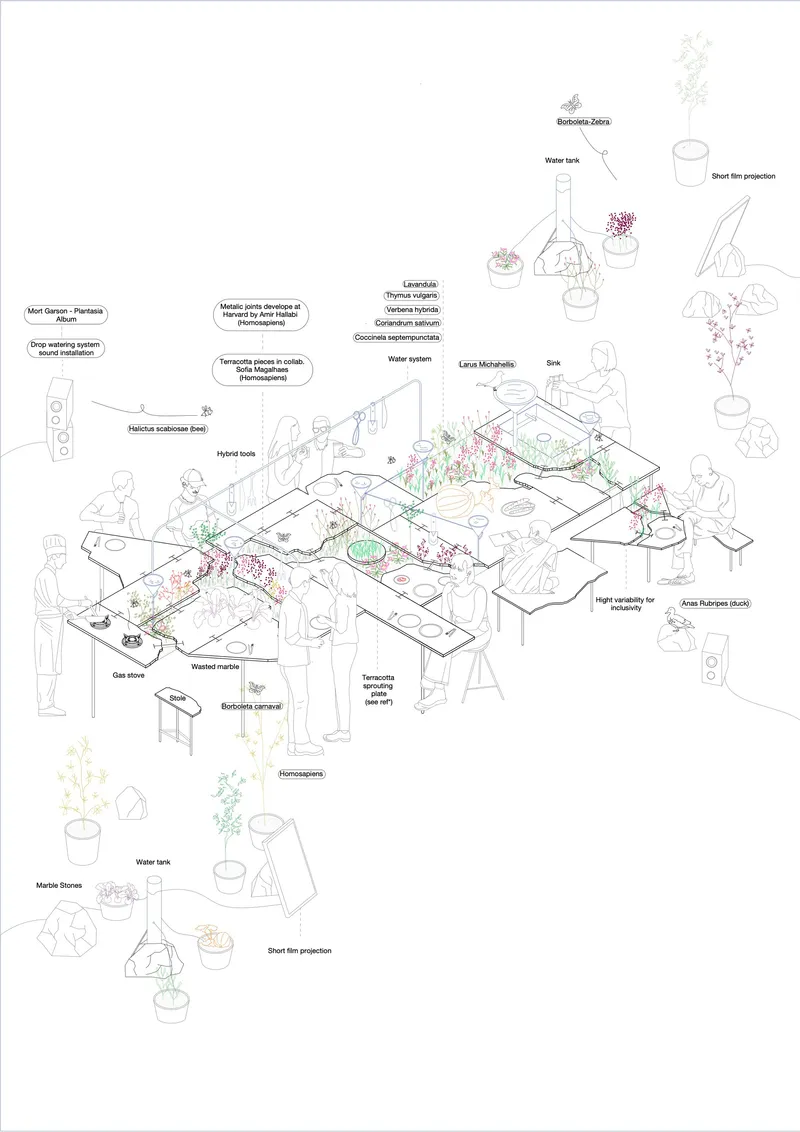
The axonometric drawing reveals what the photographs only hint at: the full spatial logic of the installation, with labeled plant species, water features, and human figures distributed along the table's length. The drawing treats people and plants as equivalent actors in the composition, placing them at the same graphic weight. Circulation paths weave around cooking stations and planting pockets, confirming that the table was designed as a landscape to be inhabited, not a surface to be served from.
Why This Project Matters
Temporary installations often oscillate between two poles: the spectacular pavilion that photographs well but teaches nothing, and the earnest participatory project that struggles to hold visual attention. The Live Multispecies Kitchen manages to avoid both traps. It is visually striking because its material commitments are genuine, and its participatory ambitions succeed because the design actually requires collective care. You cannot admire this table from a distance; it will need watering, and the bread will burn if nobody turns it.
More importantly, the project offers a concrete, buildable counter-proposal to the sealed, single-species kitchen that dominates contemporary housing. By demonstrating that cooking, growing, eating, and gathering can share a single surface, Sottomayor and Fahrenheit.Works make the case that our spatial separation from other living things is a design choice, not a necessity. That is a proposition worth carrying far beyond a temporary installation in a Porto park.
Live Multispecies Kitchen by Francisca Sottomayor and Fahrenheit.Works, lead architect Jeremy Morris. Porto, Portugal, 2025. Temporary Installation. Photography by José Guilherme Marques and Jeremy Morris.
About the Studio
Share Your Own Work on uni.xyz
If projects like this are the kind of work you want to make, uni.xyz is a place to publish your own, find collaborators, and enter design competitions.


Popular Articles
Popular articles from the community

Extended Shell: Retrofitting Kolkata's Balconies as Living Urban Thresholds
A modular retrofit system recovers the social and environmental intelligence of Kolkata's historic verandas for contemporary Park Street residents.

The Amber Palace Opera: A Geological Fiction Surfaces on Tallinn's Baltic Waterfront
Pierre Brillard reimagines a Baltic legend as a public landscape, opera house, and waterfront promenade rooted in Tallinn's coastal identity.

Singing Woman: An Opera House That Performs Before the Curtain Rises
Ovidiu Cristian Pavel's conceptual opera house translates Estonia's choral identity into a sculpted waterfront landmark facing the Baltic Sea.
Faces of the Soviet Avant-Garde: Turning Moscow's Street Names into an Open-Air Museum
A network of sculptural installations across a Moscow residential district transforms forgotten architect names into spatial encounters with cultural memor

Similar Reads
You might also enjoy these articles

Pixel Gardens: One Repeated Module Stacked Into a Terraced Social Housing Tower for Famagusta
Salem Bader's shortlisted housing tower builds a vertical neighbourhood from one repeated module, offsetting units to carve terraces, light and air.

Bao Huynh Watercolor Atelier: A Serene Art Retreat in Hội An
Bao Huynh Watercolor Atelier in Hội An blends multifunctional art spaces, sustainable design, local materials, and family-friendly living in a serene environment.

Atelier Macri Concept Store Interior Design by CASE-REAL
Atelier Macri store features a "ko" counter, walnut wood details, cork displays, blending retail, gallery, and seamless customer experiences.

Manuel Vargas Izquierdo Stadium and High-Performance Sports Center: Architectural Excellence in Jalpa de Méndez
The Manuel Vargas Izquierdo Stadium blends sustainable design, inclusive sports facilities, and cultural-inspired architecture, revitalizing Jalpa de Méndez’s public spaces.

Explore Food Generation Hub Competitions
Discover active competitions in this discipline

Challenge to design a portable theatre

Challenge to design a portable music platform

Challenge to design an open learning module for the elderly
Comments (0)
Please login or sign up to add comments
No comments yet. Be the first to comment!