
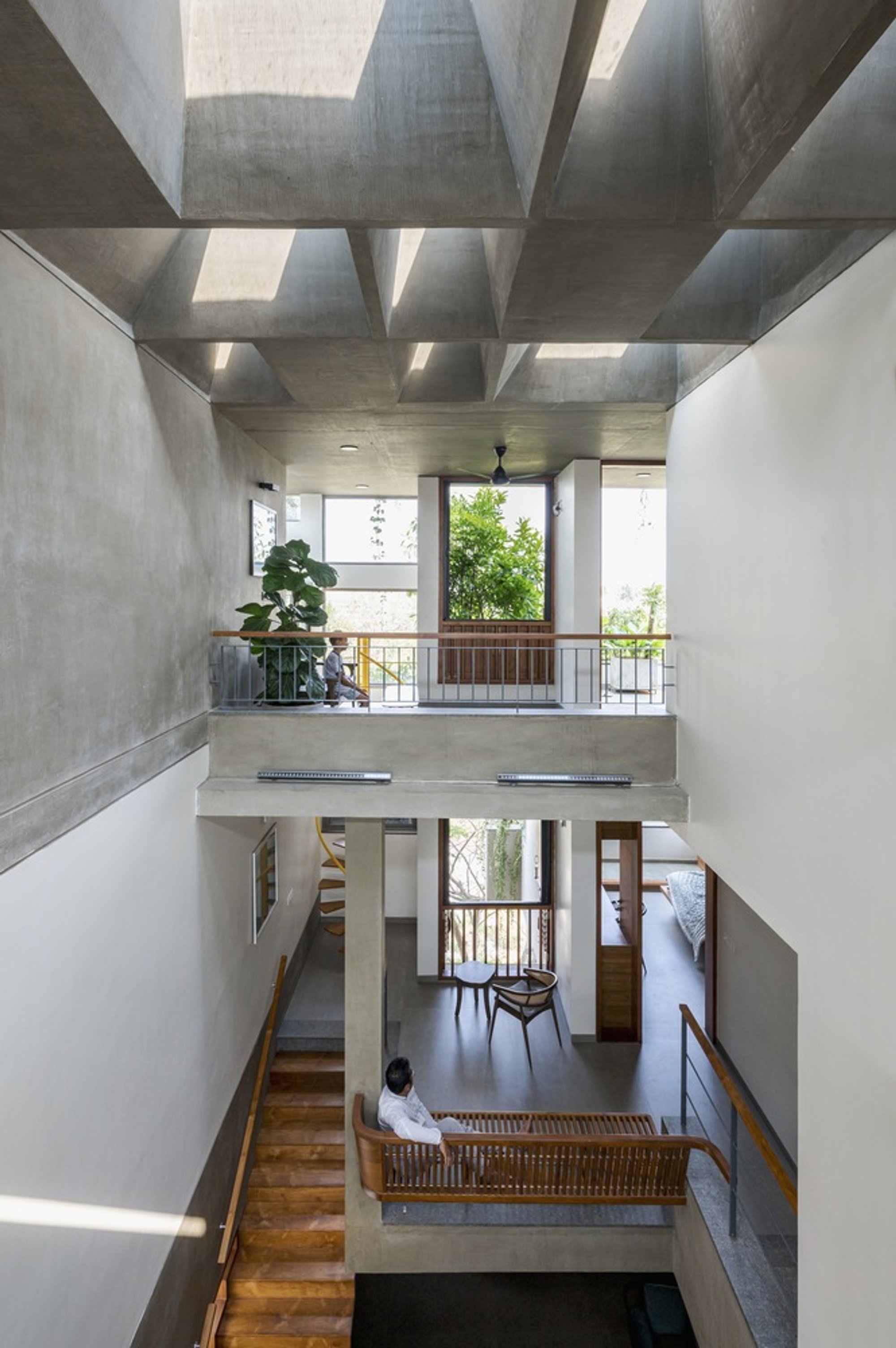
A Threshold Channels Temple Light Through a Compact Bangalore Home Built Around a Gulmohar Tree
On a 30-by-50-foot plot hemmed in by neighbors, the Ineffable Light House in Jigani turns constraint into a vertical sanctuary of green terraces and sacred

In Jigani, off Bannerghatta Road in Bangalore, a 139-square-meter plot sits boxed in on three sides by neighboring buildings. That condition would paralyze most designers into producing a sealed, inward-looking box. A Threshold did the opposite. The Ineffable Light House, completed in 2022, is a 390-square-meter residence that treats its constraints as instructions: pull light from the east and from above, anchor the plan to an existing Gulmohar tree, and stack green terraces high enough that the canopy becomes architecture.
What makes this project worth studying is not its greenery alone, which is generous, but the way its spatial logic borrows from the sequential darkness-to-light procession of traditional Indian temples. A funnel-shaped concrete skylight at the center of the house operates like a Garbhagriha, the innermost sanctum where light arrives as an event rather than a given. Every room, every staircase, every balcony is choreographed around that single vertical shaft of daylight. The result is a house that feels bigger than it is, calmer than its neighborhood, and more deliberate than its modest footprint would suggest.
The Gulmohar Axis
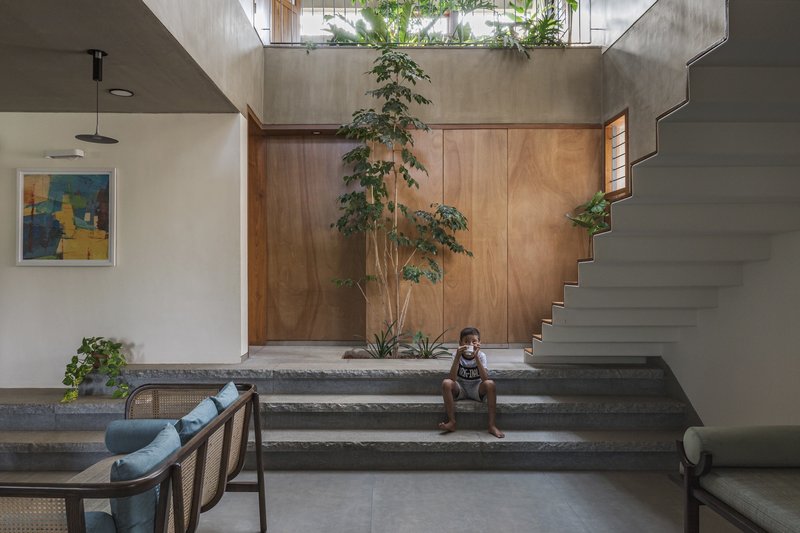
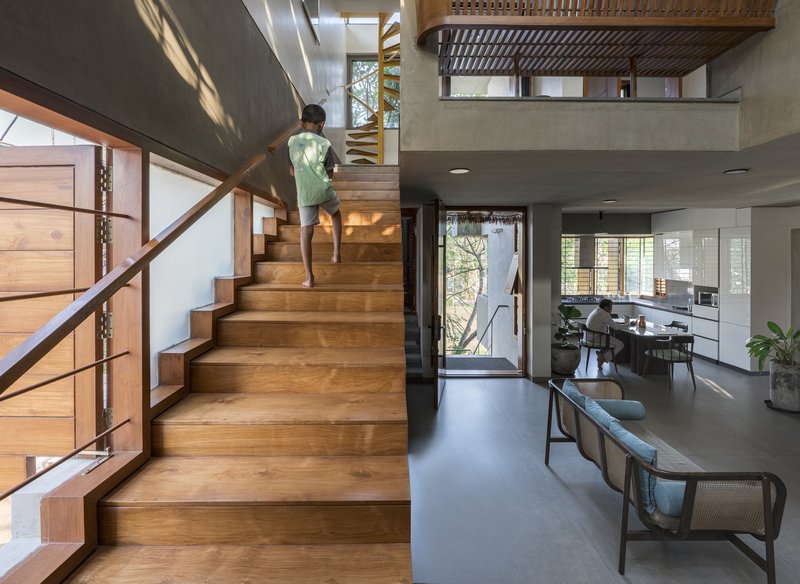
A Threshold's design began not with a grid or a program but with a tree. The existing Gulmohar on the plot established a central axis that splits the house cleanly: communal life on the north side, private functions on the south. Living room, study, kitchen, and family gathering areas occupy the northern half, where they receive the best light and cross-ventilation. Bedrooms, wardrobes, and bathrooms are tucked to the south, where residents spend less active time.
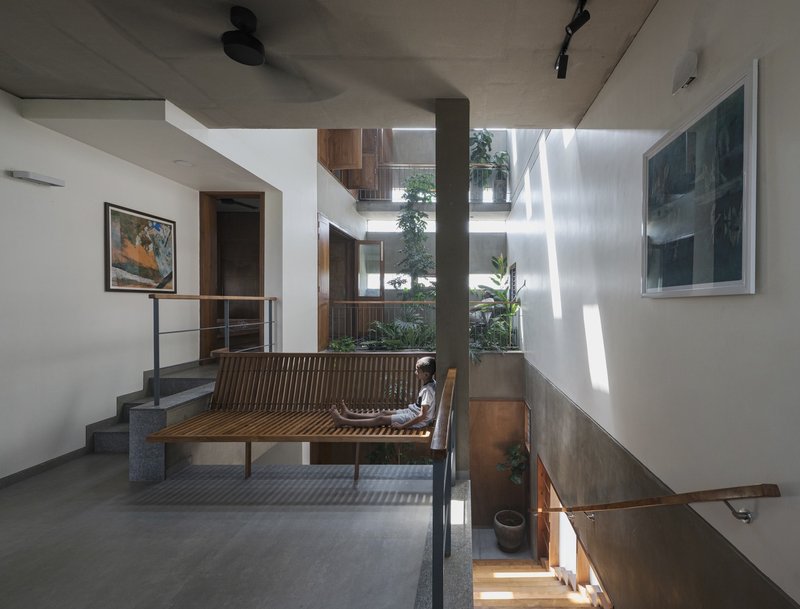
The wide concrete staircase doubles as seating, its timber wall panel warming a space that could easily have felt monastic. A tall indoor tree grows alongside it, reinforcing the idea that the Gulmohar outside is not an anomaly but a principle: vegetation is structural to the experience of this house, not decorative.
Sacred Geometry in Concrete
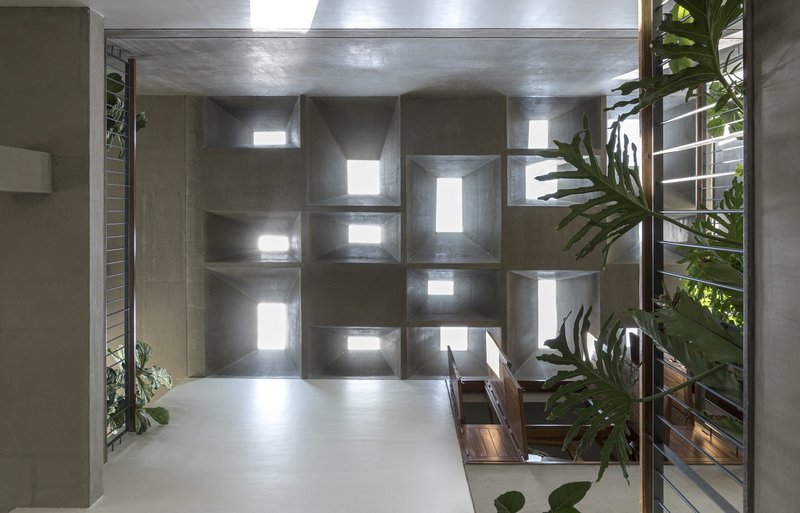
The coffered concrete ceilings are among the most striking elements here. A grid of deep, square recesses modulates the scale of each room, breaking down what would otherwise be flat, oppressive slabs into rhythmic patterns of light and shadow. The coffers recall waffle slabs in mid-century Brutalism, but their intent is different: they exist to control how sunlight enters and disperses. Daylight penetrating through corner windows near the plants creates a shifting mosaic on the ceiling throughout the day.
In the double-height living space, clerestory windows and a central concrete column frame a room that feels ecclesiastical in its proportions. The timber bench and indoor plants soften the material palette without diluting the spatial clarity. It reads as a room designed for stillness, which is a rare quality in a house built on an urban plot barely wider than a tennis court.
Cascading Green Terraces
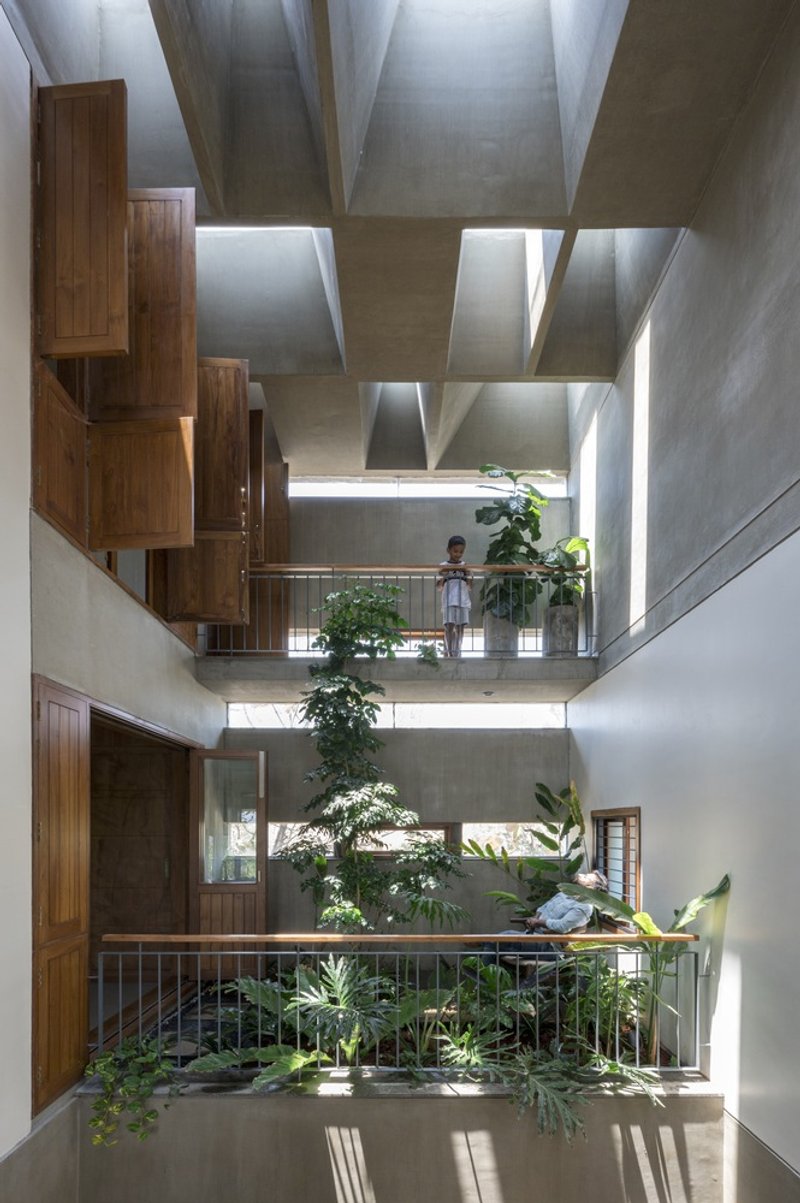
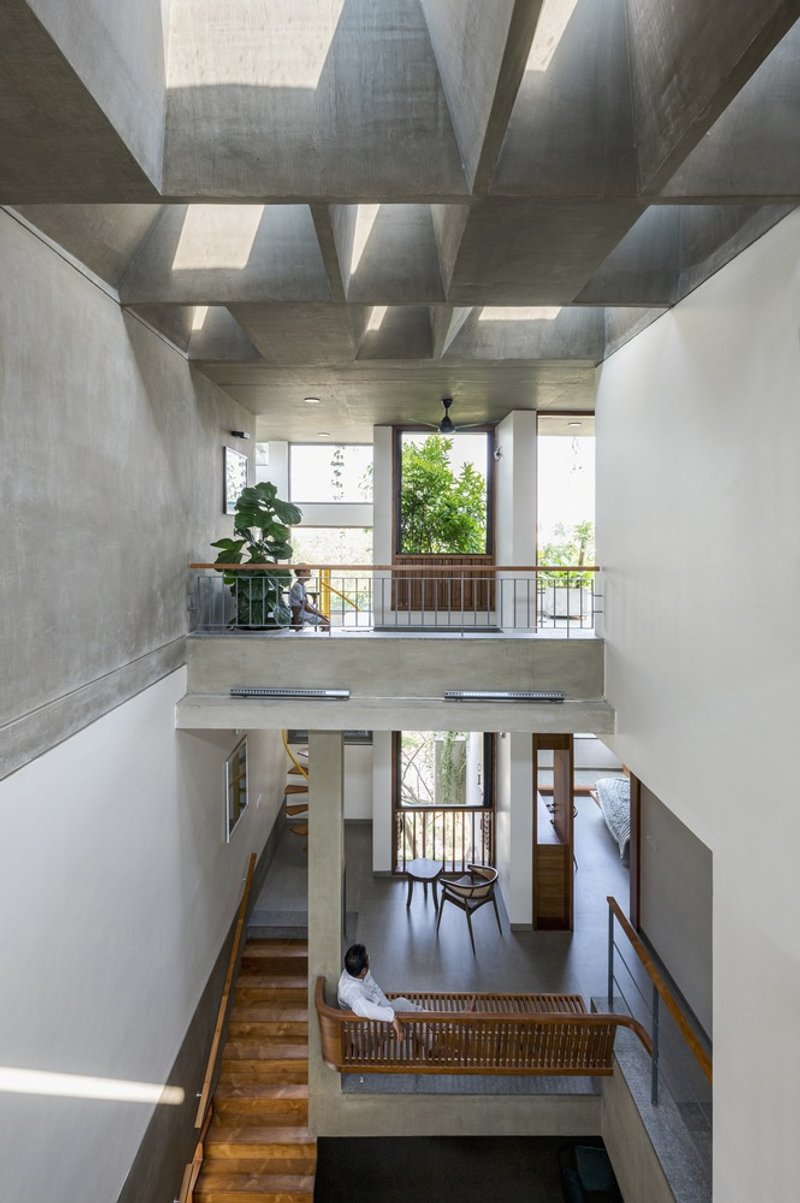
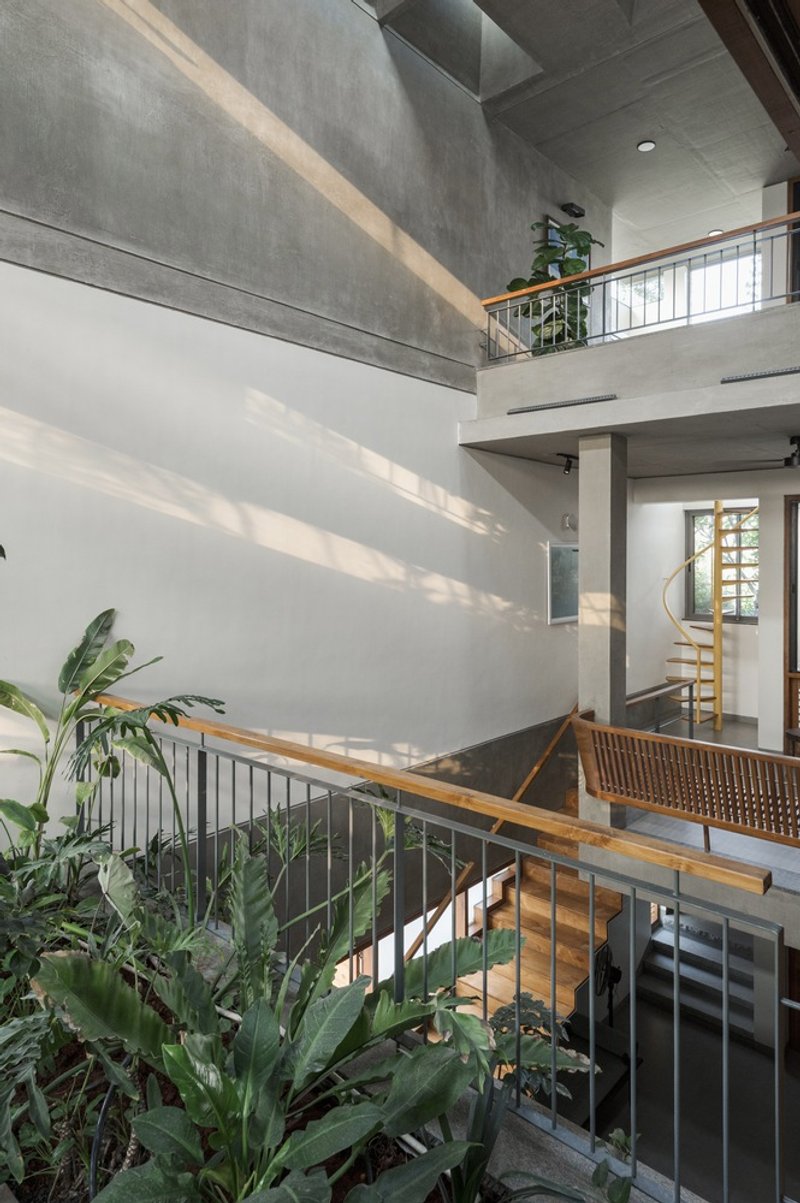
The multi-level atrium is where A Threshold's ambitions become fully legible. Planted terraces cascade southward, merging with the Gulmohar canopy and breaking down the building's mass when seen from the street. These are not ornamental planters bolted to a facade. They are extensions of the living and bedroom spaces, accessible green platforms that blur the boundary between floor and garden.
The overlapping balconies and stacked levels create visual connectivity across the section. Standing on the upper balcony, you see down through planted beds to a spiral stair below. The effect is of a vertical courtyard house, one that compensates for its tight footprint by piling depth upward. Bangalore's mild climate makes this strategy viable year-round, and the porous cross-section ensures that air moves through the house without mechanical intervention.
Bedrooms as Thresholds
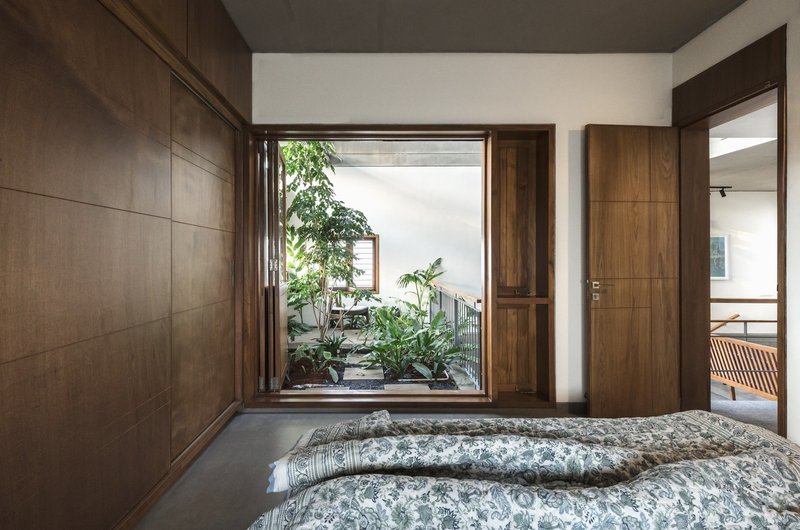
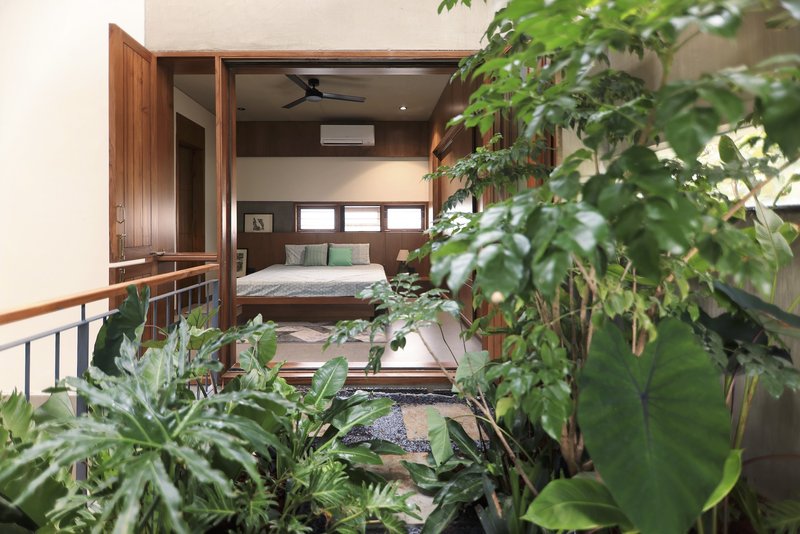
The bedrooms resist the convention of sealed, air-conditioned boxes. Each one opens onto a planted terrace or courtyard through timber-framed apertures that treat the transition between sleeping space and garden as a graduated experience. The bedroom visible through its timber-lined frame, with foliage pressing in from the terrace beyond, collapses the distinction between room and landscape.
A concrete floor in the courtyard and planted beds at varying heights keep maintenance practical while preserving the sense that nature is encroaching on the built form, not the other way around. It is a biophilic strategy that actually works rather than one that merely performs on an Instagram grid.
Filtered Light and Material Warmth
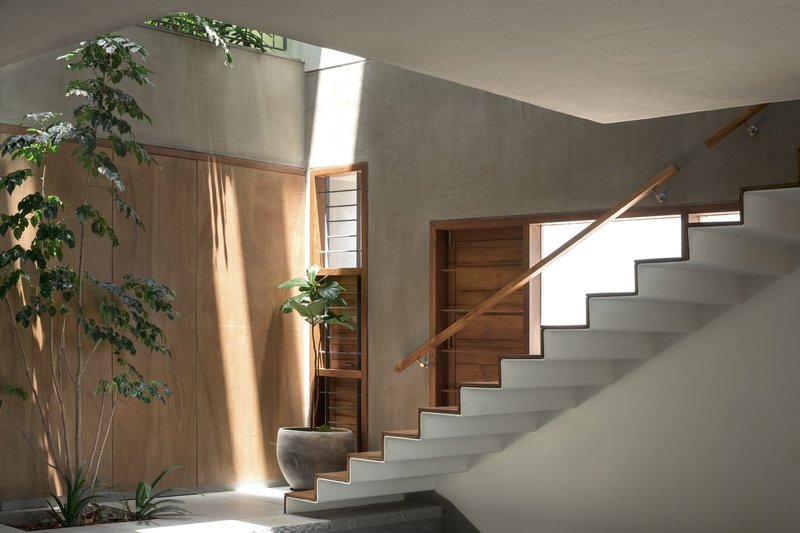
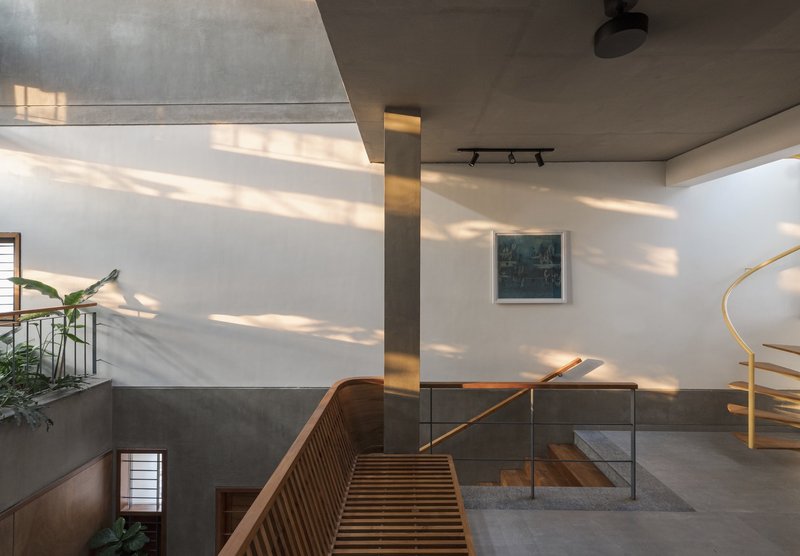
Throughout the house, filtered sunlight does the heavy lifting. Shuttered windows cast striped shadows across concrete stairs and timber handrails, creating moments of visual intensity without relying on artificial effects. The planted corners adjacent to these windows act as light wells, bouncing green-tinged daylight into otherwise deep spaces.
On the upper-level landing, dappled shadows from plants beside a timber-railed mezzanine produce the kind of atmospheric depth that architects usually chase with expensive materials. Here, the atmosphere comes from the alignment of structure, vegetation, and orientation. Concrete and timber do all the work, and they do it well: the exposed concrete reads as honest rather than austere, while timber elements at stair treads, wall panels, and railings introduce a domestic scale that keeps the house from tipping into institutional territory.
Why This Project Matters
The Ineffable Light House is a useful case study in how to make a dense urban plot feel neither cramped nor defensive. Most houses on tight sites in Indian cities retreat behind blank walls and rely on artificial cooling. A Threshold's approach, drawing light from above and the east, stacking green terraces to multiply usable outdoor space, and organizing the plan around an existing tree, demonstrates that passive design in tropical climates is not a compromise but a genuine upgrade in spatial quality.
More broadly, the project succeeds because it takes a cultural reference seriously. The temple procession from darkness to light is not a metaphor pasted onto a conventional plan. It is the organizing principle of the section, from the ground-floor threshold to the skylit atrium. That disciplined commitment to a single idea, pursued through concrete, timber, and vegetation, is what separates a considered house from a decorated one.
Ineffable Light House by A Threshold, Jigani, Bangalore, India. Site area: 139 m². Gross floor area: 390 m². Completed 2022. Project team: Avinash Ankalge, Harshith Nayak, Sameed Ahmed, Karthik Krishna. Structural consultants: Radiance. Builder: Manjunath BR., Design2konstruct. Photographs by Atik Bheda.
About the Studio
Share Your Own Work on uni.xyz
If projects like this are the kind of work you want to make, uni.xyz is a place to publish your own, find collaborators, and enter design competitions.




Popular Articles
Popular articles from the community

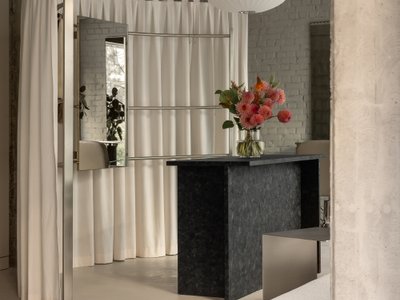
MAVA Design Turns a Column-Riddled Shell into a Serene Hair Extension Salon in Kyiv
Inside a former motorcycle factory campus, a 110 square metre beauty atelier treats structural obstacles as spatial anchors.

20 Most Popular Office Building Projects of 2025
From biophilic workspaces in India to net-positive energy offices in New Delhi, 20 office building projects that defined architecture in 2025.
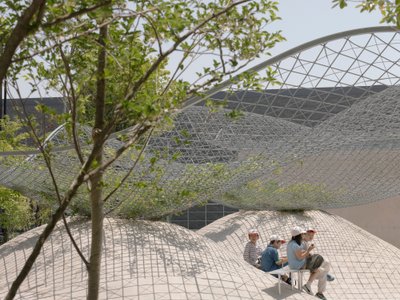
MIDW Casts a Pavilion Roof from the Earth Itself at the 2025 Osaka Expo
On a fragile reclaimed island, excavated soil becomes formwork for a concrete canopy that will eventually disappear into wisteria.
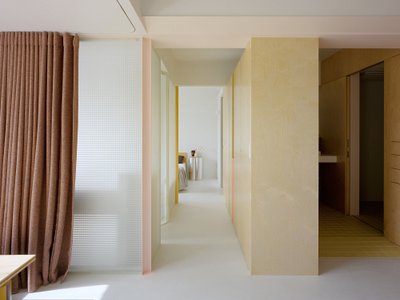
OUJ Rewires a 72-Square-Meter Taipei Apartment for Multigenerational Living After the Pandemic
Inside a 40-year-old public housing block, plywood volumes and translucent screens turn three cramped bedrooms into a flexible family home.


Similar Reads
You might also enjoy these articles
Olio Towers: A Mid-Rise for Performers That Fuses Housing, Rehearsal, and Stage
Located blocks from Houston's Theater District, this modular tower stacks living units around a central performance atrium.

Oasis: Modular Green Housing Carved into Dhaka's Urban Fabric
A shortlisted Plugin Housing entry reclaims unauthorized settlements in Dhaka with stepped concrete volumes, green roofs, and ventilation-driven design.

Black Hole: A Floating Megastructure for the Post-Physical Era
Emiliano Mazzarotto envisions a spherical, self-scaling arena where e-sports, digital hotels, and holographic stadiums replace traditional public space.
Compact & Sustainable Living in Piraeus: A Four-Level Family Home Built Around Light and Air
A narrow townhouse in one of Greece's densest port cities uses a central atrium and passive strategies to house three generations under one roof.


Explore Architecture Competitions
Discover active competitions in this discipline




The International Standard for Design Portfolios


The Global Benchmark for Architecture Dissertation Awards


The Global Benchmark for Graduation Excellence


Challenge to reimagine the Iron Throne
Comments (0)
Please login or sign up to add comments
No comments yet. Be the first to comment!