

INFILL
A STUDENT COMMUNITY IN MANILA

We grow up and live in various ways, giving us different ideas and preferences to live, study, and socialize. The idea of 'comfort' of a dwelling varies from person to person. INFILL is a communal living prototype based on health and well-being, focusing on experience and connection. It focuses on a living community that caters to different types of people by administering a wide range of styles and hierarchies of living and social spaces throughout the community. Even though INFILL is an economical and easily replicable prototype, it allows plenty of opportunities for variation, adaptability, and individuality.
01 - CONCEPT IDEA
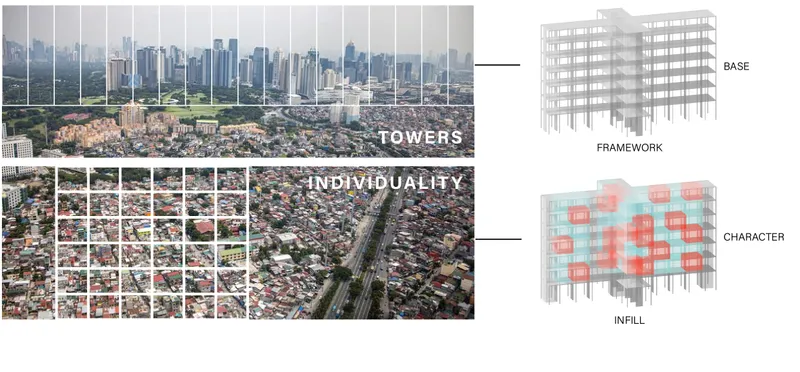
Manila's urban fabric inspires the concept of INFILL. The towers reflect its growth and future. The matte typology reflects characters and individuality. The project combines the two worlds, a tower typology that celebrates personalities and individuality - It is a canvas that showcases and highlights occupant's life and character. INFILL is designed so that its aesthetics continue to change over time.
The blank canvas :
- The steel structure - is the basic frame of the towers. These structures form a series of slots.
- The infills - are programs in the form of modular boxes filling the slots. They are living pods (single rooms, duplex rooms), communal restrooms, or vertical circulation.
The variations :
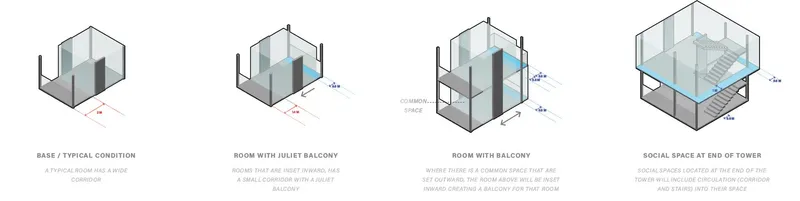
- Wide corridors - What would have been regular halls and doorways are now enlivened with people playing guitar, outdoor tables, plants, with a view of the courtyard.
- Communal spaces - various shared spaces such as social lounges, library, theater room, yoga studio, or game centers encourage more significant student interaction and collaboration.
- Terraces - Bigger communal blocks create decks for the above units. These terraces are more opportunities for students to personalize their spaces.
- Roof Terraces - incorporating parks and gardens helps promote a collaborative and less stressful environment. Roof Top gardens can be used for individual time or social gatherings.
- Ground Floors Amenities - Different types of amenities and facilities populates Level 01 and Level 02, creating a vibrant ground condition.
The way the living pods and the variations are arranged promotes a living community that caters to different types of people. The concept of the infills allows the project to administer a wide range of styles and hierarchies of living and social spaces throughout the community. (Further explained in chapter 05 : Hierarchies of Social Spaces)
Chapter 02 - Architecture, Site, and Urban Intent.
Architecturally
The intent of the project is to provide a simple, replicable, and economical structure while providing adaptability and an endless possibility of customization.
- Economical and Replicable
The steel structure is easily replicable and extendable. The living pod is a 6.5-meter by 6.5-meter box module that can accommodate a duplex room, a single room, or an ADA-accessible single room. - Adaptability
The walls of the infills are independent of the structure, therefore, it is easily turned into different uses. Empty slots can be turned into communal spaces and vice versa allowing maximum adaptability for future needs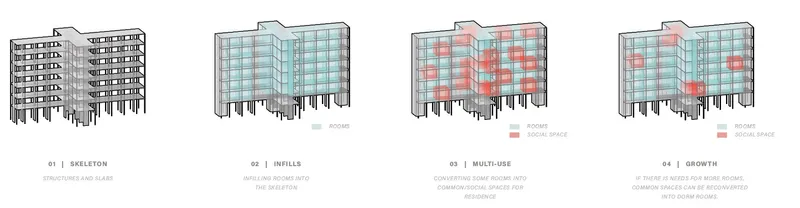
- diagram 01 - Skeleton base
- diagram 02 - maximum capacity for living pods (blue: living pods)
- diagram 03 - depending on needs, housing units are replaced with social spaces (red: social space)
- diagram 04 - Where growth is needed, social spaces can be turned back to housing units.
- Variations
The placing of housing units (at edge, or middle of slabs) allows different living variations.
Site
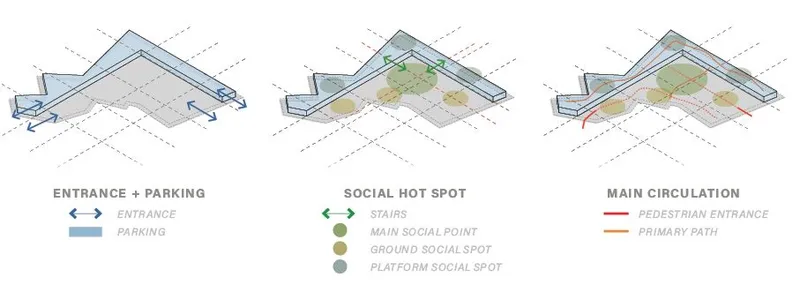
- Site Nodes - the site intends to create different types and hierarchies of social nodes.
- A central courtyard - for events and multi-purpose uses, surrounded by smaller programmed social spaces.
- Placing a single-room tower by the northwest entrance for more privacy. A separate entrance for a single-room tower (if needed) can be accommodated.
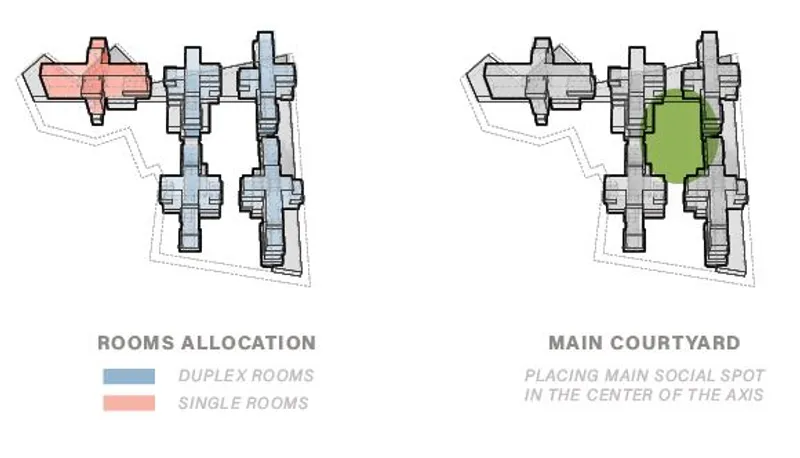
Urban Context influence
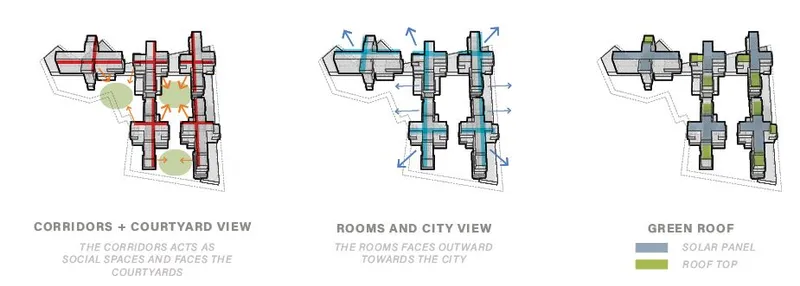
The placement of corridors, rooms, courtyards, and rooftop gardens is determined by views and social interactions. Corridors are facing inward - when there is a large event at the courtyard, corridors act as an audience platform.

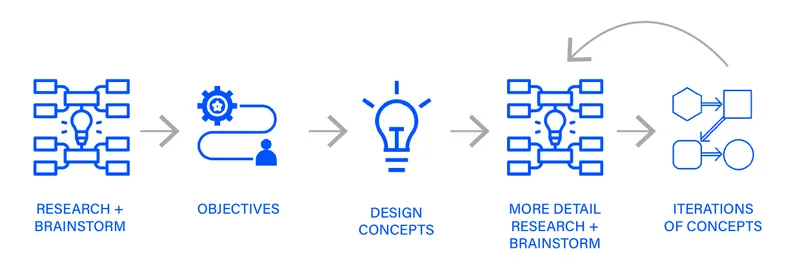
Design Investigation :
The primary design investigation for this project is a research base. As mentioned in the architecture intent, different iterations, and variations of social spaces were tested.
Chapter 03 - Programmatic
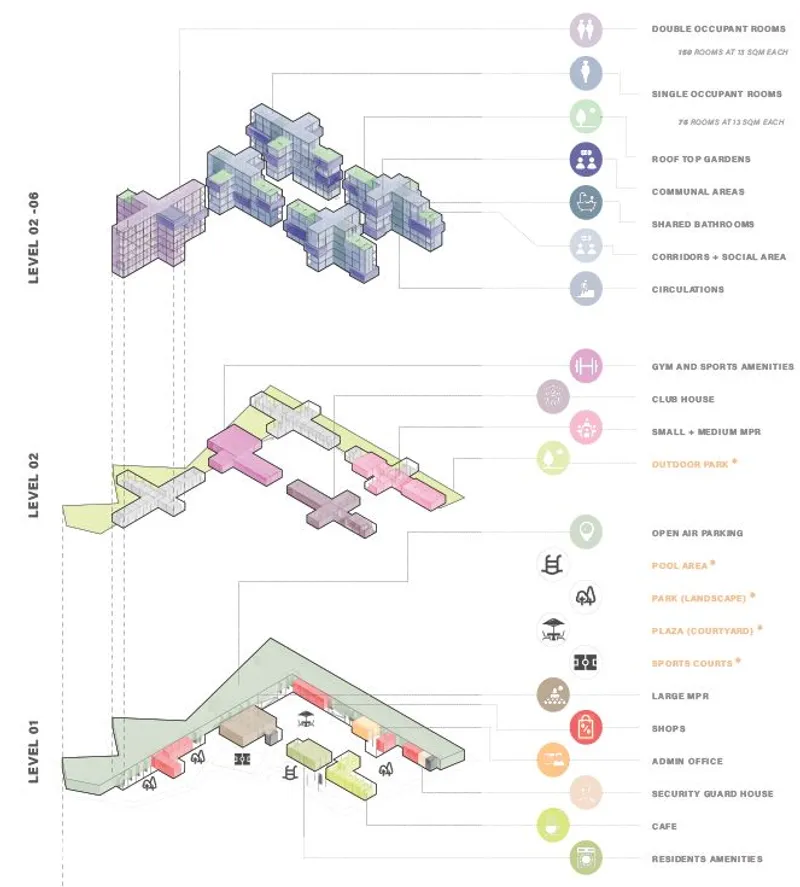
The programs are divided into 3 zones.
- The Tower - houses living pods and more private communal spaces like huddle rooms and rooftop gardens.
- The Platform Park - An elevated recreational landscape connects the towers and their amenities.
- The Ground - The ground is divided into various parts; a central courtyard with shops, cafes, and amenities; a park at each entrance; Sports courts on the west of the site that includes basketball courts, a pool, and access to the gym.
Chapter 04 - Materials
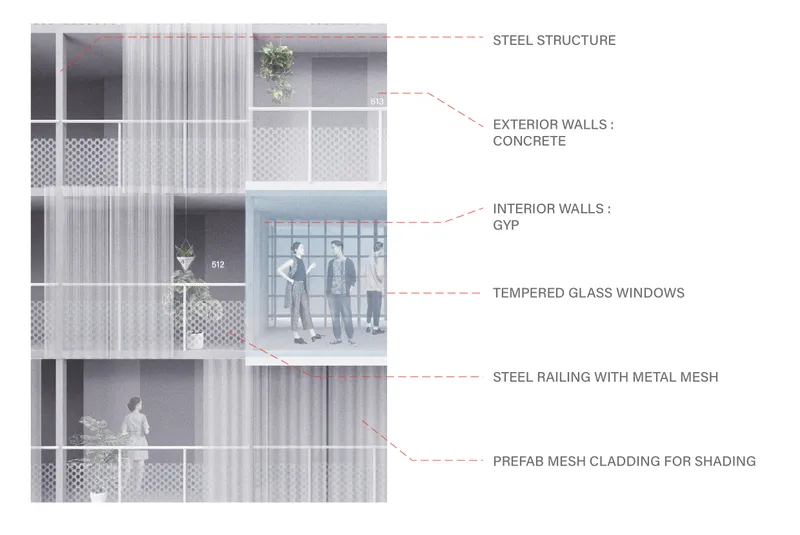
Chapter 05 - Hierarchies of Social Spaces
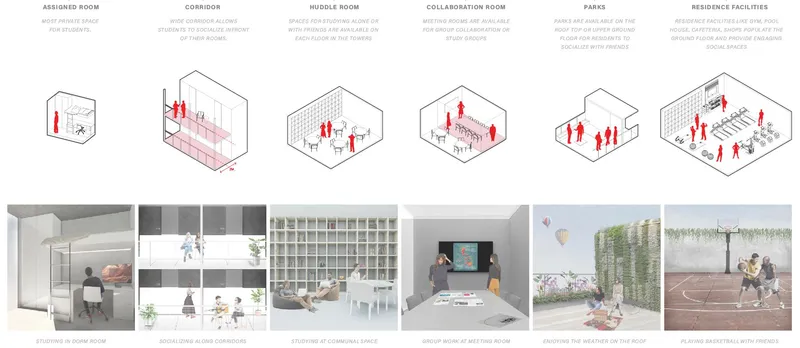
To cater to different types of people, INFILL administers a wide range of styles and hierarchies of living and social spaces throughout the community. The aim is to provide a variety of collaborative environments that encourage people to participate, contribute, and feel included. By providing the necessary spaces for them to connect, innovate and think outside the box, students from various study fields can make connections in an environment that fosters co-habitation and a greater sense of community.
From most private to most public:
- Living Pods - Dorm Room, most private space. The room design is clean and simple, allowing students to relax or work privately.
- Wide corridors - What would have been regular halls and doorways are now enlivened with people playing guitar, outdoor tables, plants, with a view of the courtyard.
- Huddle rooms - Small study areas, can be used for individual studying or 2-3 person group work.
- Collaboration rooms - used for meetings or group work.
- Roof Top Terrace - incorporating parks and gardens helps promote a collaborative and less stressful environment. Roof Top gardens can be used for individual time or social gatherings.
- Medium multi-functional spaces - various shared spaces such as social lounges, library, theater room, yoga studio, or game centers encourage more significant student interaction and collaboration.
- Facilities - Shops, cafeteria, business center
- Large facilities - Gym, club house, pool area, basketball court, boxing ring, multi-purpose room.
- Parks - herb garden, platform park, trails and entrance parks
- Central courtyard - an unprogrammed large area for events
Chapter 06 - Expansion and Growth
Within Site Expansion + Growth
The walls of the rooms are designed to be independent of the structure of the towers allowing easy conversion of spaces. When there is a need for fewer rooms, living pods can easily be converted to huddle rooms or collaboration spaces. When there is a need for more rooms, they can be converted back to living pods. However, to maintain the quality of social spaces, it is recommended that each tower maintain one roof garden, a few huddle rooms, and one medium multi-functional spaces.
Outside of Site Expansion + Growth
The prototype is easily replicable to other sites. The length, placement of living pods, and types of communal spaces will be determined according to the new location.
Notes on FAQs Answered above:
● What was the concept behind the project?
(addressed in Board 01 and Journal Chapter 01)
● What was the intent behind the organization of elements across various levels (Architectural, Site, Urban)?
(addressed in Board 01, 02, 04, 05 and Journal Chapter 02)
● Which methods of design investigation? And How many iterations were tried to arrive at the final outcome?
(addressed in Journal Chapter 02)
● How was the programme condensed into final?
(addressed in Board 03, and Journal Chapter 03)
● What/How were the materials chosen?
(addressed in Journal Chapter 04)
● How was a specific objective attempted to be met?
(Hierarchies of social spaces : addressed in Board 06 and Journal Chapter 05)
● What is the expansion plan of the project? and How will the project transform with the passing time? etc(addressed in Board 04, and Journal Chapter 06)

Popular Articles
Popular articles from the community


Architekt Andreas Gruber Scatters 23 Dark Timber Chalets Across a South Tyrolean Forest Edge
In Molini di Tures, Amonti Chalets breaks a resort into a hamlet of gabled timber houses, with parking, storage and services pushed into the slope.

LT2A and OPEN Architectes Thread a Brick and Glass High School Through a Wooded Belgian Campus
In Braine-l'Alleud, a 3,000 m² wing for Collège Cardinal Mercier pairs pale brick with a glazed colonnade, deferring to a small chapel and a dense wood.

Jaramillo Van Sluys Arquitectura and Urbanismo Turn a Demolished Registry Lot in Quito into an Orchard Plaza
In Quito's Centro Histórico, a 2,800 m² plaza exposes the San Agustín convent wall and redraws its lost Augustinian orchard in volcanic stone.

GROUP A Strips a 1969 Rotterdam Harbor Headquarters to Its Frame and Wraps It in Timber Louvers
In Rotterdam's M4H harbor district, Ferro Offices reuses a 1969 frame, adds one timber storey and reaches BREEAM-NL Outstanding.

Similar Reads
You might also enjoy these articles

The Rhythm of Seasons
A Farmers' Market Connecting Nature and the City

More Than a Building-Designing a Living System
More Than a Building-Designing a Living System
Base Beyond
DESERT COMPOUND ARID: TOURISM OF ABSENCE AND ABUNDANCE

Comments (0)
Please login or sign up to add comments
No comments yet. Be the first to comment!