
Link: Cubes That Bridge Generations Through Art and Shared Experience
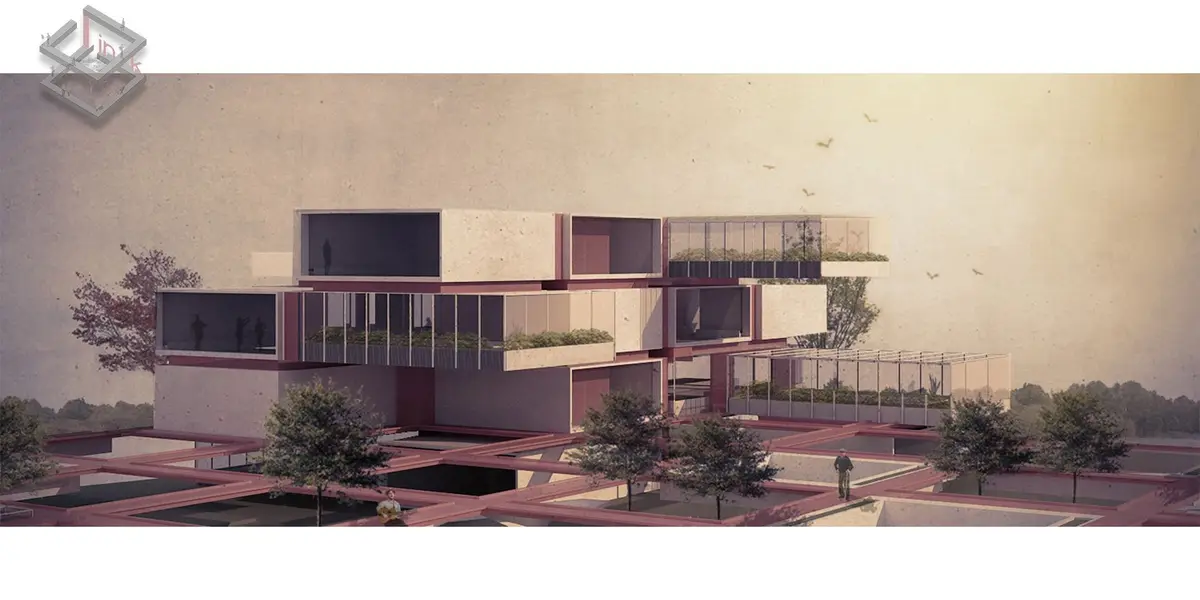
A runner-up Huddle entry proposes seven interconnected cubes of transparent concrete and glass to foster emotional exchange between young and old.


What if the generational divide could be collapsed into a geometric metaphor, then built? "Link" takes the cube, that most elemental of architectural forms, and uses it to argue that shared passions like music, painting, and storytelling can pull the elderly and the young into the same orbit. Seven cubes, each dedicated to a distinct form of artistic and intellectual expression, are stacked, shifted, and connected across a park landscape to form a social complex that treats intergenerational exchange not as a programmatic afterthought but as its primary structural logic.
Designed by Azade Taebi and Yasaman Roshani, the project earned Runner-up recognition in the Huddle competition. The concept frames society itself as a large cube composed of smaller and larger sub-cubes: smaller ones represent the younger population, while larger ones stand for the elderly, whose experience and foundational presence give them greater volume within the collective. It is a direct, almost literal reading of demographic structure, and it works precisely because of that directness.
Terraced Volumes on a Green Slope
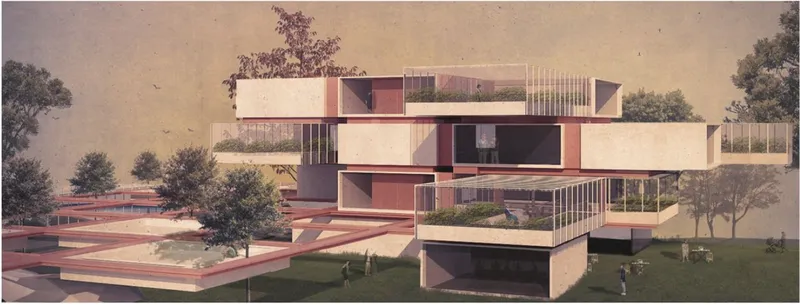
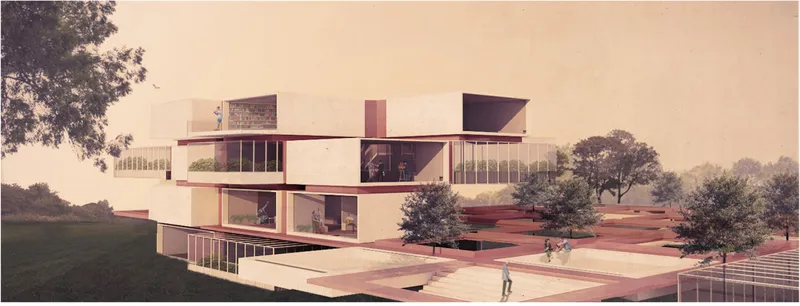
The complex settles into its site as a series of stacked horizontal volumes, their terraced rooftops stepping down a grassy slope dotted with trees. White and glass forms interlock to create a profile that reads as both monumental and porous. Terracotta-toned roof surfaces inject warmth into the otherwise neutral palette, functioning as visual beacons, particularly for visitors with low vision. Between the volumes, figures walk across these rooftop terraces, suggesting a building where the roof is as activated as the floor plate below.
The material strategy reinforces the social ambition. Transparent concrete and glass walls allow horizontal and vertical visual communication: a musician rehearsing on one floor remains visible to a painter working on the next. This deliberate permeability turns every cube into a kind of vitrine for human activity, encouraging spontaneous encounters across age groups and disciplines. Flower boxes and greenery are embedded within each volume, connecting occupants with nature and softening what could otherwise feel like a rigid geometric exercise.
Street-Level Encounter: The Building Meets the City
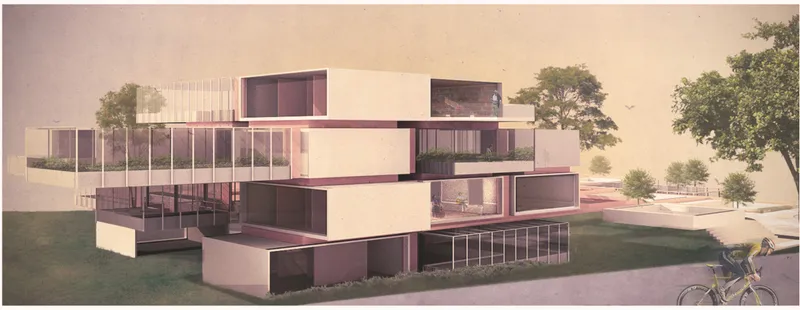
At street level, the multi-level complex presents itself as an open, approachable presence. A cyclist passes along the road, and the building's layered profile recedes gently rather than imposing a single facade. Ramps and accessible pathways ensure that individuals with disabilities, including wheelchair users, can enter and circulate freely. This is not token compliance; the ramps are woven into the circulation as primary routes, reinforcing the project's commitment to equal participation. Folding seats along these paths allow spaces to shift from corridor to exhibition area to informal gathering spot, keeping the ground plane in constant flux.
Seven Cubes, Seven Disciplines: Reading the Axonometric
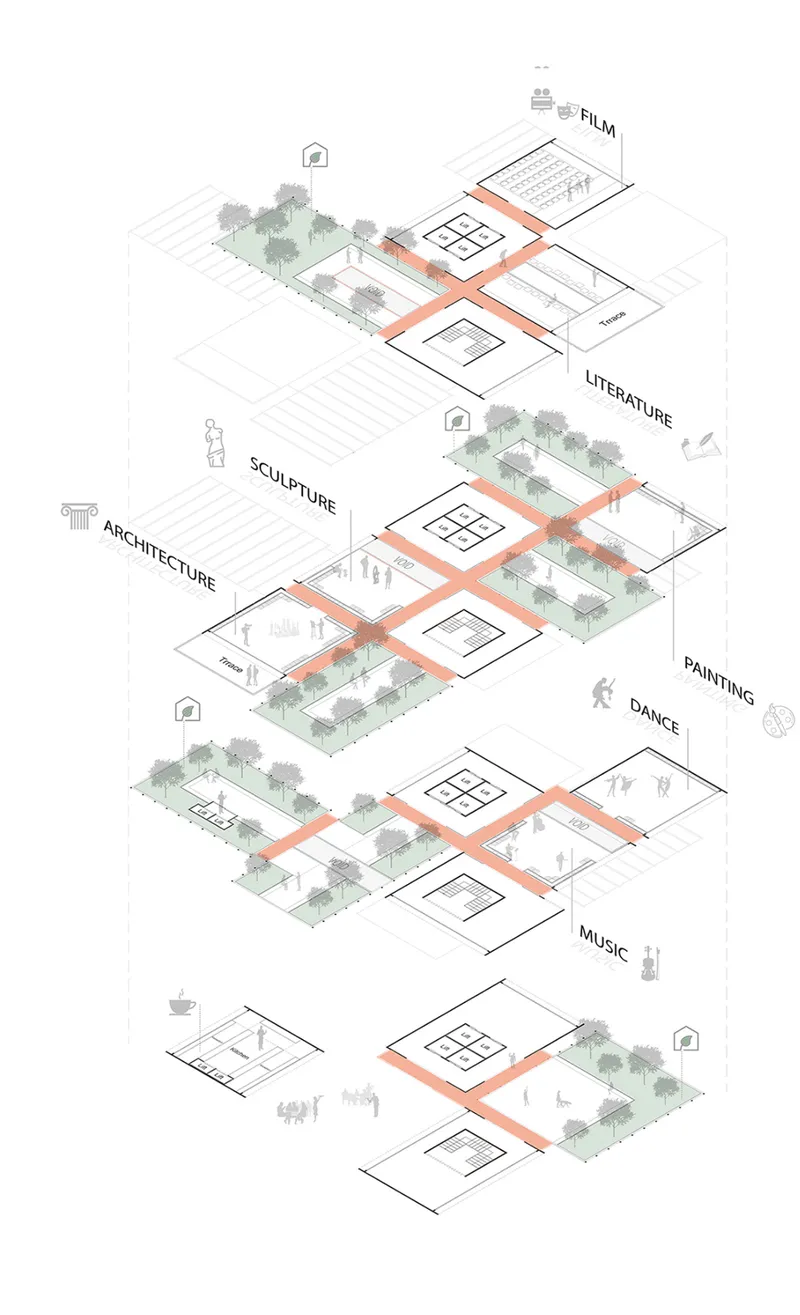
The exploded axonometric drawing reveals the project's organizational clarity. Seven cubes are stacked and offset, each labeled with a distinct program: Architecture, Sculpture, Painting, Literature, Music, Performing Arts, and Film. Connecting circulation paths, including suspended bridges, link the cubes across floors and through treetops, creating vertical and horizontal movement routes that make navigation itself a social act. A river adjacent to the site adds another layer of interaction, offering opportunities for leisure, rest, and the kind of informal exchange that structured programs rarely produce.
Beyond these seven arts-focused cubes, the complex also includes greenhouse units inspired by nature, designed to spark conversations around economics, maritime history, and mechanics. These are the spaces where a retired engineer and a curious teenager might find common ground over a shared fascination with how things work. The program is deliberately broad, ensuring that resonance between generations can occur through virtually any entry point.
Gathering Beneath the Cantilever
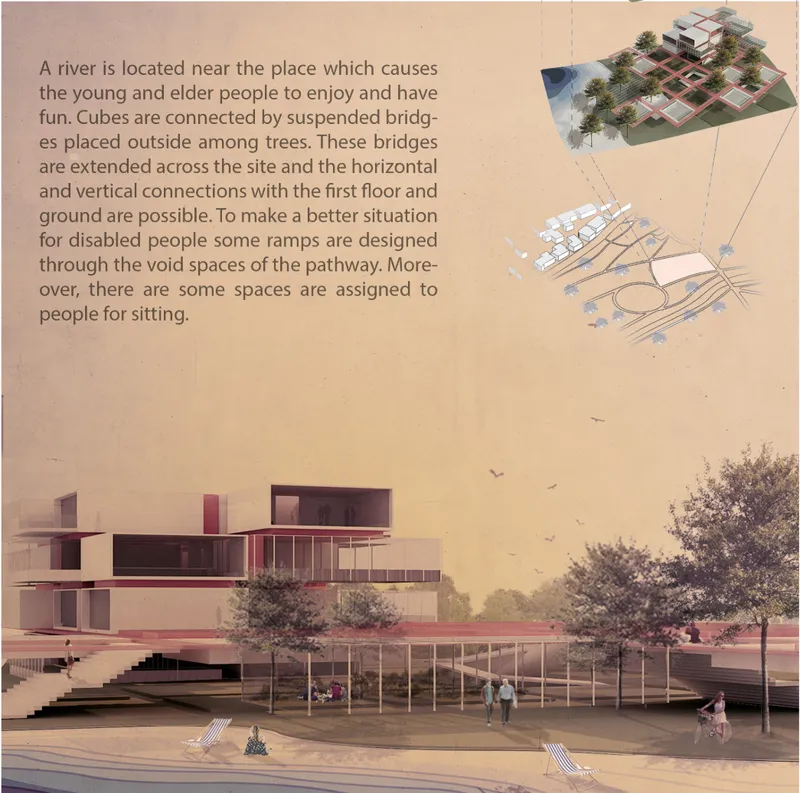
The stepped plaza at the base of the complex creates a generous public threshold. Cantilevered volumes overhead shelter a glass pavilion below, where people gather in loose clusters. The relationship between the heavy, projecting mass above and the transparent lightness at ground level produces a spatial tension that draws visitors in. It is the kind of space that rewards lingering: shaded, visible from the park, and close enough to the building's interior program that the boundary between inside and outside dissolves.
Why This Project Matters
Intergenerational design is often reduced to adjacency: place a senior center next to a daycare and hope for the best. Taebi and Roshani push further by embedding the generational relationship into the building's geometry, materiality, and circulation. The cube metaphor could easily have remained diagrammatic, but here it is resolved into a spatial experience where transparency, color, and connected pathways make cross-generational encounter nearly unavoidable. The design does not force interaction; it engineers the conditions under which interaction becomes natural.
What elevates Link beyond a competition board is its understanding that emotional infrastructure matters as much as physical infrastructure. A building that lets a young performer see an elderly musician through a wall of transparent concrete, that routes a wheelchair user through a treetop bridge to a greenhouse, that paints its floors in distinct tones so navigation becomes intuitive: these are specific, buildable decisions. They suggest that architecture's role in bridging generational divides is not abstract but profoundly material.
View the Full Project
About the Designers
Designers: Azade Taebi, Yasaman Roshani
Enter a Design Competition on uni.xyz
uni.xyz runs architecture and design competitions year-round that reward proposals with spatial conviction and real site intelligence.
Project credits: Link by Azade Taebi, Yasaman Roshani Huddle (uni.xyz).


Popular Articles
Popular articles from the community


Cube Design Draws an Ecological Corridor Between Two Shenzhen Hills with the Nankai Building
Beside Shenzhen's container docks, the Nankai Building pairs stacked balconies with a climbing green screen to connect two hillsides across its height.

FCC Arquitectura Expands a Portuguese Granite House with a Board-Marked Concrete Wing
In Portugal, JV House pairs a cleaned-up whitewashed and granite dwelling with a timber-shuttered concrete extension, courtyards and a garden pool.

David Ortega Stacks a Two-Story Mexico City Penthouse Around a Steel Stair and a Pergola-Shaded Roof Terrace
In Colonia Roma, a 300 m² penthouse uses oak joinery, a planted steel stair and a slatted roof pergola to make a new-build apartment feel like a house.


Aquadapt: An Underwater Habitat That Rewrites Its Rooms by the Hour
Curved modules ring the seabed while one shell shifts from breakfast room to cinema, farm and football pitch as residents' needs change.

Similar Reads
You might also enjoy these articles
Cube Design Draws an Ecological Corridor Between Two Shenzhen Hills with the Nankai Building
Beside Shenzhen's container docks, the Nankai Building pairs stacked balconies with a climbing green screen to connect two hillsides across its height.

Praksis A and Studio Sted Bend a Red Timber Cabin Across the Granite of Norway's Southern Coast
On the southern Norwegian coast, a 105 m² cabin follows the rock on slender posts, pairing red cladding outside with pine, brick and plywood within.
David Ortega Stacks a Two-Story Mexico City Penthouse Around a Steel Stair and a Pergola-Shaded Roof Terrace
In Colonia Roma, a 300 m² penthouse uses oak joinery, a planted steel stair and a slatted roof pergola to make a new-build apartment feel like a house.

PARALELA and LB2 Thread a Public Walkway Through the Base of a Las Condes Residential Tower
In Las Condes, Santiago, the Hamlet Building gives its fenceless ground floor to a 70-metre wooded passage linking two streets and the metro.

Comments (0)
Please login or sign up to add comments
No comments yet. Be the first to comment!