

Ippolito Fleitz Group Identity Architects Turn Eight Floors in Shanghai into a Vertical Creative City
Publicis Groupe's new headquarters in Xintiandi reimagines the office as a courtyard-driven urban landscape stacked across eight floors.


Consolidating a sprawling network of advertising, media, and public relations agencies under one roof is not just a logistical exercise. It is a statement of identity. For Publicis Groupe's Shanghai headquarters, Ippolito Fleitz Group Identity Architects took the client's 'Power of One' philosophy and translated it into an interior architecture project that treats eight floors of the CPIC Xintiandi Commercial Centre less like stacked office plates and more like a vertical city, one where the courtyard, the lane, and the public square all have analogues in steel, glass, and ceramic brick.
What makes the project genuinely interesting is not just the scale of the consolidation but the spatial strategy that holds it together. Every floor is organized around a central core, wrapped by a dynamic circulation zone whose openings shift from level to level. The result is a series of interior courtyards that borrow directly from traditional Chinese spatial typologies while remaining unmistakably contemporary. A sculptural red staircase stitches the floors together vertically, lush planting softens the boundaries between work and gathering, and a layered color strategy ensures that no two floors feel identical. The headquarters is, in effect, a single organism with eight distinct personalities.
The Red Core: Staircase as Urban Spine


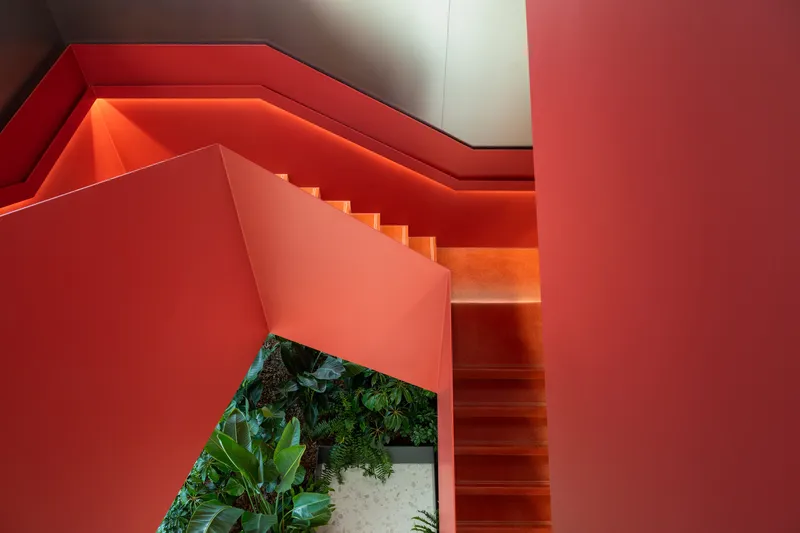
The project's most legible move is its central sculptural staircase, rendered in bold red steel and folded into angular planes that read differently from every vantage point. Viewed from below, the multi-story atrium opens toward a skylight, pulling daylight deep into the building's interior. The red palette is deliberate: it references the ceramic brick of Shanghai's lane houses while functioning as a wayfinding device that anchors all eight floors to a shared vertical axis.
The stairwell is not simply a connector. Its landings widen into gathering spots, its planted beds introduce greenery at transitions, and its folded walls create visual drama that rewards movement. In a project where hundreds of employees might otherwise default to elevators, the staircase makes walking between floors feel like crossing a threshold between neighborhoods.
Courtyard Logic on Every Floor
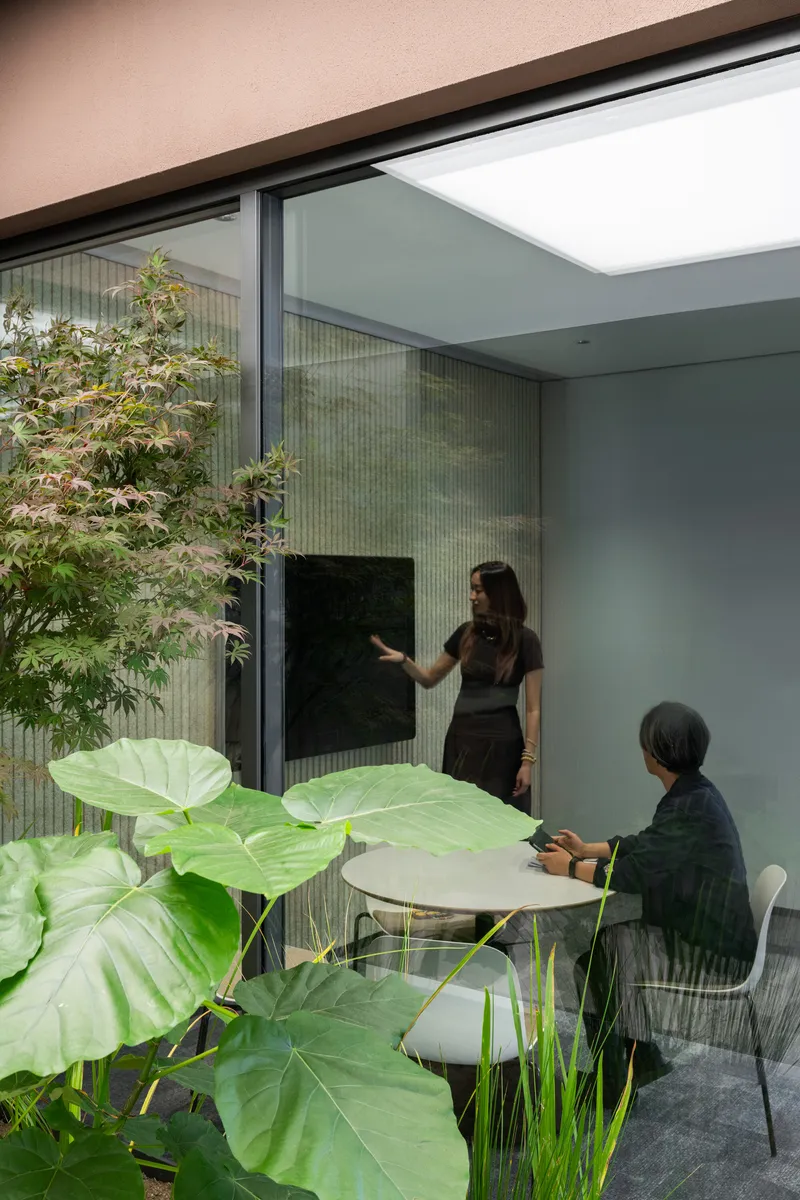


Traditional Chinese courtyard houses organize rooms around a shared open center. Ippolito Fleitz Group Identity Architects apply the same principle here, wrapping each floor's program around a central core clad in stainless steel panels and fitted with a horizontal wood shelf. The circulation zone between the core and the perimeter workspaces changes width and character from floor to floor, sometimes opening into generous planted terraces, sometimes narrowing into intimate corridors framed by red sculptural fins.
The interior courtyard terraces are striking. Elephant ear plants, ferns, and tropical foliage fill raised beds that sit between workstations and meeting zones, creating microclimates of calm within an otherwise high-energy creative office. The effect is not decorative. These planted zones function as spatial buffers, softening acoustics and providing visual privacy without the heaviness of solid walls.
Light, Glass, and the Digital Award Wall

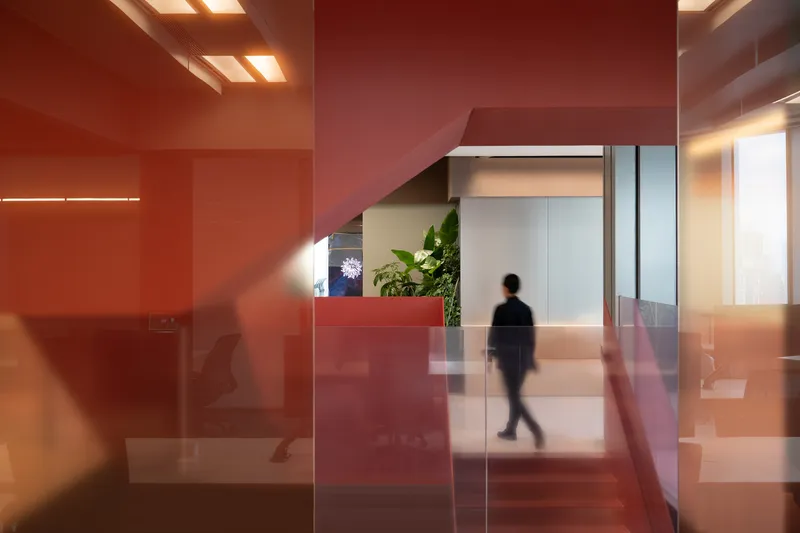
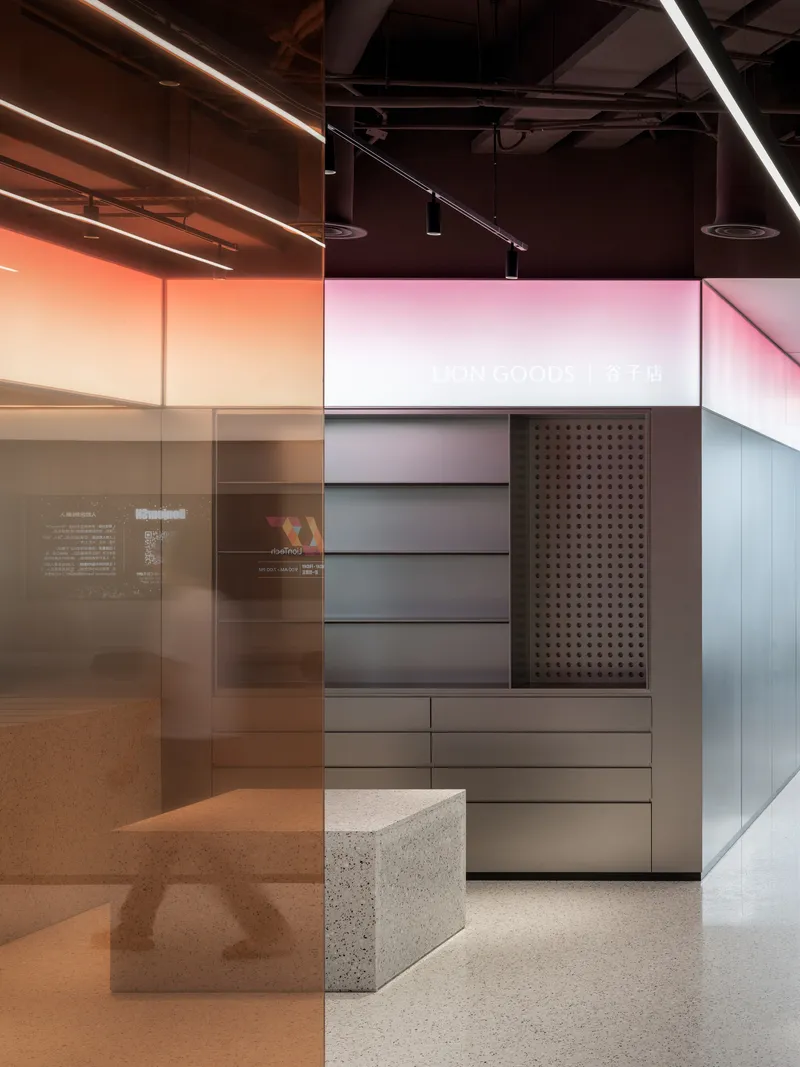
Glass brick walls embedded with LEDs create some of the project's most atmospheric moments. On the visitor floor, a backlit blue translucent wall doubles as a Digital Award Wall, its glow shifting to mark the agency's achievements. Elsewhere, translucent red glass partitions filter light through reception zones, casting warm tones across terrazzo floors. The material choice is intelligent: glass bricks offer the solidity of masonry with the luminosity of a screen, blurring the line between surface and display.
The monochromatic palette in transitional zones, visible in the terrazzo flooring and clean-lined millwork, keeps the more expressive moments from overwhelming the spaces. There is discipline here. Color and light are deployed as events, not wallpaper.
The Pitch Room and Gathering Spaces
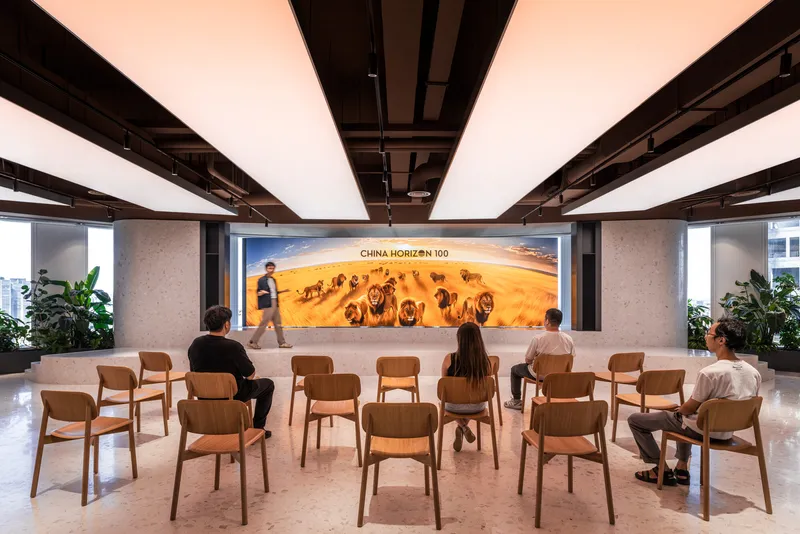

At the heart of the visitor floor sits the Pitch Room, circular in plan and fitted with a curved LED screen and smart glass that shifts from transparent to opaque on demand. It is the building's performative center, the room where ideas are sold. Movable chairs and standing tables keep the layout flexible, so the space can shift from a theater-style presentation to a workshop without a facilities team getting involved.
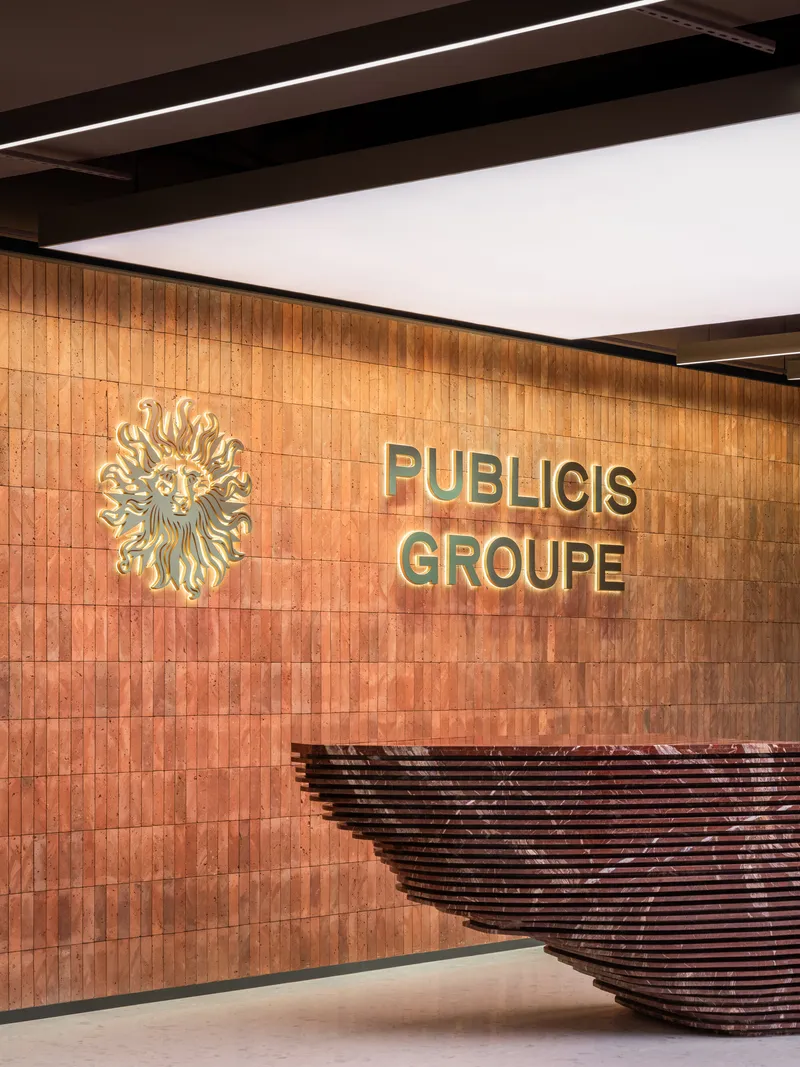
Elsewhere, a timber-clad reception wall with brass lettering and a sculptural woven desk sets the tone for arrivals, while meeting rooms with wall-mounted displays serve the day-to-day rhythms of a multi-agency operation. The detailing throughout these spaces is precise without being precious: natural materials, clean joinery, and generous proportions.
Workspaces and Informal Zones


The open-plan work areas rely on glass partitions and shifts in flooring material to define territories without enclosing them. Terrazzo runs through circulation spines while carpet and timber mark the workstation clusters. The partitions are not floor-to-ceiling, so sightlines extend across each plate, reinforcing the courtyard logic of the plan.
Green walls and planted beds appear at regular intervals within the workspace floors, most dramatically in a full biophilic wall that backs a seating nook. The planting is not aftermarket. It is integrated into the architecture, with built-in planters, irrigation, and lighting designed as part of the core and shell.
The Grand Pantry and Social Infrastructure

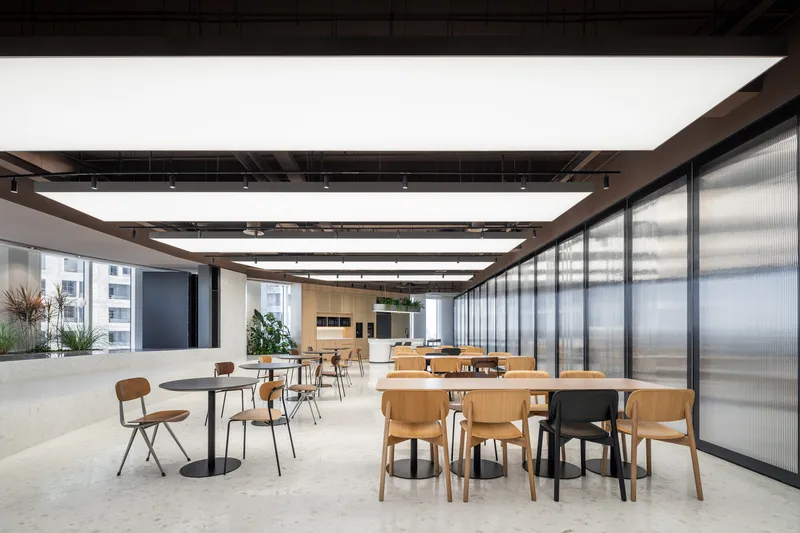

The top floor houses the Grand Pantry, a communal dining and social space fitted with foldable screens, operable partitions, and a dynamic ceiling system that can reconfigure the room for events, town halls, or casual lunches. An orange-lit kitchenette anchors one end; scattered tables and high benches fill the rest. The exposed structural ceiling above reinforces the industrial character of the Xintiandi building while distinguishing this floor from the more finished levels below.
Communal workspaces with raised timber planters, high tables, and wire-frame stools appear across several floors, extending the social program beyond a single canteen. Café-like zones with translucent glass partitions and lounge areas with upholstered seating give employees a gradient of formality to choose from. The water stations, coffee collection points, and nursing rooms tucked into the central core are quiet acknowledgments that a good office serves bodies as well as minds.
Material Texture and Biophilic Layering


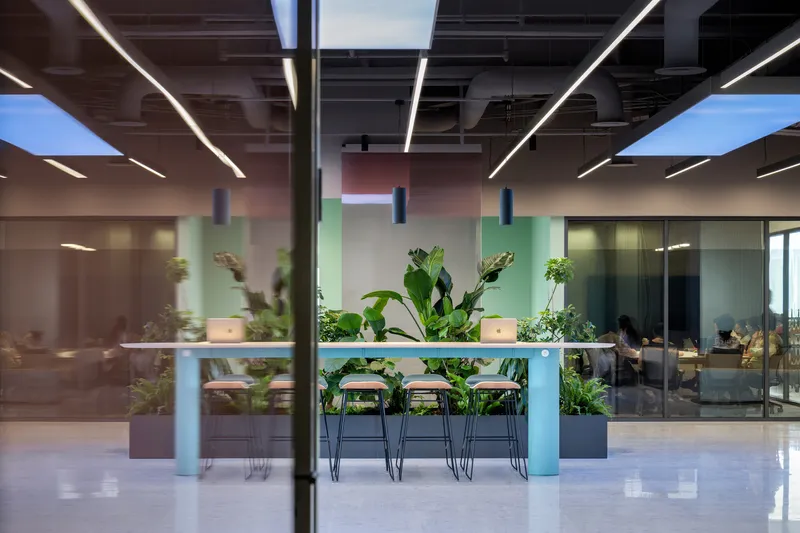
A curved bench with red cylindrical legs, a lush plant wall backing a quiet seating area, scattered tropical plants beneath an exposed ceiling: these details accumulate into something more than interior decoration. The material palette, red ceramic brick, stainless steel, timber, terrazzo, and glass brick, is deliberately drawn from Shanghai's architectural vocabulary. The red brick references lane houses. The terrazzo nods to the city's mid-century commercial interiors. Together, they ground a global corporate identity in local specificity.
The biophilic strategy goes beyond potted plants. Planting is structural, spatial, and atmospheric. It defines edges, creates privacy, and introduces texture and fragrance into a building type that too often smells only of carpet adhesive and recycled air.
Flexible Interiors and Programmatic Intelligence
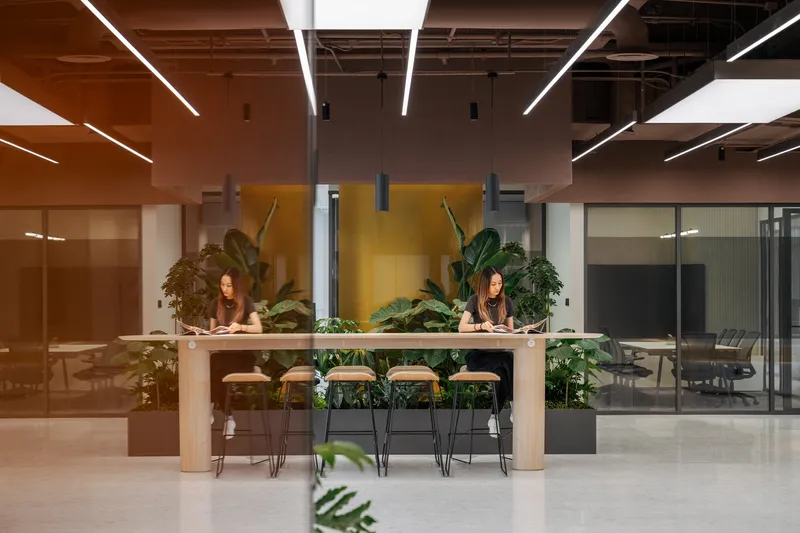

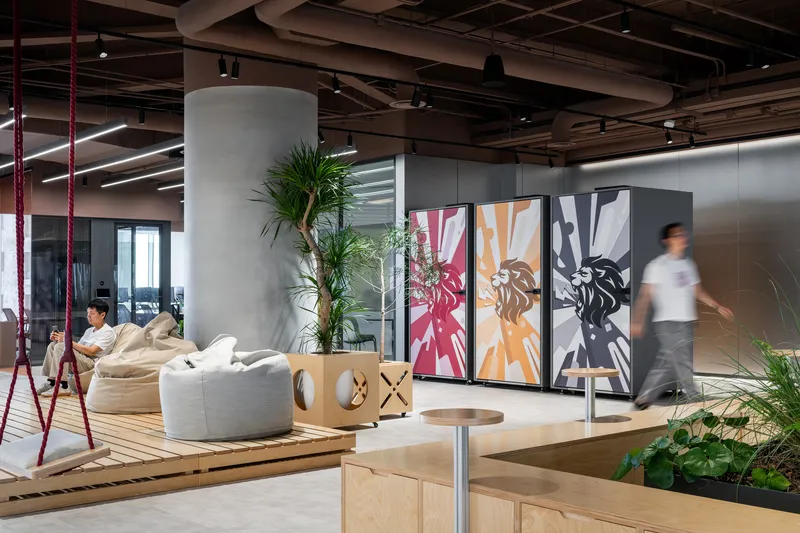
Shared work tables with light wood tops, bar stools, and integrated planters define a collaborative workspace typology that runs through the headquarters. Kitchen-adjacent work nooks on several floors allow employees to shift between focused work and casual interaction without crossing a threshold. Timber platform seating in lounge zones with triptych art panels adds a softer register, offering spaces for rest and reflection.
The layered color strategy is worth noting. Each floor receives its own accent palette, so the eight levels feel like distinct districts within a single city rather than repetitions of the same plan. It is a smart move for a client whose business is brand differentiation: the building itself becomes a demonstration of how identity can be varied within a coherent whole.
Why This Project Matters
Corporate headquarters projects rarely transcend their briefs. Most deliver a competent workplace and a polished lobby and call it a day. The Publicis Groupe Shanghai headquarters does something more ambitious: it borrows a centuries-old Chinese spatial typology, the courtyard, and reinterprets it as a vertical organizational principle. The result is an office that feels genuinely urban, with the variety of encounter and the richness of circulation that you find in a well-planned neighborhood.
Ippolito Fleitz Group Identity Architects prove here that interior architecture, when it engages seriously with context and program, can produce work as spatially complex and culturally resonant as any new-build project. The red staircase, the glass brick walls, the planted courtyards, and the flexible social spaces all serve a single idea: that bringing people together under one roof requires more than open plans and shared Wi-Fi. It requires architecture that understands how communities actually move, gather, retreat, and connect.
Publicis Groupe Shanghai Headquarters, designed by Ippolito Fleitz Group Identity Architects. Located in Shanghai, China. Photography by CreatAR Images.
About the Studio
Share Your Own Work on uni.xyz
If projects like this are the kind of work you want to make, uni.xyz is a place to publish your own, find collaborators, and enter design competitions.


Popular Articles
Popular articles from the community


Extended Shell: Retrofitting Kolkata's Balconies as Living Urban Thresholds
A modular retrofit system recovers the social and environmental intelligence of Kolkata's historic verandas for contemporary Park Street residents.

The Amber Palace Opera: A Geological Fiction Surfaces on Tallinn's Baltic Waterfront
Pierre Brillard reimagines a Baltic legend as a public landscape, opera house, and waterfront promenade rooted in Tallinn's coastal identity.

Singing Woman: Contemporary Architecture Inspired by Estonia’s Voice and the Sea
Singing Woman turns Estonia’s song culture into flowing opera house architecture, blending public life, landscape, sea, and national memory.

Manzana Morphosis: Stretching Barcelona's Grid into a Living Landscape for 2050
A radical reworking of the Eixample manzana turns density into a tool for generous public space, vertical ecology, and environmental performance.

Similar Reads
You might also enjoy these articles

Bao Huynh Watercolor Atelier: A Serene Art Retreat in Hội An
Bao Huynh Watercolor Atelier in Hội An blends multifunctional art spaces, sustainable design, local materials, and family-friendly living in a serene environment.

Atelier Macri Concept Store Interior Design by CASE-REAL
Atelier Macri store features a "ko" counter, walnut wood details, cork displays, blending retail, gallery, and seamless customer experiences.

Manuel Vargas Izquierdo Stadium and High-Performance Sports Center: Architectural Excellence in Jalpa de Méndez
The Manuel Vargas Izquierdo Stadium blends sustainable design, inclusive sports facilities, and cultural-inspired architecture, revitalizing Jalpa de Méndez’s public spaces.

KAKR Buluh Awar Hall: Revitalizing Community and Ecology Through Bamboo Architecture
Community built bamboo hall revitalizes Buluh Awar village, empowering youth, restoring ecology, celebrating vernacular craftsmanship through sustainable architecture and culture.

Explore Shanghai Competitions
Discover active competitions in this discipline

Challenge to reimagine the Iron Throne

Photograph architecture without architects

Illustrate the lost glory of Angkor Wat - Render Challenge

Design challenge to reuse E-waste
Comments (0)
Please login or sign up to add comments
No comments yet. Be the first to comment!