

SPASM Design Wraps a Multigenerational Ahmedabad Home in a Vertical Brick Jaali Veil
Ishtika House uses a perforated brick screen and a three-story courtyard void to cool a compact family residence in Gujarat's arid heat.


Ahmedabad is a city that has been thinking about brick and climate for centuries. The haveli tradition, the step wells, the tightly packed pols: all of these are built responses to relentless sun and seasonal dust storms. SPASM Design taps that lineage with Ishtika House, a 15,078 square foot residence for a multigenerational family that treats its entire envelope as an environmental filter. The defining move is a vertical brick jaali veil, a clean, box-like screen that wraps the fragmented interior volumes and negotiates two competing desires: the urge to open up to views and air, and the need for an introverted domestic world shielded from heat, dust, and the gaze of neighbors.
What makes the project worth studying is not the jaali alone, which is a well-known device, but the way every element of the house participates in a single thermal strategy. A three-story courtyard void at the center acts as a stack ventilation chimney capped by a mesh pavilion. A misting system and hanging plants cool the air as it rises. Retractable shutters adjust the permeability of the facade in real time. The house is less a static object than a calibrated machine for managing airflow, light, and moisture, one that borrows its intelligence from Jaisalmeri havelis while building its bones from steel, concrete, and salvaged wood.
The Brick Veil as Building Envelope
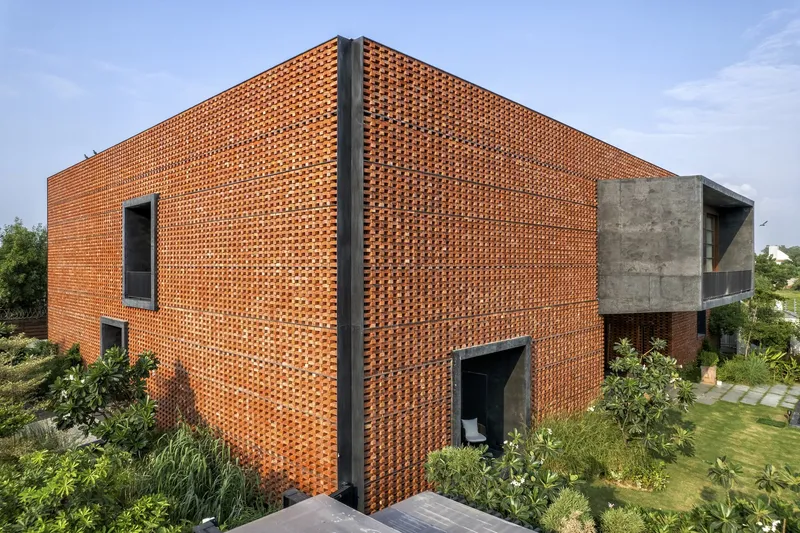
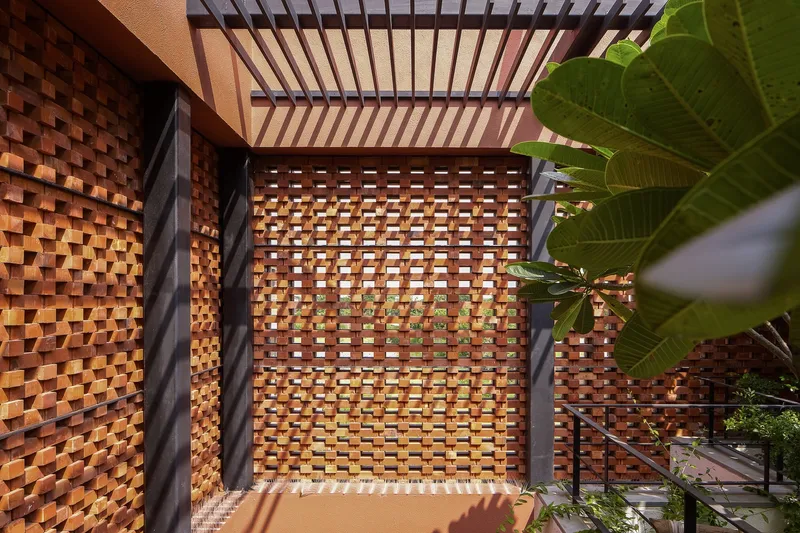
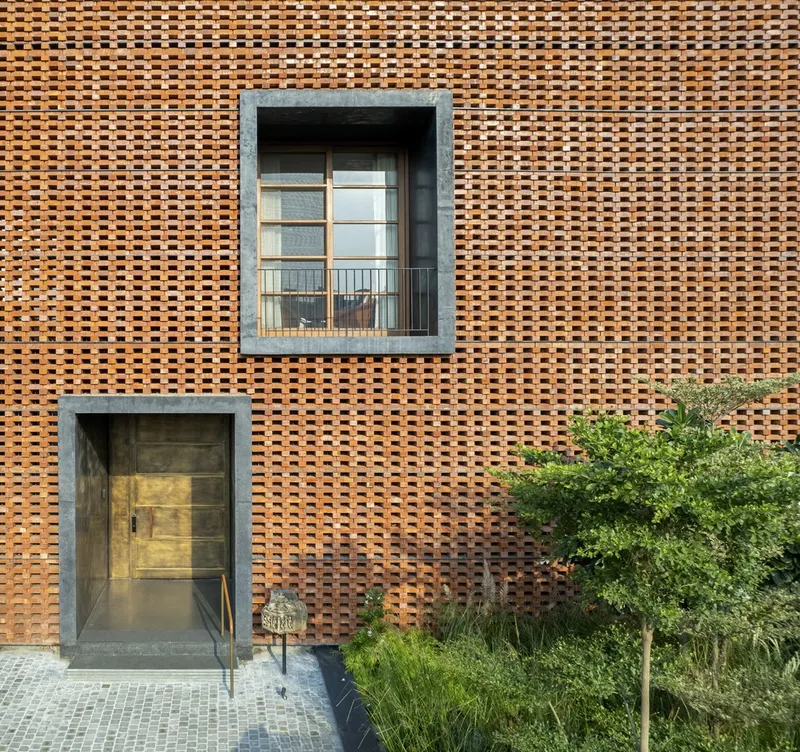
The jaali screen reads from the street as a single terracotta volume: warm, monolithic, and deliberately opaque. Up close, the weave reveals itself. The basketweave pattern is not purely decorative; it establishes a gradient of porosity that lets convective cross-ventilation pull cooler air through the house while deflecting Ahmedabad's punishing westerly winds. Concrete frames punch through the screen at key moments to frame doorways and windows, creating a dialogue between the mass of brick and the precision of reinforced concrete.
The pergola that runs along portions of the veil adds another layer of shading. Shadows from the overhead structure overlap with shadows from the jaali below, producing a constantly shifting pattern of filtered daylight across the interior floor plates. The effect is not unlike the latticed stone screens of historic Gujarati architecture, except here the material is humble fired brick and the geometry is contemporary. It is a smart inversion: the cheapest material in the palette does the most thermodynamic work.
The Three-Story Courtyard Void
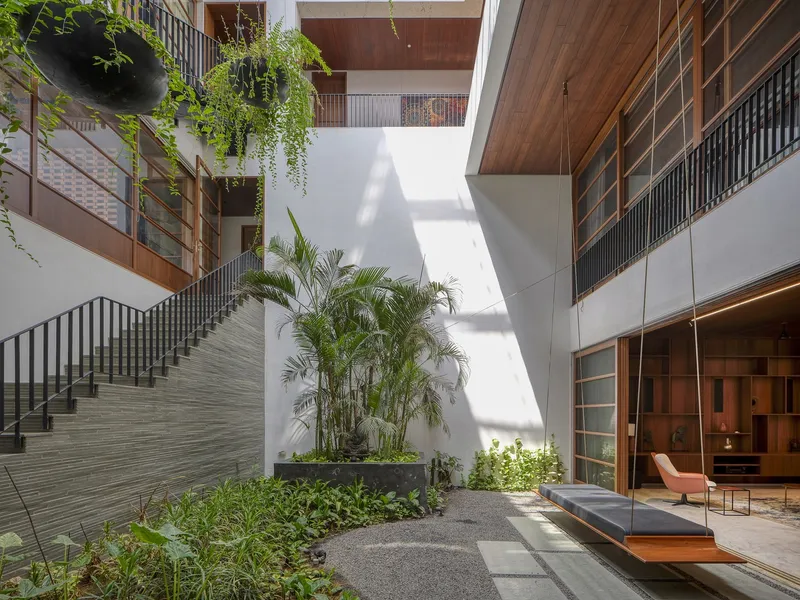
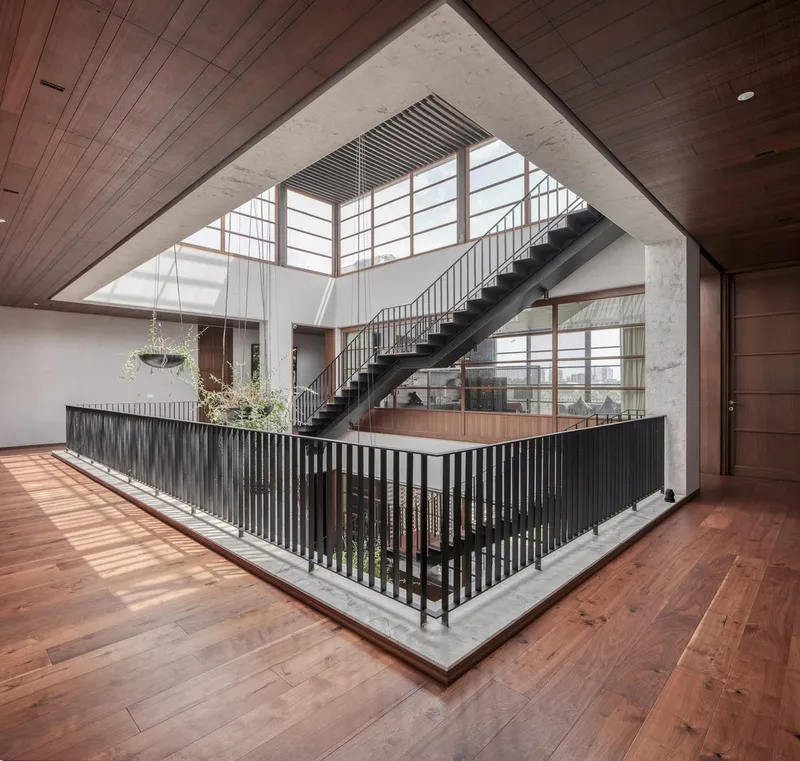
The courtyard is the lungs of the house. Rising through basement, ground, first floor, and roof level, it creates a vertical channel of air and light that every major room addresses. Palm beds and hanging plants occupy the base, contributing humidity and evaporative cooling to the rising air column. At the top, a mesh pavilion caps the void, allowing hot air to escape while preventing rain and debris from entering. The mesh is the critical detail: it turns the courtyard into a functioning stack effect chimney rather than just a scenic well.
Dappled light enters from clerestory skylights and bounces off the white walls, reaching deep into the plan on a diagonal axis that shifts throughout the day and across seasons. The architects describe the courtyard as enabling movement "between indoor, outdoor, and in-between experiences," and the spatial evidence backs this up. Staircases, bridges, and corridors all orbit the void, making it impossible to move through the house without registering the courtyard's presence.
Circulation as Spatial Event
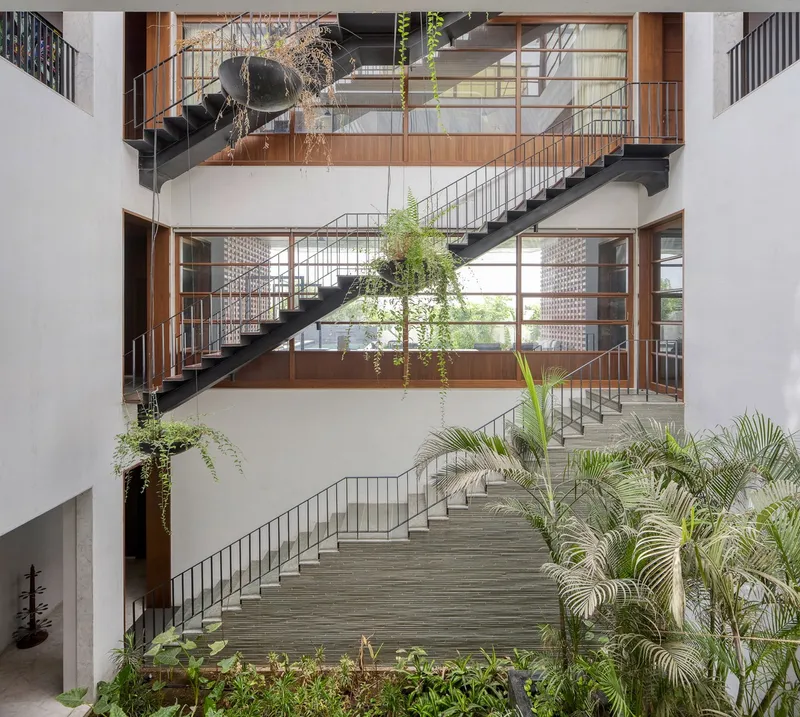
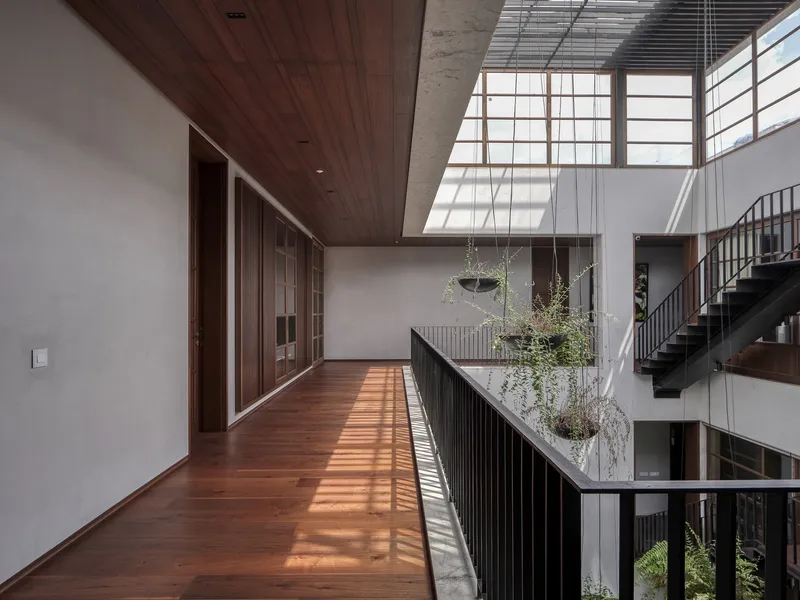
Black steel staircases and timber bridges crisscross the courtyard void, turning vertical movement into a theatrical experience. The steel is deliberately dark against the white walls, making the circulation legible as an independent structural system. Timber ceiling soffits and railings on the upper corridors warm the palette and connect the industrial framework to the salvaged wood used elsewhere in the house. It is a well-managed contrast: steel for structure and expression, wood for touch and warmth.
Walking along the first-floor corridor, you look down into the planted beds below and up through the mesh canopy above. The railing acts as a balustrade and a viewing platform simultaneously. Every landing becomes a pause point, a place where you are inside the house and yet exposed to the sky. For a multigenerational household, this kind of layered circulation is not just architectural theater; it is social infrastructure, allowing family members to see and be seen without sacrificing the privacy of individual rooms.
Thresholds and the Sliding Screen
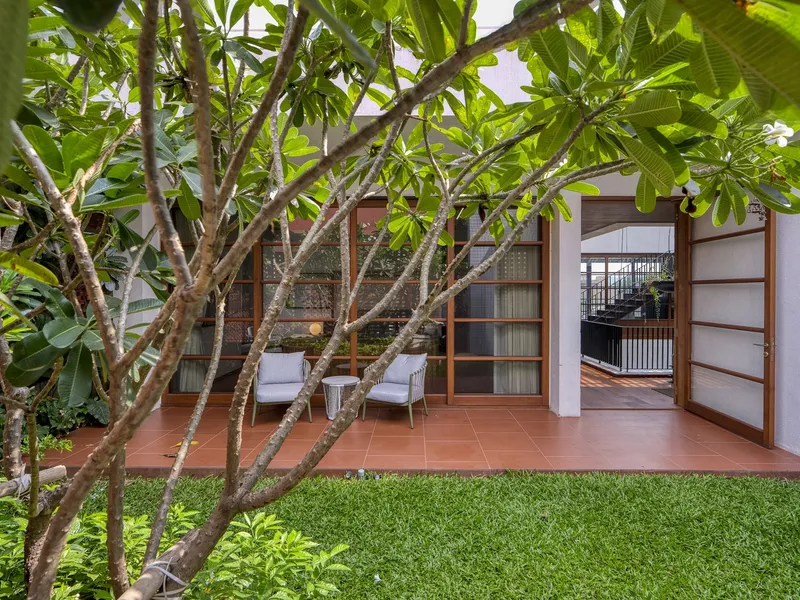
Ishtika House is a house of thresholds. The retractable sliding shutters along the terrace edge let occupants modulate the boundary between inside and outside in real time. Open them fully and the living space extends to the lawn and the frangipani canopy; close them and the house seals itself against dust storms and monsoon rain. The red tile terrace surface signals this transitional zone, a material cue that you are neither fully indoors nor outdoors.
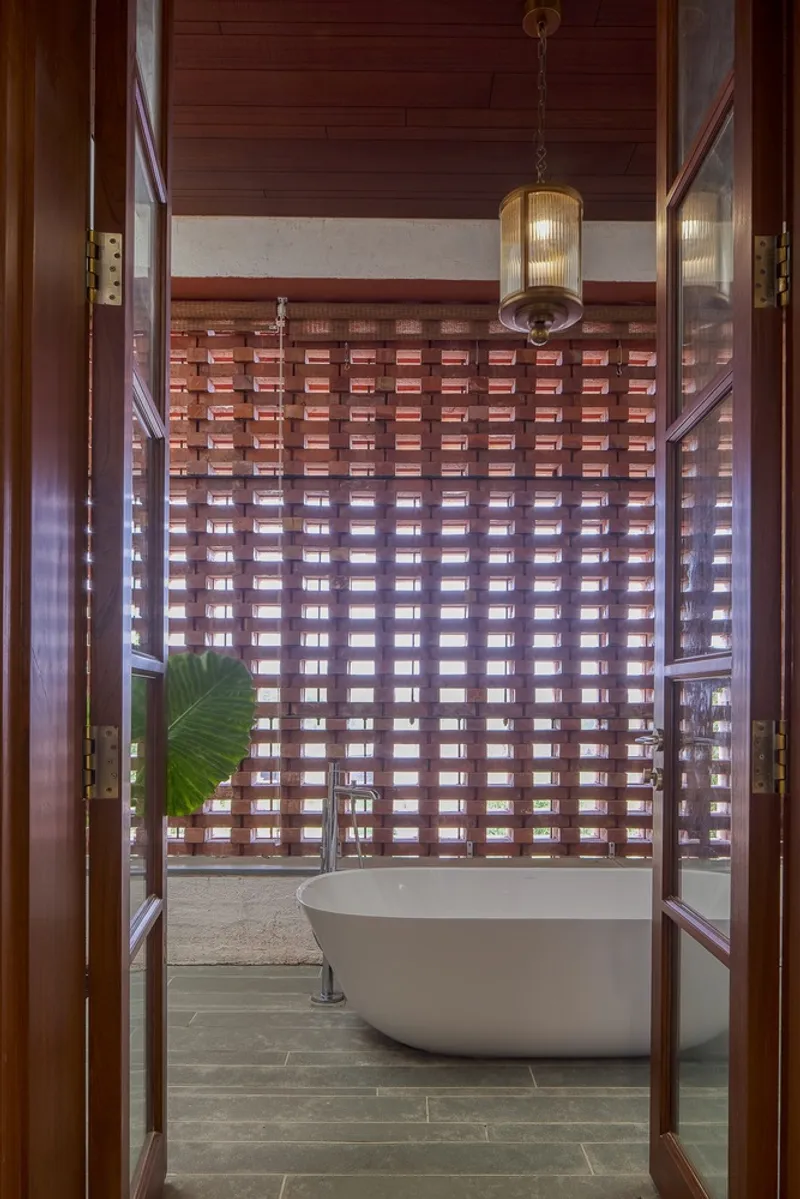
Even the bathrooms participate in this logic. A freestanding tub sits against a woven brick screen wall, borrowing filtered light from the jaali without compromising privacy. The timber doorframe that separates the bathroom from the corridor is deliberately wide, framing the scene like a painting. It is a small but telling detail: in this house, even utilitarian rooms are treated as opportunities to engage with the envelope's environmental performance.
Why This Project Matters
The climate crisis has made passive cooling strategies urgent rather than optional, yet much of the conversation around sustainable housing in South Asia remains abstract. Ishtika House is specific. It names its devices: jaali veil for cross-ventilation, mesh pavilion for stack effect, misting for evaporative cooling, pergola for solar shading, retractable shutters for seasonal adjustment. Each element is legible in the built form, which means the house can function as a teaching tool as much as a residence. That matters in a city where summer temperatures regularly exceed 45 degrees Celsius.
SPASM Design's achievement here is not inventing new technology but assembling known techniques into a coherent whole. The brick jaali references Jaisalmeri havelis. The courtyard void echoes the traditional Gujarati pol house. The salvaged wood and local stone ground the project in its material context. What is contemporary is the orchestration: the way these elements are tuned to work as a single thermal system on a tight urban lot, wrapped in a clean modernist volume that never pretends to be anything other than a house in Ahmedabad, built for the way people actually live there.
Ishtika House by SPASM Design. Ahmedabad, India. 15,078 sq ft. Completed 2023. Lead architects: Sangeeta Merchant, Shashank Patil, Divyesh Kargathra, Sanjeev Panjabi. Photographs by Umang Shah.
About the Studio
Share Your Own Work on uni.xyz
If projects like this are the kind of work you want to make, uni.xyz is a place to publish your own, find collaborators, and enter design competitions.


Popular Articles
Popular articles from the community


Temporary Home for Dogs: A Reversed Zoo Rethinks Animal Shelter Architecture
In Bucharest, a sinuous corridor and freed landscape flip the logic of containment, designing a shelter that works to make itself unnecessary.

Opera by the Sea Estonia: Three Shells Dissolving Architecture into Tallinn's Coastline
A winning opera house proposal replaces monumental form with interconnected shells that blur the boundary between building, park and Baltic Sea.

The Amber Palace Opera: A Geological Fiction Surfaces on Tallinn's Baltic Waterfront
Pierre Brillard reimagines a Baltic legend as a public landscape, opera house, and waterfront promenade rooted in Tallinn's coastal identity.
Faces of the Soviet Avant-Garde: Turning Moscow's Street Names into an Open-Air Museum
A network of sculptural installations across a Moscow residential district transforms forgotten architect names into spatial encounters with cultural memor

Similar Reads
You might also enjoy these articles


Hodi-Mandai Geram
Project Function: Preservation and revitalization of the Intangible heritage and socio-spatial identity of the Hodi by Housing, Cultural Memory Center, Sacred Grove, landscape, local tourism economy


Olio Towers: A Mid-Rise for Performers That Fuses Housing, Rehearsal, and Stage
Located blocks from Houston's Theater District, this modular tower stacks living units around a central performance atrium.

Oasis: Modular Green Housing Carved into Dhaka's Urban Fabric
A shortlisted Plugin Housing entry reclaims unauthorized settlements in Dhaka with stepped concrete volumes, green roofs, and ventilation-driven design.

Black Hole: A Floating Megastructure for the Post-Physical Era
Emiliano Mazzarotto envisions a spherical, self-scaling arena where e-sports, digital hotels, and holographic stadiums replace traditional public space.

Explore İshak Şimşek Arhitecture Competitions
Discover active competitions in this discipline

Challenge to reimagine the Iron Throne

Photograph architecture without architects

Illustrate the lost glory of Angkor Wat - Render Challenge

Design challenge to reuse E-waste
Comments (0)
Please login or sign up to add comments
No comments yet. Be the first to comment!