

James and Mau Wrap a Polish Industrial Office in Dark Brick and a Birch Forest
A 660-square-meter office near Kraków turns a preserved birch grove into a psychological buffer against its industrial surroundings.


Industrial zones rarely invite tenderness. Truck yards, flat asphalt, anonymous sheds: the typical context demands that architecture either surrender to utility or overcompensate with gestures that look absurd against the backdrop. In Niepołomice, a small town near Kraków, James and Mau found a third option. Their 660-square-meter office for the Cedrob company keeps an existing birch forest at the center of the plan and wraps the program in dark brick walls that feel heavy enough to hold their ground without shouting.
What makes the project worth studying is not the materials list but the sequencing. The architects use the birch grove as a literal vestibule, a filter that peels away the industrial landscape before you ever touch a door handle. Once inside, raw ceramic blocks replace plaster, installations vanish behind walls, and every element was individually designed for this building alone. There are no imported systemic solutions here, no catalogue partitions. The result is a workplace for 35 people that feels domestic without pretending to be a house.
The Birch Forest as Architectural Threshold
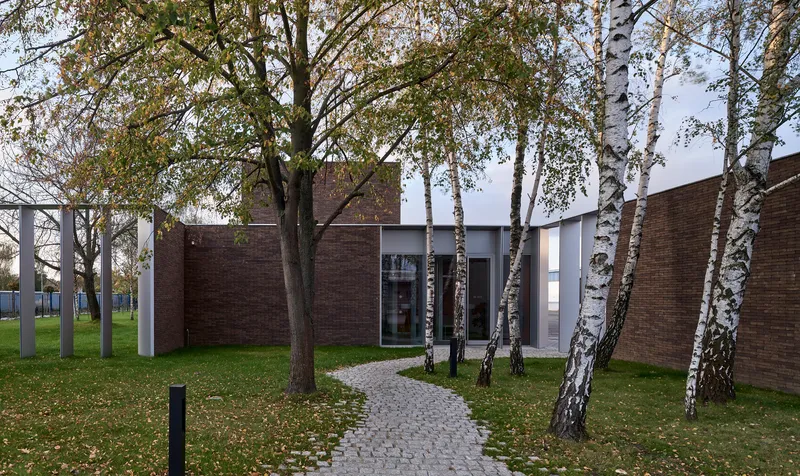


Before the building begins, the forest does the work. A cobblestone path threads through birch trunks toward the entrance, and the canopy overhead loosens your focus from the parking lot behind you. The architects recognized that the grove was the most valuable asset on a site otherwise dominated by logistics infrastructure, so they preserved it entirely and organized the plan around it. The forest appears twice: once in the approach and again inside the courtyard, framed by the office and residential wings.
The trunks become vertical counterparts to the white slats that screen the eastern facade. Stand among the birches and look toward the colonnade, and the rhythm of tree and fin starts to merge. It is a simple trick, but it works because the architects did not merely reference the forest in their detailing. They kept the actual trees and let the building be the one that adapts.
Dark Brick and the Weight of Context

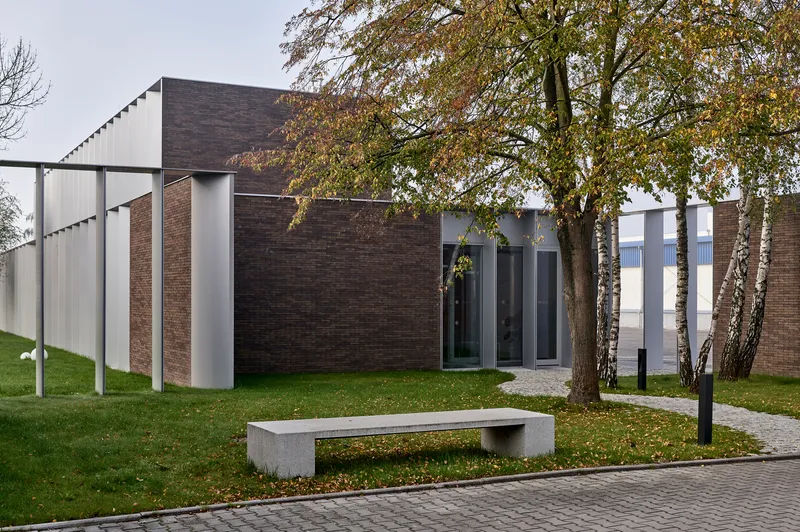
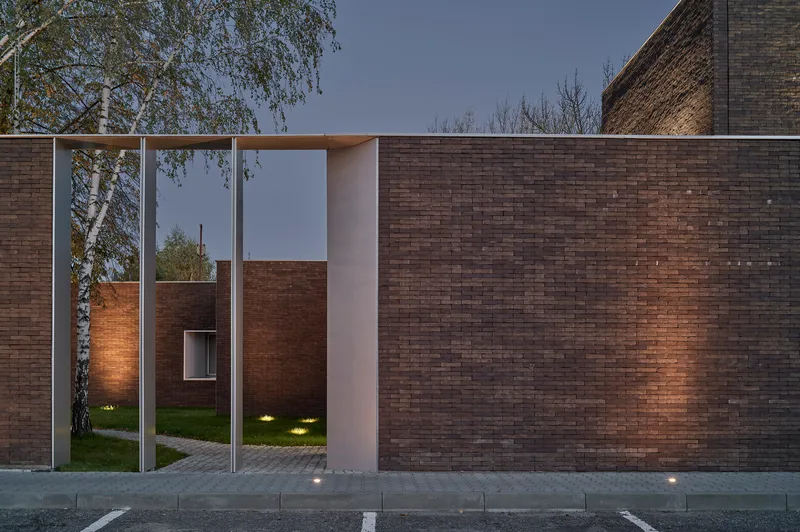
The long elevation facing the road is almost forbidding. Dark brick runs uninterrupted except for tall, narrow window openings punched at irregular intervals. Against the flat industrial plot, the wall reads as a deliberate barrier: a signal that something different happens on the other side. The material is honest about its mass, and the joints are tight, giving the surface a monolithic quality that resists the corrugated metal vocabulary of its neighbors.
At night the character shifts. Recessed lighting at the entry portal turns the brick from opaque to theatrical, and the vertical slits glow faintly. The architects clearly understood that this facade would be seen most often from a car, quickly, and they designed accordingly: one strong gesture, no fussy articulation.
The Slatted Eastern Facade and Passive Climate Logic
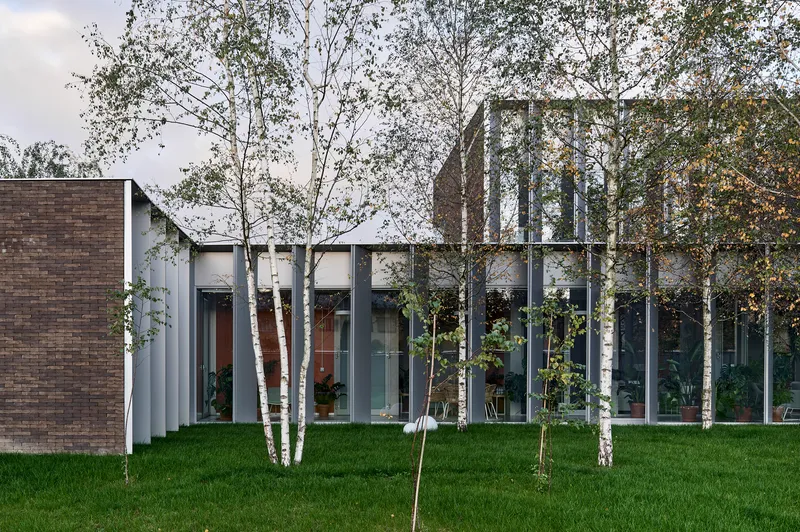
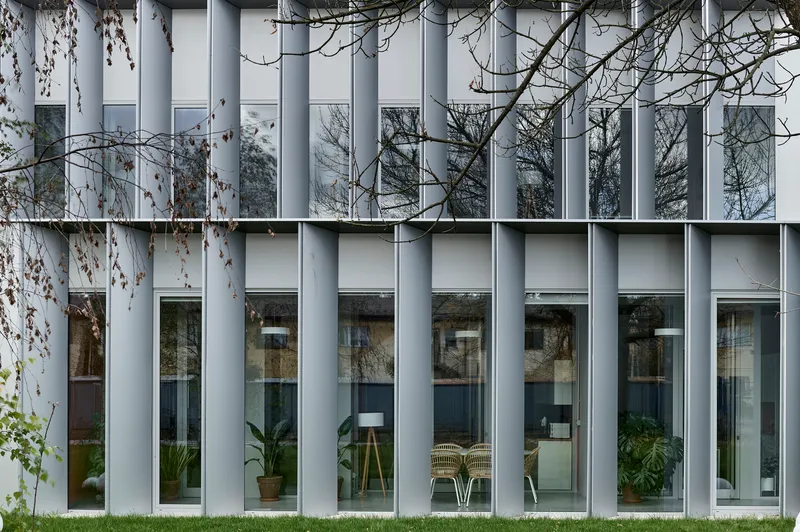

Turn the corner and the building changes personality. The eastern elevation is almost entirely glazed, shielded by a screen of vertical white fins that catch the morning sun and scatter it before it reaches the interior. The orientation is deliberate: eastern light is softer and more forgiving for office work than the punishing southern or western alternatives, and the fins modulate it further throughout the day.
Behind this screen sit two T-shaped buffer zones, each roughly 30 square meters, planted with greenery. These are not corridors. They are intermediate climate spaces that insulate the offices from winter cold and summer heat while doubling as relaxation zones for staff. The strategy is passive and spatial rather than mechanical, and it gives the building a layered section that most single-story offices never achieve.
Twilight and the Courtyard Glow

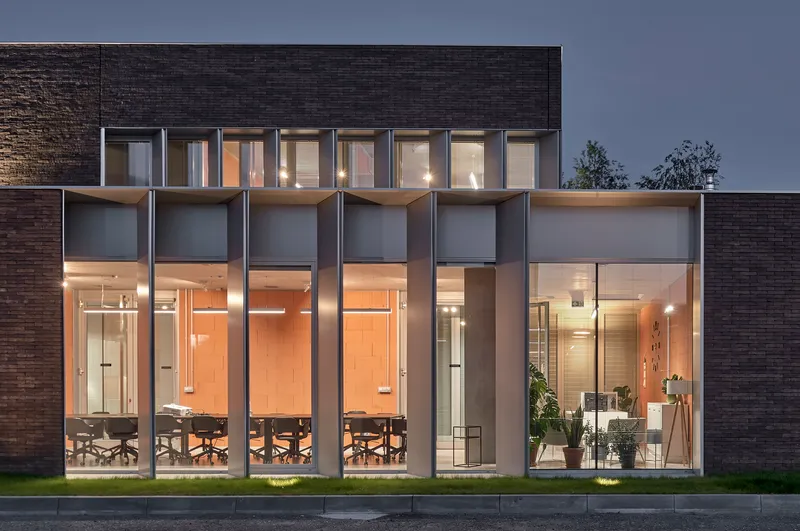
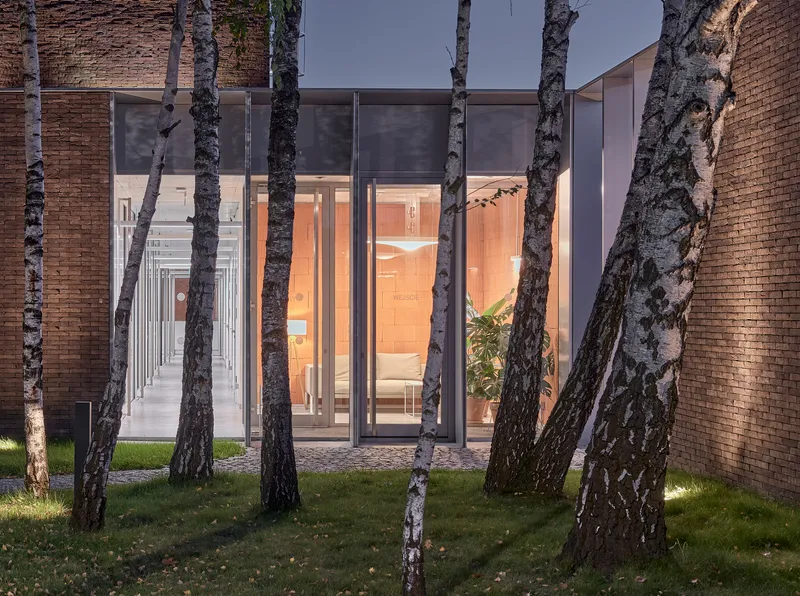
The project photographs exceptionally well at dusk, and that is not accidental. The double-height glazed bays along the courtyard become lanterns, pulling the birch trunks into silhouette and turning the lawn into an illuminated stage. The deep recesses in the brick walls create shadow pockets that give the facade depth it would lack in flat daylight. Lighting is integrated into the landscape, with uplights on the birches creating vertical lines of warm light that echo the fin screen.
For a building that houses 35 office workers in an industrial zone outside Kraków, this level of atmospheric control feels generous. It suggests that the architects thought about the building not just as a container for tasks but as a place people arrive at in the dark months of a Polish winter and need to feel welcomed.
Raw Interiors Without the Industrial Cliché

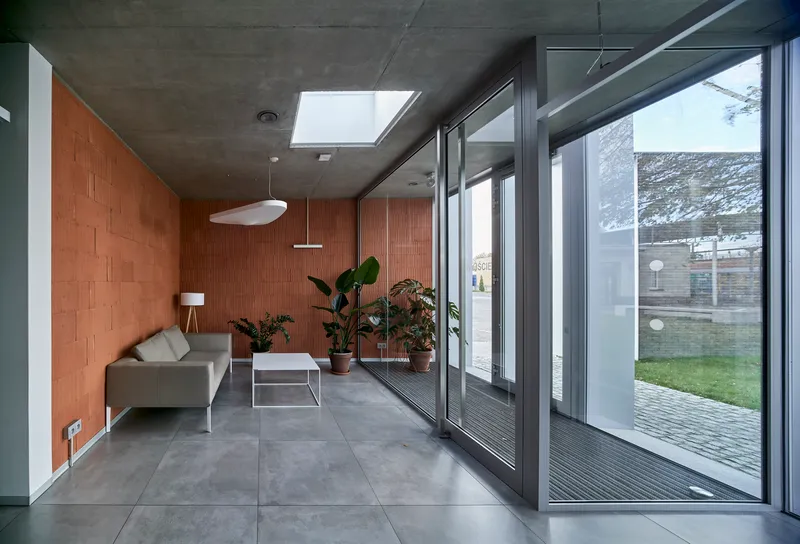

Inside, the material palette strips down further. The lobby features a vertical terracotta tile wall that rhymes with the exterior brick but feels warmer and more tactile. Exposed concrete ceilings sit above glazed vestibules that open directly to the birch courtyard, collapsing the boundary between inside and outside. Every surface is unplastered, built from raw ceramic blocks with invisible joints that required painstaking craftsmanship to execute cleanly.
The covered terrace with its rattan furniture and potted plants strikes a tone closer to a well-appointed home than a corporate break room. The architects have said they wanted employees to feel at home, and this space delivers on that ambition without resorting to the tired startup playbook of bean bags and ping-pong tables. Timber slats, floor-to-ceiling glass, and real plants do the work instead.
Workspaces and Filtered Light


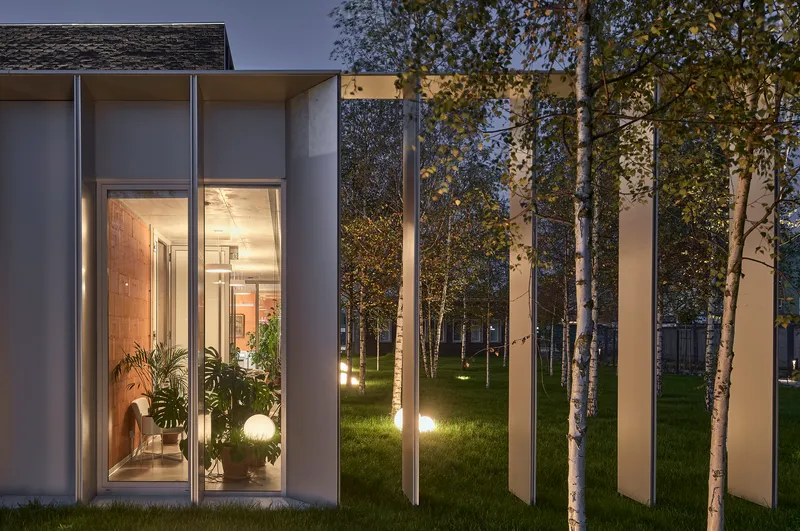
The actual office spaces are calm, almost understated. White workstations line up against glazed doors that open directly onto the lawn and trees. The furniture is minimal, and the storage walls are neatly integrated so that clutter has nowhere to accumulate. In the workspace with vertical timber slats, afternoon sunlight passes through corrugated glass to create a soft, diffused glow that avoids the harsh contrast typical of fully glazed offices.
The corner window detail is worth noting: a potted plant, a person working, birch trunks illuminated outside. The image captures the entire thesis of the building in a single frame. The workplace opens to nature, not to the truck yard. Every window was placed with this discipline, framing views that reinforce the psychological separation from the industrial context.
Dusk Portraits
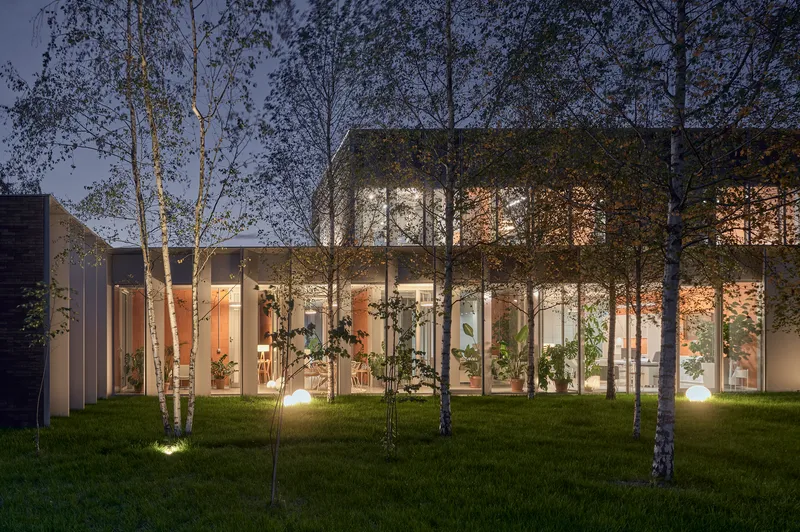

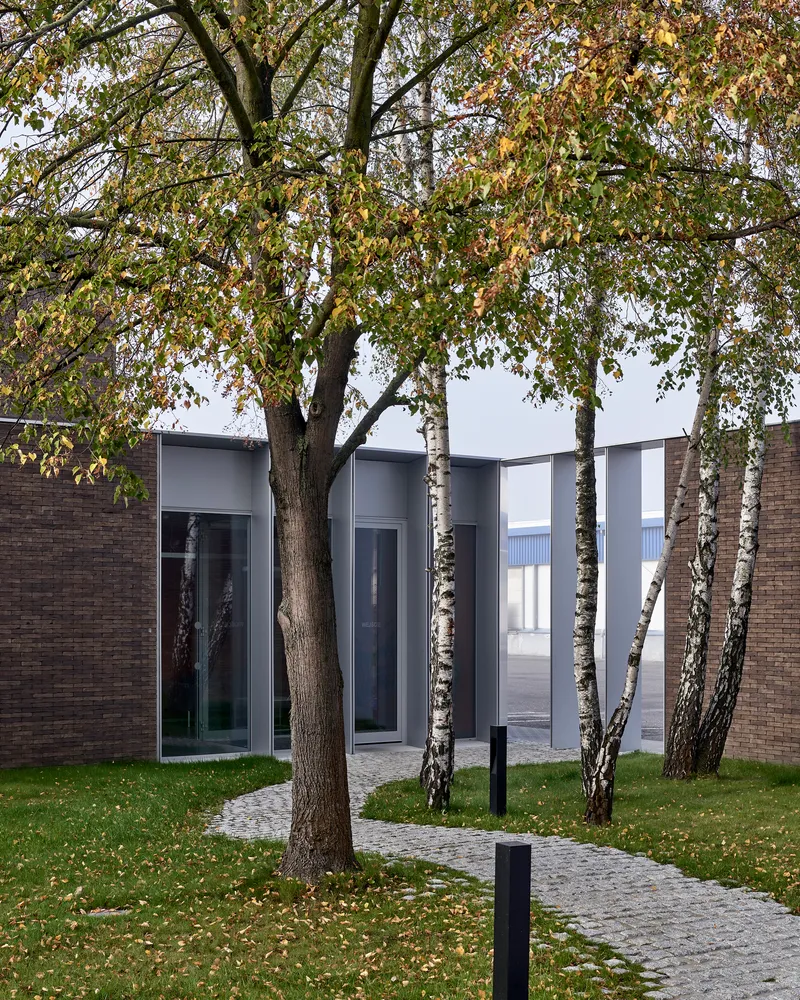
The nighttime views through the birch grove reveal the full extent of the building's transparency on the courtyard side. Interior lighting turns the glazed perimeter into a display case for the planted buffer zones, and the contrast between the luminous interior and the dark trunks creates a mood that is more Nordic cabin than Polish office park. The street-facing composition of dark brick and white panel volumes, seen with benches and birches in the foreground, shows how the courtyard landscape extends to meet the public realm.
Plans and Drawings
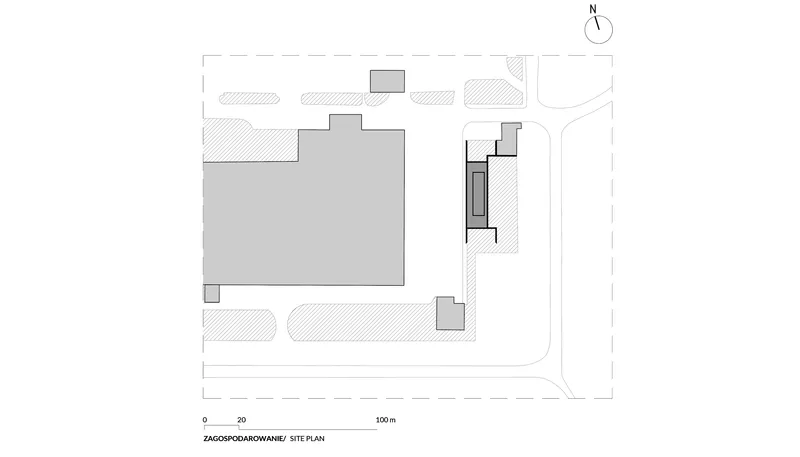


The site plan reveals what the photographs only hint at: the building occupies a corner of a much larger industrial lot, and the birch grove is a relatively small green pocket that the architects leveraged to maximum effect. The ground and first floor plans confirm a linear arrangement of rooms organized along a central circulation spine, with the courtyard carved into the middle of the footprint. Circular tree canopies dot the landscape plan, showing that the forest is not incidental but structurally integrated into the layout.
The elevations make the duality of the building legible at a glance. North and south faces show the vertical slat screens paired with brick cladding. The west elevation is almost entirely opaque brick with a single central entry, while the east elevation reveals the rhythmic slatted facade in full. The sections are the most instructive drawings: they expose a split-level interior with a curved staircase connecting the two levels, and they show how the vertical slat screen rises the full height of the building to create a unified mask over the glazed wall behind it.
Why This Project Matters
Most office buildings in industrial zones accept their context as a given and respond with indifference: metal cladding, tinted glass, a strip of ornamental grass by the entrance. James and Mau refused that script. They kept a birch forest, built a dark brick wall to shut out the trucks, and oriented the entire plan so that every workspace opens to trees rather than asphalt. The result is a building that takes its site seriously enough to disagree with it.
The broader lesson is about specificity. Nothing here is generic. The ceramic blocks have invisible joints because the architects chose not to plaster them, which meant every block had to be laid with precision. The buffer zones are shaped as climate mediators, not leftover circulation. The slat screen is calibrated to eastern light. In a profession that increasingly defaults to parametric spectacle or passive minimalism, this kind of methodical, site-specific problem solving deserves attention. It is not flashy work, but it is deeply considered, and the 35 people who use it every day are the better for it.
The Office, designed by James and Mau, led by Jaime Gaztelu and Diego Llorente Structural. Niepołomice, Poland. 660 m². Completed 2022. Photography by Jakub Certowicz.
About the Studio
Share Your Own Work on uni.xyz
If projects like this are the kind of work you want to make, uni.xyz is a place to publish your own, find collaborators, and enter design competitions.


Popular Articles
Popular articles from the community


Singing Woman: An Opera House That Performs Before the Curtain Rises
Ovidiu Cristian Pavel's conceptual opera house translates Estonia's choral identity into a sculpted waterfront landmark facing the Baltic Sea.

Opera on the Sea: Driftwood Logic Shapes a Timber Opera House on Estonia's Coast
Trevor Orgill's opera house translates the entangled drift of floating timber into a civic building where wood, water, and music converge.


David Ortega Stacks a Two-Story Mexico City Penthouse Around a Steel Stair and a Pergola-Shaded Roof Terrace
In Colonia Roma, a 300 m² penthouse uses oak joinery, a planted steel stair and a slatted roof pergola to make a new-build apartment feel like a house.

Aquadapt: An Underwater Habitat That Rewrites Its Rooms by the Hour
Curved modules ring the seabed while one shell shifts from breakfast room to cinema, farm and football pitch as residents' needs change.

Similar Reads
You might also enjoy these articles

LAVA Architecten Gives Vocational Education a Sawtooth-Roofed Face on a Mechelen School Campus
In Mechelen, Belgium, a 2,053 m² STEM school on a 6×6 m grid turns workshops and classrooms into rooms that can be rearranged as teaching changes.

KEMA Studio Turns a Derelict Marvila Attic into a 60 m² Lighthouse Apartment Above Lisbon
In Lisbon's Marvila district, a rebuilt roof, four skylights and two plywood volumes turn an unlivable attic into a bright home facing the Tagus.

Pixel Gardens: One Repeated Module Stacked Into a Terraced Social Housing Tower for Famagusta
Salem Bader's shortlisted housing tower builds a vertical neighbourhood from one repeated module, offsetting units to carve terraces, light and air.

Bao Huynh Watercolor Atelier: A Serene Art Retreat in Hội An
Bao Huynh Watercolor Atelier in Hội An blends multifunctional art spaces, sustainable design, local materials, and family-friendly living in a serene environment.

Comments (0)
Please login or sign up to add comments
No comments yet. Be the first to comment!